Influence of microstructure and inclusions on very high cycle fatigue
behaviour of compressor blade steels
Pengfei Wang1,2, Weiqiang Wang1,2, Aiju Li3 ,Ming Zhang1,2, Jianfeng Li1,4 and Songying Chen1,2
School of Mechanical Engineering, Shandong University, 17923 Jingshi Road, Jinan, China 2
Engineering and Technology Research Center for Special Equipment Safety of Shandong Province, 17923 Jingshi Road, Jinan, China
3
School of Materials Science and Engineering, Shandong University, 17923 Jingshi Road, Jinan, China 4
Key Laboratory of High Efficiency and Clean Mechanical Manufacture of Ministry of Education, 17923 Jingshi Road, Jinan, China
ABSTRACT
The fatigue behaviour of two steels, FV520B and KMN, with different heat treatment (marked as S and I) used in compressor blades has been investigated in very high cycle fatigue regime. It is found that the S-N curve of FV520B-I continuously declines with increasing the number of fatigue cycles and the cracks initiate from interior mostly, while the S-N curve of KMN-I has a slow decline after 107 cycles and surface fracture is observed mostly. Fatigue limit is observed in both low strength steels (FV520B-S and KMN-S). In order to explain the difference between the two steels, mechanical property tests, metallographic observation, and SEM analysis were carried out. The results show that the very high cycle fatigue behaviour tends to occur in bimodal microstructure compared with basket weave microstructure and high strength steels are more obvious. Besides, inclusions of FV520B-I make the crack initiation sites shift from surface to interior of specimen.
Key words: compressor blade steels; very high cycle fatigue; S-N curve; fatigue strength; microstructure
1 INTRODUCTION
The centrifugal compressor is typical gas delivery equipment which plays an important role in energy, petroleum, chemical, and other important industries. The main failure mode of compressor blades may be high cycle fatigue induced by wake flow. With the increase of rotate speed of the large centrifugal compressor, the working life of impeller rotors served for a few years or even decades is more than 107 cycles. In recent years, many research on very high cycle fatigue proved that there was no traditional fatigue limit in the S-N curve of high strength steels in very high cycle regime [Natio, (1983); Sakai, et al. (2002)] Therefore, it’s no longer reliable to design the compressor impeller with the traditional S-Ncurve and fatigue strength. The authors researched the fatigue behaviour of compressor blade steels in very high cycle regime and it is beneficial to guarantee the safety of centrifugal compressor during long life operation.
The mechanism of very high cycle fatigue is different from low cycle fatigue and high cycle fatigue. ĀHydrogen embrittlementā[Murakami, et al. (1999)] and Ādispersive decohesion of spherical carbideā
[Shiozawa, et al. (2006)]
are two main theories in very high cycle regime at now. Besides, the ultrasonic fatigue testing with high loading frequency (20 kHz) provides a new method for very high cycle fatigue research, which can reduce the test time significantly.2 EXPERIMENTAL MATERIALS AND METHOD
properties of two materials are shown in Table 1 and Table 2.
Table 1: Mechanical properties of materials.
R
m(MPa)
R
p0.2(MPa)
E
(GPa)
ρ
(kg/m
3)
HV
FV520B-I
1170
1029
194
7820
380
FV520B-S
916
701
175
7850
280
KMN-I
1193
1072
205
7840
335
KMN-S
745
612
205
7820
212
Table 2: Chemical composition of materials (mass %).
C
Mn
Si
Mo
Cr
P
S
FV520B
0.02~0.07
0.3~1.0 0.15~0.70 1.3~1.8 13.0~14.5
İ
0.030
İ
0.025
KMN
0.13~0.18
0.5~0.8 0.17~0.37 0.9~1.1
2.2~2.5
İ
0.030
İ
0.030
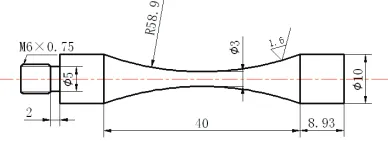
The very high cycle fatigue test was carried out on Shimadzu USF-2000 at a resonance frequency of 20 kHz and stress ratio R=-1.The resonance and interval time is 500ms:500ms, which is to reduce the heat generated by vibration. During the test, compressed cold air was used to cool the specimen until the specimen was broken or up to 109 cycles. Specimens were polished by 2000 mesh emery paper before test in order to reduce the influence of surface defect. The shape and dimensions of specimen is shown in Fig.1.
Figure 1. Shape and dimensions of specimen (in mm).
3 EXPERIMENTAL RESULTS
3.1 Microstructure
FV520B was treated by solid solution, intermediate and aging treatment, while KMN was treated by quenching and tempering. According to the tempering temperature, there were four different materials including FV520B-I, FV520B-S, KMN-I and KMN-S (I means the high strength steel, and S means the low strength steel). The microstructure of FV520B-I and KMN-I is shown in Fig.2.
(a) FV520B-I (b) KMN-I Figure 2. Microstructure of FV520B-I and KMN-I.
3.2 S-N Curve
The S-N curves obtained from all the specimens are shown in Fig.3. For FV520B-I, the S-N curve declined continuously with increasing the number of fatigue cycles and there was no traditional fatigue limit after 107 cycles. According to the slope of S-N curve, it could be divided into two regions. The curve declined slowly before 107 cycles and the crack initiated from surface (black dots in Fig.3), which was observed by fracture surface. In contrast, the curve became steep after 107 cycles and the crack initiated from interior (red dots in Fig.3). For KMN-I, there was a slow decline after 107 cycles and surface fracture was observed mostly. The very high cycle fatigue characteristics of KMN-I was not obvious compared with typical very high cycle fatigue S-N curve like FV520B. However, there was still some difference between KMN-I and traditional S-N curve with fatigue limit at 107 cycles. On the other hand, fatigue limit was observed in both low strength steels (FV520B-S and KMN-S). The fatigue limit of FV520B-S is about 465MPa, and the fatigue limit of KMN-S is about 415MPa.
Figure 3. The very high cycle fatigue S-N curves of FV520B and KMN.
3.3 Fracture Surface Observation
spectrum analysis, and only one crack initiated from interior inhomogeneous microstructure of matrix.
(a) surface crack initiation (b) crack initiation from inclusion (c) crack initiation from matrix Figure 4. Crack initiation modes of FV520B-I.
The typical feature of very high cycle fatigue was fish-eye morphology, as shown in Fig.5. When the crack propagated to the surface of specimen, the area formed a distinct boundary, which was called
“fish-eye” area [Ochi, et al. (2002)]. Some scholars believed that there was a closely connection between the existence of the fish-eye area and the distance of the crack source to the specimen surface. The difference of stress intensity factor between surface crack and interior crack resulted in the boundary of fish-eye. Besides, there was a highlight area called GBF (granular bright facet) around the inclusion, which is relatively rough and different from the smooth region around GBF. Some scholars thought that the existence of hydrogen was an important reason for the formation of GBF [Otsuka, et al. (2005)].
Figure 5. The fish-eye area and GBF of FV520B-I.
For KMN-I, the cracks initiated from surface mostly and only one interior crack initiation was observed. As shown in Fig.6, there was no obvious fish-eye morphology and fatigue source region was very smooth. Inclusion was observed in the center of GBF region, which was identified as MnS by energy spectrum analysis rather than the usual Al2O3 inclusions, and the size of MnS was about 4μm, which was much smaller than other inclusions. For the specimen with surface cracks, the microstructure was similar to FV520B, and the cracks initiated from surface processing defects usually. Some small secondary cracks were found in both fatigue source region and expansion region, which may be caused by the high propagation rate of cracks as shown in Fig.7.
fish-eye GBF
fatigue source
Figure 6. Crack initiation of KMN-I.
Figure 7. The secondary cracks of KMN-I.
For FV520B-S and KMN-S, all cracks initiated from surface and there was a fatigue limit in the vicinity of 107 cycles. Due to the high frequency of ultrasonic fatigue testing and heating of the specimen during test, the cracks of these specimens with short fatigue life cannot propagate adequately, so these specimens cannot be knocked off.
4 DISCUSSIONS
4.1 Fatigue strength prediction
The fatigue crack induced by interior inclusions was the typical feature of very high cycle fatigue, so the inclusions had an important influence to fatigue strength of high strength steels. Murakami, et al. regarded the inclusion as a crack by linear elastic fracture mechanics, and they defined A as the projected area of defects perpendicular to the direction of maximum principal stress. Considering the propagation of the crack around inclusions as a critical condition, they established "inclusion equivalent projected area model", which was used in very high cycle fatigue research widely
[
Murakami,(2002);
Murakami, et al. (1983); Murakami, et al. (1994)]
. The fatigue strength of high strength steels which contains nonmetallic inclusions can be expressed as:
ߪ
௪ൌ
ଵǤହሺுାଵଶሻ൫ξ൯భȀల (1)
Where HV is the Vickers hardness of the matrix, kgf/mm2 and ξܣ is the square root of the inclusion projection area perpendicular to the maximum principal stress, approximately equal to the diameter of the inclusions, in unit of μm. The modulus 1.56 is determined by the location of inclusion, and when the inclusion is located in surface, contact with surface and interior, the modulus is 1.43, 1.41 and 1.56 correspondingly.
Inclusion (MnS)
be obtained, that is, ߪ௪=490MPa. The fatigue strength of FV520B-I at 109cycles extrapolated by the S-N curve is about 550MPa. There is some deviation between prediction model and experimental results, which is probably due to the assumption of equivalent cracks and some research indicates that the ultrasonic fatigue test may promote the fatigue strength of specimen because of its high frequency.
As for KMN-I, most specimens cracked from surface, so we can conclude that the surface defects have an important influence on fatigue strength. Specimens were polished by emery paper before test and obvious defects had been removed, so surface roughness became an important factor. Murakami, et al. thought that the fatigue strength of specimens with surface roughness was determined by the threshold condition for non-propagation of a crack emanating from a notch root, which meant the initial value of
ඥܣோ of the defect was the crucial geometrical parameter that controls the fatigue strength. Hence, they estimated the equivalent defect size of surface roughness, ඥܣோ, the following equations can be derived:
ඥೃ ଶ ൌ ʹǤͻ ቀ ଶቁ െ ͵Ǥͷͳ ቀ ଶቁ ଶ
െ ͻǤͶ ቀଶቁଷ ǡ ݂ݎଶ ͲǤͳͻͷ (2)
ඥೃ
ଶ ؆ ͲǤ͵ͺǡ݂ݎ
ଶ ͲǤͳͻͷ (3)
Where a and b is determined by surface roughness of specimen: a means the amplitude of peak, which is the depth of defect in the cross section perpendicular to the maximum tensile stress, and b means the average distance between two peaks. Then ඥܣோ was taken into Eq. (1) instead of ξܣ , the fatigue strength of high strength steels with surface roughness can be expressed as:
ߪ
௪ǡோൌ
ଵǤସଷሺுାଵଶሻ ൫ඥೃ൯భȀల(4)
The authors measured the surface roughness of KMN-I specimens by white light interferometer, as shown in Fig.8. We can obtain the parameters that a is 0.55μm and b is 12.5μm. Then ඥܣோ can be calculated by Eq. (2), that is, ඥܣோ=1.358μm. Finally, we can obtain the fatigue strength determined by
ඥܣோusingEq. (4) and the fatigue strength ߪ௪ǡோ is 618MPa. The fatigue strength of KMN-I at 109 cycles extrapolated by the S-N curve is about 580MPa. It can be understood that there will be some deviation to reflect the overall state using roughness in certain location due to inhomogeneity of surface roughness.
Figure 8. The surface roughness of KMN-I.
4.2 Influence of microstructure on very high cycle fatigue
D efe ct d ep th of sp ec im en su rfac e / μ m
The very high cycle fatigue behaviour tended to appear in high strength steel and inclusion is an important factor. In the fatigue damage stage, cyclic stress attacked both surface and internal defects, and it was considered that the site which was selected for crack initiation was always competitive. To find out the difference of fatigue behaviour between FV520B-I and KMN-I, the authors analysed the microstructure and evaluated the distribution of inclusions. The results show that some small inclusions are observed in FV520B-I, while KMN-I is more clean relatively, as shown in Fig.9. Low level of inclusions led to the conclusion that the crack tends to initiate from surface. Besides, the very high cycle fatigue behaviour tended to occur in bimodal microstructure compared with basket weave microstructure
[Zuo, et al. (2008)]
. In the materials with bimodal microstructure like FV520B-I, most cracks initiated in the border region of two phases, which in the materials with basket weave microstructure like KMN-I, the cracks initiated from interfaces of lamellae usually and this microstructure was unfavourable to the propagation of interior cracks.(a) FV520B-I (b) KMN-I
Figure 9. The distribution of inclusions in FV520B-I and KMN-I.
5 CONCLUSIONS
The fatigue behaviour of two steels, FV520B and KMN, with different heat treatment used in compressor blades had been investigated in very high cycle fatigue regime. It was found that the S-N curve of FV520B-I continuously declined with increasing the number of fatigue cycles and the cracks initiate from interior mostly, while the S-N curve of KMN-I has a slow decline after 107 cycles and surface fracture is observed mostly. Fatigue limit is observed in both low strength steels (FV520B-S and KMN-S). We can conclude that very high cycle fatigue behaviour tends to occur in bimodal microstructure compared with basket weave microstructure and inclusions of FV520B-I make the crack initiation sites shift from surface to interior of specimen. Besides, fatigue strength of two materials was predicted by Murakami model and the authors are working to correct the model using fracture mechanics.
ACKNOWLEDGMENTS
The authors gratefully acknowledge the financial support provided by the National Key Basic Research and Development Program (973 Program 2011CB013401).
REFERENCES
Naito, T., Ueda, H. and Kikuchi M. (1983). “Observation of fatigue fracture surface of carburized steel,” J. Soc. Mat. Sci., Japan, 32 (361) : 1162-1166.
failure in steel,” Fatigue & Fracture of Engineering Materials & Structures, 22, 581-590.
Shiozawa, K., Morii, Y., Nishino, S. and Lu, L. (2006). “Subsurface crack initiation and propagation mechanism in high-strength steel in a very high cycle fatigue regime,” International Journal of Fatigue, 28, 1521-1532.
Ochi, Y., Matsumura, T., Masaki, K. and Yoshida, S. (2002). “High-cycle rotating bending fatigue property in very long-life regime of high-strength steels,” Fatigue & Fracture of Engineering Materials & Structures, 8-9, 823-830.
Otsuka, T., Hanada, H., Nakashima, H., Sakamoto, K., Hayakawa, M., Hashizume, K. and Sugisaki, M. (2005). “Observation of hydrogen distribution around nonmetallic inclusions in steels with tritium microautoradiography,” Fusion Science and Technology, 48, 708-711.
Murakami, Y. (2002). Metal Fatigue: Effects of Small Defects and Nonmetallic Inclusions, Elsevier, UK. Murakami, Y., Sakae, C. and Ichimaru, K. (1994). “Three-dimension fracture mechanics analysis of pit
formation mechanism under lubricated rolling-sliding contact loading,”Tribology Transactions, 37, 445-454.
Murakami, Y. and Endo, M. (1983). “Quantitative evaluation of fatigue strength of metals containing various small defects of cracks,”Engineering Fracture Mechanics, 17, 1-15.