FE Analysis of Reinforced Concrete Frames
Exposed to Fire
Anupama Krishna. D, Narayanan S, Priyadarshini R.S
Research Scholar, Department of Civil Engineering, College of Engineering, Thiruvananthapuram,
Kerala, India
HoD, Department of Civil Engineering, Mohandas College of Engineering and Technology, Thiruvananthapuram,
Kerala, India
Department of Civil Engineering, College of Engineering, Thiruvananthapuram, Kerala, India
ABSTRACT: From its earliest applications, reinforced concrete was the main construction material worldwide. Concrete has allowed mankind to shape the face of the earth, because, among all the other construction materials, reinforced concrete stands out for its strength, durability and cost-effectiveness. Traditionally, fire safety assessment of reinforced concrete has been based on a prescriptive single element analysis, neglecting static redundancies and restraints to thermal expansions. For long, this approach was considered conservative due to the fact that, concrete members exhibit a good performance in fire conditions when compared with other constituent materials, and concrete material presents by itself a low thermal diffusivity and considerably non-combustible material. Even for a structure labeled as safe when exposed to fire within the scope of prescriptive rules, structural engineers are not able to assess the real level of fire safety, because the real global structural response and ultimate collapse are unknown. For reinforced concrete structures the global behaviour is not yet fully understood, mainly because of the lack of reliable data concerning material’s properties at high temperatures. With current available information on temperature gradient in concrete during fire, property variation with temperature, growth of temperature during standard fire and FE modeling, the global response of 2-D reinforced concrete frames exposed to fire was analyzed. The results thus obtained have been validated using available literature. Using the validated FE model, parametric studies for different fire scenarios were done and the results are analyzed and presented.
KEYWORDS: Static redundancies, global behavior, deformations, fire scenarios, 2-D reinforced concrete frame
I. INTRODUCTION
Reinforced concrete structures are exposed to thermal loadings, whether through design or as a consequence of unavoidable conditions, heat of hydration, service function or fire. In some instances, such loadings represent the most critical loading condition and must be considered in the design of the structure [1]. The temperature gradient that forms is governed by the heat flow through the body and is a function of the density (q), specific heat (c) and thermal conductivity of concrete (k). It is commonly accepted that the proper inclusion of structural continuity and fire induced effects is vital for an accurate evaluation of the RC buildings response, the approach where each beam or column is handled as an independent memebers under fire condition is often applied due to its simplicity, meaning that its global behavior is disregarded. Influence of thermal elongation of beams, which impose considerable drifts to the outermost columns is investigated in the paper.
II. LITERATUREREVIEW
isnot yet fully understood, mainly because of the lack of reliable data concerning material’s properties athigh temperatures. Even so, codes of practice and standards, such the Eurocode 2 Part 1-2 (EN1992-1-2) [5], have drawn the first steps in the pursuit of a comprehensive model that allows structuralengineers to assess the real level of buildings’ fire safety.A lot of information has been gathered today, but still a lot of work needs to be done [6]. The behaviour of concrete in fire is not easily definedor modelled. Concrete is far from being a homogenous material, consisting of acomposite of cement gel, aggregate, and, frequently, steel (or other) reinforcement,and each of these components have a different reaction to thermal exposurein itself. Furthermore, a member exposed to fire, experiences steep thermalgradients over its cross-section. This is mainly a consequence of the shape of concretesections and their thermal massivity, more than the thermal conductivity [7].
Usually, concrete structures are designed to perform at room temperature, and the safety is checked using code provisions. However, some structures such as the chimney, nuclear reactors, and furnaces, are always subjected to high temperatures (100–500oC) and due to unpredicted fire accidents, buildings and bridges are exposed to a temperature of about1000o C [8].
III. DETERIORATIONOFTHEMECHANICALPROPERTIESOFCONCRETEANDSTEEL
The concrete and steel material behaviour when exposed to elevated temperatures is of unquestionable importance to the understanding of the structural fire performance [9].
Concrete does not have a homogeneous composition, being considered a composite and multi-phase material made from the mix of cement paste, water, a combination of fine and coarse aggregates, and in some cases adjuvant products. Each of these components presents different responses of their own to thermal exposures, resulting in a complex reaction of the whole composite system when subjected to fire actions. This is why modelling and predicting concrete behaviour at high temperatures represents a very difficult task [7]. Furthermore, it can be said that concrete performance under fire is mainly controlled by the cement past and the aggregates [11]. When subjected to high temperatures, concrete undergoes on a complex process of physical and chemical transformations. Some of these changes are reversible and others non-reversible upon cooling, meaning that concrete properties shall not remain the same after fire [7].
Deterioration in mechanical properties during fire hazard is mainly attributed to [9]: • Physicochemical changes in the cement paste;
• Physicochemical changes in the aggregates;
• Thermal incompatibility between aggregates and cement paste. • Temperature level and heating rate;
• Externally applied loads;
• Sealed or unsealed conditions of concrete, affecting moisture loss from the surface.
Sealed and unsealed concretes present different responses to the hydrothermal reactions, because while the dominant process in unsealed ones is related to the loss of various forms of water (free, chemically bound, adsorbed), in sealed concrete there is a predominance of hydrothermal chemical reactions [9].
An important feature related to cement past is the Calcium oxide – Silicon oxide (C/S) ratio. Low C/S ratio results in low calcium hydroxide content, ensuring a more beneficial hydrothermal reaction, because this component dissociates at about 400ºC into CaO and CO2. Besides that, during cooling CaO rehydrates expansively contributing to the deterioration and exposure of the moisture [9].
As far as the aggregate is concerned, a low thermal expansion improves thermal compatibility with the cement paste, and at the same time a rough angular surface contributes to a higher physical bound with the same paste [9]. Recent experimental studies indicate that strength reduction due to high temperatures is more pronounced in high-strength (HSC) and ultra-high-strength (UHSC) than in normal strength concretes (NSC) [11].
IV. THERMOSTRUCTURALANALYSIS
Recent research and real fire events have outlined thermal elongation of beams and structural continuity as key phenomenon influencing the performance of RC structures in fire. Therefore thermostructural methodis normally used to account for the whole structural response to find the response of frames when fire resistance is to be assessed [12]. The thermal analysis performed by ANSYS cannot include theparameters such as load eccentricity and support conditions. Moreover, the thermal failure criteria based on critical temperature on reinforcement are not sufficient to predict the failure time of structural elements like beams and columns. Therefore a thermo-structural analysis is performed using ANSYS [13] for various time of exposure. It is assumed that spalling of concrete does not take place and perfect bond exists between steel and concrete. Isotropic linear thermal conductivity, specific heat, and nonlinear stress strain curves at different temperature are provided as material properties. Figure1 shows the single bay frame model characteristics considered in the study. Figure 2 represents the reinforcement details of the structural elements. The loading is given as P where P=G+0.5Q, where G is the dead load (36 kN/m) and Q is the live load (12kN/m), N represents the reaction of loads from the upper floors (1000 kN) [8].
Fig. 1. Frame model characteristics [8]
Fig .2. Reinforcement details [14]
V.FIRESCENARIO
Fig.3. ISO 834 fire curve [15]
VI. ANALYTICALSTUDIES
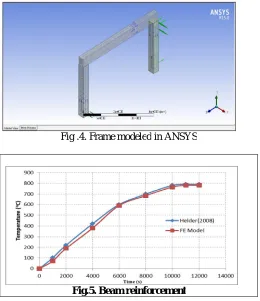
A coupled analysis was carried out in ANSYS and as part of the parametric study the temperature obtained by the column rebars and beam rebars were plotted and compared with the values of literature.Figure 4 shows the analytical model used in the study.Figures 5 and 6 represents the temperature obtained by the rebars of respective structural elements.The assumptions considered during this structural analysis are :(1)No spalling occurs; (2) No bond failure between steel and concrete happens;(3) No shear failure is considered.
The next criterion considered is column drift due to thermal expansion..The outer face of the column is assumed to be at ambient temperature under compartment fire inside the bay.
Fig .4. Frame modeled in ANSYS
Fig.6. Column reinforcement
VII. STRUCTURALDISPLACEMENTS
The column drift and the beam elongation have also been studied to get the effect of structural continuity. In Figure 7 the vertical displacements of the beam’s mid-span and Figure 8 shows the horizontal drift of column. It is possible to observe that the top of the column experiences an upward displacement, induced by the column’s thermal elongation.
Fig.7. Horizontal displacement (Column Drift)
The elongation of the column stabilizes because the applied compressive axial load becomes preponderant in relation to the thermal elongation, but the column drift goes on increasing with time. Focusing in the displacement of the beam’s mid-span, it is observed that it increases very pronouncedly through the heating process, reaching approximately 5cm after three hours of fire exposure. This increase in the vertical deflection may be attributed to the stiffness loss induced by the concrete and reinforcing steel properties degradation at elevated temperatures.
VIII.CONCLUSION
With the above analysis, it is possible to understand that reinforcement temperature of the corner bars and the fire rating can be determined based on the thermal criteria. It can be concluded that reinforcement temperature depends only on the fire load and the exposed surface area. There is not much difference between the finite element model and literature.
REFERENCES
[1] A. Ghali, R. Favre, M. Elbadry, Concrete Structures: Stresses and Deformations, Chapman and Hall, London, 1986.
[2] One Stop Shop in Structural Fire Engineering, http://www.mace.manchester.ac.uk/project/research/structures/strucfire/default.htm, accessed in 2009/04/11
[3] Fletcher, I., Borg, A., Hitchen, N., Welch, S., Performance of concrete in fire: a review of the state of the art, with a case study of the Windsor tower fire, in Proceedings of the fourth international workshop Structures in Fire. 2006: Aveiro. p. 779-790.
[4] Beitel, J., Iwankiw, N., Analysis of Needs and Existing Capabilities for Full-Scale Fire resistance testing, National Institute of Standards and Technology NIST GCR 02-843, 2002.
[5] European committee for standardisation, Design of concrete structures: General rules: - Structural Fire Design, EN 1992-1-2, Eurocode 2, Part 1-2: Brussels, 2004.
[6] Z. Ruan, L. Chen, Q. Fang, Numerical investigation into dynamic responses of RC columns subjected for fire and blast, J. Loss Prev. Process Ind. 34 (2015) 10–21.
[7] Fletcher I. A., Welch S., Torero J. L., Carvel R. O. And Usmani A. (2007): „Behaviour of Concrete Structures in Fire‟, Thermal Science, Vol. 11, No. 2, 2007, pp. 37-52
[8] Fib Bulletin 46 (2008): „Fire Design of concrete structures – structural behavior and assessment‟, Fédération internationale du beton, 209 pp. [9] Gabriel Alexander, K., Effect of fire on concrete and concrete structures. Progress in Structural Engineering and Materials, 2000: p. 429-447. [10] Kodur, V.K.R., Phan, L., Factors governing the fire performance of high strength concrete systems, in Proceedings of the fourth international
workshop Structures in Fire. 2006: Aveiro. p. 573-586
[11] Schneider, U., Horvath, J., Explosive Spalling of Concrete Under Fire Conditions, in Proceedings of the International workshop "Fire Design of Concrete Structures – From Materials Modelling to Structural Performance". 2007: Coimbra. p. 161-176.
[12] Taerwe L. From Member Design to Global Structural Behaviour in Fib. Workshop on Fire Design of Concrete Structures- From material modeling to structural performance. University of Coimbra pp 253-270 (2007)
[13] ANSYS Release 15.0, Documentation for ANSYS, 2010
[14] Hélder Francisco Brás Xavier, Rua Dr. Roberto Frias Faculty Of Engineering Of The University Of Porto, Analysis Of Reinforced Concrete Frames Exposed To Fire, Thesis, 2008
![Fig. 1. Frame model characteristics [8]](https://thumb-us.123doks.com/thumbv2/123dok_us/1514948.1185607/3.595.166.430.354.724/fig-frame-model-characteristics.webp)