ISSN(Online): 2319-8753 ISSN (Print): 2347-6710
I
nternational
J
ournal of
I
nnovative
R
esearch in
S
cience,
E
ngineering and
T
echnology
(A High Impact Factor, Monthly, Peer Reviewed Journal) Visit: www.ijirset.com
Vol. 8, Issue 2, February 2019
An Enhanced Sentiment Analysis Model for
Incorporating Implicit Aspects
R. Sindhuja 1 , M. Devi Sri Nandhini 2 M.E..,(Ph.d) ,
P.G Student , Department of Computer Science and Engineering, A.V.C. College of Engineering, Mannampandal,
Mayiladuthurai, Tamil Nadu, India 1
Assistant Professor, Department of Computer Science and Engineering, A.V.C. College of Engineering,
Mannampandal, Mayiladuthurai, Tamil Nadu, India 2
ABSTRACT: An aspect-based sentiment analysis approach helps in analyzing opinions about product features and attributes. An aspect-level sentiment analysis would refer to the sentiment associated with aspects of the product. The aspects are nothing but attributes or components of the topics, products and organisations.This paper is based on extracting aspects and related customer sentiments. This offers an approach to discover consumer preferences about services using statistical opinion mining. The proposed system extract both explicit aspects as well as implicit aspects from customer reviews. First, it performs some pre-processing steps to remove the unwanted words in the review sentences. Second, it performs the semantic aspect extraction and then it displays the status of the reviews. This system extract the implicit aspects using rule based classifiers. Due to the growing of unstructured reviews, the proposed system gives a summarized form of the information that is obtained from the reviews in order to furnish customers with pin point or crisp results.
KEYWORDS: Explicit –aspect ,Implicit – aspect, Rule Based Classifier
I. INTRODUCTION
1.1 SENTIMENT ANALYSIS
An opinion mining or sentiment analysis is the computational study of opinions or emotions towards aspects or things. Most of the aspects are attributes or components of the individuals, events, topics, products and organizations. Opinion mining is an active research area in Web mining and Natural Language Processing (NLP) in recent years. With the emerging growth of E-commerce, there are millions of product options available and people tend to review the viewpoint of others before buying a product. Knowing customers opinions for the products or services, the retailers can improve their products or services to meet customers‟ needs, therefore the retailers are paying more and more attention to the social network comments .
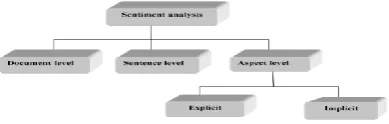
Opinion mining has been divided into three main tasks i.e sentiment classification (document-level),subjective/objective identification(sentence-level), and aspect-based sentiment analysis (feature level). Both in the document-level and sentence-level classification ,the main aim is to find the sentiment of overall document or sentence, while in aspect level aim is to find the sentiment of each aspect as a single unit.
ISSN(Online): 2319-8753 ISSN (Print): 2347-6710
I
nternational
J
ournal of
I
nnovative
R
esearch in
S
cience,
E
ngineering and
T
echnology
(A High Impact Factor, Monthly, Peer Reviewed Journal) Visit: www.ijirset.com
Vol. 8, Issue 2, February 2019
Figure 1: Structure of sentiment analysis
The next sections of the paper is organized as follows. In section 2, related works are reviewed. In section 3,
the proposed rule based classifier algorithm is presented in detailed. In section 4 obtained results are presented and discussed. Finally conclusions and future work are presented.
II. RELATED WORK
Anh-Dung Vo et.al developed a method to extract the product aspects and corresponding opinions from a large number of product reviews in a specific domain. The proposed system extract the syntactic knowledge and implied opinion aspect relations using a set of natural language processing (NLP) tools. The coarse knowledge from reviews is automatically obtained using dependency parser (DP), co-reference (CR), and named entity recognition (NER) tools. In addition opinion aspect relations are inferred from aggregate statistics for the extracted coarse knowledge .This knowledge is used to analyze new reviews and generate aspect based summaries. This process extract the aspect from the large datasets and syntactic knowledge ,is used to analyze new reviews. It needs a deeper knowledge for aspect extraction.
Li Sun, et.al have proposed a novel context-based implicit feature extracting method. This method extract the implicit features according to the opinion words and the similarity between the product features in the implicit features‟ context . This process contains the three steps. Step one: Build the co occurrence matrix to show the relationship between opinion words and product features .Step two: Determines whether there is an implicit feature, if so, find out a candidate set of implicit features. Step three: Find the correct implicit features according to the candidate implicit features‟ scores calculated based on the opinion words and the context information of the implicit features.
Here, the context information and opinion words are used to extract the implicit feature . This paper has some shortcomings, e.g. in the small scale corpora, it cannot figure out the implicit features well. And it only study the adjectives as opinion words.
Mohamad Syahrul Mubarok et.al have proposed the usage of Naïve Byes to identify an aspect from the product reviews and also to classify the sentiment polarity of the aspect - i.e., sentiment analysis on aspect level .Here ,an analysis conducted on three phases: Pre-processing, feature selection and classification. Data preprocessing is
performed by folding, tokenization, stop word removal, and stemming. The POS tagging approach and the Chi Square
method can be used for features selection . The classification was performed for two variables called aspects and sentiments by using Naïve Byes model. The Chi Square also has been proven to speed up the computation time in the classification process of Naïve Byes although it degraded the system performance and Visualizing the classification result. In the process of classification, misclassification occurred were documents that were failed to be classified by system. Misclassification can be caused when an essential feature that is missing resulted by previous processes.
T.Sangeetha et.al have proposed Aspect ranking of products for identifying and prioritizing the aspects of products based on the online reviews given by the customers. The proposed system first extract the product aspects and then the opinions on those aspects are identified via sentiment dictionaries. Here, three types of Dictionaries are used . i.e Sentiment Dictionary, Sentiment Degree Dictionary, and Negation Dictionary. Sentiment Dictionary contains 4129
ISSN(Online): 2319-8753 ISSN (Print): 2347-6710
I
nternational
J
ournal of
I
nnovative
R
esearch in
S
cience,
E
ngineering and
T
echnology
(A High Impact Factor, Monthly, Peer Reviewed Journal) Visit: www.ijirset.com
Vol. 8, Issue 2, February 2019
Level 1 has 49 highest degree of sentiment, “excellent” and “awesome” . Level 2 has 42 higher degree of sentiment, such as the words are “super” and “perfect. Level 3 has 11 words, such as the words are “rather” and “even”. Level 4 has 10 words, such as the words are “little” and “just” and Level 5 has 6 words, the words are “less” and “bit”. The
Negation Dictionary (ND) was constructed by collecting routinely used Negative words, such as “no”, “bad”, “worst”
etc .Finally the aspects are ranked based on their sentiment score. It helps us to extract the important aspects of the products to be considered before buying that particular product. This aspect ranking also makes bad impression on that product.
III. SYSTEM ANALYSIS
3.1 EXISTING SYSTEM
The existing approach uses supervised learning algorithm which needs labeling the data that is often expensive and time consuming. It is desirable to develop a learning algorithm that does not require large amounts of labeled training data. Second, traditional document-level classification techniques do not always originate meaningful aspect-based opinion polling. Also it couldn‟t satisfactorily deal with the implicit aspect expression problem which remains to be a challenge in opinion mining domain. Handling of grammatical errors in reviews is challenging one.
The existing system applies Point wise Mutual Information (PMI) based semantic association analysis and co-occurrence association rule mining to identify implicit features. These two methods measure the similarity of pairs of words and they considers the explicit aspect as implicit aspect.
3.1.1 DISADVANTAGES OF EXISTING SYSTEM
Leverage on common sense knowledge and dependency structure of sentences.
Extraction of limited dependency relationship from datasets
Using supervised learning algorithm which needs labelling the data that is often expensive and time
consuming.
Traditional document-level classification techniques do not always originate meaningful aspect-based opinion
polling.
3.2 PROPOSED SYSTEM
The main idea behind this work is to extract the implicit aspect from the reviews in order to identify important factors in their decision making process. The work begins with the collection of reviews and then performs the preprocessing and aspect extraction.
The proposed system performs preprocessing by using tokenization, stop word removal and stemming. In this process, unwanted words removed, after that aspect extractions are performed by using rule based classifiers .Rule based classifiers makes use of a set of IF-THEN rules for classification. Rules can be expressed in the following form: IF Condition THEN Conclusion
The IF part of the rule is called rule antecedents or pre condition. It THEN part of the rule is called rule consequent. The antecedents part is the condition .It consists of one or more attributes test and these tests are logically AND ed. The consequent part consists of class prediction.
A . Algorithm Input:
D, a data set class-labeled tuple, Att_val, the set of all attributes and their possible values. Output: A Set of IF-THEN rules.
Method: Rule_set={ }; // initial set of rules is empty for each class c do
repeat
ISSN(Online): 2319-8753 ISSN (Print): 2347-6710
I
nternational
J
ournal of
I
nnovative
R
esearch in
S
cience,
E
ngineering and
T
echnology
(A High Impact Factor, Monthly, Peer Reviewed Journal) Visit: www.ijirset.com
Vol. 8, Issue 2, February 2019
until termination condition;
Rule_set=Rule_set+Rule; // add a new rule to rule-set end for return Rule_Set;
B.System Architecture
Figure 2: Overall System Design
C.Modules
In this project there are three modules that are used to extract the implicit aspects. The modules are,
1 . Preprocessing
2 . Semantic Aspect Extraction 3 . Status Checking
1. Preprocessing
In preprocessing the review dataset is given as an input and the review dataset in the form of rows and columns. The preprocessing performs the following steps:
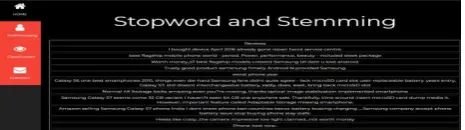
a. Stemming
It is the process of removing redundant word and stem base or root form generally a written word form. Example : word “images” will be reduced to “image”
b. Stop Words Removal
A dictionary based approach has been utilized to remove stop words from tweets . The words that has no value or meaning in the sentence are removed . Example: The, this
Example Review: I bought my device in April 2016 and it had already gone for repair twice to the service centre.
Stop word removal :
I bought device April 2016 already gone repair twice service centre.[
a. f
ISSN(Online): 2319-8753 ISSN (Print): 2347-6710
I
nternational
J
ournal of
I
nnovative
R
esearch in
S
cience,
E
ngineering and
T
echnology
(A High Impact Factor, Monthly, Peer Reviewed Journal) Visit: www.ijirset.com
Vol. 8, Issue 2, February 2019
c. Tokenization
Tokenization splits up the words into terms of tokens.
Example Review: I bought my device in April 2016 and it had already gone for repair twice to the service centre.[I,
Tokens : [ I ,bought, my ,device ,in,, April, 2016, and, it ,had, already, gone, for , repair, twice, to, the, service ,centre ][I,
Figure 4:Tokenization process 2 . Semantic Aspect Extraction
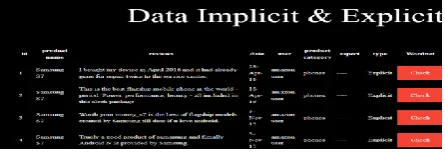
After performing preprocessing ,the next step is semantic aspect extraction . It is performed by using rule based algorithm. Here an implicit dataset is created and stored in a database. It also has Word Net to show the synonyms words related to the aspects.
Split and store the reviews in String array
Initialize „aspect‟ term
If tweet words are equal to the aspect words, the flag value is incremented by 1.
If the value is greater than 0, the aspect words are Implicit word. Then the review tweets value and the corresponding aspect terms are inserted into the icheck table and Update the table.
Then the value is 0, the words are known as Explicit word. The review tweets value and the corresponding
aspect terms are inserted into the iecheck table and Update the table
Figure 5:Semantic aspect exraction
3. Review Status Checking
In this module , the review status are displayed. Here sentiment word dataset is created and stored in a database. Using this sentiment word dataset the reviews are classified as positive ,Negative or Neutral .
Figure 6:Review status checking
Review Type
I bought my device in April 2016 and it had already gone
ISSN(Online): 2319-8753 ISSN (Print): 2347-6710
I
nternational
J
ournal of
I
nnovative
R
esearch in
S
cience,
E
ngineering and
T
echnology
(A High Impact Factor, Monthly, Peer Reviewed Journal) Visit: www.ijirset.com
Vol. 8, Issue 2, February 2019
3.2.1ADVANTAGES OF PROPOSED SYSTEM
The proposed system classifies the explicit and implicit aspects efficiently.
All the collected reviews applied to the proposed system which classifies the reviews as positive, negative and
neutral.
Aspect based opinion mining offers a larger scope method to understand aggregated consumer preferences.
It has WordNet to show the aspects related synonyms words.
IV.RESULTS AND DISCUSSION
Aspect extraction is the most vital task in aspect-level SA and hence, studied by most of the researchers .The aspect extraction phase includes an extracting explicit aspects and implicit aspects. There are enormous amount of work for the extraction of explicit aspects but implicit aspects have not been studied vigorously. Here the proposed system mainly focuses an extraction of implicit aspect and also explicit aspects.
Figure 3: System result analysis
V.CONCLUSION
In this work ,the rule based classifier is used to extract the explicit and implicit aspects from the customer reviews. In opinion mining ,aspect extraction is an important process. User-generated review data are different from usual textual articles . When people read reviews, they typically concern themselves with what aspects are mentioned in the review . As a separate preprocessing step, the rule based classifiers were specially developed for extracting aspect terms .
REFERENCES
[1] Brun, C., Popa, D. N., & Roux, C. (2014). Xrce: Hybrid classification for aspect-based sentiment analysis. In Proceedings of the 8th International Workshop on Semantic Evaluation (SemEval 2014) (pp. 838-842).
[2] Brychcín, T., Konkol, M., & Steinberger, J. (2014). Uwb: Machine learning approach to aspect-based sentiment analysis. In Proceedings of the 8th International Workshop on Semantic Evaluation (SemEval 2014) (pp. 817-822).
[3] Hai, Z., Chang, K., & Kim, J. J.(2011, February). Implicit feature identification via co-occurrence association rule mining. In International Conference on Intelligent Text Processing and Computational Linguistics (pp. 393-404). Springer, Berlin, Heidelberg.
[4] Kiritchenko, S.,Zhu,X.,Cherry,C.,&Mohammad, S.(2014). NRC-Canada-2014: Detecting aspects and sentiment in customer reviews.
In Proceedings of the 8th International Workshop on Semantic Evaluation (SemEval 2014) (pp. 437-442).
[5] Popescu, A. M., Nguyen, B., & Etzioni, O. (2005, October). OPINE: Extracting product features and opinions from reviews. In Proceedings of HLT/EMNLP on interactive demonstrations (pp. 32-33). Association for Computational Linguistics.
[6] Poria, S., Cambria, E., Gelbukh, A., Bisio, F., & Hussain, A. (2015). Sentiment data flow analysis by means of dynamic linguistic patterns. IEEE Computational Intelligence Magazine, 10(4), 26-36.
[7] Qiu, G., Zheng, M., Zhang, H., Zhu, J. K., Bu, J. J., Chen, C., & Hang, H. (2011). Implicit product feature extraction through regularized topic modeling. Journal of Zhejiang University. Engineering Science, 45(2), 288-294..
[8] Su, Q., Xiang, K., Wang, H., Sun, B., & Yu, S. (2006, December). Using pointwise mutual information to identify implicit features in customer reviews. In International Conference on Computer Processing of Oriental Languages(pp. 22-30). Springer, Berlin, Heidelberg.
ISSN(Online): 2319-8753 ISSN (Print): 2347-6710
I
nternational
J
ournal of
I
nnovative
R
esearch in
S
cience,
E
ngineering and
T
echnology
(A High Impact Factor, Monthly, Peer Reviewed Journal) Visit: www.ijirset.com
Vol. 8, Issue 2, February 2019
[10] Yu, J., Zha, Z. J., Wang, M., & Chua, T. S. (2011,June). Aspect ranking:identifying important product aspects from online consumer reviews. In Proceedings of the 49th Annual Meeting of the Association for Computational Linguistics: Human Language Technologies-Volume 1 (pp. 1496-1505).Association for Computational Linguistics.
[11] Zhang, Y., & Zhu, W. (2013, May). Extracting implicit features in online customer reviews for opinion mining. In Proceedings of the 22nd International Conference on World Wide Web (pp. 103-104). ACM.