Constructing Synonymous Gene Database for
Medline Abstracts Using SSFPOA
S.Jayaprada
1, P.Bala Krishna Prasad
2, I.Ramesh Babu
31 Sr.Assistant Professor, Dept. of CSE, VR Siddhartha Engineering College, (Autonomous) Vijayawada,India
2
Principal, Dept. of CSE, Eluru College of Engineering and Technology, Eluru, India
3
Professor, Dept. of CSE, Acharya Nagarjuna University, Guntur, India
ABSTRACT: Authors frequently use different names to refer to the same gene or protein names across Bio-medical articles. Identifying the alternate names for the same gene/protein would help biologists in the process of gene-protein interactions and protein-protein interactions. Biomedical databases such as SWISSPROT, GenBank, GOLD, UniGene and Karyn’s Genome include synonyms, but these databases may not be always up-to-date. Therefore, it is necessary to automate this process, because of the increasing number of discovered genes and proteins. In this paper we considered this problem as Natural Language processing (NLP) problem and solved using SSFPOA semantic measure. Experiments were conducted on Medline abstracts and results are compared with existing methods. Machine learning algorithms are used in our work to analyze the performance of our method. Results are evaluated with the help of performance measures and results showed high percentage of accuracy when compared with existing works.
KEYWORDS: Information Extraction (IE), Gene name, Protein name, Medline abstracts, Synonym Identification
I. INTRODUCTION
The existing MEDLINE database includes over 12 million computer-readable records within the biomedical domain and is expanding rapidly. Automatically extracting synonymous gene/protein names from these biomedical text documents requires the knowledge of IE techniques such as recognizing the gene/proteins names in the text because human genes/proteins may be named with standard English words, Names may be alphanumeric, may include Greek or Latin letters, can be case sensitive, and may be composed of multiple words. Hence there is a need for an information extraction algorithm that can extract gene/ protein names accurately. Also this task requires the knowledge of NLP techniques such as stop words and duplicates words removal in order to make the identification task simpler. Next task is named entity recognition task by ABNER tagger. Finally similarity measure SSFPOA [1] is used to calculate similarity between any two gene/protein names present in Medline abstracts so as to update the database. This paper is organized as follows: Section II discusses related work, Section III discusses about our proposed system. Section IV discusses about Evaluation of Experimental results and Section V describes Conclusions and Future work.
II. RELATED WORK
as their rules extracts taxonomic names that follow a set of prescribed syntax and linguistic rules. In our proposed work, we considered Medline abstracts. [4] assess the performance of text mining systems applied to biomedical texts including tools which recognize named entities such as genes and proteins, and tools which automatically extract protein annotations [5] The ProMiner system is a rule based system that uses a pre-processed synonym dictionary (case –sensitive) to identify potential name occurrences in the biomedical text and associate protein and gene database identifiers with the detected matches. Based on all detected synonyms for one abstract, the most plausible database identifiers are associated with the text. Porter Stemmer algorithm is used for stemming in pre processing phase. Gene Ontology is used to resolve disambiguation. In addition to this the system uses an abbreviation dictionary containing abbreviations and their long forms, which do not correspond to protein or gene names. If match overlaps, the match with higher acceptance score is considered. Even though Pro Miner system could get F-Measure of 0.83, but detection of synonyms can be evaluated using machine learning methods. Identifying gene/protein names (Named entity Recognition- NER) for the mouse and yeast organisms is done using simple matching procedure. This approach may not work for organisms with high prevalence of unspecific names, such as fly. In our proposed work, we considered ABNER for tagging the gene/protein names. [6] GAPSCORE identifies protein and gene names from text. It uses a word-based approach and scores the confidence that a word may be a gene based on appearance, morphology and context criteria that includes information from all of MEDLINE. To identify the boundaries of multi-word gene names, GAPSCORE extends the name using heuristics on part of speech tags.
expressions and added to dictionary and in third phase the extracted gene and protein names are validated and verified using precision, recall and F-measure.
III.PROPOSED METHOD
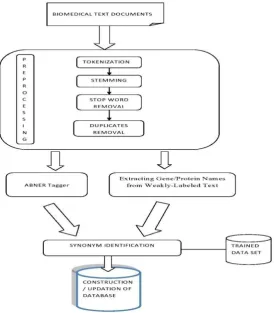
Figure 1 presents our proposed system for identifying Synonymous Gene. The framework consists of three phases: • Pre-processing
• Synonyms identification using semantic similarity measure SSFPOA • Constructing/ Updating Gene database
A. Preprocessing: Pre-processing is a technique to retrieve gene or protein terms from Biomedical documents. The following are the Natural language techniques used in preprocessing:
1. Tokenization Tokenization is the process of identifying various elements (tokens) from the given text (Medline abstracts). These tokens are given as input for the next phases. In our approach we used the heuristic rules proposed by [14] to remove nonfunctional characters and the following heuristic rules during tokenization. do not split on hyphens, do not split on single quotation marks, do not split on commas, and do not split on parentheses and brackets. Example: Lymphocyte associated receptor of death. |Lymphocyte| |associated| |receptor| |of| |death| |.|
Fig 1: Proposed System for Identifying Synonymous Gene
3. Stemming Next step is to remove suffixes by using our proposed improved stemmer algorithm. We studied improved porter stemmer algorithm [18] and identified the following various errors for which solutions are described in the form of rules in [19]
4. Duplicate Removal In order to reduce corpus we identify duplicate words and filter them. Reducing the corpus also increases the efficiency of preprocessing phase.
5. Named entity recognition: From the output corpus we should next extract gene/protein tokens. The ABNER (A Biomedical Named Entity Recognizer) tagger [20], which is an open source tool for is an open source software tool for automatically tagging genes, proteins and other entity names in text is used in our proposed approach.The latest version is 1.5, which has an intuitive graphical interface and includes two modules for tagging entities (e.g. protein and cell line) trained on standard corpora, for which performance is roughly state of the art. Difficulties for Biomedical NER.
B. Identifying Synonyms There are two types of synonyms for gene and protein names, Type I and Type II. We distinguish between Type I and Type II, Type I consist of the correspondence between the short and long forms of gene and protein names (e.g., LARD and lymphocyte associated receptor of death). Type II consists of the correspondence between all short forms (e.g., Apo3, DR3, TRAMP, LARD, and wsl). We identify synonymous gene/protein by using SSFPOA measure (only 11 matchers are used in this paper) which is compound similarity measure consisting of 12 matchers as listed below: Levenstein Distance, Smith- waterman, Needleman-Wunsch, Monge-Elkan measure, Stoilos Similarity, Boyer-Moore, synonymn dictionary, Soundex, Tri-gram , exact matcher, Jarowinkler.
C. Construction/Updation of Gene Database The Extracted gene/protein synonyms are stored in a database. If the database already consists of these gene/protein names, they are discarded; otherwise add new gene/protein names to the database (possible after filtering by a human biologist) that will enhance the current database. To Extract Gene-Protein Names from Weakly-Labeled Text we can use semantic similarity such as
))
'
(
),
(
max(
)
'
,
(
1
)
'
,
(
s
length
s
length
s
s
LD
s
s
SimScore
eq. (1)
Where LD(s,s’) is Levenshtein Distance between strings s and s’, and length(s) is the number of characters in s.
IV.EVALUATION RESULTS
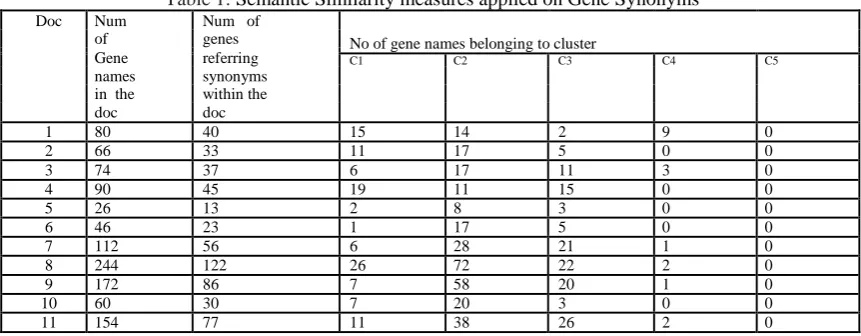
We took 50 MEDLINE Abstracts from [13] http://www.biomedcentral.com/ to construct synonymous gene/protein database. The following table 1 shows the statistics of extracted gene/protein names and their cluster similarities. Weka tool 3.7.9, 4GB RAM, Intel core i5 with 2.4 GHz processor is used for finding clusters. .arff file is created with 11 matcher values and is given to various classification techniques like Bayesnet, LibSVM and Multiplayer Perceptron. The output which represents similarity is not just 0 or 1 but in the range of 0-1 to represent different levels of similarity.
Table 1: Semantic Similarity measures applied on GeneSynonyms
Doc Num Num of
of genes No of gene names belonging to cluster
Gene referring C1 C2 C3 C4 C5
names synonyms
in the within the
doc doc
1 80 40 15 14 2 9 0
2 66 33 11 17 5 0 0
3 74 37 6 17 11 3 0
4 90 45 19 11 15 0 0
5 26 13 2 8 3 0 0
6 46 23 1 17 5 0 0
7 112 56 6 28 21 1 0
8 244 122 26 72 22 2 0
9 172 86 7 58 20 1 0
10 60 30 7 20 3 0 0
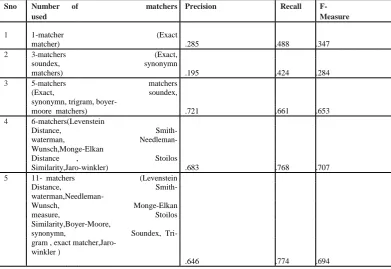
Various experimental studies are performed by considering only 1 matcher, 3 matchers,5 matchers, 6 matchers,11 matchers, so as to understand the importance of each matcher in the semantic measure SSFPOA. The following Table-2,3,4 represents the comparison of accuracy in results while using a combination of matchers for various classifiers.
Table 2: Comparison of accuracy when using different matchers (Bayesnet)
Sno Number of matchers Precision Recall F-used Measure
1 1-matcher (Exact
matcher) .267 .467 .326
2 3-matchers (Exact,
soundex, synonymn
matchers) .258 .478 .341
3 5-matchers matchers
(Exact, soundex,
synonymn, trigram,
boyer-moore matchers) .587 .661 .601
4 6-matchers(Levenstein
Distance,
Smith-waterman,
Needleman-Wunsch,Monge-Elkan
Distance , Stoilos
Similarity,Jaro-winkler) .559 .704 .614
5 11- matchers (Levenstein
Distance,
Smith-
waterman,Needleman-Wunsch, Monge-Elkan
measure, Stoilos
Similarity,Boyer-Moore, synonymn, Soundex,
Tri-gram , exact
matcher,Jaro-winkler ) 0.757 0.8 0.757
The accuracy is calculated according to Precision,Recall, and Fmeasure .Then compare the results using different matchers in SVM classifier is shown in Table-3
Table 3: Comparison of accuracy when using different matchers (SVM)
Sno Number of matchers Precision Recall
F-used Measure
1 1-matcher (Exact
matcher) .285 .488 .347
2 3-matchers (Exact,
soundex, synonymn
matchers) .195 .424 .284
3 5-matchers matchers
(Exact, soundex,
synonymn, trigram, boyer-
moore matchers) .721 .661 .653
4 6-matchers(Levenstein
Distance, Smith-
waterman, Needleman-
Wunsch,Monge-Elkan
Distance , Stoilos
Similarity,Jaro-winkler) .683 .768 .707
5 11- matchers (Levenstein
Distance, Smith-
waterman,Needleman-
Wunsch, Monge-Elkan
measure, Stoilos
Similarity,Boyer-Moore,
synonymn, Soundex, Tri-
gram , exact matcher,Jaro- winkler )
The accuracy is calculated according to Precision,Recall, and Fmeasure .Then compare the results using different matchers in MultiLayer classifier is shown in Table-4
Table 4: Comparison of accuracy when using different matchers (MultiLayer
)
Sno Number of matchers used
Precision Recall F-Measure
1 1-matcher (Exact
matcher) .269 .473 .331
2 3-matchers (Exact,
soundex, synonymn
matchers) .182 .409 .270
3 5-matchers matchers
(Exact, soundex,
synonymn, trigram,
boyer-moore matchers) .662 .625 .601
4 6-matchers(Levenstein
Distance, Smith-
waterman, Needleman-Wunsch,Monge-Elkan Distance , Stoilos
Similarity,Jaro-winkler) .376 .558 .433
5 11- matchers (Levenstein
Distance, Smith-
waterman,Needleman-Wunsch, Monge-Elkan
measure, Stoilos
Similarity,Boyer-Moore, synonymn, Soundex, Tri-gram , exact
matcher,Jaro-winkler ) .825 0.9 0.857
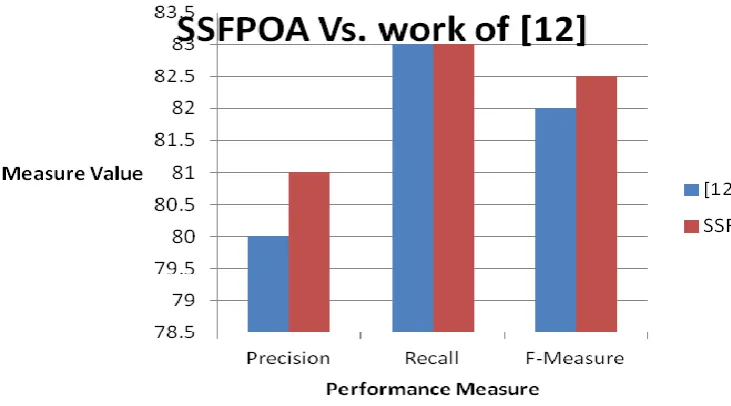
One problem noticed while evaluating SSFPOA is some of the Medline abstracts taken by us involve more number of cryptic.Pre-processing phase does not replace these cryptic with corresponding full names such as (LARD - lymphocyte associated receptor of death). This was reflected while evaluating with 1 matcher (exact matcher) as shown in table 2. Mapping cardinality of 1:1 (simple) is used in this paper and have not resolved 1:n (complex) mappings. The following Fig.2 shows a graph of overall performance of SSFPOA on the 10 Medline Abstracts when compared to [12]
V. CONCLUSION AND FUTURE WORK
This paper proposed a hybrid approach for constructing synonymous gene/protein names database dictionary from Medline abstracts that consists of three phases. In the first phase, pre-processing is carried out to reduce the corpus of the given abstracts. In the second and third phase, synonymous gene names are identified and added to the database. Experimental result shows that the proposed work provides 82% accuracy in identifying Gene and Protein names, which is evaluated and verified using the Precision, Recall and F-Measure. The Proposed architecture improved the performance of stemmer algorithm by applying new rules to the original stemmer algorithm. As there is no universally accepted tokenization method for processing text documents, our future work concentrates on improving biomedical tokenization process. Our work should also consider abstracts from other biomedical journals such as Pubmed etc. Also we need to compare Gene database constructed by us with one of the existing databases such as GenBank so as to analyse whether our approach can put update-to-date information or not.
REFERENCES.
[1]. S. Vasavi, S. Jayaprada, V. Srinivasa Rao, “Extracting Semantically Similar Frequent Patterns Using Ontologies”, SEMCCO'11 Proceedings of the Second international conference on Swarm, Evolutionary, and Memetic Computing - Volume Part II, Pages 157-165.
[2]. Hui Yang, Goran Nenadic, John A. Keane, “A cascaded approach to normalising gene mentions in biomedical literature”, Biomedical Informatics Publishing Group, Bioinformation 2(5): 197-206, 2007.
[3]. Koning D, Sarkar I, Moritz T: “ TaxonGrab, Extracting taxonomic names from text “, Biodiversity Informatics, 2, 2005, pp. 79-82 [4]. Martin Krallinger, Maria Padron and Alfonso Valencia, “A sentence sliding window approach to extract protein annotations from biomedical
articles”, BMC Bioinformatics 2005, 6(Suppl 1): S19 doi: 10.1186/1471-2105-6-S1-S19.
[5]. Hanisch D, Fundel K, Mevissen HT, Zimmer R, Fluck J , ProMiner: rule-based protein and gene entity recognition, BMC Bioinformatics, 6: S14 2005.
[6]. Chang JT, Schutze H, Altman RB, “GAPSCORE: finding gene and protein names one word at a time”. Bioinformatics Vol. 20 no. 2 2004, pages 216–225 DOI: 10.1093/bioinformatics/btg393
[7]. Hong Yu, Vasileios Hatzivassiloglou, Andrey Rzhetsky, and W. John Wilbur, “Automatically identifying gene/protein terms in MEDLINE abstracts”. Biomedical Informatics 2003. doi:10.1016/S1532-0464(03)00032-7
[8]. Schwartz, A.S ,Hearst, M.A,“A simple algorithm for identifying abbreviation definitions in biomedical text”, In Proceedings of the Pacific Symposium on Biocomputing 8:451-462,2003.
[9]. Tanabe L, Wilbur WJ , “Tagging gene and protein names in biomedical text”. Bioinformatics 2002, 18(8):1124-1132.
[10]. Hong Yu,Vasileios Hatzivassiloglou, Carol Friedman, Andrey Rzhetsky, W. John Wilbur, “Automatic extraction of gene and protein synonyms from MEDLINE and journal articles”. Proceedings of AMIA Symposium 2002:919-923.
[11]. Youngja Park, Roy J. Byrd, “Hybrid Text Mining for Finding Abbreviations and their Definitions”, Proceedings of the 2001 Conference on Empirical Methods in Natural Language Processing, Pittsburgh, PA
[12]. R.Porkodi, B.LShivakumar, “Rule based approach for constructing Gene/Protein names Dictionary from Medline abstract”, International journal of advances in computing and information technology pageno: 457-468 June 2012.
[13]. [13] http://www.biomedcentral.com/
[14]. Jing Jiang,ChengXiang Zhai ,”An Empirical Study of Tokenization Strategies for Biomedical Information Retrieval”, Inf. Retr. 2007, 10 (4-5):341-363
[15]. http://www.oocities.org/athens/sparta/7124/physicians/advanced/stopwords.pdf [16]. http://www.ncbi.nlm.nih.gov/books/NBK3827/table/pubmedhelp.T43/ [17]. http://www.lextek.com/manuals/onix/stopwords1.html
[18]. Fadi Yamout, Rana Demachkieh, Ghalia Hamdan and Reem Sabra, Further Enhancement to the Porter’s Stemming Algorithm CandE American University, 2004.
[19]. B.Jayanag, S.Vasavi, “Dynamic feature subsumption based multiclass sentiment analyzer using machine learning techniques”, Communicated to IEEE2014.