Scholarship at UWindsor
Scholarship at UWindsor
Electronic Theses and Dissertations Theses, Dissertations, and Major Papers
2008
Game theoretic approach in routing protocols for wireless mobile
Game theoretic approach in routing protocols for wireless mobile
ad hoc networks
ad hoc networks
Mohammad Naserian University of Windsor
Follow this and additional works at: https://scholar.uwindsor.ca/etd Part of the Electrical and Computer Engineering Commons
Recommended Citation Recommended Citation
Naserian, Mohammad, "Game theoretic approach in routing protocols for wireless mobile ad hoc networks" (2008). Electronic Theses and Dissertations. 5883.
https://scholar.uwindsor.ca/etd/5883
This online database contains the full-text of PhD dissertations and Masters’ theses of University of Windsor students from 1954 forward. These documents are made available for personal study and research purposes only, in accordance with the Canadian Copyright Act and the Creative Commons license—CC BY-NC-ND (Attribution, Non-Commercial, No Derivative Works). Under this license, works must always be attributed to the copyright holder (original author), cannot be used for any commercial purposes, and may not be altered. Any other use would require the permission of the copyright holder. Students may inquire about withdrawing their dissertation and/or thesis from this database. For additional inquiries, please contact the repository administrator via email
for Wireless Mobile Ad Hoc Networks
by
Mohammad Naserian
A Dissertation
Submitted to the Faculty of Graduate Studies through the
Department of Electrical and Computer Engineering in Partial Fulfillment
of the Requirements for the Degree of Doctor of Philosophy at the
University of Windsor
1*1
Published Heritage
Branch
395 Wellington Street Ottawa ON K1A0N4 Canada
Direction du
Patrimoine de I'edition
395, rue Wellington Ottawa ON K1A0N4 Canada
Your file Votre reference ISBN: 978-0-494-47096-1 Our file Notre reference ISBN: 978-0-494-47096-1
NOTICE:
The author has granted a
non-exclusive license allowing Library
and Archives Canada to reproduce,
publish, archive, preserve, conserve,
communicate to the public by
telecommunication or on the Internet,
loan, distribute and sell theses
worldwide, for commercial or
non-commercial purposes, in microform,
paper, electronic and/or any other
formats.
AVIS:
L'auteur a accorde une licence non exclusive
permettant a la Bibliotheque et Archives
Canada de reproduire, publier, archiver,
sauvegarder, conserver, transmettre au public
par telecommunication ou par I'lnternet, prefer,
distribuer et vendre des theses partout dans
le monde, a des fins commerciales ou autres,
sur support microforme, papier, electronique
et/ou autres formats.
The author retains copyright
ownership and moral rights in
this thesis. Neither the thesis
nor substantial extracts from it
may be printed or otherwise
reproduced without the author's
permission.
L'auteur conserve la propriete du droit d'auteur
et des droits moraux qui protege cette these.
Ni la these ni des extraits substantiels de
celle-ci ne doivent etre imprimes ou autrement
reproduits sans son autorisation.
In compliance with the Canadian
Privacy Act some supporting
forms may have been removed
from this thesis.
While these forms may be included
in the document page count,
their removal does not represent
any loss of content from the
thesis.
• * •
Canada
Conformement a la loi canadienne
sur la protection de la vie privee,
quelques formulaires secondaires
ont ete enleves de cette these.
All Rights Reserved. No Part of this document may be reproduced, stored or otherwise
retained in a retreival system or transmitted in any form, on any medium by any means
Previous Publication
I. Co-Authorship Declaration
I hereby declare that this thesis incorporates material that is result of joint research, as
follows: This thesis also incorporates the outcome of a joint research undertaken in
col-laboration with Mohammed Tarique under the supervision of professor Kemal Tepe. The
collaboration is covered in parts of Chapter 3 of the thesis. In all cases, the key ideas,
pri-mary contributions, experimental designs, data analysis and interpretation, were performed
by the author, and the contribution of co-authors was primarily through the provision of
discussing the simulation results.
I am aware of the University of Windsor Senate Policy on Authorship and I certify that
I have properly acknowledged the contribution of other researchers to my thesis, and have
obtained written permission from each of the co-author(s) to include the above material(s)
in my thesis.
I certify that, with the above qualification, this thesis, and the research to which it
refers, is the product of my own work.
II. Declaration of Previous Publication
This thesis includes 6 original papers that have been previously published/submitted for
Thesis Chapter Chapter 3
Chapter 4
Chapter 5
Chapter 5
Chapter 6
Chapter 7
Publication title/full citation
Mohammad Naserian, Kemal Tepe, Tarique Mohammed, "On the connectivity of nodes in wireless ad hoc and sensor networks", In the Proceedings of IEEE Canadian Conference
on Electrical and Computer Engineering, Saskatoon, Canada, pp. 2073-2075.
Mohammad Naserian, Kemal Tepe, Tarique Mohammed "Routing Overhead Analysis for Reactive Routing Protocols in Wireless Ad Hoc Network", In the Proceedings of IEEE
International Conference on Wireless and Mobile Computing, Networking and Communication (WIMOB), Montreal, Quebec, Canada, pp. 87-92, August 2005.
Kemal Tepe, Mohammad Naserian, Tarique Mohammed, "A New Hierarchical Architecture for Wireless Ad Hoc Network",
In the Proceedings of Wireless 2004, Calgary, Alberta, pp. 246-254.
Mohammad Naserian, Kemal Tepe, Tarique Mohammed "HDSR: Hierarchical Dynamic Source Routing for Heterogeneous Wireless Mobile Ad Hoc Networks", In the
Proceedings of the 10th IFIP International Conference on Personal Wireless Communications (PWC), Colmar, France, pp. 125-132, August 2005.
Mohammad Naserian, Kemal Tepe, "Game Theoretic Approach in Routing Protocol for Wireless Ad Hoc Networks", submitted to Elsevier Journal of Ad Hoc Networks. Mohammad Naserian, Kemal Tepe, "Game Theoretic Dynamic Probabilistic Forwarding in Wireless Ad Hoc Networks", submitted to Elsevier Journal of Ad Hoc Networks.
Publication Status Published
Published
Published
Published
In press
I certify that I have obtained a written permission from the copyright owner(s) to include
the above published material(s) in my thesis. I certify that the above material describes
work completed during my registration as graduate student at the University of Windsor.
I declare that, to the best of my knowledge, my thesis does not infringe upon anyone's
copyright nor violate any proprietary rights and that any ideas, techniques, quotations,
or any other material from the work of other people included in my thesis, published or
otherwise, are fully acknowledged in accordance with the standard referencing practices.
Furthermore, to the extent that I have included copyrighted material that surpasses the
bounds of fair dealing within the meaning of the Canada Copyright Act, I certify that I
have obtained a written permission from the copyright owner (s) to include such material(s)
in my thesis. I declare that this is a true copy of my thesis, including any final revisions,
as approved by my thesis committee and the Graduate Studies office, and that this thesis
Mobile Ad hoc Networks (MANETs) are becoming popular as a means of providing
com-munication among a group of people. Because of self-configuring and self-organizing
char-acteristics, MANETs can be deployed quickly. There is no infrastructure defined in the
network, therefore all of the participating nodes relay packets for other nodes and perform
routing if necessary. Because of the limitations in wireless transmission range,
communica-tion links could be multi-hop. Routing protocol is the most important element of MANET.
Routing protocols for MANET can broadly be classified as proactive routing protocol and
reactive routing protocol. In proactive routing protocols like Destination Sequence Distance
Vector (DSDV), mobile nodes periodically exchange routing information among themselves.
Hence proactive routing protocols generate high overhead messages in the network. On the
other hand, reactive routing protocols like Ad hoc On-demand Distance Vector (AODV)
and Dynamic Source Routing (DSR) work on-demand. Hence reactive routing protocols
generate fewer number of overhead messages in the network compared to proactive routing
protocols. But reactive routing protocols use a global search mechanism called "flooding"
during the route discovery process. By "flooding" mechanism a source node can discover
multiple routes to a destination. "Flooding" generates a large number of overhead packets
in the network and is the root cause of scaling problem of reactive routing protocols.
Hier-archical Dynamic Source Routing (HDSR) protocol has been proposed in this dissertation
imple-ment HDSR protocol. HDSR protocol reduces the "flooding" problem of reactive routing
protocols by introducing hierarchy among nodes. Two game theoretic models, Forwarding
Dilemma Game (FDG) and Forwarding Game Routing Protocol (FGRP), is proposed to
minimize the 'flooding' effect by restricting nodes that should participate in route discovery
process based on their status. Both FDG and FGRP protocols reduce overhead packet and
improve network performances in terms of delay packet delivery ratio and throughput. Both
protocols were implemented in AODV and the resulting protocol outperformed AODV in
our NS-2 simulations. A thorough connectivity analysis was also performed for FDG and
FGRP to ensure that these protocols do not introduce disconnectivity. Surprisingly, both
FDG and FGRP showed better connectivity compared to AODV in moderate to high node
This work would not have been possible without the help and support of many people. I
would like to deeply thank my advisor, Dr. Kemal Tepe, for his devoted guidance, constant
encouragement and constructive criticism during my Ph.D. studies. His keen advice has
helped me both professionally and personally. I would also like to thank Dr. Abbas
Yon-gacoglu, Dr. Stephen O'Leary, Dr. Shervin Erfani, Dr. Huapeng Wu and Dr. Sang-Chul
Suh for being on my advisory committee and sharing their wisdom. I would also like to give
my sincere appreciation to Dr. Majid Ahmadi, for his constant support and encouragement
during my time at the university of Windsor. I would like to thank ECE Graduate secretary,
Ms. Andria Turner, who is always kind and helpful to graduate students including myself.
I also thank Cyrilla and Prakash Menon for their editorial feedbacks on Chapter 6 and 7.
I would also like to thank Thomas Newkold for his professional assistance in editing this
dissertation.
I would like to express my deep gratitude to my dear mother, Maryam, for the emphasis
she has placed on my education through all these years and for her everlasting support and
encouragement.
Last but the most important, I would like to thank my beloved wife, Sara, for her
patience, constant love, understanding and inspiration. Achieving this goal with her makes
Declaration of Co-Authorship and Previous Publication iv
Abstract vii
Dedication ix
Acknowledgment x
List of Figures xiv
List of Abbreviations xviii
1 Introduction 1
1.1 Applications of Ad Hoc Networks 2
1.2 Challenges in Deploying MANETs 3
1.3 Problem Statement 4
1.4 Contributions 7
1.5 Thesis Organization 10
2 Background 12
2.1 Routing Protocols for Ad Hoc Networks 12
2.1.1 Ad hoc On-demand Distance Vector (AODV) 15
2.1.2 Dynamic Source Routing (DSR) protocol 16
2.3 Simulation Model 20
2.4 Introduction to Game Theory 22
2.4.1 Classifying Games 23
2.4.2 Strategic Game 23
2.4.3 General Terms and Definition 24
2.4.4 Nash Equilibrium 24
2.5 Summary 25
3 On the Connectivity of N o d e s in Wireless A d Hoc and Sensor Networks 26
3.1 Introduction 26
3.2 Background and Simulation Environment 27
3.3 Simulation Results 30
3.4 Summary 31
4 Routing Overhead Analysis for Reactive Routing Protocols 34
4.1 Introduction 34
4.2 Routing Overhead Analysis in Ad Hoc Networks 36
4.2.1 Effect of Number of Neighbors 37
4.2.2 Effect of Number of Hops 38
4.3 Mathematical Analysis of Routing Overhead 39
4.4 Numerical and Simulation Results 47
4.5 Summary 48
5 HDSR: Hierarchical Dynamic Source Routing 51
5.1 Introduction 51
5.2 Description of HDSR 53
5.3 Results for Static Scenarios 55
5.4 Results for Mobile Scenarios 62
6 Forwarding Dilemma Game in Wireless Ad Hoc Networks 70
6.1 Introduction 70
6.2 Forwarding Dilemma Game 72
6.3 Implementation of Forwarding Dilemmas Game in AODV 79
6.4 Disconnectivity versus Greedy Flooding: Optimum value for G 83
6.5 Connectivity 85
6.6 Performance Evaluation 87
6.7 Summary 88
7 Game Theoretic Dynamic Probabilistic Forwarding in Wireless Ad Hoc
Networks 91
7.1 Introduction 92
7.2 Forwarding Game 93
7.3 Utility Function of the Forwarding Game 94
7.4 Equilibrium Point . 98
7.5 Integration of FGRP with AODV 102
7.6 Simulation Results 105
7.6.1 Connectivity 106
7.6.2 Performance Evaluation 107
7.7 Summary 118
8 Concluding Remarks 119
8.1 Summary of Contributions 119
8.2 Future Works 121
References 122
Appendix A: List of Publications 132
Appendix B: IEEE Reprint Permission 135
2.1 NS-2 model 19
2.2 Mobile node model in the NS-2 20
2.3 Portrait of mobile node in the NS-2 21
3.1 Increasing the number of nodes 28
3.2 NS-2 simulation result for connectivity compared with probability of having
no isolated node from Equation (3.1) 31
3.3 Probability of connectivity of the network with area of 2000 by 2000 meters
with different number of nodes 32
3.4 Probability of connectivity of the network with area of 3000 by 3000 meters
with different number of nodes 32
3.5 Routing overhead for the scenario of Figure 3.3 33
4.1 Effect of the number of neighbors 37
4.2 Routing overhead versus number of neighbors 38
4.3 Effect of number of hops 39
4.4 Routing overhead versus number of medium nodes (Hops) 40
4.5 Effective neighbors in a two-hop-scenario 43
4.6 Two hop scenario for estimating the number of RREP packets 46
4.7 Comparison of analytical estimation and simulation of RREQ packets for one
4.8 Comparison of analytical estimation and simulation of the number of RREP
packets for one communication link 49
4.9 Total routing overhead; comparison of analytical results and NS-2 simulation 50
5.1 Limiting RREQ storming in HDSR 54
5.2 Limiting RREP storming in HDSR 55
5.3 Throughput versus packet generation rate for 40 MNs scenarios 57
5.4 Throughput versus packet generation rate for 80 MNs scenarios 58
5.5 Average delay versus packet generation rate for 40 MNs scenarios 59
5.6 Average delay versus packet generation rate for 80 MNs scenarios 60
5.7 Packet delivery ratio versus data packet generation rate 61
5.8 Packet delivery ratio versus data packet generation rate for 80 MNs scenarios 62
5.9 Routing overhead versus packet generation rate 63
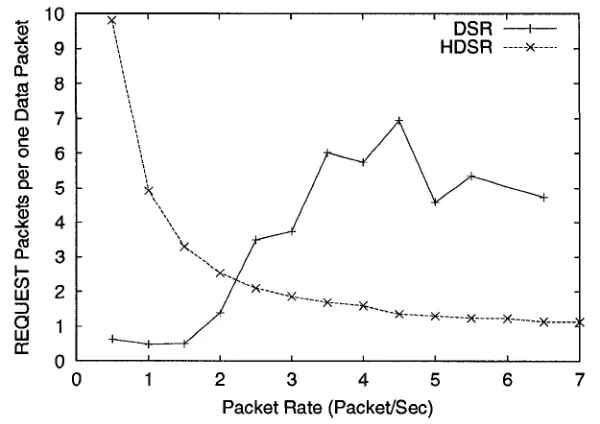
5.10 Number of RREQ Packets versus packet generation rate 64
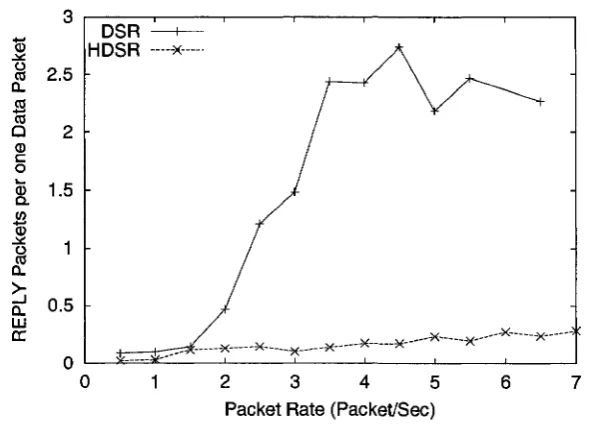
5.11 Number of RREP packets versus packet generation rate 65
5.12 Number of Error packet generated versus packet generation rate 66
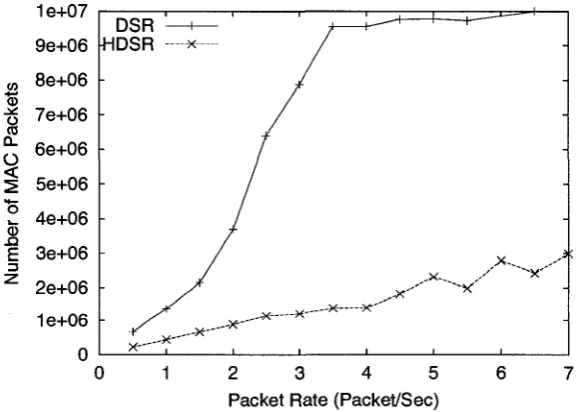
5.13 MAC load versus packet generation rate 66
5.14 Routing overhead versus number of network nodes 67
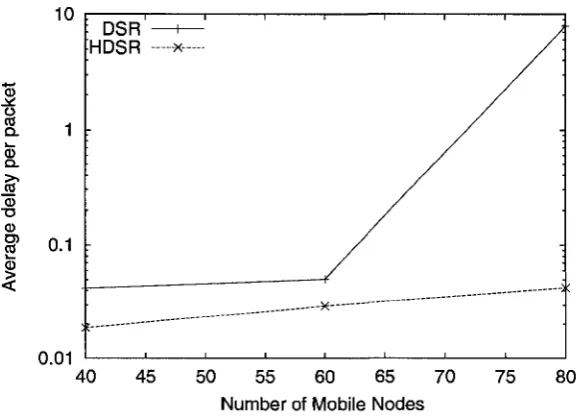
5.15 Average delay per packet versus number of network nodes 67
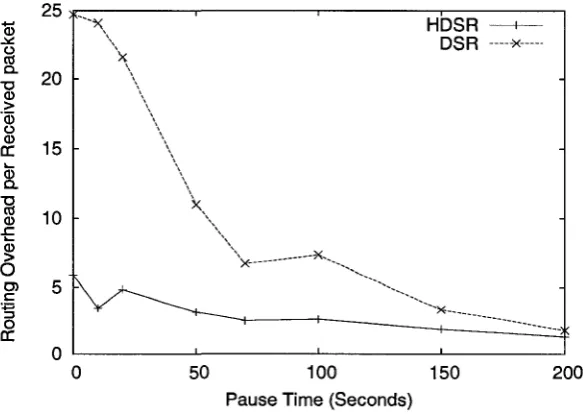
5.16 HDSR and DSR routing overhead comparison for 80 MN network 68
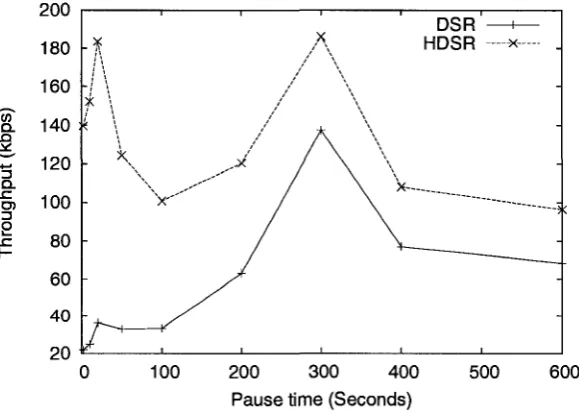
5.17 HDSR and DSR throughput comparison for 80 MN network 68
5.18 HDSR and DSR average end-to-end delay comparison for 80 MN network . 69
5.19 HDSR and DSR routing overhead comparison for 50 MN network 69
5.20 HDSR and DSR throughput comparison for 50 MN network 70
5.21 Different number of FNs for 50 MN network 70
6.1 Forwarding game played among neighboring nodes of the source node S . . 75
6.2 Symetric Forwarding Dilemma Game (FDG) matrix 78
6.3 Forwarding probability changes with node density of the network and the
6.4 Integerating NDP with AODV 81
6.5 Flowchart: Implementing the Forwarding game protocol 82
6.6 Simple topology, S and D are source and destination nodes 83
6.7 Average end-to-end delay versus network gain factor G 85
6.8 Packet delivery ratio versus network gain factor G 86
6.9 Connectivity versus number of nodes 87
6.10 Normalized overhead versus number of nodes 89
6.11 Packet delivery ratio versus number of nodes 90
6.12 Average end-to-end delay versus number of nodes 91
7.1 Utility of node i versus Si and S-i 96
7.2 Utility of node i versus S-i, K=4, m=2 and n = 3 97
7.3 Equation coefficients a 98
7.4 EQ vs. alpha 100
7.5 Strategies of the players in a two-player game 101
7.6 NASH Equilibrium 102
7.7 Integerating NDP with AODV 104
7.8 Forwarding Game Routing Protocol flowchart 105
7.9 Connectivity versus number of nodes 107
7.10 Normalized overhead versus CBR packet generation rate 110
7.11 Packet delivery ratio versus CBR packet generation rate I l l
7.12 Throughput versus CBR packet generation rate I l l
7.13 Average end-to-end delay versus CBR packet generation rate 112
7.14 Normalized overhead versus node density 113
7.15 Packet delivery ratio versus node density 113
7.16 Throughput versus node density 114
7.17 Average end-to-end delay versus node density 114
7.18 Normalized routing overhead versus maximum speed of mobile nodes . . . . 116
7.19 Packet delivery ratio versus maximum speed of mobile nodes 116
7.21 Average end-to-end delay versus maximum speed of mobile nodes 117
ACK
A O D V
A R P
B E R
CTS
C S M A
CA
CGSR
CH
C B R
C R P
C P U
D A R P A
D C A
D C F
D H C P
Acknowledgement
Ad hoc On-demand Distance Vector
Address Resolution Protocol
Bit Error Rate
Clear To Send
Carrier Sense Multiple Access
Collision Avoidance
Clusterhead Gateway Switch Routing
Cluster Head
Constant Bit Rate
Congestion adaptive Routing Protocol
Central Processing Unit
Defense Adavance Research Project Agency
Distributed Clustering Algorithm
Distributed Coordination Funcation
DIFS
D M A C
D S D V
D S R
F D G
F G R P
F N
F S R
F T P
G P S
GIS
H D S R
IEEE
IETF
I E R P
I A R P
IP
Kbps
LCC
L A N
L A N M A R
LCA
L E A R
M A C
M A N E T
DCF Inter Frame Space
Distributed Mobility Adaptive Clustering
Destination Sequence Distance Vector
Dynamic Source Routing
Forwarding Dilemma Game
Forwarding Game Routing Protocol
Forwarding Node
Fisheye State Routing
File Transfer Protocol
Global Positioning System
Geographical Information System
Hierarchical Dynamic Source Routing
Institute of Electrical and Electronic Engineers
Internet Engineering Task Force
Interzone Routing Protocol
Intrazone Routing Protocol
Internet Protocol
Kilo bits per Second
Least Cluster Change
Local Area Network
Landmark Routing Protocol
Linked Cluster Architecture
Localized Energy Aware Routing
Medium Access Control
M N
N S
N A M
OSI
OTcl
P D A
P B O A
P D A
RTS
R R E Q
R R E P
R E R R
R A R
SIFS
T C P
T B R P
U C B
U D P
V I N T
W L A N
ZRP
Mobile Node
Network Simulator
Network Animator
Open System Interface
Object Oriented Tel
Personal Digital Assistant
Progressive Back Off Algroithm
Personal Digital Assistant
Request To Send
Route Request
Route Reply
Route Error
Retransmission Aware Routing
Short Inter Frame Space
Transport Control Protocol
Topology Broadcast based on Reverse-Path Forwarding
University of California at Berkeley
User Datagram Protocol
Virtual Inter-Network Testbed
Wireless Local Area Networks
Introduction
Wireless communication has become more and more popular in recent years. Today, cellular
networks, satellite systems and wireless Local Area Networks (WLANs) are part of our daily
life. In these kinds of wireless networks, there is a fixed infrastructure that establishes and
maintains connections. There is another type of wireless network that has been under
development, called the wireless ad hoc network, that is infrastructure-less, i.e. without
a wired backbone. An ad hoc network is self-starting and self-maintaining, and can be
formed on the fly. Wireless nodes can have mobility and can join or leave the network
any time. Therefore, the network topology is changing dynamically. Ad hoc networks are
very attractive if there is no existing network infrastructure or the current infrastructure is
damaged. Some example applications are in a battle field, disaster relief, search and rescue
operations as well as sensor networks. Generally, the Mobile Ad hoc Networks (MANET)
could be a suitable solution for any application that requires a kind of temporary wireless
1.1 Applications of Ad Hoc Networks
Applications of wireless mobile ad hoc networks ranges from the military and disaster
response applications to connecting a group of computers in a classroom. Some can be
listed as following:
• Sensor Networks
Within the ad hoc networking field, wireless sensor networks assume a special role. A
sensor network is composed of a large number of small sensor nodes which are
ran-domly deployed inside an area where a phenomenon is being monitored [1] and [2].
Sensor devices are cheap to manufacture and each of them possesses identical
capabili-ties. Such devices can be located into places like volcanic eruptions, chemical hazards,
surfaces of planets, or generally where it is impossible or difficult for humans to enter.
Such networks can then form a network of their own to collect data, compute, and
acquire the desired information and relay them.
• Emergency Services
During times of emergency, when the existing infrastructure is damaged or out of
service, there will be a loss of network connectivity. Emergency workers may need
to share data with each other during their operation and they may also need some
information from the wired network. Deploying a base station is not a feasible solution,
as it may take several hours until a mobile base station can be made operational.
In such cases, ad hoc networks remain the only possible solution for the network
connectivity problems.
• Home Networking
Ad hoc networks can also be appropriate for applications in home networks where
devices can communicate directly in order to exchange information.
• Personal Communication
Personal laptops, personal digital assistants (PDA), televisions, stereos, and other
1.2 Challenges in Deploying M A N E T s
There are many unique characteristics in ad hoc networks such as mobility, bandwidth
constraint, error prone shared medium, congestion, and other resource constraints that do
not exist in other networks. These characteristics, and the shared nature of the wireless
channel, create some challenges for wireless ad hoc networks.
• Mobility
Participating nodes in a MANET can have mobility that could result in frequent route
breakages, packet collisions, transient loops, stale routing information, and difficulty
in resource reservation. An efficient routing protocol should be able to address all
issues related to node mobility.
• Scalability
When the number of nodes increases, the number of routing messages in the network
also increases. That increases the number of control messages in the network to the
point where the network can not transfer data packets.
• Energy Management
In ad hoc networks, the mobile nodes operate on battery power. A mobile node in an
ad hoc network not only generates its own traffic, but also forwards packets for other
node's of the network. Therefore, loss of battery power will affect individual node as
well as the network. When the battery of a node is exhausted, all of the routes that
have been established through that node would no longer be valid. Nodes utilize their
energy in the processing of the control messages from other nodes. That requires the
mobile node to be active most of the time in order to listen to the channel.
• Location dependent contention
The load on a wireless channel varies with the number of nodes present in a given
region. Contention for the channel becomes high when the number of nodes increases
in the given region. The high contention for the channel causes a high number of
avoid forming a high contention region in the network.
• Wireless channel reliability
Errors are higher due to the wireless medium and the multi-hop nature of the ad hoc
networks. This degrades the end-to-end throughput significantly.
• Quality of service
Because of the lack of infrastructure, ad hoc networks are not very friendly towards
applications that require stringent service requirements.
• Security
Traffic in an ad hoc network is highly vulnerable to security threats. Most network
security solutions that rely on a Centralized Authority (CA) do not exist in an ad hoc
network, which makes security in an ad hoc network a more challenging task. Shared
wireless medium exposes the network to denial of service attacks.
1.3 Problem Statement
All of the routing protocols in wireless ad hoc network utilize some sort of flooding (data
or control messages). For instance, in Ad Hoc On-Demand Distance Vector(AODV) and
Dy-namic Source Routing (DSR) protocols, Route Request (RREQ) messages are re-broadcasted
by every node. The ultimate outcome of this re-broadcasting is "flooding" of overhead
pack-ets that consumes network's bandwidth. Although some precautions, such as the "ring zero
search" mechanism in [7] and [8], have been proposed in order to limit the flooding,
flood-ing is still an issue in DSR and AODV routflood-ing protocols when the size of the network is
large. When RREQ packets are received by the neighbors of a transmitting node,
neigh-bors attempt to re-broadcast the RREQ packet in their own neighborhood soon thereafter.
Because all neighbors contend with each other to get access to the wireless medium, this
may increase number of collisions. It may also be likely that a node can receive multiple
copies of the same RREQ packet from its neighbors that do not give any new information.
consume network resources. Since flooding is a fundamental method in almost every routing
protocol for wireless ad hoc networks, a more efficient flooding algorithm could significantly
improve the performance of the routing protocol. However, reducing the number of
redun-dant flooding messages may cause disconnectivity in the network. Therefore, a delicate
balance must be maintained between routing overhead related to flooding and connectivity.
Some disadvantages of flooding are:
• Redundant re-broadcast: When a mobile node decides to re-broadcast a flooding
packet, all of its neighbors may already have received that message from other nodes.
• Contention: After receiving a flooding packet by neighbors of the originator, those
neighbors may severely contend with each other in order to get access to the medium
to re-broadcast the flooding packet.
• Collision: Collisions are more likely to occur when all neighboring nodes attempt to
re-broadcast at the same time.
Proposals to limit the "flooding" phenomenon in literature can be broadly classified as
(1) location based schemes [26], (2) cluster based schemes [27, 28, 29, 30, 31, 32, 33] and [34],
or (3) probability based schemes [35, 36, 37, 38] and [40]. Flooding in location-based
schemes is performed according to the physical location of the nodes. In order to provide
the location information, nodes are equipped with Global Positioning System (GPS). GPS
requires additional hardware and software which increase the cost. That cost increase is not
desirable for some applications such as sensor networks. In cluster-based method a group of
nodes in close proximity form a cluster. In a cluster, there are three types of nodes: (1) the
cluster-head (2) ordinary nodes, and (3) the gateway node. The cluster-head coordinates
the communications of ordinary nodes. An ordinary node that is located in the radio range
of two cluster-heads is called a gateway. Gateways pass data between clusters. Establishing
and maintaining clusters requires additional overhead packets, which consumes additional
network resources. Cluster-head and gateway nodes should dedicate all of their resources
In a probabilistic scheme, a mobile node broadcasts a flooding packet based on a
prob-ability p < 1. The simplest approach in this class is pure probabilistic flooding, in which
nodes that receive a broadcast packet retransmit that packet with probability p or discard
(drop) this packet with probability (1 — p) [39] and [36]. Through extensive simulations,
it was shown in [36] that a simple probabilistic forwarding used up to 35% fewer overhead
packets than flooding and could improve the performance of AODV even in small networks
of 150 nodes. A critical value for forwarding probability depends on the number of
neigh-bors of a node. As the number of neighneigh-bors of each node increases, the critical value of p
should decrease [37]. The major problem of probabilistic schemes is that the probability
at which a node should rebroadcast is not universal, but specific to network topology and
there is no analytical formula to obtain that probability, p. In some studies, node density,
or the number of neighbors, has been used in a function to calculate forwarding
probabil-ity [41, 42, 43] and [44]. Zhang and Dharma [45] introduced a dynamic probabilistic schemes
where every node calculates p based on the node density and the number of broadcasts of
the same flooding packet. Forwarding is performed after a random delay, which increases
the latency.
Another problem of reactive routing protocols such as DSR or AODV, is congestion.
Nodes located around the center of the network carry more traffic compared to other nodes
located around the perimeter of the network [46] making a part of the network more
con-gested. Congestion information, obtained from queues of the network interfaces, have been
used to improve ad hoc routing protocol [47] and [48]. Mobile nodes have limited battery
capacity; and battery exhaustion is one of the reasons of node failure. In some applications
replacing or re-charging the battery is not feasible. Limiting the flooding messages will help
the nodes to save energy and extends the network life. Because of the multi-hop nature of
the communication links in ad hoc networks, individual node failures may affect the
net-work performance. Energy aware routing protocols were proposed to save energy in mobile
nodes. These protocols can be classified as: (1) transmit power control [49, 50, 51, 52, 53]
and [54], (2) load distribution [55] and [56], and (3) sleep/power down [57] and [58]. In
to maintain a connected topology while saving energy. Selecting a route that minimizes the
total energy consumption is the main objective of this approach. In the load distribution
approach, network traffic is distributed among the nodes in order to increase the life of
the network nodes. In sleep/power-down approaches, nodes have the option to switch to
sleep mode in some time period to save energy. Some energy aware routing protocols incur
additional overhead packets in the network that degrade the performance [52]. Therefore,
there is always a trade off for these type of protocols between the energy saving and the
performance. Recently, it has been suggested that a fixed protocol stack like Open System
Interface (OSI) model is not suitable for ad hoc networks. An interaction among protocol
layers, called the Cross Layer, is essential to optimize the performance [59, 60, 61, 62, 63, 64]
and [65]. The authors of [63] proposed a cross layer design concept that improves network
performance significantly by using cross layer information interaction among physical, MAC
and network layers. Interaction between the physical layer and the MAC layer has been
investigated in [62] to achieve automatic transmission rate adaptation that improves
spec-tral efficiency and minimizes packet delay. In [65], the joint effect of physical and MAC
layers on power efficiency and the appropriate transmission power level was investigated.
An energy efficient scheme based on cross layer design was introduced in [61]. Authors of
[64] proposed a cross layer routing protocol. They used physical layer Signal to Interference
and Noise Ratio (SINR) and MAC layer delay in routing decisions. Choosing appropriate
routing decisions at the network layer affects the performance of the MAC layer and the
physical layer. The authors of [64] suggested that cross layer interactions among those three
layers are essential for making efficient routing decisions. We use the cross layer information
in Chapter 7 to select the forwarding nodes.
1.4 Contributions
This dissertation addresses the problem of efficient reactive routing protocol for wireless
ad hoc networks through limiting the "flooding" effect by introducing hierarchy among the
network nodes. The performance of the routing protocols for ad hoc network deteriorates
address the scalability problem in AODV and DSR routing protocols by modifying these
protocols. We first show that the severity of the flooding phenomena in reactive routing
protocols with a mathematical model and NS-2 simulations. Our mathematical model,
verified through NS-2 simulations, shows that any reactive routing protocol is sensitive to the
increase of size and number of nodes in the network. We show that reactive routing protocols
are not scalable. Also the performance of the reactive routing protocols deteriorate with
increasing traffic. The first proposed routing protocol to improve the scalability is called the
Hierarchical Dynamic Source Routing (HDSR) protocol [75]. The Dynamic Source Routing
(DSR) protocol is modified to implement the HDSR protocol. In the HDSR protocol,
network nodes are classified into Mobile Node (MN) and Forwarding Node (FN). MN can
only be the source or the destination. FN participates in the packet forwarding operation.
Because only forwarding nodes (FN) participate in the route discovery phase of the protocol,
a large number of overhead packets are eliminated. That is why there are less contention
and collisions caused by overhead packets generated during the route discovery process.
Therefore, network resources such as bandwidth and battery power are used more efficiently
in HDSR protocol compared to DSR protocol. That enables better utilization of shared
wireless medium, hence transmission of more data packets instead of overhead packets.
After receiving request packet from a source node, a few of the neighboring nodes, of the
source, which are FNs, re-broadcast the request message, which reduces the chance of packet
collision and reduce network overhead. FNs are randomly distributed and pre-selected
in the HDSR protocol, which is the case for heterogeneous networks. We utilize game
theory as a decision making tool in dynamically selecting FNs based on the desired network
performance. FDG and FGRP are the proposed game theoretic hierarchical protocols. A
Neighbor Discovery Protocol (NDP) is proposed to determine the number of neighbors
for each node without additional overhead. Game theory is used in forwarding decisions.
Forwarding Dilemma Game (FDG) is a simple protocol that uses proposed NDP to identify
the number of players of the forwarding game. The outcome of the forwarding game is the
forwarding probability that the node would use to forward the flooding packet.
availability parameter inside the utility function of the nodes. Here the proposed NDP is
also utilized with some modifications. In FGRP, the strategy of the players of the forwarding
game is their forwarding probability. The strategy selected by other neighbors (players) is
also included in the FGRP utility function. Availability parameter makes FGRP model
flexible to different applications. In FDG model, the forwarding probability is dictated
only by the number of players of the game (node density). While in FGRP, the strategy
(forwarding probability) is selected based on node's availability, other nodes participation
and node density.
At a glance, the proposed HDSR, FDG and FGRP protocols have the following unique
advantages compared to other 'flood' minimizing protocols:
• No additional hardware (i.e., GPS) is required.
• No additional control message is required. Existing control messages such as RREQ
packet has been used.
• Proposed protocols work on-demand.
• Routing overhead is reduced. Therefore, network resources such as energy and
band-width are saved.
FDG can be integrated with any routing protocol that implements "flooding". In addition
to the above advantages, FDG has also the following improvement:
• FDG is aware of node density by utilizing NDP.
• FDG protocol performs well in low and high node densities.
• Connectivity of the nodes is not compromised by limiting the flooding.
FGRP brings addition improvement by utilizing the cross layer information:
• FGRP is aware of node density by utilizing NDP.
• Connectivity of nodes is not compromised by limiting the flooding.
• Cross layer information such as congestion, residual battery level can be utilized to
implement FGRP protocol to tailor the system for desired performance.
• The FGRP protocol ensures energy consumption distribution among nodes in the
network.
• The FGRP protocol uses node energy efficiently. Hence network life is maximized.
1.5 Thesis Organization
In this dissertation, we propose algorithms that limit the packet flooding in ad hoc network.
An overview of the ad hoc networks and routing protocols is provided in Chapter 2. Since
game theory will be utilized, an introduction to game theory is provided in Chapter 2 as
well. Limiting the flooding packets can cause network disconnectivity and isolated nodes.
That is why we first investigate connectivity conditions in Chapter 3 through extensive
NS-2 simulations. In Chapter 3, we show that the probability that every node has at
least one neighbor, namely local connectivity, is a fairly good approximation for the global
connectivity. The result of Chapter 3 can be used by ad hoc network protocol designers in
hierarchical protocols like the one proposed in Chapter 5.
A method for quantizing the overhead packets in an ad hoc network with reactive routing
protocol is presented in Chapter 4. The result of Chapter 4 is helpful to validate the
computer simulations. The results of the proposed model are compared with those of the
NS-2 simulations; and they match quite well.
The HDSR protocol is introduced in Chapter 5. The advantages and disadvantages of
HDSR protocol are explained in detail. A comparative performance analysis between the
DSR protocol and the HDSR protocol is presented in Chapter 5. The forwarding node
selection in HDSR is random.
The decision to forward a flooding packet, based on the outcome of the FDG game, is
To limit the number of flooding packets, probability of selected strategy is calculated based
on the mixed strategy Nash equilibrium of the game. A novel Neighbor Discovery Protocol
(NDP) presented in Chapter 6 provides the number of players of the FDG game. We will
show in Chapter 6 that FDG applied to AODV improves the scalability performance of the
AODV routing protocol.
A dynamic probabilistic forwarding protocol for wireless ad hoc networks based on game
theory will be presented in Chapter 7. In FGRP, wireless nodes of the ad hoc network are
the players of the game and the forwarding probability of the nodes is the strategy of the
players. Each node has a utility that is a function of its strategy and its availability to
forward packets for other nodes. Parameters such as energy, congestion and the distance
from the source of the received packet can be included in a node availability parameter.
A node enters the forwarding game upon receipt of a flooding packet. In Chapter 7 we
show that utilizing FGRP improves the performance of AODV. The performance figures
will be measured by varying three network parameters: scalability (node density), packet
generation of source nodes, and mobility of nodes.
Chapter 8 will provide a summary of this work. Some future research directions is also
Background
2.1 Routing Protocols for Ad Hoc Networks
The main purpose of a routing protocol is to create and maintain a routing table that
contains information on how to reach a certain destination in the network. Nodes use
this information to forward packets that they receive to other nodes. Routing is not a
new issue in computer networking. Routing protocols such as distance vector routing (e.g.
Routing Information Protocol; RIP [3] and [4]) and link-state routing (e.g. Open Shortest
Path First protocol; OSPF [5]) have existed for a long time and are broadly used in wired
networks. These routing protocols are not suitable to be used in mobile ad hoc networks for
the following reasons: First, they were designed with a quasi-static topology assumption.
In ad hoc networks, mobile nodes can join and leave the network at any time. Nodes are
battery operated and may run out of power at any time. Therefore, the network topology
changes frequently and those routing protocols may not reach a steady state and be able to
construct routing tables. Second, those routing protocols were designed for wired networks
with bidirectional links that may not be always the case in mobile ad hoc networks. Other
than wireless channel, different radio range of wireless nodes could be the root cause of
destinations in the network, and that is not feasible in typical mobile ad hoc networks with
large numbers of nodes, such as a large wireless sensor network. In MANETs, because of the
shared wireless medium, broadcasting the routing information periodically would occupy
bandwidth and reduce network throughput. Therefore, special routing protocols are needed
for MANETs.
Since wireless nodes perform routing for other nodes of the network, the dynamic
topol-ogy of the ad hoc network causes frequent route breakage. The shared wireless medium,
high packet loss, inherent unreliability and high interference and noise contribute in the
degraded performance of the routing protocol in MANETs. Nodes that are located in
each other's radio range can not transmit at the same time because of the shared wireless
medium and this limits the bandwidth and increases delay. Routing protocols provide
self-organizing and self-configuring properties of the ad hoc network. That makes routing one
of the most important elements of ad hoc networks. Specifications for many existing ad
hoc routing protocols have been developed and prepared by the Internet Engineering Task
Force (IETF) MANET working group [6]. That group has published drafts for the following
ad hoc routing protocols:
• AODV (Ad hoc On-demand Distance Vector) [7]
• DSR (Dynamic Source Routing) [8]
• ZRP (Zone Routing Protocol) [9]
• OLSR (Optimized Link State Routing) [10]
• LANMAR (Landmark Routing Protocol) [11]
• FSR (Fisheye State Routing) [12]
• IERP (Interzone Routing Protocol) [13]
• IARP (Intrazone Routing Protocol) [14]
In literature, MANETs routing protocols are usually classified by the approach they use for
acquiring and maintaining routes. Two main approaches used today are:
1. Proactive (table-driven) routing:
In this approach, routing protocol tries to keep a routing table with routes of the
nodes in the network. Network topology changes are propagated in the entire
net-work to ensure that all nodes update their routing tables. In proactive routing
pro-tocols, like Destination Sequence Distance Vector (DSDV) [16], routing information
is periodically exchanged among the wireless nodes and a node would have a route
to any destination in the network. DSDV routing protocol is based on the classic
Bellman-Ford routing algorithm [17]. In DSDV, while network resources have been
spent (i.e. used) to acquire routes, some of the routes may not be used for the life
of the network. Exchanging routing information periodically generates huge number
of overhead packets in the network, which makes the proactive routing protocols not
suitable for MANETs especially in high mobility scenarios. The advantage of this
approach is that routes are available all the time and there would not be any route
discovery delay.
2. Reactive (on-demand) routing:
A route to a certain destination is acquired via a route discovery process when it is
needed. When the route is found, it is maintained by a route maintenance process
until it has been determined that the route is no longer needed. The advantage of
this approach is the saving of network resources, as the periodic exchange of routing
information is no longer necessary. The disadvantage is that the route discovery
process could take some time, and this adds to the packet delay. For some applications,
this may not be acceptable. There are also hybrid approaches that combine both the
proactive and the reactive routing protocols together.
In this section, a brief overview of two popular routing protocols, AODV and DSR, is
2.1.1 A d hoc On-demand Distance Vector (AODV)
Ad hoc On-demand Distance Vector (AODV) [7] is one of the most popular routing
pro-tocols for ad hoc networks. AODV performs very well both during high mobility and high
network traffic load, making it one of the most interesting candidates among the existing
ad hoc routing protocols. AODV offers low overhead and quick adaptation to dynamic link
conditions ([21] and [22]). Different AODV implementations, such as AODV-UU [23], have
been developed. Three different types of message control packets are defined in AODV:
1. Route Request (RREQ)
2. Route Reply (RREP)
3. Route Error (RERR)
AODV is a reactive protocol where routes to destinations are acquired in an on-demand
fashion. When a node needs a route to a destination, it broadcasts a RREQ packet. The
RREQ packet is propagated throughout the network and every node that receives it sets
up a reverse path, i.e., a route towards the requesting node. When the RREQ packet is
received by the destination or a node with a (fresh) route, a RREP packet is sent back to the
originator of the RREQ packet. The intermediate nodes utilize the reverse route that has
been generated in the RREQ for forwarding RREP messages. If the route is provided by the
intermediate nodes, the destination node never learns about a route back to the source node
and does not have a route if it needs to communicate with the source node (e.g. to reply
to a TCP connection request). To address this issue, the originator of a RREQ packet can
set a gratuitous RREP flag in the RREQ packet to notify the intermediate nodes to send
a gratuitous RREP to the destination node if they have a route. This way, the destination
node learns the route to the source node. Routing table entries maintained by AODV nodes
contain the following fields [7]:
• Destination IP Address
• Valid Destination Sequence Number
• Interface
• Hop Count (number of hops required to reach the destination)
• Next Hop
• List of Precursors (described below)
• Lifetime (expiration or deletion time of the route)
• Routing Flags
• State (valid or invalid)
For route maintenance, every node monitors the status of the link to the next hop. This can
be done by monitoring periodic HELLO messages (beacons) from other nodes or link layer
notifications such as those provided by IEEE 802.11 [24]. A list of unreachable destinations
is sent via a RERR packet to the neighboring nodes when a link failure is detected. Routes
are only kept as long as they are needed. If a route is not used for a certain period of time,
its corresponding entry in the routing table is deleted.
2.1.2 Dynamic Source Routing (DSR) protocol
The Dynamic Source Routing (DSR) [8] protocol is another reactive routing protocol that
is based on source routing. Source routing means that every packet contains the route
through which it should pass to reach its destination. This route is embedded in the header
of the packet. There are two main mechanisms in DSR: (1) route discovery and (2) route
maintenance. These mechanisms have been designed based on the following assumptions.
• Nodes of the network are willing to participate in network operation.
• Mobile nodes may move at any time in any direction without notice. It is assumed
that the node's speed is moderate with respect to transmission latency and wireless
• The network card of a mobile node can operate in 'promiscuous receive' mode. This
mode causes the hardware to deliver every received packet to the network driver
software without filtering based on link-layer destination address.
• Wireless links are bidirectional. It is assumed that Medium Access Control (MAC)
layer utilizes a mechanism like four-way handshaking. The four-way hand shaking
involves exchanges of Request to Send (RTS), Clear to Send (CTS), Data and
Ac-knowledgment (ACK) packets between a transmitting and receiving mobile nodes.
If a node, called source, wishes to send some packets to another node, called destination,
it first searches its route cache for a route to that destination. A route discovery mechanism
to find a route to the destination is initiated if a route does not exist in the cache. In route
discovery, the node transmits a route request (RREQ) packet that is received by other nodes
that are located in its wireless transmission range. Each route request contains addresses
of source and destination nodes, and a unique identification number (request ID). Each
node that receives the RREQ appends its address to the header of the RREQ and
re-broadcasts the RREQ if it is not the destination. If the receiving node is the destination
of the RREQ, it sends a route reply packet (RREP) to the source node after copying the
accumulated routing information located in the header of the RREQ to the header of the
RREP. When the source node receives the RREP packet, it records the new route into
its cache and utilizes that route to send data packets. Intermediate nodes that receive
the RREQ more than once and have already forwarded would ignore subsequent RREQ's.
Source and destination addresses and request ID help to identify a duplicate RREQ.
Network topology changes are detected by the route maintenance mechanism. If an
intermediate node on the route detects a broken link, it initiates the route maintenance
mechanism and sends messages to the source and other nodes that are on this route.
Ac-knowledgment messages can be used to provide assurance about the link existence. MAC
protocol acknowledgment messages can be utilized for this purpose. For instance, in the
IEEE 802.11 Wireless LAN MAC layer [25], acknowledgments are provided for every packet
(data or control). If a node does not receive any acknowledgment after sending a packet
"invalid". A route error RERR packet is broadcasted when a node discovers a broken link.
Nodes that receive the RERR packet, update their route caches. When a RERR packet is
received by the source node, a route discovery mechanism is initiated by the source node if
there is no alternative route in the cache for that certain destination.
2.2 Network Simulator (NS-2)
Network Simulator (NS-2), an open source discrete event simulator, was developed at the
University of California, Berkeley. NS-2 originated from Real Network Simulator [70] and
was developed at Cornell University, Ithica, New York in 1989. Network Simulator evolved
while it was supported by Defense Advanced Research Project Agency (DARPA) through
the Virtual InterNetwork Testbed (VINT) project at Lawrence Berkeley National
Labora-tory (LBNL) in Berkeley, Xerox Palo Alto Research Center (PARC), University of California
at Berkeley (UCB), and Information Science Institute (ISI) of the University of Southern
California (USC). NS-2 includes contributions from researchers working at UCB, Monarch
projects of Carnegie Mellon University (CMU) and Sun Microsystems. NS-2 is an
appro-priate tool to simulate and test the performances of network protocols. The simulator takes
a network scenario as input, which consists of network topology, protocols, workload and
control parameters. It produces performance results such as throughput, queuing delay
and number of dropped packets. NS-2 can simulate Transport Control Protocol (TCP)
and User Datagram Protocol (UDP), traffic source behavior such as File Transfer Protocol
(FTP), Telnet, Web, Constant Bit Rate (CBR), router queue management mechanism such
as Drop Tail, routing algorithms such as Dynamic Source Routing (DSR) protocol, Ad hoc
On-demand Distance Vector (AODV), Destination Sequence Distance Vector (DSDV) and
MAC protocol such as IEEE 802.11. Because NS-2 is open source, it provides the researcher
the flexibility to modify the implemented protocols. This makes NS-2 a very powerful tool
for research and development.
NS-2 code is written in C + + and Object Oriented Tel (OTcl). OTCL is based on
Tel script language with object oriented extensions developed at MIT. Figure 2.1 shows
Tel Interpreter
Event Scheduler Objects „ , _ . , Network Component Objects
rcl Script — * > F J
Network setup Module Simulation
Program
Figure 2.1: NS-2 model
component object libraries, and network setup libraries. The NS-2 users write programs
in Tel script to setup and run network simulations. Every packet generated in NS-2 has a
unique identification (id). The record of every packet is stored in a trace file. Trace files
contain information like time packet generation time, source ID, and packet arrival time
at the destination. Network Animator (NAM) is an additional tool to NS-2 that depicts
network activities graphically. Packet dropping, node movement, energy levels and other
network parameters can be viewed in NAM.
The Monarch project of Carnegie Mellon University extended NS-2 to simulate wireless
networks. The extended version of NS-2 provides new elements at the physical, link and
routing layers to simulate wireless networks. An overview of a wireless network proposed by
the Monarch project is depicted in Figure 2.2. Mobile nodes are independent of each other
and a network interface connected to the common channel, is provided. Wireless channel
carries packets between different mobile nodes. When a packet is transmitted, it reaches
all nodes that have network interfaces connected to the same channel. A predefined power
level is utilized in transmitting packets. The other mobile nodes receive that packet at a
certain power level which is determined by radio propagation model. A packet received at a
power level greater than a threshold value is acceptable. If the received power of the packet
is smaller than the threshold value, the packet is lost.
The architecture of a mobile node in the NS-2 is shown in Figure 2.3. Network interface
records the interface properties of the packet and invokes the propagation model upon
Simulation Results
/
Mobile Node
Mobile Node
Mobile Node
Mobile Node
Channel
Figure 2.2: Mobile node model in the NS-2
receiving a packet from the channel. Interface properties and propagation model determine
whether that mobile node can receive the packet successfully or not. A successfully received
packet by the network interface is sent to the MAC layer. If the MAC layer verifies that
the received packet is error free and collision free, the packet is then sent to the node's
entry point. If the receiving mobile node is the final destination of the packet, the address
multiplexer gives the packet to the port demultiplexer and the port demultiplexer hands
it over to the sink. If the receiving mobile node is not the final destination, the address
multiplexer will hand over the packet to the default port. The routing agent determines the
next hop address that the packet should be forwarded to and sends the packet back down
to the logical link layer. Once the hardware address is available, the packet is put into the
interface queue. Then the MAC layer takes the packet from the interface queue and sends
it to the network interface.
2.3 Simulation Model
In order to evaluate the performance of routing protocols proposed in this dissertation,
NS-2 [71] simulations were performed. In all simulations, the effective transmission range of the
wireless radio was 250 meters and MAC protocol was IEEE 802.11 with 2 megabits per
sec-ond channel capacity. IEEE 802.11 MAC was in distributed coordination function (DCF)
mode and used Request-To-Send (RTS) and Clear-To-Send (CTS) control packets [25] for
unicast data transmission to neighboring nodes. The RTS/CTS exchanges precede the data
MobileNode
Propagation and antenna models
d
Classifier: ForwardingAgent: Protocol Entity
Node Entry
LL: Link layer object
IFQ: Interface queue
MAC : MAC: Mac object
PHY: Net interface
prop/am | Radio propagation/ i antenna models
Figure 2.3: Portrait of mobile node in the NS-2
to reduce the impact of the hidden terminal problem. Data packet transmission is followed
by an acknowledgment (ACK). In all of our simulations, two ray ground propagation model
was utilized. In the simulation set ups, unless specified, wireless nodes are distributed
ran-domly over a flat area according to the uniform distribution. To compare the performance
of the proposed protocol, the following performance metrics were considered:
• Throughput
Throughput is measured as the number of bits of the successful received data packets
at the destinations and reported values are the average throughput for the duration
of the simulation time.
• Average end-to-end delay per packet
The end-to-end delay (in seconds) for successfully received packets.
• Packet delivery ratio
generated packets by the CBR sources.
• Normalized routing overhead
The number of routing packets per one data packet that is successfully received at
the destination.
2.4 Introduction to Game Theory
Application of game theory in ad hoc networks will be introduced in Chapter 6 and
Chap-ter 7. In this section I briefly introduce elements of game theory. Game theory is a part
of applied mathematics that describes and studies interactive and multi-person decision
making problems. Decision makers follow certain well defined objectives and consider their
knowledge or expectations of other decision makers. Many applications of game theory are
related to economics. Game theory has been applied to numerous fields such as law
enforce-ment, business manageenforce-ment, power and stability in politics, models for bargaining, voting
procedure, evolutionary biology and models of peace and war [76]. The field of game theory
dates back to the early days of World War II, when British naval forces playing cat and
mouse with German submarines needed to understand the game better so that they could
win more often. They discovered that the right moves were not the ones pilots and sea
cap-tains were making intuitively. By applying concepts later known as game theory, the British
improved their hit rate enormously. Their success against submarines led them to apply
game theory to many other war activities. Thus, game theory was proven in practical life
and death situations before it was actually laid out on paper as a systematic theory. Game
theory can be used either to analyze an existing system, or as a tool when designing a new
system. Existing systems can be modeled as games. The models can be used to study the
properties of the systems. For example, it is possible to analyze the effect of different kinds
of users on the system. Another approach is implementation theory, which is used when
designing a new system. Instead of fixing a game and analyzing its outcome, the desired
outcome is fixed and a game ending in that outcome is looked for. When a suitable game is
has also been utilized in decision making [80] and [81]. There is a clear distinction between
a game that involves multiple decision makers and an optimization problem, which involves
only a single decision maker. A shopper at a grocery store performs optimization by trying
to maximize satisfaction (utility) with the purchased items. One store may enter a pricing
game with other stores to determine the prices for the items [82].
2.4.1 Classifying Games
There are three classes of games: games of skill; games of chance; and strategic games [80].
Games of skills are one-player games. Optimization problems are categorized in that class.
The single player has complete control of the outcome of the game. Games of chance are
one-player games against nature that is a second player. The player does not completely
control the outcomes of the game and strategy selections do not lead to a certain outcome.
Those type of games are usually involve risk and uncertainty. Strategic games are games
with two or more players, not including nature. Each player has partial control over the
outcome of the game. Strategic games are subdivided into two-player and multi-player
games.
2.4.2 Strategic Game
A game has three elements:
1. A finite set of players n > 2.
2. The pure strategy space S{ for each player i
3. Utility (pay off) function, m, for every player. The utility function Ui depends on i's
strategy and strategies selected by other players.
The players other than some given player i are referred as "player i's opponents". They are
2.4.3 G e n e r a l T e r m s a n d D e f i n i t i o n
When players of the game try to increase and maximize their payoff they are called rational
players. In cases where the players are computers and machines, the rationality assumption
always holds. If players have knowledge about each other's moves the game has perfect
information. Games in which players make simultaneous moves (i.e. choose their strategies at the same time) are called static games and have always imperfect information. If strategy
is played in a certain order, the game is referred to as dynamic or extensive form game.
If the player's interest coincide, the game is called a cooperative game. Strategic games
where the players's interests are in conflict with each other are called zero-sum games. In
zero-sum games, the sum of the payoff of the players is constant or equal to zero. In a zero-sum game, a player can not increase his or her utility without hurting other players.
2.4.4 N a s h E q u i l i b r i u m
Nash Equilibrium is the most commonly used solution concept in game theory. Here we use
the notation and definition provided in [77] and [78].
Definition:
In the n-player game G — {S\, S2, • • •, Sn; u\, U2, • • •, un}, the strategies (S^, Svj," • • > ^n) are
a Nash equilibrium if, for each player i, S* is player i's best response to the strategies
specified for the n — 1 other players, (S*, • • •, S*_lt S*+1, • • •, <S£): Any choice of strategies
for all players is said to be a Nash equilibrium, if no player has an incentive to deviate from
that strategy in order to improve its utility. In other words, the utility of the players will
not increase if they select a non-equilibrium strategy.
ui{Si, • • • ,Si_i,Si ,Si+i, • • • ,Sn) > Ui(Si, • • • ,Si_i,Si,Si+i, • • • ,Sn) (2-1)
The strategy that provides a higher utility regardless of other players action, is called
dominant strategy. When players have no dominant strategy, playing a mixed strategy may be considered, where each of the various pure strategies is played with some probability. In
2.5 Summary
In this chapter, Mobile Ad hoc Network (MANET) is described. It is shown how MANET
differs from a traditional wired network, and why a good routing protocol is important for
MANET. The operations of proactive and reactive routing protocols have been explained.
"Flooding" problem of reactive routing protocol has been denned and explained. An
intro-duction to game theory was also provided. We will use game theory in Chapter 6 and 7 to