INVESTIGATION
Dissecting Protein Function: An Ef
fi
cient Protocol
for Identifying Separation-of-Function Mutations
That Encode Structurally Stable Proteins
Johnathan W. Lubin,*,1Timsi Rao,†,1Edward K. Mandell,2Deborah S. Wuttke,†and Victoria Lundblad*,3
*Salk Institute for Biological Studies, La Jolla, California 92037-1099, and†Department of Chemistry and Biochemistry, University of Colorado, Boulder, Colorado 80309-0125
ABSTRACT Mutations that confer the loss of a single biochemical property (separation-of-function mutations) can often uncover a previously unknown role for a protein in a particular biological process. However, most mutations are identified based on loss-of-function phenotypes, which cannot differentiate between separation-of-loss-of-function allelesvs.mutations that encode unstable/unfolded proteins. An alternative approach is to use overexpression dominant-negative (ODN) phenotypes to identify mutant proteins that disrupt function in an otherwise wild-type strain when overexpressed. This is based on the assumption that such mutant proteins retain an overall structure that is comparable to that of the wild-type protein and are able to compete with the endogenous protein (Herskowitz 1987). To test this, thein vivo phenotypes of mutations in the Est3 telomerase subunit fromSaccharomyces cerevisiae
were compared with thein vitrosecondary structure of these mutant proteins as analyzed by circular-dichroism spectroscopy, which demonstrates that ODN is a more sensitive assessment of protein stability than the commonly used method of monitoring protein levels from extracts. Reverse mutagenesis ofEST3, which targeted different categories of amino acids, also showed that mutating highly conserved charged residues to the oppositely charged amino acid had an increased likelihood of generating a severely defectiveest32
mutation, which nevertheless encoded a structurally stable protein. These results suggest that charge-swap mutagenesis directed at a limited subset of highly conserved charged residues, combined with ODN screening to eliminate partially unfolded proteins, may provide a widely applicable and efficient strategy for generating separation-of-function mutations.
A
fundamental tool forin vivoanalysis of biological path-ways employs gene inactivation. Prior to the availabil-ity of genome-wide resources, mutations in individual genes were commonly recovered from forward mutagenesis screens. Although labor-intensive, such approaches had the benefit of recovering rare novel alleles that conferred the loss of a single biochemical property. More recently, with the completion of the genome sequence of Saccharomyces cerevisiae, high-throughput methods have been used to generate a collection of mutant strains that inactivate gene products either through deletion of nonessential genes or conditional depletion ofessential genes (Winzeleret al.1999; Ben-Aroyaet al.2008; Yanet al.2008; Liet al.2011). The availability of these ge-nome-wide reagents has permitted the analysis of genetic net-works on a large scale, with the resulting information used to place genes in pathways, identify points of intersection between different pathways, and assign gene function to novel ORFs (Tong et al. 2001; Dixon et al. 2009; Chuang et al. 2010). However, an inherent caveat of these studies stems from the nature of the genetic reagents. Many proteins have more than one biochemical activity [for example, more than one interac-tion with other proteins (Venkatesan et al.2009)], and thus complete inactivation of gene function is potentially pleiotropic (Costanzoet al.2010); an additional source of pleiotropy is the aneuploidy that has been observed in a subset of yeast deletion strains (Hughes et al.2000). Furthermore, conditional deple-tion of essential genes through the use of temperature-sensitive alleles or degrons requires a temperature shift (Hartwellet al. 1970; Dohmenet al.1994), which can itself confer a phenotype even in the wild-type situation (Paschiniet al.2012).
Copyright © 2013 by the Genetics Society of America doi: 10.1534/genetics.112.147801
Manuscript received September 24, 2012; accepted for publication December 18, 2012 Supporting information is available online athttp://www.genetics.org/lookup/suppl/ doi:10.1534/genetics.112.147801/-/DC1.
1These authors contributed equally to this work.
2Present address: Department of Cellular and Molecular Medicine, University of Arizona, Tucson, AZ 85724.
A potential solution is to employ missense mutations, referred to as separation-of-function (sof2) alleles, which sur-gically eliminate a single biochemical function while leaving other activities (and presumably the structural integrity of the protein) intact. The advantages of this particular class of mutations in elucidating biological pathways, particularly in essential genes, can be substantial (Zhou and Elledge 1992; Nugentet al.1996; Umezuet al.1998). However, recovery of sof2alleles has been a logistic hurdle even for single genes, as such mutations are most often recovered from genetic screens that employ loss-of-function phenotypes, followed by careful analysis to ensure that only one function has been impaired (for examples, see Rudgeet al.2001; Laurençonet al.2003; Bertuch and Lundblad 2003; Mu et al. 2008). As a conse-quence, the amount of experimental effort necessary to iden-tify and characterize sof2mutations has been a substantial barrier to recovering such mutations on a large scale. The obstacles stem from two technical hurdles. Thefirst challenge is identifying the rare mutations that alter a specific bio-chemical property of a protein among the much larger set of hypomorphic mutations that alter nonspecific properties (such as protein stability/folding). A second hurdle is the presumption that a large number of mutations must be screened, since very few amino acids are likely to yield a sep-aration-of-function phenotype when mutated. If candidate mutations are generated by reverse genetics, the problem is further confounded by the decision of which amino acid substitution(s) would be most likely to result insof2defects. Toward the goal of developing a widely applicable protocol for generating sof2 alleles, we examined several approaches that might alleviate the two obstacles described above. Our experimental system was theEST3gene, which encodes a small (181 amino acid) subunit of yeast telomerase with two distinct categories ofsof2alleles and loss-of-function (LOF) as well as overexpression dominant-negative (ODN) phenotypes that can be easily monitored (Hughes et al. 2000; Lee et al. 2008, 2010). Est3 can also be expressed as a soluble structurally stable protein inEscherichia coli(Leeet al.2010), thereby pro-viding an opportunity to assess the secondary structure of mu-tant and wild-type proteins by circular dichroism (CD). In this study, examination of the properties of a large panel of mutant Est3 proteins revealed a striking correlation between in vivo ODN phenotypes andin vitroprotein stability, resulting in the conclusion that ODN assays can provide a facile means of identifying mutant proteins that are structurally intact. We also used a systematic set of mutations introduced into 20% of the amino acids in the Est3 protein to assess the phenotypic consequences of mutating different categories of amino acids to alaninevs.a residue with a high potential to disrupt protein folding. Alanine mutagenesis has been the default option for reverse mutagenesis (Cunningham and Wells 1989; Baase et al.1992; Wertmanet al.1992) on the assumption that such a substitution should have a minimal effect on protein struc-ture (Dao-Pinet al.1991; Limet al.1992). We show instead that introduction of a residue that is potentially disruptive to protein structure is in fact more useful in distinguishing
between mutant proteins that are unfolded (and thus do not have a ODN phenotype) vs. proteins that have a defect in a specific activity (with a strong ODN phenotype). Based on our analysis of several different categories of mutations, we propose that charge-swap mutagenesis directed at highly con-served charged amino acids, combined with an assessment of ODN phenotypes to eliminate unstable proteins, is an effective strategy for identifyingsof2alleles in proteins.
Materials and Methods
Yeast strains and plasmids
All genetic analyses were performed in two isogenic strains, YVL2967 (MATa ura3-52 lys2-801 trp1-Δ1his3-Δ200
leu2-Δ1) or YVL3057 (MATa est3-Δ ura3-52 lys2-801 trp1-Δ1 his3-Δ200leu2-Δ1/pEST3 CEN URA3). Missense mutations in EST3 were introduced into either pVL1024 (2m LEU2 ADH-EST3) or pVL2537 (CEN LEU2 EST3); a complete list of the yeast plasmids used in this study is shown in Support-ing Information,Table S1. Standard genetic methods were used to introduce plasmids into yeast, and telomere length was assayed as described previously (Lendvay et al.1996; Paschini et al.2010).
Expression and purification of wild-type and mutant Est3 proteins
His10-SUMO-Est3 proteins cloned in the pET-His-Smt3 vec-tor (Mossessova and Lima 2000) were grown inE. coliBL21 (DE3) to OD6001.0 and cold-shocked on ice for1 hr, and 1.0 mM IPTG was added to induce protein expression. Cells were allowed to grow post induction for 24 hr at 15, har-vested, and resuspended in lysis buffer A [100 mM KH2PO4/ K3PO4, pH 7.5, 100 mM Na2SO4, 10% glycerol, 10 mM imidazole, and 3 mM b-mercaptoethanol (b-ME)] with an EDTA-free protease inhibitor cocktail tablet (Roche) and PMSF, as recommended by the manufacturer, followed by lysis by sonication and cell debris separation by centrifu-gation at 25,000 · g for 20 min. The soluble cell lysate (supernatant) was decanted, and the pelleted cell debris was resuspended with lysis buffer to the same volume as the supernatant. Aliquots of the pellet and supernatant fractions were resolved on a 13% SDS-PAGE gel, and sol-ubility was assessed by Western blot analysis against the His tag to compare the His10-SUMO-Est3 bands from the two fractions (Figure S1).
100 mM Na2SO4, 5% glycerol, and 3 mMb-ME). The contam-inating 14-kDa His10-SUMO tag was separated from the 20.6-kDa Est3 protein by a second round of Ni2+-affinity chromatography in buffer B containing 20 mM imidazole. Est3 eluted at.95% purity, as assessed on Coomassie-stained gels (Figure S1), and was concentrated and buffer-exchanged to 50 mM potassium phosphate buffer (pH 7.4) using a 9000 MWCO protein concentrator (Pierce). Concentrations were obtained using an extinction coefficient of 15,930 M21cm21. CD spectra and melting curves: acquisition and analysis
All CD experiments were carried out in a 0.05-cm cuvette using a Chirascan-plus spectropolarimeter (Applied Photo-physics) equipped with a Quantum Mechanics Peltier temper-ature controller. CD spectra were obtained in 50 mM potassium phosphate buffer (pH 7.4). Buffer baselines were acquired using the flow-through buffer from the protein concentrator for each mutant. CD spectra of wild-type and mutant Est3 proteins (10 mM) were collected from 180 to 300 nm in 1-nm increments over a temperature range of 5– 75with steps of 10and equilibration times of 3 min per step. A subsequent experiment, with the same wavelength range and equilibration time, collected data points between 30 and 50with steps of 2for better estimation of the melting transition. Data acquisition and initial processing such as base-line subtraction and curve smoothing were performed using ProData Viewer (Applied Photophysics) with further process-ing in Microsoft Excel. The midpoint temperatures of the ther-mal denaturation curves at 208 and 222 nm were determined from fits to the Boltzmann sigmoid equation using Prism GraphPad software.
Results
An in vivo dominant-negative effect on telomere replication correlates with in vitro stability of mutant Est3 proteins
We previously proposed that the overall structure of mutant Est3 proteins should be largely intact for those proteins that are capable of disrupting telomere replication when over-expressed in a wild-type strain (i.e., ODN), whereas the in-ability to confer an ODN phenotype would indicate an improperly folded protein (Lee et al. 2008). To test this as-sumption directly, we assessed thein vitroproperties of muta-tions in four amino acids of the Est3 protein: est3-W21A, est3-D86A,est3-R110A, andest3-V168E. As shown previously, strains expressing these four alleles exhibit severe LOF pheno-types, comparable to that of anest3-Δnull strain (Leeet al. 2008). Two of these mutations (est3-R110Aandest3-V168E) also represent distinct categories ofsof2alleles: V168 is part of a group of residues that provide a binding site on Est3 for interaction with telomerase whereas R110A defines a separate activity that is not required for either association with telomer-ase or enzyme activity (Lee et al. 2008, 2010). Despite com-parable LOF phenotypes, these four mutations show striking differences with regard to their ODN phenotypes. Overexpression
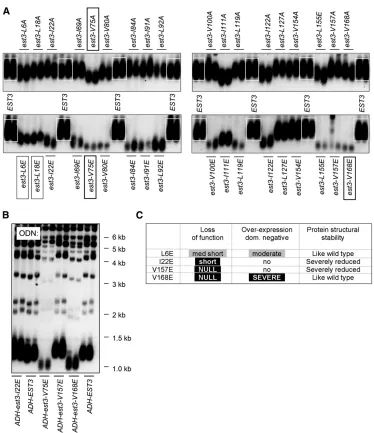
of either Est3-R110A or Est3-V168E conferred a substantial telomere length decline in a wild-type strain (i.e., in the presence of the wild-type Est3 protein expressed from its native genomic locus), whereas overexpression of the Est3-W21A or Est3-D86A proteins had no impact (Leeet al.2008 and Figure 1A; see also below).
To examine whether this differential ODN response was a reflection of protein stability, recombinant versions of the Est3-W21A, Est3-D86A, Est3-R110A, and Est3-V168E pro-teins were examined relative to the wild-type Est3 protein following expression in E. coli. Structure stability was initially assessed based on expression and solubility of His10-SUMO-tagged Est3 mutant proteins by evaluating the partitioning ofE. coli-expressed protein into insolublevs. sol-uble fractions after cell lysis by Western blot analysis (Figure S1). The wild-type His10-SUMO-Est3 protein expressed well and partitioned roughly equally between the insoluble and soluble fractions, whereas expression of His10 -SUMO-Est3-D86A was markedly reduced, exhibiting expression levels only 30% of the wild-type and yielding very little, if any, soluble protein. Although expression of His10 -SUMO-Est3-W21A was less impaired, subsequent purification revealed that this mutant protein eluted in the void of the size-exclusion column (data not shown), indicating that it formed soluble aggregates. Thus, both of these mutant proteins exhibited a marked loss of structural stabilityin vi-tro, providing a potential explanation for their failure to disrupt wild-type yeast telomere replication in vivo when overexpressed.
proteins to exert a dominant-negative impact on telomere length when overexpressed.
Mutagenesis of hydrophobic amino acids to alanine can often fail to identify functionally relevant residues
In the example above, changing valine 168 to a charged residue resulted in a mutant protein with a profound effect on Est3 function. However, mutating this same residue to alanine had no effect on telomere replication (Leeet al.2008 and see below). This result runs counter to the usual convention, in which mutation to alanine is the default choice when assess-ing the potential contribution of an amino acid to protein function to minimize any possible perturbation of protein structure (Cunningham and Wells 1989; Moreira et al. 2007). However, an alternative premise is that amino acid changes that are likely to be highly detrimental to protein folding would provide a more effective means of distinguish-ing between residues that are important for stabilityvs.those that perform a discrete biochemical function. This approach is based on the rationale that, if a residue is located in the in-terior of the protein, mutating it to a charged residue is likely to disrupt the structural integrity of a protein (Dao-Pinet al.
1991; Lim et al. 1992); this destabilized mutant protein should confer a LOF phenotype but will be phenotypically silent in the ODN assay. In contrast, mutating a surface resi-due that is critical for a specific activity (such as a protein interaction) to a nonconservative amino acid substitution is less likely to affect protein structure; as a consequence, such mutations should exhibit defects in both the LOF and ODN assays.
tolerant to alanine mutagenesis, with very modest declines in telomere length observed in a limited subset of the mutant strains. Not unexpectedly, introduction of a gluta-mic residue in place of these 18 hydrophobic residues had a far more substantial impact on Est3 function, with 12 mutant strains displaying a severe impairment in telomere length maintenance. The differential response to alaninevs. glutamic acid mutagenesis suggested that the more severe phenotypes were due to disruption of protein structure. However, when this collection of hydrophobic /glutamic acid mutations was examined in the ODN assay, four mutant proteins were capable of conferring an effect on telomere replication in the presence of the wild-type Est3 protein (Figure 2B; Figures S6andS7). Notably, the extent of the ODN defect paralleled the magnitude of the LOF defect for each of these four mutations. For example, est3-V75E and est3-V168E, which both behaved like null mutations when introduced into anest3-Δstrain in the LOF assay (Figure 2A and Lee et al. 2008), had a pronounced impact in the ODN assay (Figure 2B). Similarly, est3-L6E and est3-L18E exhibited comparable effects in both the LOF and the ODN assays (Figure 2A;Figures S6andS7), although the modest phenotypes in both assays indicate that these two residues are less critical for Est3 function.
The fact that the ODN phenotype was comparable to that of the corresponding LOF phenotype in each case argues that the glutamic acid residues introduced at these four sites did not interfere with protein structure. Consistent with this, the CD spectra of the purified Est3-L6E mutant protein, as well as the midpoint of the melting curves at 208 and 222 nm, were indicative of an overall structure that was highly similar to that of the wild-type Est3 protein (Figures S2,S3, and S8), similar to the results for the Est3-V168E protein (Figure 1). The remaining mutations that conferred ex-tremely short telomeres in the LOF assay were phenotypi-cally silent in the ODN assay (Figures S6andS7), suggesting that their in vivo defects were due to impaired structural stability. This was confirmed for est3-I22Eand est3-V157E, as the comparable mutant proteins expressed very poorly in E. coli and with greatly reduced solubility (Figure S1), in-dicating that these hydrophobic residue side chains are likely internalized and important for structural integrity of the protein. These observations provide additional support for the premise that the ODN assay can provide a rigorous means of distinguishing between mutations that impair struc-tural stability of a proteinvs.those that are potential separa-tion-of-function alleles (Figure 2C). The results with this panel of 36 mutations (thein vivodata set is summarized inFigure S9) also demonstrate that mutagenesis to residues other than alanine may be necessary to identify hydrophobic residues that are important for function. In particular, the potential contribution of valine 168 to Est3 function would have been overlooked in a mutagenesis strategy that relied only on ala-nine substitutions.
One unexpected observation from this analysis was that expression and solubility of the Est3-V157A protein inE. coli
was reduced, and the Est3-I22A protein formed soluble aggregates (Figure S1 and data not shown). This was un-anticipated, as the est3-I22A and est3-V157A yeast strains were indistinguishable from a wild-type strain with regard to telomere function, at least as assessed under laboratory conditions (Figure 2A). Presumably, additional features of thein vivomilieu (such as association with other subunits of the telomerase complex) that are not recapitulated in the E. coliexpression system contribute to function (and presum-ably to stability) of these two mutant Est3 proteins in yeast. This indicates that an examination of the properties of wild-type and mutant Est3 proteins expressed in E. coliprovides a very stringent assessment of protein stability.
Comparing charge-swap and alanine mutagenesis of charged residues in Est3
Although the above analysis supports the ODN assay as a strategy for identifying functionally important residues, hydrophobic residues proved to be an inefficient target, as only two (V75 and V168) among 18 residues qualified as strongsof2alleles. Moreover, neither V75 nor V168 could be distinguished on the basis of amino acid conservation ( Fig-ures S4 and S9), arguing that this criterion would not be helpful in restricting mutagenesis to a more limited subset of hydrophobic amino acids.
Because charged residues are often located on the surface of a protein, mutagenesis of this class of amino acids might provide a more enriched category of candidate sof2alleles. To test this, we conducted a similar systematic analysis of 18 charged residues in Est3, which were mutated either to al-anine or to a charged residue (as a charge swap) and ana-lyzed for ODN and LOF phenotypes. Unlike the situation with the hydrophobic residues, amino acid conservation was a strong predictor of whether a charged residue would generate a potential sof2mutation, as shown by the sum-mary in Figure 3. In particular, mutations in four (K68, K71, R110, and D166) of the six invariant or highly conserved residues conferred a strong LOF phenotype that was also accompanied by a pronounced ODN phenotype. In contrast, only one residue (D164) of the eight moderately conserved amino acids gave rise to a notable telomere replication defect when mutated (although mutations in two additional resi-dues in this category conferred more modest phenotypes).
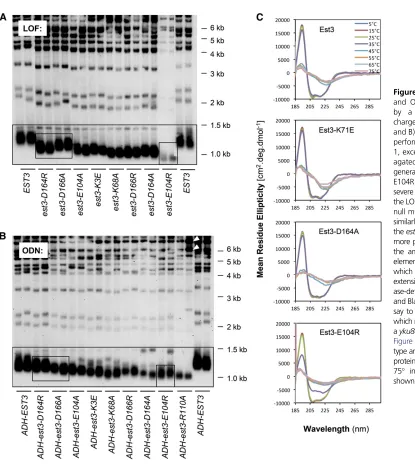
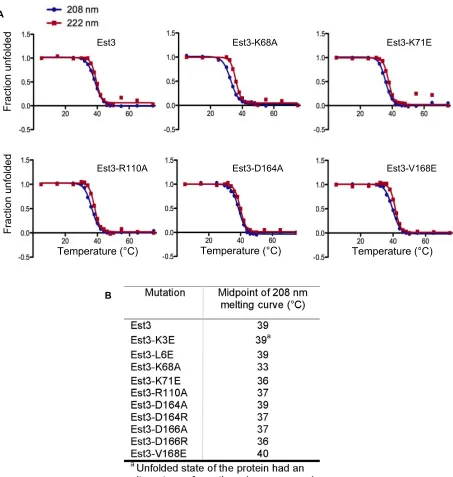
was not included; similarly, only Est3-R110A was tested as est3-R110A and est3-R110E have essentially identical LOF and ODN phenotypes). Consistent with this prediction, the spectra forfive of these mutant Est3 proteins were comparable to that of the wild-type protein (Figure 1B and Figure 4C; Figure S2), with a thermal denaturation pattern that was ei-ther highly similar (Est3-K71E, Est3-R110A, Est3-D164A, and Est3-D166R) or only slightly reduced at 36 (Est3-K68A) relative to the wild-type Est3 protein. The spectra for the sixth protein in this group (Est3-K3E) also closely resembled that of the wild-type Est3 protein at temperatures up to 36(Figures S2andS8), indicating that the Est3-K3E protein exhibited a secondary structure that was also highly similar to that of the wild-type protein under conditions that were permissive for yeast growth. Curiously, however, the thermal denaturation pattern for Est3-K3E protein from 45 to 75 indicated that this mutant protein unfolded into an anomalous structure (Figure S8). The biological relevance of this deviation from the wild-type denaturation pattern is
strain displayed a null phenotype, with telomeres reaching a critically short length after a limited period of growth (small box, Figure 4A). However, the ODN phenotype con-ferred by theest3-E104R mutation was notably less severe, as telomeres were shortened to only an intermediate length by overexpression of this mutant protein (small box, Figure 4B). This contrasts with the est3-R110A mutation [which, likeest3-E104R, exhibited a null phenotype in the LOF assay (Leeet al.2008)], as overexpression of the Est3-R110A mu-tant protein resulted in the appearance of senescence and the recombination-dependent telomeric rearrangements that are a hallmark of critically short telomeres (Figure 4B and data not shown). The incomplete correlation between the LOF and ODN phenotypes therefore suggested that the Est3-E104R mutant protein was partially destabilized in vivo. To test this prediction, the in vitro properties of the bacterially expressed mutant protein were examined. Although expres-sion and solubility of His10-SUMO-tagged Est3-E104R protein were not affected (Figure S1), the Est3-E104R spectra indi-cated reduced stability, as evidenced by unfolding of the Est3-E104R protein at a temperature (35) that did not affect the wild-type protein (Figure 4C). Both the reducedin vitro struc-tural stability and the attenuated ODN phenotype argues that the magnitude of the LOF phenotype displayed by the est3-E104R strain was due in part to a loss of structural integrity of the mutant protein, rather than solely due to loss of a single biochemical property. This example illustrates how a dimin-ished ODN phenotype can be used to eliminate certain alleles as candidatesof2mutations for future studies.
Discussion
Reverse mutagenesis of a protein is usually driven by two technical assumptions: (i) target highly conserved residues
and (ii) introduce alanine substitutions. In this study, we have tested these two assumptions with the Est3 protein by conducting a systematicin vivo analysis of how two different categories of amino acids—hydrophobic and charged residues— respond to mutation to alanine vs. a residue with a high potential to disrupt protein folding. The results, summarized in Figure 3 andFigure S9, demonstrate that mutation to a charged residue has a higher probability of generating a severe LOF phenotype; of the 18 amino acids that con-ferred short or very short telomeres when mutated, 15 had a more pronounced telomere replication defect in response to a charged residue substitution than mutation to alanine. We subsequently used two complementary assays to assess whether the resulting phenotypes were simply due to de-stabilization of protein structure by examiningin vivoODN phenotypes in yeast as well asin vitrostructural stability of proteins expressed inE. coli. This second aspect of the anal-ysis indicates that an ODN assay can be used to identify structurally stable mutant Est3 proteins with defined bio-chemical defects (summarized in Figure 5 and Figure 6). Below we consider several implications of this study and suggest a strategy based on the data presented here that may be useful for designingsof2mutations in other proteins.
Using ODN phenotypes to eliminate hypomorphic mutations due to unstable proteins
Classically, separation-of-function alleles have been defined, based on in vivo characteristics, as mutations that confer a restricted subset of the full range of phenotypes displayed by the null mutation. This is often accompanied by the as-sumption that such mutations have eliminated a single bio-chemical property (such as a protein-binding surface) without impairing overall protein stability. If so, such alleles can be powerful genetic reagents for subsequent studies Figure 3Conservation of charged residues pre-dicts the likelihood of generating asof2allele in
EST3. Results from Figure 4, Leeet al.(2008), and data not shown (corresponding to residues that did not have a telomere defect when mutated) are summarized. For LOF phenotypes,“medium short”
and“short”correspond to a 100- to 130-bp or to a 140- to 160-bp reduction in telomere length, re-spectively, and“null”refers to mutants with telo-meres that are.175 bp shorter than wild type with an accompanying senescence phenotype. For ODN phenotypes,“moderate,” “strong,”and
“severe” correspond to the “medium short,”
“short,”and“null”LOF phenotypic categories. The two different nomenclatures emphasize that the LOF and ODN phenotypes are not directly com-parable (since the ODN assay measures telomere length in a strain expressing both wild-type and mutant variants ofEST3, the phenotypic lag until steady-state telomere length is reached is different in the LOF and ODN assays). Degree of amino acid conservation was determined based on an align-ment of 20 Est3 protein sequences encompassing theSaccharomyces,Kluveromyces, andCandidaclades (Figure S4), where“high,” “moderate,”
designed to identify the interacting partner. However, defin-ingsof2alleles based solely on the range of LOF phenotypes potentially fails to identify those mutations that encode (partially) destabilized proteins. One aspect of this study, therefore, was to examine the potential correlation between in vitroprotein stability andin vivophenotypes as a means of asking whether an ODN phenotype could predict struc-tural stability. Toward this goal, 16 mutant Est3 proteins, corresponding to 7 mutations in hydrophobic residues and 9 in charged residues, were examined for structural stability following expression inE. coli, as summarized in Figure 5. This collection of mutant proteins represented the full range ofin vivophenotypes forest32mutations: null LOF but no ODN (3 mutations); moderate LOF but no ODN (1 muta-tion); an attenuated ODN relative to LOF (2 mutations); and null, strong, or moderate LOF with comparable ODN (2, 4, and 2 mutations, respectively). As Figure 5 illustrates, the
correlation between mutations with comparable ODN and LOF phenotypes and wild-typein vitroprotein stability was striking. In contrast, for est32mutations that conferred an ODN phenotype that was less severe than the corresponding LOF phenotype, the corresponding proteins exhibited a de-gree of structural instability that reflected the discrepancy between the ODN and LOF phenotypes.
uncover any evidence of protein instability, even though the CD spectra and melting curves for the bacterially expressed Est3-E104R protein demonstrate that this mutant protein does not retain a wild-type secondary structure. This indi-cates that, while monitoring protein levels in extracts can be a useful tool in excluding substantially destabilized mutant proteins, it fails to discriminate against partially unstable proteins that would be less-than-ideal reagents for subse-quent analyses.
Separation-of function mutations in EST3
This study, as well as a prior one (Lee et al. 2008), has identified 11 amino acids in EST3that display ODN and LOF phenotypes of comparable magnitude when mutated. These 11 residues can be divided into three categories based on their response to either alanine substitution or mutation to a charged residue (Figure 6). Class I residues exhibit the same degree of impairmentin vivowhen mu-tated, regardless of whether the amino acid change is an alanine substitution or a charge swap. In contrast, the majority category (class II) contains both hydrophobic and charged amino acids that result in a strong phenotype when mutated to a charged residue (as indicated by red bars in Figure 6) but are unaffected (or only modestly impaired in the case of V75) by an alanine substitution (as indicated by gray bars in Figure 6). The third category contains two residues that are severely impaired by mu-tation to alanine, whereas a charge swap results in an attenuated ODN phenotype indicative of a partially de-stabilized protein. This distribution suggests that the sim-ple notion of substitution with alanine as a side chain
“null” is overly simplistic. Instead, the effectiveness of an alanine substitution in revealing the role of the
targeted amino acid is context-dependent based on the struc-tural environment.
Mutations in these 11 amino acids define two discrete functions ofEST3 and thus constitute two different sets of sof2alleles, as summarized in the last column of Figure 6. One set of residues (E114, N117, D166, and V168) pro-motes the association of the Est3 protein with the telomer-ase complex, as previously shown by immunoprecipitation, whereas a second group performs at least one other activity that is not required for either interaction with telomerase or enzyme activity (Leeet al.2008, 2010). Excluded from this group of sof2 mutations is E104, based on thein vivoand in vitro analysis indicating thatest3-E104A andest3-E104R encode proteins that are partially unstable (Figure 4 and Figure S10). The importance of determining whether a mu-tant protein is structurally intact becomes apparent when assessing the ability of mutant Est3 proteins to associate with the telomerase complex. Our prior data indicated that association of the Est3-E104A and Est3-E104R proteins with telomerase was reduced (Lee et al. 2008); however, the results presented in this study suggest that this may simply be an artifact of how an unstable Est3 protein behaves in a telomerase co-immunoprecipitation assay. The same ratio-nale applies to charge-swap mutations in K68 and D164 (residues in class III, Figure 6), as the decreased interaction of the Est3-K68E and Est3-D164R mutant proteins with telo-merase may be subject to the same caveat.
A rapid reverse genetics protocol for identification of separation-of-function mutations
We propose instead a reverse mutagenesis strategy that incorporates the concept that any mutation that confers LOF and ODN phenotypes of comparable magnitude is a po-tentialsof2mutation. This definition has the advantage that it does not rely on characterization of the particular bio-chemical property in question as a precursor to recovery of this class of alleles. We further propose that limiting the mutagenesis to charge-swap mutations in invariant or highly conserved charged residues for ODN phenotypes may pro-vide a rapid protocol for identification ofsof2mutations. In the case of the 181-amino-acid Est3 protein, charge-swap mutations in three of the six invariant/highly conserved amino acids conferred strong in vivo phenotypes and encoded structurally stable proteins (est3-K71E, est3-R110E, andest3-D166R). In our laboratory, this approach has also been effective in identifying sof2 mutations in genes encoding the Est1 and Est2 subunits of telomerase as well as a wider set of genes involved in DNA replication and recombination, suggesting that this protocol may be widely applicable (L. Nguyen, J. W. Lubin, T. M. Tucey, and V. Lundblad, unpublished data). This method obvi-ously will not be comprehensive in identifying every func-tional residue on the surface of a protein if only conserved charge residues are targeted, and it is not applicable to proteins that confer lethality when overexpressed. How-ever, even a limited subset of new sof2mutations, espe-cially in essential genes, could be highly instructive, as this class of genetic reagents has a long history of uncov-ering previously unanticipated functions of proteins.
Acknowledgments
The authors thank Chris Lima at the Memorial Sloan-Kettering Cancer Center for the generous gift of the pET-His-Smt3 vector and Karen Lewis for assistance with the CD instrument. This research was supported by National Institutes of Health grants R37 AG11728 (to V.L.), R01
GM059414 (to D.S.W.), T32 GM08759 (to T.R.), and by Cancer Center Core grant P30 CA014195 (the Salk Institute).
Literature Cited
Baase, W. A., A. E. Eriksson, X. J. Zhang, D. W. Heinz, U. Sauer et al., 1992 Dissection of protein structure and folding by di-rected mutagenesis. Faraday Discuss. 93: 173–181.
Ben-Aroya, S., C. Coombes, T. Kwok, K. A. O’Donnell, J. D. Boeke et al., 2008 Toward a comprehensive temperature-sensitive mutant repository of the essential genes ofSaccharomyces cer-evisiae. Mol. Cell 30: 248–258.
Bertuch, A. A., and V. Lundblad, 2003 The Ku heterodimer per-forms separable activities at double-strand breaks and chromo-some termini. Mol. Cell. Biol. 23: 8202–8215.
Chuang, H. Y., M. Hofree, and T. Ideker, 2010 A decade of sys-tems biology. Annu. Rev. Cell Dev. Biol. 26: 721–744.
Costanzo, M., A. Baryshnikova, J. Bellay, Y. Kim, E. D. Spearet al., 2010 The genetic landscape of a cell. Science 327: 425–431. Cunningham, B. C., and J. A. Wells, 1989 High-resolution epitope
mapping of hGH-receptor interactions by alanine-scanning mu-tagenesis. Science 244: 1081–1085.
Dao-Pin, S., D. E. Anderson, W. A. Baase, F. W. Dahlquist, and B. W. Matthews, 1991 Structural and thermodynamic consequences of burying a charged residue within the hydrophobic core of T4 lysozyme. Biochemistry 30: 11521–11529.
Dixon, S. J., M. Costanzo, A. Baryshnikova, B. Andrews, and C. Boone, 2009 Systematic mapping of genetic interaction net-works. Annu. Rev. Genet. 43: 601–625.
Dohmen, R. J., P. Wu, and A. Varshavsky, 1994 Heat-inducible degron: a method for constructing temperature-sensitive mu-tants. Science 263: 1273–1276.
Hartwell, L. H., J. Culotti, and B. Reid, 1970 Genetic control of the cell-division cycle in yeast. I. Detection of mutants. Proc. Natl. Acad. Sci. USA 66: 352–359.
Herskowitz, I., 1987 Functional inactivation of genes by dominant negative mutations. Nature 329: 219–222.
Hughes, T. R., S. K. Evans, R. G. Weilbaecher, and V. Lundblad, 2000 The Est3 protein is a subunit of yeast telomerase. Curr. Biol. 10: 809–812.
Laurencon, A., A. Purdy, J. Sekelsky, R. S. Hawley, and T. T. Su, 2003 Phenotypic analysis of separation-of-function alleles of MEI-41, Drosophila ATM/ATR. Genetics 164: 589–601. Lee, J., E. K. Mandell, T. M. Tucey, D. K. Morris, and V. Lundblad,
2008 The Est3 protein associates with yeast telomerase through an OB-fold domain. Nat. Struct. Mol. Biol. 15: 990–997. Lee, J., E. K. Mandell, T. Rao, D. S. Wuttke, and V. Lundblad, 2010 Investigating the role of the Est3 protein in yeast telo-mere replication. Nucleic Acids Res. 38: 2279–2290.
Lendvay, T. S., D. K. Morris, J. Sah, B. Balasubramanian, and V. Lundblad, 1996 Senescence mutants ofSaccharomyces cerevi-siae with a defect in telomere replication identify three addi-tionalESTgenes. Genetics 144: 1399–1412.
Li, Z., F. J. Vizeacoumar, S. Bahr, J. Li, J. Warringer et al., 2011 Systematic exploration of essential yeast gene function with temperature-sensitive mutants. Nat. Biotechnol. 29: 361– 367.
Lijnzaad, P., and P. Argos, 1997 Hydrophobic patches on protein subunit interfaces: characteristics and prediction. Proteins 28: 333–343.
Lim, W. A., D. C. Farruggio, and R. T. Sauer, 1992 Structural and energetic consequences of disruptive mutations in a protein core. Biochemistry 31: 4324–4333.
Lundblad, V., and E. H. Blackburn, 1993 An alternative pathway for yeast telomere maintenance rescues est12senescence. Cell 73: 347–360.
Moreira, I. S., P. A. Fernandes, and M. J. Ramos, 2007 Hot spots: a review of the protein-protein interface determinant amino-acid residues. Proteins 68: 803–812.
Mossessova, E., and C. D. Lima, 2000 Ulp1-SUMO crystal struc-ture and genetic analysis reveal conserved interactions and a regulatory element essential for cell growth in yeast. Mol. Cell 5: 865–876.
Mu, W., W. Wang, and J. C. Schimenti, 2008 An allelic series uncovers novel roles of the BRCT domain-containing protein PTIP in mouse embryonic vascular development. Mol. Cell. Biol. 28: 6439–6451.
Nugent, C. I., T. R. Hughes, N. F. Lue, and V. Lundblad, 1996 Cdc13p: a single-strand telomeric DNA-binding protein
with a dual role in yeast telomere maintenance. Science 274: 249–252.
Paschini, M., E. K. Mandell, and V. Lundblad, 2010 Structure pre-diction-driven genetics inSaccharomyces cerevisiaeidentifies an interface between the t-RPA proteins Stn1 and Ten1. Genetics 185: 11–21.
Paschini, M., T. B. Toro, J. W. Lubin, B. Braunstein-Ballew, D. K. Morriset al., 2012 A naturally thermolabile activity compro-mises genetic analysis of telomere function in Saccharomyces cerevisiae. Genetics 191: 79–93.
Rudge, S. A., T. R. Pettitt, C. Zhou, M. J. Wakelam, and J. A. Engebrecht, 2001 SPO14separation-of-function mutations de-fine unique roles for phospholipase D in secretion and cellular differentiation inSaccharomyces cerevisiae. Genetics 158: 1431– 1444.
Tong, A. H., M. Evangelista, A. B. Parsons, H. Xu, G. D. Baderet al., 2001 Systematic genetic analysis with ordered arrays of yeast deletion mutants. Science 294: 2364–2368.
Umezu, K., N. Sugawara, C. Chen, J. E. Haber, and R. D. Kolodner, 1998 Genetic analysis of yeastRPA1reveals its multiple func-tions in DNA metabolism. Genetics 148: 989–1005.
Venkatesan, K., J. F. Rual, A. Vazquez, and U. Stelzl, I. Lemmens et al., 2009 An empirical framework for binary interactome mapping. Nat. Methods 6: 83–90.
Wertman, K. F., D. G. Drubin, and D. Botstein, 1992 Systematic mutational analysis of the yeastACT1gene. Genetics 132: 337– 350.
Winzeler, E. A., D. D. Shoemaker, A. Astromoff, H. Liang, K. Ander-sonet al., 1999 Functional characterization of theS. cerevisiae genome by gene deletion and parallel analysis. Science 285: 901–906.
Yan, Z., M. Costanzo, L. E. Heisler, J. Paw, F. Kaper et al., 2008 Yeast Barcoders: a chemogenomic application of a uni-versal donor-strain collection carrying bar-code identifiers. Nat. Methods 5: 719–725.
Zhou, Z., and S. J. Elledge, 1992 Isolation ofcrtmutants consti-tutive for transcription of the DNA damage inducible geneRNR3 inSaccharomyces cerevisiae. Genetics 131: 851–866.
GENETICS
Supporting Information http://www.genetics.org/lookup/suppl/doi:10.1534/genetics.112.147801/-/DC1
Dissecting Protein Function: An Efficient Protocol
for Identifying Separation-of-Function Mutations
That Encode Structurally Stable Proteins
Johnathan W. Lubin, Timsi Rao, Edward K. Mandell, Deborah S. Wuttke, and Victoria Lundblad
Figure S1 (A) Expression and solubility of wild type and mutant His10-SUMO-Est3 proteins were assessed by anti-His Western blot. Solubility was assessed by quantitating the partitioning of the His10-SUMO-Est3 proteins into pellet (P) vs. supernatant (S) fractions after bacterial cell lysis. Expression was quantitated relative to the wild-type using ImageJ software. (B) Coomassie-stained gels of wild-type and mutant Est3 proteins expressed from E. coli BL21(DE3) cells and purified to >95% purity.
A
B
Lubin et al.
Me
an
R
es
id
u
e
El
lip
ti
ci
ty
[c
m
2.d
eg
.d
m
ol
-1.r
es
id
ue
-1]
Wavelength (nM)
Figure S2 CD spectra of the indicated soluble mutant Est3 proteins with data collected from 185 to
300 nm at 30°, 32°, 34° and 36° C. Proteins used for this analysis were stored at -80° C following expression and purification as shown in Figure S1; since Est3-104R became insoluble following storage at -80°, it was not included in this analysis.
Lubin et al.
Est3 Est3-K68A Est3-K71E
Est3-R110A Est3-D164A Est3-V168E
F
ra
ctio
n u
nfo
ld
ed
F
ra
ctio
n u
nfo
ld
ed
Temperature (°C) Temperature (°C) Temperature (°C)
Figure S3 (A) Thermal denaturation curves at 208 and 222 nm and (B) midpoint temperatures (determined from fits to the Boltzmann sigmoid equation using Prism GraphPad software) for the indicated mutant proteins, compared to wild type.
A
B
Lubin et al.
Figure S4 Alignment of 20 Est3 protein sequences from the three sub-clades of Saccharomytina, with the position of the 36 hydrophobic and charged residues that were subjected to mutagenesis indicated. Arrow size and color as described to the right; black arrows = wild type. E104, with a partially attenuated ODN phenotype relative to LOF, is indicated in maroon.
Lubin et al.
L6 L18 I22 I69 V75 V80 I84 I91 L92 V100
K3 K68 K71 D86 E104
D14 I26 D49 D77 K79 R85 E94 R105
1 2 3 4 5 6 7 8 9 10 11 12 13 14 15 16 17 18 19 20 null LOF strong ODN null LOF no ODN moderate LOF moderate ODN moderate LOF no ODN weak LOF weak ODN weak LOF no ODN Ca n d id a Kl u ve ro ym ce s S ac char om yc es S. cerevisiae S. paradoxus S. mikatae S. kudriavzevii S. bayanus S. castellii S. dariensis K. polysporus C. glabrata S. kluverii K. waltii K. lactis A. gossypii C. lusitaniae P. stipitus D. hansenii C. guilliermondii C. tropicalis C. dubliniensis C. albicans 1 2 3 4 5 6 7 8 9 10 11 12 13 14 15 16 17 18 19 20 1 2 3 4 5 6 7 8 9 10 11 12 13 14 15 16 17 18 19 20
D124 L127 K140 V154
I111 L119 I122 L155 V157 V168 R110 D164 D166
EST 3 EST 3 E S T 3 E S T 3 EST 3 EST 3 E S T 3 E S T 3 EST 3 EST 3 E S T 3 E S T 3 EST 3 EST 3 E S T 3 E S T 3
Figure S5 Loss of function (LOF) assay monitoring telomere length of est3-∆ yeast strains bearing single copy plasmids expressing mutations in hydrophobic residues (mutation to alanine, upper panels; mutation to glutamic acid, lower panels) from the native EST3 promoter. The genotypes of mutations that conferred a strong phenotype in the ODN assay are boxed.
5 kb 4 kb 3 kb 2 kb 1.5 kb 1.0 kb 5 kb 4 kb 3 kb 2 kb 1.5 kb 1.0 kb
Lubin et al.
Figure S6 Over-expression dominant (ODN) phenotypes, as assessed by monitoring telomere length in EST3 yeast strains bearing high copy plasmids expressing the indicated mutations in hydrophobic residues under control of the ADH promoter. The effects of the two mutations (est3-V75E and est3 -V168E) that exert a strong ODN phenotype are shown in Figure 2.
Lubin et al.
ODN: ODN:
Figure S7 An alternative assay for ODN phenotypes, based on synthetic lethality in the presence of a yku80-∆ mutation, as previously described (Evans and Lundblad 2001; Lee et al. 2008). Growth of YKU80 or yku80-∆ strains (generated by plating on media that selects either for or against a YKU80URA3 plasmid) which also contain high copy plasmids expressing the indicated mutations in hydrophobic residues, under control of the ADH promoter. As predicted from the lack of an ODN effect on telomere length (Figure S6), the majority of the mutations in hydrophobic residues similarly have no effect in this assay.
Lubin et al.
Figure S8 Spectra for the indicated Est3 mutant proteins collected from 5° to 75° with a step-size of 10°, collected in parallel with the spectra shown in Figures 1 and 4.
Me
an
R
es
id
u
e
El
lip
ti
ci
ty
[c
m
2.d
eg
.d
m
ol
-1.r
es
id
ue
-1]
Wavelength (nM)
Lubin et al.
Figure S9 Summary of LOF (loss of function) and ODN (over-expression dominant) phenotypes for mutations in hydrophobic residues mutated to either alanine (A) or glutamic acid (E), based on data shown in Figures 2, S5, S6 and S7. Level of conservation was determined as described in the legend for Figure 3 and based on the alignment shown in Figure S4.
Lubin et al.
Figure S10 An alternative assay for ODN phenotypes, based on synthetic lethality in the presence of
a yku80-∆ mutation (described in Figure S7). Effects on viabiity in a yku80-∆ strain of a subset of the
same mutations shown in Figure 4B present on high copy plasmids and under control of the ADH promoter. The sensitivity range of this assay is such that “strong” vs. “severe” ODN phenotypes (using the nomenclature defined in the legend for Figure 4) of the mutations shown in (C), above cannot be distinguished. However, differences between the mutations shown in (A), above, provide a more sensitive assay than telomere length, as shown in Figure 4B.
Lubin et al.
The parental plasmids used for all in vivo analysis were pVL1024 (2µLEU2ADH-EST3) and pVL2537 (CENLEU2EST3), which have both been described previously (Lee et al. 2008).
Lee, J.S., Mandell, E.K., Tucey T.M. Morris, D.K. and Lundblad, V., 2008 The Est3 protein associates with yeast telomerase through an OB-fold domain. NSMB 15:990-997.
Lubin et al.