ISSN(Online): 2320-9801
ISSN (Print) : 2320-9798
I
nternational
J
ournal of
I
nnovative
R
esearch in
C
omputer
and
C
ommunication
E
ngineering
(An ISO 3297: 2007 Certified Organization)
Vol. 3, Issue 9, September 2015
RMP ZR 1.0, an Efficient Algorithm to Stop
Secret Communication through
Steganography over Internet
1
Er. Rakesh Kumar, 2Pratik Kumar
Computer Science Researcher, Dept. of Computer Science & Engineering, Ranchi University, India1
B. Tech. Final Year, Dept. of Computer Science & Engineering, CIT, Ranchi University, India2
ABSTRACT: As we know, Social Networking Sites are being used in Terrorist Activities for secret communication by
the Terrorists. That’s why, it has become prime necessity of different countries like India, U.S.A, Russia etc. to find a solution to stop these secret communication. In this research paper, we have introduced a new and efficient technique that will stop secret communication over internet (or Social Networking Sites). In this research, we have used Steganography and Cryptography both. RMP ZR 1.0 will give full control to the Social Networking Sites over the transfer of Stegano Images. It may be proved to be very successful technique to make terrorists attempt failure.
KEYWORDS: RMP ZR 1.0, secret communication, Terrorist Activities, Steganography, Cryptography.
I. INTRODUCTION
RMP ZR 1.0 is an efficient technique which will meet the prime necessity of countries like India, U.S.A, Russia etc to stop secret communication over internet (or Social Networking Sites). The basic principles behind the development of RMP ZR 1.0 are the concepts of Steganography as well as Cryptography. If a sender ‘A’ sends a hidden message (or information) behind an image through a Social Networking Site, ‘Mbook’ to ‘B’ then the receiver ‘B’ will surely receive the image, though ‘B’ cannot retrieve the original message as sent by ‘A’. The reason behind this is that RMP ZR 1.0 will be applied to the image just when the user clicks the upload button.
Cryptography Versus Steganography: Steganography[1] differs from cryptography in the sense that where cryptography focuses on keeping the contents of a message secret, steganography focuses on keeping the existence of a message secret. Steganography and cryptography are both ways to protect information from unwanted parties but neither technology alone is perfect and can be compromised. Once the presence of hidden information is revealed or even suspected, the purpose of steganography is partly defeated. The strength of steganography can thus be amplified by combining it with cryptography. The comparison and contrast between steganography and cryptography is illustrated from the following table[2]:
S. No. Context Steganography Cryptography
1. Host Files Image, Audio, Text, etc. Mostly Text Files
2. Hidden Files Image, Audio, Text, etc. Mostly Text Files
ISSN(Online): 2320-9801
ISSN (Print) : 2320-9798
I
nternational
J
ournal of
I
nnovative
R
esearch in
C
omputer
and
C
ommunication
E
ngineering
(An ISO 3297: 2007 Certified Organization)
Vol. 3, Issue 9, September 2015
4. Type of Attack
Steganalysis: Analysis of a file with an
objective of finding whether it is stego file or not.
Cryptanalysis
Table No. 1.1
II. INITIAL RESEARCH WORKS:
1. We have sent a .bmp image of size 20x20 through Gmail to a Gmail-id and then downloaded the image at the receiver’s end.
2. We have uploaded a bitmap image (.bmp), a .jpeg image, a .png image and a .gif image of size 20x20 at Facebook. After that we downloaded the image.
3. We have sent a .bmp image through Whatsapp and downloaded the image at the receiver image.
We compared the original image with the image we obtained after download as from the receiver’s end.
Conclusion 1: When we downloaded the image from Gmail we obtained .jpeg image instead of the .bmp image which was sent.
Conclusion 2: When we downloaded the image from Facebook we got .jpeg image instead of .bmp and .jpeg. As far as .png and .gif image are considered we got the .png and .gif respectively.
Conclusion 3: In case of WhatsApp we obtained the same result as we mentioned in Conclusion 2.
Final Conclusion of our Initial Research Work:
We conclude from the analysis that the image obtained after download will have the same extension as of the image which was sent by the sender. This conclusion is not valid for .bmp image. If we send a .bmp image it will be converted into .jpeg image (Due to compression) that means if a sender sends an image in .bmp format the sender will receive .jpeg image when he/she downloads the image.
III. PROPOSED ALGORITHM
ISSN(Online): 2320-9801
ISSN (Print) : 2320-9798
I
nternational
J
ournal of
I
nnovative
R
esearch in
C
omputer
and
C
ommunication
E
ngineering
(An ISO 3297: 2007 Certified Organization)
Vol. 3, Issue 9, September 2015
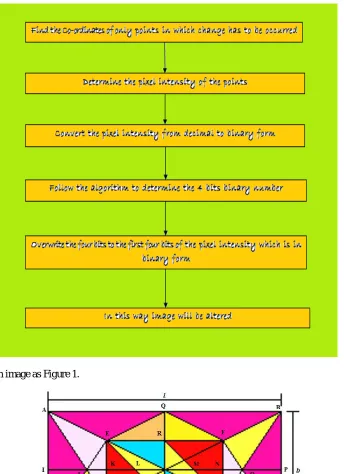
Consider the taken image as Figure 1.
Figure 1
where l and b are the length and the breadth of the image (dimension of the image i.e. l x b)
ISSN(Online): 2320-9801
ISSN (Print) : 2320-9798
I
nternational
J
ournal of
I
nnovative
R
esearch in
C
omputer
and
C
ommunication
E
ngineering
(An ISO 3297: 2007 Certified Organization)
Vol. 3, Issue 9, September 2015
A ≡ (0, 0) B ≡ (l, b) C ≡ (l, b) D ≡ (0, b) E ≡ (l/4, b/4) F ≡ (3l/4, b/4) G ≡ (3l/4, 3b/4) H≡(l/4,3b/4)
I ≡ (0, b/2) J ≡(l/6, b/2) K ≡ (l/4, b/2) L≡(3l/8,b/2) M ≡ (5l/8, b/2) N ≡ (3l/4, b/2) O ≡ (5l/6, b/2) O’≡(l/2,b/2) P ≡ (l, b/2) Q ≡ (l/2, 0) R ≡ (l/2, b/4) S≡(l/2,3b/4)
T ≡ (l/2, b)
Step 2: Find out the pixel intensity of the points A, B, C, ……, R, S, T by using Algorithm RZ 1.0 Step 3: Convert the pixel intensity from decimal to binary form.
Step 4: Consider only the first eight bits of the pixel intensity (which is converted into binary form). Step 5: Find X as
X = (Z + Pv)
where Z = first eight bits of the pixel intensity and Pv = eight bits of position value in the binary form Step 6: Find r1 as
r1 = rand() % 255 Calculate (key)10 usingthe following formulae:
(key)10 =
r1 + 100 // if r1 < 100
+ 50 // if r1 > 100
Step 7: Find (key)2 i.e. K2 (say). Step 8: Create message as follows: M1 =
X K2’ X’ K2 X’ K2’ X K2
X K2’ X’ K2 X’ K2’ X K2
X K2 X’ K2’ X’ K2 X K2’
X K2 X’ K2’ X’ K2 X K2’
(Note: 1 block = 8 bits)
Where X, X’, K2 and K2’ all are of 8 bits. KEY =
B1 B2 B3 B4 B5 B6 B7 B8
B9 B10 B11 B12 B13 B14 B15 B16
B17 B18 B19 B20 B21 B22 B23 B24
B25 B26 B27 B28 B29 B30 B31 B32
B1 = K2;
Up to B8 follow the following instruction Shift the MSB to the LSB position and shift the LSB to one bit towards left. For instance, K2 = (11100001)2 hence,
B1 = (1110 0001)2 MSB LSB
B1 = (1110 0001)2
B2 = (1100 0011)2
B3 = (1000 0111)2
And so on…
ISSN(Online): 2320-9801
ISSN (Print) : 2320-9798
I
nternational
J
ournal of
I
nnovative
R
esearch in
C
omputer
and
C
ommunication
E
ngineering
(An ISO 3297: 2007 Certified Organization)
Vol. 3, Issue 9, September 2015
Bit 8 Bit 7 Bit 4 Bit 3 Bit 6 Bit 5 Bit 2 Bit 1
For instance, B9 = (11001001)2 (From the above). And so on..
Now Calculate as follows :
B17 = B1 OR B2; B18 = B1 OR B3 B19 = B1 OR B4; B20 = B2 OR B3 B21 = B2 OR B4; B22 = B3 OR B4 B23 = B5 XOR B6; B24 = B5 XOR B7 B25 = B5 XOR B8; B26 = B6 XOR B7 B27 = B6 XOR B8; B28=B7 XOR B8 B29 = B9 AND B10; B30 = B10 AND B12 B31 = B13 AND B14; B32 = B15 AND B16
Now we will perform XOR operation between M1 and KEY such that Res = M1 XOR KEY Res will be of 256 Bits.
Step 9: Apply MATLAB Code RZ 2.0, a Data Compression Technique and store it in RRes. Step 10: Repeat Step 9 and overwrite the value in RRes until RRes is reduced to 4 bits. Step 11: Overwrite these 4 bits to pixel intensity (in binary form) of the pints A, B, C, ……, S, T.
Algorithm RZ 1.0
Step 1: Open the image in MATLAB. For instance, consider the following statement: a = imread(‘ D:\sti\N_Image1.bmp ’);
Here ‘a’ is a variable used in workplace; ‘N_Image1.bmp’ is an image which is stored in ‘sti’ folder in ‘D:\’ drive; and ‘imread’ is a MATLAB Command.
Step 2: Find out a1, a2, a3 as follows:
a1=double(i(:,:,1))
a2=double(i(:,:,2)) a3=double(i(:,:,3))
Step 3: Determine ‘x’ using the following mathematical statement: x=a1+a2+a3 MATLAB Code RZ 2.0:
V. SCOPE AND FUTURE
The features of RMP ZR 1.0 can be enhanced in near future that may help to suppress Terrorism. clc; clear all; close all; sig=1:4; Symbols=[1 2 3 4];
ISSN(Online): 2320-9801
ISSN (Print) : 2320-9798
I
nternational
J
ournal of
I
nnovative
R
esearch in
C
omputer
and
C
ommunication
E
ngineering
(An ISO 3297: 2007 Certified Organization)
Vol. 3, Issue 9, September 2015
VI. CONCLUSION
This Algorithm RMP ZR 1.0 is found to be very efficient and successful to stop secret communication over Internet or Social Networking Sites through image steganography. If RMP ZR 1.0 is used then no secret information of our Nation ‘India’ can be sent to different countries by the spy placed in our countries. This is the reason why terrorism will be reduced up to much extent. RMP ZR 1.0 will give the control to ‘The Indian Defense’ over the terrorist activities.
REFERENCES
1. T.Morkel, J.H.P. Eloff and M.S.Olivier. ‘An Overview Of Image Steganography.’ ,Information and Computer Science, University of Pretosia, in Proceedings of the Fifth Annual Information Security South Africa Conference (ISSA2005), Sandton, South Africa, June/July 2005. 2. Vijay kumar Sharma and Vishal srivastava. ‘A Steganography Algorithm For Hiding Image In Image by Improved LSB Substitution By
Minimize Detection.’ ,Journal Of Theoretical and Applied Information Technology, Vol 36, No 1,ISSN: 1992-8645, Feb 2012.
BIOGRAPHY
He has done B. Tech in CSE from CIT, Ranchi in 2015. He has designed his own programming language namely RAKs. M. PLUS which will be better and faster than c++ in many respects. He is nominated for Honorary Doctorate for his successful research works at I.N.O.U, Lucknow. He gave his valuable contribution in the field of Information security. He also proposed a new methodology to find the steganographic signature of different steganography tools. He is currently working on ‘Virus pot & Information security’. Image Processing, Cryptography, Information security and Data mining are his research areas of interest.
Pratik Kumar