ISSN(Online): 2320-9801
ISSN (Print): 2320-9798
International Journal of Innovative Research in Computer
and Communication Engineering
(An ISO 3297: 2007 Certified Organization)
Vol. 3, Issue 8, August 2015
Relay Node Selection of Opportunistic
Routing Algorithm with Sleep Mode in WSN
Archana P R1, Tintu Mary J ohn2
PG Student [Communication Engineering], Dept. of ECE, CAARMEL Engineering College, Pathanamthitta, Kerala,
India1
Assistant Professor, Dept. of ECE, CAARMEL Engineering College, Pathanamthitta, Kerala, India2
ABSTRACT: In real-life applications of wireless sensor networks(WSNs), optimization of the network operation is required to extend its lifetime.Routing could be a crucial issue in information gathering device network, whereas on the alternative hand sleep-awake synchronization is that the key issues for event detection device networks. In order to increase the energy efficiency, sensors functioning supported duty cycle. The essential mechanism for sleep programming is that nodes alternate between awake/asleep modesaccording to independent wake-up schedules with fixed duty cycled. Packet forwarding is implemented by having the sender polling. The availability of awake neighbours by broadcasting an RTS packet for jointly performing channel access and communicating relevant routing information. Available neighbouring nodes respond with a clear-to-send (CTS) packet carrying information through which the sender can choose the best relay.select out a sub-set of nodes to be awake throughout a given epoch whereas the remaining nodes unit of measurement among the sleep state that minimizes power consumption, that the general energy consumption are reduced. This focuses on sleep programming for High Speed Energy Efficient at Idle slots are want to speed up the transmission speed of the network.
KEYWORDS: Wireless sensor network (WSN), Sleep and Awake mode, Duty cycled Geographic Routing,energy efficiency.
I. INTRODUCTION
A wireless sensor networks(WSNs) consists of the spatially distributed autonomous sensors to monitor the physical or environmental conditions, such as temperature, sound, pressure, etc. and to cooperatively pass their data through the network to a main location. The development of wireless sensor networks was motivated by military applications such as battlefield surveillance and today such networks are used in many otherapplications such as industrial process monitoring and control, machine health monitoring.The sensor nodes can work as autonomous devices and be deployed in various types of environments.
One of the main concerns when developing the WSNs is to extend their lifetime.a sensor node is powered by a finite energy source such as a battery or a super capacitor that restricts the WSNs’ lifetime. The renewable energy sources like solar or wind have been investigated and integrated with the sensor nodes recently for longer operation. However, the intermittent nature of these sources still has a significant effect on the network performance. Therefore, energy consumption of the WSNs needs to be taken into account when planning the network operation.
ISSN(Online): 2320-9801
ISSN (Print): 2320-9798
International Journal of Innovative Research in Computer
and Communication Engineering
(An ISO 3297: 2007 Certified Organization)
Vol. 3, Issue 8, August 2015
II. RELATED WORK
Multipathrouting can reduce the need forroute updates, balance the traffic load and increase the data transfer rate in a wireless sensor network, improving the utilization of the limited energy of sensor nodes. However, previous multiple path routing methods use flooding for route discovery and transmit data with maximum power regardless of need, which results in waste of energy.In the existing works on sleep mode in WSNs there exist a pair of targets: purpose coverage and node coverage. The Awake nodes in each epoch square measure chosen to cover every purpose of the deployed field in purpose coverage. Existing purpose coverage oriented algorithms dissent in their sleep designing goals: minimizing energy consumption or minimizing average event detection latency. For the purpose of node coverage, awake nodes square measure to construct a globally connected network such each asleep node may be a quickly neighbour of a minimum of 1 awake node.
Sink mobile information is flooded alone on demand, each node should not have enough initial neighbours thus on kind it easier for the node neighbour node demand.
III.MODULESINVOLVED
A. Sleep/Awake Mode:
The technology of power saving is separated into four study aspects.
1. The schedule between the sleeping and waking up of sensors: achieves the effectiveness of saving power by sleeping mechanism.
2. Typically sensor nodes area unit created at the foremost sensitive vary once sensing, however exploitation power management to regulate the sense vary are going to be able to attain the effectiveness of saving power.
3. As wireless sensing element nodes adopt the strategy of Multi Hops, therefore a way to notice a shortest path and create the info transmitted to the sink to succeed in throughout of power saving is incredibly necessary.
4. Once a sensing element node delivers data, alternative nodes near it's going to receive the data that's not transmitted to them. This can cause the consumption of power, therefore commonly the close to nodes are going to be created to sleep to avoid the happening of overhead.
B. GCKN Sleep scheduling Algorithm:
There are 2 geographic-distance-based connected-k neighbourhood (GCKN) sleep programming algorithms.The primary one is that the geographic distance based connected-k neighbourhood for first path (GCKNF) sleep programming algorithmic program. The other is that the geographic-distance-based connected-k neighbourhood for all paths (GCKNA) sleeps programming algorithmic program.
C. CSMA/CA
Node Here the controller of waterproof is enforced on high of the link layer. Every node will grasp the neighbour data at the time of your time slot allocation. Whereas slot allocation every node shares it’s immediate node data to others, thus by this data every node will store the knowledge concerning two hop neighbours cluster information, like virtual bunch.
In wireless detector network, the nodes are stable and static for his or her life time, therefore the neighbour node convenience not about to be amendment until last. and therefore the main work is to keep up sleep a lot of and effective knowledge forwarding by accessing the waterproof layer, therefore the link failure is out of the scope of this and there are such a large amount of routing strategies offered to focus on link failure, thus it\'s necessary to incorporate and check the link failures with Improved Sleep mode.
ISSN(Online): 2320-9801
ISSN (Print): 2320-9798
International Journal of Innovative Research in Computer
and Communication Engineering
(An ISO 3297: 2007 Certified Organization)
Vol. 3, Issue 8, August 2015
As shown in figure 1, here the entire time is split into slots, and any slots into sub slots. Every node synchronic timer, therefore every node is aware of once the time interval begins and ends. All the nodes are going to be in idle listen mode at starting of every time interval. If any node has information then the node can check the slot convenience in sub slot. If node has high priority information then it will occupy initial sub slot, or own slot suggests that second sub slot alternatively third sub slot.
Fig. 1. CTS/RTS frame
D. HSEEIS Algorithm
HighSpeed Energy Efficient at Idle Slots combines the strength of CSMA, pair wise TDMA and broadcast TDMA. Consider the figure 2 let there are 8 neighbour nodes. In that every node is 1 or 2 hop neighbour to each other. Consider the diagram given below. In that T1, T2….represent the slot sequences and S1, S2…represent the sensor nods.Therendezvous slots can be calculated by clock arithmetic. Let node S1 wants to create a rendezvous.
Fig. 2. Rendezvous slot selection for 8 sensor nodes (T17 is rendezvous slot for s1 but T9 is not rendezvous slot)
IV.RESULTANDDISCUSSIONS
Networksimulator is used here. By using ns2, the results can be achieved by NAM and another one is X graph.
ISSN(Online): 2320-9801
ISSN (Print): 2320-9798
International Journal of Innovative Research in Computer
and Communication Engineering
(An ISO 3297: 2007 Certified Organization)
Vol. 3, Issue 8, August 2015
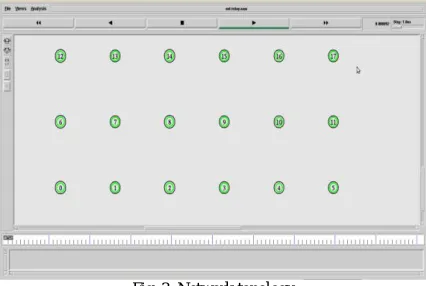
Figure 3 shows the network topology. In this the network is considered with grid type of topology with 17 sensor types of nodes and one base station.
CSMA/CA technique is used here. So each node has the slot to transfer the data. In this it has considered the individual and random time slot allocation based on virtual clustering method.
The originating message at the beginning is shared by the base station. After time slot allocation each node will receive the message, and will forward it to the other nodes after updating the routing information. The route to destination will be selected based on less hop count.Figure 6 shows the originating message sharing from base station.
Fig. 6.Base station shares the originating message after time slot allocation
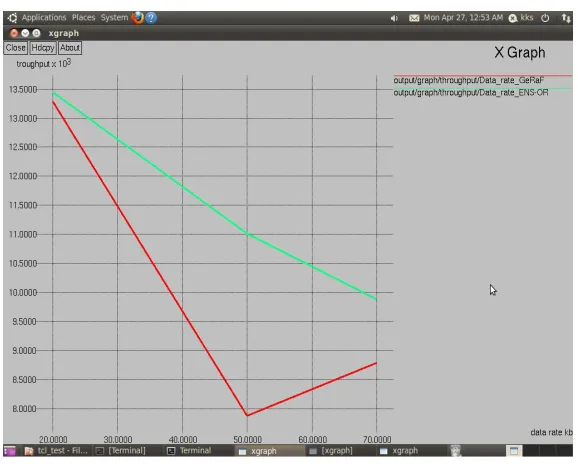
The performance of different technique can be viewed by using Xgraph
ISSN(Online): 2320-9801
ISSN (Print): 2320-9798
International Journal of Innovative Research in Computer
and Communication Engineering
(An ISO 3297: 2007 Certified Organization)
Vol. 3, Issue 8, August 2015
Fig.8 Delay
Here we can see that Throughput increases and Delay decreases.
V. CONCLUSION AND FUTURE WORK
The QoSparameters like packet delivery fraction, delay, energy and overhead are improved compared to the existing system. These are achieved with the assistance of unintentional on demand vector routing, geographic routing and CSMA/CA.
The vital mechanism used here is sleep/active mode of sensor node. This is can be obtained with the help of geographic distance primarily based connected-k sleep programming algorithms.In case, any node has the information to send to base station then sender and receiver ought to be in active mode, remaining the entire node will visit sleep. to form synchronization b/w sender and receiver and neighbour node use RTS/CTS.
In furure work if any node has data then the node can check the slot accessibility in sub slot. If node has high priority data then it can occupy first sub slot, or own slot means that second sub slot alternatively third sub slot. For that the fundamental CSMA/CA protocol with some modifications are going to be used than RTS/CTS.
REFERENCES
1. PrachiPande and Sumesh Kumar Devangan“A High Speed, Delay Tolerant Hybrid MAC for Collision Free, Reliable Communication in Wireless Sensor Network”,ISSN.
2. Survey On Sleep And Awake Method Using Geographic Opportunistic Routing In WirelessSensor Networks
3. Hing. Zhang and H. Shen, (2010) “Energy efficient beaconless geographic routing in wireless sensor networks,” IEEE Transactions. Parallel Distribution System Volume. 21,Number. 6,Page Number. 881–896
4. Jaung. Pan, L. Cai, Y. T. Hou, Y. Shi, and X. X. Shen, (2005)“Optimal base station locations in two tiered wireless sensor networks,” IEE Transaction MobileComputing. Volume. 4, Number. 5, Page Number. 458–473,