A CYTOGENETIC STUDY OF
A
CHROMOSOME FRAGMENT I N MAIZE1M. M. RHOADES2
Division of Cereal Crops and Diseases, Bureau of Plant Indust~y,’ U . S. Department of Agriculture. Ames, Iowa
Received March 6, 1936
INTRODUCTION
ACH of the ten groups of linked genes in maize has been associated
E
with a specific member of the haploid set of ten chromosomes. The morphology of the ten chromsomes has been studied a t pachytene by MCCLINTOCK (1933) and each member found to differ from the others in such characters as length, position of the spindle fiber insertion region and presence of deeply staining knobs in definite positions, so that they can be recognized by their morphological characteristics.The fifth longest chromosome of the haploid set of maize has a spindle fiber insertion region that is nearly median, dividing the chromosome into two arms. The ratio of the length of the two arms is 1.1 : I .o. In certain strains the longer of the two arms, however, is differentiated a t pachytene by the presence of a deeply staining knob that makes it easy to distinguish between the two nearly equal arms of the chromosome.
Plants which possess an extra chromosome V are said to be trisomic for this chromosome. These trisomic plants differ markedly in appearance from their disomic sibs and it is possible to classify a segregating progeny into trisomic and disomic types with considerable accuracy. For this reason plants trisomic for chromosome
V
have been successfully utilized in an at- tack on certain problems.There are two secondary trisomes possible for each primary trisome since the extra chromosome in the secondary trisome is composed of two identical arms, that is, one of the arms of the chromosome is represented twice in the extra chromosome. One of the two secondary trisomes for chromosome V has been found (RHOADES 1933b). The extra chromosome consisted of two short arms of chromosome V. This secondary differed strikingly in appearance from both primary trisomes and disomes.
OCCURRENCE O F A F R A G M E N T P L A N T
An individual which was intermediate in its appearance between its trisomic and disomic sibs arose in the progeny of a chromosome V primary
Contribution from the Division of Cereal Crops and Diseases, Bureau of Plant Industry, U. S. Department of Agriculture, and the Farm Crops Subsection, Iowa Agricultural Experiment Station, Ames, Iowa, cooperating.
Journal Paper No. 1331. Iowa Agricultural Experiment Station, Ames, Iowa.
492 M. M. RHOADES
trisome. Cytological examination of this exceptional plant showed that it contained a fragment of chromosome V. Studies a t pachytene showed that this fragment consisted of the entire short arm of chromosome
V
with aterminal spindle fiber insertion region. That the break which produced the fragment occurred exactly a t the spindle fiber region is indicated by the fact that in many clear pachytene figures no evidence of any chromatic material on one side of the insertion region was ever found. The nature of this fragment in its relation to a normal chromosome V is shown diagram- matically in figure I .
FIGURE I.-Diagrammatic representations of normal chromosome V showing relative length of the two arms, position of spindle fiber insertion region, location of knob and of frag- ment chromosome which consists of the entire short arm of chromosome V and which has a terminal spindle fiber insertion region. The in- sertion regions are designated by the stippled areas.
FIGURE a.-Trivalent groups of the two normal and the fragment chromosomes a t metaphase I showing the orientation of the fragment chromosome to be such that it dis- joins to the same pole as one of the normal chromosomes.
.
As previously reported, maize plants trisomic for chromosome V differ markedly in their appearance from their disomic sibs. Especially notice- able are the thick broad leaves with relatively blunt tips, the stubby tas- sel and the reduced height of the trisomic plants. Plants carrying the short arm of chromosome
V
in excess are intermediate in appearance between primary trisomes and disomes.CYTOGENETICS O F FRAGMENT CHROMOSOME
Cytological observations of microsporocytes a t metaphase I showed that the fragment chromosome was associated with the two normal chromosomes V in approximately 53 percent of the cases to form a tri- valent group. This frequency of trivalents is considerably lower than the
85-90 percent found in plants trisomic for the whole chromosome V. If
CHROMOSOME FRAGMENT I N MAIZE 493 of the three homologous chromosomes occurs in primary trisomes but the occurrence of univalents and their failure to pass to either pole in anaphase results in a deviation of the genetic ratio from a
5 :
I to about 3.35: I (RHOADES 1933") for genes in chromosome V.Typical trivalent figures involving the fragment chromosome are shown
in figure 2. The orientation on the metaphase plate of the trivalent group
was such that the fragment would pass to the same pole as one of the normal chromosomes and was rarely of the type that would permit the two normal chromosomes to pass together to one pole while the fragment went to the other pole. Only four gametic types are usually formed. The theoretical gametic ratio for genes located in the short arm would be 3A: I U if the four gametic types are formed with equal frequencies and if
the dominant allele is carried in the fragment chromosome and in one of the two normal chromosomes.
t
+
1-
4---'
a2
2 - - -
FIGURE 3.-Diagrammatic representation of the four gametic types produced by a frag- ment plant. The locus U Z , which is included in the fragment, is used to mark the diiTerent chromo-
somes.
The rare occurrence of primary trisomes in the progeny from fragment plants substantiates this idea of a non-random segregation of the members of the trivalent group.3 Since the spindle fiber insertion region of the frag- ment chromosome is comparable in size with that of the two normal chro- mosomes, the failure of occurrence of random segregation indicates that the insertion region does not of itself control chromosome segregation. Such a conclusion has been reached on genetic grounds by DOBZHANSKY and STURTEVANT (1931) in their studies on Drosophila translocations. The four gametic types from a fragment plant are shown diagrammatically in figure 3.
494 M. M. RHOADES
When a trivalent group was present at metaphase, disjunction occurred and the three chromosomes were distributed between the two poles. If a bivalent and a univalent were present, however, the behavior of the uni- valent was variable. Often it never reached the metaphase plate and re- mained in the cytoplasm during the formation of the daughter nuclei. If it
reached the metaphase plate it was often late in beginning its migration to one of the two poles and consequently was not included in the telophase nuclei. Occasionally the univalent apparently succeeded in reaching one of the poles and was, therefore, included in the n u c l e u ~ . ~ So far as observed the univalent never divided in the first meiotic division. If a univalent was present it was always the fragment chromosome.
Knowing that only four gametic types are formed, that trivalent groups are formed at metaphase in about 50 percent of the cells, we can calculate the gametic ratio for a gene located in the short arm of chromosome
V
ifwe assume that only those fragment chromosomes which were members of trivalent groups reach the pole. Based on the above the expected back- cross ratio from fragment plants of AAa constitution with a in one of the normal chromosomes is S A : 3a or 3 7.5 percent recessives.
Studies a t pachytene showed that the fragment was often paired with the two normal chromosomes. The fragment was paired in approximately one-half of the microsporocytes. The difficulty in interpreting all figures makes this ratio of doubtful value but there was a t least rough agreement between the frequency of trivalent complexes observed at pachytene and
at metaphase.
T h a t the insertion region is not the place where synapsis must be initi- ated is indicated by the follow'ing observations a t pachytene. I n those microsporocytes in which the fragment had paired with the short arms of the two normal chromosomes
V
the terminal insertion region of the frag- ment chromosome was usually some distance removed from the insertion regions of the normal chromosome. I n most synaptic configurations i t was some distance from the terminal insertion region of the fragment to the place where the fragment first paired with one of the normal chromosomes. Pairing between the three homologous arms was always between two of the three chromsomes, that is, one of the chromosomes was always un- paired at any given region. There was never any tendency for all three chromosomes to be associated a t the same point. The fact that the inser- tion region of the fragment chromosome had no tendency to be associatedCHROMOSOME FRAGMENT I N MAIZE 49 5
with the insertion regions of the normal chromosomes
V
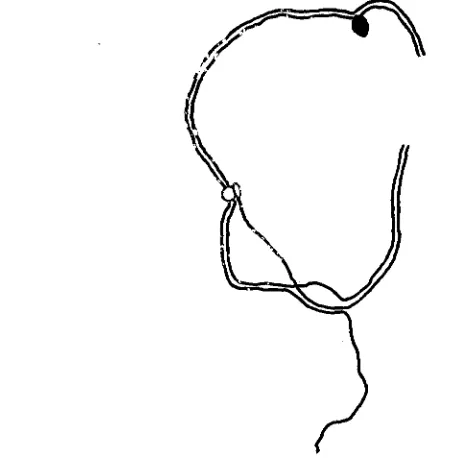
indicates that the insertion regions in themselves have no specific attraction. In disomes a t pachytene the insertion regions of two synapsed chromosomes lie side by side. This is probably caused by their being brought together by the synapsing of the homologous loci on either side and not because of any specific attraction to one another. It was not uncommonly observed that even though the three homologous arms were involved in a synaptic com- plex the terminal insertion region of the fragment was attached or stuck to the insertion regions of other pairs of chromosomes. This “stickiness” of insertion regions has often been observed in normal preparations and is not a characteristic feature of the insertion region of the fragment chromo- some.FIGURE 4.-Camera lucida sketch of synaptic relationships of the fragment chromosome and the two normal chromosomes V a t pachytene. In this figure the insertion region of the fragment is in juxtaposition with the two insertion regions of the normal chromosomes. One of the normal chromosomes has a deeply staining knob in the long arm.
496 M. M. RHOADES
region of the unpaired fragment in some cells, where it was not stuck to other insertion regions, appeared to be split or divided a t pachytene. The distal end of the insertion region was cleft to form a heart-shaped struc- ture. As the diagrammatic sketch of the fragment chromosome in figure 5
illustrates there is a concentration of deeply staining chromatin near the insertion region while the more distal portions contain much less deeply staining material. A considerable amount of genetic data strongly suggests that the disjunction of the insertion regions is always reductional in the first meiotic division. DARLINGTON (1931) in his theory of meiosis accounts for this by assuming that the split of the insertion region occurs some time after the equational split of the chromosome into two chromatids.
If
the observation of the split nature of the terminal insertion region of the un- paired fragment is to be considered applicable to paired chromosomes, then the previous failure to observe the double nature of the insertion region a t midprophase is probably due to its homogenous appearance and because its usual interstitial location is such as to conceal the split if i t occurred. Only when the insertion region is favorably located, that is, terminally, could the split be evident. There is, of course, the possibility that the split condition of the insertion region of the unpaired fragment is not repre- sentative of conditions in paired chromosomes with internal insertion re- gions. Moreover, if the insertion does split a t the same time as the chromo- some there is no reason why the two daughter insertion regions cannot be- have as “one effective insertion region” a t metaphase and anaphase.LEWITSKY (1931) and others hold that no chromosome has a strictly terminal insertion region. It is true that none of the normal complement of maize chromosomes (MCCLINTOCK 1933) has a terminal insertion re- gion b u t LEWITSKY’S statement does not hold for the fragment chromo- somes described in this paper since conditions for cytological observations are exceptionally good a t pachytene in maize and the fragment chromo- some clearly had a terminal insertion region. The fragment chromosome was as stable as the regular complement of 20 chromosomes in its behavior throughout all the somatic mitoses and no irregularities were manifested.
LOCATION OF G E N E S I N LONG AND SHORT ARMS O F CHROMOSOME V
Since the fragment consists of the entire short arm of chromosome V i t can be employed in determining which of the genes located in this chromo- some are situated in the short arm and which are in the long arm. The A Z
C'BROMOSOME FRAGMENT I N MAIZE 497
a I : I backcross ratio will be had for A,: U,. The magnitude of the deviation
will depend upon the frequency with which the fragment chromosome, which carried the dominant allele, is included in functioning femalegametes. The fragment chromosome was paired with the two normal chromosomes a t metaphase I in about 50 percent of the microsporocytes. If we assume that a similar condition holds for the megasporocytes and if we make the further assumption that the unpaired fragment chromosome does not suc- ceed in reaching either of the two poles in anaphase I, and is consequently lost, the expected ratio of
A , :
U, seeds in the backcross of fragment plantsis 5Az:3uz seeds. Table I gives the ratio of A z : a z seeds actually found and indicates that A2 is in the short arm of chromosome
V.
Disomic sister plants gave 869 A , seeds to 890 u2 seeds or a I : I ratio. The average ofFIGURE s.-Diagrammatic sketch of an unpaired fragment chromosome a t pachytene. The equational split into two chromatids has occurred and the heart-shaped appearance of the terminal insertion region suggests that it also is double a t this stage. There is more deeply staining chroma- tin near the insertion region than in the more distal portions of the chromosome.
33.6 percent recessives suggests that either approximately 67 percent of the megasporocytes had a trivalent group or else that the unpaired frag- ment reached one or the other of the two poles in the first anaphase with a considerable frequency.
A
more useful and efficient test for the presence of any locus in the short arm is the occurrence of fragment plants which are homozygous for the recessive gene in the backcross progeny of a frag- ment plant carrying one recessive allele in a normal chromosome. If the locus under consideration is in the short arm, no fragment plants will occur, barring the rare occurrence of exceptional individuals through chromatid crossing over, which are homozygous for the recessive allele. This latter test was used for all the genes tested, as it required fewer plants and was of a more critical nature.Linkage group 5 contains 23 genes. The order of the following genes in u2 bml bv pr y s v,
o 6 12 .?I 40 7 2
the genetic map is correct,
,
according to the data sum-marized by EMERSON et a1 (1935). The exact location of the other genes in the linkage map is uncertain. Eight of the 23 genes in this chromosome
498 M. M. RHOADES
found to be in the long arm of chromosome V while only
A z
and Bml were situated in the short arm. Of especial interest is the placing of Bml andBtl on opposite sides of the spindle fiber insertion region as these two loci
show little crossing over (BURNHAM and RHOADES in EMERSON et a1 1935).A z is only some 6-7 crossover units from Btl, which is in the long arm,
and it occupies, a t present, the leftmost position of all the factors in the genetic map of chromosome V. If the magnitude of crossing over per unit of physical length is the same in the two arms of the chromosome, and we have no reason to believe otherwise, the length of the genetic map for
TABLE I
az
-
Ratio of A z : a z seed from backcross of A Z X-az Az
-
-
-
PEDIQREE OF
FRAQYENT PLANT A2 SEEDS a? SEEDS
PERCENT RECE881VE8
2524 6 187 87 31.8
2524 14 166 66 28.4
2525 9 206 I 18 36.4
2525 6 228 130 36.3
2525 3 59 25 29.8
2524 25 I74 77 30.7
2525 2 117 66 36.1
2525 8 92 44 32.4
2524 29 97 47 32.6
3'17 a I95 I 1 1 36.3
Total 1521 771 Aver.%=33.6
chromosome
V
is due for a considerable extension as new genes are located in the short arm to the left of A z . Three-point backcross data forBml
-
Pr-
V z are available. Bml is so close to the insertion region that wecan consider the amount of crossing over between Bml-Pr essentially equal to that between the spindle fiber and P r . Let us calculate, as best we can, the approximate length of the genetic map for the long arm of chromosome
V.
The three-point backcross data give the following recom- bination values: Bml- Pr = 2 2 . 3 percent, Pr- V z = 4 3 . 4 percent. According to HALDANE'S (1919) table for estimating the map distance from recom- bination percentages the map distance for the Bml-Pr interval is 2 4 . 5units and that for the Pr
-
V Z interval is 60.8 units. The sum 85.3 units gives an estimate of the map distance from the insertion region to the VzCHROMOSOME FRAGMENT I N MAIZE 499
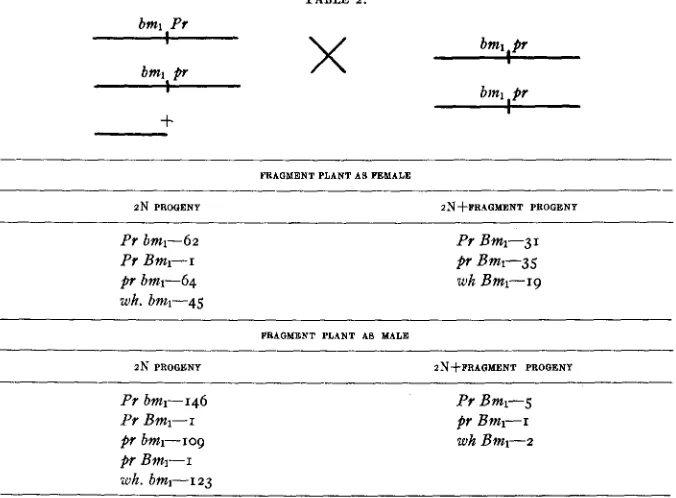
I n the course of the studies with the fragment several plants were ob- tained which carried either recessive a2 or bml in the two normal chromo- somes
V
and the dominant allele in the fragment chromosome. Con- sidering the bml locus these plants were of the following constitution: bmlPr/bmlpr/Bml and for the a2 locus had a2pr/azpr/Az constitution. When a plant carrying the bml gene was used in reciprocal crosses with a recessive individual the following results were obtained :From the above data where the fragment was used as the pollen parent it is evident that even though the fragment plant was Bml in phenotypic appearance it bred true for bml excepting those cases where fragment pol- len functioned or where a crossover had occurred which transferred the
Bml allele to a norwal chromosome.
The following calculations can be made from the data in table 2 . (I) The percentage of functioning eggs carrying the fragment chromosome was 33.
TABLE 2 . bml Pr
___)__I_ bml
,
prI binl pr
8
bml Pr
X
I
-k
W A G N E N T PLANT A 0 FEMALE
-
ZN PROGENY PN+FRAGMENT PROGENY
Pr bml-62
Pr B m l - - i
pr bm1-64
wk. bml-45
PT Bml-31 Pr Bml-35
w h Bml-19
FRAGMENT PLANT AS MALE
I N PROGENY ZNfFRAQMENT PROGENY
PT bml-146 Pr Bml-5
Pr Bml-r pr Bml-1
pr bml-109 wh Bml-2
Bmi-I
wh. bml-i 23
The above crosses were segregating for colored and colorless aleurone. The colorless (wh.) class was included because of the bml data.
(2) The frequency of crossing over between the fragment chromosome and
500 M. M. RHOADES
somes could be used as cytological proof of genetic crossing over if such evidence were needed after the conclusive work of STERN (1931) and CREIGHTON and MCCLINTOCK (1931). Obviously a more critical proof would be the transference of the recessive bmz allele from a normal chromo- some to the fragment chromosome. Such crossovers have occurred in other progenies.
More extensive data from reciprocal crosses similar to the above were obtained for the A 2 locus. The percentage of fragment eggs was 33. The percentage of functioning fragment pollen was 1.2 and the amount of crossing over, based on a thousand individuals, between the fragment chromosome and the normal chromosomes in the A2-insertion region in- terval was six percent. JENKIN’S (1934) data places.Az and Btl
7
units apart. Therefore the map distance from A , to the insertion region is not more than 7 units. The frequency of crossing over between the fragment and the normal chromosome in the A2-insertion region interval was six percent. It would seem then that the frequency of crossing over in thisinterval was the same in disomes as in fragment plants. But the fragment
is associated with the normal chromosome in approximately 50 percent of the microsporocytes. Therefore the cross over value of six units should be doubled. This indicates that crossing over for this interval, when the fragment is associated with the two normal chromosomes, occurs consider- ably more frequently in fragment plants than in diploids.
The results obtained from this study of the fragment chromosome agree with previously known facts concerning the order of genes in this chromo- some. MCCLINTOCK (1932) placed the Bml locus in the short arm near the insertion region from her work with ring-shaped fragments. Moreover, cytogenetic studies with a reciprocal translocation (RHOADES 1933~) in- dicated that Btl and Bml were both near the insertion region of chromo- some
V.
STADLER (1935) obtained a deficiency for theV s
locus. This defi- ciency occurred in the long arm of the chromosome. I n addition to sub- stantiating the above, the fragment studied places the two closely linked genes Btl-
Bml (1-2 units apart) on opposite sides of the insertion region.
Moreover it definitely places six loci in the long arm and two in the short arm of chromosome V.When plants of bmlPr/Bmlpr/Bml constitution were used as the pollen parent in a backcross the following data were obtained:
5 1 5
Pr bml:568p r Bml:383 Pr bml:386 pr bml. These data give a recombination value of
CHROMOSOME FRAGMENT I N MAIZE 501 was not represented in the duplicating fragment (RHOADES 1931). Unfor- tunately only the Pr-insertion region interval was involved in the present studies. More data on this problem will be obtained later.
SUMMARY
I . A plant which was intermediate in appearance between the trisomic and disomic individuals occurred in the progeny of a plant trisomic for chromosome
V.
This exceptional plant carried in addition to the normal complement of 2 0 chromosomes a fragment of chromosome V. The frag- ment chromosome consisted of the entire short arm of chromosomeV
with a terminal spindle fiber insertion region.2 . The cytological behavior of this fragment chromosome was studied
a t pachytene and metaphase in microsporocytes. The fragment chromo- some was associated with the two normal chromosomes in approximately one-half the cells. Segregation of the three members of the trivalent groups was not random, but in such a manner that the fragment chromosome usu- ally accompanied one of the normals when it passed to a pole.
3 . The spindle fiber insertion region of the fragment chromosome was
observed to be split or double in those cells where it was lying free in the nucleus as a univalent. The equational split into two chromatids was clearly evident.
4. The V2
Ys
P r V12V 3
andBtl
loci were located in the long arm ofchromosome
V.
The Bml and A 2 loci were located in the short arm of the chromosome.5.
Pollen hyperploid for the fragment chromosome occasionally func- tioned in competition with haploid pollen.6. Crossing over in certain regions was apparently more frequent in fragment plants than in diploids.
LITERATURE CITED
CREIGHTON, H. B. and MCCLINTOCK, BARBARA, 1931 A correlation of cytological and genetical DARLINGTON, C. D . , . I ~ ~ I Meiosis. Biol. Rev. 6 : 221-264.
DOBZHANSKY Th. and STURTEVANT, A. H., 1931 Translocations between the second and third chromosomes of Drosophila and their bearing on Oenothera problems. Pub. Carnegie Instn.
421 : 29-59.
EMERSON, R. A., BEADLE, G. and FRASER, A. C., 1935 A summary of linkage studies in maize. Mem. Cornel1 Agric. Expt. Sta. 180: 1-83.
HALDANE, J. B. S., 1919 The combination of linkage values and the calculation of distances be- tween the loci of linked factors. J. Genet. 8: 291-297.
HUSKINS, C. L. and HEARNE, E. MARIE, 1933 Meiosis in asynaptic dwarf oats and wheat. J. Roy. Micr. Soc. 53 : 109-1 I 7.
JENKINS, M. T., 1934 Linkage relations of the Azaz factor pair in maize. J. Amer. Soc. Agron.
LEWITSKY, G. A., 1931 Bull. Appl. Bot. Genet. Plant Breeding 27: 24-264.
crossing over in Zea mays. Proc. Nat. Acad. Sci. 17: 492-497.
5 0 2 M. M. RHOADES
MCCLINTOCK, BARBARA, 1932 A correlation of ring-shaped chromosomes with variegation in Zea Mays. Proc. Nat. Acad. Sci. 18: 677-681.
1933 The association of non-homologous parts of chromosomes in the mid-prophase of meio- sis in Zea Mays. Z. Zellf. mik. Anat. 19: 191-237.
RHOADES, M. M., 1931 A new type of translocation in Drosophila melanogaster. Genetics 16: 490- 504.
1g33a An experimental and theoretical study of chromatid crossing over. Genetics 18: 535- 5 5 5 .
1933b A secondary trisome in maize. Proc. Nat. Acad. Sci. 19: 1031-1038.
1933~ A cytogenetical study of a reciprocal translocation in Zea. Proc. Nat. Acad. Sci. 19: 1022-103 I.
STERN, C., 193 I Zytologisch-genetische untersuchungen als Beweise fur die Morgansche Theorie
des Faktorenaustausche. Biol. Zhl. 51 : 547-587.