Scholarship at UWindsor
Scholarship at UWindsor
Electronic Theses and Dissertations Theses, Dissertations, and Major Papers
2008
The experience of deliberate self -harm: Impulsive and
The experience of deliberate self -harm: Impulsive and
compulsive features
compulsive features
Sarah Bertrim University of Windsor
Follow this and additional works at: https://scholar.uwindsor.ca/etd
Recommended Citation Recommended Citation
Bertrim, Sarah, "The experience of deliberate self -harm: Impulsive and compulsive features" (2008). Electronic Theses and Dissertations. 8194.
https://scholar.uwindsor.ca/etd/8194
This online database contains the full-text of PhD dissertations and Masters’ theses of University of Windsor students from 1954 forward. These documents are made available for personal study and research purposes only, in accordance with the Canadian Copyright Act and the Creative Commons license—CC BY-NC-ND (Attribution, Non-Commercial, No Derivative Works). Under this license, works must always be attributed to the copyright holder (original author), cannot be used for any commercial purposes, and may not be altered. Any other use would require the permission of the copyright holder. Students may inquire about withdrawing their dissertation and/or thesis from this database. For additional inquiries, please contact the repository administrator via email
This reproduction is the best copy available.
by
Sarah Bertrim, M.A.
A Dissertation
Submitted to the Faculty of Graduate Studies Through the Department of Psychology in Partial Fulfillment of the Requirements for
the Degree of Doctor of Philosophy at the University of Windsor
Windsor, Ontario, Canada
2008
1*1
Published Heritage Branch
Direction du
Patrimoine de I'edition
395 Wellington Street OttawaONK1A0N4 Canada
395, rue Wellington OttawaONK1A0N4 Canada
Your file Votre reference ISBN: 978-0-494-57644-1 Our file Notre reference ISBN: 978-0-494-57644-1
NOTICE: AVIS:
The author has granted a
non-exclusive license allowing Library and Archives Canada to reproduce, publish, archive, preserve, conserve, communicate to the public by
telecommunication or on the Internet, loan, distribute and sell theses
worldwide, for commercial or non-commercial purposes, in microform, paper, electronic and/or any other formats.
L'auteur a accorde une licence non exclusive permettant a la Bibliotheque et Archives Canada de reproduire, publier, archiver, sauvegarder, conserver, transmettre au public par telecommunication ou par Nnternet, preter, distribuer et vendre des theses partout dans le monde, a des fins commerciales ou autres, sur support microforme, papier, electronique et/ou autres formats.
The author retains copyright ownership and moral rights in this thesis. Neither the thesis nor substantial extracts from it may be printed or otherwise reproduced without the author's permission.
L'auteur conserve la propriete du droit d'auteur et des droits moraux qui protege cette these. Ni la these ni des extraits substantiels de celle-ci ne doivent etre imprimes ou autrement
reproduits sans son autorisation.
In compliance with the Canadian Privacy Act some supporting forms may have been removed from this thesis.
Conformement a la loi canadienne sur la protection de la vie privee, quelques formulaires secondaires ont ete enleves de cette these.
While these forms may be included in the document page count, their removal does not represent any loss of content from the thesis.
Bien que ces formulaires aient inclus dans la pagination, il n'y aura aucun contenu manquant.
1*1
I hereby certify that I am the sole author of this thesis and that no part of this
thesis has been published or submitted for publication.
I certify that, to the best of my knowledge, my thesis does not infringe upon
anyone's copyright nor violate any proprietary rights and that any ideas, techniques,
quotations, or any other material from the work of other people included in my thesis,
published or otherwise, are fully acknowledged in accordance with the standard
referencing practices. Furthermore, to the extent that I have included copyrighted material
that surpasses the bounds of fair dealing within the meaning of the Canada Copyright Act,
I certify that I have obtained a written permission from the copyright owner(s) to include
such material(s) in my thesis and have included copies of such copyright clearances to my
appendix.
I declare that this is a true copy of my thesis, including any final revisions, as
approved by my thesis committee and the Graduate Studies office, and that this thesis has
Although non-suicidal deliberate self-harm (DSH) is often characterized as
impulsive in the literature, the impulsive and compulsive features of DSH have not been
adequately investigated. This study used qualitative and quantitative methods to examine
the impulsive and compulsive features of DSH in two samples: clinicians describing the
prototypical DSH client (N= 115) and undergraduates self-reporting on DSH experiences
(N= 96). Of 3460 undergraduates, 12.14% endorsed a history of multiple DSH episodes.
Both samples endorsed predominantly multiple methods including self-cutting,
scratching, burning, and hitting. According to Simeon and Favazza's (2001) hypothetical
model, these would be classified as "impulsive" DSH (98.25% in clinician sample,
94.79% in undergraduate sample). It was predicted that clinicians would describe DSH
as more impulsive than compulsive, consistent with this model. In contrast, it was
predicted that undergraduates would describe more compulsivity than impulsivity in
association with DSH. Items generated to reflect impulsive and compulsive features of
DSH were evaluated using expert ratings of these items and established measures of
impulsivity and compulsivity. Analyses within and between the two samples revealed:
(1) a set of items designed to reflect impulsive and compulsive features of DSH can be
reduced to components relating to these two constructs in both samples; (2) impulsivity
and compulsivity as reflected in these items show a negative correlation (r = -.42, p <
.01); (3) clinicians described more compulsive than impulsive features in association with
the prototypical DSH client's DSH; (4) undergraduates described more compulsive than
impulsive features in association with DSH; (5) in undergraduates, general impulsivity
and compulsivity positively predicted the number of methods of DSH, while
DSH-specific compulsive features were positive predictors of number of methods, frequency,
and frequency per year. Impulsive/urge-driven features positively predicted number of
methods and negatively predicted severity. Qualitative data offered insights into the
complex relationship between impulsivity and compulsivity. These findings suggest that
it is inaccurate to qualify these forms of DSH as "impulsive" in clinical and non-clinical
settings, and that compulsivity (particularly specifically as it relates to DSH) may play a
participate in this project. Without their willingness to share their experiences, this
project would not have been possible. I am encouraged by the comments offered by
many of the clinician respondents, as they showed that excitement for research and
support of doctoral training are alive and well. I am very grateful to the undergraduate
participants who shared their personal experiences and provided rich insights into the
experience of DSH. My hope is that I have done their efforts justice, and that this work
contributes to an enhanced understanding of DSH.
I would also like to thank my advisor, Dr. Stephen Hibbard, who provided
insights, suggestions, and consultation throughout the formulation and execution of this
study. My committee members' enthusiastic and collaborative approach to their roles
enhanced the project on many levels, and I thank them for helping to make this a
rewarding experience for me.
My friends and family have been wonderful supports, and have helped me through
this lengthy process in many ways. Those who have gone through the process of
completing a doctoral dissertation - and those are going through it now - have been great
source of information, advice, company, distraction, commiserating, and refraining the
light at the end of the tunnel when it sometimes seemed a little dim. I am fortunate to
have such great people in my life, and I look forward to our next adventures together.
Most of all, I want to thank my husband, Chris, who has been an endless source of
support and encouragement throughout this process. Without exception, he has been
dedicated to doing anything and everything to facilitate my graduate training. He
cheerfully uprooted from Montreal to move to Windsor and then to Ottawa. He accepted
going into debt and having little free time together without complaint. He quietly allowed
me to be stressed out and preoccupied when I needed to be, and he offered fun diversions
at precisely the right moments. Somehow in the meantime, he found time to change
career paths, acquire a new skill set, launch a great career with an exciting future, and
donate a substantial portion of his liver for transplant. In short, I could not have asked for
a more loving and responsive partner who is just an all-around amazing person. I feel so
Page
AUTHOR'S DECLARATION OF ORIGINALITY iii
ABSTRACT iv
DEDICATION v
LIST OF TABLES xiii
Chapter
I INTRODUCTION
DSH in Historical Context
Overview
Early contributions
Early classification of DSH
Focus on DSH in psychiatric inpatient facilities and
hospital settings
Increasing scientific rigour
Classification of DSH
Summary of Historical Overview
Definition of DSH
Classification of Impulsive and Compulsive DSH
Prevalence of DSH
Age at Onset and Course
Characteristics of DSH
Gender
Culture and Ethnicity
DSH and the DSM-IV Nomenclature
Diagnoses Associated with DSH
Other Features Associated with DSH
Functions of DSH
Treatment of DSH
The Relationship Between Impulsivity and Compulsivity
1
3
3
3
4
7
8
8
11
12
14
17
18
19
21
21
22
23
25
26
28
Features of Impulsivity
Models and Measures of Impulsivity
DSH as an Impulsive Act
The Construct of Compulsivity
Features of Compulsivity
Models and Measures of Compulsivity
DSH as a Compulsive Act
Evaluating Impulsivity and Compulsivity in DSH
Rationale and Purpose of the Present Study
Overview of the Present Study
Hypotheses
34 35 38 40 41 44 45 46 48 50 52
II Study 1 (Clinician Survey)
METHOD
Participants and Procedure
Participants
Procedure
Tests and Measures
DSH Questionnaire for Clinicians (DSH-C)
55
55
55
56
58
58
III Study 1 (Clinician Survey)
RESULTS 59
Description of Clinicians' Experiences with Clients Engaging
in DSH 59
Experience base with clients engaging in DSH 59
Description of the "most typical or salient" DSH client 59
DSH Characteristics 60
of sessions 64
Qualitative Analyses 66
Interrater reliability 66
Themes identified in qualitative analysis 67
Analysis of DSH-C Questionnaire Data 70
Principal components analysis 70
Internal consistency of four-factor solution 73
Expert Ratings Analysis 73
Expert ratings 73
Intra- and intercorrelations of experts' ratings on
Impulsivity and compulsivity with DSH-C components 76
Intracorrelations of expert ratings 77
Intracorrelations of DSH-C components 77
Relations of expert ratings to DSH-C components 78
Summary of DSH-C Questionnaire Data 81
Construction of Impulsivity and Compulsivity Scales using
the DSH-C 82
Summary of Clinician Respondent Data (Study 1) 83
Study 2 (Undergraduate Sample)
METHOD 85
Participants and Procedure 85
Participants 85
Procedure 86
Tests and Measures 88
DSH Questionnaire for Undergraduates (DSH-U) 88
Frequency of Impulsive and Compulsive Acts (FICA) 89
1.7 91
Behavioral Inhibition/Activation Scales (BIS/BAS) 91
Tridimensional Personality Questionnaire (TPQ) 92
State Trait Anxiety Inventory (STAI) 93
Yale-Brown Obsessive Compulsive Scale (Y-BOCS) 93
Padua Inventory (PI) 94
Paulhus Deception Scales (PDS) 94
Qualitative Methods 95
Study 2 (Undergraduate Sample)
RESULTS 97
Description of Undergraduate Participants Engaging in DSH 97
Evidence relating to reporting 97
Gender 98
Age at onset and course of DSH 98
Number and type of DSH methods 99
Mental health and medical treatment history 101
Diagnoses 102
Frequency of impulsive and compulsive acts 104
Analysis of DSH-U Questionnaire Data 106
Principal components analysis 106
Internal consistency of four-factor solution 109
Relations of Expert Ratings to DSH-U Components 109
Intracorrelations among DSH-U components 111
Relations of expert ratings to DSH-U components 111
Analysis of Impulsivity and Compulsivity Questionnaire Data 114
Correlations between DSH-U components and measures of
impulsivity and compulsivity 119
Construction of DSH Impulsivity and DSH Compulsivity Scales 121
Comparing DSH Impulsivity and DSH Compulsivity within
and between samples 126
Correlations between DSH scales and measures of
impulsivity and compulsivity 130
Predicting DSH Characteristics from Impulsivity and
Compulsivity 132
Predicting DSH Characteristics from Measures of Impulsivity
and Compulsivity 133
Predicting DSH Characteristics from DSH-U Components 136
Predicting DSH Characteristics from DSH Impulsivity and
DSH Compulsivity Scales 140
Summary of Data Predicting DSH Characteristics from
Impulsivity and Compulsivity 142
Qualitative Analyses of Undergraduate DSH Experience 144
Qualitative Analysis of Written Paragraph 145
Interrater reliability 146
Before DSH 146
During DSH 150
After DSH 154
Overall Experience of DSH 156
Process of DSH 158
Qualitative Analysis of Semi-Structured Interviews 160
Validity and reliability in semi-structured interviews 160
Qualitative analysis 162
ego-dystonic nature of DSH 165
Deliberation or efforts to resist DSH 167
Primary reward following DSH 168
Regret following DSH 169
Pattern of impulsive and compulsive features 170
VI DISCUSSION 172
Summary of Findings 174
Study 1: Clinician survey 174
Study 2: Undergraduate sample 177
Integration of Study 1 and Study 2: Comparison of
impulsive and compulsive features 180
Relevance of Findings to Hypotheses 181
Hypothesis 1 and hypothesis 2 181
Hypothesis 3 and hypothesis 4 183
Predicting DSH characteristics from impulsivity and
compulsivity 186
Practical Implications 188
Theoretical Implications 189
Limitations and Directions for Future Research 191
APPENDIX A - Study 1 (Clinician Survey)
Appendix A l : Letter of Information 195
Appendix A2: Clinicians Demographic Information 197
Appendix A3: Clinicians - Understanding of DSH 198
Appendix A4: DSH Questionnaire for Clinicians (DSH-C) 200
Appendix A5: Response Card 201
Appendix A6: Debriefing Form 202
APPENDIX B - Study 2 (Undergraduate Sample)
Appendix Bl
Appendix B2
Appendix B3
Appendix B4
Appendix B5
Appendix B6
Appendix B7
Appendix B8
Undergraduate Telephone Screen
Consent to Participate in Research
Letter of Information
Undergraduate Demographic Information
DSH Questionnaire for Undergraduates (DSH-U)
Undergraduates: The Experience of DSH (Paragraph)
Semi-Structured Interview
Debriefing Form
207
210
213
215
218
219
220
225
REFERENCES 226
Study 1: Clinician Survey
Table Page
1. Demographics of Clinician Respondents 55
2. Description of "most typical or salient" DSH Client 60
3. Age at Onset and Course for "most typical or salient" DSH Client 61
4. DSH Methods for "most typical or salient" DSH Client 62
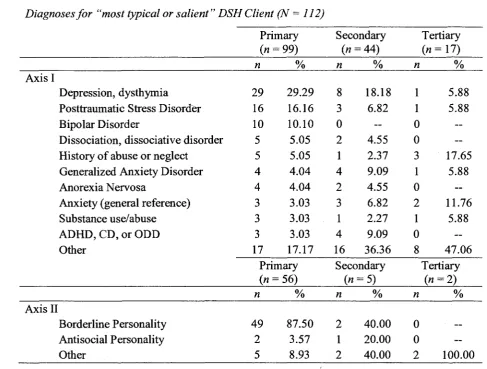
5. Diagnoses for "most typical or salient" DSH Client 64
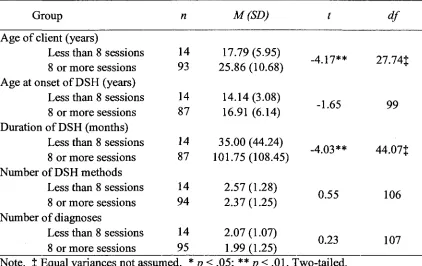
6. Independent Samples Mests Comparing Groups Based on
Number of Sessions 65
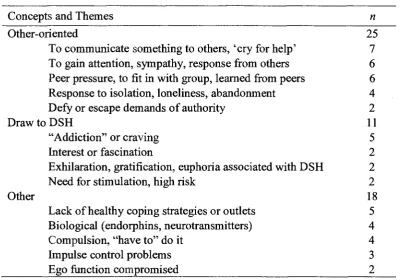
7. Qualitative Analysis of Clinician-Identified DSH Themes 67
8. Total Variance Explained for PC A of DSH-C 71
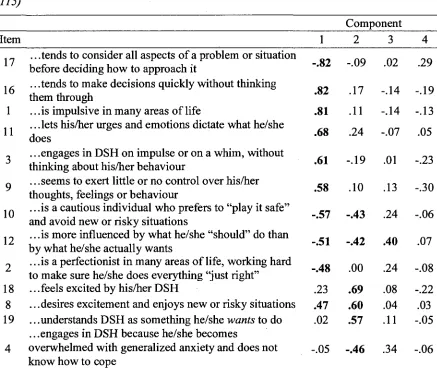
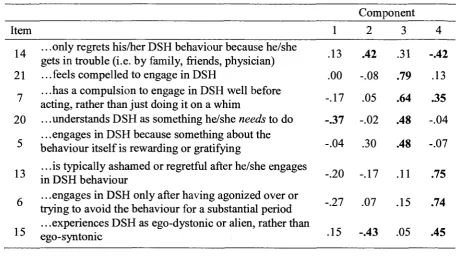
9. Variable Loadings on Four Extracted Components for DSH-C
(Varimax Rotation) 72
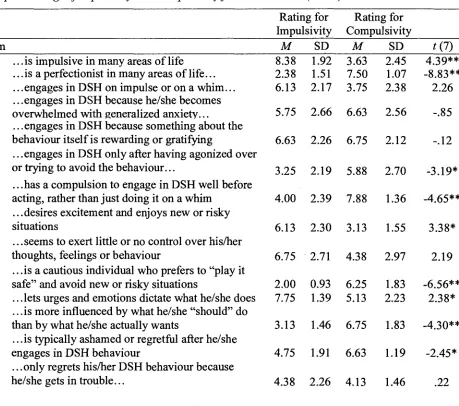
10. Expert Ratings of Impulsivity and Compulsivity for DSH-C Items 74
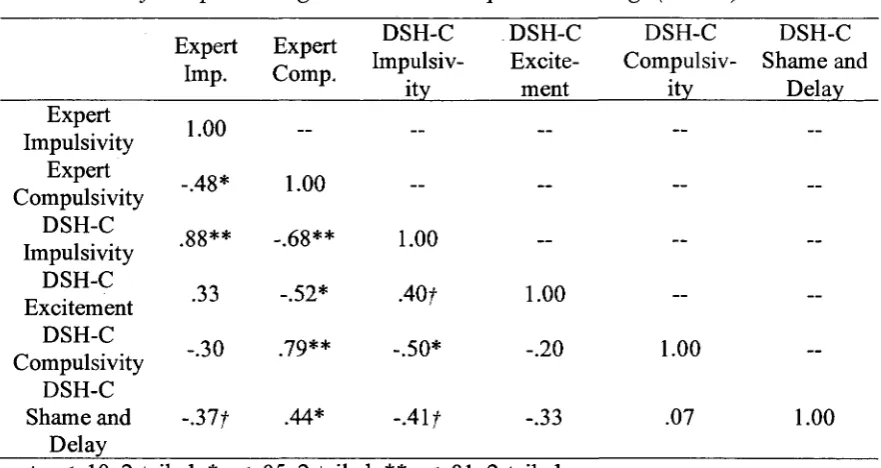
11. Correlations for Expert Ratings and DSH-C Component Loadings 77
12. Sequential Regression for Variables Predicting Expert Impulsivity Ratings 79
13. Sequential Regression for Variables Predicting Expert Compulsivity Ratings 80
Study 2: Undergraduate Sample
14. Demographics of Undergraduate Participants 85
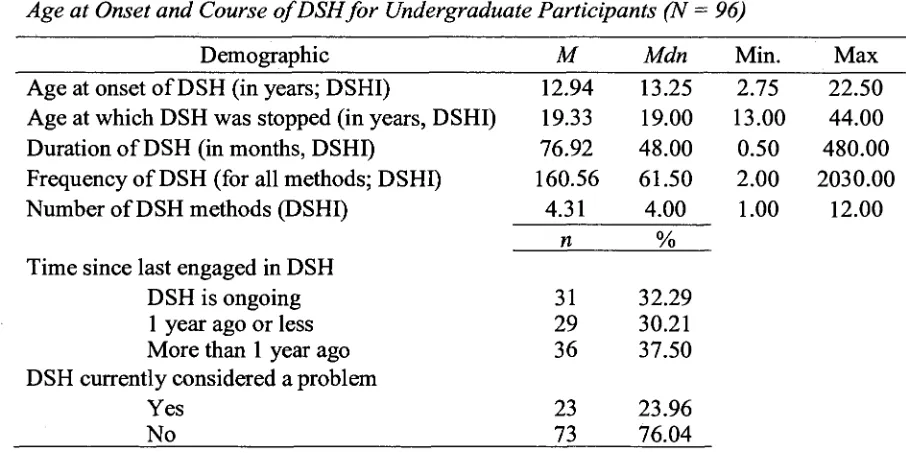
15. Age at Onset and Course of DSH for Undergraduate Participants 99
16. DSH Methods for Undergraduate Participants 100
17. Mental Health and DSH Treatment History in Undergraduate Participants 102
18. Diagnoses for Undergraduate participants 103
19. Impulsive Behaviours Endorsed by Undergraduate Participants 105
20. Compulsive Behaviours Endorsed by Undergraduate Participants 105
21. Total Variance Explained for PCA of DSH-U 106
22. Variable Loadings of Four Extracted Components for DSH-U
(Varimax Rotation) 108
24. Sequential Regression for Variables Predicting Expert Impulsivity Ratings 112
25. Sequential Regression for Variables Predicting Expert Compulsivity Ratings 113
26. Questionnaire Data for Undergraduate Sample 114
27. Total Variance Explained for PCA of Impulsivity and Compulsivity Measures 115
28. Variable Loadings on Two Extracted Components for Impulsivity and
Compulsivity Measures (Varimax Rotation) 116
29. Simultaneous Regression for DSH-U Components Predicting
Impulsivity/Sensation Seeking 118
30. Simultaneous Regression for DSH-U Components Predicting
Anxious Compulsivity 118
31. Bivariate Pearson Correlations between DSH-U Components and Measures of
Impulsivity and Compulsivity 120
32. Statistics for DSH Items for Clinicians, Undergraduates, and
Combined Samples 123
33. Item-total Statistics for DSH Impulsivity and DSH Compulsivity Scales 125
34. Mixed Design ANOVA for DSH Engagement Style (Impulsivity versus
Compulsivity by Engagement Style Specificity (General versus Specific) by
Group (Clinicians versus Undergraduates) 127
35. Bivariate Pearson Correlations between DSH Scales and Measures of
Impulsivity and Compulsivity 131
36. Summary of Simultaneous Regression Analyses for Impulsivity/Sensation
Seeking and Anxious Compulsivity Components Predicting DSH
Characteristics 133
37. Logistic Regression for Impulsivity/Sensation Seeking and
Anxious Compulsivity Components Predicting DSH Severity 135
38. Summary of Simultaneous Regression Analyses for DSH-U Components
Predicting DSH Characteristics 137
39. Logistic Regression for DSH-U Components Predicting DSH Severity 139
40. Summary of Simultaneous Regression Analyses for DSH Impulsivity and
41. Logistic Regression for DSH Impulsivity and DSH Compulsivity
Predicting DSH Severity 142
42. Experience Before DSH based on Written Paragraphs 146
43. Experience During DSH based on Written Paragraphs 150
44. Experience After DSH based on Written Paragraphs 154
45. Overall Experience of DSH based on Written Paragraphs 156
46. DSH Process based on Written Paragraphs 159
47. Impulsive and Compulsive Features of DSH based on Semi-Structured
CHAPTER I
Introduction
Despite a long history and many anecdotal accounts in the literature, deliberate
self-harm (DSH) remains a complex phenomenon that is only in the early stages of being
examined empirically. Until relatively recently, researchers and theorists have struggled
to define DSH, let alone understand the features and phenomenology of this behaviour in
its varied forms and populations. Many contemporary researchers define DSH as the
deliberate, direct destruction or alteration of one's own body tissue without conscious
suicidal intent (Favazza, 1998).
Although several descriptive and hypothetical models of the etiology,
phenomenology, and classification of DSH have been proposed, fewer studies have
examined these aspects of DSH empirically. One popular such model suggests that DSH
can be divided into compulsive DSH (i.e., hair pulling, nail biting, skin picking) and
impulsive DSH (repetitive or episodic self-cutting, burning, hitting), with recognition that
some impulsive and compulsive features may overlap (Favazza & Rosenthal, 1990;
Simeon & Favazza, 1995). Notwithstanding the relative lack of systematic evaluation of
this model, some researchers have referred to "impulsive DSH" and "compulsive DSH"
as distinct entities, perhaps in part due to the model's intuitive appeal and convention. In
addition, much of the research to date has focused on specific clinical samples,
particularly borderline personality disorder and eating disorders, despite evidence that a
substantial proportion of non-clinical samples engage in repetitive DSH. Thus, the degree
to which findings might generalize to non-clinical or other samples is unclear.
Recent work has begun to examine DSH in more depth, and the beginnings of an
empirically based understanding of the features and functions of DSH have begun to
emerge. This study will contribute to an empirically based understanding of the process
of how DSH occurs, namely by examining the impulsive and compulsive characteristics
of repetitive DSH. Traditionally, DSH has been viewed as an impulsive act,
characterized by a failure to resist impulses to self-harm. Indeed, contemporary
researchers often make the assumption that "impulsive" DSH (skin cutting, burning,
hitting) is indeed impulsive in nature, or is associated with impulsivity (for example,
regard have not been consistent and many aspects of the experience of DSH seem to be
more consistent with a compulsive act, even within the putative "impulsive DSH"
category. The impulsive and compulsive features of DSH have not been examined in the
literature in an in-depth manner and this topic merits investigation. This is an important
aspect of DSH to consider as it has implications for understanding, classifying,
researching, and treating DSH.
In order to address this gap in the literature, this study will employ both
qualitative and quantitative methods to examine the impulsive and compulsive features of
DSH. The inclusion of qualitative methods is essential to allow a description of the
phenomenology of DSH. Phenomenology refers to the study of an individual's lived
experience, including their detailed description of the experience in question and the
subjective meaning they construct relating to that experience (Starks & Brown, 2007).
Thus, qualitative methods were included to permit a rigorous description of the DSH
experience from the perspective of the individual engaging in the behaviour. This will in
turn allow for an integration of qualitative and quantitative data, strengthening the
understanding of the experience or phenomenology of DSH.
In addition to using both qualitative and quantitative methods, DSH will be
considered from two distinct perspectives. First, impulsive and compulsive features of
DSH will be examined from the perspective of mental health professionals in reference to
what they consider to be the prototypical client who engages in repetitive DSH. Second,
these features of DSH will be examined from the perspective of a non-clinical sample of
undergraduate students with a history of repetitive DSH. This study will provide an
empirical basis upon which to base an understanding of the experience of DSH in terms
of impulsive and compulsive features, both within and between these two groups. In
addition, this study will employ multiple measures to capture the multidimensional
constructs of impulsivity and compulsivity. These constructs will be concretely
operationalized and they will be examined in terms of how they apply to the act of DSH
in these samples. Finally, this study's inclusion of a non-clinical sample is important, as
DSH in Historical Context
Overview. Prior to the last 10 to 15 years, the majority of the literature on DSH
could be characterized as descriptive reports and attempts to classify the behaviour using
non-empirical means. Many researchers to date have been primarily focused on
describing characteristics of DSH including the prevalence, age of onset, the most
common types and frequency of self-harm, and associated features or characteristics.
Some have focused on examining why DSH occurs from a motivational or functional
perspective. Other researchers have made attempts to classify DSH, with the implicit aim
of providing a framework within which the professional community can research and
treat DSH.
In general, early studies are plagued with serious weaknesses that limit their utility
and generalizability, including a tremendous variance in the definition of DSH, a
predominance of single case studies and small samples, a heavy reliance on psychiatric
inpatient or prisoner samples, and a lack of comparison and control groups (Feldman,
1988; Ross & McKay, 1979). Importantly, there has historically been a relative lack of
literature concerning DSH in non-clinical samples despite the acknowledgement that
DSH in non-clinical groups seems to be increasing in prevalence (Skegg, 2005) and may
have unique characteristics as compared to clinical or prisoner samples. Furthermore,
many researchers consider some forms of DSH to be an impulsive act without adequately
evaluating the impulsive and compulsive features of DSH (Favazza & Rosenthal, 1993).
Despite these limitations, these studies have been imperative in providing a
foundation on which researchers continue to build. They have clearly shaped the
conceptualization of what constitutes DSH and guided the literature to date. Therefore, a
review of selected contributions will demonstrate this study's place in the development of
this body of work. With this foundation, it is possible to extend the literature beyond
describing the features and functions of DSH, and begin to empirically address the
question of how DSH occurs in terms of impulsive and compulsive processes.
Early contributions. Observations and case reports of DSH are evident in the
literature, with some dramatic case reports and descriptions of DSH being noted as early
as the 19 century (Favazza, 1998). Many of these reports presented sensationalized
the behaviour. The few authors that endeavoured to explain the puzzling phenomenon
tended to use the predominant psychoanalytic perspective, pointing to actual or symbolic
castration, or a compromise between life, death, or sexual drives as an explanation
(Ackerman & Chidester, 1936; Dabrowski, 1937; Menninger, 1935). Standing out among
these case studies, Emerson (1913) presented the psychoanalysis of a woman who
engaged in repetitive self-cutting in order to relieve distress. According to this report, the
woman "was not insane" (p. 41) and in fact was portrayed as quite insightful. Emerson
interpreted the woman's self-harm as stemming from psychosexual trauma, symbolism
associated with sexuality and menstruation, and aggressive tendencies against the self.
Most notably, Emerson acknowledged that there was a "multiplicity of motives" (p. 51)
underlying the behaviour, and suggested that self-harm of this nature "is too complex to
be merely impulsive, it is the end result of a process of thinking, motivated by feelings
and impulses aroused by the repressed memories of early sadistic and perverse treatment"
(p. 50). Thus, while Emerson's emphasis was on psychoanalytic interpretations of the
behaviour, he noted the likelihood of over-determined etiology and the nature of the act
itself as being more complex than a simple impulsive response.
Early classification ofDSH. Menninger is credited with the first documented
attempt to classify DSH in his work, Man Against Himself (1938). He divided
self-mutilation into six categories: Neurotic self-self-mutilation (nail-biting, skin-picking and
disfiguring hair-removal); religious self-mutilation (genital self-mutilation); puberty rites
(hymen removal and circumcision); psychotic self-mutilation (enucleation of the eyes and
extremity amputation in psychosis); self-mutilation in organic diseases (intentional
fracturing of fingers); and customary and conventional self-mutilation (shaving beards
and clipping fingernails). In his conceptualization of this behaviour, Menninger
considered the physiological and psychological functioning of the individual, the meaning
of the self-harming behaviour in the individual's cultural or subcultural context, the
severity and nature of the self-harm behaviour, and the psychodynamic origins of the
behaviour. Thus, Menninger took an early bio-psycho-social approach to understanding
DSH (Walsh & Rosen, 1988).
Like all classification systems, Menninger's model was imperfect as some
his categories (Walsh & Rosen, 1988). However, Menninger's (1935) work presented a
distinct advantage over the previous psychodynamic reports of DSH since it emphasized
the importance of multiple factors beyond those relating only to intrapsychic or
psychodynamic drives and conflicts. In addition, he considered self-harm to be present in
both "normal" and pathological populations, disputing some of the sensationalized reports
of severe DSH. Menninger emphasized that self-injury may be an attempt at self-healing
or self-preservation. He was the first to make the important distinction between suicide
and self-harming behaviour, highlighting the "paradox that local self-destruction is a form
of partial suicide to avert total suicide" (Menninger, 1935, p. 450). The distinction
between deliberate self-harm and suicide remained elusive to the field for decades, and
the two were not consistently or adequately distinguished until relatively recently
(Guertin et al., 2001). Therefore, although they were not integrated into the DSH
dialogue for many years, Menninger's insights constitute groundbreaking contributions to
our understanding of this complex phenomenon.
In an apparent endeavour to further consider the nature of DSH, Menninger (1935,
1938) contrasted neurotic self-mutilations with those of psychotic individuals, perhaps
foreshadowing the distinction between compulsive and impulsive processes. According to
psychoanalytic theory, the role of the ego is to find a compromise between the internal
demands of the individual with those of the conscience or the external world (Ford &
Urban, 1998). In the case of neurotic self-mutilation, Menninger (1935) explained that
the conscience of the individual is stern or cruel and demands self-punishment, so the ego
"concedes as little as possible to insistence of the conscience" (p. 411), the result of
which is self-mutilating acts rather than more severe self-punishment. In contrast, he
described the psychotic individual's ego as sick or powerless, and therefore unable to
strike a compromise with the demanding conscience. He also implied that the psychotic
individual is more moved by destructive urges, and less able to resist these due to an
impaired ego. In Menninger's view, this results in the ego surrendering completely to the
conscience's demands for self-punishment or to the destructive urges experienced,
resulting in particularly severe acts of self-mutilation and self-amputation. He also
suggested that 'normal' individuals are less at the mercy of the harsh conscience and are
make a suitable compromise that does not involve self-harm. While clearly
psychoanalytic in nature, this theory of self-harm behaviour suggests alternative
processes to explain self-harm in different populations, perhaps with psychotic and
neurotic self-harm corresponding in some respects to impulsive and compulsive
processes, respectively.
Later in an alternative classification system of DSH, Pao (1969) identified two
types of cutting behaviour, coarse and delicate self-cutting. Like Menninger, Pao's
endeavour to distinguish deliberate self-harm from suicidality was an important
distinction that was typically ignored prior to the late 1970s and 1980s. In Pao's model,
coarse self-cutting consisted of single-episode, life threatening acts of self-harm, while
delicate self-cutting referred to repeated episodes of superficial cuts that were non-life
threatening in severity. In a study of 413 new admissions to a psychiatric hospital over a
10-year period, Pao (1969) found that 7.7 percent of admissions engaged in self-cutting,
with 15.6 % engaging in coarse self-cutting and 84.4 % engaging in delicate self-cutting.
He found that individuals who engaged in coarse self-cutting were older (at least 35 years
of age), predominantly male, and typically suffering from a psychotic depression. In
contrast, individuals who engaged in delicate self-cutting were younger (between age 16
and 24 years), predominantly female, and typically vacillating between "being psychotic
and being 'normal'" (p. 195). He also noted that the delicate self-cutter exhibited
periodic but marked withdrawal that was punctuated with "sudden 'impulsive' action
such as breaking things" (p. 196), a pattern that was interspersed with periods of normal
behaviour and appropriate functioning.
Pao (1969) focussed the majority of his discussion on the associated
characteristics and dynamics of delicate self-cutting in women, describing the experience
as an altered state comparable to depersonalization, derealization, or a fugue state. He
suggested that due to mounting tension, the individual would become highly focused on
the self and cease to allow the ego to monitor interactions with the environment, which
would in turn result in the individual participating in the drive-dominated act of
self-harm. More concretely, Pao explained that the woman would experience an unexplained
increase in tension, would "struggle with herself over cutting or not cutting" (p. 198), and
the moment of cutting, the individual was oblivious to her surroundings, unaware of the
act of cutting, and did not experience a pain sensation. Once realizing what had
happened, Pao indicated that the women might be overwhelmed with feelings of disgust,
regret, or guilt but that pleasure was also experienced due to the relief of tension. It is
interesting to note that Pao's description of mounting tension, acting on a
drive-dominated impulse to self-cut, and experiencing pleasure and relief following the act is
consistent with some definitions of an impulsive act (Oldham, Hollander & Skodol,
1996). However, the mounting tension before the act, the struggle over whether or not to
engage in self-harm, and the tension reduction and guilt that followed the act may be
more consistent with a compulsive behaviour (see Skodol & Oldham, 1996).
Focus on DSH in psychiatric inpatient facilities and hospital settings. Between
the mid-1960s and mid-1970s there was a resurgence of publications that tended to centre
specifically on self-cutting in psychiatric inpatient facilities and emergency departments,
with authors often referring to DSH as 'wrist cutting' or 'wrist slashing' (for example,
Graff & Mallin, 1967; Rosenthal, Rinzler, Wallsh, & Klausner, 1972). In general, this
behaviour was viewed as reflecting particularly severe pathology, and these individuals
were regarded as dramatic frequenters of inpatient services (Rosenthal et al., 1972).
Indeed, Graff and Malin (1967) suggested that, "wrist slashers have become the new
chronic patients in mental hospitals, replacing the schizophrenics" (p. 36). Although
many authors failed to distinguish between individuals attempting suicide and those
engaging in self-harm without suicidal intent, they endeavoured to describe various
features of the "typical chronic cutter" (Rosenthal et al., 1972). Attempts to outline a
'wrist-cutting syndrome' resulted in some preliminary efforts to make generalizations
about characteristics of this population. Most accounts during this time described
individuals who engage in deliberate self-harm as attractive, intelligent, unmarried young
women who, among other difficulties, have trouble relating successfully to others (for
example, Graff & Malin, 1967; Grunebaum & Klerman, 1967). The seemingly
paradoxical presentation of individuals with such positive qualities engaging in what was
presented as an erratic and unsettling behaviour elicited a sensationalized style of
Increasing scientific rigour. Some criticism was raised concerning the
tremendous number of hypothetical causes of DSH and the anecdotal reports of extreme
cases. Of particular note, Ross and McKay (1979) commented on the 'mind-boggling
array' of explanations for DSH behaviour, and noted that these varied explanations
tended to represent the predominant school of thought of the investigator. They criticized
the lack of scientific rigour with which authors approached the subject to date. In
particular, Ross and McKay noted that while explanations abound, data are often
presented without statistical analysis or interpretation, and hypotheses explaining
deliberate self-harm were very infrequently derived from theory, data, or a functional
analysis of the behaviour. This critique of the predominant style of addressing DSH in
the research literature proved to be an important contribution that encouraged a more
thoughtful, empirically based approach.
Beginning in the 1980s, a second surge of publications regarding DSH began and
has continued to be a trend to the present. The aforementioned contributions were
integrated into the professional literature, producing an apparent increase in the level of
interest in the many facets of deliberate self-harm. Furthermore, the demand to approach
the topic in a more scientifically sound manner seemed to improve the quality of the work
being produced. As a result, researchers endeavoured to utilize more sound methodology
to define and classify DSH, determine prevalence rates, evaluate etiological factors and
associated features, and expand on our understanding of the phenomenology of this
apparently common but poorly understood phenomenon.
Classification of DSH. In the past two decades, the literature on DSH has evolved
into a more focused, scientific, and useful body of work. Often cited as marking this
important transition, Pattison and Kahan (1983) conducted an analysis of 56 case reports
published between 1960 and 1980 in an effort to describe the characteristics of what they
referred to as "the deliberate self-harm syndrome". In describing their view of DSH,
Pattison and Kahan explained "there is impelling impulse with increasing tension,
followed by psychic relief after the self-injury" (p. 867). The following symptoms of this
syndrome are noted:
1. sudden and recurrent intrusive impulses to harm oneself without the perceived ability to resist;
control;
3. increasing anxiety, agitation, and anger;
4. constriction of cognitive-perceptual processes resulting in a narrowed perspective on one's situation and personal alternatives for action;
5. a sense of psychic relief after the act of self-harm; and
6. a depressive mood, although suicidal ideation is not typically present (Pattison & Kahan, 1983, p. 867).
Based on this conceptualization, Pattison and Kahan (1983) used strict criteria,
including cases of DSH of low lethality when there were data on individuals (rather than
groups) and excluding cases judged to be highly lethal, substance overdoses, indirect
self-harm, and involving young children. They found that approximately half of the
population studied were women, the age of onset was typically in late adolescence,
multiple episodes and multiple methods of deliberate self-harm were most commonly
reported, the lethality of the harm was typically quite low, and the self-harming behaviour
tended to continue over a period of many years. Despair, anxiety, anger, and cognitive
constriction were noted to be predominant psychological symptoms. In addition, these
researchers indicated that a lack of social support, substance abuse, homosexuality in
men, and suicidal ideation in women were predisposing factors. Pattison and Kahan
reported that 54% of the cases studied could be considered model cases containing all of
the features noted above, while 16% were model cases containing all of the features
except for the recurrence of episodes of self-harm. These authors viewed this finding as
evidence to support a relatively uniform syndromal pattern of DSH.
Beyond attempting to describe a pattern of clinical features associated with DSH,
Pattison and Kahan (1983) also proposed a classification model based on three distinct
variables. First, the directness variable addresses how directly or indirectly the individual
harms the self. Direct harm was described as involving direct and conscious intent to
injure one's body tissue, such as cutting, hitting, or burning oneself. Indirect harm was
described as involving actions over a longer period of time accompanied by a lack of
conscious awareness of the destructive potential of the behaviour, such as severe obesity
or reckless driving. Second, the lethality variable addressed the potential for death to
occur following the behaviour. Third, the repetition variable addressed whether the act
occurs as a single episode or multiple episodes. In combining these three variables into a
patterns could be captured. Within this dimensional model, DSH was described as a class
of self-destructive behaviour characterized by direct harm to the self with low lethality in
a repetitive pattern; in contrast, suicide could be described as direct harm to the self with
high lethality in a single episode.
Of note, Pattison and Kahan (1983) noted that while DSH and other classes of
self-destructive behaviour are problems that may require clinical attention, they are not
necessarily associated with a particular diagnosis. Therefore, they argued that DSH
should be considered an independent syndrome, suggesting it might be most appropriately
classified as a disorder of impulse control, since it shares the essential features of failing
to resist an impulse, increasing tension before committing the act, and experience of
pleasure or gratification following the act. Similarly, Lacey and Evans (1986) described a
'multi-impulsive disorder' that involved a varied presentation of interchangeable
symptoms of impulsivity such as binge eating, substance abuse, kleptomania, and
self-mutilation. They suggested that individuals who have been diagnosed with this putative
disorder tend to present with one or more of these symptoms; when the presenting
impulsive symptom is treated, another impulsive problem emerges. The notion of a
specific DSH impulse disorder has been supported by other researchers, most notably
Favazza (1992) and Favazza and Rosenthal (1993), but to date the requisite research
evidence has not been presented to support these hypotheses.
While these efforts to delineate a syndrome of deliberate self-harm were not
widely adopted, Pattison and Kahan's emphasis on the three key variables of directness,
lethality, and repetition became central to the work that would follow in the realm of
deliberate self-harm research. Other models and variables were offered as alternative or
adjunct factors to consider. For example, Walsh and Rosen (1988) suggested that the
degree of physical damage (superficial, mild, moderate, severe), the individual's
psychological state (benign, agitated, psychic crisis, psychotic decompensation), and the
social acceptability of the act (acceptable in most social groups, acceptable within a
specific subculture, unacceptable in most social groups, entirely unacceptable in all social
groups) were important variables with which one could evaluate self-harming behaviour.
Walsh and Rosen's model considered physical self-alteration as a continuum ranging
piercing (referred to as Type I) to severe and socially unacceptable forms that occur
during psychotic decompensation such as self-amputation or eye enucleation (referred to
as Type IV). These researchers offered this as a heuristic schema to assist in
distinguishing benign acts of DSH from those that would be considered dysfunctional and
warrant clinical attention. These efforts to identifying key variables or dimensions helped
to shape the definition of DSH and highlighted the clinical importance of DSH, sparking
interest and research productivity in the area.
Marking another significant contribution to the literature, Favazza (1987, 1989, &
1996) published his perspectives of the area he referred to as self-mutilation, integrating
cultural anthropology and clinical psychiatry. This work is often credited as a pivotal
contribution to contemporary work on DSH in clinical populations, and the many
references to his publications that followed support this assertion. In particular, as noted
below, Favazza (1996) offered a comprehensive definition of DSH and a classification
system for various types of DSH, both of which have been popularized in the current
DSH literature. Like those before him (Lacey & Evans, 1986; Pattison & Kahan, 1983)
Favazza (1992) considered repetitive and episodic DSH to be impulsive in quality.
However, this distinction has not been adequately evaluated in a sound empirical manner.
Despite this limitation, following Favazza's work and subsequent publications, the
number of publications on the topic of deliberate self-harm grew exponentially. Various
researchers endeavoured to break the topic into key components to investigate specific
aspects of this phenomenon, which has advanced our understanding of DSH considerably.
While a comprehensive understanding of the many facets of DSH still eludes us, the basis
of our current understanding is more empirically based than ever before.
Summary of Historical Overview
Deliberate self-harm has been discussed as a part of the psychological literature
since the early 1900s, with even earlier case reports being described (Favazza, 1996).
These early works offered insights into the difference between DSH and suicide, the
presence of DSH in "normal" or high functioning individuals, the consideration of
multiple bio-psycho-social factors in DSH, the presence of multiple motives or reasons
and the potential for classifying various types or dimensions of DSH. However, despite
this long history in the literature, many aspects of DSH remain poorly understood.
Efforts to clarify the nature of DSH have tended to reflect the orientation of the writers,
and the majority of the literature prior to the 1980s has reflected case descriptions and
hypothetical models or dimensions of DSH. Researchers have tended to focus on
describing characteristics of individuals who engage in DSH, offering hypotheses
regarding possible etiology, and establishing a classification system for DSH.
Methodological problems plagued much of the early literature on DSH as case studies
were often employed, definitions of DSH were inconsistent, and samples often consisted
of violent prisoners and psychiatric inpatients with severe pathology and complex
presentations (or a mixture of such groups, further complicating interpretations). While
many such studies were interesting from a theoretical perspective, they were often based
on unsubstantiated theories and hypothetical constructs rather than scientific evidence.
It was not until the past two decades that a shift in the focus and quality of the
literature occurred, and researchers began to produce more methodologically sound
studies to contribute to our understanding of this complex phenomenon. However, it is
apparent that the basic processes underlying DSH have still not been adequately explored.
Although some researchers continue to refer to "impulsive" DSH processes based on
hypothetical typologies and convention, the impulsive and compulsive aspects of DSH
have not been systematically examined. The research on this aspect of DSH is relatively
limited, and findings to date have been equivocal. The sections that follow review the
more recent literature relating to DSH and the limited findings relating to the process of
how DSH occurs with emphasis on impulsive and compulsive processes.
Definition of DSH
Defining DSH has proven to be a formidable task and inconsistencies in
terminology and definitions have hindered the ability to review and integrate much of the
literature. Over 30 terms have been identified to describe this phenomenon, including
self-mutilation, parasuicide, cutting, auto-aggression, delicate self-cutting, symbolic
wounding, local self-destruction, self-abuse, self-inflicted violence, and self-injurious
being overly inclusive, too specific, misleading or judgemental (Connors, 2000). Some
authors include indirect self-harming behaviour such as drinking heavily, major acts of
self-harm such as self-amputation, and stereotypic self-injurious behaviour such as head
banging, while others might be quite specific and exclude any self-harming behaviour
that does not involve mild to moderate skin cutting in women (Feldman, 1988; Suyemoto,
1998). In addition, some include isolated episodes of DSH, while others require
repetitive instances of DSH. 'Deliberate self-harm' or 'non-suicidal self-injury' are terms
that tend to be considered accurate, non-judgemental, and sufficiently descriptive, and are
therefore preferred terms for many researchers. As a result of these disparate definitions
of DSH and the consequent differences in sample selection, the body of literature on this
topic is quite heterogeneous. Further complicating this issue is the fact that publications
on DSH appear in a wide variety of professional journals including but not limited to
psychiatry, psychology, general medicine, surgical medicine, emergency medicine,
dermatology, criminology, sociology, and anthropology. These factors can render it
difficult to integrate findings or compare across studies.
Recognizing this challenge, Favazza (1996) endeavoured to integrate the
important features of DSH into an appropriate operational definition. He defined DSH or
self-mutilation as "the deliberate, direct destruction or alteration of body tissue without
conscious suicidal intent" (Favazza, 1996, p. 260). He emphasized that the act is
deliberate rather than accidental, direct rather than indirect, and not a consciously suicidal
act. This definition addresses some of the problems of previous researchers who often
broadened their definition to include suicidal gestures and attempts, and indirect forms of
self-harm such as overdoses or high-risk behaviour. In his writing, Favazza (1996) also
endeavoured to address the social acceptability of the act in cultural context.
Suyemoto (1998) extensively reviewed the literature and after integrating the
features that appear to be commonly viewed as central to DSH, suggested the following
as the best-fitting definition: "(DSH) is a direct, socially unacceptable, repetitive behavior
that causes minor to moderate physical injury; when (deliberately self-harming), the
individual is in a psychologically disturbed state but is not attempting suicide or
responding to a need for self-stimulation or a stereotypic behavior characteristic of mental
behaviour, indirect self-harm such as risk-taking behaviour, and culturally sanctioned acts
like minor piercing or tattooing are therefore excluded from this definition. While
perhaps somewhat cumbersome, this definition seems representative of the elements
generally acknowledged to be central to DSH. As noted above, many studies of DSH
continue to include any self-injury with both suicidal and non-suicidal participants in a
single group (for example, Arensman, Townsend, Hawton, Bremner, & Feldman, 2001;
Haw, Hawton, Houston & Townsend, 2001; Hawton, Hall, Simkin, Bale, Bond, Codd &
Stewart, 2003; Hawton, Rodham, Evans & Weatherall, 2002; Hurry, 2000). This is an
important distinction, as evidence supports the notion that suicidal behaviour and
deliberate self-harm are likely distinct processes associated with different features
(Fulwiler, Forbes, Santangelo, & Folstein, 1997; Walsh & Rosen, 1988). Given the
explicit and comprehensive nature of Suyemoto's (1998) definition, this will be the
definition used for the purposes of this study.
Classification of Impulsive and Compulsive DSH
Favazza and colleagues outlined a method for classifying DSH in a clinically
relevant manner (Favazza, 1996; Favazza & Rosenthal, 1990; Simeon & Favazza, 1995).
This classification system is frequently referred to in the contemporary literature and,
while it is considered a heuristic or hypothetical model (rather than empirically derived),
it has been used as a basis for classification of DSH in some studies (for example, Favaro
& Santonastaso, 1998,1999). At its most broad level, Favazza's categorization separated
DSH into culturally sanctioned versus deviant-pathological self-injury. Culturally
sanctioned DSH is that which involves rituals and practices that are repeated consistently
across generations within a culture or society, and which reflects the traditions, beliefs,
and symbolism of that group. Examples of this type of self-mutilation include religious
healers self-harming and using blood in healing rituals, and scarification to identify social
standing or tribal membership. These forms of self-injury are commonly encountered
within specific cultural groups, and are therefore sanctioned and supported by those who
identify with that culture. Deviant-pathological self-injury, on the other hand, refers to
acts of DSH that are not culturally sanctioned, and are therefore viewed as problematic.
sub-categories. First, major DSH consists of sudden and severe acts of self-harm that are
most commonly associated with psychosis or acute intoxication. These acts occur
infrequently or most typically in a single episode and involve a great deal of tissue
damage, such as self-amputation or eye enucleation. Favazza noted that such acts are
often reported to be in response to hallucinations, literal interpretations of religious
doctrines, or significant distortions in thinking and logic. Second, stereotypic self-injury
involves stereotypic acts of self-harm that are repetitive in a monotonous and rhythmic
pattern, for example repetitive head banging or constant biting that is often associated
with pervasive developmental disorders and neurological dysfunction. Favazza (1996,
1998) explained that in this form of DSH, symbolic meaning or associated thought
content or affect is difficult to discern or presumably absent, and the behaviour is
believed to be highly biologically driven. Third, moderate/superficial DSH refers to
self-harm that involves moderate tissue damage with low potential for lethality, including
cutting, burning, skin scratching, skin picking, hair pulling, and carving.
According to Favazza's model (1996, 1998), moderate or superficial DSH can be
further subdivided into three categories: compulsive, episodic, and repetitive. Favazza
and others (Simeon & Favazza, 1995) describe compulsive self-mutilation as an act of
superficial/moderate self-harm that occurs several times daily in a repetitive and
ritualistic manner. Favazza (1998) cites trichotillomania, or recurrent hair-pulling, as the
most studied and typical example of compulsive self-mutilation, although repetitive
skin-picking and nail-biting are also classified as "compulsive." Trichotillomania is currently
classified as a disorder of impulse control in the DSM-IV (2000), since it occurs in
response to an irresistible urge or impulse and is followed by a sense of gratification or
relief. However, trichotillomania has been described as occurring in an automatic
fashion, and is typically devoid of conscious intent, elaborate thought content or affective
experience; this is comparable to the presentation of individuals diagnosed with
obsessive-compulsive disorder (OCD), with primarily compulsions and few or no
obsessions (Favazza, 1998). Therefore, while it is referred to here as compulsive
self-mutilation, it should be noted that this proposed form of DSH likely has both impulsive
and compulsive elements (Simeon & Favazza, 1995).
on the nature of the act itself, episodic and repetitive DSH derive their names from the
frequency of occurrence of the act. Simeon and Favazza (1995; 2001) explained that the
broader category of impulsive DSH could subsume both episodic and repetitive forms.
However, despite this suggestion of a similar impulsive quality to the act, Favazza (1996,
1998) has noted some differences in the nature of DSH in these two remaining groups.
Specifically, episodic DSH refers to self-injury that occurs 'every so often'. Favazza
explained that individuals who engage in episodic DSH do not think a great deal about
the behaviour, and they do not integrate the behaviour into an identity for themselves.
These individuals tend to deliberately harm themselves to achieve a desirable result, such
as to feel better, to get rapid relief from distressing thoughts and emotions, to relieve
anxiety, or to regain a sense of control. Favazza described episodic DSH as occurring as
a symptom or associated feature of a variety of DSM-IV diagnoses, as well as in response
to general psychological distress, intrapsychic conflict, or stressful life circumstances.
Thus, the conditions under which this type of self-injury occurs are quite varied,
rendering it quite difficult to develop a cohesive sense of episodic DSH as an entity.
Favazza (1998) suggested that episodic DSH becomes repetitive DSH when the
individual becomes overwhelmingly preoccupied with self-harming. In his view, the
individual may describe their self-harm as an addiction, as the behaviour "seems to
assume an autonomous course" (Favazza, 1998, p. 264). These individuals are described
as being preoccupied with acts of self-harm, they experience cravings to engage in the
behaviour, and they may experience 'withdrawal' symptoms when prevented from acting.
Furthermore, Favazza (1996; 1998) noted that individuals who engage in repetitive DSH
may embrace an identity as 'a cutter' or 'a burner', and the behaviour takes on a more
central role in the individual's life as compared to someone who engages in episodic
DSH. Individuals engaging in repetitive DSH may develop a ritualized sequence of
behaviours lasting for hours or days before acting (Connors, 2000). Favazza (1996)
proposed that repetitive DSH is best regarded as an impulse control disorder due to its
frequent, uncontrolled pattern and impulsive quality. Of note, Favazza (1998) also
indicated that transition from episodic to repetitive self-injury as variable from person to
person; the graduation from episodic to repetitive may occur between the 5th and 10th
difficulty in attempting to delineate these two subgroups on an objective level.
Favazza's (1996) system for classifying DSH has been praised for its clinical
utility, and seems to correspond with some general patterns in the literature. For
example, the domain of self-injurious behaviour in children with developmental delays
has been treated as a clinical issue associated with particular populations and features, but
that area of work seems clearly separate from individuals who engage in singular acts of
self-harm while in psychotic states, or who deliberately cut or burn themselves in
response to distress. However, the distinction among the three proposed subtypes of
superficial/moderate self-harm is less clear, and has not been sufficiently explored in the
literature. As a result, some researchers have referred to "compulsive" and "impulsive"
DSH as the two principal categories of moderate or superficial DSH (Simeon & Favazza,
1995). However, qualifying these subtypes in this way seems premature, given the
relatively little empirical work that has attempted to validate the impulsive and
compulsive qualities of DSH in these individuals.
Prevalence of DSH
Due to the variations in definitions of DSH, the varied populations studied, and
the diverse nature of the problem, prevalence estimates have been somewhat difficult to
ascertain. In addition, a number of authors have suggested a general increase in DSH in
clinical and community populations in recent years (i.e., Hawton et al., 2003; Ross &
Heath, 2002; Walsh & Rosen, 1988; Whitlock, Eckenrode, & Silverman, 2006; Yates,
2004). Several prevalence estimates have been offered in clinical and non-clinical
populations, ranging from 4% to over 61% (Briere & Gil, 1998; DiClemente, Ponton, &
Hartley, 1991; Muehlenkamp & Gutierrez, 2004).
Recent studies examining relatively large community or non-clinical samples have
reported DSH rates of 4% in the general population (Briere & Gil, 1998) and in
non-clinical military recruits (Klonsky, Oltmanns, & Turkheimer, 2003). As would be
expected, the prevalence of DSH in clinical populations has been estimated to be
considerably higher than that of the general population, in the range of 21% for a mixed
clinical sample of inpatients and outpatients reported (Briere & Gil, 1998). Generally, in
1998), although when adolescent inpatients alone are considered, estimates are as high as
40% (Darche, 1990) to 61% (DiClemente et al., 1991). DSH constitutes a symptom of
Borderline Personality Disorder (APA, 2000), and rates in this population range from
63-80% (Shearer, 1994; Shearer, Peters, Quaytman, & Ogden, 1990). Prisoner populations
have also received some attention in the literature, with up to 50% of prisoners reportedly
engaging in self-harm behaviour and only 10% of these presenting with a serious suicidal
risk (Chapman, Specht, & Cellucci, 2005; Haines, Williams, Brain, & Wilson, 1995).
Many studies of DSH focus on psychiatric inpatients, adolescent inpatients, and prisoners
given the high incidence and convenience of these samples (Walsh & Rosen, 1988).
Since the onset of DSH is commonly reported during the adolescent to young
adulthood years and since DSH is often not disclosed to mental health professionals
(Whitlock et al., 2006), non-clinical high school and undergraduate samples are
particularly important to consider. In a study of public high school students, 15.9%
admitted to engaging in DSH (Muehlenkamp & Gutierrez, 2004), while surveys of
American undergraduate and graduate students have found 8% to 17% of students
reporting DSH (Favazza, 1989, 1992; Whitlock et al., 2006). More strikingly, in some
undergraduate samples, 35% (Gratz, 2001) to 40% (Paivio & McCulloch, 2004) of
students admitted to a history of DSH on at least one occasion. Although these latter two
studies included infrequent and minor acts of DSH, it is apparent that the proportion of
non-clinical adolescents and young adults engaging in DSH is substantial.
Therefore, even the most conservative estimates suggest that DSH is a serious
issue in both clinical and non-clinical populations. Indeed, more attention must be
allotted to these non-clinical populations, since much of the literature to date has utilized
samples of psychiatric inpatients, outpatients, and prisoners. The nature of DSH in these
latter populations may not be generalizable to non-clinical populations who engage in
DSH. Clearly, non-clinical adolescents and young adults engaging in DSH constitute a
substantial sized population worthy of more in-depth study (Ross & Heath, 2002).
Age at Onset and Course
The estimated age at onset and course of DSH varies, perhaps in part due to the
Many researchers have reported the age at onset to be in the range of early teens to early
twenties (Favazza, 1992; Favazza & Conterio, 1988; Feldman, 1988; Graff & Malin,
1967; Pao, 1969; Pattison & Kahan, 1983; Rosenthal et al., 1972). Clinical reports tend
to support these findings (Levenkron, 1998; Smith, Cox & Saradjian, 1999). One recent
non-clinical sample of undergraduate and graduate students reported a range of age of
onset from age 10 to 20 in approximately 86% of individuals, with an average age of
onset of 15 to 16 years (Whitlock et al., 2006). In a study of non-clinical adolescents, the
average age of onset was 13.5 (Nock & Mendes, 2008).
In terms of the course of DSH, some authors have indicated that repetitive DSH
typically continues for 5 to 10 years (Favazza, DeRosear, & Conterio, 1989) or 10 to 15
years (Favazza & Rosenthal, 1993) before subsiding. Indeed, Briere and Gil (1998)
found that rates of DSH tend to decline in middle adulthood in both clinical and
community samples. However, DSH has been noted to persist for decades in some cases
and may remain prominent into later adulthood (Favazza et al., 1989; Sansone, Gaither &
Songer, 2002). In addition, the course may wax and wane, becoming more or less
prominent at different points over the course of the individual's life (Favazza &
Rosenthal, 1993). Explanations for this generally variable course have not yet been
delineated, but are likely related in part to the tremendous variation in the types of DSH,
the range of associated disorders, and the individual and environmental features related to
this phenomenon.
Characteristics of DSH
Despite the methodological problems that have plagued the early literature on
DSH, there has been some consistency with respect to the characteristics of DSH itself.
Multiple episodes and multiple methods are commonly reported (Favazza & Conterio,
1989; Gratz, 2001; Nock & Mendes, 2008; Walsh & Rosen, 1988; Whitlock et al., 2006).
For example, Pattison and Kahan (1983) found that in their sample, the number of
episodes ranged from 1 to 100, with 59% reporting 5 to 100 episodes; of those with
multiple episodes, a mean of 21 episodes and mode of 15 episodes was reported. Favazza
and Conterio (1988) found that the average number of acts of DSH in their survey was