ISSN (Online) : 2319 - 8753
ISSN (Print) : 2347 – 6710
International Journal of Innovative Research in Science, Engineering and Technology
An ISO 3297: 2007 Certified Organization Volume 7, Special Issue 5, April 2018 1st International Conference on Recent Innovation in Civil Engineering and Management (ICRICEM '18)
22nd March 2018
Organized by
Department of Civil Engineering & MBA, Loyola Institute of Technology, Chennai, Tamilnadu, India
Seismic Analysis and Design of Vertically
Regular and Irregular RC Frames
T.Sankavai1, S.Gayathri2
PG Student, Department of Civil Engineering, Anna University Regional campus, Coimbatore, India1
Teaching Fellow, Department of Civil Engineering, Anna University Regional campus, Coimbatore, India2
ABSTRACT: Structural irregularities are one of the major causes of damage amplification under seismic action. Past earthquakes, indeed, have shown that buildings with irregular configuration or asymmetrical distribution of structural properties are subjected to an increase in seismic demand causing greater damages. Hence this report aims to study and understand the critical behaviour of regular and vertically irregular structures subject to seismic excitation. Response spectrum analysis and ductility designing has been carried out using IS 13920. Analysis and building configurations are based on IS 1893 :2002. This report includes the modelling of regular building, stiffness irregular building and geometric irregular building. 25m X 24m(600m2) is the total plinth area for regular building, stiffness irregular building and mass irregular building. Plinth area for geometric irregular building is 40m X 24m(960m2) with setbacks in 6th and 11th floors in X-direction. Floor height of each structure is 3.5m with G+14 storeys. The main aim of this work is to make a comparative study of the structure by considering a model in regular type and three models in irregular type. The structures are located in zone III. Various models of the structures have been created using staad.pro software. The most suitable plan with column and wall location is worked out. Various seismic parameters like lateral displacements, storey drift, base shear, storey displacements has been obtained.
KEYWORDS: Asymmetric buildings, response spectrum analysis, lateral loads, base shear, storey drift, storey displacements.
I.INTRODUCTION
Earthquake resistant design of reinforced concrete buildings is a continuing area of research since the earthquake engineering has started not only in india but in other developed countries also. The buildings still damage due to some one or other reason during earthquakes(1). In spite of all the weaknesses in the structure, either code imperfections or error in analysis and design, the structural configuration system has played a vital role in catastrophe. The IS: 1893 (Part 1):2002 has recommended building configuration system in section 7 for the better performance of the RC building during earthquake. The building configuration has described as regular or irregular in terms of size and shape of the building, arrangement of structural elements and mass(1).A building that lacks symmetry and has discontinuity in geometry, mass or load resisting elements is called irregular. These irregularities may cause interruptions of force flow and stress concentrations.During an earthquake, failure of structure starts at points of weakness. This weakness arises due to discontinuity in mass, stiffness and geometry of structure. The structures having this discontinuity are termed as Irregular structures. Irregular structures contribute a large portion of urban infrastructure. Vertical irregularities are one of the major reasons of failures of structures during earthquakes. For example structures with soft storey were the most notable structures which collapsed. So, the effect of vertically irregularities in the seismic performance of structures becomes really important. Height-wise changes in stiffness and mass render the dynamic characteristics of these buildings different from the regular building.
II. CRITERIA FOR IRREGULARITIES IN INDIAN BUILDING CODES
ISSN (Online) : 2319 - 8753
ISSN (Print) : 2347 – 6710
International Journal of Innovative Research in Science, Engineering and Technology
An ISO 3297: 2007 Certified Organization Volume 7, Special Issue 5, April 2018 1st International Conference on Recent Innovation in Civil Engineering and Management (ICRICEM '18)
22nd March 2018
Organized by
Department of Civil Engineering & MBA, Loyola Institute of Technology, Chennai, Tamilnadu, India
prescribed minimum values for the structure to have the irregularities as if the ratio of one of the quantities such as stiffness, mass and strength between adjacent stories exceeds a minimum prescribed values.
III. OBJECTIVES OF THE STUDY
To calculate the design lateral forces on regular and irregular buildings using response spectrum analysis and to compare the results of different structures.
Three irregularities in structures namely mass, stiffen, vertical geometry irregularities.
To carry out ductility based design earthquake resistant design as per IS 13920 corresponding to equivalent
static analysis and time history analysis and to compare the difference in design. To propose the best suitable building configuration on the existing condition
IV. METHODOLOGY
4.1 RESPONSE SPECTRUM ANALYSIS
This approach permits the multiple modes of response of a building to be taken into account. This is required in many building codes for all except for very simple or very complex structures. The structural response can be defined as a combination of many modes. Computer analysis can be used to determine these modes for a structure. For each mode, a response is obtained from the design spectrum, corresponding to the modal frequency and the modal mass, and then they are combined to estimate the total response of the structure. In this the magnitude of forces in all directions is calculated and then effects on the building is observed(1). Following are the types of combination methods:
absolute - peak values are added together
square root of the sum of the squares (SRSS)
complete quadratic combination (CQC) - a method that is an improvement on SRSS for closely spaced modes
The result of a RSM analysis from the response spectrum of a ground motion is typically different from that which would be calculated directly from a linear dynamic analysis using that ground motion directly, because information of the phase is lost in the process of generating the response spectrum.
In cases of structures with large irregularity, too tall or of significance to a community in disaster response, the response spectrum approach is no longer appropriate, and more complex analysis is often required, such as non-linear static or dynamic analysis(1).
4.2 DUCTILITY DESIGNING
The initial design is by elastic methods as the direct application of plastic design may lead to undesirably large rotations of a few members at low lateral loads. On small earthquakes it is desirable to keep the whole structure within the elastic range and limit damage. The design of joint steel is considered to be most important as even cracking in this area can lead to high joint rotations and thus excessive interstorey deflections with consequent non structural damage(1). The columns are designed to provide excess capacity over the beams at the joints so that plastic hinges in the columns are avoided. Nevertheless dynamic investigations suggest that even with these precautions column hinges can still occur, Other effects such as non structural partitions stiffening parts of the structure can induce column failures elsewhere. The consequences of column failure are so serious that every effort must be made to ensure that the best possible performance of them is obtained. Finally the effects of lifting and rocking of foundations must be considered as such movement could invalidate the assumed plastic hinge locations and reduce the damping and lateral resistance of the building(2). Therefore the ductility designing is processed as,
1. Design of beam flexural steel at column face
2. Design of beam column joint steel to cover shear development from beam capacities
3. Design of remainder of beam steel
ISSN (Online) : 2319 - 8753
ISSN (Print) : 2347 – 6710
International Journal of Innovative Research in Science, Engineering and Technology
An ISO 3297: 2007 Certified Organization Volume 7, Special Issue 5, April 2018 1st International Conference on Recent Innovation in Civil Engineering and Management (ICRICEM '18)
22nd March 2018
Organized by
Department of Civil Engineering & MBA, Loyola Institute of Technology, Chennai, Tamilnadu, India
V. MODELLING
Fourtypes of building configurations were considered. Regular structure, Mass irregular structure, structure with ground storey as the soft storey and vertically geometric irregular building. All the structures are 15 storeyed.
(a) Regular structure .
(b) Mass irregular structure
(c) Stiffness irregular structure (soft storey):
(d) Vertically geometric irregular structure
Fig.5.1-REGULAR STRUCTURE Fig.5.2-MASS IRREGULAR STRUCTURE
Fig5.3-STIFFNESS IRREGULAR STRUCTURE Fig.5.4-GEOMETRIC IRREGULAR STRUCTURE
VI. SPECIFICATIONS AND DESIGN DATA
Live load - 2KN/m2
Density of RCC considered - 25 KN/m2
Thickness of slab - 150mm
Depth of beam - 400mm
Width of beam - 350mm
Dimension of column - 400 X 400mm
5.000m5.000m 5.000m5.000m
5.000m4.000m
4.000m 4.000m
4.000m 4.000m
52.500m
3.500m 3.500m 3.500m
ISSN (Online) : 2319 - 8753
ISSN (Print) : 2347 – 6710
International Journal of Innovative Research in Science, Engineering and Technology
An ISO 3297: 2007 Certified Organization Volume 7, Special Issue 5, April 2018 1st International Conference on Recent Innovation in Civil Engineering and Management (ICRICEM '18)
22nd March 2018
Organized by
Department of Civil Engineering & MBA, Loyola Institute of Technology, Chennai, Tamilnadu, India
Thickness of outside wall - 230mm
Thickness of inner partition wall - 115mm
Height of each floor - 3.5m
Earthquake zone - III
Damping ratio - 5%
Importance factor – 1
Modal combination - SRSS
Type of soil - Medium
Type of structure - Special moment resisting frame
Response reduction factor - 5
VII. RESULTS AND DISCUSSIONS
The buildings are analysed by Response Spectrum Analysis. The lateral loads, base shear, and storey drift is taken for comparison for the analysis results. The values are tabulated below.
7.1 ANALYSIS
The models of regular building, stiffness irregular building, mass irregular building, and vertically geometric buildings are analysed.
Equivalent static analysis is used for manual analysis and response spectrum analysis is used for software analysis.
The buildings are assumed to be located in zone III with medium soil conditions.
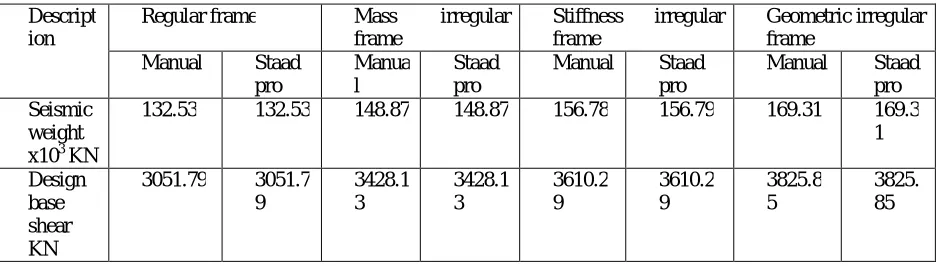
Following tabulation shows the seismic weight and design base shear of the models
TABLE 7.1 VALUES OF SEISMIC WEIGHT AND BASE SHEAR
Descript ion
Regular frame Mass irregular
frame
Stiffness irregular
frame
Geometric irregular frame
Manual Staad
pro
Manua l
Staad pro
Manual Staad
pro
Manual Staad
pro Seismic
weight x103 KN
132.53 132.53 148.87 148.87 156.78 156.79 169.31 169.3
1
Design base shear KN
3051.79 3051.7
9
3428.1 3
3428.1 3
3610.2 9
3610.2 9
3825.8 5
3825. 85
7.2 LATERAL LOAD
ISSN (Online) : 2319 - 8753
ISSN (Print) : 2347 – 6710
International Journal of Innovative Research in Science, Engineering and Technology
An ISO 3297: 2007 Certified Organization Volume 7, Special Issue 5, April 2018 1st International Conference on Recent Innovation in Civil Engineering and Management (ICRICEM '18)
22nd March 2018
Organized by
Department of Civil Engineering & MBA, Loyola Institute of Technology, Chennai, Tamilnadu, India
TABLE.7.2 – LATERAL LOADS FOR ALL BUILDINGS
FIG.7.1 – GRAPH OF LATERAL LOADS
7.3 STOREY SHEAR
It is the sum of design lateral forces at all levels above the storey under consideration(3).
The values of the storey shear is calculated manually by using equivalent static analysis and in staad pro by
using response spectrum analysis. 0
500 1000 1500 2000 2500
1 2 3 4 5 6 7 8 9 1 0 1 1 1 2 1 3 1 4 1 5
FL
O
O
R
L
E
V
E
L
KN LATERAL LOADS
LATERAL LOADS
REGULAR FRAME STIFFNESS IRREGULAR FRAME
MASS IRREGULAR FRAME GEOMETRIC IRREGULAR FRAME
Storey level
m
Lateral Loads (KN) Regular
building
Mass irregular building
Stiffness irregular building
Geometric irregular
building
X Z
1 2.580 2.563 4.798 6.753 6.616
2 10.321 10.254 15.050 27.013 26.463
3 23.222 23.071 31.099 60.779 59.543
4 41.283 41.014 52.910 97.302 95.322
5 64.505 64.085 80.482 155.718 152.550
6 92.887 92.282 113.816 169.790 166.336
7 126.430 239.809 152.911 231.104 226.402
8 165.132 164.057 197.767 301.850 295.708
9 208.996 207.635 248.384 350.309 343.182
10 258.019 256.340 304.763 488.847 478.901
11 312.204 592.182 366.903 303.255 297.085
12 371.548 369.129 434.805 360.898 353.555
13 436.053 433.214 508.467 423.554 414.936
14 505.718 502.426 587.892 491.222 481.228
ISSN (Online) : 2319 - 8753
ISSN (Print) : 2347 – 6710
International Journal of Innovative Research in Science, Engineering and Technology
An ISO 3297: 2007 Certified Organization Volume 7, Special Issue 5, April 2018 1st International Conference on Recent Innovation in Civil Engineering and Management (ICRICEM '18)
22nd March 2018
Organized by
Department of Civil Engineering & MBA, Loyola Institute of Technology, Chennai, Tamilnadu, India
It is found that there is no significant deviations of the values which is calculated in both the ways. Therefore software values are so reliable.
The storey shear values of different models are tabulated and the representive graph is shown below:
TABLE.7.3 – STOREY SHEAR FOR ALL THE FLOORS IN THE BUILDINGS
STOREY LEVEL
BASE SHEAR (KN) REGULAR
BUILDING
MASS IRREGULAR BUILDING
STIFFNESS IRREGULAR BUILDING
GEOMETRIC IRREGULAR BUILDIND
1 3054.16 3429.36 3585.68 3828.74
2 3014.57 3394.57 3510.81 3750.72
3 2920.95 3311.26 3380.94 3567.20
4 2785.70 3187.88 3215.08 3301.65
6 2471.96 2880.03 2860.26 2737.10
7 2327.96 2721.92 2699.69 2521.94
8 2196.32 2457.00 3549.24 2305.67
9 2065.32 2325.74 2392.27 2081.28
10 1912.37 2165.00 2205.86 1856.56
11 1715.91 1955.76 1968.48 1550.21
12 1460.28 1447.36 1665.97 1334.72
13 1140.06 1123.50 1294.40 1041.14
14 760.51 746.14 860.34 677.89
15 335.96 328.63 379.17 263.89
FIG.7.2 – GRAPH OF STOREY SHEAR
7.4 STOREY DRIFT
It is the displacement of one level relative to the other level above or below. It can also be defined that the relative displacements of the floors against lateral loading(3).
The storey drift of various floors are calculated using software.
The storey drift is being limited as 0.004 times the height of the floor as per clause 7.11.1 of IS 1893(PART
I):2002.
The values of the storey drift of the various models are tabulated and graph is shown below. 0
5000 10000 15000
1 2 3 4 5 6 7 8 9 1 0 1 1 1 2 1 3 1 4 1 5
ST
O
R
EY
S
H
E
AR
K
N
FLOOR LEVEL
STOREY SHEAR
REGULAR FRAME STIFFNESS IRREGULAR FRAME
ISSN (Online) : 2319 - 8753
ISSN (Print) : 2347 – 6710
International Journal of Innovative Research in Science, Engineering and Technology
An ISO 3297: 2007 Certified Organization Volume 7, Special Issue 5, April 2018 1st International Conference on Recent Innovation in Civil Engineering and Management (ICRICEM '18)
22nd March 2018
Organized by
Department of Civil Engineering & MBA, Loyola Institute of Technology, Chennai, Tamilnadu, India
TABLE.7.4 – VALUES OF STOREY DRIFT FOR ALL THE BUILDINGS ALONG X AND Z AXIS
STOREY LEVEL
STOREY DRIFT (mm) REGULAR
BUILDING
MASS IRREGULAR STRUCTURE
STIFFNESS IRREGULAR STRUCTURE
GEOMETRIC IRREGULAR STRUCTURE
X Z X Z X Z X Z
1 4.64 4.25 5.23 4.79 8.48 7.88 3.19 3.02
2 6.74 5.896 7.63 6.68 7.15 6.23 4.41 4.05
3 6.594 5.722 7.54 6.54 6.66 5.77 4.11 3.75
4 6.17 5.35 7.12 6.18 6.19 5.37 3.64 3.35
5 5.69 4.95 6.65 5.79 5.71 4.98 3.191 2.95
6 5.21 4.55 6.16 5.38 5.22 4.57 3.37 5.65
7 4.72 4.14 5.59 4.90 4.73 4.15 3.09 2.84
8 4.22 3.711 4.81 4.23 4.23 3.73 2.65 2.43
9 3.73 3.29 4.23 3.74 3.74 3.31 2.195 2.04
10 3.22 2.86 3.71 3.29 3.24 2.87 1.79 1.67
11 2.71 2.43 3.13 2.81 2.73 2.44 2.14 6.83
12 2.21 1.99 2.33 2.09 2.21 2.01 1.92 1.65
13 1.694 1.55 1.75 1.602 1.71 1.57 1.47 1.27
14 1.192 1.115 1.23 1.10 1.21 1.13 1.01 0.89
15 0.73 0.71 0.77 0.76 0.75 0.73 0.58 0.55
FIG.7.3 – STOREY DRIFT ALONG X AXIS
0 10 20 30
1 2 3 4 5 6 7 8 9 1 0 1 1 1 2 1 3 1 4 1 5
ST
O
R
EY
D
R
IF
T
M
M
FLOOR LEVEL
STOREY DRIFT (X-AXIS)
REGULAR FRAME STIFFNESS IRREGULAR FRAME
ISSN (Online) : 2319 - 8753
ISSN (Print) : 2347 – 6710
International Journal of Innovative Research in Science, Engineering and Technology
An ISO 3297: 2007 Certified Organization Volume 7, Special Issue 5, April 2018 1st International Conference on Recent Innovation in Civil Engineering and Management (ICRICEM '18)
22nd March 2018
Organized by
Department of Civil Engineering & MBA, Loyola Institute of Technology, Chennai, Tamilnadu, India
FIG.7.4 – STOREY DRIFT ALONG Z AXIS
VIII. CONCLUSION
Regular and irregular frame models have been analysed for the same zone factor.Lateral loads, storey drift and base shear have been obtained from staad pro using response spectrum analysis and results have been compared.The irregular frame models shows maximum values when compared with the regular model. Stiffness and geometric irregular structure shows maximum base shear when compared with regular and mass irregular frame. Varying lateral loads have been obtained for mass irregular frame and geometric irregular frame in the storeys having swimming pool and setbacks. In stiffness irregular structure storey drift is maximum in the soft storey when compared with other storeys. Hence it can be concluded that the lateral displacements and base shear increases as the irregularities in the buildings increases. Regular building may be considered to be the suitable building configuration. When compared with the other irregularities building with mass irregularity performs well.
REFERENCES
1) Pankajagarwal and shirkhandemanish“EARTHQUAKE RESISTANT DESIGN OF STRUCTURES” 2) IS 13920:1993-Ductile detailing of reinforced concrete structures subjected to seismic forces. 3) IS 1893 (Part 1):2002-Criteria for earthquake resistant design of structures.
4) IS 456:2000-Plain and reinforced concrete.
5) IS 875 Part 5 and IS 1893 (Part 1):2002 – load definitions.
6) SEISMIC ANALYSIS OF BUILDINGS SYMMETRIC & ASYMMETRIC IN PLAN B K Raghuprasad, Vinay S, Amarnath.K. SSRG International Journal of Civil Engineering (SSRG-IJCE) – volume 3 Issue 5 – May 2016
7) International Journal for Research in Applied Science & Engineering Technology (IJRASET) COMPARATIVE STUDIES ON SEISMIC ANALYSIS OF REGULAR AND VERTICAL IRREGULAR MULTISTORIED BUILDING Nonika. N, Mrs. GargiDanda De
8) International Research Journal of Engineering and Technology (IRJET) SEISMIC ANALYSIS OF REGULAR AND IRREGULAR BUILDINGS WITH VERTICAL IRREGULARITY USING STAAD.ProAkhil R, Aswathy S Kumar
9) SRTMU's Research Journal of Science Seismic ANALYSIS OF VERTICALLY IRREGULAR BUILDING SHAIKH A. Aijaj, G.S. Deshmukh 0
5 10 15 20 25
1 2 3 4 5 6 7 8 9 1 0 1 1 1 2 1 3 1 4 1 5
ST
O
R
EY
D
R
IF
T
M
M
FLOOR LEVEL
STOREY DRIFT (Z-AXIS)
REGULAR FRAME STIFFNESS IRREGULAR FRAME