Interaction Protocol for the Protector
System
Aimed At the Protection of Mistreated
Persons
Prof. Akshatha kamath1, Indira Priyadharsini S2, Chaithra S3
Assistant Professor, Department of Computer Science and Engineering, Sri Krishna Institute of Technology,
Bengaluru, Karnataka, India1
U.G Student, Department of Computer Science and Engineering, Sri Krishna Institute of
Technology, Bengaluru, Karnataka, India2, 3
ABSTRACT: Countless number of men and women, mainly women are daily being mistreated, battered and abused by their ex-couples or their current lovers. In this sense,an electronic monitoring is definitely an efficient tool for assisting to guarantee the basic safety of victims. Ambient Intellect, depending on ubiquitous processing, represents a good strategy to make technology adapt to people in order to solve the battle of developing strategies that allow the early detection and prevention of problems in safety environments and, specifically, the protection of people under risk situations, including cases of mistreatment or loss. This paper identifies Guardian, an integral solution created for increasing the security of mistreated and at-risk people by means of the integration of GPS, GPRS and ZigBee technologies. The basic structures of the system, the proposed wireless devices, as well as the interaction protocol used between the system and the devices are described. Furthermore, a first hardware and software prototype is depicted and tested.
KEYWORDS:Ambient Intelligence; Mistreatment; Safety; GPS DEVICE; GPRS; ZigBee.
I. INTRODUCTION
Regarding to statistical data from the Ministry of Home of Spain [1], from 2006 to 2008 more than 60 women were killed annually by way of a lovers or ex-couples vacation. In 2008, a 23% of the killed women experienced filed a formal grievance against their murderers. In case of violence against women exercised by partners or couples, or in the framework of other emotional relations, the government regulators consider the electronic monitoring as an indispensable tool for assisting to guarantee the safety of victims. Found in this regard, Ambient Intellect is an appearing multidisciplinary area based on ubiquitous computing and that influences on the appearance of protocols, communications, systems, devices, and many others [2]. Environmental intellect proposes new ways of interaction between people and technology, making the second option to adapt to the users' needs and the environment that surrounds them [3].
geographical and activity context is the foundation to Ambient Intelligence to demonstrate all its potential. There are different strategies that propose electronic digital tele- monitoring systems aimed at traffic monitoring victims and aggressors [5] [6] in order to reduce risk situations. Even though these approaches are based on locating and data transmission technologies such as GPS [7] and GPRS [8], they do not consider the challenge of interior locating, where satellite based setting systems as GPS do not work properly.
Through this sense, this paper identifies protector system, an Ambient Intellect based electronic system directed at the location and safeguard of folks under risk situations. These risk situations include prevention of aggressions to threatened people, as well as surveillance and treatment of children, elderly and other vulnerable people. The Protector system makes use of different wi-fi technologies, such as A-GPS [7], GPRS [8] and ZigBee [9], to supply the majority of its features. Consequently, this project involves the structure and creation of a completely distributed innovative hardware and software platform.
II. RELATED WORK
It is important to point out that, in the country of Spain the pressure over the assistance system is growly increasing, as well as the necessity to offer services with increased quality. Since mentioned above, countless numbers of folks, mainly women are daily mistreated, battered and mistreated by their ex-couples or their current couples [1]. In this scenario, the technology can play a decisive role. Although the current range of incidents related to violence against women exercised by husbands or couples, or in the framework of other psychological relations, are increasingly more advertised than in the past [1], there are still hidden facts to be known. In such situations, one of the main aspects is guaranteeing that the potential aggressor and victim are literally segregated by a certain safety distance. There are strategies centered on monitoring and locating accurately the aggressor including the BI ExacuTrack(R) single system [5]. This kind of system involves a light, resistant and tamper-proof device that is worn by the aggressor on their ankle, offering long power supply autonomy.
The locating process is performed by using a combo of several technologies, including independent GPS, A-GPS [7] and AFLT (Advanced Forward Link Trilateration) [10]. Using this combo of wireless technologies, the system can estimate effectively the position of the user, even in hard conditions, such as inside your home, vehicles in motion or between high buildings. Other strategy is the One Part Global positioning system unit [6], whoever main objectives are the device ubiquity, less requirement device maintenance and robustness against tries of manipulation on the aggressor's device.
This method includes an integrated active GPS DEVICE device [7] that combines a GPS DEVICE recipient, the device sends notifications to the supervisor agents in real time through fernkopie, e-mail or SMS. Manager agents can create add-on or exclusion areas that surround a specific geographic location, as the victim's residence or work place. Using a combo of monitoring devices in victim and aggressor, the agents can control the proximity between both. If perhaps the aggressor is too close to the victim's home, work place or some of the exclusion areas, the two providers and the victim are notified. These approaches do not cover completely in house situations where GPS or GPRS coverage can are unsuccessful or such approaches need to define and control exclusion areas. In this sense, the Guardian system includes devices that incorporate GPS, GPRS and ZigBee in the same wi-fi module, thus covering all situations in an independent way.
PROTECTOR SYSTEM:
. Fig. 1. Basic schema of the Protector System
Both users carry a mobile device with A-GPS, GPRS and ZigBee capabilities. Both devices (the victim's one and the potential aggressor's one) obtain their position making use of their AGPS module. Consequently, the control center monitors the positions of both users. However, this information is not enough to achieve an efficient protection. This kind of is because the GPS DEVICE or A-GPS technologies do not properly work on some situations, as in house locations (e. g., properties or tunnels) [7].
The ZigBee technology [9] covers those situations where GPS or A-GPS cannot work effectively. In the protector system, the ZigBee module can be used when users are practically located. In addition, ZigBee is activated when you cannot find any A-GPS or GPRS coverage. At this moment, both devices (the victim's one and the actual aggressor's one) start searching the transmission from the counterpart device. That is, the device uses the ZigBee's signal durability between both devices in order to identify a potential risk. Therefore, if some of the devices detect the other one, it sends a sound the alarm to the control center using GPRS. If you have no GPRS coverage, both devices will raise visual and acoustic alarms, using the buzzers included in the devices. This way, the control center determine if the space between users and the last time before losing the coverage suggest any risk for the threatened user.
The cellular devices utilized in the Protector system are formed by different functional units or hardware modules interconnected to each other Charge and electric power supply: contains a light-weight power system, that is, a chargeable battery and a charge and electric power| supply system. The demand system will be applied in the same component and will allow recharging the battery through an USB port.
USB: Communication interface between the device and a private computer. Upon the one hand, it will allow configuring the device. On the other hand, it is going to allow recharging the internal battery.
Fig 2. Practical architecture of the Protector system devices
This practical architecture is founded on dependent will be based upon the n-Core Sirius devices from Nebusens [12], deeply explained in the next section. Each n-Core Sirius devices includes an 8-bit RISC microcontroller, a ZigBee transceiver and several internal and external communication ports (including GPIO, I2C and USB/RS-232 UART) to {hook up} to distinct devices, including detectors, actuators, as well as other electronics or even computers.
GPS DEVICE: This is the component in charge of obtaining the runs with these devices position and offering these to the processor through a serial data interface.
GSM Module: It allows communication of a device with the GSM network. The modem can be used to send and receive calls and messages. The modem is controlled with the help of a microcontroller that uses Hayes AT command set to get modem perform intended tasks. Quectel M66 GSM modem is used in the wristwatch to send distress messages as well as to obtain cell parameters and RSSI value.
III. OBSERVATIONS
Fig 3.1 shows track that was followed for obtaining readings in Semi-Urban Clusters. Figure 3.3 shows track that was followed for obtaining readings in Rural Clusters. Green Marker identifies the location obtained via GPS and Blue Marker identifies the location obtained from our watch.
Fig.3.2 Route for Rural Clusters (Jahangir Puri to Alipur Village)
III. RESULTS
To measure the effectiveness of wristwatch, we tested it in three possible scenarios. We have characterized them as Urban, Semi-Urban, and Rural. Data were taken in Delhi. For urban clusters, the route opted was Pitampura to Peera Garhi, for semi-urban clusters, the route opted was Adarsh Nagar to Jahangir Puri, and for rural areas, the route opted was Jahangir Puri to Alipur village.
The implemented hardware prototype for the wireless device is the result of the integration of two well differentiated devices: a ZigBee communication module and a mobile phone with GPRS and GPS capabilities. This way, the combination of these two devices allows providing all the features defined by the functional units of the hardware architecture.
API (Application Programming Interface) to access all its functionalities. This platform was chosen because it provides all the needed functionalities by means of its full-featured n-Core firmware and the n-Core API. Regarding the software side of the Guardian device, we have chosen Android 2.1 (API-7) for the prototype presented in this paper, as it is the latest official version supported by the HTC Hero smartphone. The device is programmed in Java and using the Eclipse IDE (Integrated Development Environment).
IV. CONCLUSION AND FUTURE WORK
The Protector system pursuits a revolutionary concept: the total supervision of people under risk situations, augmenting their safety and autonomy in a completely ubiquitous way. It is important to mention that there is no similar solution in the market, specifically a device with the characteristics specific to develop this project. This fact implies a high level of hardware development. Furthermore, there is not a hardware/software platform that fully provides the middleware layers necessary to integrate all the mentioned technologies. In this regard, the creation of
a hardware and software prototype has achieved two objectives: to validate the proposed architecture and check that the utilized technology is appropriate for the system.
Future work includes the full development of all the projected functionalities. This includes the production of an extended and more integrated hardware prototype for the wireless devices.
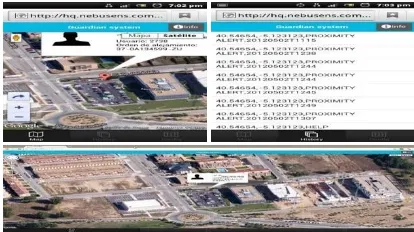
Fig 4. Preliminary representation of the location of the device using Google Maps.
In the future, the Sirius B device will communicate directly with an Android smartphone via the ADK interface, allowing two-way communication. Finally, the system will be implemented in a real scenario in order to test its actual performance.
REFERENCES
[1] India today. (2014, Sept. 14). Statistics: 92 womenraped in India every day, 4 in Delhi[Online]. Available:http://indiatoday.intoday.in/story/india-rape-92-women-everyday-4-delhi-statistics/1/380956.
[2] DNA Web Team. (2015, Aug. 1). India ranks second on list of kidnapping hotspots [Online]. Available: http://www.dnaindia.com/india/report-india-ranks-second-onlist-of-kidnapping-hotspots-2110058
[3] A. Sharma. (2014, Dec. 8). Crime Capital: 1 woman abducted every 2 hours in Delhi [Online].
http://indiatoday.intoday.in/story/crime-capital-1-womankidnapped-in-every-2-hours-indelhi/1/405721.html [4] T. Worstall. (2015, May 7). IMF pegs India to be one of World’s fastest growing Economies [Online].
[5] J. Pascoe, “The Smartwatch,” in Proc. Conf. Mobile and Ubiquitous Systems (CSMU), Guimaraes Portugal, 2006, pp. 203-206. [6] G. M. Djuknic and R. E. Richton, “Geolocation and Assisted GPS”, Computer, vol. 34, n. 2, pp. 123– 125, 2001.
[7] Yieh-Ran Haung and Yi-Bing Lin, “A bandwidth-on-demand strategy for GPRS”, IEEE Transactions on Wireless Communications, vol. 4, n. 4, pp. 1394–1399, Jul. 2005.
[8] P. Baronti, P. Pillai, V. W. C. Chook, S. Chessa, A. Gotta, and Y. F. Hu, “Wireless sensor networks: A survey on the state of the art and the 802.15.4 and ZigBee standards”, Comput. Commun, vol. 30, n. 7, pp. 1655–1695, 2007.
[9] A. Küpper, Location-Based Services: Fundamentals and Operation, 1st ed. Wiley, 2005.