ISSN(Online): 2319-8753 ISSN (Print): 2347-6710
I
nternational
J
ournal of
I
nnovative
R
esearch in
S
cience,
E
ngineering and
T
echnology
(A High Impact Factor, Monthly, Peer Reviewed Journal) Visit: www.ijirset.com
Vol. 8, Issue 6, June 2019
Addressing Interpretability and Cold-Start in
Matrix Factorization for Recommender
Systems
Kavita Mogal, Prof. Kurhade N.V
P.G. Student, Department of Comp Engineering Sharadchandra Pawar College of Engineering, Otur, Pune, India
Professor, Department of Comp Engineering Sharadchandra Pawar College of Engineering, Otur, Pune, India
ABSTRACT: Online buying is the most favorable in 21st century, around one trillion items should be buy and sold through using online shopping. Recommender systems suggest to users items that they might like (e.g., news articles, songs, movies) and, in doing so, they help users deal with information overload and enjoy a personalized experience. One of the main problems of these systems is the item cold-start, i.e., when a new item is introduced in the system and no past information is available, then no effective recommendations can be produced. The item cold-start is a very common problem in practice: modern online platforms have hundreds of new items published every day. To address this problem, we propose to learn Local Collective Embeddings–a matrix factorization that exploits items’ properties and past user preferences while enforcing the manifold structure exhibited by the collective embeddings. We present a learning algorithm based on multiplicative update rules that are efficient and easy to implement. Experiments on two item cold-start use cases: news recommendation and email recipient recommendation, demonstrate the effectiveness of this approach and show that it significantly outperforms six state-of-the-art methods for item cold-start. In This scenario B2B as well as B2B problem occurred frequently. With this research we proposed an approach which will eliminate the matrix factorization problem using cold start recommendation for online users. The experimental analysis shows how proposed system provide the better results than classical algorithms.
KEYWORDS: co-clustering, overlapping co-clustering, cold-start, product recommendations, interpretability.
I. INTRODUCTION
ISSN(Online): 2319-8753 ISSN (Print): 2347-6710
I
nternational
J
ournal of
I
nnovative
R
esearch in
S
cience,
E
ngineering and
T
echnology
(A High Impact Factor, Monthly, Peer Reviewed Journal) Visit: www.ijirset.com
Vol. 8, Issue 6, June 2019
method for recommendation, LCE, that combines the content and collaborative information in a unified matrix factorization framework while exploiting the local geometrical structure of the data; We propose a simple and efficient learning algorithm, based on multiplicative update rules and prove its convergence; • We conduct an extensive experimental study and we show that the proposed methods outperform six stateof-the-art methods for item-cold start recommendation.
II. LITERATURE SURVEY
Exploiting the local geometric structure of the data to discover better low-dimensional representations has been exploited by Cai et al. [1]. Inspired by the success of using the nearest neighbour graph for label propagation in semisupervised learning, they propose a clustering technique. The algorithm favours factorizations for which similar instances have similar low-dimensional representations. The authors show that, by imposing this constraint, they outperform classical clustering algorithms and classical factorization techniques. In this work, we impose such geometrical constraints but for collective factorization for which we can handle multiple data sources, i.e., the content and collaborative data matrices
The Regression Based Latent Factor model [2] for applications where ”bag-of-words” representation of items is natural. The main idea is regularizing the user and item factors simultaneously through the user features and the words associated with the items. The user ratings are modelled as user’s affinity to the item’s topics, where the user’s affinity to topics and topic assignments to items are learned jointly in supervised fashion. In our experiments we only use the item feature as user features are not available. As recommended by the authors, we run 20 EM iterations with 100 samples, drawn after 10 burn-in samples. In the email recommendation experiment, we test for k ∈ {10, 25, 50} factors, while for the news recommendation experiment we test only k = 10 due to the long running times.
This method [3] handles the cold-start in two steps: (1) factorizing the collaborative matrix to learn latent factor representation of the users and items, (2) learning a mapping between the user/item attributes and the corresponding latent factors. When a new user/item arrives in the system, the mapping from (2) is used to infer the factors from the attributes, and then the factors are used to make predictions. As proposed by the authors, we used Bayesian Personalized Ranking (BPR) to factorize the collaborative matrix. To learn the mappings we used the K-Nearest-Neighbour and BPR optimization; however, the kNN mapping was superior in all cases and thus we report the results for only for kNN mapping. This is consistent with their experimental results. We test with different number of latent factors k ∈ {100, 200, 300, 400, 500, 600, 700, 800, 900, 1000}.
Shmueli et al. [4] consider a similar scenario of news recommendation (Section 5.3), i.e., predicting the articles a user is most likely to comment on. They combine content based and collaborative filtering approach using a latent factor model. The odds that a user will comment an article are estimated as the inner product of the user and article factors, where the article factors are represented as the sum of the latent factors associated with the textual content (tags–named entities) and the commenter’s. A modification of the model for real-time scenarios is presented in [3]. The authors show that the recommendation accuracy grows as the number of commenter’s grows. However, in an item cold-start scenario articles are not yet associated with commenter’s, thus an can only be represented with the latent factors of the textual tags
ISSN(Online): 2319-8753 ISSN (Print): 2347-6710
I
nternational
J
ournal of
I
nnovative
R
esearch in
S
cience,
E
ngineering and
T
echnology
(A High Impact Factor, Monthly, Peer Reviewed Journal) Visit: www.ijirset.com
Vol. 8, Issue 6, June 2019
Soboroff [6] proposed a technique based on Latent Semantic Indexing (LSI) for combining the collaborative filtering input and the document content for recommendation of textual items. The method builds a content profile for each user as a linear combination of the preferred documents. LSI is then applied to the user profiles to discover topics in the collection and implicitly learn commonalities among the user profiles. Incoming documents are projected into the LSI space and compared to user profiles. The documents are recommended to the users with the most similar profiles. The author argues that applying LSI on the user profiles instead of the documents allows one to take into account the collaborative input and consequently improves the recommendation performance. However, the system is not evaluated in the cold-start scenario
According to [7] the problem of item cold-start is of great practical importance because of two main reasons. First, modern online platforms have hundreds of new items everyday and effectively recommending them is essential for keeping the users continuously engaged. Second, collaborative filtering methods are at the core of most recommendation engines, as they tend to achieve the state-of-the-art accuracy. However, to produce recommendations at the expected accuracy they require that items are rated by a sufficient number of users. Therefore, it is crucial for every collaborative recommender to reach this state as soon as possible. Having methods that produce accurate recommendations for new items will allow enough feedback to be collected in a short amount of time, making effective collaborative recommendations possible.
As the data is intrinsically influenced by time we sort the mailboxes chronologically. We divide the messages in 80% training and 20% testing, resulting in 10 independent train/test subsets. Only the recipients that appear in the training period are considered as potential receivers. We tune the hyper-parameters of the methods on independent validation set, 10% of the training set. Finally, we evaluate the statistical significance of the differences in performance by using a Wilcoxon signed rank test [8].
The output of the algorithms is a ranking of the past recipients of how likely they are to be recipients of the new email. The feedback from the users is explicit, i.e., we have ground truth of who are the recipients of the mail as specified by the user. To evaluate the ranking produced by each algorithm we use the state-of-the-art metrics from Information Retrieval: Micro and Macro F1, Mean Average Precision (MAP), and Normalized Discounted Cumulative Gain (NDCG) [9]
Recently, matrix factorization techniques have been extensively used in the recommendation systems and topic modelling literature. Many collaborative filtering systems approximate the collaborative matrix by applying techniques such as Singular Value Decomposition (SVD) or UV decomposition [10]. Similar matrix factorization techniques have been used to discover topics in a document collections by decomposing the content, i.e., document-term matrix. Non-negative Matrix Factorization (NMF) is one such approach that factorizes the document-term matrix in two nonnegative, low-rank matrices, where one matrix corresponds to the topics in the collection and the other represents the extent to which documents belong to these topics. Due to the non-negativity constraints, NMF produces a so-called “additive parts-based” representation of the data that increases the sparsity and interpretability of the hidden factors.
III. PROBLEM STATEMENT
The proposed work first investigate data mining approaches like Apriori, FP Tree, FIUT and find the issues of existing system, System also focus on database security like SQL injection with parallel data mining top k retrieval approach on synthetic and real time dataset in distributed framework and provide recommendation for B2B as well as B2C scenario.
Objectives of System
ISSN(Online): 2319-8753 ISSN (Print): 2347-6710
I
nternational
J
ournal of
I
nnovative
R
esearch in
S
cience,
E
ngineering and
T
echnology
(A High Impact Factor, Monthly, Peer Reviewed Journal) Visit: www.ijirset.com
Vol. 8, Issue 6, June 2019
To implement the algorithm and test it for real time datasets to reduce costly, repeated database scans. To embed system on distributed framework and check its functionality.
Scope of System
With exponential increase in number of everyday internet users there has arise the need to understand their internet usage activity for further improvement in services provided to them.
Need to improve the e-Business using attractive recommendations.
The data involved in these cases is a huge chunk of data which needs to be studied thoroughly to understand user needs.
To provide great user experience to users in their day to day activity this Big Data needs to be analyzed.
IV. PROPOSED SYSTEM
In some cases the decision on whether or not to make a purchase is based largely on price but in many instances the purchasing decision is more complex, with many more considerations affecting the decision-making process before the final commitment is made. Retailers understand this well and attempt to make use of it in an effort to gain an edge in a highly competitive market. Specifically, in an effort to make purchasing more likely, in addition to balancing the salability and profit in setting the selling price of a product.
ISSN(Online): 2319-8753 ISSN (Print): 2347-6710
I
nternational
J
ournal of
I
nnovative
R
esearch in
S
cience,
E
ngineering and
T
echnology
(A High Impact Factor, Monthly, Peer Reviewed Journal) Visit: www.ijirset.com
Vol. 8, Issue 6, June 2019
In FIM, on Real time transactional dataset apply the proposed algorithms and extract the frequent item sets from historical data
For the database security apply SQL injection and prevention approach that can be provide the highest security against internal as well as external attackers.
FP- Tree itemset mining is another example for parallel data mining and frequent item set mining scheme.
V. RESULTS AND DISCUSSIONS
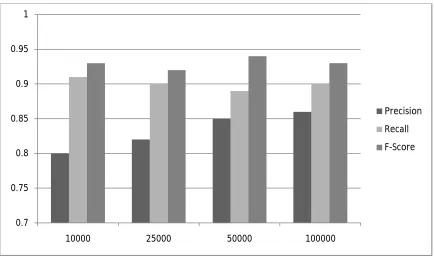
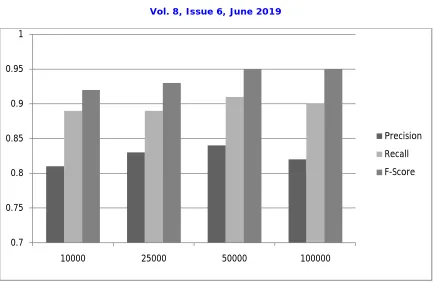
The proposed system has evaluated in distributed environment, for the system performance evaluation, calculate the matrices for accuracy. The system is executed on java 3-tier architecture framework with INTEL 2.7 GHz i3 processor and 4 GB RAM with deep learning approach. The below figure 2 and figure 3 shows the precision, recall and f-score of B2B as well as B2C recommendation respectively.
Figure 2 : Performance evaluation of B2B recommendation with various instances
0.7 0.75 0.8 0.85 0.9 0.95 1
10000 25000 50000 100000
Precision
Recall
ISSN(Online): 2319-8753 ISSN (Print): 2347-6710
I
nternational
J
ournal of
I
nnovative
R
esearch in
S
cience,
E
ngineering and
T
echnology
(A High Impact Factor, Monthly, Peer Reviewed Journal) Visit: www.ijirset.com
Vol. 8, Issue 6, June 2019
Figure 3: Performance evaluation of B2C recommendation with various size of instances
VI. CONCLUSION
In this research work, the main focus is on the problem of cold start and work on recommender systems. Proposed machine learning has focused primarily on the accuracy of prediction. This work explicitly addresses the aspect of interpretability. By formulating co-clustering as a constrained matrix factorization approach. System also investigate data mining approaches like Apriori, FP Tree, FIUT and find the issues of existing system, System also focus on database security like SQL injection with parallel data mining top k retrieval approach on synthetic and real time dataset in distributed framework and provide recommendation for B2B as well as B2C scenario.
VII. FUTURE WORK
To implement this system with distributed Hadoop Distribution File System (HDFS) environment on large scale data will be the future of system.
REFERENCES
[1] D. Cai, X. He, X. Wu, and J. Han. Non-negative matrix factorization on manifold. In International Conference on Data Mining, 2008
[2] Z. Gantner, L. Drumond, C. Freudenthaler, S. Rendle, and L. Schmidt-Thieme. Learning attribute-to-feature mappings for cold-start recommendations. In International Conference on Data Mining, 2010.
[3] E. Shmueli, A. Kagian, Y. Koren, and R. Lempel. Care to comment?: recommendations for commenting on news stories. In World Wide Web Conference, 2012.
[4] E. Shmueli, A. Kagian, Y. Koren, and R. Lempel. Care to comment?: recommendations for commenting on news stories. In World Wide Web Conference, 2012.
[5] A. P. Singh and G. J. Gordon. Relational learning via collective matrix factorization. In ACM Conference on Knowledge Discovery and Data Mining, 2008.
0.7 0.75 0.8 0.85 0.9 0.95 1
10000 25000 50000 100000
Precision
Recall
ISSN(Online): 2319-8753 ISSN (Print): 2347-6710
I
nternational
J
ournal of
I
nnovative
R
esearch in
S
cience,
E
ngineering and
T
echnology
(A High Impact Factor, Monthly, Peer Reviewed Journal) Visit: www.ijirset.com
Vol. 8, Issue 6, June 2019
[6] I. Soboroff. Combining content and collaboration in text filtering. In IJCAI Workshop on Machine Learning for Information Filtering, 1999. [7] A. T. Gediminas Adomavicius. Toward the next generation of recommender systems: a survey of the state-of-the-art and possible extensions. IEEE Transactions on Knowledge and Data Engineering, 2005
[8] J. Demˇsar. Statistical comparisons of classifiers over multiple data sets. The Journal of Machine Learning Research, 2006
[9] R. Baeza-Yates and Ribeiro-Neto. Modern information retrieval. ACM press New York, 1999