The Impact of Implementation Design and
Build Management on Cost Performance at
Interior Hotel Project
(Case Study : Interior Hotel Project at PT XYZ)
Manlian Ronald A. Simanjuntak
1, Niko
2Professor in Construction Management, Universitas Pelita Harapan, Jakarta, Indonesia1
Department of Master of Civil Engineering, Universitas Pelita Harapan, Jakarta, Indonesia 2
ABSTRACT: The current delivery method in the construction sector between the Owner and the Contractor is generally the traditional approach (Design - Bid - Build). However, the ideal condition of the delivery method system in accordance with the present era is Design – Build system. This is shown from the data of the Ministry of Public Works and People's Housing, as the infrastructure organisation claim that the Design - Build system as considered more efficient in terms of time and cost comparing to the traditional method : Design-Bid-Build system. This study aims to find out what matters that need to be considered while using Design and Build management, analyze the factors that affected theDesign and Build management on cost performance, and know the results of the regression test. Some of the theories that will be studied in this research are design and build management, cost performance, and interior contractor. The research instrument used in the form of questionnaires that aims to obtain primary data in this study. The research variables were obtained from the literature study of 74 independent variables and 1 dependent variable which was then validated again by 5 expert respondents. Questionnaires distributed to 35 respondents selected as interior contractors. Through quantitative research, the indicators that affect the implementation of design and build management on cost performance at interior hotel project are: the internal part in the interior contractor, the relationship with the owner, and the characteristics of the project.
KEYWORDS: design and build management, cost performance, interior hotel
I. INTRODUCTION
The construction project is one of the areas worked in a construction sector. According to the Indonesian Construction Law (Undang Undang Jasa Konstruksi) No. 18/1999, in general, a construction project involves 4 parties, such as Project Owner, Planning Consultant, Supervision Consultant, and Project Contractor.
The Project Owner is called as the Construction Service User, while the Planning Consultant, Construction Supervisor / Construction Management, Construction Contractor is usually called the Construction Service Provider.
The usage of design-build delivery method system is increasing in construction projects in United States as well as around the world. Research by the Construction Industry Institute (CII) identifies that design-build projects show the best project performance, so now governments and private project owners consider design-build systems to be used for their various advantages. In Indonesia, the design-build system is still not commonly used, especially for non-residential and government projects. It is shown by data of there is only a small number of design-build system projects compared to the one with traditional (design-bid-build) system, and also reflected in Indonesian Construction Law No 18/1999 and Government Regulation No. 28/2000 (Indonesian’s Rules) which only discussed a glance of this design-build system. In government construction project, procurement with a design-design-build system has not been set yet so the design-build tender still be unimplemented.
However, based on the Regulation of the Minister of Public Works and People's Housing of the Republic of Indonesia No. 12 / PRT / M / 2017 regarding The Standards and Guidelines for Procurement of Integrated Design and Build Construction Works (Design & Build), finally made as a reference for design and build system including discussed matters that should be considered when using it for construction works, both in terms of administration and implementation.
The success indicator of the design and build system is based on three aspects: the characteristics of the project as disclosed in Article 5 of PUPR No. 12 / PRT / M / 2017, managerial skills of the service user, and internal factors of the service providers.
The advantage of using a design-build system compared to the others is “one responsibility” because there is only a single contract issued by the project owner which also produce a better results regarding a certain guaranteed designand quality performance assurance is provided by the contracted design-build contractor. This condition will certainly impact on cost savings because the design and construction workand communicate together as a team making evaluation of materialalternatives, work methods and value engineering run efficiently. Over lap design and construction processis much shorter and without any redesign. The system implementation will also reduce the administrative work of the project owner. The fixed cost of the project can be early determined, the project decision to “go” or“not go” is made before spending a certain and significant design cost. Balanced risk is borne by design-build contractors, and added jobs due to errors and omissions are eliminated. However, there are still some things for further consideration in the execution ofdesign-build system, such as the complexity of the design-build contractor selection process, especially during RFQ / RFP (Request for Qualification / Request for Proposal) so that the owners who didn’t have adequate in-house staffs should ask for consultant's help.
The impact of implementing design-build development management still need to be thoroughly researched to get the recommendations in relation with cost performance from the point of view of the construction service provider (design-build contractor).
The problems discussed in this research are:
1. What should be considered in the use of design & build development management? 2. What are the development indicators using design & build management?
3. How about the result of the analysis regarding the impact of the implementation of the design and build development management in improving the cost performance on the interior hotel project?
II. LITERATURE REVIEW
Design and Build Management
Design and Build can be defined as a procurement with a contractual system between the owner of the project and design build contractor who is responsible for performing the design and construction process efficiently. Design and Build is simpler in the process, compared to the traditional method called design- bid- build, where the design and construction process is clearly separated by the contract of work.
The Design and Build process can be divided into several stages of implementation (Zane Satterfield, 2009): 1. Planning process, 2. Procurement process, 3. Design development process, 4. Construction process, 5. Monitoring and Control Process, 6. Closing process.
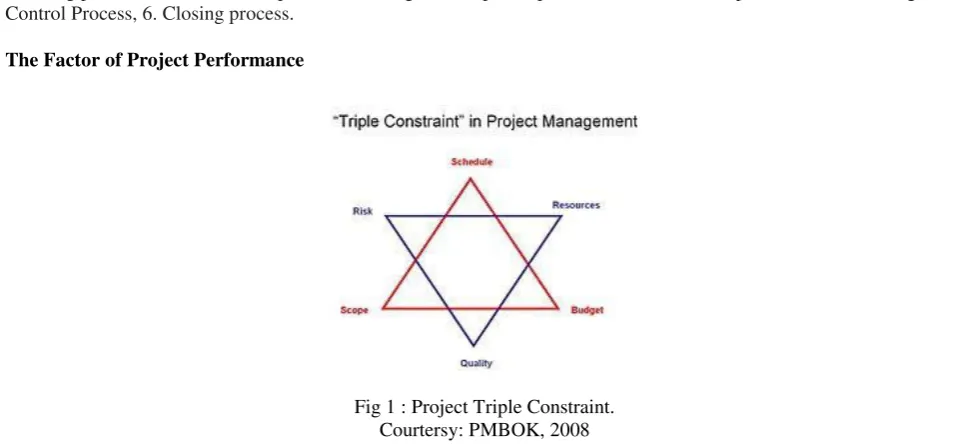
The Factor of Project Performance
The successful factor for a project's performance are (Harold Kerzner, 2001): Cost ; The cost that’s used to work on a project should not exceed the available budget. Time (Schedule); Implementation of a project has a range of time that has been targeted and must be fullfiled. If the completion of the project is longer, so the loss of costs incurred higher. Quality ; Each activity shall produce a good quality result, in accordance with the plan and shall meet the technical specifications as required by the assignor.
Cost Performance
Cost performance is to compare between the cost agreed between the owner and the contractor with the actual cost of completion of the project, if the percentage is smaller then the performance is better. The process of performance control in the construction project implementation generally consists of 3 main steps (Dipohusodo, 1996), namely: establishing performance standards where these standards can be budgeted and scheduled. Besides that, measuring the performance against the standard by comparing the actual performance with performance standards. Results of work and expenditures that have occurred compared to the schedule and the cost that has been planned. Lastly by doing corrective action in case of deviation against predefined standard.
Variables Used in This Research
In this research, 8 factors are gathered from several literature with each factor consist as the following variables: Factor 1 (designer’s team): designer’s experience (X1), understanding based on TOR (term of references) (X2), understanding towards the regulation standards (X3), understanding in estimating duration of every activity (X4), understanding in estimating cost (X5), understanding the changing design requested (X6); retardment in achiving definite design due to different perception (X7), contractor input to designers (X8); Factor 2 (builder’s team): defected design causing changes from the first plan (X9), the realization of the work that it is not accordance with the
developing design plan (X10), avalibity of machine and tools for contractors (X11), the relationship quality between contractor and owner (X12), the cash flow of contractors (X13), the contractor’s competencies (X14), the contractor’s experience (X15); Factor 3 (project manager’s (PM) team): the PM’s experience (X16), the PM’s competencies (X17), the PM’s ability in selecting personels (X18), the PM’s ability in identifying the activity (X19), the PM’s experience in scheduling works (X20), the PM’s ability to communicate and coordinate with the Owner (X21), the PM’s ability to communicate with subcontractors (X22), the PM’s ability in leading the team (X23), the PM’s ability to encourage teams to commit to quality, cost, and time (X24), the PM’s ability in scheduling and controlling (X25), the PM’s authority in making the decision of daily activities, financial, and team member selection (X26); Factor 4 (owner management ability): the availability of owner representative for assisting owner (X27), the limitation of owner’s budget (X28), the limitation of owner’s personel authorization in decision making(X29), approval of both parties (X30), the communication quality of owner with designers (X31), owner involvement in every meeting with designers (X32), the owner’s ability in evaluating the results of the developed design submitted by contractors (X33), owner’s initiation to give advices on the design (X34), owner’s understanding in calculating the budget based on TOR (X35), owner’s understanding in deciding the duration of the work (X36), owner’s experience in preparing the TOR (X37), the tight project schedule determination by owner (X38); Factor 5 (procurement): price quotation of the tender participants exceed the standard price (X39), the availability of the experienced Design and Build company (X40), lack of technical assesment criteria in judging the qualification of tender participants (X41), the selection of dealing contract type is lumpsum contract (X42), price negotiation process without considering the fair offering price (X43) ; Factor 6 (project scope): defining clear project scope in TOR (X44), the congruence in making the design specification standard (X45), the definite criteria of ending result (X46); Factor 7 (project complexity): project size as comparation within similar project for the contractors (X47), the complexity of work scope given by owner (X48); Factor 8 (external factors) : condition and environment location site improper with the presumption (X49), the governmental condition or policy changes in politics and economics (X50).
III.RESEARCH METHODOLOGY
This research is carried out quantitatively, through questionnaires which are completed with interviews and observations / surveys to the location of research objects, as well as technical data of the project to obtain sufficient information of the implementation design and build method at interior hotel project and project implementation performance itself that covers the cost performance of the project.
Respondents selected in this study are divided into 2, namely Respondents Experts and Respondents Research. Respondent experts are respondents who hold a minimum of S2 in the field of interior in academia or who have experienced at least 10 years in the field of interior. These expert respondents play a role in validating the variables to be used. Research respondents were the parties which the questionnaire was distributed. Respondents of this study consist of respondents in interior contractors who have at least 1 year experience in the field of interior, and have a minimum formal education in Strata 1 (S1) in their field.
To answer the problem of the first research that is the things that need to be considered in the use of design and build management by using a quantitative approach. Quantitative research is conducted to collect data obtained from questionnaires distributed to selected respondents which will then be processed statistically. The statistical calculations based on the questionnaire answers will be processed by correlation test, intercorrelation test, factor analysis and regression analysis using the tool of SPSS (Statistical Package for the Social Sciences) version 22.
To answer the third research, the result of the regression test of the influence of the implementation of the design and build management in improving the cost performance of the interior hotel project, will be processed quantitatively by using the tools of SPSS (Statistical Package for the Social Sciences) version 22.
IV.ANALYSIS AND RESULTS
The factor that affect the implementation design and build management on cost performance at interior hotel project
Expert respondents in this study amounted to 5 people, with 1 of them are academics, and 4 of them are practitioners where the expert respondents are not limited only from a particular city. Approach to expert respondents using questionnaires with variables similar to those used in the research questionnaire, it's just a choice of answers in the form of "yes" or "no".
Determination of the choice of a variable to proceed to the research questionnaire is if 3 out of 5 respondents are experts say "yes" to a variable. Based on questionnaires distributed to this expert respondents, there are found 24 of 74 variables that are not included in this study, so there are 50 variables that will be disseminated to the respondents research with Likert scale:
1 = No effect / no impact on construction cost. 2 = Less influence on construction cost. 3 = Sufficient effect on construction cost. 4 = Affects the cost of construction. 5 = Greatly affect the cost of construction.
The questionnaire was distributed to respondents in interior contractors. From 40 questionnaires distributed, 35 successful questionnaires were collected. This is the number of respondents analyzed in this study. Characteristics of respondents to be discussed include the experience in the field of interior and last education, as well as positions of respondents. The characteristics of these respondents will be presented as a percentage.
Table 1 : Characteristic of Respondents
CHARACTERISTIC
Category Total Percentage (%)
Experience 1-5 years 18 51%
5-10 years 10 29%
>10 years 7 20%
Education Undergraduate /
Bachelor
30 86%
Postgraduate 5 14%
Position Engineering Staff 15 43%
Profesional Staff 12 34%
Manager (Project Manager)
5 14%
Director 3 9%
From 50 independent variables tested, 4 strongly correlated variables are X21, X24, X36, X37, X43. From 5 variables that have strong correlation, derived from 2 indicators that are: internal part in interior contractor and relation factor with owner, and spread to 3 factors which used in this research that are: owner management capability, internal part of interior contractor which is related with Project Manager, and procurement process.
Table 2: Intercorrelation Table Correlations
X21 X24 X36 X37 X43
X21 Pearson Correlation
1 .704** .362* .336* .412*
Sig. (2-tailed)
,000 ,032 ,048 ,014
N 35 35 35 35 35
X24 Pearson Correlation
.704** 1 .346* ,311 .407*
Sig. (2-tailed)
,000 ,042 ,069 ,015
N 35 35 35 35 35
X36 Pearson Correlation
.362* .346* 1 .988** .861**
Sig. (2-tailed)
,032 ,042 ,000 ,000
N 35 35 35 35 35
X37 Pearson Correlation
.336* ,311 .988** 1 .857**
Sig. (2-tailed)
,048 ,069 ,000 ,000
N 35 35 35 35 35
X43 Pearson Correlation
.412* .407* .861** .857** 1
Sig. (2-tailed)
,014 ,015 ,000 ,000
N 35 35 35 35 35
**. Correlation is significant at the 0.01 level (2-tailed). *. Correlation is significant at the 0.05 level (2-tailed).
In the intercorrelation analysis, variables that have a correlation value> 0.4 with the number of more than half the number of variables tested, will be excluded from the model. From 5 variables tested, then to pass in this intercorrelation analysis the variable must have at least 2 pairs with other variables that have correlation value <0.4. From the result of intercorrelation analysis, 4 independent variables have correlation value <0,4 with the number of more than half of the tested variable are X21, X24, X36, X37 which will be continued to the next analysis.
Table 3 : Factor Analysis
KMO and Bartlett's Test
Kaiser-Meyer-Olkin Measure of Sampling Adequacy.
,571
Bartlett's Test of Sphericity
Approx. Chi-Square
147,395
df 6
Table 4 : Anti-image Matrices
X21 X24 X36 X37
Anti-image Covariance
X21 ,488 -,317 -,004 ,001
X24 -,317 ,483 -,018 ,016
X36 -,004 -,018 ,022 -,022
X37 ,001 ,016 -,022 ,023
Anti-image Correlation
X21 .634a -,652 -,043 ,014
X24 -,652 .598a -,172 ,153
X36 -,043 -,172 .550a -,987
X37 ,014 ,153 -,987 .543a
a. Measures of Sampling Adequacy(MSA)
Factor analysis is performed to form several groups of selected independent variables from the results of intercorrelation analysis that are considered valid to explain the factors that can influence the implementation of the design and build construction on the cost performance of the interior hotel project. Factor analysis begins with the Bartlett of Sphericity test and Keizer Meyer Olkin Measure of Sampling Adequacy (KMO). This test is performed to measure the intercorrelation level between variables and whether or not there is a factor analysis with KMO> 0.5 criteria and Barltlett's test of Sphericity at significant numbers <0.05.
The value of KMO obtained is 0.571, above which is hinted at 0.5 and Barltlett's significant value 0.00, below 0.05 so factor analysis can be done and there is no significant relationship between independent variables inside and outside factors. The value of Anti Image Correlation is above 0,5.
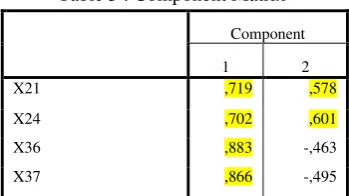
Table 5 : Component Matrixa
Component
1 2
X21 ,719 ,578
X24 ,702 ,601
X36 ,883 -,463
X37 ,866 -,495
Extraction Method: Principal Component Analysis.
a. 2 components extracted.
From 4 free variables analyzed, will then form 2 factor component. The independent variables of component factor 1 are X21, X24, X36, and X37. The indepent variables of component factor 2 are X21 and X24.
Regression Test
Table 6 : Regression Analysis
Model Summaryc
Model R R Square
Adjusted R Square
Std. Error of
the Estimate
Durbin-Watson
1 .883a ,779 ,772 ,238
2 .907b ,822 ,810 ,218 2,050
a. Predictors: (Constant), X21 b. Predictors: (Constant), X21, X24 c. Dependent Variable: Y
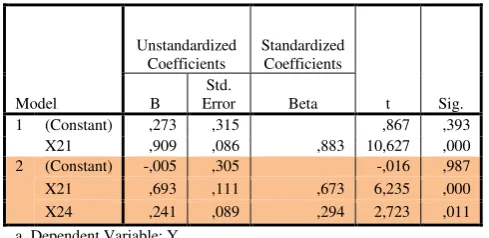
Based on the preceding table, the number of regression model that formed is 2 regression models. The first regression model consisted of only 1 variable, that is predictor variable that is X21 with R2value 0,779. This value of R2 gives the meaning that the variable X21 contributes 77.9% to the dependent variable (Y, cost performance). When combined with X24, the R2 value of the combination is 0.882. This value of R2 gives the meaning that the variables X21 and X24 contributed 82.2% of the dependent variable (Y, cost performance), while the remaining 11.8% are described outside of the independent variables.
Table 7 : Coefficientsa
Model
Unstandardized Coefficients
Standardized Coefficients
t Sig.
B
Std.
Error Beta
1 (Constant) ,273 ,315 ,867 ,393
X21 ,909 ,086 ,883 10,627 ,000
2 (Constant) -,005 ,305 -,016 ,987
X21 ,693 ,111 ,673 6,235 ,000
X24 ,241 ,089 ,294 2,723 ,011
a. Dependent Variable: Y
Based on the preceding table, the regression equation constant value is -0.005, the variable coefficient of X21 is 0.693, and the variable coefficient of X24 is 0.241. From the values of the coefficients of these variables, obtained the regression equation as follows:Y = -0,005 + 0,693 (X21) + 0,241 (X24)
V. CONCLUSION
From the statistical analysis, there are significant variables that influence the performance of design and build work cost, namely: (X21) Project Manager's ability to communicate and coordinate with the Owner during the design and build and (X24)Project Manager's ability to encourage the team to commit in quality, cost, and time of design and build. Both of these variables are obtained from the internal parts in the interior contractor. The ability factor of Project Manager while running the design & build project is very determining the actual cost in construction process.
The regression equation showing the relationship between cost performance and the factors affecting design and build management is as follows:Y = -0,005 + 0,693 (X21) + 0,241 (X24)
Therefore, the Project Manager shall have a communication, coordination, and encouragement to the team in committing towards the quality, cost, and time of the design and build workis significantly needed,in order to run the work on schedule and optimalize an appropriate comparison between actual costs and costs contracts.
REFERENCES
[1] Abdullah, Zunaibi B., “Getting Their Hands Dirty: Qualitative Study on Hands-on Learning for Architectural Students in Design-Build Course, Journal of Design and Built Environment,” Vol 8, 2011.
[2] Adnan, H., Bachik, F., and Supardi A., “Success Factors of Design and Build Projects in Public Universities, Journal of Faculty Architecture, Planning, & Surveying, University Technology MARA, Malaysia,” 2011.
[3] Akbar, Farid, “Identifikasi Faktor-faktor Kunci Keberhasilan dalam Tahap Desain Proyek Konstruksi yang Berpengaruh Terhadap Kinerja Waktu, Universitas Indonesia,” 2006.
[4] Alam, Toni, “Identifikasi Faktor – Faktor Risiko Proyek Rancang Bangun (Design & Build) Pada PT. XYZ Yang Berpengaruh Terhadap Kinerja Waktu, Universitas Indonesia,” 2011.
[5] Bower, Denise, “Management of Procurement, London,” 2003.
[6] Chan, A.P., Ho, D.C.K. and Tam, C.M., “Design / Build Project Success Factors : Multivariate Analysis, Journal Construction Engineering Manage”, 27(2), 2001.
[7] Chan, A.P., Ho, Scott, D. and Lam, W.M., “Framework of Success Criteria for Design / Build Project, Journal of Management in Engineering, ASCE”, 18(3), 2002.
[8] Ghozali, Imam, “Aplikasi Analisa Multivariate, Badan Penerbit Universitas Diponegoro,” 4th edition, 2006.
[9] Hadiarto, Yudho Dwi, “Faktor Yang Berpengaruh Terhadap Penerapan Bentuk Kontrak Design – Build Pada Proyek Jasa Konstruksi Jalan – Jembatan di Lingkungan Departemen PU Dalam Upaya Meningkatkan Efisiensi, Universitas Indonesia”, 2009.
[10] Hughes, James, “Design Bid Build v. Guaranteed Maximum Price Contracting : The Basic for Owner’s Counsel, Journal New York,” 2012.
[11] Law, Huston, Charles L, “Management of Project Procurement, the Mc Graw Hill Companies, Incl., Newyork”, 2001. [12] Kerzner, Harold, “Project Management, a System Approach to Planning, Scheduling, and Controlling, seventh edition,” 2001.
[13] Lam, W Edmond, “Why is Design-Build Commonly Used in the Public Sector? An illustration from Hongkong, The Australian Journal of Construction Economics and Building,” Vol 3 No 1, 2012.
[14] Lesniak A, Plebankiewicz, and Zima K., “Design & Build Procurement System – Contractor Selection, Journal of Archives Civil Engineering,” LVIII 4, 2012.
[15] Lesniak A, Plebankiewicz, and Zima K., “Design & Build Procurement in the Polish Public Sector, Journal of Public Procurement,” Vol 13 Issue 3, 2013.
[16] Levy, M Sidney, “Construction Process Planning and Management”, 2010.
[17] Ling Y Florence, and Leong F Edwin, “Performance of Design-Build Projects in Terms of Cost, Quality, and Time : Views of Clients, Architects, and Contractors in Singapore, The Australian Journal of Construction Economics and Building,” Vol 2 No 1, 2012.
[18] Ling Y Florence, “Design-Build : How to Increase its Usage, and its Impact on Architects and Contractors in Singapore, The Australian Journal of Construction Economics and Building,” 2012.
[19] Molenar, Keith R, and Gransberg Douglas D., “Design Builder Selection for Small Highway Projects, Journal of Management in Engineering, ASCE”, 17(4), 2001.
[20] Nazir, Moh., “Metode Penelitian, Ghalia Indonesia, Bogor,” 2005. [21] Petersen, Christine, “The Practical Guide to Project Management,” 2013.
[22] Praboyo, Budiman,”Keterlambatan Waktu Pelaksanaan Proyek : Klasifikasi dan Peringkat dari Penyebab-penyebabnya, Universitas Kristen Petra, Surabaya,” 1998.
[23] Saqib, Muhammad, Farooqui, Rizwan, U. and Lodi, Sarosh, H., “Assessment of Critical Success Factors for Construction Projects in Pakistan, 1st International Conference on Construction in Developing Countries, Karachi, Pakistan,” 2008.
[24] Singarimbun, Masri dan Effendi, Sofian, “Metode Penelitian Survey, LP3ES,” 1987.
[25] Sitorus, Juanto, “Faktor-faktor Risiko Yang Berpengaruh Terhadap Kinerja Waktu Proyek EPC Gas di Indonesia, Universitas Indonesia,” 2008.
[26] Soeharto, Imam, “Manajemen Proyek ; Dari Konseptual Sampai Operasional, Jakarta, Erlangga,” 1995.
[27] Songer, A.D. and Molenaar, K.R., “Project Characteristics for Successful Public Sector Design-Build, Journal Construction Engineering Manage,” 123(1), 1997.
[28] Songer, A.D and Molenaar, K.R., and Robinson, Graham, D., “Selection Factors and Success Criteria for design-Build in the US and UK, University of Colorado,” 1997.
[29] Tsai, Tsung-Chieh and Yang, Min-Lan, “Risk Assessment of Design Bid Build and Design Build Building Project, National Yunlin University of Science and Technology, Journal of Operation Research Society of Japan,” 53(1), 2010.
[30] Undang-Undang Republik Indonesia No. 18 Tahun 1999 Tentang Jasa Konstruksi
[31] Peraturan Menteri PUPR No.12 Tahun 2017 Tentang Standar dan Pedoman Pengadaan Pekerjaan Konstruksi Terintegrasi Rancang dan Bangun (Design and Build)