ISSN(Online): 2320-9801 ISSN (Print) : 2320-9798
I
nternational
J
ournal of
I
nnovative
R
esearch in
C
omputer
and
C
ommunication
E
ngineering
(An ISO 3297: 2007 Certified Organization)
Vol. 4, Issue 2, February 2016
Security Enhancement of Optical Code
Division Multiple Access System Using
Multicode-Keying Encryption
Reshma A T1, Vipin V R2
PG Student [OEC], Dept. of ECE, TKM Institute of Technology, Kollam, Kerala, India1
Assistant Professor, Dept. of ECE, TKM Institute of Technology, Kollam, Kerala, India2
ABSTRACT: This paper demonstrate the design and analysis of Optical Code Division Multiple Access (OCDMA)
system by incorporating Multicode-Keying encryption technique. OCDMA has become a well-known technology to implement all-optical communication for transporting multipurpose information. In OCDMA system unique code is assigned to each subscriber, so it is considered to be relatively secure as compared to other optical networks. The advanced study of OCDMA has revealed that it is easy to intercept the data by eavesdroppers. Multicode-Keying is a multiple-bit-per symbol modulation technique, supporting higher bit rate without increasing the speed of photonics and electronics. Optical Codes with large cardinality support Multicode-Keying encryption for enhancing physical layer confidentiality in OCDMA system.
KEYWORDS: Confidentiality; Multicode-Keying; One-time-pad encryption; Optical Code Division Multiple Access;
OptiSystem
I. INTRODUCTION
Optical Code Division Multiple Access (OCDMA) has recently generated substantial research topic as a promising technology because of its stunning features like flexibility, reconfigurability, ease of network control and potential for enhanced physical layer security [1], [3].
Due to tremendous increase in the volume of information exchange and strong demands in security and privacy, the issues and degree of physical-layer confidentiality potentially supported by OCDMA have become an interesting research topic. In conventional ON-OFF Keying (OOK) OCDMA, data bits can be easily distinguished by an eavesdropper using a simple energy detector in the uplink side of the user, without the need of decoding the codeword in use.[1] This is because only data bits of 1 are transmitted with the user’s one-and-only-one codeword (i.e., presence of energy) in OOK. Thus, two-code-keying, in which every user is assigned two distinct code words: one codeword for transmitting data bits of 1 and another codeword for bits of 0, was proposed. To further enhance the physical layer confidentiality one-time-pad encryption was added on the top of two-code keying.
The goal of this paper is to improve physical layer confidentiality [4] of OCDMA system by “Multicode-Keying Encryption” technique. The enhancement of confidentiality by means of “Multicode-Keying” with one-time-pad encryption is investigated in this paper.
II. MULTICODE-KEYING ENCRYPTION
ISSN(Online): 2320-9801 ISSN (Print) : 2320-9798
I
nternational
J
ournal of
I
nnovative
R
esearch in
C
omputer
and
C
ommunication
E
ngineering
(An ISO 3297: 2007 Certified Organization)
Vol. 4, Issue 2, February 2016
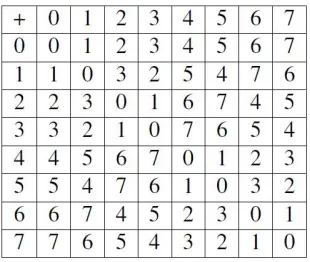
Multicode-Keying is a multiple-bit-per-symbol modulation technique. The main advantage of this technique is it supports higher bit rate without increasing the speed of photonics and electronics. One of the 2m code words is conveyed to represent the transmission of one of the 2m symbols. As a result the effective rate becomes m times the symbol rate. Interestingly, with 2m-code-keying, it is found that the encrypted symbols (i.e., code words in transmission) are determined by applying modulo-2m addition in (finite) Galois field of GF (2m) to the associated data bits and encryption keys. For example, with m = 3, every three serial data bits ∈ {000, 001, 010, 011, 100, 101, 110, 111} are mapped to one of the eight symbols: {0, 1, 2, 3, 4, 5, 6, 7} correspondingly. Similarly, the encryption keys contain the same set of eight symbols, which are equivalently binary coded as ∈ {000, 001, 010, 011, 100, 101, 110, 111} respectively.
Table 1: Modulo-2m addition in GF (2m)
The encrypted symbol (or cipher text), also denoted in the binary form as is then computed by the formula
= for i = 0, 1, 2, which is equivalent to the modulo-23 addition in Table 1. The entries in the table denote the encrypted symbol of (equivalent to codeword in transmission) for every pair of data symbol of and key symbol of . The XOR operation in the two-code-keying encryption is equivalent to the modulo-2 addition in GF (2), which belongs to a sub-field of GF (23), as shown in Table 1. Similarly, the four-code keying encryption applies the modulo-22 addition in GF (22), also a subfield of GF (23).
III. SYSTEM ARCHITECTURE
Multicode-Keying encryption is done in optical domain with the help of all-optical XOR gate and all-optical Code word Multiplexer (CMUX). Different from other designs, these two all-optical modules are designed to handle optical signals in the NRZ format in order to provide large enough (time) window to switch optical code words in the CMUX. Another advantage of using these two SOA-based modules is that SOAs with carrier recovery time <10 ps (i.e., >500 GHz) have been commercialized.
The polarization-independent all-optical XOR gate is based on the design in [6]. The gate, which was experimentally demonstrated at 10 Gb/s, utilized the gain saturation effect by the cross-gain modulation (XGM) in the SOAs without the need of clock signals or additional input control signals. In principle, a backward injected Ki optical
NRZ pulse at the top SOA will saturate the SOA’s gain and thus prevent a simultaneously forward injected Di optical
NRZ pulse from passing through the SOA. In other words, the Di pulse can pass through only if the Ki pulse is absent.
ISSN(Online): 2320-9801 ISSN (Print) : 2320-9798
I
nternational
J
ournal of
I
nnovative
R
esearch in
C
omputer
and
C
ommunication
E
ngineering
(An ISO 3297: 2007 Certified Organization)
Vol. 4, Issue 2, February 2016
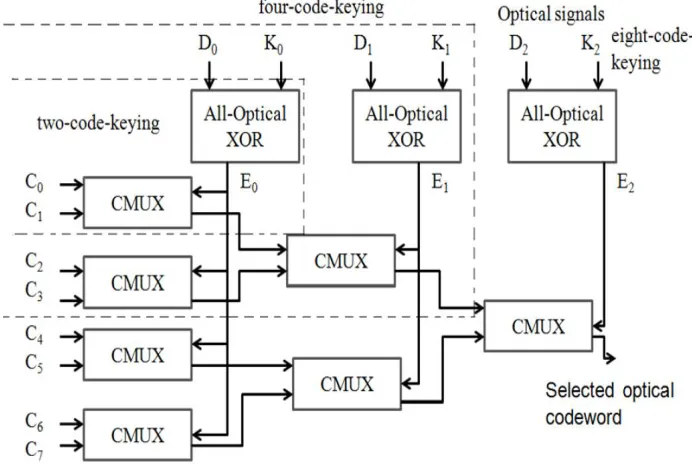
Fig. 1 All-optical design for Multicode-Keying Technique
Our polarization-independent all-optical CMUX is designed to function like a 2 × 1 codeword selector by means of the XGM in the SOAs. The NRZ encrypted symbol Ei from the all-optical XOR gate is sent into the back input of the
top SOA as shown in Fig.1. In principle, a backward injected Ei pulse at the top SOA will saturate the SOA’s gain and
thus prevent a simultaneously forward injected optical codeword Cj from passing through the SOA. In other words, Cj
can pass through only if Ei = 0. The middle SOA is configured to function as an optical inverter. Inducing the XGM,
the backward injected Ei pulse saturates the SOA’s gain and prevents a forward injected CW laser beam from passing
through the SOA, thus giving Ei as the output. Similarly, the bottom SOA allows optical codeword Cj+1 to pass only if
Ei = 0 (i.e., Ei= 1). Combining both outputs at the 2 × 1 passive combiner, the all-optical 2 × 1 CMUX operation, + , is obtained as the output.
A novel all-optical design of the hardware for Multicode-keying encryption technique is shown in Fig.1. Both data symbols and encryption keys are now in the optical form. Multicode-keying encryption is used to represent 2m code words with m serial data bits per symbol. The block diagram shown above is used to represent 23 code words with m = 3.
IV.SIMULATION MODELING
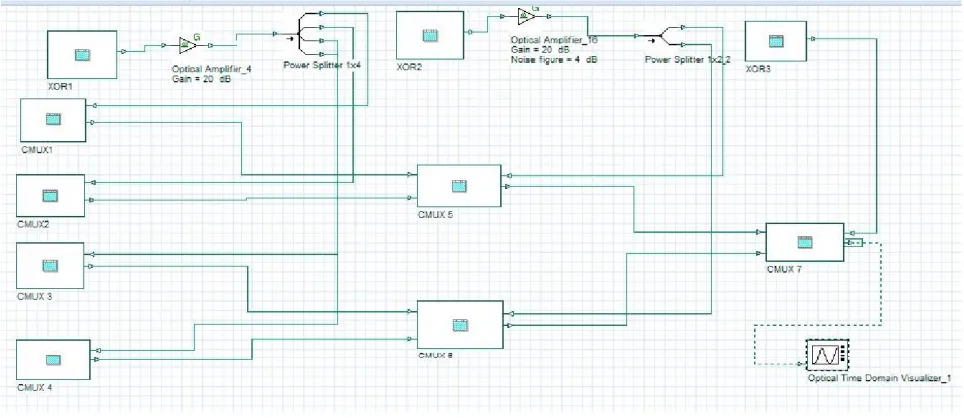
The simulation setup of proposed Multicode-Keying Encryption technique modelled using OptiSystem Version 12 simulation software is shown in the Fig.2. The block diagram shown above is the design of eight-code keying encryption technique. Eight-code Keying consist of three all-optical XOR gate, seven all-optical CMUX. The XOR 1 output E0 is amplified by an Optical amplifier (OA). Then it is split into four by a 1 × 4 Power Splitter. Thus encrypted
data E0 from XOR 1 act an input of CMUX 1, CMUX 2, CMUX 3 and CMUX4. The selected code words coming from
these CMUXs given to CMUX 5 and CMUX 6.The encrypted data E1 is given from XOR 2 to CMUX 5 and CMUX 6.
The outputs from CMUX 5 and CMUX 6, encrypted data E2 from XOR 3 are act as the input of CMUX 7.As the name
ISSN(Online): 2320-9801 ISSN (Print) : 2320-9798
I
nternational
J
ournal of
I
nnovative
R
esearch in
C
omputer
and
C
ommunication
E
ngineering
(An ISO 3297: 2007 Certified Organization)
Vol. 4, Issue 2, February 2016
Table 2: Code words in Subsystems
The data bits and Keys in the XORs are given in Table 3. The code words are selected according to the Cipher bits coming from XOR 1, XOR 2 and XOR 3.
Table 3: Data bits And Keys
According to the data bits and keys in Table 3, the cipher bits obtained by the XOR operation are E0 = 1010110110; E1
ISSN(Online): 2320-9801 ISSN (Print) : 2320-9798
I
nternational
J
ournal of
I
nnovative
R
esearch in
C
omputer
and
C
ommunication
E
ngineering
(An ISO 3297: 2007 Certified Organization)
Vol. 4, Issue 2, February 2016
V. RESULTS AND DISCUSSIONS
The results obtained from Optical Time Domain Visualizer of OptiSystem version 12 is shown in the Fig.3. Eight code words are applied in this encryption technique. The code words used are . The CMUX 7 gives the sequence of code words . So due to the increased number of code words, eavesdropper find difficulty to figure out the data symbols from these code words.
Fig. 3 All-optical Eight-code Keying Encryption
VI.CONCLUSION
In this paper the confidentiality improvement of OCDMA system with “Multicode-Keying Encryption” technique is analyzed. The cipher bits obtained from the All-optical XOR Gate is mapped to 2m code words. So even though code words are not hidden, the eavesdropper’s find difficulty in figuring out how the code words are mapped to the data symbols. Also optical encryption by using all-optical XOR gate has low latency and immune to electromagnetic interference. The all-optical design is scalable and integrable, and able to handle both data bits and encryption keys in the optical and non-return-to-zero (NRZ) format.
REFERENCES
1. E. Narimanov, W.C. Kwong, G.-C. Yang, and P. R. Prucnal, ‘Shifted carrier-hopping prime codes for multicode keying in wavelength-time OCDMA,’ IEEE Trans. Commun., vol. 53, no. 12, pp. 2150–2156, Dec. 2005.
2. C.-Y. Chang, G.-C.Yang, andW. C.Kwong, ‘Wavelength-time codeswith maximum cross-correlation function of two for multicode-keying optical CDMA,’ J. Lightw. Technol., vol. 24, no. 3, pp. 1093–1100, Mar. 2006.
3. C. Yang, R. P. Scott, D. J. Geisler, N. K. Fontaine, J. P. Heritage, and S. J B. Yoo, ‘Four-state data encoding for enhanced security against upstream eavesdropping in SPECTS O-CDMA,’ J. Lightw. Technol., vol. 29, no. 1, pp. 62–68, Jan. 1, 2011.
4. T. H. Shake, ‘Security performance of optical CDMA against eavesdropping,’ J. Lightw. Technol., vol. 23, no. 2, pp. 655–670, Feb. 2005 5. N. Kostinski, K. Kravtsov, and P. R. Prucnal, ‘Demonstration of an all optical OCDMA encryption and decryption system with variable
two-code keying,’ IEEE Photon. Technol. Lett., vol. 2, no. 24, pp. 2045–2047, Dec. 2008.
ISSN(Online): 2320-9801 ISSN (Print) : 2320-9798
I
nternational
J
ournal of
I
nnovative
R
esearch in
C
omputer
and
C
ommunication
E
ngineering
(An ISO 3297: 2007 Certified Organization)
Vol. 4, Issue 2, February 2016
BIOGRAPHY
Reshma A T received her B.Tech degree in Electrical and Electronics Engineering from
University of Kerala in 2014. She is currently pursuing second year M.Tech in Optoelectronics and Communication Systems at TKM Institute of Technology.
Vipin V R received his B.E degree in Electronics and Communication Engineering in 2008 and