University of Windsor University of Windsor
Scholarship at UWindsor
Scholarship at UWindsor
Electronic Theses and Dissertations Theses, Dissertations, and Major Papers
2009
Extending Scojo-PECT by migration based on application level
Extending Scojo-PECT by migration based on application level
checkpointing
checkpointing
Jiaying Shi
University of Windsor
Follow this and additional works at: https://scholar.uwindsor.ca/etd
Recommended Citation Recommended Citation
Shi, Jiaying, "Extending Scojo-PECT by migration based on application level checkpointing" (2009). Electronic Theses and Dissertations. 7923.
https://scholar.uwindsor.ca/etd/7923
This online database contains the full-text of PhD dissertations and Masters’ theses of University of Windsor students from 1954 forward. These documents are made available for personal study and research purposes only, in accordance with the Canadian Copyright Act and the Creative Commons license—CC BY-NC-ND (Attribution, Non-Commercial, No Derivative Works). Under this license, works must always be attributed to the copyright holder (original author), cannot be used for any commercial purposes, and may not be altered. Any other use would require the permission of the copyright holder. Students may inquire about withdrawing their dissertation and/or thesis from this database. For additional inquiries, please contact the repository administrator via email
Extending Scojo-PECT by migration based on
application level checkpointing
By
Jiaying Shi
A Thesis
Submitted to the Faculty of Graduate Studies through the School of Computer Science in Partial Fulfillment of the Requirements for
the Degree of Master of Science at the University of Windsor
Windsor, Ontario, Canada 2009
1*1
Library and Archives CanadaPublished Heritage Branch
395 Wellington Street OttawaONK1A0N4 Canada
Bibliotheque et Archives Canada
Direction du
Patrimoine de I'edition
395, rue Wellington OttawaONK1A0N4 Canada
Your file Votre reference ISBN: 978-0-494-57636-6 Our file Notre reference ISBN: 978-0-494-57636-6
NOTICE: AVIS:
The author has granted a
non-exclusive license allowing Library and Archives Canada to reproduce,
publish, archive, preserve, conserve, communicate to the public by
telecommunication or on the Internet, loan, distribute and sell theses
worldwide, for commercial or non-commercial purposes, in microform, paper, electronic and/or any other formats.
L'auteur a accorde une licence non exclusive permettant a la Bibliotheque et Archives Canada de reproduire, publier, archiver, sauvegarder, conserver, transmettre au public par telecommunication ou par I'lnternet, preter, distribuer et vendre des theses partout dans le monde, a des fins commerciales ou autres, sur support microforme, papier, electronique et/ou autres formats.
The author retains copyright ownership and moral rights in this thesis. Neither the thesis nor substantial extracts from it may be printed or otherwise reproduced without the author's permission.
L'auteur conserve la propriete du droit d'auteur et des droits moraux qui protege cette these. Ni la these ni des extraits substantiels de celle-ci ne doivent etre imprimes ou autrement
reproduits sans son autorisation.
In compliance with the Canadian Privacy Act some supporting forms may have been removed from this thesis.
Conformement a la loi canadienne sur la protection de la vie privee, quelques
formulaires secondaires ont ete enleves de cette these.
While these forms may be included in the document page count, their removal does not represent any loss of content from the thesis.
Bien que ces formulaires aient inclus dans la pagination, il n'y aura aucun contenu manquant.
1+1
Author's Declaration of Originality
I hereby certify that I am the sole author of this thesis and that no part of this thesis has
been published or submitted for publication.
I certify that, to the best of my knowledge, my thesis does not infringe upon anyone's
copyright nor violate any proprietary rights and that any ideas, techniques, quotations, or
any other material from the work of other people included in my thesis, published or
otherwise, are fully acknowledged in accordance with the standard referencing practices.
Furthermore, to the extent that I have included copyrighted material that surpasses the
bounds of fair dealing within the meaning of the Canada Copyright Act, I certify that 1
have obtained a written permission from the copyright owner(s) to include such
material(s) in my thesis and have included copies of such copyright clearances to my
appendix.
I declare that this is a true copy of my thesis, including any final revisions, as approved
by my thesis committee and the Graduate Studies office, and that this thesis has not been
Abstract
In parallel computing, jobs have different runtimes and required computation resources.
With runtimes correlated with resources, scheduling these jobs would be a packing
problem getting the utilization and total execution time varies. Sometimes, resources are
idle while jobs are preempted or have resource conflict with no chance to take use of
them. This greatly wastes system resource at certain degree.
Here we propose an approach which takes periodic checkpoints of running jobs with the
chance to take advantage of migration to optimize our scheduler during long term
scheduling. We improve our original Scojo-PECT preemptive scheduler which does not
have checkpoint support before. We evaluate the gained execution time minus overhead
To my wife, Xiaoguang Li
Acknowledgements
I would like to take this opportunity to express my sincere gratitude to my supervisor Dr.
Angela C. Sodan. Without her extensive guidance and constant encouragement, I could
not finish this thesis. I would also like to thank all committee members, Dr. Roberto
Muscedere, Dr. Xiaobu Yuan and Dr. Dan Wu for their valuable time and comments.
My special thanks go to my wife, Xiaoguang Li, for her support and good advices during
the two and half years' graduate study.
I would like to thank Lichun Zhu for his great work on modifying and debugging
programs; Peiyu Cai for his idea and help on assuming algorithm; Xijie Zeng, Wei Jin
and Xiaorong Cao for the happy experience during the time I worked with them.
Last, but not least, I would like to thank all of my friends for all the help and support
Table of Contents
Author's Declaration of Originality ..iii
Abstract iv
Dedication v
Acknowledgements vi
List of Tables ix
List of Figures x
1. Introduction 1
2. .Background Issues: 5
3. Scojo-PECT 8
3.1 Scojo-PECT Preemptive Scheduler 8
3.2 Core Scheduling Algorithm 9
4. Extended Job Scheduling Algorithm 11
4.1 Assumption, Motivation, Scheduling Objective 11
4.2 Cost Model 12
4.2.1 Trend of Checkpoint File Sizes 12
4.2.2 Interval Setting 19
4.3 Checkpointing Scheme by Migration with Checkpointing at Application Level 22
5. Experiment and Result Analysis
5.1 Experiment Environment Setup 30
5.1.1 Workload Modeling 30
5.1.2 Evaluation Plan 31
5.2 Experiment of Results 33
5.3 Result Analysis 39
6. Conclusion and Future Work 41
6.1 Conclusion 41
6.2 Future Work 41
Reference 43
Appendix 46
List of Tables
Table 1. Relation Chart of Application & System Level Checkpoint 13
Table 2. Scheduler Parameters 31
List of Figures
Figure 1. Scojo-PECT Scheduler sketch map 10
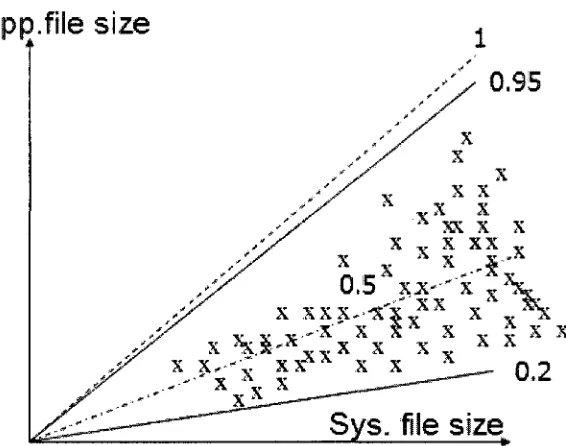
Figure 2 Chart of relation between application and system file sizes 14
Figure 3. Probability density function & Cumulative distribution function 15
Figure 4. Relation of reduction of file size in ISING and SOR applications 17
Figure 5. The (PDF) probability density function and (CDF) cumulative distribution
function of gamma distribution 18
Figure 6. MTBF chart under different reliability level 20
Figure 7. Probability density function of normal distribution 21
Figure 8 Job initialization stage 23
Figure 9 Migration stage 26
Figure 10 Migration & Backfill 28
Figure 11 Relative Response Time for long and medium jobs at seed 71 34
Figure 12 Relative Response Time for long and medium jobs at seed 31 35
Figure 13 Relative Response Time for long and medium jobs at seed 7 36
Figure 14 Relative Response Time for long and medium jobs at seed 23 37
Figure 15 Relative Response Time for long and medium jobs at seed 13 38
1. Introduction _
In high performance computing area, a job has one or more processes, like serial job and
parallel job. People cared about how to schedule the jobs that would bring more benefit.
There are three metrics to evaluate a schedule strategy. At users' view, response time
defines how fast the job has been processed. It is the time period between job submission
and termination. Usually we use average response time instead of each individual one. As
some situations did exist when average response time got good result, while several
specific jobs were severely delayed. So, another metric fairness would be counted in. It is
the factor to check whether the job is fairly or unfairly treated. It sets up a threshold to
compare a job's response time and its estimated response time as it's been submitted. At
systems' view, utilization defines how efficient the resources have been taken advantage
of. It could be counted as a relation between used and total resource during a time scale.
Better utilization would lead to shorter response time but not guarantee in every case.
Thus, sometimes there is a tradeoff between response time and utilization.
There are two basic types of job scheduling approaches: time sharing and space sharing.
For time sharing, multiple jobs are allocated to run on the same set of processors.
Multiple processes share using a processor with time slices. The advantage of time
sharing is that jobs can start to run sooner (maybe result as a shorter response time).
Regarding space sharing, processors are divided into groups and each group exclusively
suspended. Space sharing is easy to implement without any context switch overhead.
Unfortunately, inefficient packing schemes usually generate fragmentations. Some
scheduling methods are proposed to improve the performance of time and space sharing,
e.g. backfilling, by which a job is scheduled to run out of its original FCFS (First Come
First Serve) order to fill the "holes".
Checkpointing mechanism is a term we often used in database and high-performance
computing area. It keeps the current program's computation state into stable storages for
the purpose of recovery once occur failure and get restart with minimum loss of
computing work. We extended the original scheduler to take use of checkpoint
mechanism not for fault tolerance but for the resource flexibility by storing the
computation state periodically. As the original scheduler does not support the checkpoint
and it only does preemption (suspend jobs when slice ends and resume on the same
resource in its own type slice), it greatly restricts the usage of computation resource even
if there is free resource.
A checkpoint of a single process contains the processor's address space and states of its
registers. And a global state is required in additional in multi-processor and distributed
systems. It has the information to describe the relationship between checkpoints of each
processor. To restart from a checkpoint, it just needs to initialize the address space from
Two basic types of checkpointing schemes are full checkpointing and incremental
checkpointing. With full checkpointing, the system just saves the whole image of current
process state into stable storage. And incremental checkpointing, it maintains a list of all
the dirty pages of memory which has been modified during the computation since the last
checkpoint. When reaching the checkpoint, only those pages on the list will be stored
since the remaining pages are just read only variables. The latter approach would save
larger space in checkpoint file size and thus reduce the checkpoint overhead greatly.
There is another classification method based on platforms, several major categories of
checkpointing are: Hardware level, additional hardware incorporates with processor to
save state; System/Kernel level, operation system will be responsible for taking
checkpoint; Application level, the checkpoint code is directly inserted into application by
programmer or preprocessor. Application level checkpoint (ALC): for this definition, it is
a checkpointing technique in application level. It highly depends on programmer who is
required to have sufficient knowledge on specific applications. In the abstraction level, it
selects relevant core of data in order to reduce the amount of checkpoint file size and
achieve more efficient operation by pre-compiler, which we will discuss in background
issue for more detail.
In our thesis, we extended original scheduler by adding application level checkpoint.
in utilization and average relative response time.
The rest of the thesis is organized as follows. Background issues are discussed in Chapter
2. Chapter 3 introduces original Scojo-PECT. And extended job scheduling algorithm is
described in detail in Chapter 4. Chapter 5 presents the simulation, experiments and
results analysis. Finally, the conclusion of the thesis is made in Chapter 6 and we discuss
2. Background Issues:
Job scheduling in parallel computing area has been studied for a long period. Around the
scheduling approaches, there is generally not only the time sharing and the space sharing,
but also other mechanisms involved such as preemption and backfill. However, these
approaches could partially solve the fragmentation created during arranging jobs phase
and make better use of idle resource avoiding making nodes unfairly working(the
situation some nodes running busy, some keep idle).
There is now another option to improve the performance of total job scheduling using
migration based on checkpointing, which we discussed above. One type is system level
checkpointing, and the other is application level checkpointing. For system level
checkpointing, University of Wisconsin introduced Condor system [14] which provides
important features that: Source code does not need to be modified to take advantage of
these benefits. Code that can be re-linked with the Condor libraries then the jobs can
produce checkpoints and they can perform remote system calls [14], and Lawrence
Berkeley National Laboratory introduced BLCR (Berkeley Lab Checkpoint/Restart) [16],
a system-level checkpoint/restart implementation for Linux clusters that targets the space
of typical High Performance Computing applications, including MPI. As a kernel module,
it has a "callback" interface to allow any library or application code to cooperate in the
For application level checkpointing, Cornell University introduced C3 (Cornell
Checkpoint Compiler) [15] system, it executes almost all source code and instruments
them to perform application level state saving by insert a potential checkpoint at locations
in the application where checkpoints might be taken. And the pre-compiler co-work with
the native compiler of hardware platform to interpret the calls from the instrument
application.
As those two kinds of checkpointing mechanisms present, which one would be better for
high performance computation. What is the exact difference between them?
The differences between System level vs. Application level checkpointing techniques:
One is the checkpoint file size. As we know, the system level checkpointing approach
barely has the knowledge of what application it is. It just stores the whole image of
process at the time it takes the checkpoint. For application level checkpointing approach,
it is been assumed the programmer has sufficient knowledge on applications and could
tell what kind of variables are dead, which part of image could be compressed. In this
manner, the size of checkpoint file get smaller compare to system one. In [15], authors
made comparison between C3 and Condor, used five kinds of applications for testing, it
proved ALC could have smaller size compare to SLC, though results varies.
level, the operation system will handle the checkpoint and decide when to generate a
checkpoint, what is more, that kind of checkpoint in system level could be done at
arbitrary time as the processes has been preempted with no risk of lacking records. The
application level, the application at the beginning based on its own code will have no idea
when and how to do the checkpoint operation. So inserting the intervals for application
level checkpointing would be better choice for the simulation. In [1][2][3], the authors
studied on determining the optimal interval for setting checkpoints in application and
made proof. [2][3], are continuous study and the authors in latter made great efforts
modifying the formula to let it suits more cases and made more accurate to predict the
interval.(the former failed to make prediction on small size of checkpoint file) And in [1],
author tried to verify the impacts over the system overall quality of interval setting
through many aspects, as they put interval as adjustable parameter and they also pointed
out the optimal checkpoint intervals heavily depend on some system parameters, such as
the time to place a checkpoint, the time to recover from a fault, the fault arrival rate,
which has the similarity with [2] [3]. And for this reason, we decided to take advantage of
their existing parameter and formula to make it suitable to our research.
As the checkpointing mechanism usually is applied in HPC (High Performance
Computing) field for the purpose of fault tolerance, we imported the idea into our work as
a solution to let the application have more flexibility choosing free computation resource
3. Scojo-PECT
The extending work is all based on the Scojo-PECT. In this chapter, we are going to
discuss the detailed original scheduler including how it works, what kind of scheduling
techniques have been adopted and also some priorities of jobs.
3.1 Scojo-PECT Preemptive Scheduler
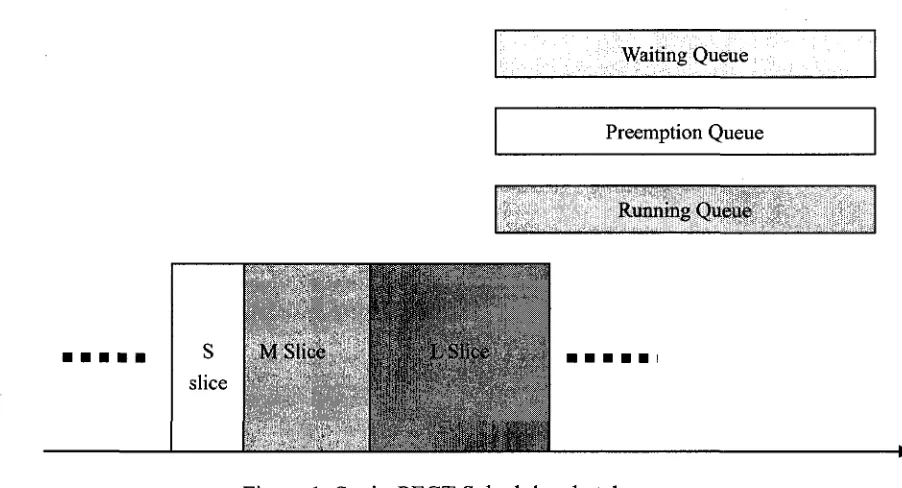
Scojo-PECT [8] is a job scheduler framework. Scojo-PECT provides coarse grain time
slices to avoid the excessive waiting time when jobs getting access to their resource. All
running jobs are preempted and divided into three types (short, medium, long) based on
their runtimes. This could make the preemption in the disk affordable. They are
scheduled in different time slices of their own types.
Scojo-PECT does not require checkpointing [10] support and therefore impose the
constraint that preemption jobs without checkpoint could just restart on the same resource
instead of migrating to different resources. One slice time of each type was scheduler per
time interval which was set based on the resource time share which is predefined.
Resource shares [9] can be defined based on specific job mixes, administrator's policies.
E.g. it can be set different for different times during the day.
Scojo-PECT can either use EASY or conservative backfilling. Backfilling is an approach
means jobs could be move ahead by not delay the first waiting job. Conservative
backfilling [10] requires none jobs in queue to be delayed compare to their schedule
position upon submission. Within the scheduler, the job will not dynamically change and
jobs per type were typically scheduled in FCFS order with backfilling applied.
Scojo-PECT also provides safe non-type backfilling [8] because the manual division of
job into several types may generate fragmentations since job runtimes and job sizes are
correlated. Non-type backfilling means preempted or waiting jobs of different slices can
be backfill to a slice if they do not delay any jobs of the slice type or their own types.
Scojo-PECT implemented an event-driven simulator to have it co-work with scheduler.
The event-based simulator defines four kinds of events with job submission and
termination mean new job come into waiting queue and job finish running and release the
occupied resources. Slice begin events describe new time slice starts and specific jobs
resumed/scheduled to run and slice end events means one slice run out of its time share
and all running jobs are preempted.
3.2 Core Scheduling Algorithm
The detailed original algorithm of Scojo-PECT [8] is:
At first, at the end of slice, jobs were preempted at the end of corresponding time slice
Second, scheduler attempts to schedule jobs of slice type from waiting queue which first
fit the free resource;
Then, scheduler tries to backfill (EASY or Conservative) of slice type;
Last, scheduler will try to non-type backfill (e.g. using the medium and long type job in
their waiting queue to backfill the fragmentation left in small job type slice).
Waiting Queue
Preemption Queue
Running Queue
4. Extended Job Scheduling Algorithm
In this chapter, we are going to discuss how we extended the original scheduler. We start
talking about the motivation and objective. And we explain the cost model (interval
setting, overhead distribution calculation) we have applied in our experiment in detail. At
last, we will discuss the extended job scheduling algorithm such as how it works, what
extra benefit it could get compared to original scheduler. After that, we will analyze the
potential benefit of a simple case by adopting our extending job scheduling algorithm.
4.1 Assumption, Motivation, Scheduling Objective
The extending of applying application level checkpoint is based on the following
assumptions:
1. We introduce checkpoint in our simulator as an approach for flexibly using free
resource, not for the aim of failure recovery
2. All the jobs randomly generated by Lublin-Feitelson model are independent
As we discussed the original Scojo-PECT, it has feature like preemption while it will
restrict scheduler to make decision on using idle resources even there are available. And
originally the Scojo-PECT did not have checkpoint support, for this reason, we imported
checkpoint/migration mechanism to let the scheduler to better utilize resource much
The objective of the scheduler one is to get better average response time based on
different workload model. The response time means the time cost between jobs been
submit and return back. It generally represents the efficiency of scheduler processing
operation. Another is to find out the relation between the average response time and
relative factors like average job size, randomly job generation and also job type ratio.
4.2 Cost Model
As we discussed in background issue, there are two major differences between system
and application level checkpoint. One is the file size, and the other checkpoint time. For
the first, we involved the gamma distribution [11] and we will discuss it in detail at below,
and the latter, we borrowed their formula for setting up optimal intervals for application
level checkpoint [3].
4.2.1 Trend of Checkpoint File Sizes
The background of this function is our investigation of other peoples' experiment results
between system level and application level checkpoint sizes using different categories of
program. The most common situation is the application level will reduce the full size of
checkpoint files in system level to the average of 50%, which in another way means
nearly half space of checkpoint file could be saved by applying the modification in
application level [5].While, there are still some specific application required more on the
levels will be less, vice versa. Two extreme cases are the application level checkpoint
files nearly be the same as the system level one; and the application level checkpoint file
shrink tremendously and close to 20%, shows in Table 1. So we manually set the statistic
bound ranges from 20% to 95% of the full size of system level checkpoint file [5][6].
With the trend, as it closes to the low bound 20%, the probability of density is higher,
which means there is much higher possibility to reduce the checkpoint file size for at
least 20%, and to the other side, high bound 95%, the probability of density is almost
none means there is little chance for application level checkpoint reduce the file size for
95%. Applications ISLNG 256 ISING512 ISING768 ISING 1024 ISING urn ISING 1536 ISING 1792 SOR25C 80RS12 SOR 768 SOR1024 SOR1280 GAUSS 512 GAUSS 1024 ASP 512 ASP 1024 2*BODY40» System-Level Checkpoints 3176 3962 5268 7082 9408 12251 15601 3409 4999 7613 11251 15994 5312 11806 3990 7230 3540 User-Defined Chedqpomts 269 1049 2341 4145 6461 9289 12629 540 2104 4692 8304 12940 2052 820(1 1024 4096 312 Size Redaction 91.5% 73.5 % 55.5 % 41.4% 31.3% 24.1 %
19.0 % ' 84.1% 57.9 % 3S.3 % 26.1 % 19.1 % 61.3 % 30.5 % 743 % 43.3 % 91.1 %
Table 1. Relation Chart of Application & System Level Checkpoint [5]
the reduction of file size, so based on the table 1 [5], we analyzed the data and formed the
chart. To better present the relation and make it precisely, we chose the gamma
distribution with the two bounds fixed at 0.2 and 0.95, which totally express and cover
the specific case. The trend chart we have created partly from those data [5] and is shown
below to indicate the relation between application level checkpoiont file and system level
checkpoint file when the file size goes up, see Figure 2.
Figure 2 Chart of relation between application and system file sizes
The gamma function is used to let it control the randomly generated figures which
represent the checkpoint file size of system level to display the trend which would be
close to the gamma distribution, with its parameter fixed. As for gamma distribution [11],
in probability theory and statistics, is a two-parameter family of continuous probability
distributions. One is the shape parameter k and the other is scale parameter 0. So a
a~T (k,0). For its probability density function, both k, 6 would be positive, it could
be expressed as
F(x;k,0) = x k-i e -x/e»
e
knk)
forx>0andk, 6»0. [11]
If k is a positive integer, then T (k) = (k-1)!
k= 1,6 = 2.0 — k- 2,9 = 2.0 it = 3,6 = 2.0 — k = 5,6=1.0 — jfc = 9,9 = 0.5 —
i i i
0 2 4 6 8 10 12 14 16 18 20
So back to our prediction of the application level checkpoint file size, based on the
function given above, we let Sapp be the application level checkpoint (ALC) file size and
Ssys be the system level checkpoint(SLC) file size, combined with the upper and lower
bound restriction, we formed our formula:
Sapp= a x Ssyswith a~T (k,#)
This also could be expressed as:
-x/0
Sapp = F(x;k,6>) x Ssys = xk"'—- x Ssys for x>0 and k=2, 0 = \ (1) 6k T{k)
Gamma_Low for Cumulative distribution 0.2, which is 0.8274 (2)
Gamma_High for Cumulative distribution 0.95, which is 4.743 (3)
While x = gammaRandom.getnextdouble (), one function in colt.jar (provides a set of
Open Source Libraries for High Performance Scientific and Technical Computing in
Java.), between GammaJLow and Gamma_High, based on formulas above, Sapp would
be
x + Gamma_Low - Gamma Low
Gamma_High - Gamma_Low x&yj=Sapp (4)
So the checkpoint overhead of ALC would be
ALC cost = —— + Tcoor,
IB
where IB is integrated bandwidth of reliable storage, we put the 0.5 to be the
coordination time of processes before the checkpointing starts and for current technology
A ¥^ A x-0.8314 _ A C ALC cost = x Ssys + 0.5,
2.9266x70
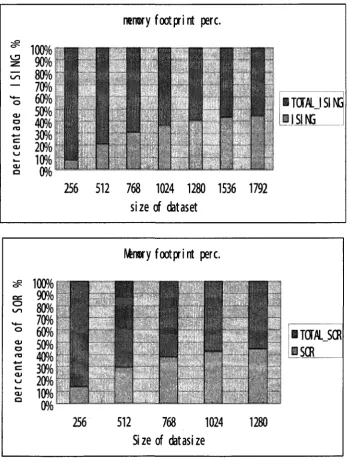
The reason why we pick why we pick the shape parameter k as 2 and the scale parameter
6 as 1, we concluded the two specific application and judged different situations while
the size changed from Figure 4.
o n o c Q '0 90% 80% 7(M 60% 50% 40% 30% 20% 10% JUS'
11
rarrory footprint perc.
IT0TALJSIN3 11 SINS
256 512 768 1024 1280 1536 1792 size of dataset
100%| o o CD a as c KJ a i
80%
70%
60%
50%
40%
30%
20%
10%
256Itenwy footprint perc.
ITOWLJCR [SCR
512 768 1024 1280 Size of datasize
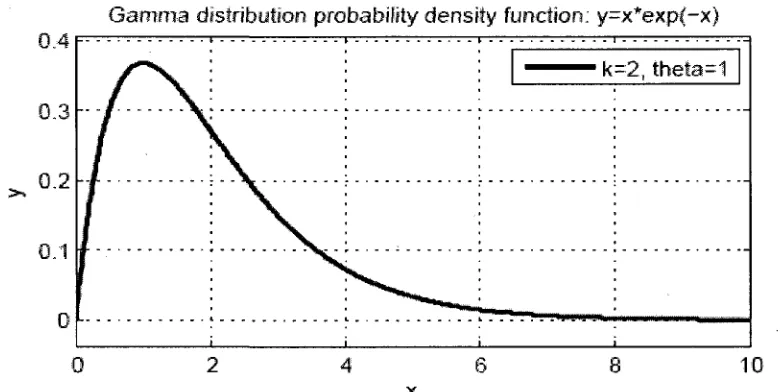
For calculating the low bound and high bound, we used the assistant tool MATLAB, to
draw the graph and get the figures at two extreme bounds. Like the Figure 6 below, we
settle the cursor on the cumulative distribution function chart and move it to get the right
figure at 0.2 and 0.95, then we map the x to the probability density function chart. Let
them cover the 20% and 95% of the total area.
Gamma distribution probability density function; y=x*exp(-x)
0.3-0.2
0.1
0
1 - - " - - - " - • • : • i • • _ • : • - . . . . . : . . . .
i i
i
--2, ihela=t
4 8 x
8 10
Gamma distribution Cumulative distribution function: y="l-exp(-x)-x*exp{-x)
Figure 5. The (PDF) probability density function and (CDF) cumulative distribution
4.2.2 Interval Setting
For deciding the interval of checkpointing, several papers [1][2][3] discussed optimal
intervals in the context of failure tolerance, the first was brought up in early 1974 given
an explicit formula Topt = V25M [ 1 ] where 8 is the time to write a checkpoint file, M is
the mean time between system failures (MTBF, it involves the whole aspects of system
such as CPU, memory, power cable etc.), and Topt is the optimum compute time between
writing checkpoint files. But its restriction is this model completely fails to predict
simulation results for small M. As for that reason, the second paper brought up in 2003,
by Young and claimed that Topt = •N/25(M + R) - 5 [3] to be an excellent estimator of
the optimum compute interval between restart dumps for values of (T +S)/M < — at the
end, where R be the restart time. In 2009, chen etal[\] pointed out the optimal
checkpoint intervals heavily depend on some system parameters, such as the time to place
a checkpoint, the time to recover from a fault, the fault arrival rate, and the user specified
parameters, like user defined timing constraints. Setting the intervals could influent the
system availability and task execution time.
We picked up the first formula to help us setting interval for our simulator. The reason is
we need to roughly predict the interval, although the model did not count the failure
probability. The MTBF as its definition is the mean time between failure for individual
components (e.g., processors, disks, memories, power supplies and networks). A large
leads to frequent individual failure. For components mentioned above, they all have an
operational lifetime measured in years. There are three different component reliability
levels: MTBFs of 104,105,106 hours. In particular, the IBM BlueGene/L system with
65536 nodes is expected to have an MTBF of less than 24 hours [4]. We followed the
graph and select the MTBF under the reliability level of 10s hours, with 128 nodes
involved in our simulation system around 200 hours. So in our case, the optimal
checkpoint interval would be set following the formula:
Topt= V25M = 20VS =20 J^-+ 0.5
V 70
S
:i to
140 120 I0O
-fe » h
60
\-40
20
V
10.000
joaooo
UJOO.OOO
*
\ ToraFLOPS
1 \
i \
-\
p i — i — I I I I
i»o
~r-t+»t-t-..iM>«
'\Pet-aFLOPS.
10000 IOWO0
System Size (number of nodes)
Figure 6. MTBF chart under different reliability level. [4]
every cases, thus we try to make our simulation more close to the real situation by adding
the normal distribution (Gaussian distribution) on the base interval setting and fix the
confidence limit o2 to let the probability density located between the confidence limits.
The normal distribution is Tmt~ldu,52) a n^ after expanded it is the formula with
variable x related with ju and a2, with ju be the median value of the bell curve and
o2 be the variance, here we define the a2 be around two to let the probability density
would reach 99.5% between the variances.
>(*)-1
542K exp
•(x-jif 2S2
M
{ M = 0,S2=1 )
CO
o
O
o o
/ • • •
\
,/ . / !
-n, v 2.1%Jk 2.1% 0.1%
- 3 a -2o - l a lcr 2a 3a
Figure 7. Probability density function of normal distribution [12]
So far, we have done checkpoint overhead part and for migration and restart time we need
to clarify them. The migration time is not depending on the number of nodes, but linearly
storage to target nodes.
Migration cost = ^ - +7^ [21]
W
This formula was developed by Peiyu Cai [21]. (W is the write speed of stable storage
during the migration and for current technique we take 30MB/s, and Tmjn is the base time
which represents the basic overhead.) And for restart cost, that time on local node is
constant. Its cost relies on putting images to the node memory, once the migration done
transfer, the time to restart just short within one second.
4.3 Checkpointing Scheme by Migration with Checkpointing at Application
Level
As the original Scojo-PECT does not have checkpoint/migration support, the original
idea to introduce migration based on checkpointing is to fill fragmentations which were
created during the jobs being scheduled and find out the improvement of the scheduler
performance like average relative response time. The original scheduler handles the slice
by a series of operations such as release preempted jobs' memory, calculate free
resources, search preemption queue, waiting queue and apply backfill strategy if
possible.
As Peiyu Cai discovered mainly four cases on system level before [21], we did some
investigations on the application level on his basis. After investigating the scheduler, we
checkpointing. We reached a conclusion that to take better use of the free resources and
fill up the fragmentations, we could achieve it through backfilling (get jobs in the rear
position ahead) and migration (put jobs run on other free resource at the same time or at a
later time).
Generally, the application level checkpoint extension has three main stages:
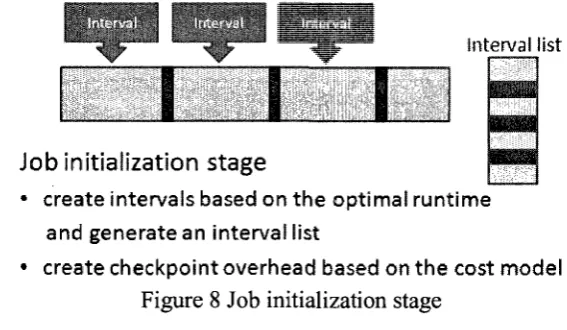
1. Job initialization stage, see Figure 8. We figure out the places where we need to insert
our checkpoint intervals (create intervals based on the runtime) and generate an
interval list to hold them in time order and meanwhile calculate checkpoint overhead
based on the cost model.
In;= rt f J|
Interval list
I I I
Job initialization stage
• create intervals based on the optimal runtime
and generate an interval list
• create checkpoint overhead based on the cost model
Figure 8 Job initialization stage
2. Create next checkpoint event stage. As the scheduler processed jobs slice by slice and
generally jobs can be started either at the beginning or the middle of slice. So we
summarized two places we create the checkpoint event. 1) The beginning of slice, at
that time all the jobs we prepared to run in the particular slice, each has their own
jobs start from the beginning of slice.
3. Handle checkpoint event stage, see Figure 10. In this stage, we are going to discover
the chance to take advantage of migration based on checkpointing. We have two
kinds of queues here dealing with checkpointed jobs and selecting jobs for migration.
One is the reserve queue (It holds the checkpointed jobs) and the other is the
candidate queue (It holds the jobs which are able to run on the free resources at the
checkpoint time).
When reaching the checkpoint, a couple of things will be done. 1) Stop job and add
checkpoint overhead to simulate the checkpoint process. 2) Move the checkpointed
job into reserve queue. In reserve queue, a comparison function will pick out the
candidate jobs (could run on free resources) for migration and move them from
reserve queue into candidate queue. 3) The original scheduler do schedule first (try to
find out any non-type backfill), and right away migration operation will be done to let
jobs in candidate queue run on the free resources again.
The whole process of the simulation will contain such terms:
Reserve queue, it will hold the checkpointed jobs.
Candidate queue, it will hold the jobs which are able to run on the free resources at the
checkpoint time.
Application level interval list, it will hold the interval event based on jobs and sort it by
4.4 Extended Scheduling Algorithm
We only gain benefits based on the migration stage. In this chapter, we will focus on
talking about migration phase of handling the checkpoint event stage.
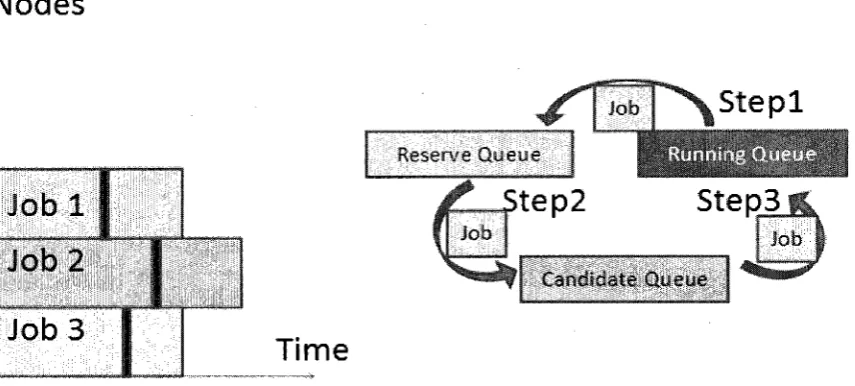
During us dealing with the checkpoint event, we can classify them into several steps, see
Figure 9:
The first step: get jobs from running queue and add them to the reserve queue, which is
used to hold the checkpointed jobs. And then let the original scheduler do schedule first
(The schedule function normally checks preemption queue, waiting queue of own job
type and other job types). We only extend the original scheduler and will not affect the
original decision.)
The second step: in the reserve queue, we compare the nodes of jobs with the total free
nodes in the cluster at the checkpoint time and pick out jobs which are able to run to the
candidate queue.
The third step: try to assign free nodes to candidate jobs of candidate queue. For each job,
if free resources are not the same as the original ones, do migration; if it is, run the
Nodes
Job 1
Job 2
Job 3
^ T job ^ * V Ste p 1
Reserve Queue
5tep2
Rjnnns?
StepH,
Job
Candidate Queue
Time
Figure 9 Migration stage
After we extended the original scheduler, we could have more flexibility on using free
resources, as we have more chance to backfill and migration. We deal with the situation
in Figure 10 like the following:
1) Job 2 will finish first, and the scheduler will search the preemption queue, waiting
queue of its own type and then waiting queue of other types to see if any jobs
could be backfilled. For this case, no other jobs can run.
2) Job 1 will have checkpoint, it will be moved from running queue and added to
reserve queue, and the original scheduler will do schedule (check preemption
queue, waiting queue of own job type and other job types). Later in this case, as
the free resource have been used by Job 3 (non-type backfilled), Job 1 will wait in
reserve queue.
3) Slice ends and change to another type of slice, Job 3 is preempted but can
4) Job 3 finishes and it will do the same operations as Job 2 did.
5) Job 4 will checkpoint, at this time it will also be added to reserve queue from
running queue, and the original scheduler will do schedule (check preemption
queue, waiting queue of own job type and other job types). Then job 1 and job 4
in the reserve queue will be moved to candidate queue because this time the free
resource are enough for them to run, and the last they are added to running queue
and start to run. Here Job 1 migrates to other resources as Job 4 prefers to run on
its original nodes.
N o d e s
J o b l
Job2
I
Job3 •-I
Jo-;-',
T i m e
slice e n d
N o d e s
m^m
Mfeffibackfilled
•H
•
s l i c e e n d
1
lofc4ReserveQ.
J o b l
Nodes ReserveQ C a n d i d a t e Q
W#M
w&n
t
Job:I "
| j o b 4
J o b l
• »
11111
jllllllSi t i migrated j o b
L... ! .Tiroe
slice e n d
Figure 10 Migration & Backfill
The main algorithm of doing migration is like the following:
case(APPCPevent){
job = getEventJob(APPCPevent); stop(job);
add To reservedQ(job); // reservedQ is a list that holds checkpointed jobs and let them hang on and wait.
Schedule(); // original Scojo-PECT scheduler function.
} // by here all possible jobs can be backfill'd or non-type backfilled will be backfilled.
for (all job in reservedQ) { // this is try to fill some of the jobs back migration supported, if (currentFreeNodes>=jobNodes) {
add to cahdidateQ(job) // jobs may back to run in own slice, if own position taken by backfilled jobs, perform "in slice" migration.
}
for (all job in candidateQ) {
restart (job);
}
else if(freeNodePosition = originalNodePosition) {
run(job) // no job takes its original position, back to run normally.
}
}
For this heuristic of selecting candidate jobs, in our extension, we always pick out the
jobs suit best in the candidate queue to fit the resource, and keep assigning resources to
jobs until the free resources have been taken used of (here may leave small number of
resource idle).
In our simulation, the heuristic for job selection does not affect the complexity of original
scheduler. Because the selection heuristic has already been merged into original one
which is using easy to fit or called first fit. The adoption of heuristic for job selection did
affect the execution time, its original runtime costs thirteen minutes for one run and the
5. Experiment and Result Analysis
In this chapter, we are going to introduce the experiments on our modified scheduler. The
experiment aims to test the fitting of the modified algorithm on handling jobs. We first
introduce the experiment environment in 5.1, and then propose the test cases in 5.2 and
deliver the testing results in 5.3 and final summarization on the observation from the
experiments.
5.1 Experiment Environment Setup
We used our own laptop for the testing environment. Its configurations are:
CPU: Intel Dothan 1.73GHz (One processor)
Memory: 2 Gigabytes DDR 533
Operation System: Microsoft XP SP2.
5.1.1 Workload Modeling
In our simulation, we only use the Lublin-Feitelson statistical workload model [19] which
is the best-available synthetic workload model (it includes sequential jobs, correlations
between runtimes and sizes, and varying inter-arrival times at different times of the
day/night). All workloads comprise of 10000 jobs. The other detailed parameters are listed
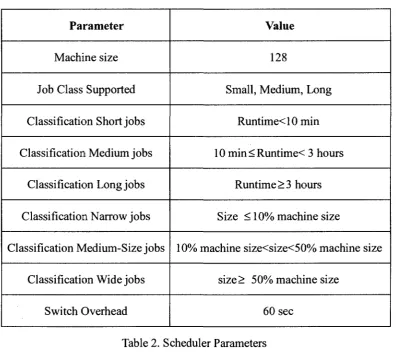
in table 2.
As in this event-based simulator, jobs are generated based on Lublin-Feitelson Model and
submitted. Therefore there would be different circumstances, like a job may end up
during the slice or exactly at the end of slice although these situations rarely happen.
While we still need to take this into consideration no matter whether it will give the
positive affection or the negative affection.
Parameter
Machine size
Job Class Supported
Classification Short jobs
Classification Medium jobs
Classification Long jobs
Classification Narrow jobs
Classification Medium-Size jobs
Classification Wide jobs
Switch Overhead
Value
128
Small, Medium, Long
Runtime<10min
10 min<Runtime< 3 hours
Runtime > 3 hours
Size < 10% machine size
10% machine size<size<50% machine size
size> 50% machine size
60 sec
Table 2. Scheduler Parameters
5.1.2 Evaluation Plan
The goals of these tests are trying to reveal the relation of relative average response time
Some terms we need to specify related to the results first:
Response time: it defines as the time span from the job was submitted to the job finished.
Runtime: it defines as the time period when the job starts to run and finishes running.
Relative response time: it represent as the ratio for the average response time and the
runtime.
In the test, we use different seed parameters. We are going to choose 7, 31, 13, 23 in
addition to original one 71. The reason why we are trying to use different seeds number
is the seed as a random parameter worked in Lublin-Feitelson model, it control the
function when generating jobs, filling them with different correlation of runtime and size.
It also changes the memory size of each job. So different seed may have different jobs
Work Load Seed 71 Seed 23 Seed 31 Seed 13 Seed 7 % ofJobs
Nshort
64
65
63
64
64
Nmed
19.5 19 20 19 20 Nbng 16.5 16 17 17 16
% of Work
Wshort
0.5
0.5
0.5
0.4
0.5
Wm ed
26 27 25 26.5 26 Wlong 73.5 72.5 74.5 73.1 73.5
Avg. Job Size
^short 9 9 9 9 8 ^med 17 17 16 17 17 ^long 19 20 20 20 21 Avg. Inter-Arrival Time (sec) 810 1038 860 798 840
Table 3 Characteristics of synthetic workloads
As we implemented checkpoint/migration, we will also make some combinations to test
the benefit purely from the migration stage rather than compare the checkpoint/migration
stage with the original simulation. Thus, there will be three cases: original, checkpoint
without migration, checkpoint with migration.
5.2 Experimental Results
The experimental results for the different cases with different seed numbers are showed
Relative Response Time(Long) Seed=71
16 -.
14
1 Q
-1 Z 1 ft
-o 6 4 2
-u
HNoCP_NoK •CP_MG J* AVG LN 6.87 6.48 . i.' AVG LH 9.53 9.5i .' '
— . ' • AVG U 14.56 14.53 ; "*r AVG LA 8.2 8.02 BNoCP_NoMG •CP_MG 20
-l b •
l u •
5
-u
HNoCP_NoMG
•CPJTC
R e l a t i v e Response Time(Medium)
— r » j
1
AVG MN
6.78
6.04
AVG
mm
1 1 . 6
1 1 . 5 7
•
AVG MW
16.81 16.78
Seed=71
h — | X: '
t< *
AVG HA
8.61 8.23
• N o C F _ M G
• C P mG
Figure 11 Relative Response Time for long and medium jobs at seed 71
In Figure 11, we can observe that the overall relative response time get improved 2.20%
for long jobs and 4.41 % for medium jobs, even with the wide jobs performed very badly
Relative Response Time(Long) Seed=31
Relative Response Time (Medium) S e e d ^ l
•NoCPJIdIG
aCP MG
Figure 12 Relative Response Time for long and medium jobs at seed 31
In Figure 12, we can observe that the overall relative response time get improved 1.21%
Relative Response Time(Long) Seed-7
20
1 cr
-I D
1 1 " )
1U
5
-0 •
BNoCP_NoMG
• C P J I G
rm
i ''' * pjp^if
AVG LN
7 . 2 8
6 . 9 9
-•'••• b j i j j
SH
rV;J;H
AVG LM1 1 . 7 2
10.73 _ ^
m •••
I
; : | | | AVG LW 17.06 16.78 "•"".""j'u.;\;;;HH
AVG LA 9.44 9.34Relative Response Time(Medium) Seed-7
1 6 -I 1 A -1 4 1 0 -i n .
1U O 6 4 2 -U •NoCP_NoMG
@C P J I G
f • . . . - . . . -1
t ,
AVG MN
6.5
5.61
AVG MM
1 1 . 4 8
1 1 . 2 6
H
AVG MW
1 5 . 1 1
14.89 ' AVG HA 8.4 8.23 BNoCP_NoMG
BCP KG
Figure 13 Relative Response Time for long and medium jobs at seed 7
In Figure 13, we can observe that the overall relative response time get improved 1.06%
R e l a t i v e Response Time(Long) Seed=23
°NoCP_NoMG
•CP MG
R e l a t i v e Response Time(Medium) Seed=23 12 -.
1 n .
1U o c 0 4 • 2 -n . u HNoCP_NoMG mCP_IG I —
•
#i
AVG MN 4.77 4.341 \
AVG MM 8.19 7.64 - . AVG MW 11.33 11.32
*** 1
AVG MA
6.05
5.8
•HoCP_NoMG
BCP_MG
Figure 14 Relative Response Time for long and medium jobs at seed 23
In Figure 14, we can observe that the overall relative response time get improved 1.64%
Relative Response Time (Long) Seed=13 16
-1/1
-l^i
LC
10 -O " K 4 2 -o • BNoCP_NoMG MCP_MG
• * " " ' "
™ . , ™™ „ - , .
" " "
AVG LN
5.5
4 . 9 6
1=
Jt"
AVG LM 8.27 8.23 ... __ .t . i i l l :: Mil
^B
..;..•
r-n-# = AVG LW 13.55 13.44 \"' iijii AVG LA 6.9 6.78 •NoCPJJdlG ^CP MGR e l a t i v e Response Time (Medium) Seed=13
30 -I
ZU
1 c; 1 3
1 r*i _
1U 5 u -BNoCP_NoMG aCP_MG .
t'*'wm
™^
AVG MN 8.18 7.44 -••. iiiig - jjjjjl'^';"BBI
AVG MM 13.35 12.88?
- ' f c
'
!r
''-1
•;;'( l i l
.'
;
: jlj
V/fB
AVG W 25.21 24.97 AVG MA 10. 52 10.04 •NoCP_NoMG •CP MGFigure 15 Relative Response Time for long and medium jobs at seed 13
In Figure 15, we can observe that the overall relative response time get improved 1.74%
Relative Response Time under seeds
Figure 16 Relative Response Time under different seeds
In Figure 16, we can observe that under different seeds the improvement of medium jobs
is around 4% at average and long jobs is around 1.5% at average, as the reason long jobs
are wider and medium jobs could take better use of checkpointed long jobs.
5.3 Result Analysis
Here we are going to discuss the efficiency of optimization. We will focus on the
improvement on the average relative response time under different situations.
The application level checkpoint approach in our simulation generally insert regular
checkpoint intervals in each job, which was calculated by program depend on their
going in slice after slice, in each slice jobs are taking up resource at certain time, and
some application level checkpoint intervals may happen at the same time but with very
mere chance. Most situations will be one job does the checkpoint operation while other
jobs are executing normally.
From the results, we could obtain that wide jobs are not easy to get checkpoint and
migrate, as they have to wait for enough resource to have itself to be executed. If we just
look at the narrow and medium jobs, the performance will be better. This also means that
long jobs will have less chance to take advantage of checkpointed medium jobs, as the
long jobs are wider. Also it means the medium jobs will have more chance to take better
6. Conclusion and Future Work
6.1 Conclusion
In this thesis, we have presented a job scheduling approach which employs application
level checkpoint and migration scheme on the original Scojo-PECT to tune up the
performance. As expected, this approach improves overall relative response time for both
medium and long type jobs, especially for the narrow and medium-size jobs. Specially,
the thesis has these contributions:
1) We implemented the application level checkpoint/migration as an extension to the
original scheduler;
2) We found out that application level checkpoint/migration improved the relative
response time a little;
3) We discovered that wide jobs usually are difficult to be migrated after being
checkpointed, as it will need to wait for enough free resource to resume its former
checkpointed work.
4) Narrow jobs are more suitable to use application level checkpoint as they require very
little resources, and thus get greater improvement. The reason is that, as the total
resources fixed, narrow jobs are more flexible to take use of free resources than other
size jobs. .
6.2 Future Work
selecting different algorithms to choose suitable jobs in candidate queue. Currently we
just tried the greedy algorithm and are not sure whether it produces the best combination
ofjobs.
Other works may be that we try some other impact factors, like we use real traces which
have different job type ratio and use different inter-arrival times. What is more, we could
also try with smaller job sizes because in the experiments we proved that the wide jobs
Reference
[1] Nianen Chen .Shangping Ren "Adaptive Optimal Checkpoint Interval and Its Impact
on System's Overall Quality in Soft Real-time applications" Symposium on Applied
Computing , Proceedings of the 2009 ACM symposium on Applied Computing,
2009.
[2] John W. Young "A First Order Approximation to the Optimum Checkpoint Interval"
Communications of the ACM, 1974
[3] John Daly "A Model for Predicting the Optimum Checkpoint Interval for Restart
Dumps", Springer Berlin / Heidelberg, 2003
[4] Petrini, F. Davis, K. Sancho, J.C'System-level fault-tolerance in large-scale
parallel machines with buffered coscheduling", Proceedings of 18th International
Parallel and Distributed Processing Symposium, 2004.
[5] Silva, L.M. Silva, J.G. "System-Level versus User-Defined checkpointing",
Proceedings on Seventeenth IEEE Symposium 1998.
[6] Schulz, M. Bronevetsky, G Fernandes, R. Marques, D. Pingali, K. Stodghill,
P. "Implementation and Evaluation of a Scalable Application-level
checkpoint-Recovery Scheme for MPI Programs", Proceedings of the ACM/IEEE
SC2004 Conference Supercomputing, 2004.
[7] Stellner, G "CoCheck: checkpointing and process migration for MPI" Proceedings of
IPPS '96, The 10th International Parallel Processing Symposium, 1996.
Parallel-Job Scheduling, High Performance Computing and Communication
(HPCC), Houston, LNCS 4782, Springer Verlag, Sept. 2007.
[9] A.C. Sodan, "Autonomic Share Allocation and Bounded Prediction of Response
Times in Parallel Job Scheduling", Seventh IEEE International Symposium on
Network Computing and Applications, July 2008.
[10] A.C. Sodan, Loosely Coordinated Coscheduling in the Context of Other Dynamic
Approaches for Job Scheduling—A Survey, Concurrency & Computation: Practice
& Experience, 17(15), Dec. 2005, pp. 1725-1781.
[11] Gamma Distribution. http://en.wikipedia.org/wiki/Gamma_distribution
[ 12]Normal Distribution. http://en.wikipedia.org/wiki/Normal_distribution
[13]A.C. Sodan, Adaptive Scheduling for QoS Virtual-Machines under Different
Resource Availability—First Experiences,_Job Scheduling Strategies for Parallel
Processing (JSSPP), 2009.
[14] Condor System, University of Wisconsin, http://www.cs.wisc.edu/condor/overview/
[15]C3 (Cornell Checkpoint (pre)Compiler) System, Department of Computer Science,
Cornell University, http://www.cs.cornell.edu/~stodghil/papers/ipdps05.pdf
[16] Paul H Hargrove, Jason C Duell, Berkley lab checkpoint/restart (BLCR) for Linux
clusters, Journal of Physics: Conference Series 46 (2006), pp. 494-499.
[17] John Paul Walters and Vipin Chaudhary, Application-Level Checkpointing
Techniques for Parallel Programs, Springer-Verlag Berlin Heidelberg, 2006
Practice and a Direction Forward in Checkpoint/Restart Implementations for Fault
Tolerance, 19th IEEE International Parallel and Distributed Processing Symposium
(IPDPS'05), 2005
[ 19] Feitelson Workload, http://www.cs.huji.ac.il/labs/parallel/workload/logs.html
[20] Colt, Open Source Libraries for High Performance Scientific and Technical
Computing in Java, http://acs.lbl.gov/~hoschek/colt/
[21]Peiyu Cai, Extending Scojo-PECT by migration based on system level
Appendix
In this appendix, we are going to test the proper migration and backfill functionalities of
the extended scheduler in the simulation.
Test Parameters
Description of testing parameters
Job type definition:
Small jobs < lOmin
1 Omin < < Medium jobs < 3 hours
Long jobs > 3 hours
Interval setting: 800 sec, the reason we choose 800s here is to make sure the small job
will be skipped as we do checkpoint and migration only on medium and long type jobs.
Checkpoint overhead: 3 sec. time costs doing the checkpoint
Average relative response time (ARRT), its definition is the ratio of the average response
time compared with its optimum runtime and the smaller number the better result.
Test Example
The job have several attributes, job submit time, job runtime, optimal node for job, job
memory size for application level checkpoint approach it also have the two other
SimpleJob(0, flex, new SimpleTime(O), Serialruntime, Nopt, Nmax, Nmin, Memory size,
config)
We manually created 6 jobs and arranged the submission time for each at different points
by setting up the parameters after calculation. After analysis the debugging process, we
could find the checkpoint/migration operation at the right decision points. This could
show that we have employed our implementation correctly according to the algorithm we
have proposed before. The detailed can be expressed like below:
Case Codes
if(i==0) //Serial run time/(nodes*0.65) = actual run time tmpJob =
new SimpleJob(0, flex, new SimpleTime (0), 24876, 128, 128, 128, 10, config);//299 else if(i==l)
tmpJob =
new SimpleJob(l, flex, new SimpleTime(80), 24876, 128, 128, 128, 10, config);//299 else if(i==2)
tmpJob = new SimpleJob(2, flex, new SimpleTime(lOO), 32045, 29, 29, 29, 240, config);//1700
else if(i=3)
tmpJob = new SimpleJob(3, flex, new SimpleTime(180), 84500, 99, 99, 99, 1024*3, config);//1300
else if(i==4)
config);//20000
else if(i==5)
tmpJob = new SimpleJob(5, flex, new SimpleTime(600), 1300000, 100, 100, 100, 1024*3, config);//20000
MATLAB Code for Calculation of Checkpoint File Size
Some codes in MATLAB using to draw the probability density function and cumulative
distribution function of gamma distribution are shown below:
syms x yl y2;
yl=x*exp(-x);
y2=l -exp(-x)-x*exp(-x);
subplot(2,l,l);
h=ezplot(yl,[0,10]);
title('Gamma distribution probability density function: y=x*exp(-x)');
legend('k=2,theta=l');
ylabel(y);
set( h, 'LineWidth' ,2 );
grid on;
subplot(2,l,2);
h=ezplot(y2,[0,10]);
title('Gamma distribution Cumulative distribution function: y=l-exp(-x)-x*exp(-x)');
legend('k=2, theta=l');
ylabel('y');
Vita Auctoris
NAME: Jiaying Shi
PLACE OF BIRTH: JiangSu, P.R. China
YEAR OF BIRTH: 1982
EDUCATION: Houcheng High School, Zhang Jiagang, JiangSu, China
1997-2000
Nanjing University of Technology, Nanjing, China
2000-2004
University of Windsor, Windsor, Ontario, Canada
![Table 1. Relation Chart of Application & System Level Checkpoint [5]](https://thumb-us.123doks.com/thumbv2/123dok_us/1464100.1179369/24.596.172.477.361.621/table-relation-chart-application-level-checkpoint.webp)
![Figure 6. MTBF chart under different reliability level. [4]](https://thumb-us.123doks.com/thumbv2/123dok_us/1464100.1179369/31.596.158.482.293.589/figure-mtbf-chart-different-reliability-level.webp)
![Figure 7. Probability density function of normal distribution [12]](https://thumb-us.123doks.com/thumbv2/123dok_us/1464100.1179369/32.595.137.490.320.559/figure-probability-density-function-normal-distribution.webp)