ISSN(Online): 2320-9801
ISSN (Print): 2320-9798
International Journal of Innovative Research in Computer
and Communication Engineering
(An ISO 3297: 2007 Certified Organization)
Vol. 3, Issue 6, June 2015
Improved File Dynamics P2P Capability in
Mobile ad-hoc Networks for Efficient File
Sharing
AshwiniS. Jagtap
M.E. Student, Dept. of Computer Engineering, Dhole Patil College of Engineering, Savitribai Phule Pune University,
Pune, India
ABSTRACT: Wireless communications are receiving more attention now a days. In mobile ad-hoc networks nodes are moving freely from one location to another.So in MANET disconnections occurs often. So there is a problem of file
availability. For that purpose file replication can be used. With the help of access mechanisms, peer to peer (P2P) file
sharing can be done over Mobile Ad-hoc Network(MANET). The capability of file querying suffer from the properties of networks which include node mobility and limited communication range and resource. For these problems file
replication can be used. File replication plays important role in enhancing file availability and reduce file querying delay. By creating replicas, the probability of encountered requests can be improved. Previously proposed model were considering node storage for the replication but lacks to consider the node mobility. In our system we have considered the mobility of the node.Forthat purpose we have considered Optimal File Replication Rule is which consider the priority of the files. In the proposed system we are going to consider two factors first is the peer mobility and second one is battery energy for identifying the best neighbour for replication of the file. So in this workwearegoingtoimprovisetheefficiencyofthefilereplicationbyconsideringthesetwofactors.
KEYWORDS: Mobile Ad-hoc Network, file sharing, efficiency, node mobility,battery energy.
I. INTRODUCTION
The MANET differentiates itself from traditional wireless networks by its dynamic changing topology, no basestation support, and multi-hop communication ability [9]. In a MANET, nodes are free to move to the random locations and are able to meet node which is in the communication range also thy can exchange their information with the other nodes. Withthehelpoffilereplicationwecanimprovefileavailability and reduce file querying delay. It creates
replicas for a file to improve its probability of being encountered by requests. But it is not viable and ineffective to enable every node to hold the replicas of all files in the system as there are limited node resources. Also, file querying
delay is always a main concern in a file sharing system. Users often desire to receive their requested files quickly no
matter whether the files are popular or unpopular. There are different protocols which are already present in which each
individual node replicates files it frequently queries creating redundant replicas in the system or a group of nodes create one replica for each file they frequently query [9] creating redundant replicas which are reduced by group cooperation,
neighbouring nodes may separate from each other due to node mobility, leading to large query delay. The present file
replication protocols enable to allocate limited resource to different files for replica creation to achieve the minimum
global average querying delay, which means that global search efficiency optimization under limited resource but they
do not consider their properties like peer mobility, battery energy. The basic idea of considering these two features is it will increase the efficiency. Also by considering the battery energy nodes remaining power can be calculated and
considered before doing the replication operation. Because of which the retransmission can be avoided. Using the peer mobility feature the link stability is calculated. So with the help of those two features best neighbour is identified.
II. RELATED WORK
ISSN(Online): 2320-9801
ISSN (Print): 2320-9798
International Journal of Innovative Research in Computer
and Communication Engineering
(An ISO 3297: 2007 Certified Organization)
Vol. 3, Issue 6, June 2015
the query will be routed. If the current peer fails to select a sufficient number of relevant peers it floods the query
through the random overlay network, which badly affects the routing efficiency and effectiveness. To address the
unsuccessful relevant peers search problem, we propose to organize the P2P network into semantic clusters of peers sharingsimilarknowledge bases. The proposed approach here is (i) its retrieval effectiveness in term of recall and precision, (ii) its routing efficiency in term of messages traffic.Advantages -Improves the recall and precision metrics while it dramatically reduce network traffic.Disadvantages-Some effective benchmarks has not taken into considerations
In the paper Evaluation ofPeer-to-Peer Network ContentDiscovery Techniquesover Mobile Ad-Hoc Networks, [4] author has proposed an evaluation of the two approachesforP2PcontentdiscoveryrunningoveraMANET. The first, based
on unstructured P2P networks, relies on controlled flooding, while the second, based on structured P2P networks, uses
distributed indexing to optimize searches. Use simulations to evaluate the effect of network size, mobility,channel error rates, network workload, and application dynamics in the performance of P2P protocols over MANETs.Advantages-Structured protocols, conversely, consume less energy and are more appropriate for MANETs where topology ismostlystatic.
When mobile users move and contact each other opportunistically, they form a Delay Tolerant Network (DTN), which can be exploited to share data among them. Data replication is one of the common techniques for such data sharing.XuejunZhuo,Qinghua Li[7] have recognizethedeficiencyofexistingdatareplicationschemeswhich treat the
complete data item as the replication unit, and propose to replicate data at the packet level. We analytically formulate the contact duration aware data replication problem and give a centralizedsolutiontobetterutilizethelimitedstoragebuffersand the contact opportunities. Further they proposed a practical contact Duration Aware Replication Algorithm (DARA) which operates in a fully distributed manner and reduces the computational complexity. Extensive simulations on both synthetic and realistic traces show that our distributed scheme achieves close-to-optimal performance, and outperforms other existing replication schemes.
In this paper, Zheng Jing, Wang Yijie [8] have considered a dynamic adaptive replica allocation algorithm that can adapt to the nodes motion is proposed to minimize the communication cost of object access. When changes occur in the access requests of the object or the network topology, each replica node collects access requests from its neighbours and makes decisions locally to expand replica to neighbours or to relinquish the replica. The algorithm dynamically adapts the replica allocation scheme to a local optimal one. Simulation results show that our algorithms efficiently reduce the communication cost of object access in MANET environment.
In Delay Tolerant Networks (DTNs), mobile nodes connect to each other using opportunistic contacts.The paper i) address the problem of where to cache, it exploit social relations among nodes, and propose a novel centrality metric to evaluate the caching capability of each node within the social community. ii) Identify the effects of contact duration on caching. To address the problem of how much data to cache, derives an adaptive caching bound at each node based on its specific contact patterns with others. iii) Developedadistributedcachingprotocol,anddemonstrate that it can significantly improve the performance of data access though trace-driven simulations[6].
By Takahiro Hara[9], different consistency conditions of data operations on replicas in MANETs. First,classified consistency levels according to application requirements. After that the protocols are proposed to achieve them and, then, discuss the impact of replica allocation for the system performance when the memory space of mobile hosts is limited. The main contributions of this paper are 1) the classification of consistency levels according to the system and application requirements, 2) the choices of the existing techniques and their extensions for design of the protocols of these consistency levels in MANETs, and 3) performance studies of these protocols.
In ad hoc networks, mobile hosts move freely, disconnections occur frequently, and this causes frequent network division. Consequently, data accessibility in ad hoc networks is lower than that in the conventional fixed networks. In this paper, three replica allocation methods are proposed to improvedata accessibility by replicating data items on mobile hosts. With these three methods, taken into account the access frequency from mobile hosts to each data item and the status of the network connection [10].
ISSN(Online): 2320-9801
ISSN (Print): 2320-9798
International Journal of Innovative Research in Computer
and Communication Engineering
(An ISO 3297: 2007 Certified Organization)
Vol. 3, Issue 6, June 2015
AccordingtoYu-Chee-Tseng [11]thepropertiesofMANETScanbedynamicchangingtopology,nobase-stationsupport,andmultihopcommunicationcapability. Forcommunicationtheyuse the hopping concept. When two nodes are within the radio range, they communicate witheach other using single hop function. The problem discussed here is about the flooding of broadcasting .The problem with broadcasting is storm problem. For this rebroadcasting can bedone which is done on timely basis.
III.PROPOSED APPROACH AND DESIGN A. Problem Definition
Therearedifferentfilereplicationprotocols available, themainproblemwithavailableprotocols is that they lack a rule to allocate limited resource to different files for replica creationin order to achieve the minimum global average querying delay that is global search efficiencyoptimization under limited resource. Available protocols simply
consider storage as the resource for replicas, but neglect that a node’s frequency to meet other nodes also controls the Availabilityofitsfiles. Thereisaproblemofhowtoallocatethelimitedresourceinthenetworkto different files for
replication so that the overall average file querying delay is minimized andalso selecting a best neighbour node for
replication of file is the main problem.
B. Proposed Architecture and Design
The proposed system shown in Figure. 1 consist of different file of dynamic size. When the request for the file
comes the popularity of the file is identified. After that those files are prioritized by the peer based on the popularity of the file. Each node has the list of files. The files are arranged in the descending order of the files popularity. When
more requests for same files are generated, the replication is done in that case. While doing the replication most popular files are replicated on the neighbour. The number of files that are replicated is based on the size or space
available on the node. The case when replication is needed and particular neighbor does not have a space then another neighbor is selected in that case.
Figure 1: Proposed System Architecture
Now while selecting the neighbor if we take any neighbor the problem may arrive because in MANET nodes are moving so selected neighbor can move to the next place within some time.The other factor for consideration is that node may has less remaining battery energy.If we select this node for replication then that node goes off within some time.So while selecting the neighbor those factors need to be taken care.Neighbour selection algorithm is used for that purpose which selects the best neighbor for replication and then files are replicated on that neighbor we call
it as a success .In case on not getting the neighbor the failure may occur.And then the same process is carried out again.While selecting best neighbor for replication of files we are going to consider both the factors together.
1. Peer mobility: In MANET environment peers are free to move from their location at any-time. We consider this important factor, thus we predict the lifetime of a link between the forwarding peer and its neighbors. To predictthe lifetime of a link i-j between the peer pi and its neighbor njϵN we are based on the Route-lifetime Assessment Based Routing protocol (RABR) protocol functions.
2. Battery Energy:The calculation of energy level is important to determine the battery level of every peer during active data transmission. Here we assume that the battery level of a wireless peer decreased when the peer initiated data transmission or when the peer forwards packets. A peer gets disconnected if the battery power
finishes. For predicting the remaining battery power we assume that the transmit power is fixed. Energy
ISSN(Online): 2320-9801
ISSN (Print): 2320-9798
International Journal of Innovative Research in Computer
and Communication Engineering
(An ISO 3297: 2007 Certified Organization)
Vol. 3, Issue 6, June 2015
E(packet) = b*(packet size) + c 3. Proposed Algorithm: Neighbors selection algorithm
Pref (nj) = α * Link stability (i-j) + α * Peer Load (nj)
For selecting K best neighbors of node BEGIN:
Step 1: The forwarding peer pi ranks its neighbours according to a Preference function
Step 2: Then it selects the first k neighbour, which have the greatest score.
Step 3: The Preference function computes the score of each neighbour njfor a given query q, as a weighted
arithmetic sum of Link stability, Peer Load. END
IV.RESULTS
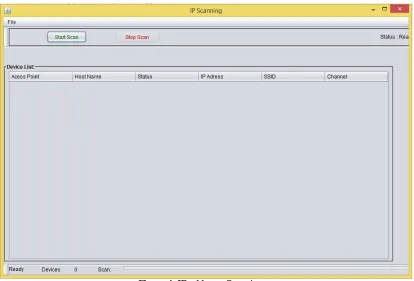
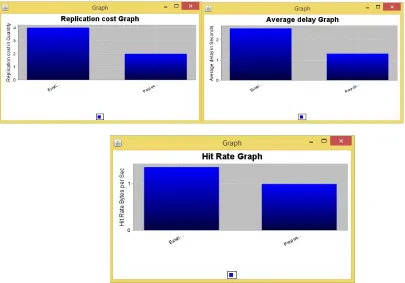
The figures displayed bellows the results of the proposed system. In the proposed system sender can send the files of any size and of any kind (pfd, xls,doc etc).Figure 2 shown below shows the senders window for selecting the file for replication. In Figure-3 is after selecting the search for node it detects the done which are in the range. Figure 4 displays the window while scanning for the IP addresses. List of IP addresses is shown in the Figure-5.Figure 6-7 shows the results of file download and file replication respectively. Figure 8 shows the performance graphs of the system by considering the factors like Hit Rate, Replication Cost, and Average delay.
ISSN(Online): 2320-9801
ISSN (Print): 2320-9798
International Journal of Innovative Research in Computer
and Communication Engineering
(An ISO 3297: 2007 Certified Organization)
Vol. 3, Issue 6, June 2015
Figure 3 : Node Identification
ISSN(Online): 2320-9801
ISSN (Print): 2320-9798
International Journal of Innovative Research in Computer
and Communication Engineering
(An ISO 3297: 2007 Certified Organization)
Vol. 3, Issue 6, June 2015
k
Figure 5: Scanned IP addresses
ISSN(Online): 2320-9801
ISSN (Print): 2320-9798
International Journal of Innovative Research in Computer
and Communication Engineering
(An ISO 3297: 2007 Certified Organization)
Vol. 3, Issue 6, June 2015
Figure 7 : File Replication
ISSN(Online): 2320-9801
ISSN (Print): 2320-9798
International Journal of Innovative Research in Computer
and Communication Engineering
(An ISO 3297: 2007 Certified Organization)
Vol. 3, Issue 6, June 2015
V. CONCLUSION AND FUTURE SCOPE
For maximizing file availability in the mobile ad-hoc network the replication can be used. If small number of replicas are used, file sharing can’t be efficient.The idea is that a data item should best be placed on a node with very good
connectivity with other nodes that are interested in the data item’s topic. Set of nodes that are interested in a topics form a Community of interest.There is different file replication protocols used but they suffer from the problems like
allocating limited resources to different files and consider storage as a resource for replicas. The solution provided for
this is globally optimal file replication. The approaches discussed in the paper are for allocating the limited resources.
Using the priority based rule the replication is done on neighbors. But as the nodes are moving from their places it is not efficient to replicate files of any size on any neighbor. For that purpose we are have proposed a model that considers
peer mobility and battery energy for identifying the best neighbor. In this way replication can be done on selected neighbor, which will increase the efficiency. In future we can consider more features along with the mentioned features
for finding the neighbour.We can also plan to analyze a more complex environment including file addition and deletion, file time-out and dynamic node querying pattern.
VI.ACKNOWLEDGEMENT
Sincere thanks to the reviewers for reviewing this manuscript and providing inputs for greatly improving the quality of this paper.
REFERENCES
1. Kang Chen “,Maximizing P2P File Access Availability in Mobile Ad Hoc Networks though Replication for Efficient File Sharing”,
Student Member, IEEE and Haiying Shen, Senior Member, 2015.
2. W. Gao, G. Cao, A. Iyengar, and M. Srivatsa, “Supporting cooperative caching in disruption tolerant networks.” in Proc. of ICDCS, 2011
.
3. A. Lindgren, A. Doria, and O. Schelen, “Probabilistic Routing in Intermittently Connected Networks,” ACM SIGMOBILE MobileComputing and Comm. Rev., vol. 7, no. 3, pp. 19-20, 2003
4. Leonardo B. Oliveira Isabela G. SiqueiraDanielF. Macedo,“Evaluation ofPeer-to-Peer Network ContentDiscovery Techniquesover Mobile Ad-Hoc Networks”, Sixth IEEE International Symposium,2005.
5. TaoufikYeferny,“AnEfficientPeer-to-PeerSemanticOverlayNetworkforLearningQueryRouting,IEEE 27th International Conference,2013 6. X. Zhuo, Q. Li, G. Cao, Y. Dai, B.K. Szymanski, and T.L. Porta, “Social-Based Cooperative Caching in DTNs: A Contact Duration
Aware Approach,” Proc. IEEE Eighth Int’l Conf. Mobile Adhoc and Sensor Systems (MASS), 2011.
7. X. Zhuo, Q. Li, W. Gao, G. Cao, and Y. Dai, “Contact Duration Aware Data Replication in Delay Tolerant Networks,” Proc. IEEE 19th Int’l Conf. Network Protocols (ICNP), 2011.
8. Zheng Jing, Wang Yijie, Lu Xicheng, and Yang Kan,“A Dynamic Adaptive Replica Allocation Algorithm in Mobile Ad Hoc Networks” School of Computer, National University of Defense Technology, Changsha, China,2004.
9. Takahiro Hara, Sanjay Kumar Madria,“Consistency Management Strategies for Data Replication in Mobile Ad Hoc Networks”, Senior Member, IEEE, JULY 2009.
10. Takahiro Hara,“Effective Replica Allocation in Ad Hoc Networks for Improving Data Accessibility”,2001.
11. Y.Tseng,S.Ni, and E.Shih,“Adaptiveapproachestorelievingbroadcast storms in a wireless multihop mobile ad hoc network,” in 2001.
BIOGRAPHY