ABSTRACT
SHENG, XINXIN. Goal-Based Agent Design: Decision Making in General Game Playing. (Under the direction of Professor David Thuente.)
General Game Playing's primary research thrust is building automated intelligent
computer agents that accept declarative descriptions of arbitrary games at run-time
and are capable of using such descriptions to play effectively without human
intervention. The research in general game playing approximates human cognitive
processes, sophisticated planning, and problem solving with an instant reward system
represented in games. General game playing has well-recognized research areas with
diverse topics including knowledge representation, search, strategic planning, and
machine learning. It attacks the general intelligence problem that Artificial
Intelligence researchers have made little progress on for the last several decades.
We have designed and implemented an automated goal-based general game playing
agent that is capable of playing most games written in the Game Description
Language and has shown excellent results for general-purpose learning in the general
game playing environment. Our contributions include: the general game playing
agent designed to play a wide variety of games, the knowledge reasoning performance
improvement algorithm, the run-time feature identification algorithm, the contextual
Goal-Based Agent Design: Decision Making in General Game Playing
by Xinxin Sheng
A dissertation submitted to the Graduate Faculty of North Carolina State University
in partial fulfillment of the requirements for the degree of
Doctor of Philosophy
Computer Science
Raleigh, North Carolina
2011
APPROVED BY:
_______________________________ ______________________________
Professor David Thuente Professor Peter Wurman
Chair of Advisory Committee
_______________________________ ______________________________
Professor James Lester Professor Munindar Singh
ii
DEDICATION
iii
BIOGRAPHY
Xinxin Sheng (盛欣欣) was born in Qingdao, China to Qinfen Guo (郭琴芬) and Zhengyi Sheng (盛正沂). She attended Shandong University for undergraduate in English Language and Literature from 1995 to 1999 and received the second
Bachelor's degree from Tsinghua University in Computer Science in 2002. She
moved to Raleigh, USA the following year. After graduated from North Carolina
State University with a Master of Science degree in 2005, she continued into the Ph.D
program in Computer Science. She has published with several Artificial Intelligence
conferences and journals, and served as program committee member and reviewer for
international computer science conferences. In addition to academic endeavors, she
worked for SGI (2001), Schlumberger (2002-2003), IBM (2006-2011), and joins
iv
ACKNOWLEDGMENTS
I am indebted to my advisor, David Thuente, for his incisive advice and his gracious
guidance. He has been so supportive and so encouraging that working with him has
been absolutely productive. I would like to thank Dr. Peter Wurman for introducing
me to artificial intelligence research. He opened a door to so many opportunities and
excitements -- the wonderland that I will continue surfing for many years to come.
I am grateful that Michael Genesereth sponsored the annual AAAI general game
playing competition. Thanks to the GGP workshop in Barcelona, I had enlightening
discussions with Michael Thielscher, Daniel Michulke, Hilmar Finnsson, Nathan
Sturtevant, and Stephan Schiffel, who also maintains the Dresden GGP website.
In the eight years of my Ph.D endeavors, my husband Qian Wan has stood beside me
no matter how difficult the situations were, in sickness and in poor. My parents have
urged me never settle for anything less than that of which I am capable. Michael
Smith, Joel Duquene, and Jane Revak have inspired me and encouraged me to stand
behind my own choices and not to give up because it is hard. They have mentored me
for both professional advances and character development.
I also appreciate that North Carolina State University sponsored my graduate study
v
TABLE OF CONTENTS
List of Figures...ix
List of Tables...xi
1 Introduction ... 1
1.1 History of General Game Playing Research ... 3
1.2 General Game Playing Framework ... 4
1.2.1 Multi-Agent Game Playing System ... 4
1.2.2 Game Description Language ... 5
1.2.3 Dedicated Games ... 6
1.3 Research Status in General Game Playing ... 7
1.4 Contributions and Limitations of Our GGP Player ... 11
2 Game Description Language ... 14
2.1 Syntactic and Semantic Definition ... 14
2.2 Game Relations Definition ... 15
2.3 Multi-Agent System Communication Protocol ... 16
2.4 Reasoning with GDL ... 18
2.5 Development of GDL ... 18
3 Designing the GGP Agent ... 20
3.1 Heuristic Search ... 22
3.2 Logic Resolution ... 25
3.3 Learning ... 26
3.4 Game Examples ... 29
4 Knowledge Representation and Reasoning ... 34
4.1 Reasoning with Logic: Substitution, Unification and Backward Chaining .. 34
vi
4.3 Using Hash Tables to Expedite Reasoning ... 38
4.4 Hash Tables Performance Analysis ... 46
5 Sub-Goal Identification ... 53
5.1 Generating Training Set with Simulation ... 53
5.1.1 Random Simulation versus Active Learning ... 54
5.1.2 Determining the Simulation Size ... 56
5.1.3 Out of Scope Situations ... 57
5.2 Identify the Sub-Goals ... 58
5.3 Sub-Goal Analysis Example ... 59
5.3.1 Statistical Analysis ... 60
5.3.2 Sub-Goals versus Actual Goals ... 63
5.3.3 Using Sub-Goals in Game Play ... 64
5.4 Experiments for Generality ... 66
6 Decision Making in GGP ... 71
6.1 Grouping of Sub-Goals ... 71
6.2 Decision Trees ... 72
6.2.1 Decision Tree C4.5 Algorithm ... 72
6.2.2 Build C4.5 with Sub-Goals ... 76
6.2.3 Using Decision Tree for Evaluation ... 78
6.2.4 Decision Tree Learning versus Individual Sub-Goal Learning ... 81
6.2.5 Time Cost of Using Decision Tree Algorithm ... 88
6.2.6 Overfitting Concerns ... 90
6.3 Contextual Decision Tree ... 91
6.3.1 Decisions Bounded by Search ... 91
6.3.2 Building Contextual Decision Trees ... 92
vii
6.3.3.1 Comparison with Other Learning Algorithms ... 96
6.3.3.2 Comparison with Other Widely Available GGP Players ... 99
6.3.3.3 Comparison with Human Expert Game Strategies ... 101
6.3.4 Time Cost of Contextual Decision Trees ... 102
7 Beyond the Current GGP Framework ... 105
7.1 Issues with the Current GDL ... 105
7.1.1 Burden of the Natural Numbers ... 106
7.1.2 Confusion of the Comparison ... 108
7.1.3 Challenge of Infinity ... 110
7.2 Extension Implementation ... 111
7.3 Impact of the Extension ... 118
7.4 Extension Application to Coalition Games ... 119
7.4.1 Coalition Games ... 119
7.4.2 Coalition Farmer Game ... 120
7.5 Benefits and Concerns ... 125
8 Summary ... 128
9 Future Work ... 130
9.1 GGP Definition ... 130
9.2 GGP Competition ... 131
9.3 GGP Evaluation ... 133
References...135
Appendices...142
Appendix A General Game Playing Example Game List...143
Appendix B Full Tic-Tac-Toe Game Description in GDL...148
viii
ix
LIST OF FIGURES
Figure 1.1: Differences between the classic game agent and the GGP agent ... 2
Figure 3.1: Architecture of our General Game Playing agent ... 21
Figure 3.2: Pseudo-code for minimax search in general games ... 24
Figure 3.3: General game examples I ... 29
Figure 3.4: General game examples II ... 31
Figure 4.1: Tic-Tac-Toe example ... 35
Figure 4.2: Tic-Tac-Toe hash table mapping example ... 39
Figure 4.3: Pseudo-code for converting GDL sentences into hash tables ... 43
Figure 4.4: Normalized time cost comparison to find legal actions ... 47
Figure 4.5: Normalized time cost comparison to play with random actions ... 48
Figure 4.6: Normalized time cost comparison to search one-step for goals ... 49
Figure 5.1: Tic-Tac-Toe X-player winning features based on 95% confidence interval ... 61
Figure 5.2: Tic-Tac-Toe middle game example ... 63
Figure 5.3: Tic-Tac-Toe X-player winning rate against random O-player ... 66
Figure 5.4: Heated map of the Connect Four board positions ... 67
x
Figure 5.6: Performance comparison of random player, one-step goal-search player,
and sub-goal learning player ... 70
Figure 6.1: Pseudo-code for decision tree C4.5 ... 73
Figure 6.2: A decision-tree example ... 77
Figure 6.3: Pseudo-code of using decision tree for state evaluation ... 79
Figure 6.4: Evaluating searched states in a partial game tree ... 80
Figure 6.5: Mini-Chess: winning rate for four White players ... 83
Figure 6.6: Connect Four: winning rate for four White players ... 85
Figure 6.7: Crossing Chinese Checkers: winning rate for four Red (first) players ... 86
Figure 6.8: Ten-iteration Farmer game: winning rate for Alice ... 88
Figure 6.9: State changes in game playing ... 93
Figure 6.10: Pseudo-code for creating contextual decision tree ... 95
Figure 6.11: Winning rate comparison of five different playing strategies ... 98
Figure 6.12: Connect Four: intermediate game examples (Allis, 1988) ... 101
Figure 7.1: Arithmetic addition defined with GDL in the Farmer game ... 107
Figure 7.2: Pseudo-code for extending GDL to call external resources ... 113
xi
LIST OF TABLES
Table 4.1: The average number of knowledge base visits during random matches .. 37
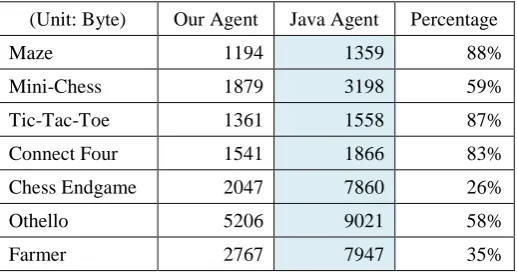
Table 4.2: Agent time usage (milliseconds) ... 50
Table 4.3: Agent memory usage (bytes) ... 51
Table 6.1: Execution time comparison: goal-search versus decision tree ... 89
1
1
Introduction
Games have fascinated humans for centuries. “The term game refers to those
simulations which work wholly or partly on the basis of a player’s decisions.”
(Angelides, 1993). Games are, in fact, abstract models of real-world logics. Computer
game playing research covers many Artificial Intelligence (AI) topics such as
goal-based agent design, massive search, decision making, and machine learning.
Scientists simulate games on computers with software programs and work very hard
to improve the performances of computer game players. Programming an automated
game playing agent that can challenge, even overcome, human experts in
competitions has been a goal for many computer scientists for several decades. Some
game playing programs have proven to be very successful: Chinook (Schaeffer, 1997)
became the world champion Checkers player in 1989 and Deep Blue (Hsu, 2002) the
world Chess champion in 1997. The success of Deep Blue became the milestone
showing that computer game playing exhibited "human comparable" intelligent
behavior, i.e., passed the Turing test (Turing, 1950) in Chess.
In contrast to human players, these successful computer game players usually
capitalize on their computational strength with powerful search techniques that use
2
functions. Domain knowledge of the game is used in designing the computer player
and thereby equipping it with specific strategies for that particular game. The decision
making procedure caters to and only to the game that it is designed to play.
However, the computer player that excels in one game does not necessarily or even
usually play another game. In recent years, many researchers have been interested in
designing one computer game player that would adapt and evolve to play different
kinds of games. This is how General Game Playing (GGP) emerged as a research
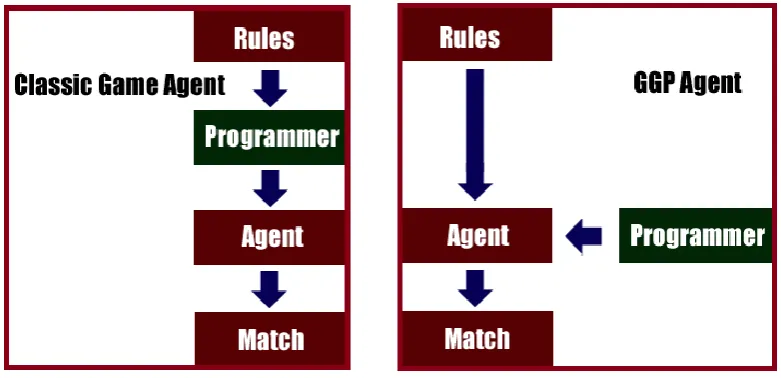
topic. Figure 1.1 shows the difference between the classic game agent and the GGP
agent, where the programmer does not hard code game rules into the agent building.
Figure 1.1: Differences between the classic game agent and the GGP agent
The concept of General Game Playing is creating computer programs to play different
games automatically without human intervention. GGP research aims at building
3
games at run-time, and are able to use such descriptions to play effectively without
human intervention. The research approximates human cognitive processes,
sophisticated planning, and problem solving with an instant reward system
represented in games. Designing one universal game agent that is able to play a wide
variety of games provides insights into knowledge representation, modeling, and
learning the underlying intelligent behavior.
1.1
History of General Game Playing Research
Barney Pell was one of the first to identify GGP as a research problem (Pell, 1993).
He suggested designing programs that, given the rules of unknown games, can play
without human intervention. According to Pell, such programs are considered a better
approximation to human intelligence than programs that focused on winning a
particular game. He also proposed the language to define symmetric Chess-like games
and developed Metagamer, a program that plays games in such categories.
Based on Pell’s work, Michael Genesereth advanced GGP research by proposing the
GGP competition, which has been held annually since 2005 at the Association for the
Advancement of Artificial Intelligence (AAAI) conference or International Joint
4
As more members joined the GGP community, the first GGP workshop was held at
IJCAI in 2009 and the second GGP workshop at IJCAI in 2011. The first journal issue
specifically dedicated to GGP, Künstliche Intelligenz (Artificial Intelligence in
German), was published by Springer in 2011. Stanford University has a website
dedicated to GGP and Dresden University of Technology hosts a GGP website for
agents to play (see references GGP Dresden; GGP Stanford).
1.2
General Game Playing Framework
There are three pieces in the GGP competition framework: the multi-agent game
system that contains the game manager and agents, the Game Description Language
(GDL) with which the games are depicted, and a wide variety of example games. The
framework enables the GGP agents to play against each other for performance
evaluation.
1.2.1 Multi-Agent Game Playing System
The General Game Playing structure can be understood as a multi-agent system with
one game manager agent coordinating one to several game playing agents. The player
agents communicate through the game manager but not with each other. The game
manager starts the automated game play by sending out the game information and
5
All agents participating in the game accept the same game rules as provided. From the
received information, the game playing agents figure out the initial game state, the
legal actions, the goals and rewards, their own roles in the game, and other game
elements. All agents participating in the game communicate by submitting actions to
the game manager and receiving game updates from the game manager. The game
manager validates the actions submitted and only legal actions are accepted. The
accepted actions are broadcast to all the playing agents and thereby the game moves
forward to the next stage. The game moves forward in this manner until a terminal
state is reached. This is when the game manager stops the game and awards the
winner. A detailed description of the communication protocol is in Section 2.3.
1.2.2 Game Description Language
The GGP games are written in the Game Description Language (GDL) which defines
the logic syntax and semantics in general games (Love, 2005). GDL can be
understood as a specification language for multi-agent environments, working as
formal laws to guide the agents to understand the game rules and their own roles so
that they can participate in the games (Schiffel, 2009a). A game written in GDL can
be understood as a finite state transition system with one initial state and at least one
6
starts from the initial state and transits from one state to the next precisely in response
to the actions taken.
GDL is written in Knowledge Interchange Format (KIF) (Genesereth, 1992), which
is a subset of the First Order Logic (FOL). GDL grammar and syntax can be used to
define functions, constants, variables, operators, game states and game rules. All
operators, including the negation, are in prefix notation. The state of the game is
described with a group of propositions that are true in that state.
The Game Description Language is quite powerful and has been used to define
numerous different games. However, as a language written in the First Order Logic,
GDL suffers the limitation of the FOL as well (see Section 7.1).
1.2.3 Dedicated Games
GGP is designed to include a wide variety of games, including single-player games,
two-player games, multiple-player games, turn-taking or simultaneous games,
zero-sum or non-zero-sum games, competitive or cooperative games, etc. There are
about 40 kinds of games in the GGP database with more than 200 variations that are
created by slight modifications. Many of these games have been played in the annual
General Game Playing competitions at AAAI and IJCAI. See Appendix A for a
7
No human intervention is allowed in GGP competitions. An agent can be given a
common game that has already been solved or be challenged with a new game that the
world has never seen before. Because the winning dynamics are dramatically different
from one game to another, a good strategy in one game can become a bad one in
another. To design a GGP player, researchers cannot depend on game domain
knowledge, assumptions about the game rules, or predefined evaluations tuned to a
target game. Building an agent that automatically adapts and learns is the challenge of
GGP research.
1.3
Research Status in General Game Playing
Game playing is limited by time and space resources. Most games are not
exhaustively searchable. Agents need to allocate limited time to logic reasoning,
game tree search, action payoff evaluation, machine learning, game states update,
agent communications, etc.
Many successful GGP players have emerged in the past few years. All use knowledge
recognition and reasoning techniques to analyze the game states and calculate legal
actions. Different GGP research groups approach the GGP problem from different
8
GGP research may use results of game specific research as long as assumptions about
specific game rules are avoided in designing GGP agents. Kuhlmann and Stone
approach the GGP problem by identifying games that are similar to known games
(Kuhlmann, 2006, 2007). The agent decomposes the given new game into directed
graphs and maps them into graphs of known games for reinforcement learning. The
agent determines if the new game graph and one of the known game graphs are
isomorphic directed graphs. When an isomorphism is recognized, the agent can use
known game strategies and relational patterns (such as preceding or succeeding
conditions) to solve the given game. The graph isomorphism approach pays an
obvious cost at the beginning of the game. But once the game is recognized, the GGP
agent can use all known strategies of the game from its known game database to play
and outperform other players who have much less knowledge and experience about
the game being played. The required relational recognition makes the agent's
performance fluctuate. When given a completely new game that the world has never
seen, the isomorphic identification loses its advantage.
James Clune developed an automatic construction of heuristic evaluation functions
based on game rule analysis (Clune, 2007). Heuristics in a given game can be either
action or anti-action heuristics: respectively, the action recommended or the action to
9
player is in control, control stability, and termination definitions, the agent builds an
abstract game model to convert game information into stable numeric features to
guide the game play. The strength of this approach is that it is independent of known
games or known game strategies. But since this approach is only scanning the game
description to extract candidate features, game run-time dynamics are not and cannot
be considered. It makes the agent focus on "how the game is written" instead of "what
the game is about.”
One fundamental question in GGP is how to generate heuristic functions before the
search reaches a conclusion. The FLUX player applies fuzzy logic to quantify the
degree of how likely a state satisfies a winning state before a search can give a definite
answer (Schiffel, 2007). Combined with other factors, such as the distance to
termination and actively seeking or avoiding termination based on whether the goals
are reached, the FLUX player has had impressive performances in competitions. The
challenge for this approach is that all possible choices of the agent are confined in the
[0, 1] range. When the game branching factor grows large, the differences between the
payoffs become smaller. At some point, the differences can become too small to
practically distinguish the outcome of one action from that of another action.
The first two years in the GGP competition focused on incorporating the traditional
10
the GGP field by using Monte Carlo rollouts with upper confidence bounds for tree
searches (Bjornsson, 2009; Finnsson, 2009). This searching technique significantly
out-performed the naive Monte Carlo search. The debate on how to allocate limited
resources between searching and learning has been going on ever since computer
game playing came into existence and is likely to continue. The success of CADIA
has brought the old game research topic back into the GGP field: how to combine the
player searching algorithms with the learning algorithms. In other words, how GGP
agents can combine the traditional knowledge-based approaches with the new
simulation-based approaches.
The Ary player introduced Monte Carlo Tree Search (MCTS) into the GGP area
(Méhat, 2010, 2011). The game tree search is paralleled on a cluster of computers
with one multiplexer to communicate with the game manager and coordinating a
group of sub-players which search a portion of the game tree and evaluate the search
results. Experiments with four different strategies to combine the results of parallel
sub-players have shown different effectiveness with different games. Some games,
such as breakthrough and blocker, cannot be easily parallelized.
The past winners in the GGP competition are the CLUNEPLAYER (2005),
FLUXPLAYER (2006), CADIAPLAYER (2007, 2008), ARY (2009, 2010), and
11
has not published yet. There are also other GGP researchers in the field, focusing not
on agent performance, but approaching the topic from different angles, such as game
description theorem proving (Thielscher, 2009a; Schiffel, 2009b), game factorability
analysis (Cox, 2009), end game exploration (Kostenko, 2007), single-player game
generalization (Méhat, 2010), the GGP framework expansion to incomplete
information games (Thielscher, 2010) and coalition games (see Chapter 7).
1.4
Contributions and Limitations of Our GGP Player
Although different GGP agents address different aspects of the GGP problem, three
fundamental elements remain common: using knowledge representation and
reasoning to calculate the game state and move the game forward, using search
algorithms to foresee future game outcomes, and using machine learning algorithms
to provide the agent with intelligent decisions. Our GGP agent contains the reasoning,
search and learning modules as well.
The rest of the dissertation is organized as follows. The agent architecture is described
in Chapter 3. Using hash tables to expedite knowledge reasoning is discussed in
Chapter 4. Chapter 5 shows how our agent uniquely and automatically identifies
run-time winning features. Rather than just relying on individual features, we
12
each other in Section 6.2. For games with large search spaces, we also expand the
feature grouping to contextual decision making in Section 6.3. Finally, in Chapter 7,
we proposed a new interface to expand the current GDL structure to other
programming languages. This not only reduces the computational complexity, but
allows the incorporation of coalition eCommerce games and opens the door to
connect the GGP agent to realistic problem solving in other domains. Our research
contributions include: the general game playing agent designed to play a wide variety
of games, the knowledge reasoning algorithm to improve the agent's performance, the
run-time feature identification algorithm to dynamically analyze winning features, the
automated decision making algorithm based on the game context, and the GDL
extension to enrich games allowed in the GGP domain. Each contribution has been
published.
The search algorithm has not been our research focus. Our agent is equipped with
minimax search along with a simple adjustment to play multiple-player and
simultaneous games (see Section 3.1). Random playing is used to gather the training
set for learning. For games that are seldom winnable using random playing (such as
Chess), the training set cannot be effectively gathered. This makes learning
impossible. Our agent can still submit legal actions in the game play, but its
13
directed play to use as the training set will benefit those games, but that violates the
generality expectation and is not part of the current research (see Section 5.1.3).
In summary, general game playing is an emerging but well recognized research area
with diverse research topics. We have designed and implemented an automated
14
2
Game Description Language
Game Description Language has been developed as a formal symbolic system to
define arbitrary games in the GGP area. It was first defined in 2005 for the AAAI
General Game Playing competition and included only "finite, discrete, deterministic
multi-player games of complete information" (Love, 2005). GDL serves as the input
language to describe the game world for game playing agents and the communication
language to coordinate players and to call for the start and the end of the games. This
chapter briefly summarizes the GDL grammar as defined in specification publications
(Love, 2005; Genesereth, 2005) and provides the motivation for GDL improvements.
2.1
Syntactic and Semantic Definition
The syntax of GDL allows variables, constants, logical operators, and sentences.
Variables begin with a ?. Constants can be relation constants, such as adjacent as in
board positions, or object constants, such as King in Chess. The types of constants are
determined by the context. Operators are written in prefix notation. Negations are
allowed. Sentences can be grounded or not grounded. The rules of the game are prefix
implications. The head of the rule is a relation constant with a number of arguments.
15
allowed, but has to be finite and decidable to avoid unbounded growth. The state of
the game is described with a group of propositions that are true in that state. The game
rules serve as the transition functions between states. The rules define the resulting
states given the current state and the moves of all players. The special reserved
keyword distinct is true if and only if the two terms are not identical.
2.2
Game Relations Definition
A set of relations is defined in GDL as game specific relations to bridge the logic
description and the terminology in the game world. Tic-Tac-Toe is a turn-taking game
in which two players alternatively mark the 3 by 3 grid into X or O. We use
Tic-Tac-Toe as an example to explain the reasoning process. Appendix B contains the
complete Tic-Tac-Toe description written in GDL for quick reference.
The game relations are defined as:
The game players: (role X), (role O)
The game initial state: (init (cell 1 1 blank)), ..., (init (cell 3 3 blank))
The facts that hold in the current state: (true (control X))
The game state update (facts that hold in the next coming state):
16
The legal actions allowed: (<= (legal ?player (mark ?x ?y)) (true (cell ?x ?y
blank)) (true (control ?player)))
The moves made by players: (does (O, mark(cell 1 2)))
The goals for the game players: (<= (goal ?player 100) (line ?player))
The terminal states of the game: (<= terminal (role ?player) (line ?player))
These relations, highlighted in bold, are considered as reserved keywords in the logic
definition of the game. In the logic reasoning process, these reserved relations are
treated no different than the user defined game relations. The Othello game written in
GDL is given in Appendix C. Recursive relations are defined in Othello.
2.3
Multi-Agent System Communication Protocol
The general game playing system contains one game manager (also called game
master or game server) and one or more automated game playing agents. No human
intervention is allowed in the game playing process. GDL provides the
communication protocol for the player agents to communicate through the game
manager.
The game manager contains the database about games, registered agents, and
previous matches, which are instances of games. A match is created with the
17
When the game commences, the game preparation time gives players time to prepare,
configure, and deliberate before the first step begins. The game interval time is the
time players have in each step to respond to the game manager. Different game time
set-ups affect agents in different ways. For example, an agent specialized in learning
would prefer a longer game preparation time and an agent specialized in search would
prefer a longer game interval time.
The game manager distributes the selected game written in GDL to all participating
player agents. Such communication takes place through HTTP messages.
The START command is the first message from the game manager to the agents. It contains the players agents' roles in the game, the game rules, and the value of the play
clock (game preparation time and game interval time). The agents respond with
READY and use the given time to analyze the game and calculate the best actions to submit. When time is up for each step, the game manager validates the actions
received and replaces an illegal action with a random legal action if necessary. The
PLAY command broadcasts the legal actions accepted (or replaced) to all players for them to update the game states. When the terminal conditions are met, the game
manager uses the STOP command to end the game. The players respond with DONE
18
2.4
Reasoning with GDL
Although GDL has been used as the formal language for game play, reasoning with
GDL has not provided satisfactory performance. There have been many attempts to
incorporate existing reasoning techniques into GDL. Research has been done on
mapping GDL into more convenient data structures, such as Propositional Automata
(Schkufza, 2008; Cox, 2009), into C++ (Waugh, 2009), and Binary Decision
Diagram (Kissmann, 2011). We propose mapping GDL into hash tables which will be
discussed in Chapter 4.
There are other attempts to embed GDL into a structure-rewriting formalism (Kaiser,
2011) and into the functional programming language OCAML compiler (Saffidine,
2011). Both target transforming GDL into an efficient encoding that scales to large
games.
2.5
Development of GDL
The first version of GDL (Love, 2005; Genesereth, 2005) was only intended to
describe finite, discrete, deterministic, complete information games. As the GGP field
matured over the past few years, incomplete information games were brought into the
GGP framework by defining the additional keywords of random and sees (Thielscher,
19
individually or in groups. We develop a GDL extension with additional new
keywords include and use in Chapter 7 and have successfully experimented with a
20
3
Designing the GGP Agent
Different types of games require different playing strategies. Single-player games
usually emphasize game tree searching. One example is using the IDA* algorithm to
solve the 15-puzzle with a search space of O(1013) (Korf, 1985). Two-player complete
information games, where the agents have access to the entire state of the game,
generally are played with search, evaluation functions, supervised learning, theorem
proving and machine building. Successful examples include Chess (Hsu, 2002),
Othello (Buro, 1997) and Checkers (Schaeffer, 1997). Stochastic games or games of
chance have to consider probabilities. Temporal difference learning is used to
evaluate Backgammon (Tesauro, 1992). Incomplete information games normally
have large branching factors due to hidden knowledge and randomness. Risk
management and opponent modeling are part of the poker player design (Billings,
2002).
In contrast to these computer players that are dedicated to specific games, the general
game player is supposed to make no assumptions about what the games are like.
Game evaluation functions, weight analysis or search adjustment cannot be
hard-coded in GGP. A general game player needs to automatically create playing
21
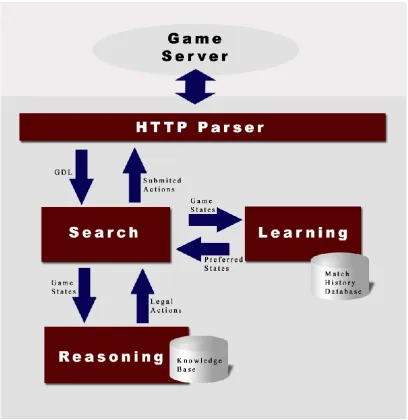
Figure 3.1: Architecture of our General Game Playing agent
Based on the GGP communication protocol described in Section 2.3, the agent needs
a HTTP parser to interact with the game manager. Since GDL limits the scope of the
games to only "finite, discrete, deterministic multi-player games of complete
information" (Love, 2005), game tree search is proper to these games. Attempts to
22
keywords. We also need a reasoning module to identify legal actions in a given game
state and a learning module to evaluate the outcome of the actions. Our agent
architecture is shown in Figure 3.1. We'll explain each module in the following
sections of this chapter.
3.1
Heuristic Search
A complete game tree is a directed graph with the initial game state as the root, the
terminal states as the leaves, and all possible moves from each position as
intermediate tree nodes. The number of nodes in a complete game tree is bounded by
O(bd), where b is the branching factor and d is the game depth. Chess has roughly 3884
(~10130) possible game states (De Groot, 1965). Tic-Tac-Toe has roughly 39 (nine
cells, each with three possible values, ~19,000) possible intermediate game states.
Although a complete game tree can provide the optimal action at every step, in most
cases, it is too expensive to build.
In this dissertation, the term game tree refers to the partial game tree that uses the
current game state as the root and includes as many nodes as the player can search.
Search algorithms that explore one ply, two plies, ahead of the current state are called
23
Assuming both players play optimally, minimax search can be used in two-player
complete information games. It recursively computes the minimax values of the
successor states, beginning from the tree leaves and backing up through the tree as the
recursion unwinds. Minimax is a depth first tree search. It has the space complexity of
O(bd) and time complexity of O(bd).
We make certain adjustments for the minimax search in our agent. For single-player
and simultaneous games, every ply is a MAX ply. For games with more than two
players, we assume each player is in competition with all others and attempts to make
optimal moves for himself. Therefore, all other players' moves are treated as MIN ply.
The minimax search becomes the max-min-min search in a three-player turn-taking
game.
Search algorithms used in GGP include Binary Decision Diagrams (Edelkamp, 2011),
Monte-Carlo Tree Search (Finnsson, 2011; Gudmundsson, 2011; Möller, 2011), and
tree parallelization (Méhat, 2011). Among these search algorithms, Monte-Carlo Tree
Search has recently been recognized as the new benchmark for game tree search in the
AI area (Kroeker, 2011). We are aware that minimax is not optimal in our algorithm
and should be replaced, but the focus of our research has been on the learning
24
Figure 3.2: Pseudo-code for minimax search in general games
1. function action minimax(GameState state, depth) { 2. if(isTimeOut() || reachMaxDepth()){//recursion base 3. action = state.getAction();
4. action.value=evaluate(state); //get the action that leads to the selected state 5. return action;
6. } 7. else {
8. legalActions = state.getLegalActions();
9. selected = legalActions[0]; //set the default action as the first legal action in the list. 10. childrenStates = state.doActions(legalActions);
11. for each childState in childrenStates {
12. tempAction = minimax (childState, depth+1); 13. if(isMyTurn(depth)) {
14. //no matter how many players are in the game, only my actions reach for the max value.
15. if(selected.value < tempAction.value) { //MAX ply 16. selected = tempAction
17. selected.value = tempAction.value; 18. }
19. } else {
20. if(selected.value > tempAction.value) { //MIN ply 21. selected = tempAction
22. selected.value = tempAction.value; 23. }
24. } 25. }
26. return selected; 27. }
25
3.2
Logic Resolution
A GGP game starts from one initial state and transits from one state to the next only
by actions. The agent uses the reasoning module to retrieve game states, each player's
roles, game transitions, game termination validation, and legal actions. Knowledge
representation and reasoning algorithms including inference, deduction, substitution
and unification are used in the agent (see Section 4.1).
Our first attempt to develop a learning algorithm used forward chaining to calculate
the legal actions in a given game state. The forward chaining approach starts from the
facts in the Knowledge Base (KB) and keeps solving the rules and adding new facts
entailed by the KB. This is supposed to be efficient because each time we mark a new
proposition as true, it will be added to the KB and can be re-used by another reasoning
thread without being re-generated. Since there are many propositions (e.g. board
adjacency) that stay unchanged from the beginning to the end of the game, calculating
them once and using them repeatedly should save time.
This assumption turned out to be wrong. As more and more propositions are added to
the KB, the size of the KB grew tremendously. The KB starts with only propositions
describing the game state and grows into millions of logical inferences that can be
generated from the KB about the game. Although the forward chaining procedure's
26
needs to access the KB so frequently that trivial delays in the KB access can
significantly impair agent performance (see Section 4.2).
We had to revert to the backward chaining reasoning algorithm. It starts from the
target clause and works backward to the facts in the KB. The backward chaining itself
is not as efficient as forward chaining because it conducts a considerable amount of
redundant searching (Brachman, 2004). Yet it is more proper in the GGP context
because the KB size is kept small and the KB access is kept efficient.
3.3
Learning
While logic resolution is straight forward in determining the available legal actions,
selecting good actions remains challenging. Most games are too large to be searched
exhaustively so the search has to be truncated before a terminal state is reached. The
agent has to make decisions without perfect information. Evaluation functions replace
terminal or goal states so that the game can move forward.
Note that the evaluation functions return an estimate of the expected utility of the
game at a given state. The "guessing" is not as correct as searching but it can be very
useful. Research has shown that in a Chess game, even expert players seldom look at
more than 100 possible situations to decide on an action (De Groot, 1965). Compared
27
intelligence and Deep Blue excels with computational power. The performance of a
game-playing program is dependent concurrently on its ability to search and the
quality of the evaluation. Our research focus is primarily on the quality of the
evaluation functions.
The purpose of general game playing is to build automated agents to play arbitrary
games. Learning is the core research problem in the GGP. It is indeed surprising that
the general learning algorithms have not dominated the state of the art in GGP. The
reason is mainly due to the difficulty of designing general-purpose learning
algorithms. The GGP competition set-up also makes it hard to differentiate how much
search or learning individually contributes to the agent's winning. Lack of evaluation
benchmarks has made it hard to measure the learning results (see Section 9.3). Three
known learning algorithms in GGP include transfer learning, temporal difference
learning, and neural network algorithms.
Transfer learning generalizes known games into directed graphs and uses graph
isomorphism to map the known strategies to new games (Kuhlmann, 2007; Banerjee,
2007). It is dependent on the availability of known games. When given a game that the
world has never seen before, the agent loses its advantage.
Game Independent Feature Learning (GIFL) is the temporal difference learning (Kirci,
28
learned only if the player that wins the game makes the last move. Features-to-Action
Sampling Technique (FAST) is another temporal difference method that uses
template matching to identify piece types and cell attributes (Finnsson, 2010). It is
designed to play board games only.
The neural network algorithm transforms the goal of a game to obtain an evaluation
function for states of the game (Michulke, 2009, 2011). It is capable of learning and
consequently, improving with experience. But games where the ground-instantiation
of the goal condition is not available, such as when the goal conditions (or predecessor
conditions in the chain) are defined in a recursive manner, are out of the scope of this
algorithm.
The learning algorithm we decided to pursue does not depend on any known games,
any game types, or assumptions of the game rules. It is based on game simulations,
not on how the game rules are written. Our learning algorithm has three steps. First,
the agent singles out influential features that helped the players win (see Chapter 5).
Second, the agent identifies some individual features that are more beneficial when
combined with certain other features. It uses a decision tree (see Section 6.2) to
evaluate the entire game state, not the individual features. Third, the agent moves
from global learning to local learning (see Section 6.3). The game states are better
29
3.4
Game Examples
We now give a few example games that we use in the rest of the dissertation to
illustrate the effectiveness and performance of the algorithms in building an
intelligent general game player. The games we chose include small, middle, and large
size games; single-player, two-player, and three-player games; zero-sum and
non-zero-sum games; turn-taking and simultaneous games; direct search, strategic
and eCommerce games.
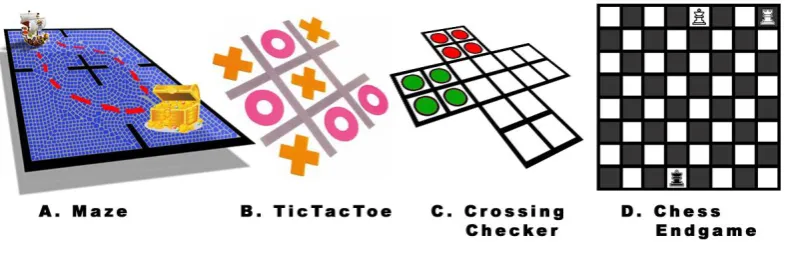
Figure 3.3: General game examples I
Maze: This is a small-size single-player game (Figure 3.3A). The player searches for the gold in the maze and brings it back to the entrance.
Tic-Tac-Toe: This is a two-player, turn-taking, small-size board game played on a 3 by 3 grid (Figure 3.3B). It is a territory-taking game in which once a position is taken
30
Crossing Chinese Checkers: Two players alternatively move or jump pieces to the other end of the board (Figure 3.3C). Players can either move one grid forward or
jump over one piece and land on the other side. Players can repeat jumping until no
legal jump is available as part of the same move. The first player with all four pieces
in the target area wins.
Chess Endgame: This is a middle-size strategic game with three pieces left on the 8 by 8 Chess board (Figure 3.3D). The piece movements obey the regular Chess rules.
White needs to checkmate Black in at most 16 steps to win. Unlike Tic-Tac-Toe,
positions taken by players can be released.
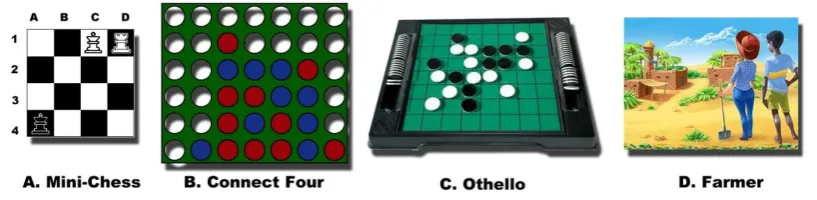
Mini-Chess: Two players play on a 4 by 4 Chess board with the same movement rules as regular Chess (Figure 3.4A). White has a rook at (c,1), and a king at (d,1). Black
has only a king at (a,4). This is an asymmetric game. White must checkmate Black in
at most ten steps; otherwise, Black wins.
Connect Four: Classic vertical Connect Four is a middle-size territory-taking game. Two players alternatively drop pieces down slots from the top of a six by seven grid
(Figure 3.4B). The first player that connects four pieces in a line (horizontal, vertical,
or diagonal) wins. White goes first and it is advantageous to go first. Connect Four has
31
Figure 3.4: General game examples II
Othello: Othello is a large-size two-player territory-taking game (Figure 3.4C). The player tries to flip the opponent's pieces into his own color. The player with majority
of pieces showing at the end of the game wins. Othello has a branching factor of 8-12
and a search space of roughly 364 (~1030) .
Farmer: Farmer is a three-player simultaneous game especially written for GGP (Figure 3.4D). Traditional computer game research covers mainly two-player
turn-taking games, but the Farmer game sets up tasks for three players (Alice, Barney
and Charlie) to make as much money as possible in the given iterations. Each player
tries to make more money than either of the other players. In each iteration, all three
players act simultaneously.
The three players each start with 25 gold pieces. It takes 10 gold pieces to build (buy)
a farm and 20 gold pieces to build a factory. The players begin with no commodities
on hand. They have to build a farm before growing wheat or cotton and build a factory
32
farm is built it will produce wheat if the “grow wheat” action is taken or cotton if the
“grow cotton” action is taken at any subsequent iteration. Once the factory is built it
will produce flour if the “manufacture flour” action is taken or cloth if the
“manufacture cloth” action is taken, provided the player has the required wheat or
cotton in inventory.
However, manufacturing products from raw materials is not the only way to make
money. Players can buy and sell directly to the market as well. The market has an
infinite supply of commodities and gold. The initial market price for wheat is 4 gold
pieces, flour 10, cotton 7 and cloth 14 gold pieces. After every step of the game, the
market price of each commodity automatically increases by one even if nothing is
bought or sold. In addition to this automatic increase, the product price decreases by
two in the next iteration for every selling action of that commodity and increases by
two in the next iteration for every buying action of that commodity. The players begin
with no inventory. The buy action will fill up the player’s inventory with that
commodity and the sell action will clear the inventory of that commodity. Essentially
all commodities except gold have only a single unit size.
The Farmer game is a very interesting game in many aspects. It contains a simplified
skeleton of manufacturer financial activities, such as invest in infrastructure (farm or
33
keeping the inventory down. It also contains the elements of the stock market, such as
an inflation indicator (prices increase by one in every step) and a market pressure
indicator (price goes down by two for every selling action, and up by two for every
buying action). The Farmer game opens the possibility of using general game playing
techniques to explore, and perhaps even solve, skeletal real world financial or social
problems.
Another outstanding feature about the Farmer game is the simultaneous movement of
all three players. Each player can buy or sell one of the four commodities, grow or
make one of the four raw materials, or build one of the two infrastructures. Each
player has 12 to 14 possible legal actions in every step. In other words, the branching
factor is about 123 because the three players move simultaneously. The typical
branching factors is 36 for Chess, 7 for Connect Four, 10 for Checkers, and 300 for Go
--- all are well-recognized complex games. The complexity of the Farmer game is
amazing.
The Farmer game can be very flexible too. The game can be easily reconfigured from
three players to two, four or more players. It can be changed from 10 iterations to 20,
40 or more iterations. The game dynamics change accordingly. Further discussions on
34
4
Knowledge Representation and Reasoning
As mentioned in Chapter 2, the game manager provides the player agents with the
initial state of the game, the set of game rules, and their roles in the game. The game
state information is in the form of logic propositions. The game's legal actions and
goals are defined in the form of logic relations. The agents' roles in the game are
provided in the form of logic statements. With such information, the agents use
knowledge representation and reasoning to calculate the available actions. It is
impossible to conduct further game operations such as game tree search or learning
without knowledge resolution. Reasoning is the foundation in all general game
players. However, not all reasoning algorithms are the same. The contents in this
chapter have been published (Sheng, 2010b).
4.1
Reasoning with Logic: Substitution, Unification and
Backward Chaining
The game state is a collection of true propositions or facts. The facts are stored in the
Knowledge Base (KB). The game rules are written in prefix logic implications.
35
produce a new set of propositions. The reasoning algorithms used in our general game
player include substitution, unification and backward chaining.
We now use Tic-Tac-Toe game as an example. Suppose the grid is marked as in
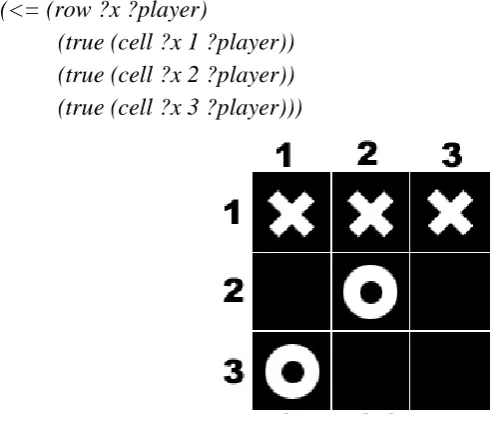
Figure 4.1 and O-player is in control in the current state. The game relation row is
defined as below:
(<= (row ?x ?player)
(true (cell ?x 1 ?player)) (true (cell ?x 2 ?player)) (true (cell ?x 3 ?player)))
Figure 4.1: Tic-Tac-Toe example
The arguments that begin with ? are variables. To answer the question "Is there an ?x
value such that (cell ?x 1 ?player) is true?", the inference rule substitution is used.
Substitution inference is looking for a variable/ground term pair so that the
proposition sentence is true (Russell, 2003). In the Figure 4.1 example, (cell 1 1 X)
36
The substitution rule gives different groups of variable assignments to each condition
in the row implication. For the first condition clause (true (cell ?x 1 ?player)), the
assignments are {x=3, player =O}, {x=1, player =X}. For the second clause (true
(cell ?x 2 ?player)), the assignments are {x=1, player =X}. The unification rule is
introduced to combine the two clauses. Unification requires finding substitutions to
make different logic expressions identical (Russell, 2003). Only the pair {x=1, player
=X} satisfies both the first condition and the second condition concurrently.
Using the unification inference recursively until all clauses in the implication body are
unified with a known fact is the process called backward chaining. Backward
chaining is the goal-oriented reasoning that finds implications in the knowledge base
that conclude with the goal (Russell, 2003). If the clause cannot be determined in the
current implication, the agent introduces other rules to the process.
4.2
Limitations of the Knowledge Base
In the reasoning process, the propositions are stored in the KB. When the game state
proceeds forward or a new query is needed, the agent searches the KB to substitute
variable values with grounded terms. New propositions will be generated, and copied
37
Tic-Tac-Toe is a simple example and we use it only for illustration purposes. Connect
Four is a middle-size game with a branching factor of seven. Othello is a large-size
game with a branching factor that varies from 8 to 12. The KB is very frequently
queried for both proposition search (returning all applicable values) and theorem
proving (returning true when the first applicable value is found). Table 4.1 shows the
average number of KB accesses based on 100 random matches. The KB access count
from the beginning to the end of the match is in hundreds for a Tic-Tac-Toe match, in
thousands for a Connect Four match, and in millions for an Othello match. The access
frequency grows quickly as the game size grows, even without a heuristic search
involved.
Table 4.1: The average number of knowledge base visits during random matches
Static
Propositions
Dynamic
Propositions State Features
Search Prove Search Prove Search Prove
Tic-Tac-Toe 0 0 10 80 76 110
Connect Four 12 263 424 2,016 760 3,297 Othello 68,423 603,490 556,345 1,577,560 27,269 2,008,058
Static propositions are the facts that never change from the beginning to the end of the
game. They are either defined in the game description or can be inferred from and
only from the static propositions. Tic-Tac-Toe does not have any static propositions
defined in the game. The board adjacency relations defined in Othello are considered
38
over the game cycle. They can be added or removed as the game proceeds. State
features contain the game state information and are the most frequently queried group
of the three.
The KB is accessed frequently during the game cycle. So the data structure in the KB
affects the reasoning performance of the agent. The larger the game, the more
significant the influences of the KB data structure are. A small performance
improvement in the reasoning process can be greatly amplified to expedite searches
and learning and therefore, add up to huge improvements in the agent's performances.
GDL has been known as not particularly efficient in reasoning, and there are many
attempts to improve its performance (see Section 2.4).
4.3
Using Hash Tables to Expedite Reasoning
We propose using hash tables to improve the reasoning performance. Hash tables use
hash functions to convert data into indexed array elements. A hash table is a
commonly used data structure to improve the search performance. Depending on the
implementation, the searching complexity varies, but the time complexity of
searching a hash table can be as low as O(1). We designed the hash function so that it
groups all propositions starting with the same logic terms together. Because the
39
hashing function will not create collisions in the conversion. The hashing function is a
one-to-one literal-to-integer perfect hashing.
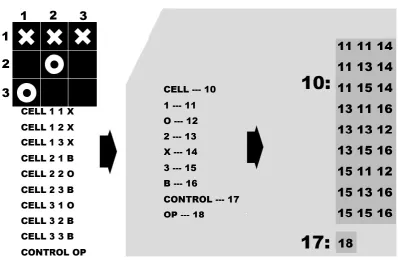
As shown in Figure 4.2, each proposition stored in the KB is decomposed into the list
of its arguments. The literal cell is mapped into integer 10, and each of the arguments
in the same sentence are converted into distinct integers. The fact (cell 1 1 X) is stored
as (10 11 11 14) in the KB. All propositions starting with the term cell are grouped
together so that its integer value 10 occurs only once as the group index. Variables are
mapped into negative numbers so that the reasoning process knows what should be
instantiated.
40
Using hash tables to convert the data stored in KB from game specific features to
integers not only saves storage space, but also saves search time. Without hashing, the
KB search conducts string comparisons and is dependent on the length of the string.
Suppose one proposition has an average of n strings, and each string has an average of
m letters. A positive equal comparison has the computational complexity of O(m*n).
But using the hash table, only O(n) comparisons are needed. The length of the string
does not matter anymore. The savings are beneficial to any GGP player that uses logic
substitution, unification and backward chaining reasoning algorithms.
Some GGP players in the field choose to convert GDL into other programming
languages with better AI support, such as Prolog or LISP, or other compilers or
reasoning tools. The hash tables presented here create a one-to-one hashing schema
that map each game element into a unique integer. The agent does not need to handle
hashing value collisions. Perfect hashing is as good as any hashing method can do.
The hash table is of the same cardinality as the game rules.
To avoid human cheating, all the competition games are scrambled into random letter
combinations, which can be long, meaningless strings. For example, (cell 1 1 B),
which means a ternary relation cell that relates a row number, a column number, and a
content designator, is logically equivalent to the description (position first first empty),
41
replaced consistently for all other occurrences in the game rules. With the proposed
hash tables, as long as the logic relations are the same, the scrambled version of the
game will be treated the same, no matter if the logic relation is scrambled into
two-letter words or two-hundred-letter words.
In addition to converting the data stored in the KB, we expand the hash values to the
reasoning process. When the agent receives the game description at the beginning of
the game, it converts the entire game logic into integers. Which literal is used does not
affect the logic relations as long as the changes are consistent. Therefore, the rule (<=
(goal ?player 100) (line ?player)) is logically equivalent to (<= (15 -3 77) (26 -3)) as
long as the terms are changed consistently for other places in the game rules. Figure
4.2 shows how the propositions in the Tic-Tac-Toe example game state are converted
into distinct integers in the KB. The pseudo-code for hashing the game description
written in GDL to integers is presented as in Figure 4.3.
The standard Java API is used in the calculation. The hash code of a string is
calculated from the ASCII value of each letter in the string, as shown in function
hashCode. To avoid collisions, the hash code is mapped into a unique index value
with the getIndex function, creating a perfect hash. In general game playing
circumstances, even for a very complicated game like Chess or Othello, the rules in
42
description is limited, possibly less than one hundred. We have not seen any actual
hash collisions in all known GGP example games (list given in Appendix A). Perfect
hashing of game literals creates a table of the same cardinality as the game description
43
44
function parseGDL(gameDescription)
1. expressionArray = parseGDLToExpresionStrings(gameDescription); 2. for all expressions in expressionArray
3. hashKey = getKeyWord(expression); 4. index = getIndex(hashKey);
5. childrenArray = parseChildren(expression); 6. KB[index].add(children);
function parseGDLToExpresionStrings(gameDescription) //expression is the group of literals surrounded by parenthesis 7. for all letters in the gameDescription
8. char c = gameDescription.charAt(i); 9. if c=='('
10. bracketCount++; 11. else if c==')' 12. bracketCount--;
13. if bracket == 0 //when one complete sentence identified 14. end = i+1;
15. expressionArray[Index++] = gameDescription.subString(begin, end); 16. begin = end;
function getKeyWord(expression)//keyword is the first parameter of expression 17. nextIndex ← find the next space in the expression;
18. //parameters in one expression are separated by spaces. 19. keyWord = expression.subString(0, nextIndex);
function getIndex(hashKey)
20. index ← look up the hash table by hashKey; 21. if index does not exist in HashTable
22. index = tableSize+1; //assign the next table slot to index 23. putIndexToHashTable(hashCode(hashKey), index);
45
function hashCode(hashKey) // standard Java String.hashcode() API 26. if the hashKey is empty
27. hashcode = 0; 28. else
29. for each letter in the hashKey
46
In our agent, the knowledge representation and reasoning process are conducted with
integers. Only the equal and not-equal operations are invoked. No addition or
subtraction operations are allowed. The hashing conversion from GDL to the integers
is processed only once at the beginning of the game. Subsequent reasoning is
conducted directly with integers and access only the KB but do not search the hash
table key-value pairs. Introducing hash tables into the reasoning process is because
the KB is visited extremely often (Table 4.1). When communicating to the game
manager, the agent translates the integers back into the strings. Considering the
communication is only done at the end of each step, this translation cost is minimal.
4.4
Hash Tables Performance Analysis
Dresden University of Technology general game playing website has published a Java
agent player (see reference GGP Player). Our GGP agent is written in Java and we
compare our agent against the published Java agent for performance benchmarks.
Different games have different logic relations and therefore different reasoning
computational complexities. We compare our agent and the published Dresden Java
agent in seven games: Maze, Mini-Chess, Tic-Tac-Toe, Connect Four, Chess
Endgame, Othello, and Farmer. A wide variety of different game sizes, player
47
The experiments were run on a desktop PC with Intel Q6600 2.4GHz CPU, 2GB
memory, and Ubuntu Linux 10.04. To design a fair comparison to test the reasoning
speed of the two Java players, we used three criteria:
Initial Game Step: We compare the time consumed by each agent from the beginning of the game to finding all available legal actions in the initial game state.
The agent parsed the input from the game manager into the game rules, the initial
game state, and its own role in the game. It proceeds with the knowledge reasoning
process to find available legal actions. The time used by the published Java agent is
normalized as 100% and the time used by our agent is converted into its percentage, as
shown in the Figure 4.4. Depending on which game, our agent used about 10% - 40%
of the time that the Dresden Java agent used.
48
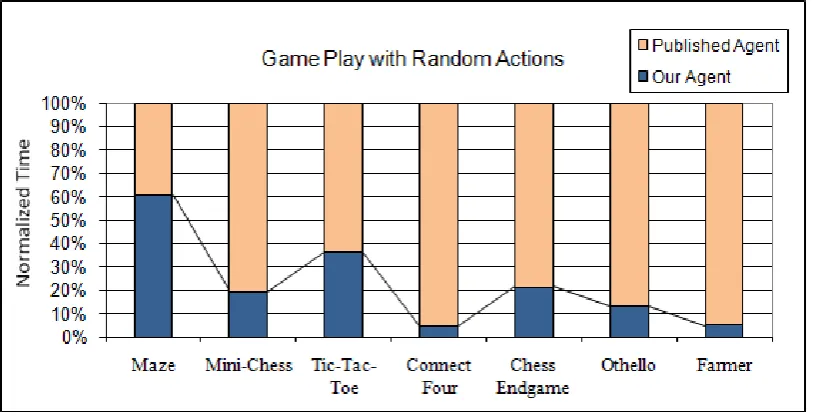
Random Play: We compare the time consumed by the two agents from the beginning to the end of the game. All players take random actions in this scenario. The clock is
set for each individual agent. In addition to the reasoning in the first step, the agents
perform the state transition logic operations to move the game forward. The time used
by the published Dresden Java agent is normalized as 100% and our agent uses 5% -
60% as much time, as shown in Figure 4.5.
Figure 4.5: Normalized time cost comparison to play with random actions
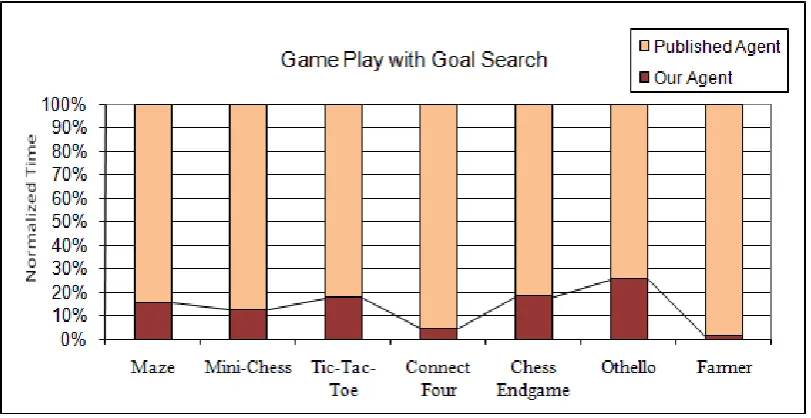
Goal-Search: We compare the time consumed from the beginning to the end of the game. In this scenario, the agent searches for the goals one step ahead of the current