Scholarship@Western
Scholarship@Western
Electronic Thesis and Dissertation Repository
8-17-2016 12:00 AM
A comparison of solution methods for Mandelbrot-like
A comparison of solution methods for Mandelbrot-like
polynomials
polynomials
Eunice Y. S. Chan
The University of Western Ontario
Supervisor
Robert M. Corless
The University of Western Ontario
Graduate Program in Applied Mathematics
A thesis submitted in partial fulfillment of the requirements for the degree in Master of Science © Eunice Y. S. Chan 2016
Follow this and additional works at: https://ir.lib.uwo.ca/etd
Part of the Numerical Analysis and Computation Commons
Recommended Citation Recommended Citation
Chan, Eunice Y. S., "A comparison of solution methods for Mandelbrot-like polynomials" (2016). Electronic Thesis and Dissertation Repository. 4028.
https://ir.lib.uwo.ca/etd/4028
This Dissertation/Thesis is brought to you for free and open access by Scholarship@Western. It has been accepted for inclusion in Electronic Thesis and Dissertation Repository by an authorized administrator of
Abstract
We compare two different root-finding methods, eigenvalue methods and homotopy meth-ods, using three test problems: Mandelbrot polynomials, Fibonacci-Mandelbrot polynomials, and Narayana-Mandelbrot polynomials. For the eigenvalue methods, using both MATLAB and Maple, we computed the eigenvalues of a specialized recursively-constructed, supersparse, up-per Hessenberg matrix, inspired by Piers Lawrence’s original construction for the Mandelbrot polynomials, for all three families of polynomials. This led us to prove that this construction works in general. Therefore, this construction is genuinely a new kind of companion matrix. For the homotopy methods, we used a special-purpose homotopy, in which we used an equiv-alent differential equation to solve for the roots of all three families of polynomials. To solve these differential equations, we used our own ode solver, based on MATLAB’sode45routine, which has pole-vaulting capabilities. We had two versions of this ode solver: one in MATLAB, and the other in C++that implements Bailey’s ARPREC package.
Keywords: Root-finding, companion matrix, eigenvalues, homotopy, Mandelbrot polyno-mials, Fibonacci-Mandelbrot polynopolyno-mials, Narayana-Mandelbrot polynomials
First and foremost, I would like to express my sincere gratitude to my supervisor, Prof. Robert M. Corless, for his infinite wisdom and wonderful guidance. Without him, none of this would have been possible.
I would also like to thank my parents for everything that they have done for me for the past 23 years.
Lastly, my heartfelt appreciation goes to everyone in the Department of Applied Mathe-matics at Western University for making this such an enjoyable experience.
Contents
Abstract i
Acknowledgements ii
List of Figures v
1 Introduction 1
1.1 Conditioning . . . 2
1.2 Root-finding methods . . . 5
2 Mandelbrot polynomials and matrices 9 2.1 Mandelbrot polynomials . . . 9
2.2 Condition numbers and pseudozeros . . . 12
2.3 Mandelbrot matrices . . . 13
2.3.1 Using full matrices . . . 16
2.3.2 Using sparse matrices . . . 17
2.4 Homotopy method . . . 19
2.5 Pole-Vaulting . . . 22
2.5.1 Residues . . . 23
2.5.2 Distinctness . . . 25
2.6 Our custom ode solver . . . 27
2.6.1 Runge-Kutta Methods . . . 27
2.7 Accuracy of the roots . . . 31
2.7.1 Newton polishing . . . 32
2.8 Smallest roots . . . 33
2.9 Results for homotopy methods . . . 34
3 Fibonacci-Mandelbrot polynomials and matrices 37 3.1 Introduction . . . 37
3.1.1 Fibonacci-Mandelbrot polynomials . . . 38
3.2 Condition numbers and pseudozeros . . . 39
3.3 Fibonacci-Mandelbrot matrices . . . 40
3.3.1 Results . . . 46
3.4 Homotopy methods . . . 48
3.4.1 Distinctness . . . 54
3.4.2 Smallest roots . . . 55
4 Narayana-Mandelbrot polynomials and matrices 59
4.1 Introduction . . . 59
4.1.1 Narayana’s cows sequence . . . 59
4.1.2 Narayana-Mandelbrot polynomials . . . 60
4.2 Condition numbers and pseudozeros . . . 61
4.3 Narayana-Mandelbrot matrices . . . 62
4.3.1 Results . . . 67
4.4 Homotopy methods . . . 70
4.4.1 Smallest roots . . . 72
4.4.2 Results . . . 75
5 Concluding Remarks 78 5.1 Future Work . . . 80
Bibliography 87
Curriculum Vitae 88
List of Figures
1.1 Plots of all roots of the Mandelbrot (1.1a), Fibonacci-Mandelbrot (1.1b), and Narayana-Mandelbrot (1.1c) polynomials, with cardioid in grey. . . 8
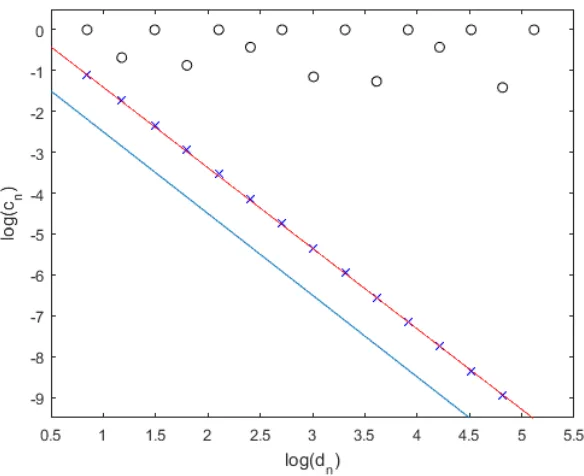
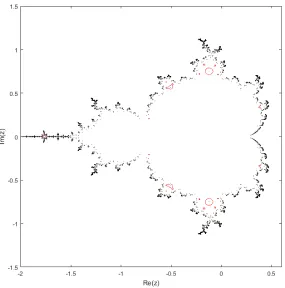
2.1 Plot of both mininum and maximum condition numbers against degree of the Mandelbrot polynomials. . . 12 2.2 Roots of p15(z) with|p15(z)|= 0.1 in red. . . 13
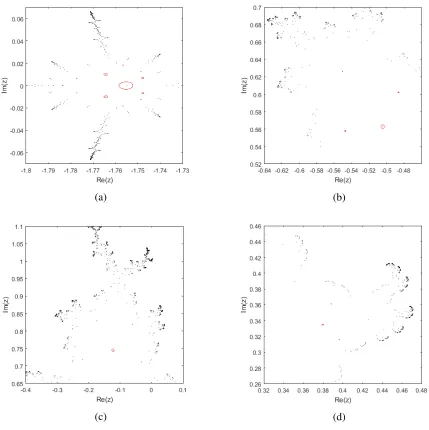
2.3 Different regions the Mandelbrot polynomial with a degree of 16,383, where the roots are not as well-conditioned, with|p15(z)|=0.01 in red. . . 14
2.4 All 32,767 roots ofp16(z), produced in Maple 2016. . . 16
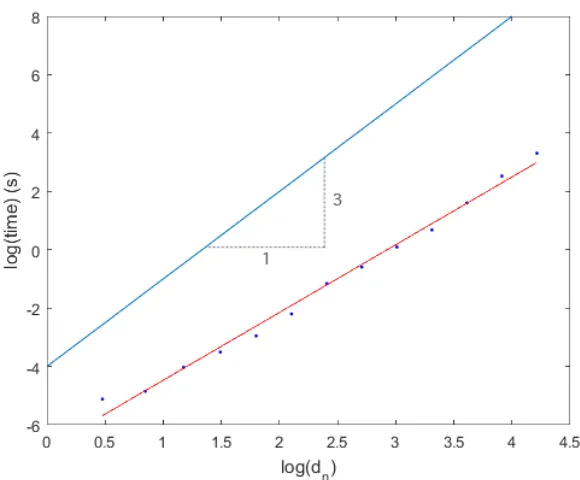
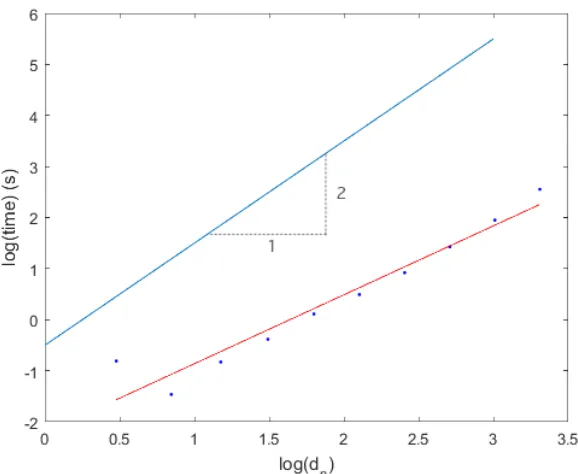
2.5 Time taken for eigenvalue computation of Mandelbrot matrices. The slope of the line of best fit is around 2.3. . . 17 2.6 Time taken for eigenvalue computation using sparse matrices. The slope of the
line of best fit is around 1.3. . . 19 2.7 Diagram demonstrating pole-vaulting technique (p is the pole, and ρ is the
radius of the semicircular arc). . . 22 2.8 Homotopy paths of p3(z) and contour where|p3(z)|=1. . . 23
2.9 Plots of homotopy paths and contour|pn(z)|=1 of the Mandelbrot polynomials
fromn=4 ton= 9. . . 24 2.10 Log-log plots of smallest roots snof Mandelbrot polynomials (difference from
1/4) . . . 34 2.11 Time taken to compute roots of Mandelbrot polynomial using a homotopy
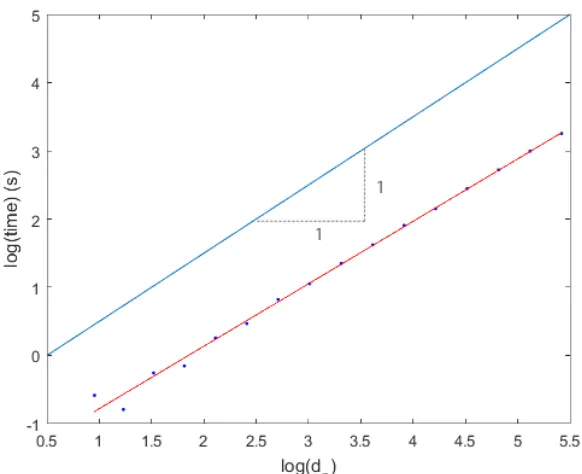
method. The line of best fit has a slope about 0.92. . . 35 2.12 All 2,097,151 roots of the Mandelbrot polynomial p22(z). These roots were
produced in MATLAB using our own ODE solver. . . 36
3.1 Minimum and maximum condition numbers of the roots for Fibonacci-Mandelbrot polynomials. . . 40 3.2 All 609 roots ofq15(z) with|q15(z)|= 0.2 in red. . . 41
3.3 Different regions the Fibonacci-Mandelbrot polynomials where the roots are not as well-conditioned with|q15(z)|=0.05 in red. . . 42
3.4 Image visualizations of inverses of Fibonacci-Mandelbrot matrices, where−1, 0 and 1 are black, grey, and white respectively, using Maple 2016. . . 47 3.5 Plots of eigenvalues using MATLAB’seigroutine. . . 48 3.6 Computed eigenvalues ofn=23, which has a degree of 28,656 of the
Fibonacci-Mandelbrot matrices using Maple. . . 49 3.7 Time taken to compute eigenvalues of Fibonacci-Mandelbrot matrices. . . 49 3.8 Homotopy paths forq5 and contour where|q5(z)|= 1. . . 52
polynomials fromn= 6 ton= 11. . . 53 3.10 Log-log plots of smallest roots sn of Fibonacci-Mandelbrot polynomials
(dif-ference from 1/4). . . 55 3.11 Time taken to compute roots of qn(z) using homotopy methods. The line of
best fit has slope of 0.82. . . 57 3.12 Plot of all 3,524,577 roots of the Fibonacci-Mandelbrot polynomial q33(z).
The residuals were all smaller than 10−4. . . 58 4.1 Condition numbers of the roots of the Narayana-Mandelbrot polynomials,rn(z). 62
4.2 Roots ofr21(z) with|r21(z)|=0.1 in red. . . 63
4.3 Different regions the Narayana-Mandelbrot polynomials where the roots are not as well-conditioned with|r21(z)|=0.05 in red. . . 64
4.4 Roots ofr27(z), which has a dimension of 18,559. . . 68
4.5 Results MATLAB gives when evaluating the eigenvalues ofM28 using
recur-sion from Equation (4.10), showing numerical artefacts. . . 69 4.6 Results Maple gives when evaluating the eigenvalues ofM28 using recursion
from Equation (4.13), again showing numerical artefacts. . . 69 4.7 Time taken for computing the eigenvalues of the Narayana-Mandelbrot matrices. 71 4.8 Homotopy paths forr6(z) and contour where|r6(z)|= 1. . . 73
4.9 Plots of homotopy paths and contour |rn(z)| = 1 of the Narayana-Mandelbrot
polynomials fromn= 7 ton= 12. . . 74 4.10 Smallest roots of the Narayana-Mandelbrot polynomials (difference from 1/4). 75 4.11 Time taken to compute roots ofrn(z) using homotopy methods. . . 76
4.12 Roots ofr36(z), which has a degree of 578,948. . . 77
Chapter 1
Introduction
In this thesis, we explore two different methods for finding roots of Mandelbrot-like problems:
eigenvalue methods and homotopy methods. We are interested in finding out which of the
two methods is better in solving multivariate polynomial systems, since there are many useful
applications such as computer aided geometric design (CAGD). However, instead of looking
into multivariate polynomials system for this thesis, we have decided to retract to a simpler
problem, which is only univariate, but with large degree. The three families of
polynomi-als that we explore are the Mandelbrot polynomipolynomi-als, Fibonacci-Mandelbrot polynomipolynomi-als, and
Narayana-Mandelbrot polynomials. The last two are new to this thesis.
The recursion for the Mandelbrot polynomials [19] is
p0= 0
pn+1= zp2n(z)+1, (1.1)
wheren= 0,1,2, . . .. Dario Bini et al. used the Mandelbrot polynomials to test their package
MPSolve (Multiprecision Polynomial Solver), which was originally presented in [3]. MPSolve
is a package for the approximation of the roots of a univariate polynomial using the Aberth
method. According to Bini’s personal website, they were able to compute around 4 million
roots of the Mandelbrot polynomials using their updated package, MPSolve 2.0 (see [4] for
more details).
The Fibonacci-Mandelbrot polynomials and Narayana-Mandelbrot polynomials are new
families of polynomials that are similar to the Mandelbrot polynomials. However, the recursion
for both of these families of polynomials are based on their respective sequences, Fibonacci
se-quence [22] and Narayana’s cows sese-quence [23]. The recursion for the Fibonacci-Mandelbrot
polynomials is
q0 = 0
q1 = 1
qn+1 = zqn(z)qn−1(z)+1, (1.2)
wheren= 1,2,3, . . .. Similarly, the recursion for the Narayana-Mandelbrot polynomials is
r0 = 1
r1 = 1
r2 = 1
rn+1 = zrn(z)rn−2(z)+1, (1.3)
wheren= 2,3,4, . . ..
1.1
Conditioning
Before looking into the two root-finding methods that we applied to our three families of
polynomials, we first should look at the condition numbers to see whether the roots of these
polynomials are well-conditioned. The following proofs were only done for the Mandelbrot
polynomials; however, similar arguments can be made for both the Fibonacci-Mandelbrot and
1.1. Conditioning 3
Consider the following for the Mandelbrot polynomials:
pn(z+ ∆z) pn(z)+ p0n(z)∆z (1.4)
Ifξnis a root of pn andξn+ ∆ξn is a root of pn+ ∆pn,
0= (pn+ ∆pn) (ξn+ ∆ξn)
=
:0
pn(ξn)+ p
0
n(ξn)∆ξn+ ∆pn(ξn)
p0n(ξn)∆ξn = −∆pn(ξn)
∴ ∆ξξn
n
= − 1
ξnp0n(ξn)
· ∆pn(ξn)
1 , (1.5)
which means that our absolute condition number is 1/p0n(z) (see [8, Section 3.2.1]). Simi-larly, our absolute condition numbers for the Fibonacci-Mandelbrot and Narayana-Mandelbrot
polynomials are 1/q0n(z) and 1/r
0
n(z), respectively.
We can also look at the pseudozeros of the Mandelbrot polynomials (see [8, Section 2.4])
to confirm the result that we have gotten from calculating the condition number. Studying the
pseudozeros will further help us understand what happens if the coefficients of the Mandelbrot
polynomials are somehow changed, such as by measurement error or numerical errors. Given
ε >0, we can define the set of pseudozeros
Λε(pn)= n
z: (pn+ ∆pn) (z)= 0 & |∆pn| ≤ε o
(1.6)
Since
pn(z)+ ∆pn(z)= 0, (1.7)
this means that
by construction. Therefore,
Λε(pn)= n
z:|pn(z)| ≤ε o
, (1.9)
which we can use to confirm the fact that the roots of the Mandelbrot polynomials are
well-conditioned and can be located accurately.
However, this is not the only way to do pseudozeros; we can also use polynomial bases
(which we will denote asφk(z)) to compute our pseudozeros. Given the weightsαk ≥ 0,ε >0,
and 0≤ k≤n, our set of pseudozeros can also be defined as
Λε=
n
z:|pn(z)| ≤ε·B(z) o
(1.10)
where∆pn= Pnk=0∆ckφk(z), and each|∆ck| ≤ε·αk, andB(z)=Pnk=0αk|φk(z)|. In the monomial
basis, B(z) grows exponentially indn, doubly exponentially inn; essentially, small changes in
the coefficients force large changes in the value of pn(z). The same argument can be made for
both the Fibonacci-Mandelbrot and Narayana-Mandelbrot polynomials to show that their roots
are also well-conditioned (when the monomial basis is not used).
Additionally, we need to look into the numerical stability of our recurrence relation. The
rounding errors made in the computation of the floating-point evaluation of the Mandelbrot
polynomials is, using the IEEE model [14]
fl(zp2n+1)=z·fl(pn)2(1+δ1)(1+δ2)(1+δ3)+1·(1+δ3), (1.11)
where (1+δj) represents the rounding error (due to floating point numbers) that is introduced
when an arithmetic operation is performed. We can rewrite Equation (1.11) as
ˆ
1.2. Root-finding methods 5
The notationθ3is taken from [14]. It means that roughly 3 rounding errors,
|θn| ≤
nµ
1−nµ, (1.13)
whereµis machine precision. Knowing that the recursion for the Mandelbrot polynomials is
pn+1(z)=zp2n(z)+1, we get the following
ˆ
pn+1(z)− pn+1(z)=zpˆ2n(z) (1+θ3)+1+θ1−zp2n(z)−1
=z( ˆpn(z)+ pn(z))·(1+θ3)·( ˆpn(z)− pn(z))+θ1
en+1 2zpn(z)·en(1+θ3)+θ1. (1.14)
Therefore,
en =(2z)n−1·(pn−1(z)·pn−2(z)· · ·p1(z))e1+O(θn). (1.15)
From Equation (1.15), we are particularly interested in the (2z)n−1·(pn−1(z)·pn−2(z)· · ·p1(z))
part. Since we know that the largest root of the Mandelbrot polynomials is approximately
−2, substituting this into (2z)n−1, where n is, for example, 8, we get quite a large number, which is around 16,000. Therefore, we need to see whether (pn−1(z)· pn−2(z)· · ·p1(z)) is
small enough to keep en small. Using Maple, we find that the computed values of (2z) n−1 ·
(pn−1(z)· pn−2(z)· · ·p1(z)) ranges from 0 to about 10,000 whenn = 8. Since our largest value
is less than 4n−1, this means that our recursion is mildly unstable: dn2 is an acceptable factor,
about what you would expect for a random polynomial.
1.2
Root-finding methods
One of the methods that we explored for root-finding is using eigenvalue methods, using these
three families of polynomials as test problems. For this method, we computed the eigenvalues
conventional companion matrix constructions, such as the ones found in [13], [8, Chapter 6],
and [6], we used a supersparse1recursively-constructed upper Hessenberg companion matrix,
inspired by Piers Lawrence. In his paper [9], he introduced this construction for the Mandelbrot
polynomials. We then used a similar construction for the Fibonacci-Mandelbrot polynomials
and Narayana-Mandelbrot polynomials. The surprising analogy between all three families of
supersparse companion matrices led us to prove that this construction works in general (proof
in Chapter 5), leading us to a genuinely a new kind of companion matrix that can offer better
numerically-conditioned for unimodular polynomials.
This new kind of companion matrix also fall into the class of Bohemian matrices, which
stands for BOunded HEight Matrix of Integers [11]. As will be seen later, the companion
matrices for these families of polynomials only contain elements {−1,0} for the Mandelbrot
matrices, and{−1,0,1}for the Fibonacci-Mandelbrot and Narayana-Mandelbrot matrices.
The second method that we looked into for finding roots ishomotopy continuation methods.
One early work about homotopy methods is [17], which claims that the amount of
computa-tional work is roughly proporcomputa-tional to the number of solutions. For each family of polynomials,
we used a special-purpose homotopy equivalent to a differential equation. Using the previous
roots as our initial conditions, the solutions of these differential equations end up being the
roots of the polynomial that we are trying to solve. When we first started, to solve these
dif-ferential equations, we used Shampine & Reichelt’s Odesuite in MATLAB (more specifically
ode45) [20]. However, because we needed to avoid singularities when integrating, we decided to write our own ode solver (described in Chapter 2), which is very similar to MATLAB’s
ode45routine, but has pole-vaulting capabilities. Realizing that we need to use multiple preci-sion to compute the roots of higher iterations, we also implemented a verpreci-sion that uses Bailey’s
ARPREC package [2] in C++. Using homotopy methods, we were also able to look at the
smallest roots of the Mandelbrot, Fibonacci-Mandelbrot, and Narayana-Mandelbrot
polyno-mials.
1.2. Root-finding methods 7
Altogether, these two different methods for root-finding were tested in three families of
polynomials: Mandelbrot polynomials (Chapter 2), Fibonacci-Mandelbrot polynomials
(Chap-ter 3), and Narayana-Mandelbrot polynomials (Chap(Chap-ter 4). Figure 1.1 shows all of the roots
(overlaid on top of each other with the roots for the largest degree at the bottom) for each
fam-ily of polynomials, each with a grey cardioid to allow comparison of the size of the roots of
(a) Roots of Mandelbrot polynomials fromn= 3 ton=19.
(b) Roots of Fibonacci-Mandelbrot polynomials fromn=4 ton=30.
(c) Roots of Narayana-Mandelbrot polynomials fromn=4 ton=36.
Chapter 2
Mandelbrot polynomials and matrices
2.1
Mandelbrot polynomials
Mandelbrot polynomials, which are used by Bini et al. [4, 3] as a test problem, are based on
the Mandelbrot set [19]
zn+1 =z2n+c, (2.1)
wherez0 = 0 andcis a complex constant. We can simplify Equation (2.1) by dividing
every-thing byc, removing the trivial rootc= 0:
zn+1
c =c
z n
c
2
+1. (2.2)
From this, we can rename the variables in Equation (2.2) to get the Mandelbrot polynomial,
which is defined by the recurrence relation
p0(z)=0
pn+1(z)=zp2n(z)+1, (2.3)
wheren= 0,1,2,3, . . ..
Expanding Equation (2.3) using the monomial basis expansion, the first six polynomials of
pn(z) are
p0(z)= 0
p1(z)= 1
p2(z)= z+1
p3(z)= z3+2z2+z+1
p4(z)= z7+4z6+6z5+6z4+5z3+2z2+z+1
p5(z)= z15+8z14+28z13+60z12+94z11+116z10+114z9
+94z8+69z7+44z6+26z5+14z4+5z3+2z2+z+1. (2.4)
A few noticeable properties of the Mandelbrot polynomials include [9]:
1. The degree ofpn(z) fork>0 isdn =2n−1−1.
2. The roots ofpn(z) are periodic points of the Mandelbrot set with periodn.
3. The coefficients of pn(z) when expressed in the monomial basis are nonnegative integers.
Indeed pn(z) is unimodular1.
4. Derivatives can be computed from the recurrence relation by p0
0(z)= 0 and for alln≥ 0
by
p0n+1(z)= pn(z) pn(z)+2zp
0
n(z) .
5. pn(z) and p0n(z) can simultaneously be evaluated by their recurrence relations at a cost of
O(n) orO(lndn) operations.
Proof of Property 1 From the recurrence relation, shown in Equation (2.3), it can easily be
1Polynomials that are unimodular have coefficients that increase to a unique maximum then decrease when the
2.1. Mandelbrot polynomials 11
seen that the degree of the polynomials is
dn =2·dn−1+1. (2.5)
We can prove by induction that the degree of the Mandelbrot polynomials can be expressed as
dn =2n−1−1. (2.6)
First, we can substituten=1 into Equation (2.6):
d1 =21−1−1 =20−1
=1−1= 0, (2.7)
which we can see from p1(z) in Equation (2.4) is true. Assuming whenn= k,dk = 2k−1−1 is
true. Then, whenn=k+1,
dk+1 =2·dk+1
=2·(2k−1−1)+1
=2·2k−1−2+1
=2·2k−1−1
=2k+1−1−1 (2.8)
which matches to Equation (2.6). This, therefore, proves that the degree of the Mandelbrot
polynomials isdn= 2n−1−1.
Sketch of Property 2 The roots of pn(z) are periodic points of the Mandelbrot set with
pe-riodn. For example, pn(−1) ∈ {0,1}. Indeed, p2(−1) = 0, p3(−1) = 1, p4(−1) = 0, and the
2.2
Condition numbers and pseudozeros
We will first look at the condition numbers of the roots of the Mandelbrot polynomials. As
mentioned in Chapter 1, the condition number for the roots is 1/p0
n(z). Figure 2.1 shows
the log-log plot of both the minimum and maximum condition numbers against the degree
of the Mandelbrot polynomials. Here, the circles represent the maximum condition numbers,
in which the minimum p
0
n(ξn)
, whereξnis a root of pn(z), were used to compute our condition
numbers. It can be seen that none of the condition numbers here exceed the value of 1. On
the other hand, the crosses are the minimum condition numbers. Looking at the line of best fit
running through these data points, some roots become better conditioned as the degree of the
polynomials increase. The slope of this line is around−2 (the lower line with a slope of−2 is
there for reference).
Figure 2.1: Plot of both mininum and maximum condition numbers against degree of the Mandelbrot polynomials.
We can also plot the pseudozeros of the Mandelbrot polynomials by the plotting the
con-tours of pn(z) = ε, where εis an arbitrarily small number. Figure 2.2 illustrates this idea: it
2.3. Mandelbrot matrices 13
Figure 2.2: Roots ofp15(z) with|p15(z)|= 0.1 in red.
roots are too small to be seen, meaning that these roots are well-conditioned. However, the
roots in which the contours that surrounds it can be seen are those roots that are not as
well-conditioned. Figure 2.3 shows |p15(z)| = ε, where ε = 0.01, in red, at the most interesting
parts of the Mandelbrot polynomials, where the contours can be seen in Figure 2.2, but has the
contour|p15(z)|= 0.01 plotted instead.
Knowing that the roots are well-conditioned, we can now look at two different methods in
solving the Mandelbrot polynomials: an eigenvalue method and a homotopy method.
2.3
Mandelbrot matrices
The Mandelbrot matrices, first thought of by Piers Lawrence [9], are recursively-constructed
(a) (b)
(c) (d)
2.3. Mandelbrot matrices 15
the corresponding Mandelbrot polynomials. We begin our recursive matrices with
M2 =
−1
, (2.9)
which corresponds to p2(z). It is obvious that the eigenvalue of Equation (2.9) is−1, which is
clearly the root of p2(z)= z+1. Letrn =
0 0 . . . 1
andcn=
1 0 · · · 0
T
, where
the length of both vectors aredn =2n−1−1. Then, our matrix construction is
Mn+1=
Mn −cnrn
−rn 0
−cn Mn ,
for alln>1. The first few Mandelbrot matrices are
M3=
−1 0 −1
−1 0 0
−1 −1
, (2.10) and
M4 =
−1 0 −1 −1
−1 0 0
−1 −1
−1
−1 −1 0 −1
−1 0 0
−1 −1
. (2.11)
Evaluating the eigenvalues of both M3 andM4, we can see that the eigenvalues are the roots
of p3(z) and p4(z) respectively. We can show that pn(z) = det(zI− Mn) for alln > 0 using
Figure 2.4: All 32,767 roots ofp16(z), produced in Maple 2016.
2.3.1
Using full matrices
Using Maple 2015, we were able to compute up to n = 16, which is 32,767 roots using a
machine with 32 GB of memory, shown in Figure 2.4. Although the Mandelbrot matrices are
sparse, initially, for simplicity’s sake, we used full matrices in our eigenvalue computation.
Figure 2.5 shows the time taken to compute the eigenvalues of the Mandelbrot matrices as the
dimensiondnof the matrix increases. As you can see from the figure, the line fitted to the data
(the bottom red line) is not as steep as the reference line (the top line), which has a slope of 3.
In fact, the slope of the line of fit is around 2.3. Therefore, this method has a time complexity
of order less than O(dn3). This fact is surprising because we expected this method to have a
time complexity of exactlyO(d3
n). We believe that the time complexity calculated here is less
than what we expected because the algorithm effectively uses a divide and conquer approach
to solve for the eigenvalues due to the structure of these companion matrices, thus reducing the
2.3. Mandelbrot matrices 17
breaking into roughly equal halves.
Figure 2.5: Time taken for eigenvalue computation of Mandelbrot matrices. The slope of the line of best fit is around 2.3.
Since we are using full matrices in our eigenvalue computations, this means that the space
complexity is quite large, O(d2n), and since the matrices that we are working with are quite
sparse, most of the numbers that are stored would actually be zeros. Therefore, using the
sparse data type would help us save space when storing our matrices, and hopefully help us
compute more roots. However, computing eigenvalues using sparse data structures do present
some difficulties which will be discussed in the next subsection.
2.3.2
Using sparse matrices
To take advantage of the sparseness of the matrices when solving for the eigenvalues, we can
use MATLAB’s eigs routine, which uses Arnoldi iteration to solve for eigenvalues. Unlike solving for eigenvalues using full matrices, we cannot solve for all of the eigenvalues at once.
Instead, we have to look at different regions and compute the eigenvalues that are in each region
trying to find all of the eigenvalues of the Mandelbrot matrices.
The first issue is determining what regions to look at that would help us compute our
eigen-values. Borrowing the idea from homotopy methods (which will be discussed later in this
chapter), we can use the roots from the previous iteration to help us locate the new roots.
How-ever, for matrices of higher dimensions, it becomes increasingly difficult to locate all of the
eigenvalues. Therefore, as the dimension of the matrices increases, the number of
eigenval-ues that need to be found at each region also increases. Also, since we are computing several
eigenvalues from each region, it means that we will end up getting duplicates. This introduces
another challenge of eliminating all of the duplicate eigenvalues that were computed, so that
each eigenvalue only appears once. Since these eigenvalues are computed numerically, the
eigenvalue duplicates may not necessarily be exactly the same. This imposes another
chal-lenge when comparing two results in determining whether they are in fact duplicates of each
other or whether they are distinct roots, but located near each other. Unfortunately, using this
routine, we were only able to compute all of the roots up ton=13, which is only 4,095 roots.
In the interest of time, we decided not to pursue this any further.
The time taken to compute these eigenvalues of the Mandelbrot polynomials using sparse
matrices can be seen in Figure 2.6. The slope of the line that passes through the data points is
around 1.3; the line above it is a reference for the steepness of a slope of 2. Although, here,
it shows that the time complexity is of order O(d1n.3), which is less than the time complexity
when using full matrices, it does not seem quite correct. However, we are lacking some data
since we are only considering the time computed for up ton= 13. Once higher dimensions are
achieved using this method, the time complexity may increase; it might possibly have a higher
time complexity than the method that uses full matrices. Therefore, more research would need
2.4. Homotopy method 19
Figure 2.6: Time taken for eigenvalue computation using sparse matrices. The slope of the line of best fit is around 1.3.
2.4
Homotopy method
Consider this special-purpose homotopy
Hn(ζ, τ)= ζ(pn−1(ζ))2+τ2. (2.12)
When τ = 0, it is clear that the zeros of the homotopy is ζ = 0, and the zeros (twice) of
pn−1(z), which, in other words, are the rootsξn−1 of the previous polynomials. On the other
hand, whenτ = 1, Hn(ζ, τ) is the same as our Mandelbrot polynomials, which means that the
roots of our homotopy are equivalent to the roots of pn(z). Therefore, by differentiating both
describes a path from the roots ofζ(pn−1(ζ))2 to the roots ofpn(ζ), provided thatp0n(ζ),0:
0= Hn(ζ, τ)
0= d
dτHn(ζ, τ)
= dζ
dτ· p
2
n−1(ζ)+2ζ· pn−1(ζ)·p0n−1(ζ)
dζ dτ+2τ
= dζ
dτ
p2n−1(ζ)+2ζpn−1(ζ)
+2τ
= p0n(ζ)
dζ
dτ+2τ . (2.13)
Thus,
dζ dτ = −
2τ
p0
n(ζ)
, τ∈[0,1]. (2.14)
However, since our initial conditions include the roots of the previous polynomial,ξn−1, it
means that we encounter a singularity when we first solve this differential equation numerically.
To reiterate,p0n(z)= pn−1(z)(pn−1(z)+2zp0n−1(z)), and sinceξn−1is a double root ofzp 2
n−1(z), this
means that p0n(ξn−1)= 0. Additionally, sinceξn−1is a double root, this also means that two new
rootsξn will stem from this one initial condition. In order to achieve this, we can use Taylor
series expansion to perturb our initial conditions so that our solutions will go on two different
paths, thus giving us two distinct solutions for each previous root. Letζ = ξn−1+aτ+O(τ2),
whereτis arbitrarily small. To find what the coefficientais, we can do the following:
pn−1(ζ)= pn−1(ξn−1+aτ)
pn−1(ξn−1+aτ)= pn−1(ξn−1)+aτp0n−1(ξn−1)+O(τ2)
pn−1(ξn−1+aτ)=aτp0n−1(ξn−1)+O(τ2). (2.15)
Substituting this into the right hand side of Equation (2.12) and setting this expression to 0, we
get the following:
0= (ξn−1+aτ)(aτp
0
2.4. Homotopy method 21
From here, we can collect the coefficients of powers of 2 forτ, and solve fora, which is
a=± 1
p0
n−1(ξn−1) s
−1 ξn−1
. (2.17)
As we can see from Equation (2.17),acan either be positive or negative. This means that we
can perturb our initial conditions in two different directions. Instead of using
ζ(0)= ξn−1, (2.18)
as our initial condition, we would use
ζ(τ)=ξn−1+
τ
p0n−1(ξn−1) s
−1 ξn−1
(2.19)
and
ζ(τ)=ξn−1−
τ
p0
n−1(ξn−1) s
−1 ξn−1
, (2.20)
resulting in finding two different roots. Therefore, using this technique, we are able to perturb
our initial condition, ξn−1, to avoid the singularity that we encounter when τ = 0. This is
essentially the Puiseux expansion ofζ(τ):
ζ(τ)= ξn−1±aτ+O(τ2) (2.21)
and the reason we usedτ2 instead of just simplyτin the homotopy.
Unfortunately, these are not the only singularities that we encounter when solving Equation
(2.14). As an example, we can look at the singularities that we encounter when n = 3. The
differential equation for p3(z) is
dζ dτ =
−2τ
3ζ2+4ζ+1 , (2.22)
that we will encounter singularities whenζ(τ)= −1 and−13, which is whenτ 0.3849. This
will give us problems when trying to integrate along the realτ-axis. Therefore, we need to use
some method, such as the pole-vaulting technique, in order to avoid these singularities.
2.5
Pole-Vaulting
The pole-vaulting technique is a way to avoid singularities by backing offfrom the pole slightly,
and then going in a semicircular arc in the complex τ-plane (see [8, Section 12.11.1]), also
visually shown in Figure 2.7. Our semicircular path can be defined as
τ= p−ρeiθ, (2.23)
where pis the location of our singularity (which is a pole), andρis the radius of our
semicir-cular arc (or mathematically,ρ = p−τ). From Equation (2.23), we can see that whenθ = 0,
τ = p−ρ, and whenθ = π, τ = p+ρ. This means that we will be hopping over the pole by
taking 0≤ θ≤π.
τ=0 x 1
p
ρ
Figure 2.7: Diagram demonstrating pole-vaulting technique (pis the pole, andρis the radius of the semicircular arc).
Therefore, our ordinary differential equation for pole-vaulting becomes
dζ dθ =
dζ dτ
dτ dθ =
−2i(p−ρeiθ)ρe−iθ p0
n(ζ)
, θ∈[0, π]. (2.24)
Using this pole-vaulting technique, we can easily integrate Equation (2.22). Figure 2.8 shows
the paths (in black) that were taken to achieve the roots for p3(z). In the figure, the blue circles
2.5. Pole-Vaulting 23
grey line is the contour|p3(ζ)|= 1. Notice that in this figure, two of the final roots stem from
our initial pointζ =ξ2 = −1, and only one root comes fromζ = 0. This matches our previous
comment about needing to perturb our initial conditions so that we can get two separate paths
from this initial point. Figure 2.9 shows the homotopy paths of the Mandelbrot polynomials
fromn= 4 ton=9.
Figure 2.8: Homotopy paths ofp3(z) and contour where|p3(z)|= 1.
2.5.1
Residues
Our discussion about pole-vaulting thus far only looks at the case where we are integrating in
a semi-circular arc above the real axis. However, we are also interested in knowing whether
integrating along a semi-circular path below the real-axis would give us the same result. To
determine whether there is any difference, we can compute the residues by integrating around
(a) n=4 (b) n=5
(c) n=6 (d) n=7
(e) n=8 (f) n=9
Figure 2.9: Plots of homotopy paths and contour |pn(z)| = 1 of the Mandelbrot polynomials
2.5. Pole-Vaulting 25
when θ = 2π. In MATLAB, using our own ode solver (which will be discussed later in this
chapter), the residues are of orderO(10−2). Since this value is much smaller than the distance from where we start integrating our differential equation in the complex plane to our pole, we
believe that it does not matter whether we use a pole-vaulting technique to integrate above or
below the real axis. We also used multiple precision to compute the residues to ensure that
the values that we computed for our residues were just simply due to the numerical technique
that was used. The residues computed with higher precision areO(10−5), which is less than the
value that we computed when using MATLAB, as expected. Therefore, this confirms that we
should be able to compute all of the roots of the Mandelbrot polynomials regardless of whether
we are integrating above or below the real axis.
2.5.2
Distinctness
From the paper [10], we learn that all of the roots in this family of polynomials are distinct.
To ensure that this statement is true, we need to make sure that the paths of integration of all
routes taken to find the roots do not cross, thus leading us to find all the roots without getting
any duplicates. To illustrate this, we can see that none of the homotopy paths cross in each
plot of Figure 2.9. However, this is not a strong enough argument to confirm that all paths
are distinct. We also need to prove uniqueness, which requires the Lipschitz condition in a
domain R to be satisfied in order for there to be at most one solution [5, Chapter 6.3]. We,
however, already know that the solutions of the differential equations are not unique if our
initial condition is ζ(0) = ξn−1, since it is a double root. Therefore, in place of ζ(0) = ξn−1
as our initial conditions, we will use our perturbed initial conditions (see Equations (2.19) and
(2.20)).
Consider the following general initial value problem:
We say that f satisfies a Lipschitz condition in a region R if there is a constant L ≥ 0 such
that [5, Chapter 6.2]
|f(t,u)− f(t,v)| ≤ L|u−v|, if (t,u), (t,v)∈ R. (2.26)
Letting our regionR= C∼S, whereS is a small region surrounding each singularity, and
applying this definition to our homotopy for the Mandelbrot polynomials,
|f(t,u)− f(t,v)| ≤L|u−v|=
−2t p0
n(u)
− −2t
p0
n(v) =
−2t p0n(v)− p0n(u)
p0
n(u)p0n(v) . (2.27) Defining
p0n(v)= p
0
n(u+v−u)
= p0n(u)+ p00n(u)(v−u)+O(v−u), (2.28) we get
L|u−v|=
−2t p0n(u)+ p
00
n(u)(v−u)+O(v−u)
p0
n(u)p0n(v)
−2t p00n(u)
p0
n(u)p0n(v)
|v−u| . (2.29)
Therefore,
L= −2t p
00
n(u)
p0
n(u)p0n(v)
. (2.30)
However, sincep0n(u)≈ p
0
n(v), we can rewrite Equation (2.30) as
L= −2t p
00
n(u)
(p0
n(u))2
2.6. Our custom ode solver 27
As long as we avoid the singularities, when p0n(z)=0, we will be following a continuous path,
which means that the second derivative is bounded. From this, we know thatLis also bounded,
thus satisfying the Lipschitz condition. Therefore, this shows that the solutions to our initial
value problems are in fact unique.
2.6
Our custom ode solver
When we first started, we used MATLAB’s ode45routine to solve our differential equations to find the roots of the Mandelbrot polynomials. However, instead of using the pole-vaulting
technique, we decided to integrate in the complex plane using a triangular pathway. We were
able to compute all of the roots up ton = 20, which is 524,288 roots, until some pathways
diverged offto infinity when computing some of the roots whenn = 21, due to the increased
density of the singularities. Therefore, we decided to write our own ode solver in MATLAB
(and eventually in C++) to solve these differential equations so that we can step around the
roots by using pole-vaulting. Although we could have used MATLAB’s ode45 routine for
the pole-vaulting technique, we did not want to compute all of the singularities as it becomes
computationally expensive for high degrees. Therefore, our ode solver is based on MATLAB’s
ode45routine, which uses the Runge-Kutta-Fehlberg algorithm, but instead of terminating the program when it reaches a singularity, it is able to step around the singularity using the pole
vaulting technique described in the previous section and continue integrating until it reaches
the final point, which in our case isτ=1.
2.6.1
Runge-Kutta Methods
Euler’s method is the simplest method for solving an ordinary differential equation numerically.
However, it is not very accurate (or at least not accurate enough for our liking) since it is only
a first order method. To improve on this, we could use Taylor series expansion to increase the
order of our solution by using higher order derivatives. Since p0n(z), p
00
approximations are also available in O(n), i.e. O(lndn), flops, Taylor series methods could
well be viable for this problem. However, we decided to take another approach: to evaluate
the derivative function f(t,x(t)) more than once at different points, and then use a weighted
average of the values thus obtaining an approximation of the slope of the secant. This idea
gives what are called the Runge-Kutta (RK) methods, which we have found to be adequate for
our needs.
There are different RK methods in use [8, Chapter 13]. If we let the weights bebi, the time
step beh, andi=1,2,3, . . . ,s, the general form for an explicit Runge-Kutta methods is
xk+1= x0+h(b1k1+· · ·+bsks)= xk+h s X
i=1
biki, (2.32)
where the stages are
k1 =f(tk,xk)
k2 =f(tk+c2h,xk+a21k1)
k3 =f(tk+c3h,xk+a31k1+a32k2)
...
ks=f tk +csh,xk +as1k1+as2k2+· · ·+as,s−1ks−1 , (2.33)
which can also be expressed as
ki =f
tk +cih,xk +h i−1 X
j=1
ai jkj
, (2.34)
Here, the ci andai j are the weights of our previously computed values of kj, j < i. We can
2.6. Our custom ode solver 29
the following form:
c A
bT
=
0
c2 a21
c3 a31 a32
... ... ... ...
cs as1 as2 · · · as,s−1
b1 b2 · · · bs−1 bs
, (2.35)
whereAis a lower-triangular matrix with zeros as diagonal entries.
For robustness and to ensure quality of the solution, we need an adaptive step size scheme.
The goal of an adaptive step scheme is to take the largest stepsize possible while ensuring that
the absolute local truncation error is less than a tolerance given by the user for every step.
Here, we have decided to use the Runge-Kutta-Fehlberg method (RKF45) [12], which is a
fourth-order method with an error estimate of orderO(h5). TheButcher tableaufor the
Runge-Kutta-Fehlberg method, where the first row of coefficients at the bottom of the table gives the
fifth-order accurate method, and the last row gives the fourth-order accurate method, is
0
1/4 1/4
3/8 3/32 9/32
12/13 1932/2197 −7200/2197 7296/2197
1 439/216 −8 3680/513 −845/4104
1/2 −8/27 2 −3544/2565 1859/4104 −11/40
16/135 0 6656/12825 28561/56430 −9/50 2/55
25/216 0 1408/2565 2197/4104 −1/5 0
From Equation (2.36), we can see that the fourth-order approximation is
xi+1= xi+
25 216k1+
1408 2565k3+
2197 4104k4−
1
5k5 (2.37)
and our fifth-order approximation is
˜xi+1 =xi+
16 135k1+
6656 12825k3+
28561 56430k4−
9 50k5+
2
55k6. (2.38)
The local truncation error is
τi+1= ˜xi+1−xi+1. (2.39)
We can use the truncation error to help us calculate the size of the next step. By Taylor’s
theorem, our local truncation error is proportional to
τi+1 =khp+1 (2.40)
for some constantkand where p, in our case, is 4. So, we can multiply a scalarqwithhto get
the following:
τi+1(qh)=kqphp
=qpkhp
=qpτi+1(h)
≈qp(˜xi+1−xi+1) . (2.41)
Therefore, to make
|τi+1(qh)| ≈ |qp(˜xi+1−xi+1)|<tol, (2.42)
we want
q≤
"
tol |˜xi+1−xi+1|
#1/p
2.7. Accuracy of the roots 31
but in practice, we use
q≤ 0.8
"
tol |˜xi+1−xi+1|
#1/p
. (2.44)
Therefore, the optimal step size for the next step isqh. This is a very primitive way of step-size
control, but has worked adequately for these problems, most notably because we may improve
the approximate answer by a Newton step on pn(z)= 0.
We can take advantage of the automation of the step sizes to help us locate singularities
that are in the way. In our ode solver, once the step size falls below a certain size, say 10−6, the method will start integrating around the singularity using the Runge-Kutta-Fehlberg method
once again. As a reminder, the differential equation that is used to integrate around the
singu-larity is given as
dζ dθ =
dζ dτ
dτ dθ =
−2i(p−ρeiθ)ρe−iθ p0
n(ζ)
, θ∈[0, π],
which can also be found as Equation (2.24). The problem that we encounter here is that we
actually do not know what p or ρ are since we do not know where the exact location of the
singularities are. Therefore, to estimateρ, which is the distance that we are from the pole, we
can use Newton’s method
ρ= ζi−
p0n(ζi)
p00
n(ζi)
, (2.45)
since the denominator of our differential equation is just simply p0
n(ζ), and we can easily
cal-culate p0
n(ζi) and p00n(ζi).
Once the semi-circular path is finished integrating (whenθ = π), our ode solver continues
integrating along its original path until it reachesτ=1.
2.7
Accuracy of the roots
To check for the accuracy of these roots, we can calculate the residuals by evaluating pn(ξn).
We expect that we can use Newton’s method to reduce the size of the residuals of each of the
2.7.1
Newton polishing
To improve on the accuracy of our roots, we expect that we can use Newton’s method to polish
the roots:
ξn= ξn−
pn(ξn)
p0
n(ξn)
. (2.46)
We only polish each root once as we fear polishing the roots any more than that may cause the
roots to skip over to another root. However, Newton’s method may not actually give us better
results. As we can see from the paper [10] by Corless and Lawrence, Newton’s method has
problems when p00n(z) is too large, which the authors found out when trying to find the largest
roots of the Mandelbrot polynomials.
The authors began with the observation that the largest root is quite close to, but slightly
closer to zero than,−2. In order to use Newton’s method, the derivatives need to be calculated,
which they found to be (atz=−2)
p0n(z)=
4n−1−1
3 , (2.47)
which resulted in the Newton estimate to be
zn −2+
3
4n−1−1. (2.48)
However, the Newton estimate above is not quite right: the error of Equation (2.48) isO(4−n),
but the guess is alreadyO(4−n) accurate, so taking a Newton step hardly improves this estimate.
Therefore, we need to look at the growth of higher derivatives. The Newton estimate is based
on the expansion
pn(−2+ε)= pn(−2)+ p0n(−2)ε+
1 2p
00
n(−2)ε
2+· · · , (2.49)
2.8. Smallest roots 33
second derivative of the Mandelbrot polynomial evaluated at−2 is
p00n(−2)=− 1 274
2n+ 1
3−
k
9
!
4n− 8
27 , (2.50)
which exposes the problem with Newton’s method. Here, p00n(−2) is O(ε
−2), so we cannot
neglect theO(ε2) term in this case. In [10], the authors go on to find an analytical expression
for the largest magnitude real roots of the Mandelbrot polynomials, but we shall not need that
here.
2.8
Smallest roots
We can also use homotopy methods, as described above, to find the smallest roots, sn, of the
Mandelbrot polynomials by just simply using the smallest root from the previous iteration as
our starting point. We empirically deduce from our computations that thatsn has the form:
sn =
1
4 +αRen
−βRe±iα
Imn−βIm+h.o.t. (2.51)
We can plot the real (minus 1/4) and imaginary part of the smallest roots in a log-log plot,
shown in Figure 2.10 to compute βRe and βIm, which turn out to be, to the accuracy that we
use, 2 and 3 respectively. However, we are not sure that these are exact. Therefore, we can
approximate
sn
1 4 +
αRe
n2 ±
αIm
n3 . (2.52)
Knowing what βRe andβIm are, we can computeαRe andαIm, which are approximately 9.869
and 58.81, respectively. Corless and Lawrence [10] conjectured thatαRe isπ2. This work does
(a) Real part (b) Imaginary part
Figure 2.10: Log-log plots of smallest roots sn of Mandelbrot polynomials (difference from
1/4)
2.9
Results for homotopy methods
We were able to compute in MATLAB, using our own ode solver, all the roots of the
Man-delbrot polynomials up to n = 22, which has a degree of 2,097,151 to the order of O(10−4)
precision (see Figure 2.12). However, according to Bini’s personal website, they were able to
solve for around 4 million roots, which is one more iteration that what we have computed.
The time that it took to compute the roots using a homotopy method can be seen in Figure
2.11. In this figure, the line of best fit that runs through the data points has a slope of around
0.92, which is less than 1 (the line above our data is a reference to show the steepness of a line
with a slope of 1). Computationally speaking, this does not make any sense. There is a lower
bound on the complexity of O(dn) because we have to output dn roots; further, evaluating a
residual at each root costsO(lndn) flops, making an overall lower bound of O(dnlndn). What
must be happening here is that the “constant” hidden by theOsymbol is larger for the first few
n, and only is asymptotically constant. The roots are getting easier to find for largerdn.
As we compute the roots using our custom ode solver in MATLAB, we notice that we lose
accuracy as the iteration increases. We believe that the residuals are getting larger because of
the mild instability of the recurrence relation. Therefore, we need to use multiple precision in
2.9. Results for homotopy methods 35
for arbitrary precision in C++. Unfortunately, the ARPREC package does not lend itself to
OpenMP parallelization since it is not entirely thread safe [1]. Despite this, we were able to
compute up ton= 19, which has a degree of 262,143 thus far with the maximum residual of
O(10−11).
Figure 2.12: All 2,097,151 roots of the Mandelbrot polynomial p22(z). These roots were
Chapter 3
Fibonacci-Mandelbrot polynomials and
matrices
3.1
Introduction
The Fibonacci sequence, which is Sequence A000045 of the Online Encyclopedia of Integer
Sequences [22] is a widely known sequence. It begins
0,1,1,2,3,5,8,13,21,34,55, . . . (3.1)
and is generated by the recursion
Fn= Fn−1+Fn−2 (3.2)
withF0 =0 and F1 =1. There is a plethora of resources such as [16], [18], and the references
therein, that talk about the Fibonacci sequence which can be referred to if the reader wants to
learn more about the Fibonacci sequence.
3.1.1
Fibonacci-Mandelbrot polynomials
The Fibonacci-Mandelbrot polynomials are very similar to the Mandelbrot polynomials,
de-scribed in the previous chapter, but are slightly different. As a reminder, the recursion for the
Mandelbrot polynomials is
pn+1(z)= zp2n+1, (3.3)
where p0= 0. The Fibonacci-Mandelbrot polynomials, on the other hand, have the recursion
q0(z)=0, q1(z)=1
qn+1(z)=zqn(z)qn−1(z)+1, (3.4)
wheren=1,2,3, . . .. Instead of taking the polynomial from the previous iteration and squaring
it, we are multiplying the polynomials from the previous two iterations together. This is the
reason why it is called the Fibonacci-Mandelbrot polynomials.
Expanding Equation (3.4) using the monomial basis expansion, we can get the first few
polynomials:
q0(z)=0
q1(z)=1
q2(z)=1
q3(z)=z+1
q4(z)=z2+z+1
q5(z)=z4+2z3+2z2+z+1
q6(z)=z7+3z6+5z5+5z4+4z3+2z2+z+1
q7(z)=z12+5z11+13z10+22z9+28z8+28z7+23z6+16z5+10z4+5z3+2z2+z+1.
3.2. Condition numbers and pseudozeros 39
Some properties of the Fibonacci-Mandelbrot polynomials include:
1. The leading and trailing coefficients are 1.
2. All coefficients are positive integers.
3. The polynomials are unimodular.
4. The next-to-leading coefficient is a Fibonacci number.
5. Putdn = degqn. Thend1 =0, d2= 0,dn+1 =dn+dn−1+1 ordn = Fn−1, whereFnis a
Fibonacci number (see Equation (3.2)).
6. The roots ofqn(z) lead to periodic points ofqn+1(z)=zqn(z)qn−1+1, of periodn−2. For
instance,q3(−1)=0,q4(−1)=1,q5(−1)= 1, and then repeats: qn(−1)={0,1,1}.
7. The coefficients ofqngrow doubly exponentially:O(φφ
n
),φ= 1+
√
5
2 1.618. . ..
3.2
Condition numbers and pseudozeros
Similar to the Mandelbrot polynomials, the absolute condition number of the roots is 1/q0n(z).
Figure 3.1 shows the minimum and maximum condition numbers of the roots of the
Fibonacci-Mandelbrot polynomials. The maximum condition numbers are represented by the circles, and
are computed by taking the reciprocal of the minimum value of q
0
n(z)
. On the other hand, the
minimum condition numbers are represented by the crosses, and computed by taking the
recip-rocal of the maximum value of q
0
n(z)
. Just as we have seen for the Mandelbrot polynomials,
the maximum condition number for the Fibonacci-Mandelbrot polynomials is also 1, which
means that the roots are well-conditioned. The slope for the line of best fit for the minimum
condition number for the Fibonacci-Mandelbrot polynomials is around−1.9, which is slightly
greater than−2. The line that is below the lines of best fit is for reference; it has a slope of−2.
Additionally, we can look at the pseudozeros of the Fibonacci-Mandelbrot polynomials by
Figure 3.1: Minimum and maximum condition numbers of the roots for Fibonacci-Mandelbrot polynomials.
with respect to the location of the roots. Figure 3.2 shows the roots ofq15(z) with the contours
of|q15(z)| = 0.2 in red. Here, we can see that the contours that are visible encircles the roots
quite closely, which mean that the roots are well-conditioned. We can look closer into some
of the more interesting regions (that contain more red) of the roots of Fibonacci-Mandelbrot
polynomials, and reduce the size of the contour that we are looking into for these particular
regions. In Figure 3.3, we zoom into 4 different regions of the roots of q15(z), and plotted
|q15(z)|=0.05 instead of|q15(z)|= 0.2.
3.3
Fibonacci-Mandelbrot matrices
Using Piers Lawrence’s idea of using supersparse companion matrices to compute the roots
3.3. Fibonacci-Mandelbrot matrices 41
(a) (b)
(c) (d)
3.3. Fibonacci-Mandelbrot matrices 43
Fibonacci-Mandelbrot polynomials,qn(z). We start with
M3= [−1], (3.6)
in which the eigenvalue,−1, is the root ofq3(z)= z+1 and
M4 = 0 1
−1 −1
, (3.7)
where the eigenvalues,−1 2 ±
√
3i
2 , are the roots ofq4(z)=z
2+z+1. Also, note that
MT4 =
0 −1
1 −1
(3.8)
also leads to a similar family. However, we decided to use Equation (3.7) so that the
subdiago-nal of these family of companion matrices will always be−1.
Letrn =
0 0 · · · 1
andcn=
1 0 · · · 0
T
be row and column vectors of length
dn, wherednis the degree of the polynomial,qn(z). Then, our matrix construction would be
Mn+1 =
Mn (−1)dn+1cnrn−1
−rn 0
−cn−1 Mn−1 (3.9)
for alln>2. The first few Fibonacci-Mandelbrot matrices are
M5 =
0 1 1
−1 −1
−1
−1 −1
and
M6 =
0 1 0 1 −1
−1 −1 0 0
−1 0 0
−1 −1
−1
−1 0 1
−1 −1
. (3.11)
Computing the characteristic polynomials for both Equations (3.10) and (3.11), they both
match the Fibonacci-Mandelbrot polynomials, q5(z) andq6(z), respectively. We can also
con-struct the Fibonacci-Mandelbrot matrices slightly differently: we can swapMn andMn−1, and
changernandcnto the correct lengths. Thus, the recursion for this companion matrix is
Mn+1 =
Mn−1 (−1)dn+1cn−1rn
−rn−1 0
−cn Mn
, (3.12)
ma-3.3. Fibonacci-Mandelbrot matrices 45
trices using the recursion shown in Equation (3.12) are
M5 =
−1 1
−1
−1 0 1
−1 −1
, (3.13)
M6 =
0 1 −1
−1 −1
−1
−1 −1 0 0 1
−1 0 0 0
−1 0 1
−1 −1
, (3.14)
in which the characteristic polynomials of bothM5(Equation (3.13)) andM6(Equation (3.14))
also matchq5(z) andq6(z) respectively. It can be shown thatqn(z)= det(zI−Mn) for alln> 3
using induction and the Schur complement [24], which will be shown in Chapter 5.
Unlike the Mandelbrot matrices, notice that the Fibonacci-Mandelbrot matrices contain
{−1,0,1}, whereas the Mandelbrot matrices contain just the values{0,−1}. What is also
inter-esting is that the inverses of these Fibonacci-Mandelbrot companion matrices have inverses that
M6(Equation (3.11)) that follows the recursion found in Equation (3.9),
M−61 =
0 −1 1 0 0 0 0
0 0 −1 0 0 0 0
−1 0 −1 −1 1 0 0
0 0 0 0 −1 0 0
−1 0 −1 0 0 −1 0
1 0 1 0 0 0 −1
−1 0 −1 0 0 0 0
. (3.15)
We can also use Maple to help us visualize the next few inverses, shown in Figure 3.4, where
−1 is black, 0 is grey, and 1 is white. It is obvious from these plots that there is clearly a pattern
for the inverses of the Fibonacci-Mandelbrot polynomials. More research is required to learn
more about the inverses of these companion matrices and will be left to future work.
3.3.1
Results
Using our first matrix construction (Equation (3.9)), MATLAB’seigroutine was able to com-pute the eigenvalues of M22, which has a dimension of 17,710, correctly (see Figure 3.5a).
However, it was not able to successfully compute the roots ofq23(z) correctly, shown in
Fig-ure 3.5b. In MATLAB’s eigroutine, the default for balanceOption is ‘balance’, which enables balancing. In most cases, the balancing step improves the conditioning of the matrix
to produce more accurate results. However, in our case, it did not give us the correct results.
Therefore, we computed the eigenvalues once again with ‘nobalance’, but unfortunately, produced the same (incorrect) results. Additionally, we did not attempt to solve for the
eigen-values of sparse matrices even though it is very likely that it can help us find more roots using
this method.
We also tried computing the eigenvalues of the Fibonacci-Mandelbrot matrices using both
3.3. Fibonacci-Mandelbrot matrices 47
(a)M−1
7 (b)M
−1 8
(c)M−91 (d)M−101
(a) Computed eigenvalues ofM22, which has a
di-mension of 17,710.
(b) Computed eigenvalues computed of M23,
which has a dimension of 28,656.
Figure 3.5: Plots of eigenvalues using MATLAB’seigroutine.
results. Maple 2015 actually gives us the results that we were expecting (see Figure3.6a),
whereas Maple 2016 gives us inaccurate results (see Figure 3.6b).
From Figure 3.7, we can see that the time complexity is around O(dn2.3), which is very
similar to the time complexity that we computed when using the eigenvalue method on the
Mandelbrot matrices. As a reference, the top line has a slope of 3, which is the slope that we
expect our line of best fit to have.
3.4
Homotopy methods
We can also use homotopy methods to solve for the roots of the Fibonacci-Mandelbrot
poly-nomials. Consider the following homotopy:
Hn(ζ, τ)= ζqn−1(ζ)qn−2(ζ)+τ. (3.16)
Comparing this homotopy (Equation (3.16)) to the homotopy used for the Mandelbrot
3.4. Homotopy methods 49
(a) Using Maple 2015 (b) Using Maple 2016
Figure 3.6: Computed eigenvalues ofn = 23, which has a degree of 28,656 of the Fibonacci-Mandelbrot matrices using Maple.
is that the variableτin the homotopy for the Mandelbrot polynomials is squared, whereas here
in Equation (3.16), is just simplyτ. This is because the zeros whenτ= 0 are simple atζ = 0,
the roots ofqn−1(ζ), and the roots ofqn−2(ζ): we do not start at any double roots.
Similarly to the Mandelbrot polynomials, we can differentiate the right-hand side of
Equa-tion (3.16) with respect toτto give us the following differential equation:
dζ dτ =
−1
qn(ζ)
, (3.17)
where we integrate 0≤τ≤ 1. Just as we did for the homotopy method used for the Mandelbrot
polynomials, we can use the zeros ofζqn−1(ζ)qn−2(ζ) as our initial conditions to help us find
the roots ofqn(ζ).
Unfortunately, just as when solving the differential equations numerically for the
Mandel-brot polynomials, we encounter singularities along the real-axis when solving Equation (3.17)
for the Fibonacci-Mandelbrot polynomials. As an example for this case, we can look at the
singularities whenn= 4. The differential equation forq4(z) is
dζ dτ =
−1
2ζ+1, (3.18)
whereζ(0)= 0 andζ(0)= −1 (since it is the root ofq3(z)). There are no roots forq2(z), so we
do not includeq2(z) in our initial conditions. From Equation (3.18), it is obvious that we will
encounter a singularity whenζ = −1
2. Also, since Equation (3.18) is separable, we can easily
find the value ofτwhenζ =−1
2, and check thatτlies on the real-axis between 0 and 1.
dζ dτ =
−1 2ζ+1
(2ζ+1) dζ =−dτ
ζ2+ζ =−τ+C, whereCis a constant. (3.19)
3.4. Homotopy methods 51
whenζ =−1 andτ=0, we can substitute the corresponding values to Equation (3.19):
(−1)2+(−1)=C
1−1=C
C= 0. (3.20)
Therefore, whenζ= −1 andτ= 0, our constantCis also 0. Knowing that our constantC = 0,
we can now solve forτwhenζ = −1
2 to see at what value ofτwe encounter a singularity for
Equation (3.18):
−1 2
!2 + −1
2
! =−τ
1 4 −
1 2 =−τ
−1 4 =−τ
τ= 1
4. (3.21)
This shows that we do in fact encounter a singularity if we integrate along the real-axis, which
means that we need to use the pole-vaulting technique described in the previous chapter (see
Section 2.5) in order to avoid the singularities.
Since we are not starting from double roots for the Fibonacci-Mandelbrot polynomials, this
means that we do not need to perturb our initial condition, which we had to do for the
Man-delbrot polynomials. Instead, we can simply use the zeros of ζqn−1(ζ)qn−2(ζ), as mentioned
before. This means we only will get one root from each initial condition, unlike in the
Man-delbrot polynomials, where we get 2 roots from the zeros of pn−1(ζ) (remember that we only
got 1 root fromζ =0 for the Mandelbrot polynomials). As demonstrated in Figure 3.8, created
in MATLAB, we can see the homotopy paths taken from our initial points to our roots,ξ5. In
this figure, the root, ξ3 = −1, is indicated by a triangle, the roots, ξ4 = −0.5± 0.86603. . .,
Figure 3.8: Homotopy paths forq5and contour where|q5(z)|=1.
The grey line that surround the roots is the contour,|q5(z)|= 1. Notice in this figure that three
singularities are avoided by pole-vaulting.
Figure 3.9 shows the homotopy paths of the Fibonacci-Mandelbrot polynomials fromn=6
to n = 11. To simplify the plots, all of the initial points are blue circles (instead of showing
where each initial point comes from), while the final points are red crosses. These plots clearly
show that only one root stems from each initial point, unlike the Mandelbrot polynomials, seen
in Figure 2.9. One can prove that the gcd of qn(z) and qn−1(z) is 1: they can have no roots in
common because each would be periodic with periodnandn−1 and hence a fixed point, but
3.4. Homotopy methods 53
(a) n=6 (b) n=7
(c) n=8 (d) n=9
(e) n=10 (f) n=11
Figure 3.9: Plots of homotopy paths and contours |qn(z)| = 1 of the Fibonacci-Mandelbrot
3.4.1
Distinctness
Just as we have seen with the homotopy paths for the Mandelbrot polynomials, the paths for
the Fibonacci-Mandelbrot polynomials also do not cross (see Figures 3.8 and 3.9). We can
also prove, just like in Section 2.5.2, that each initial value problem is unique as long as the
singularities are avoided. However, this time, we do not need to be concerned about the initial
condition, and can start with the zeros ofζqn−1(ζ)qn−2(ζ), since these are not double roots.
Just as we did for the Mandelbrot polynomials, letting our region R = C, we can find the
Lipschitz constant for the homotopy for the Fibonacci-Mandelbrot polynomials
|f(t,u)− f(t,v)| ≤L|u−v|=
−1 q0
n(u)
− −1
q0
n(v) =
−q0n(v)+q
0
n(u)
q0
n(u)q0n(v) . (3.22) Let
q0n(v)=q0n(u+v−u)
=q0n(u)+q
00
n(u)(v−u)+O(v−u). (3.23)
Substituting Equation (3.23) into Equation (3.22), we get
L|u−v|=
−q0n(u)−q00n(u)(v−u)+q0n(u)+O(v−u)
q0
n(u)q0n(v)
−q00n(u)
q0
n(u)q0n(v)
|v−u|
−q00n(u)
(q0
n(u))2
|v−u| . (3.24)
Therefore,
L= −q
00
n(u)
(q0
n(u))2
. (3.25)