Electronic Thesis and Dissertation Repository
11-9-2015 12:00 AM
Applicative Structure in Wolof
Applicative Structure in Wolof
Christen HarrisThe University of Western Ontario Supervisor
Dr. Ileana Paul
The University of Western Ontario Graduate Program in French
A thesis submitted in partial fulfillment of the requirements for the degree in Doctor of Philosophy
© Christen Harris 2015
Follow this and additional works at: https://ir.lib.uwo.ca/etd
Part of the African Languages and Societies Commons
Recommended Citation Recommended Citation
Harris, Christen, "Applicative Structure in Wolof" (2015). Electronic Thesis and Dissertation Repository. 3464.
https://ir.lib.uwo.ca/etd/3464
This Dissertation/Thesis is brought to you for free and open access by Scholarship@Western. It has been accepted for inclusion in Electronic Thesis and Dissertation Repository by an authorized administrator of
(Thesis format: Monograph)
by
Christen Harris
Graduate Program in French Studies
A thesis submitted in partial fulfillment of the requirements for the degree of
Doctor of Philosophy
The School of Graduate and Postdoctoral Studies The University of Western Ontario
London, Ontario, Canada
This dissertation investigates applicative structures in Wolof, based on new data collected
from native speakers in Saint Louis, Senegal. The dual purpose of this dissertation is to
describe the applicative constructions available in Wolof and to identify their syntactic
structure. Following previous work on applicatives, the description of these applicatives
focuses on their object properties and the c-command configuration of the VP. The
analysis is framed within the Minimalist Program (Chomsky 1993, 1995, 2000). I
propose multiple function heads involved in applicative formation which account for the
properties in Wolof.
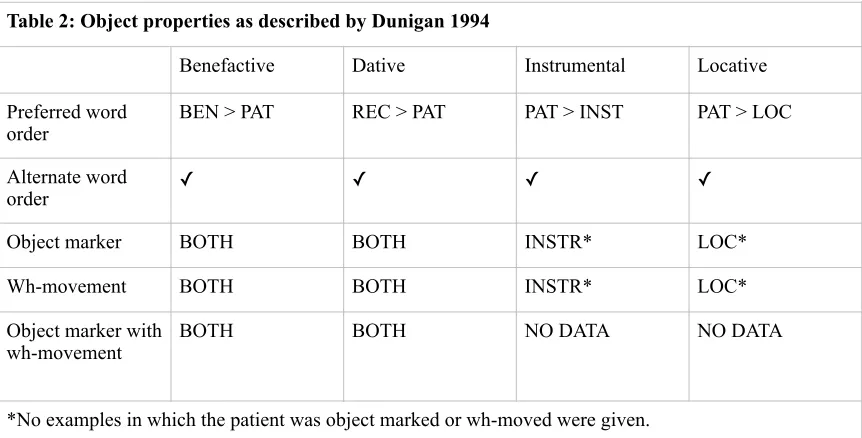
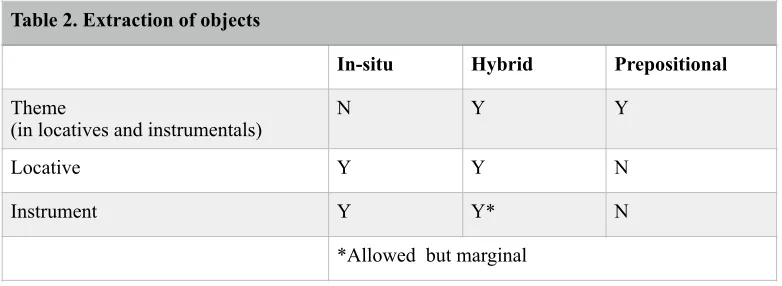
Four types of applicatives, benefactive, dative, instrumental, and locative in
Wolof. They are classified into three groups based on their object properties, selectional
restrictions, and c-command configuration. The groups are benefactive applicatives,
dative applicatives, and oblique applicatives (including instrumental and locative). Object
properties will show that benefactive and dative applicatives are symmetrical applicatives
while instrumental and locative applicative, which have been previously identified as
symmetrical (Dunigan 1994), show mixed symmetrical and asymmetrical behaviour.
C-command tests will show that in benefactive and dative applicatives, the applied object
asymmetrically c-commands the theme but in instrumental and locative applicatives, it is
the theme that asymmetrically c-commands the applied object.
The analysis proposed is based on the Thematic and Raising Applicative
Hypothesis from Georgala (2012). I propose a third applicative head in addition to
thematic and raising Appls, which I call Oblique Appl. Although not a standard
theoretical tool in Minimalism, the notion of Downward Merge from Phillips (2003) and
McGinnis (2005) is incorporated in Oblique Appl to account for instrumental and locative
applicatives which fall outside the explanatory power of the Raising and Thematic
Hypothesis vis-à-vis c-command and verbal adjacency. In the spirit and Marantz (1993)
and Georgala (2012), I argue that all three applicative heads merge in the same position,
merge within the lexical VP.
Keywords: applicative, Wolof, double object construction, verbal valency, instruments,
locatives
“It is slowly that one catches the monkey in the bush.”
Wolof Proverb
Laurence Earl Harris 1955-2015
I would first like to thank Ileana Paul, my advisor. Her constant support and
encouragement were instrumental in the achievement of this dissertation. Her
understanding and love of syntax have moulded and motivated me in both the good times
of this process and the bad.
I would also like to thank the professors that taught me and helped me over the
years, David Heap, Jacques Lamarche, Michiya Kawai, Jeff Tennant, and François Poiré.
I would also like that thank my senior thesis advisor, Sarah Gordon, who set me on the
path of research and languages.
I am deeply indebted to Boubacar Boris Diop and his son Moustapha Diop for
taking me in during my fieldwork in Senegal. They introduced me to many Wolof
speakers and linguists as well as providing me with wonderful insight into Wolof. I would
also like to thank Ibrahim Saar and Abdoulaye Dial for their help teaching me Wolof and
understanding its grammar. Finally, I cannot forget the wonderful and generous people
who worked with me as native language consultants including Badara Saar, Dame Diop,
Moussa Ndiaye and Hyacinthe Dione, and Xadija Diene as well as those who wished to
remain anonymous.
I have been lucky to be surrounded by such wonderful and stimulating fellow
graduate students. Thank you Kristen Izaryk for listening to many a syntactic rant and
always taking the time to chat with me about research. I also would like to thank Jorge
Emilio Roses Labarada and Olga Kharytonava who also helped and encouraged me along
the way. I cannot forget Nico Baier with whom I had many delightful and stimulating
discussion about Wolof, applicatives, syntax, and all these Senegal.
Lastly, I cannot forget to thank my wonderful family who have supported me
throughout the entire journey. Darryl Wheeler, who has loved me through the good times
and the bad and was always ready with a hug and a Blizzard. My mother, Ann Marie
always there to listen and to help me think outside the box. Sadly, he was unable to make
it to see this moment, but he will always be in heart.
Abstract ii
Acknowledgements vi
List of abbreviations xii
CHAPTER 1
1. Introduction to Wolof 1
1.1. Clause structure 3
1.1.1. Clause Types 4
1.1.2. Nouns and DPs 10
1.1.3. Adjectives 13
1.1.4. Focus and Question Formation 13
1.2. Methodology 14
1.3. Overview of thesis 16
CHAPTER 2
2. Applicatives: Theoretical Background 17
2.1. Applicatives 18
2.1.1. Typology 20
2.1.2. Object properties 24
2.1.2.1. Passivization 25
2.1.2.2. Pronominalization 27
2.1.2.3. Word Order 29
2.1.2.4. Extraction 31
2.1.3. C-command 33
2.1.4. Summary 36
2.2. Syntactic Approaches 36
2.2.1. Issues in applicative research 36
2.2.2. Marantz 38
2.2.5. Georgala 52
2.2.6. Summary 57
2.3. Existing work on Wolof applicatives 58
2.3.1. Schwartz 1975 58
2.3.2. Dunigan 1994 59
2.3.3. Dione 2013 64
2.4.Theoretical Assumptions 65
2.4.1. Overview of proposed analysis 66
2.5. Conclusion 68
CHAPTER 3
3. Wolof benefactive and dative applicatives 70
3.1. Object Properties 70
3.1.1. Word Order 71
3.1.2. Pronominalization 72
3.1.3. Extraction 76
3.1.4. Object Omission 78
3.1.5. Summary of Object Properties 81
3.2. C-command 82
3.2.1. Tests 82
3.2.1.1. Quantifier Binding 82
3.2.1.2. Reflexivization 90
3.2.1.3. Weak Cross-Over 93
3.2.1.4. Summary of c-command tests 99
3.3. Analysis 99
3.3.1. Benefactives 100
3.3.2. Datives 103
3.3.3.2. Different Merges 118
3.3.3.3. Rightward Adjunction 121
3.3.4. A ‘small clause’ problem 122
3.4. Conclusion 126
CHAPTER 4
4. Oblique Applicatives 128
4.1. Oblique objects in Wolof 128
4.1.1. In situ applicatives 130
4.1.2. Hybrid Applicatives 133
4.1.3. Prepositional Instruments and Locatives 134
4.1.4. Fronted Oblique Objects 135
4.2. Object Properties 138
4.2.1. Pronominalization 138
4.2.2. Extraction in oblique applicatives 142
4.3. C-command 147
4.3.1. Quantifier Binding 148
4.3.2. Weak Cross-Over 150
4.3.3. Conclusion 153
4.4. Analysis 153
4.4.1. Lack of Object Scrambling 156
4.4.2. Extraction 158
4.4.3. The in-between nature of instruments and locatives 160
4.4.4. Other applicative proposals 162
4.4.5. Movement out of VP 165
4.5. Conclusion 169
REFERENCES 174
CURRICULUM VITAE 184
ABS - absolutive case ACC - accusative case APPL - applicative ASP - aspect AT - actor topic BEN - benefactive CAUS - causative CL - classifier
CREL - complementizer of relative clauses
CS - construct state CT - circumstantial topic DAT - dative
DEF - definite DET - determiner ERG - ergative case FOC - focus
FV - final vowel GEN - genitive case HABIT - habitual IND - indicative INST - instrumental LOC - locative
NOM - nominative case OFOC - object focus OM - object marker OP - object pronoun PASS - passive PAT - patient PERF - perfective PL - plural
PRES - present PST - past REL - relativizer SA - subject agreement SFOC - subject focus SG - singular
SP - subject pronoun
CHAPTER 1
1. INTRODUCTION TO WOLOF
Wolof is a language of the West Atlantic branch of the Niger Congo family. It is primarily
spoken in Senegal and The Gambia with speakers also found in Mauritania, Mali, and
Guinea-Bissau. As of 2006, Ethnologue estimates approximately four million first
language speakers between these four countries. Estimates of both first and second
language speakers worldwide are around 7 million (Torrence 2012).
Wolof is the main vehicular language in Senegal, and is used, alongside the
official language French, in political venues, domestic business, and the media. Even
with the widespread use, the language remains largely oral. Wolof is spoken by
approximately 80 percent of the population either as a first or second language (Taylor
1995). While French is the official language of government and education, the majority
of the population do not speak it. Thus, Wolof is used for daily communication instead of
French by many Senegalese.
The first major dialect split in Wolof is between Senegalese Wolof and Gambian
Wolof. The two are mutually intelligible but are marked by differences in phonology,
morphology, and syntax. I set Gambian Wolof aside and focus only on Senegalese Wolof.
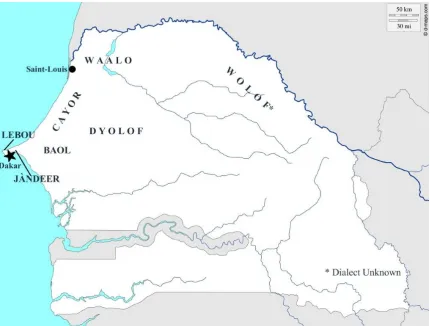
As for Wolof spoken in Senegal, Ethnologue lists five dialects: Baol, Cayor, Dyolof,
Lebou, and Jander (Lewis et al. 2014). Waalo is another dialect not mentioned by
Figure 1: Map of Wolof Dialects in Senegal
It is important to note that Lebou Wolof is not the same dialect as Dakar Wolof which
will be described next.
Another dialect which is not mentioned on Ethnologue is Dakar Wolof, also
known as Urban Wolof. Dakar Wolof is an urban dialect spoken primarily in the Dakar
region of Senegal, as the name suggests. It is characterized by borrowed lexical items,
code-switching, and reduction of the nominal class system. French, English, and Arabic
loan words are the main sources of borrowed words and expressions in Dakar Wolof. As
for syntactic characteristics, the most salient variation is the reduction in the noun class
system from fifteen classes to two classes: b- for singular nouns and y- for plural nouns.
The last dialect I would like to mention is the Wolof spoken in Saint Louis and the
Atlantic Ocean and the southern border of Mauritania. Zribi-Hertz and Diagne
characterize the Wolof of Saint Louis, in sociolinguistic terms, as “upper-class
conservative” (2002:827). They note that speakers in Saint Louis cultivate an awareness
of ‘Good Wolof’. There are fewer borrowed words than Dakar Wolof and all the noun
classes have been retained by speakers. The data analyzed in this thesis come from the
Saint Louis dialect.
Since education in Senegal takes place in French, most speakers are not literate in
Wolof. However, in recent years, there has been a significant push to integrate more
national languages into the school systems leading to Wolof and other national languages
classes being taught in schools. Publication of Wolof newspapers and books as well as
educational material and dictionaries is climbing, but still lags far behind French
publications. A standard orthography for Wolof was adopted in 1972 but spelling in
everyday contexts remains fluid. Most speakers spell phonetically using French
orthography. For example, [u] is spelled with a ‘u’ in standardized Wolof but many
people write [u] with ‘ou’ as in French. I present all data using the standard orthography
as outlined by Diouf in Dictionnaire wolof-francais (2003) and Fal (1999).
While gaining popularity among linguists, Wolof remains understudied,
particularly with regard to syntax and semantics. Recent works focusing on these areas,
such as Njie (1987), Robert (1991), Dunigan (1994), Nouguier-Voisin (2002), Russell
(2007), Torrence (2012), Martinovic (2013), and Dione (2013) have added great insight
into the language. The aim of this dissertation is to add to the study of Wolof with an in
depth treatment of its predicate argument structure. Treating all aspects of a language’s
argument structure is far too ambitious a goal for a single thesis so I will only attempt a
treatment of the argument structure of applicative predicates.
1.1. Clause Structure
There have been several syntactic treatments of Wolof in generative frameworks. Njie
(2007) describe and analyze Dakar Wolof focusing on clause structure. Torrence (2012)
and Martinovic (2013) explore the left periphery of Wolof clauses. Descriptive works on
Senegalese Wolof include Ngom (2003) and Fal (1999). Dione (2013) treats applicative
and causatives in Wolof using Lexical Functional Grammar. The rest of this section is
devoted to a brief description of Wolof. First, the basic clause structures are presented in
1.1.1. Nouns are described in 1.1.2., followed by adjectival modification in 1.1.3. The last
area of Wolof to be presented is focus and question formation in 1.1.4. Much of the
information given here is cited from Torrence (2012). Additional sources are cited when
used.
1.1.1. Clause Types
Neutral sentences in Wolof are SVO. As for verbal agreement, the verb agrees with the
subject in person and number. Agreement is not marked on the verb as affixes, rather
person and number are indicated on a subject marker that is considered an independent
word. The linear order of subject markers in relation to the verb depends on the tense,
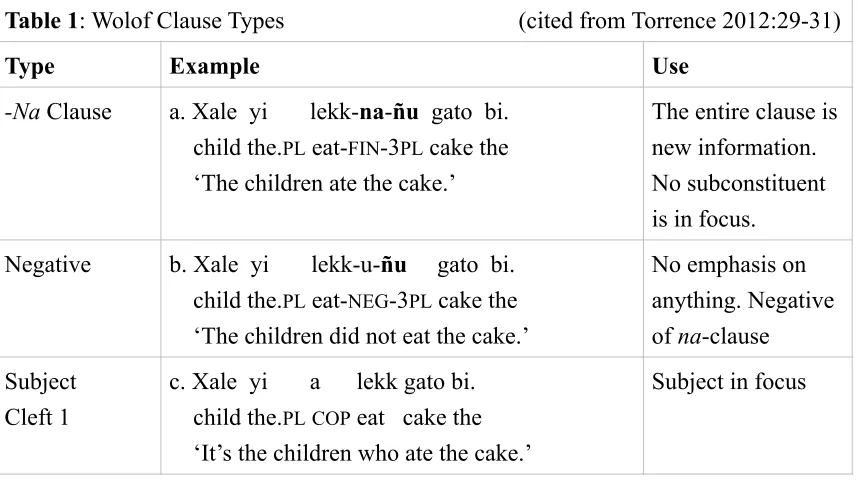
aspect, mood, negation, and clause type. A list of clause types and agreement is giving in
Table 1. There is no object agreement in Wolof.
Table 1: Wolof Clause Types (cited from Torrence 2012:29-31)
Type Example Use
-Na Clause a. Xale yi lekk-na-ñu gato bi.
child the.PL eat-FIN-3PL cake the
‘The children ate the cake.’
The entire clause is new information. No subconstituent is in focus.
Negative b. Xale yi lekk-u-ñu gato bi.
child the.PL eat-NEG-3PL cake the
‘The children did not eat the cake.’
No emphasis on anything. Negative
of na-clause
Subject Cleft 1
c. Xale yi a lekk gato bi.
child the.PLCOP eat cake the
‘It’s the children who ate the cake.’
Subject Cleft 2
d. Xale yi ñu a lekk gato bi.
child the.PL 3PL COP eat cake the
‘It’s the children who ate the cake.’
Subject in focus
Negative Subject Cleft 1
e. Xale yi a lekk-ul gato bi.
child the.PL COP eat-NEG cake the
‘It’s not the children who ate the cake.’
Negative of subject cleft
Negative Subject Cleft 2
f. D-u xale yi a lekk gato bi. IMPERF-NEG chid the.PLCOP eat cake the ‘It’s not the children who ate the cake.’
Negative of subject cleft
Non-subject Cleft
g. Gato bi l-a xale yi lekk.
cake the XPL-COP child the.PL eat
‘It’s the cake that the children ate.’
Non-subject in focus
Subjunctive h. Bëgg-na-a ñu lekk-ko.
want-FIN-1SG 3PL eat-3SG
‘I want them to eat it.’
CP complement of predicates of desire, command, wish, etc.
Adverbial i. Tusuur ñu lekk-ko.
always 3PL eat-3SG
‘They always eat it.’
CP/TPs that are introduced by certain adverbs in the left periphery
Optative j. Xale yi nañu lekk gato bi!
child the.PLOPT-3PL eat cake the
‘The children, may they eat the cake!’
Wish or desire of speaker
Negative Optative
k. Xale yi b-u ñu lekk gato bi!
child the.PL C-NEG-3PL eat cake the
‘The children, may they not eat cake!’
Wish of desire of speaker
Progressive l. Xale y-àng-i lekk gato bi.
child CL-PROG-LOC eat cake the
‘The children are eating the cake.’
Ongoing actions or current states
Subject Focus Progressive
m. Xale y-àng-ii di lekk gato bi.
child CL-PROG-LOCIMPERF eat cake the
‘It’s the children who are eating the cake.’
A detailed description of each of these clause types is not needed to understand
the data in the following chapters. I would like to take a closer look, however, at several
of these clause types because their relevance in chapters 3 and 4. The first clause type is
what Torrence calls the -na clause. Here the entire clause expresses new information. I
refer to this clause as a neutral clause rather than a -na clause. As can be seen the lexical
subject xale yi ‘the children’ precedes the verb, lekk ‘to eat’ and the subject markers
(bolded) appear after the verb and agree with the lexical subject for person and number.
I note here that the orthography I use represents the subject markers as independent
words. The clause in (1) from Torrence is given in (2) using the orthography adopted 1
here (see Fal 1999 and Diouf 2003 for more on orthography). Non-Subject
Focus Progressive
n. Gato b-àng-ii xale yi di lekk.
cake CL-PROG-LOC child the.PLIMPERF eat
‘It’s the cake that the children are eating.’
Non-subject in focus
Predicate Focus Progressive
o. Xale yi da-ñu lekk gato bi.
child the.PL do-3PL eat cake the
‘The children did eat the cake.’ ‘Eat the cake is what the children did.’
Focus on predicate or predicate (and complement) of a clause, explanation
Modal p. Ma togg-al-la ceeb bi?
1SG cook-BEN-2SG rice the
‘Should I cook you the rice?’
Request
Exclamative q. Aka mu leen dóór!
EXCL 3SG 3PL hit
‘How he hit them!’
Exclamations
Neutral clause (repeated from a. in Table 1)
(1) Xale yi lekk-na-ñu gato bi.
child the.PL eat-FIN-3PL cake the
‘The children ate the cake.’
The bound/independent status of inflectional morphemes does not affect the analysis offered and spelling
1
One final note on the Wolof examples presented in this thesis is that I do not break down
subject markers morphologically in the examples. I present them as a single unit and
gloss them simply by the person and number features and the semantic features such as
predicate focus or object focus, as seen in (2). This is not motivated by theoretical
concerns but is done for convenience.
The next clause type that will be important in this thesis is a cleft structure that is
used to focus the subject. A copular element a follows the clefted subject xale yi ‘the
children’.
A second way of forming a subject cleft is to include a subject marker that agrees
with the subject for person and number. In (4), the particle ñu reiterates the subject xale yi
‘the children’ and precedes the particle a. While not shown in Table 1, the vowel contact
between ñu+a results in the form ñoo (see Ka 1987 for more on morphophonological
patterns in Wolof).
The non-subject cleft is used to focus syntactic objects. The focused object, gato
bi ‘the cake’, appears in the sentence initial position followed by the particle la. The
(2) Xale yi lekk nañu gato bi.
child DEF1 eat 3PL cake DEF1
‘The children ate the cake.’
Subject cleft 1 (repeated from c. in Table 1)
(3) Xale yi a lekk gato bi.
child the.PL COP1 eat cake the
‘It’s the children who ate the cake.’
Subject cleft 2 (repeated from d. in Table 1)
(4) Xale yi ñu a (>ñoo) lekk gato bi.
child the.PL 3PL COP1 eat cake the
subject, xale yi ‘the children’, follows the cleft particle and the verb, lekk ‘to eat’, follows
the subject.
Progressive clauses involve a progressive morpheme in the subject marker. In (6),
the y- represents the class of the subject nominal, in this case plural. It combines with a
progressive morpheme, àng, and finally a locative morpheme -i which indicates the
proximity of the subject.
Another possibility is that yàngi is both progressive and subject focus as proposed by
Zribi-Hertz and Diagne (2002:839).They argue the -a particle marks subject focus while
-ng is the copular particle. Like Torrence, they assume -i is a locative morpheme involved
in obviation.
As mentioned earlier, the morphological division of subject markers is not crucial to a
discussion of Wolof applicatives, which are the subject matter of this thesis. I adopt
Torrence’s assertion that -a is the copular particle.
Non-subject cleft (repeated from g. in Table 1)
(5) Gato bi l-a xale yi lekk.
cake the XPL-COP child the.PL eat
‘It’s the cake that the children ate.’
Progressive with lexical subject (repeated from l. in Table 1)
(6) a. Xale y-àng-i lekk gato bi.
child CL-PROG-LOC eat cake the
‘The children are eating the cake.’
(7) y(i>a)-a -ng -i
A second way to express ongoing actions or current states is to use both a lexical
subject, xale yi ‘the children’, and a corresponding subject marker, ñu ngi as in (6). This 2
second type of progressive clause is commonly used when the subject is not focused and
is not new information. In the following example, I assume -ng as a progressive
morpheme.
I assume as well that -i is a locative morpheme that marks the proximity of the subject
since the marker can also surface as ng-a when the subject is not proximal to the speaker.
In (8) the children are close to the speaker or have been mentioned recently in the
conversation while in (9) the children are not near the speaker or were mentioned further
back in the conversation.
The last clause type I will talk about is what Torrence calls the predicate focus
progressive. I refer to it simply as predicate focus. In this clause, the subject marker is
made up of two morphemes, da- and the corresponding agreement for person and number
of the subject, -ñu in the case of (10). The subject marker precedes the lexical verb, lekk
‘to eat’.
Progressive
(8) Xale yi ñu ng-i-y lekk gato bi.
child DEF1 3PL PROG-LOC-IMP eat cake DEF1
‘The children are eating the cake.’
Progressive
(9) Xale yi ñu ng-a-y lekk gato bi.
child DEF1 3PL PROG-LOC-IMP eat cake DEF1
‘The children are eating the cake.’
Dunigan (1994) argues that in these cases, the lexical subject is in a topic position and the subject marker
2
A final note about Wolof clauses is that Wolof does not have a syntactic passive
construction (Dione 2013). Sentences with a passive interpretation are expressed using a
3SG impersonal pronoun in subject position. A more detailed description and analysis of
the different clause types are given in Torrence (2012) and Zribi-Hertz and Diagne (2002)
(see also Njie 1982, Dunigan 1994, Fal 1999, Ngom 2003, and Russell 2007 for more on
Wolof clause structure).
1.1.2. Nouns and DPs
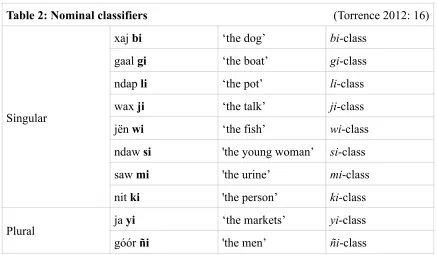
Wolof nouns are divided into nominal classes. Torrence (2012) identifies fifteen noun
classes, which he classifies into eight singular, two plural, two locative, and three
defective classes. Noun class is not marked on the noun itself but on the determiner. The
determiner is made up of a consonant that reflects the nominal class and a vowel that
expresses relative location of the noun. The singular classifiers are: b-, g-, l-, j-, w-, s-,
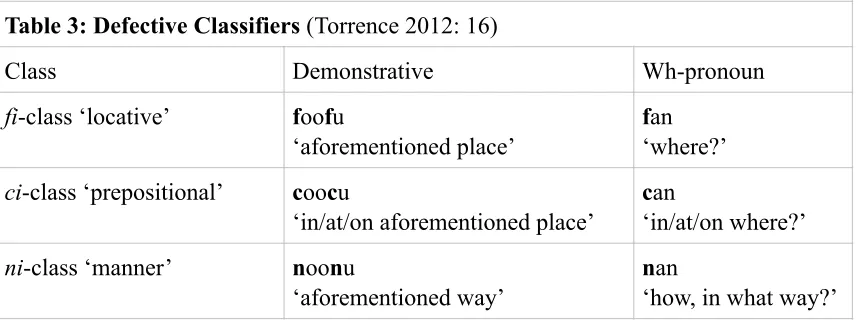
m-, k-, and the plural classifiers are: y-, ñ-. The three defective classifiers are f- (locative),
n- (manner), c- (preposition).
Predicate focus (repeated from o. in Table 1)
(10) Xale yi da-ñu lekk gato bi.
child the.PL do-3PL eat cake the
When the noun is definite, these classifiers combine with either -i or -a. When -i
is used, it indicates proximity or salience of the noun, be it conversational, physical, or
temporal. When -a is used it indicates the distance or non-salience of the noun.
Indefinite determiners consist of the vowel a- and the nominal classifier.
Table 2: Nominal classifiers (Torrence 2012: 16)
Singular
xaj bi ‘the dog’ bi-class
gaal gi ‘the boat’ gi-class
ndap li ‘the pot’ li-class
wax ji ‘the talk’ ji-class
jën wi ‘the fish’ wi-class
ndaw si 'the young woman’ si-class
saw mi 'the urine’ mi-class
nit ki 'the person’ ki-class
Plural ja yi ‘the markets’ yi-class
góór ñi 'the men’ ñi-class
(11) a. xaj b-i
dog CL-PROX
‘the dog mentioned recently (in the conversation)’ ‘the dog that is close (physically)’
‘the dog that existed recently/[currently exists]’
b. xaj b-a
dog CL-DISTAL
‘the dog mentioned a while ago (in the conversation)’ ‘the dog that is far away (physically)’
‘the dog that existed a long time ago’
Indefinite nouns can also be expressed as a bare noun or with the numeral benn ‘one’.
The defective classifiers are used only with demonstratives and pronouns.
The order of constituents within the DP is as follows.
(12) a-b xaj
a-CL dog
‘a dog’ (Torrence 2012:18)
(13) a. xaj
dog ‘a dog’
b. benn xaj
one dog
‘a dog’ (Torrence 2012:18)
Table 3: Defective Classifiers (Torrence 2012: 16)
Class Demonstrative Wh-pronoun
fi-class ‘locative’ foofu
‘aforementioned place’
fan ‘where?’
ci-class ‘prepositional’ coocu
‘in/at/on aforementioned place’
can
‘in/at/on where?’
ni-class ‘manner’ noonu
‘aforementioned way’
nan
‘how, in what way?’
Table 4 INDEFINITE DETERMINER NUMERAL POSSESSIVE PRONOUN SIMPLEX QUANTIFIER noun DEFINITE DETERMINER DEMONSTRATIVE
CREL + complement
1.1.3. Adjectives
Adjective is not a grammatical category in Wolof (McClaughlin 2004, Tamba et al.
2012). Qualitative adjectives are expressed by a relative clause containing a stative verb
that describes the property in question.
The (a) examples in (14) and (15) show a relative clause modifying an indefinite noun
while the (b) examples involve a definite noun. The complementizer in definite relative
clauses is homophonous with the definite determiner. The exact mechanics of relative
clauses in Wolof is not crucial here, so I will not look at it further. For more information
on relative clauses and adjectival modification in Wolof see Torrence (2012), McLaughlin
(2004).
1.1.4. Focus and Question Formation
Focus and wh-question formation in Wolof involve the cleft structures mentioned earlier
(see Table 1 and examples 4 and 5) (Torrence 2012, Martinovich 2013). The focused or
(14) a. bal bu mag
ball CREL be.big
‘a big ball’ (lit: a ball that is big)
b. bal bi mag
ball CREL be.big
‘the big ball’ (lit: the ball that is big)
(15) a. bal bu tutti
ball CREL be.small
‘a small ball’ (lit: a ball that is small)
b. bal bi tutti
ball CREL be.small
questioned element (underlined) is placed at the beginning of the sentence followed by
the appropriate subject marker and a copular particle, -a.
Wh-questions are types of focus constructions. I assume the focused NP/wh-phrase, if
present, is found in CP or focus position in the left periphery. For detailed descriptions
and analyses of focus and question formation see Torrence (2012) and Martinovich
(2013).
1.2. Methodology
The majority of the data presented in this thesis are new data collected in the field in
Saint Louis, Senegal. Only first language Wolof speakers who had grown up in Saint
Louis region were consulted for data collection to control for dialectal variation. A total
Subject cleft
(16) a. Ayda moo (>mu a) lekk dibi.
Ayda 3SG.COP1 eat dibi
‘It is Ayda who ate dibi.’
Non-subject cleft
b. Dibi l-a Ayda lekk.
dibi XPL-COP Ayda eat
‘It is dibi that Ayda ate.’
Subject wh-question
(17) a. Kan moo (>mu a) lekk dibi?
who 3SG.COP eat dibi
‘Who ate dibi?’
Non-subject wh-question
b. Lan l-a Ayda lekk?
what XPL-COP Ayda eat
of seven consultants responded to grammaticality judgement tasks, elicitation tasks, and
acceptability tasks. All data were verified by at least three different speakers.
Data were collected in the city of Saint Louis, Senegal, situated on the northwest coast of
Senegal just south of the border with Mauritania. The data were collected during two
research trips, totaling five months in Saint Louis during the spring and fall of 2013.
None of the consultants have any formal instruction in Wolof. Five of the seven
consultants had formal instruction in French through at least a high school level of
education. All consultants are Wolof and French bilingual speakers. The consultants
ranged in age from twenty to mid-sixties and were all male.
Data were collected using French as the metalanguage. Three types of tests were
preformed in order to target different information. Elicitation tasks, such as translations,
were used to define basic utterances and identify relevant vocabulary and grammatical
information to facilitate further testing. Once baseline sentences and structures were
established with elicitations, negative evidence was collected using grammaticality
judgements and acceptability judgements. Grammaticality judgements were used to target
syntactic constraints. Limited context was provided when presenting sentences and the
consultants were asked to judge sentences.
Grammaticality judgements show what structures are acceptable but they do not
offer much insight into the semantic information encoded in a sentence (Matthewson
2004). To target the semantics of tests sentences, acceptability tasks were used. The
acceptability tasks are similar to grammaticality judgements except that the sentence in
question is presented in a detailed context that selects for a particular semantic property
or interpretation. The consultant was then asked to rate whether the sentence was
appropriate within the provided context. Contexts were presented as verbal descriptions,
1.3. Overview of Thesis
The rest of the thesis is organized as follows. Chapter 2 offers a general description of
applicative structures and gives an overview of some of the major analytical approaches
for applicatives. Previous research published on Wolof applicatives will be presented at
the end of chapter 2. Chapter 3 focuses on the description and analysis of benefactive and
dative applicatives. Instrumental and locative applicatives and their analysis are the
Chapter 2
2. APPLICATIVES: THEORETICAL BACKGROUND
Applicatives are of interest to linguists because of the particular challenges they pose for
syntactic theory. Early formal approaches to applicative sentences attempted to elucidate
a single structure from which all types of applicatives arise (Baker 1988, 1992, Larson
1988, Marantz 1993). More recent proposals (McGinnis 2005, Pylkkänen 2008, Georgala
2012) involve multiple structures for different types of applicatives. Such approaches
have many advantages over more traditional, single structure approaches, but still fail to
account for the full range of applicative variation exhibited. I maintain that a subtler
approach is needed, involving unique structures for different types of applicatives, based
on a detailed exploration and analysis of Wolof applicatives. The need for different
structures casts doubt on treating applicatives as a construction because although they
share descriptive similarities (adding an argument), structurally they are quite different. I
assume that “applicative” refers to a class of descriptively similar structures. Note that
this assumption fits within the Minimalist approach to syntactic theory, where we have
moved away from constructions in an attempt to find the primitive components of the
grammar.
In this chapter, I present an overview of applicatives and their properties using
examples from various languages. Applicatives are grouped into types based on the theta
role of the applied object (e.g. benefactive, dative, instrument, locative, reason, etc.).
Cross-linguistically, these different applicatives tend to show common patterns of
behaviour in relation to object properties and syntactic configuration. Differences in
behaviour are also discussed and provide motivation for classifying applicatives by type
rather than assuming a single applicative construction. I then turn to theoretical work on
applicatives and then review several previous analyses of Wolof applicatives. Building
propose different structures for the different applicatives found in Wolof. These structures
will be motivated and discussed in more detail in chapters 3 and 4.
2.1. Applicatives
The term applicative refers to verb forms in which the verbal valency has been increased 1
by one. Payne (1997) defines an applicative as “... a valence increasing operation that 2
brings a peripheral participant onto center stage by making it into a direct object. The
‘new’ direct object is sometimes referred to as the applied object (186).” This is
illustrated in English in examples (1-3) below. The first sentence shows an example of the
transitive, non-applicative, use of write. The sentence in (2) shows an applicative in
English with the same verb. The sentence now contains two objects, Sam, the recipient,
and a letter. The sentence in (3) has two complements like the applicative version in (2)
Sam and a letter, but the recipient is contained in a prepositional phrase. I call examples
like (3) prepositional complement sentences.
(1) Bill wrote a letter.
(2) Bill wrote Sam a letter.
(3) Bill wrote a letter toSam.
I note here that the term ‘applicative’ is at times confused with the term ‘double
object construction’. While the two are sometimes used interchangeably, there is an
important distinction between them. A double object construction involves two direct
objects associated with a single predicate, as seen in (4). It is also an applicative by
definition since the valency of the verb bake has increased by one from “Bill baked a
cake.”.
‘Applicative’ is also used to refer to sentences that contain an applicative verb. Note that ‘verb forms’
1
does not necessarily mean that applicative forms are morphological distinct from non-applicative forms. In some languages, like English, there is no overt change in verb form.
I exclude causative constructions from the discussion of applicatives, even though they technically fall 2
(4) Bill baked Sarah a cake.
The valency increase of an intransitive verb, however, does not lead to a sentence with
two objects so it can’t be called a double object construction. The term applicative still
correctly qualifies the sentence in (5b) and others like it, as a valency increase has
occurred between (5a) and (5b) even though there is only one object present, Katonga.
In other words, double object constructions are applicatives, but not all
applicatives are double object constructions. Note that I consider lexically ditransitive
verbs, like give, as applicatives. This is not an obvious conclusion since the valency of
the verb has not increased. Ditransitive verbs, like give, cannot be used intransitively, and
strongly resist even transitive usage. Nevertheless, the second half of Payne’s definition
does describe ditransitive verbs in double object constructions because the indirect object
has been metaphorically moved from a peripheral position within the PP, (6a), to a direct
object, (6b).
(6) a. I give presents to the children.
b. I give the children presents.
It is important to note that I do not assume that the sentence in (b) is derived from (a)
unlike Larson proposes (1988). They involve different derivations and structures
following Marantz (1993) and Harley (2002). Predicates like these which involve a
non-morphologically marked applied object are called valency-preserving (Creissels 2004). Luganda
(5) a. Mukasa ya-tambu-dde
Mukasa 3SG.PST-walk-PST
‘Mukasa walked.’
b. Mukasa ya-tambu-le-dde Katonga.
Mukasa 3SG.PST-walk-APPL-PST Katonga
Now that applicative sentences have been briefly described, I turn to a discussion
of generally recognized properties of applicatives.
2.1.1. Typology
Cross-linguistically, applicatives are found in languages from all over the world. They
are common in three geographical areas: Africa, the western Pacific region, and the
Americas according to the World Atlas of Language Structures Online (Polinsky 2013).
There is quite a bit of variation within applicative sentences. There are multiple ‘flavors’
of applicatives based on the thematic role of the applied object, such as benefactive, goal,
instrumental, locative, and reason. The inventory of which applicatives are available
depends on the language in question. In some languages, applicatives are very productive
and can express multiple theta roles, like Bantu languages, while in others, like English,
applicatives are more constrained.
In English, applicatives have limited productivity: benefactive or recipient/source
arguments can be expressed as a direct object but only with a certain class of verbs, those
which convey a transfer of possession, like give, send, sell, write. The sentence in (7a)
shows an applicative with a recipient applied object, Sam, and (7b) shows a benefactive
object, Sarah. Note that in both sentences the possession of the theme objects, a letter
and a cake, is transferred to the applied object.
(7) a. Bill wrote Sam a letter.
b. Bill baked Sarah a cake.
Since both applicatives express a transfer of possession, I call them dative applicatives. 3
Examples of dative applicatives from other languages are given in (8) - (12). Greek,
Basque, and Albanian examples are similar to English in that there is no overt applicative
marker attached to the verb.
This type of applicative has been called ditransitive or possessor dative, although the exact terminology
3
Some languages, like Mandarin, on the other hand, require an additional
morpheme, like gĕi, in applicative sentences. If gĕi is missing, the sentence is
ungrammatical (12b).
Greek
(8) O Nikos edhose tis Marias ena vivlio.
the.NOM Nick.NOM gave.3SG the.GEN Mary.GEN a.ACC book.ACC
‘Nick gave Mary a book.’ (Georgala 2012:104)
Basque
(9) Jonek Norari liburua ekarri dio.
J-ERG N-DAT book-ABS bring AUX1
‘Jon brought Nora the book.’ (Oyharçabal 2010:235)
Albanian
(10) Agimi i mban Drites çanten time.
Agim.NOM CL holds Drita.DAT bag.ACC my
‘Agim holds my bag for Drita.’ (Pylkkänen 2008:21)
Kinyarwanda
(11) Umugóre y-iim-ye ábáana ibíryo.
woman she-refuse-ASP children food
‘The woman refused food to the children.’ (Kimenyi 1980:31)
Mandarin
(12) a. Wŏ mài-gĕi-le Măli yī-ge shŏubiăo.
1SG sell-GEI-PERF Mali 1-CL watch
‘I sold Mali a watch.’ (cited from Georgala 2012)
b. *Wŏ mài-le Măli yī-ge shŏubiăo.
1SG sell-PERF Mali 1-CL watch
‘I sold Mali a watch.’
While in English only dative applicatives are possible, in other languages,
applicative sentences can express a wide range of theta roles as seen in Chaga (13) and
Ndendeule (14).
Some languages allow an applied object with intransitive verbs, like
Kinyarwanda. A locative applied object, intebe ‘chair’ has been added to the intransitive
Benefactive applicative - Chaga
(13) a. N-a-i-lyi-i-a m-ka k-elya.
FOC-SP-prs-eat-APPL-FV wife food
‘He is eating food for his wife.’
Instrumental applicative - Chaga
b. N-a-i-lyi-i-a ma-woko k-elya.
FOC-SP-prs-eat-APPL-FV hand food
‘She is eating food with her hands.’
(Marantz 1993:121-122)
Malefactive applicative - Ndendeule
(14) a. ma-yani γa-ki-βa-yͻmͻ-εl-a ma-chi βa-lumba.
6-baboon 6SA-PST-break-APP-FV 6-water 2-hunter
‘The baboons finished the hunter’s water.’
Locative applicative - Ndendeule
b. βa-lumba βa-ki-tul-il-a nyama pa-manyahi.
2-hunter 2-PST-skin-APP-FV 9.animal 16-grass
‘The hunters skinned the animal on the grass.’
Reason applicative - Ndendeule
c. m-wana a-ki-lel-el-a ki-hembe.
1-child 1SA-PST-cry-APP-FV 7-knife
‘The child cried for a knife.’
verb iica ‘sit’ in (15). A benefactive object has been applied to the intransitive verb kor
‘work’ in (16).
In some languages, applicatives can be iterated. The sentence in (17) has a
locative applied object, intebe ‘chair’, and a benefactive applied object, umugabo ‘man’.
Additionally, there are two applicative suffixes attached to the verb, -i for the benefactive
and -ho for the locative.
In (18), there are three objects, a benefactive object umugóre ‘woman’, a dative
object ábáana ‘children’, and a theme object ibíryo ‘food’. Only one applicative
morpheme appears on the verb and it is associated with the presence of the benefactive
object.
Locative applicative - Kinyarwanda
(15) Umugabo y-iica-yé-ho íntebe.
man he-sit-ASP-on chair
‘The man is sitting on the chair.’ (Kimenyi 1980:38)
Benefactive applicative - Kinyarwanda
(16) Umugóre a-rá-kor-er-a umugabo.
woman she-PRES-work-APPL-ASP man
‘The woman is working for the man.’ (Kimenyi 1980:32)
Locative and benefactive applicative - Kinyarwanda
(17) Úmwáana y-iicar-i-yé-ho íntebe umugabo.
child he-sit-APPL-ASP-LOC chair man
‘The child is sitting on the chair for the man.’ (Kimenyi 1980:113)
Triple object construction - Kinyarwanda
(18) Umukoôbwa a-rá-hé-er-a umugóre ábáana ibíryo.
girl she-PRES-read-APPL-ASP woman children food
Predicates with dative objects in Kinyarwanda don’t show overt morphology, similar to
English, Greek, and Albanian applicatives. Recall from section 2.1. that I assume double
object constructions with or without overt applicative morphology are applicatives so the
sentence in (18) involves two applicative heads, dative and benefactive, only one of
which is overtly realized.
From this brief survey, we see applicatives can express a variety of theta roles
including dative (recipient or source), benefactive, instrumental, locative, and reason.
They can be signaled by overt or null morphology and they are compatible with transitive
and intransitive predicates. In the next section, I focus on the object properties of
applicatives.
2.1.2. Object properties
Object properties are often a starting point for applicative research. Researchers attempt
to determine to what extent the objects in applicative sentences show similar syntactic
properties as “normal” direct objects (e.g. of a monotransitive verb). Common object
properties are passivization, pronominalization, and adjacency to the verb. In applicatives
that have two objects, one or both objects can have object properties depending on the
language and applicative type in question. When both objects display object properties,
the applicative is classified as symmetrical. When only one object has direct object
properties, the applicative is classified as asymmetrical. In the literature, people often
refer to the languages themselves as symmetrical or asymmetrical (see Bresnan and
Moshi 1990, Ngonyani 1996, 1998) but looking at the full range of data this classification
is not entirely accurate. As will be seen in this section, some applicative types in certain
languages show symmetrical properties while other types in the same language show
asymmetrical properties. This mixed behaviour is particularly relevant to the discussion
2.1.2.1. Passivization
One test for objecthood is passivization. If an argument can be made the subject of a
passive sentence, it behaves like a direct object. In symmetrical applicatives, either object
can be the subject of a passive while in asymmetrical ones only one object can be.
English, for example, only allows the applied object, Jill, to become the subject of a
passive sentence (19b). The direct object, a cake, cannot be the subject of a passive
applicative sentence, (19c); it loses its object properties when the applied object is
present.
(19) a. Mary baked Jill a cake.
b. Jill was baked a cake (by Mary).
c. *A cake was baked Jill (by Mary). 4
Compare this to the prepositional complement sentence in which the theme, a cake, can
be the subject of a passive and the benefactive object, Jill, cannot.
(20) a. A cake was baked for Jill (by Mary).
b. *Jill was baked a cake for (by Mary).
In (19), we saw in English that the applied object acts like a direct object rather than
oblique objects, while the original direct object, the theme, no longer exhibits object
properties as it does in the prepositional complement sentence in (20).
In some languages, however, both objects in applicatives can be the subject of a
passive sentence. Kinyarwanda has symmetrical applicatives that allow either object to be
the subject of a passive sentence. Example (21a) involves two applied objects, a
benefactive umugabo ‘man’ and a dative ímbwa ‘dog’,resulting in a total of three direct
objects. Symmetry is shown because the subject position can be filled by any one of the
three objects in a passive, as shown in (b-d).
In certain dialects of English, theme passivization is acceptable.
As mentioned earlier, I do not classify Kinyarwanda as a symmetrical language
because there is variation based on the type of applicative sentence. Locative applicatives
do not show symmetrical behaviour like the benefactive applicative in (21). In locative
applicatives, only the applied object can raise to subject position (22a). The theme cannot
be the subject of a passive sentence (22b).
Active sentence
(21) a. Umugóre a-rá-hé-er-a umugabo ímbwa ibíryo.
woman she-PRES-give-APPL-ASP man dog food
‘The woman is giving food to the dog for the man.’
Passive - Benefactive subject
b. Umugabo a-rá-hé-er-w-a ímbwa ibíryo n’ûmugóre.
man she-PRES-give-APPL-PASS-ASP dog food by.woman
lit:’The man is given food to the dog by the woman.’ (The man benefits
from the woman giving food to the dog.”
Passive - Dative subject
c. ímbwa i-rá-hé-er-w-a umugabo ibíryo n’ûmugore.
dog she-PRES-give-APPL-ASP man food by.woman
‘The dog is given food for the man by the woman.’
Passive - Theme subject
d. ibíryo bi-rá-hé-er-w-a umugabo ímbwa n’ûmugore.
food she-PRES-give-APPL-ASP man dog by.woman
‘The food is given to the dog for the man by the woman.’
(Kimenyi 1980: 65-66)
Passive - locative subject
(22) a. Umwaana y-a-menn-w-e-ho amaazi n’umubooyi.
child SP-PST-pour-PASS-ASP-APPL water by.cook
For this reason, I classify applicative types based on their symmetrical or
asymmetrical properties, rather than classifying them by languages. In English, which
only have one type of applicative, they are asymmetrical. In Kinyarwanda, benefactive
and dative applicatives are symmetrical while locative applicatives are asymmetrical.
2.1.2.2. Pronominalization
The second object property under consideration is the pronominalization of objects using
a verbal clitic or affix. In Bantu languages, like the Kinyarwanda example in (23),
pronominalization is generally called ‘object marking’ and involves a prefix (underlined)
attached to the verb. The pronominal prefix matches the noun it replaces for noun class.
Passive - theme subject
b. *Amaazi y-a-menn-w-e-ho umwaana n’umubooyi.
water SP-PST-pour-PASS-ASP-APPL child by.cook
‘The water was poured on the child by the cook.’
(Zeller and Ngoboka 2006:102)
(23) a. Umugóre a-rá-bi-he-er-a umugabo ímbwa
woman she-PRES-it-give-APPL-ASP man dog
‘The woman is giving it to the dog for the man.’
b. Umugóre a-rá-yi-he-er-a umugabo ibíryo.
woman she-PRES-it-give-APPL-ASP man food
‘The woman is giving food to it for the man.’
c. Umugóre a-rá-mu-he-er-a ímbwa ibíryo.
woman she-PRES-him-give-APPL-ASP dog food
‘The woman is giving food to the dog for him.’
Symmetrical applicatives allow both, or all, the objects to be pronominalized
using verbal prefixes, as in (23), while asymmetrical applicatives only allow one. For
example, in Kiswahili, the benefactive object can be marked but not the theme object.
As with passivization, pronominalization shows that Kinyarwanda locative applicatives
are asymmetrical. The applied object can be marked on the verb but not the theme.
The pronominalization test will show that like Kinyarwanda, Wolof has both
symmetrical and asymmetrical applicatives (see chapters 3 and 4).
Kiswahili - Benefactive object agreement
(24) a. Juma a-li-wa-let-e-a wa-toto mw-alimu.
Juma 1-PST-1-bring-APP-FV 2-child 1-teacher
‘Juma brought the teacher for the children.’ (Ngonyani 1998:84)
Kiswahili - Theme object agreement
b. *Juma a-li-m-let-e-a mw-alimu wa-toto.
Juma 1-PST-1-bring-APP-FV 1-teacher 2-child
‘Juma [brought] the teacher for the children.’ (Ngonyani 1998:86)
Kinyarwanda - locative object marking
(25) a. Umubooyi y-a-mu-menn-ye-ho amaazi.
cook SP-PST-OM-pour-ASP-APPL water
‘The cook poured water on him/her.’
Kinyarwanda - theme object marking
b. *Umubooyi y-a-ya-menn-ye-ho umwaana.
cook SP-PST-OM-pour-ASP-APPL child
‘The cook poured it on the child.’
2.1.2.3. Word Order
Asymmetrical applicatives, like those found in English and Kiswahili, only allow one
object, the dative/benefactive object, to appear adjacent to the verb. Julie cannot follow a
car as seen by the ungrammaticality of (26b). The same is true for the benefactive object,
ma-gazeti ‘papers’, in (27b).
(26) a. Sally sold Julie a car.
b. *Sally sold a car Julie.
On the other hand, symmetrical applicatives, as illustrated in the examples below
from Kikuyu, allow either object to appear adjacent to the verb. The benefactive object in
(28) ciana ‘children’ can precede or follow the theme, mũbira ‘ball’.
Kiswahili - Benefactive - theme order
(27) a. Juma a-li-chor-e-a ma-gazeti picha.
Juma 1-PST-draw-APPL-FV 6-paper 10.picture
‘Juma drew pictures for papers.’
Kiswahili - Theme - benefactive order
b. *Juma a-li-chor-e-a picha ma-gazeti.
Juma 1-PST-draw-APPL-FV 10.picture 6-paper
‘Juma drew pictures for papers.’
(Ngonyani 1998:81)
Kikuyu - Benefactive > theme order
(28) a. Mũ-geni a-ra-gũ-ĩ-ire ci-ana mũ-bira.
1-guest 1SA-PRG-buy-APPL-PF 8-child 3-ball
In Kinyarwanda instrumental applicatives either the theme or instrument is allowed to be
adjacent to the verb as in Kikuyu but locative applicatives have fixed word order like
English and Kiswahili.
Kikuyu - Theme > benefactive order
b. Mũ-geni a-ra-gũ-ĩ-ire mũ-bira ci-ana.
1-guest 1SA-PRG-buy-APPL-PF 3-ball 8-child
‘The guest bought a ball for the children.’
(Ngonyani and Githinji 2006:35)
Instrumental applicative - theme > instrument order
(29) a. Umugabo y-a-tem-eesh-eje igiti umuhoro.
man SP-PST-cut-APPL-ASP tree machete
‘The man cut the tree with the machete.’
Instrumental applicative - instrument > theme order
b. Umugabo y-a-tem-eesh-eje umuhoro igiti.
man SP-PST-cut-APPL-ASP machete tree
‘The man cut the tree with the machete.’
(Zeller and Ngoboka 2006:117)
Locative applicative - locative > theme order
(30) a. Umubooyi y-a-menn-ye-ho umwaana amaazi.
cook SP-PST-pour-ASP-APPL child water
‘The cook poured water on the child.’
Locative applicative - theme > locative (Zeller and Ngoboka 2006:108)
b. *Umubooyi y-a-menn-ye-ho amaazi umwaana.
cook SP-PST-pour-ASP-APPL water child
‘The cook poured water on the child.’
Word order shows that some applicatives in Kinyarwanda are symmetrical (e.g.
instrumentals) while others (e.g. locatives) are asymmetrical. A similar pattern will be
seen in Wolof applicatives in chapters 3 and 4.
2.1.2.4. Extraction
A third property, A-bar extraction, provides useful information about the objects in
applicatives. In English, the theme object what in (31a) is questioned, and the sentence is
acceptable. In (31b) the sentence’s acceptability is degraded when the dative object, who,
is questioned. Extraction thus shows the English applicative to be asymmetrical, just as
we have seen above.
(31) a. What did you give Julie?
b. ?Who did you give books?
In symmetrical applicatives, either object can be extracted. For example in Kiswahili, the
instrument can be questioned as in (32a) or the theme can be questioned like in (32b).
The wh-word, nini ‘what’, remains in situ but assuming wh-movement is required at LF
for interpretation (Huang 1982), these are still cases of A-bar extraction.
As with the other object properties, an object’s accessibility for extraction
sometimes depends on the type of applicative sentence as seen in Kinyarwanda (33) and
Instrument questioned - Kiswahili
(32) a. wa-toto wa-li-vunj-i-a nini ch-ungu?
2-child 2-PST-break-APP-FV what 7-pot
‘What did the children break the pot with?’
Theme questioned - Kiswahili
b. wa-toto wa-li-vunj-i-a nini ma-we?
2-child 2-PST-break-APP-FV what 6-rock
‘What did the children break with the rocks.?’
(34). Either object can be extracted in dative applicatives. In (33) the theme, igitabo
‘book’, has been relativized. In (34), the dative object, umukoôbwa ‘girl’ has been
relativized.
Kinyarwanda locative applicatives, however, do not allow the theme to be extracted, only
the locative object. The sentence in (35) is ungrammatical because the theme object,
igitabo ‘book’, has been relativized while relativizing the locative object in (36), ishuûri
‘school’, is grammatical.
Kinyarwanda - Theme extracted
(33) N-a-boon-ye igitaboi [umuhuûngu ya-a-haá-ye umukoôbwa ti].
SP-PST-see-ASP book boy SP-PST-REL.give-ASP girl
‘I saw the book [that the boy gave to the girl].’ (McGinnis 2001:15)
Kinyarwanda - Dative extracted
(34) N-a-boon-ye umukoôbwai [umuhuûngu y-a-haá-ye ti igitabo].
I-PST-see-ASP girl boy he-PST-REL.give-ASP book
‘I saw the girl to whom the boy gave the book.’ (Kimenyi 1980:68)
Theme extracted from locative applicative - Kinyarwanda
(35) *y-a-tw-eerets-e igitaboi [úmwáalímu y-oóhere-jé-ho ishuûri ti].
SP-PST-OP-show-ASP book teacher SP-REL.send-ASP-APPL school
‘He showed us the book [that the teacher sent to school].’ (McGinnis 2001:15)
Locative extracted
(36) Umugabo y-a-tw-eerets-e ishuûrii [úmwáalímu y-oóhere-je-ho…
man SP-PST-OP-show-ASP school teacher SP-REL.send-ASP-APPL
ti igitabo].
book
‘The man showed us the school to which the teacher sent the book.’
The data once again indicate that both symmetrical and asymmetrical applicatives exist in
the same language. Languages are not necessarily symmetrical or asymmetrical. Rather
symmetrical or asymmetrical classification is better applied to applicative types
themselves.
2.1.3. C-command
A second issue for applicative research is the structural relationships between the objects.
Tests sensitive to c-command are often used for exploring structural relationships
between items. In applicatives, previous research has shown the objects have an
asymmetrical c-command relationship, where one of the objects c-commands the other.
Whether the applied object c-commands the theme or vice-versa depends on the language
and the type of applicative in question.
Looking at data from quantifier binding in English applicatives, a quantified
dative object, like every worker, can bind an anaphor within the theme (37a) but the
theme, every paycheck, cannot bind an applied dative (37b).
Quantifier Binding - Applicative
(37) a. I sent every workeri hisi paycheck. Applied > Theme
b. *I sent itsi owner every paychecki.
In the prepositional complement construction (38), a quantified DO, every check, can
bind an anaphor in the PPIO (38a) but the PPIO, to every worker, cannot bind a DO (38b).
Quantifier Binding - Prepositional Complement Construction
(38) a. I sent every checki to itsi owner. Theme > Applied
b. ??I sent hisi paycheck to every workeri.
Similar patterns obtain for other c-command tests (39-48), as shown by Barss and Lasnik (1986) and Larson (1988) (examples taken from Larson 1988:336-338).
Anaphor Binding - Applicative
b. *I showed herself Mary.
Anaphor Binding - Prepositional Complement Construction
(40) a. I showed Mary to herself. Theme > Applied
b. *I showed herself to Mary.
Weak Crossover - Applicative
(41) a. Which manidid you send hisi paycheck? Applied > Theme
b. *Whosei pay did you send hisimother?
Weak Crossover - Prepositional Complement Construction
(42) a. Which checki did you send to itsi owner? Theme > Applied
b. *Which workeri did you send hisi check to?
Superiority - Applicative
(43) a. Who did you give which paycheck? Applied > Theme
b. *Which paycheck did you give who?
Superiority - Prepositional Complement Construction
(44) a. Which check did you send to who? Theme > Applied
b. *Whom did you send which check to?
Each...the other - Applicative
(45) a. I showed each man the other’s socks. Applied > Theme
b. *I showed the other’s friend each man.
Each...the other - Prepositional Complement Construction
(46) a. I sent each boy to the other’s parents. Theme > Applied
b. *I sent the other’s check to each boy.
Negative Polarity Items - Applicative
(47) a. I showed no one anything. Applied > Theme
b. *I showed anyone nothing.
Negative Polarity Items - Prepositional Complement Construction
(48) a. I sent no presents to any of the children. Theme > Applied
b. *I sent any of the packages to none of the children.
Not all of these tests are amenable to applicatives in other languages. Negative polarity
superiority effects. Quantifier binding is one test that lends itself well to other languages
(Marantz 1993) and is often used in applicative research. I present the relevant data
below.
Looking at a range of languages, benefactives and datives typically c-command
theme objects, as in the English examples. In Swahili, quantifier binding shows the
applied object asymmetrically c-commands the theme. The applied object kila mwandishi
‘each other’ binds the anaphor chake ‘his’ in the theme object, (49a). The quantified
theme in (48b), however, cannot bind the anaphor, wake ‘its’, in the applied object.
Instrumental applicatives in Kinyarwanda, however, show that the applied object does not
always c-command the theme. A quantified theme object, buri muryango ‘each door’ in
(50a), can bind an anaphor in the applied instrumental object, rwáwo ‘its’, but not
vice-versa.
Quantifier binding - Swahili
(49) a. Ni-li-m-som-e-a [kila mwandishi]i kitabu chakei.
SP-PST-OP-read-APPL-FV each author book his
‘I read each author his book.’
b. *Ni-li-m-som-e-a [kila kitabu]i mwandishi wakei.
SP-PST-OP-read-APPL-FV each book author its
‘I read for its author each book.’
(Marantz 1993:117)
Quantifier binding - Kinyarwanda
(50) a. N-a-fúngul-ish-ije buri muryangoi úrufunguzo rwáwoi.
I-PST-open-APPL-ASP each door key its
C-command tests show the applied object usually c-command the theme object but there
are exceptions, like instrumental applicatives in Kinyarwanda.
2.1.4. Summary
Given the inter- and intralinguistic variation in applicative sentences, it is important to
identify which types of applicatives are present in a language (e.g. benefactive,
instrumental, locative, etc.), what the properties of the objects are (e.g. symmetrical or
asymmetrical), and which object c-commands the other. Applicatives do not always show
the same properties or c-command, even within the same language as illustrated by
Kinyarwanda.
2.2. Syntactic Approaches
The goal of any formal syntactic analysis of applicatives is to account for the presence of
an additional direct object, (e.g. its selection and Case), the objects’ properties (e.g.
extraction, passivization, object marking, and word order), and the structural relationship
between the objects (e.g. binding, wh-movement, superiority, negative polarity items,
reciprocalization and reflexivization). There are many proposals available in the literature
to account for applicatives and their properties. I start with a very brief overview of
pre-Minimalist approaches to applicatives (traditionally called double object constructions)
before turning in more detail to more recent proposals.
2.2.1. Issues in applicative research
What is challenging about applicatives is the presence of an additional object. Starting
with a transitive verb, the resulting applicative will have two ‘direct objects’. Starting
with an intransitive verb, the applicative will have one direct object. Major questions for
b. *N-a-fúngul-ish-ije umuryano wáyoi buri rufunguzoi.
I-PST-open-APPL-ASP door its each key
‘I opened itsi door with each keyj/*i.’
applicative analysis are where is this additional object in the structure and how does it get
there. Early generative approaches assumed a ternary structure in which both objects
were sisters to each other and the verb (Baker 1988).
(51)
However, a ternary branching structure is problematic for theoretical and empirical
reasons. First, developments in Minimalist syntactic theory do not support a ternary
branching structure analysis for any type of sentence. Following Kayne (1984), binary
branching structures were adopted by many as the only possible type of structure in
generative syntax. Binary branching structure prevents both objects from simultaneously
being sisters of the verb. One object would necessarily be higher than the other.
(52) a. b.
Empirical evidence supports a structure in which the objects are not sisters.
C-command data show an asymmetry between the two objects. The applied object typically
c-commands the theme object, as shown in section 2.1.3. The structure in (51) is ruled
out because it predicts mutual c-command between the objects and (52a) is ruled out
because it predicts the second object will c-command the first. In English, however, the
first object commands the second. As for the structure in (52b), the first object
c-commands the second, which matches the empirical data but we will see that it is unable