Available online: https://edupediapublications.org/journals/index.php/IJR/ P a g e | 2300
Enhancing Technical School students’ Interest in Electricity using
E- learning teaching activities in Benue state.
Fatoki, Joseph Olaiya1*, Iji, Clement Onwu1, Adejo, Musa James1, and Egbe-Okpenge, Enecheho G1.
1Department of Science Education, Federal University of Agriculture, Makurdi, Nigeria.
ABSTRACT
The study determine the impact of e-leaning teaching activities on the interest of technical school students in electricity, the study involves 724 part II students consisted of 543 male and 181 female students. Two research questions and two hypotheses were asked and formulated respectively. The electricity interest inventory was used to collect data with two lesson plans of which one was for the experimental group and one for control group. Two research questions were answered using the mean and standard deviation. The hypotheses were tested at 0.05 level of significance using analysis of covariance. The results from the study revealed that students exposed to the ELTA showed greater interest in electricity contents than those taught with lecture method. It also revealed that there was no significant difference in the mean interest scores of male and female technical school students. The study recommended this approach to be adopted in schools and the training of teachers in every subject area.
Key words: E- learning, Electricity, Interest, Teaching activities.
Introduction
Interest is very much important in that it need to do with human attitude, his/her action and reaction to issues, how committed he/she is to
such issues. According to Harbor-Peter (2001), interest is a subjective feeling of intentness or curiosity over something. It is the preference for particular types of activities that is the tendencies to look out for and participate in certain activities (Agwagh in Harbor-Peter, 2002). In most cases any subject of better performance show the intensity of self interest. The poor achievement in Physics especially on electricity as reported by the Chief Examiner report, (NABTEB, 2010/2011), may be indicative of the lack of interest by students. The body also reported that majority of the candidates failed to recognize the relationship between resistance and the balance lengths on the meter bridge wire and candidates wrongly stated the definition of certain concepts: an example is the definition of a junction as a point where two or more current meet instead of a junction is a point where three or more wires meet. These weaknesses are evidence that students have difficulties in understanding concepts in Electricity.
Available online: https://edupediapublications.org/journals/index.php/IJR/ P a g e | 2301
The more important task is to insightfully design learning approach and activities that start with students’ viewpoint rather than the teacher’s anticipation to foster conceptual change (Olubunmi, 2006). Ada (2010) advised that teachers should evolved, the approach that involved learner’s active participation that will generate interest in the students rather than the traditional methods. The Registrar and chief executive of NABTEB reports consistently revealed the poor achievement of the students in Electricity as a result of lack of interest in physics. The purpose of this study was to ascertain the efficacy of E-learning teaching activities when used to teach technical school students on the concept of electricity. Hence, the researcher sought to explore the e-learning teaching activities whether it would arouse
technical school student’s interest.
Research Questions
The study was guided by the following research questions:
(i) What are the mean interest ratings of technical school students taught electricity using ELTA and those taught with lecture Method? (ii) What are the mean interest ratings of male and female technical school students taught electricity using ELTA?
Research Hypotheses
The following hypotheses were formulated and tested at 0.05 level of significance:
1. There is no significant difference
between the mean interest ratings of technical school students taught electricity using e-Learning teaching activities and those taught using lecture method.
2. There is no significant difference in
the mean interest ratings of male and female technical school students taught electricity using ELTA.
Methodology Study Area
This study focused on the part II students of the Technical Schools in Education zone B of Benue State, Nigeria. The study was carried out in Benue State, Nigeria. The state is made up of three educational zones, A, B, and C with twenty three local Governments areas as follows, Zones A (7), B (7), and C (9). The specific area of study is zone B where interest of students in physics in the technical schools is generally poor (Benue State Examination Board, 2015) where there exist better populated and more Technical Colleges in this zone than any other in the state. The population of the study consist 724 part II Students in Education Zone B in the 2013/2014 academic session. This number is made up of 543 males and 181 females.
Experimental Design
This study adopted a quasi-experiment design of
non-randomized group pretest-posttest design of non-equivalent
group.
Instruments for Data Collection
Available online: https://edupediapublications.org/journals/index.php/IJR/ P a g e | 2302
items and revised is the case for a negative item. The options were scored using four points scale. The reliability coefficient of EII as computed, using Cronbach Alpha, was 0.864.The reliability coefficient of EII was above 0.70 which means the instrument was reliable.
Method of Data Analysis
Means and standard deviations were used to answer the research questions. Analysis of Covariance (ANCOVA) was used to test the hypotheses at 0. 0 5 level of Significance. Results
The result of Table 1which answered research question one had revealed that the pretest mean interest ratings of both experimental and control
groups were 43.60 and 41.15 while the standard deviations were 5.59 and 4.14 respectively. The mean difference of both groups before the commencement of treatment was 2.45, Showing that the subject of study was at the same level of ability before the commencement of the study.
Also, the posttest mean interest rating for experimental groups was 90.28 and standard deviation was 9.33 while control group had the mean interest ratings of 66.65 and standard deviation of 10.23. The mean difference was 23.63, which showed that there was an improvement in the interest of the Technical Schools Students in Electricity.
Table 1: Mean Interest rating of Technical Schools Students in E- Learning
Teaching Activities and Lecture Method.
Source N Pre-test Post-test
𝑿 SD 𝑿 SD
Experimental Group
81 43.60 5.59 90.28 9.33
Control Group 142 41.15 4.14 66.65 10.23
Mean difference 2.45 23.63
Total 223
Available online: https://edupediapublications.org/journals/index.php/IJR/ P a g e | 2303
Table 2: ANCOVA, Result of Technical Schools Students’ interest ratings in Learning Teaching Activities and Lecture Method.
Source
Type III Sum of
Squares Df Mean Square F Sig.
Corrected Model 45230.364a 2 22615.182 941.579 .000
Intercept 2.712 1 2.712 .113 .737
PreTestIntTotal 16432.521 1 16432.521 684.165 .000
Group 17795.808 1 17795.808 740.925 .000
Error 5284.040 220 24.018
Total 1312852.000 223
Corrected Total 50514.404 222
a. R Squared = .895 (Adjusted R Squared = .894)
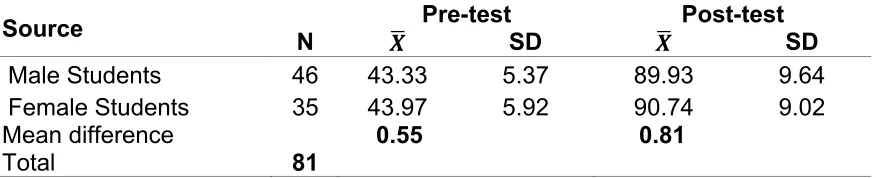
The results of Table 3 which answered research question two had revealed that the pretest mean interest ratings of both male and female students were 43.34 and 43.97 while the standard deviations were 5.37 and 5.92 respectively. The mean difference of both groups was 0.55 showing that the subject of study was at the same level of ability before the comment of the study.
Also, the posttest mean interest rating for male students was 89.93 and, standard deviation was 9.64 while female students had the mean interest rating of 90.74 and standard deviation of 9.02. The mean difference was 0.81this showed that there was an improvement in the interest of both male and female in Electricity.
Table 3:Mean Interest Ratings of Male and Female Technical Schools Students in E-
Learning Teaching Activities.
Source N Pre-test Post-test
𝑿 SD 𝑿 SD
Male Students 46 43.33 5.37 89.93 9.64
Female Students 35 43.97 5.92 90.74 9.02
Mean difference 0.55 0.81
Available online: https://edupediapublications.org/journals/index.php/IJR/ P a g e | 2304
In Table 4, reading across row heading Gender, F (1, 78) with df =1 and P-value of .977 which was greater than the set P-value of 0.05. Since p >.05, the hypothesis three was not rejected.
Hence, the male and female Technical Schools Students’ equally improved in their interest in Electricity concepts taught during the period of this study.
Table 4: ANCOVA, Result of Technical Schools Students’ interest rating of male and female students in E-Learning Teaching Activities.
Source
Type III Sum
of Squares Df Mean Square F Sig.
Corrected Model 4295.045a 2 2147.522 62.797 .000
Intercept 1407.235 1 1407.235 41.150 .000
PreTest Int Total 4282.065 1 4282.065 125.215 .000
Gender .029 1 .029 .001 .977
Error 2667.425 78 34.198
Total 667209.000 81
Corrected Total 6962.469 80
a. R Squared = .617 (Adjusted R Squared = .607)
Discussion of Findings
The findings revealed that students taught using ELTA had higher interest significantly than those taught using Lecture Method (LM). Lack of interest in the LM was in agreement with Imoko (2004) and Ada (2010) who concluded that the LM makes students developed dislike and they show lack of interest because of the method. Harbour-Peter (2002) stated that performance in any subject depend on interest. Achor, (2001) admitted that e-learning strategy is a veritable tool that impacts on secondary
school physics students’ interest and
achievement.
On the effect of E-learning teaching activities in bridging the gap between the male and female technical schools student mean interest ratings in electricity had revealed that there was no significant difference in mean interest ratings of
male and female students taught electricity with ELTA. This finding was in agreement with Wombo (2014).
Conclusion
Based on the finding of the study, the ELTA enhanced students’ interest due to its creation of curiosity in them. This finding made the researcher to conclude that the method was elegant to students’ interest. So, it is concluded that the e-learning teaching activities was appropriate to be adopted by physics teachers in their physics classrooms. Also, Physics teachers in technical schools should be encouraged to use ELTA in teaching other concepts in physics.
REFRENCES
[1] Achor, E.E. (2001). Students’ cognitive
Available online: https://edupediapublications.org/journals/index.php/IJR/ P a g e | 2305
demands of secondary physics. Unpublished Ph. D Thesis, University of Nigeria, Nsukka.
[2] Ada, N.A (2010). Curriculum and
Instruction an introduction to general methods
and principle of teaching, Makurdi. Aboki
publisher; pg 80-100.
[3] Akinyemi,O.A and Afolabi, F. (2009)
Constructivitist Practices through Guided Discovery approach. The effect on students cognitive achievement in Nigeria Secondary
Schools Physics. Bulgerian Journal of Sciences
and Education Policy, Volume 3, Number 2.
[4] Benue State Examination Board (2015).
Examination records for Technical Colleges in Benue State. Nigeria.
[5] Fatoki, J.O. (2007). Misconception and
Achievement, in physics among secondary
school students’ African journal of indigenous
development, Makurdi, Benue State. Pg 165-174.
[6] Harbor-Peters, V.F. (2001). Unmasking
some aversive aspects of school mathematics and strategies, for averting them. Inaugural lecture 5thjuly.
[7] Harbor-Peters, V.F (2002).Teaching
strategies in Animalu, A.O.E and Harbor-Peters (Ed) the workshop for re-training Mathematics Teachers at the University of Nigeria secondary school, Nsukka. Enugu Slapp press.
[8] Imoko, B.I. (2004). Effect of concept
mapping on students’ achievement and interest in trigonometry .Sub-department of science Education University of Nigeria, Nsukka.
[9] Koller, O. Baumert, J & Schnabel, K.
(2001).Does Interest matters? .The relationship between academic, interest and achievement in
mathematics. Journal of research in
mathematics education,32,448-470.
[10] National business and technical
examination board (2010/2011).NABTEB
Chief examiner report, through the Registrar.
[11] Olubunmi, E.O. (2006). Science and
technology Education, in Nigeria. The
Euphoria, The frustration and the Hopes 21st
Inaugural lecture, Lagos State University, Lagos, Faculty of Education.
[12] Wombo, A.B. (2014) Effects of