© 2015, IJCSMC All Rights Reserved
360
Available Online atwww.ijcsmc.com
International Journal of Computer Science and Mobile Computing
A Monthly Journal of Computer Science and Information Technology
ISSN 2320–088X
IJCSMC, Vol. 4, Issue. 3, March 2015, pg.360 – 370
RESEARCH ARTICLE
Study of Data Cleaning & Comparison
of Data Cleaning Tools
Sapna Devi
1, Dr. Arvind Kalia
2¹Himachal Pradesh University Shimla, India
²Himachal Pradesh University Shimla, India
1
[email protected]
;
2[email protected]
Abstract— Data Cleaning is a major issue. Data mining requires clean, consistent and noise free data. Incorrect or inconsistent data can lead to false conclusion and misdirect investment on both public and private scale. Data comes from various systems and in many different forms. It may be incomplete, yet it is a raw material for data mining. This research paper provides an overview of data cleaning problems, data quality, cleaning approaches and comparison of data cleaning tool.
Keywords: Data cleaning, Data Quality, Data Preprocessing
I.
INTRODUCTION
© 2015, IJCSMC All Rights Reserved
361
A. SINGLE SOURCE PROBLEMS
Schema- related data quality problems occur because of the lack of appropriate model-specific or application specific integrity constraints. E.g. Due to data model limitations or poor schema design, or because only a few integrity constraints were defined to limit the overhead for integrity control. Instance-specific or application specific problems relate to errors and inconsistencies that cannot be prevented at the schema level. Table1 and Table2 shows the single source problem at schema level and single source problems at instance level.
TABLE I
Examples for Single-source problems at schema level (violated integrity constraints)[2]
Scope/Problem Dirty Data Reasons/Remarks
Attribute Illegal values Bdate=30.13.70 Values outside the
domain range Record Violated attribute
dependencies
Age=22, bdate=12.02.70 Age = current year-birth year should hold
Record type
Uniqueness violation
Emp1=(name=”John smith”, SSN =”123456” ) Emp2=(name=”Peter Miller”,SSN=”123456”)
Uniqueness for
SSN(social security number ) violated
Source Referential integrity violation
Emp=(name=”John Smith”,deptno=127 Referenced department (127) not defined
TABLE II
Examples for Single-source problems at instance level [2]
Scope/Problem Dirty data Reasons/Remarks
Attribute Missing values Phone=9999-999999 Unavailable values during data entry(dummy values or null)
Misspelling City=”Liipzig” Usually typos , phonetic errors Cryptic values,
Abbreviations
Experience=”B”: Occupation=”DB Prog”
Embedded values Name=”J. Smith 12.02.70 New York”
Multiple values entered in one attribute( eg. In a free-form field) Misfielded values City=”Germany”
Record Violated attribute dependencies
City=”Redmond”, zip=77777 City and zip code should correspond
Record type Word
transpositions
Name1=”J. smith”, name2 =” Miller P.”
Usually in free –form field
© 2015, IJCSMC All Rights Reserved
362
records ……)
Emp2=(name=”J. smith”….)
to some data entry errors
Contradicting records
Emp1=(name=”jhon smith”, bdate=12.02.70)
The same real world entity is described by different values
Source Wrong References Emp=(name=”John smith ” , deptno =17)
Referenced department(17) is defind but wrong
B. MULTISOURCE PROBLEMS
When multiple sources are integrated the problems present in single source are aggregated. Each source may contain dirty and inconsistent data and the data in the sources may be represented differently, overlap or contradict. This is because the sources are typically developed, deployed and maintained independently to serve specific needs. This results in a large degree of heterogeneity w.r.t. data management systems, data models, schema designs and the actual data.Table III shows the multisource problems.
TABLE III
Examples of multisource problems at Schema & Instance Level [2] Customer(Source1)
CID Name Street City Sex
11 Kristen Smith 2 Hurley PL South Fork, MN 48503 0
24 Christian Smith Hurley St 2 S Fork MN 1
Client(Source 2)
Cno LastName FirstName Gender Address Phone/Fax
24 Smith Christoph M 23 Harley St. Chicago IL,60633-2394 333-222-6542
333-222-6599
493 Smith Kris L. F 2 Hurley Place,South Fork MN, 48503-5998 444-555-6666
Customers(Integrated target with cleaned data) No
.
LName FName Gender Street City State ZIP Phone FAX CID Cno
1 Smith Kristen L. F 2
Hurley Place
South Fork
MN 48503
-5998
444-555-6666
11 493
2 Smith Christian M 2
Hurley Place
South Fork
MN 48503
-5998
24
3 smith Christoph M 23
Harley Street
Chicago IL 60633
-2394 333-222-6542 333-222-6599 24
C. DATA QUALITY
© 2015, IJCSMC All Rights Reserved
363
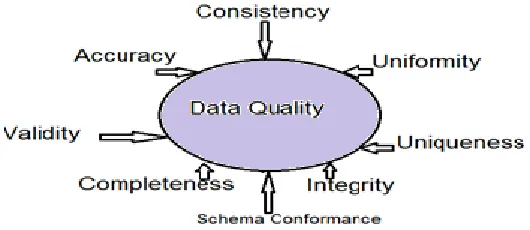
Data must conform to the set of quality criteria.[3] Figure 2 describes the set of criteria of data quality and data must fulfill each criterion to ensure its quality .
Figure 2: Set of criteria of data quality.
Accuracy: It depend upon how the data is collected. The condition of quality of being correct or exact, freedom from errors and defects.
Integrity: It refers to maintaining and assuring the accuracy and consistency of data over its entire life cycle.
Completeness: Completeness of data is the extent to which the expected attributes of data are provided.
Validity: data validity is the correctness and reasonableness of data.
Consistency: Data consistency is the process of keeping data uniform through all its location.
Schema Conformance: Conformance of data value to schema design and requirement.
Uniformity: state or quality of being uniform overall sameness.
Density: Density refers to compactness and Distribution of data.
Uniqueness: State or quality of being unique without any kind of duplication.
D. DATA CLEANING PROCESS
Data Auditing: Auditing the data is done to find the types of anomalies contained within it. Statistical methods are used for auditing. Syntactical anomalies are detected using parsing. The results of auditing the data support the specification of integrity constraints and domain formats. Integrity constraints are depending on the application domain and are specified by domain expert. Each constraint is checked to identify possible violating tuples. For one-time data cleansing only those constraints that are violated within the given data collection has to be further regarded within the cleansing process.
Workflow Specification: Multiple operations over the data are applied for Detection and elimination of common order problems. This is called the data cleansing workflow. It is specified after auditing the data to gain information about the existing anomalies in the data collection at hand. One of the main challenges in data cleansing insists in the specification of a cleansing workflow that is to be applied to the dirty data automatically eliminating all anomalies in the data.
© 2015, IJCSMC All Rights Reserved
364
Figure 3: Data cleaning process[4]Post-Processing/Control: After executing the cleansing workflow the results are checked to again verify the correctness of specified operations. Within the controlling step the tuples that could not be corrected initially are inspected intending to correct them manually.[4]
II.
LITERATURE SURVEY
Mong Li Lee [1] in his paper examined the problem of detecting and removing duplicates records. Several different techniques to pre-process the records before sorting them so that potentially matching records will be brought to close neighborhood subsequently.
Rahm, Hong Hai Do [2] in their paper defined the various data cleaning problems and current approaches like Single source problems and Multisource problems and Data quality problems.
Hamid Ibrahim Housien et al[6] in their paper study the data scrubbing algorithms and frameworks in data warehouse .
Nidhi Choudhary[8] in his paper study the various problems and approaches in Data cleaning.
Joseph M. Hellerstein[9] in his paper discuss the quantitative cleaning of large databases, and defines the approaches to improve data quality.
Rajashree Y.Patil et al [10] have discussed various data cleaning algorithms for data warehouse.
Heiko Müller et al[4] in their paper discussed the various data cleaning process and compare the data cleaning frameworks.
Mong Li Lee et al[5] in their research paper they proposed a generic knowledge based framework for effective data cleaning that implements existing cleaning strategies and more.
Kofi Adu-Manu Sarpong et. al[11] in their paper conceptualized the data cleansing process from data acquisition to data maintenance. Data Cleansing is an activity involving a process of detecting and correcting the errors and inconsistencies in data warehouse.
Taoxin Peng [12] in his paper presented a framework for How to improve the efficiency while performing data cleaning and How to improve the degree of automation when performing data cleaning, which provides an approach to managing data cleaning in data warehouses by focusing on the use of data quality dimensions, and decoupling a cleaning process into several sub-processes.
III.
NEED AND SCOPE OF STUDY
© 2015, IJCSMC All Rights Reserved
365
using data and data can be from more than one sources , so to extract quality and efficient result data cleaning is very necessary.
IV.
OBJECTIVE
A. To have the general understanding of data cleaning. B. To study the data cleaning tools.
C. To clean the data using various data cleaning tools like Ms Excel Data cleaner, RapidMinor and Winpure Clean & Match.
V.
RESEARCH METHDOLOGY
The theoretical study has been done from various sources like journals, research papers, books and internet. Data Cleaning tools has been used for the cleaning of various kind of excel data . On the basis of results obtained comparison of tools has been done to find the best tool for data cleaning.
VI.
COMPARISON OF DATA CLEANING TOOLS
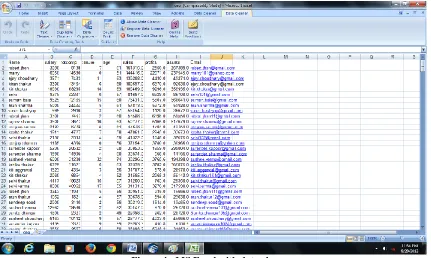
A. MS EXCEL DATA CLEANER
Excel Files Data Cleaning Utility is an useful addin for Excel to Clean and Organize Data. It is fast & Reliable and you can save your precious time & Money.[14]
Text cleaner: A Collection of Tools to Clean Text in Selected Cells. Duplicate Cleaner: A Collection of Tools to eliminate duplicate entries. Data Organizer: A Collection of Tools to Organize Data.
© 2015, IJCSMC All Rights Reserved
366
Figure 4: MS Excel with data cleanerB. RAPIDMINOR:
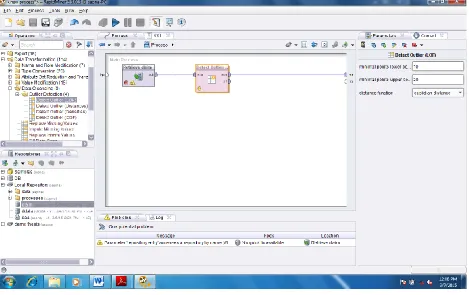
Rapid minor is a software platform that is used for data mining. We can also clean our data using RapidMinor. This tool contain various operators for data cleaning or data cleansing. It released on 2006, latest version available is Rapid Minor 6. It can be installed on any operating system that is cross platform, Language independent, Licensed by AGPL proprietary. Rapid minor support about twenty two file format [7]. It easily reads and writes Excel files and different databases. Using RapidMinor we can clean ,transform our data[13] . The operators for data cleaning are:-
Attribute name and Role Modification Operator
Type conversion
Attribute set reduction & transformation
Value Modification
Outlier Detection
Filtering
Sorting
Rotation
Aggregation© 2015, IJCSMC All Rights Reserved
367
Figure 5: Screen shot of RapidMinor processC. WINPURE CLEAN & MATCH
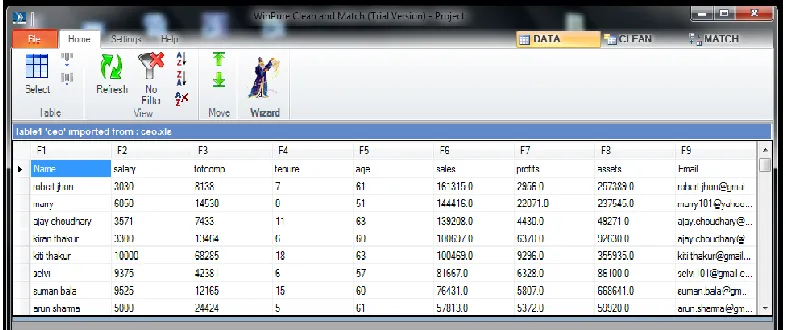
Its a comprehensive data cleansing, data deduplication software and a data listing software solution. It helps to clean mailing lists, spreadsheets, marketing databases and electronic mails. The software carries out data deduplication and offers the option of basic as well as advanced search. It helps to merge duplicate records on one or two lists which help to make the merging process effective and easier. "WinPure Clean & Match " offers some interesting features such as „Safe Merge‟ options that make sure that no data is lost while merging the records. The following are some properties for "WinPure Clean & Match 2012" Software:
1. It determines a data duplication on the list to achieve the results set.
2. It helps in selecting the master record from each duplicate group, Each group of duplicates provides the ability to select a Master record. This Master record will be the record from each duplicate that will be kept. However this master record has missing values in columns.
© 2015, IJCSMC All Rights Reserved
368
Figure 6: Winpure clean and MatchVII.
RESULTS AND ANALYSIS
Table IV represent the three excel files ,cleaned using data cleaning tools , Student file contain 20 records .This file is cleaned using “MS Excel Data cleaner”. It contain 10% Missing values and 4 duplicate records. CEO Data file is cleaned using “Winpure clean & Match”, it contain 25% missing values and 11 duplicate records. Mis_claim Data file is cleaned using “RapidMinor”, It contain 7 % missing values and 20 duplicate records.
TABLE IV
Files used and Properties
File Name No. of records No. of Fields Missing Value Duplicates Records
Student 20 11 10% 4
CEO data 400 9 25% 11
Mis_claim Data 841 13 7% 20
© 2015, IJCSMC All Rights Reserved
369
TABLE VCompa
rison of Data Cleaning toolsTools
Problems
MS Excel with data cleaner
RapidMinor Winpure Clean & Match
Missing Values No Yes Yes
Availability Desktop Desktop Desktop
Duplication Yes Yes
Yes uses the matching
Illegal Values Elimination
No No Yes
Misspelling No No No
Merge No Yes Yes
File Format Excel CSV, Database, Excel, Access, binary, XML
Text files, Excel , commercial DBMS,
Ease of use Moderate Moderate High
VIII.
CONCLUSIONS
Data cleaning is very necessary part of data mining. From the above study we can see that there are different types of problems in data cleaning .Data cleaning methods and approaches depend upon the type of data which we want to clean and according to that we apply particular methods. This paper also present a comparison of data cleaning tools and determines the best tool. Each tool has its own specific features and depending upon the data we can use the tool to clean data. In future work we can check other functionality of these tools and suggest own.
REFERENCES
[1] Li Lee Mong , Cleansing Data for Mining and Datawarehousing, school of computing National University of Singapore, 1999 .
[2] Rahm E. & Hai Do Hong, Data Cleaning: Problems and current approaches, IEEE Bulletin of the Technical Committee on Data Engineering, 2000
[3] http://www.ukessays.co.uk accessed on 7-4-2014 at 4:18pm
© 2015, IJCSMC All Rights Reserved
370
[5] Li Lee Mong, Wang Ling Tok & Lup Low Wai, IntelliClean: A knowledge-based intelligent data cleaner, Proceedings of the ACM SIGKDD, Boston, USA, 2000
[6] Ibrahim Housien Hamed, Zuping Zhang & Qays Abdulhadi Zainab,A comparison study Of Data Scrubbing algorithm and framework in Data Warehousing,,International Journal of Computer Applications (0975 – 8887) April 2013
[7] Mikut Ralf & Reischl Wiley Markus Interdisciplinary Reviews: Data Mining and Knowledge Discovery, Volume 1, Issue 5, pages 431–443, September/October 2011
[8] Choudhary Nidhi ,A Study over Problems and Approaches of Data Cleansing/Cleaning,Volume 4, Issue 2, February 2014
[9] M. Hellerstein Joseph, Quantitative cleaning of large databases February 27,2008.
[10]
Y.Patil
Rajashree
, Dr. Kulkarni R.V.
,
A Review of Data Cleaning Algorithms for Data Warehouse Systems. IJCSIT , Vol. 3 (5) , 2012.[11
] Sarpong Kofi Adu-Manu, Davis Joseph George, Panford Joseph Kobina , ” A Conceptual Framework for Data Cleansing – A Novel Approach to Support the Cleansing Process” International Journal of Computer Applications , Volume 77– No.12, September 2013.[12] Peng Taoxin ,” A FRAMEWORK FOR DATA CLEANINGS IN DATA WAREHOUSES”,School of Computing, Napier University,10 Colinton Road, Edinburgh, EH10 5DT, UK
.
[13] www.rapidminor.com accessed on 25-2-2015 at 5:18pm .
[14] www.winpure.com accessed on 07-01-2015 at 4:13 pm.
![TABLE I Examples for Single-source problems at schema level (violated integrity constraints)[2]](https://thumb-us.123doks.com/thumbv2/123dok_us/1958790.1258099/2.612.63.550.441.705/table-examples-single-source-problems-violated-integrity-constraints.webp)
![TABLE III Examples of multisource problems at Schema & Instance Level [2]](https://thumb-us.123doks.com/thumbv2/123dok_us/1958790.1258099/3.612.68.553.352.613/table-iii-examples-multisource-problems-schema-instance-level.webp)