A Strategy for Scheming Green and Reliable Internet of Things
G Saraswathi
& Sumayya Afreen
Assistant Professor,Dept of CSE,Stanley College of Engineering and Technology, India
Abstract:Internet of Things (IoT) is innovation within the subject of Communication in which a number of smart devices are concernedsharing data and making the collaborative selection. IOT is going to be a marketplace-converting pressure for a huge type ofactual-time tracking programs, together with E-healthcare, houses automation device, environmental tracking, and industrial automation as it's miles assisting to a massively wide variety of traits and attaining higher price efficiency. This article explores the emerging IoT in terms of the capability Energy Efficiency Reliability (EER) troubles. This paper discusses the capacity EER limitations with examples and shows treatments and techniques which are helpful in propellingthe development and deployment of IoT programs.
Keywords-Energy Efficiency Reliability; Internet of Things; Machine to Machine Communication
I. INTRODUCTION
When humans communicate about “the next massive aspect”, they’re never wondering big sufficient. It’s no longer a lack of imagination;it’s a lack of statement. Normally talking, IoT refers back to the network paired with everyday items, which might beprepared with worldwide intelligence. It is beginning incredible opportunities for a large set of novel application thatpromotes the quality of our lives. In current years, IoT has gained tons interest from researchers and practitionersfrom around the world. Living in this sort of smart international people will be collaboratively and at once served by way of theclever devices (e.g., cell phones, laptops), Smart environments (e.g., residences, shops), Smart transportation(e.g., motors, trains), and so forth. For e.g., GPS helps a user’s locations can constantly transmit to a server that tells usthe quality routes for the traveler's destination, maintaining the character stuck in traffic. All gadgets within the smart international aresupposed to be equipped with additional sensory and communication accessories so that they can
experience the expression andtalk with each different, they may require more energy. The energy efficient products(hardware or software)followed by means of IoTboth to facilitate reducing the greenhouse effect of present packages and services or to reducethe effect of the greenhouse effect of IoT itself. In human history, the smart global is receiving various interest fromgovernment, instructional, industry, and so forth [1]. It is therefore expected that the IoT will become a truth over the following 20years.Living in such a smart world, it’s become easy for a people to share the information worldwide. Forexample by using the GPS system, one can send its global position to any of the targeting applications. The use ofmobile phones, computers and internet connect the people worldwide to access and share the information. Therecent trends such as cloud technology, Wireless Sensor Networks (WSN), RFID etc. makes the world smarter. TheFig. 1 below shows the concept for smart world where the objectives and services of smart world has been clearlyshown. This article focuses on recent trends and development of embedding smart device with hot green technologiesto enable the smart world universally become IP enabled with the help of IPV6.
Figure 1. Concept of Smart World
According to [9], the Ubiquitous application has three objectives, which are to reducetime loss due to lag, reduce the medium cost, and reduce inaccuracy in traditional medicalflow. Lag is the time required for printing and sending paper or for human-basedtransmission of information which causes delays that may represent a major reason forrevenue loss. A reduction in lag would reduce the gap between when data is recorded in asystem and when it is available for information processing.In addition, ubiquitous agriculture and healthcare consumers will send out data fromvarious sources receive real-time information, knowledge, and relevant expertise andsearch out relevant and useful information. If the above-mentioned criteria are satisfied,the application will become truly ubiquitous. It will be a system that is embedded,performing one or a few dedicated functions. It will be pervasive, connecting devices, andembedded in such a way that the connectivity is unobtrusive and always available. It willbe context-aware, linking changes in the environment with computer systems. It will bemobile, using technology while moving. It will be wearable, using devices while theuser's hands, voice, eyes or attention are actively engaged with the physical environment.It will be sentient, perceiving its environment and reacting accordingly. And it will beambient, working in concert to support people in carrying out everyday life activities,tasks and rituals in an easy, natural way using information and intelligence that is hiddenin the network connecting these devices. The Internet of Things (IoT) refers to the ever-growing network of physical objects that feature an IP address forinternet connectivity, and the communication that occurs between these objects and other Internet-enabled devices andsystems. Definition of ITU-T (Telecommunication Standardization Sector of the International Telecommunications Union) :“In abroad perspective, the IoT can be perceived as a vision with technological andsocietal implications. From the perspective of technical standardization, IoT can be viewed as a global infrastructure forthe information society, enabling advanced services by inter- connecting (physical and virtual) things based on, existingand evolving, interoperable information and communication technologies. Through the exploitation of
identification,data capture, processing and communication capabilities, the IoT makes full use of things to offer services to all kindsof applications, while maintaining the required privacy.''Definition of IERC (IoT European Research Cluster) : “A dynamic global network infrastructurewith self-configuring capabilities based on standard and interoperable communication protocols where physical andvirtual “things'' have identities, physical attributes, and virtual personalities and use intelligent interfaces, and areseamlessly integrated into the information network.'' In summarized form-“The term "Internet of Things" emanated todescribe a number of technologies and research disciplines that enable global connectivity over the world-widephysical objects”. The fig. 2 below shows the system connectivity of Internet of things network how different physicaldevices get interconnected in IoT network.
Figure 2.Example of IoT
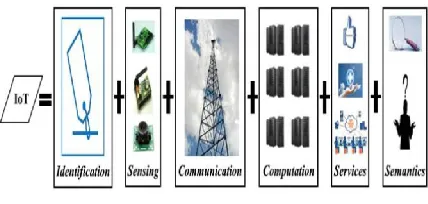
Elements of IoT: The elements of IoT are identification, sensing, communication technologies, computation, services and semantic asdescribed in Fig. 3 below.
Identification methods such as electronic product code (EPC) plays crucial role in identification of objects and sendingits information to database, data warehouses etc. which is then analyzed to perform specific actions based on requiredservices. In computation, the smart embedded devices such as FPGA, microcontrollers as well as cloud data also playsimportant roles in processing large amount of data over internet of things. The IoT services involved the identityservices which enable the identification of smart devices in real world. Aggregation services gather and summarize theraw information which need to be processed and reported. The collaborative related services act on raw data and takeaction accordingly. Ubiquitous services provide real time action on demand.
Green IoT: Green IoT consists of two aspects. The first one refers to designing energy efficient computing devices,communications protocols, and networking architectures for interconnecting the physical world. The second aspect is toleverage IoT technologies to cut carbon emissions and pollutions and enhance the energy efficiency. Enabling greenIoT involves various technologies such as RFID, sensor networks, cellular networks, machine-to-machinecommunications, energy harvesting devices and communications, cognitive radio, cloud computing, and big dataanalysis. With the advances of these enabling technologies, green IoT poses a great potential to bolster economic andenvironmental sustainability. NIC (National Intelligence Council) enabling research and development to enable energysaving when the G-IoT devices to communicates to real world. Considering the energy efficiency the green energy IoTconcept can be defined as [7], “The energy efficient procedures (hardware or software) adopted by IoT either tofacilitate reducing the greenhouse effect of existing applications and services or to reduce the impact of greenhouseeffect of IoT itself. In the earlier case, the use of IoT will help reduce the greenhouse effect, whereas in the later casefurther optimization of IoT greenhouse footprint will be taken care. The entire life cycle of green IoT should focus ongreen design, green production, green utilization and finally green disposal/recycling to have no or very small impacton the environment.''
III. METHOD OF SOLUTION
Since a mass of Sensor nodes {N0, N1…} are deployedin the IoT sensor domain, IoT communication shouldfocus on energy saving by optimizing sensor nodessensing, processing, and transmissions, and ultimatelyprolong the lifetime of the whole IoT communication. Inaddition, since the BS (Basestation) is also a power-consuming component in IoT communication, great efforts should alsobe made on the BS to achieve environment friendly,green IOT communication.
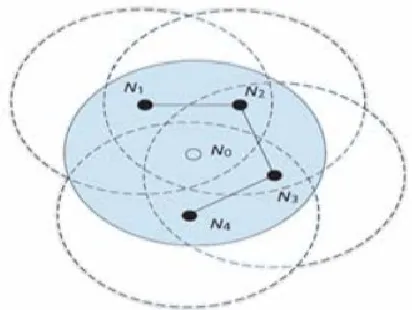
Figure 4. An example that node N0 may switch to sleepmode because its sensing range is fully covered by
the connected neighbors N1… N4.
A. Reliability :
Reliability is critical for Efficient IoT communication,because unreliable sensing, processing, and transmissioncan cause false monitoring data reports, long delays, andeven data loss, which would reduce people’s interest inIoT communication. Therefore, the rapid growth of IoTcommunication demands high reliability.Now, let us discuss the EER issues in IoT communication by surveying several potentially useful solutions toshed light on this research line.
B. Energy Efficiency in IoT Communication:
in an applicationdomain. This is because a massive number of devices areinvolved in IoT. The Energy Efficiency (green) becomesa challenging issue especially in the IoT sensor domain.IoT Communication dominates energy consumption.Energy Efficiency can be increased by wisely adjustingtransmission power (to the minimal necessary level), andcarefully applying algorithms and distributing computingtechniques to design efficient communication protocols(e.g., routing protocols) [5].
It can be further improved by activity scheduling, the objective of which is to switch some nodes to low-poweroperation (“sleeping”) mode so that only a subset ofconnected nodes remain active while the functionality(e.g., sensing and data gathering) of the original networkis preserved. In [6] an activity scheduling scheme is proposed for sensing coverage, which appears to be the bestin the literature. This scheme requires time to be slotted,and activity scheduling is then done in rounds. In eachround, a node selects a random timeout and listens tomessages from neighbors before it expires. These messages contain the activity decision (i.e., whether to beactive or not) of their senders.When the timeout expires, which is solely based on thereceived information, the node makes its own activitydecision and announces it to the neighbors by transmitting a message. A node decides to be active if its sensingrange (coverage circle) is fully covered by the sensingranges of a connected set of active neighbors.
C. Reliability in IoT Communication:
For achieving Green IoT, since not all sensor nodes areexpected to simultaneously be active in the IoT domain,Reliability is a challenging issue. In order to improve theReliability of IoT communication, exploiting redundancytechnologies, including information redundancy, spatialredundancy, and temporal redundancy, can be an efficient approach for IoT communication.
D. Reliability in Sensing and Processing:
Due to component faults and so on, a single IoT node may not be sufficient to accurately sense and process monitoring data. Therefore, a majority vote in green IoTcommunication is desirable to improve reliability. In
[7],a local vote decision fusion (LVDF) algorithm is presented, which can be directly applied in IoT communication. In LVDF, each IoT node Ni first independentlysenses, processes, and makes an initial single-bit decisiondi ∈ {0, 1} on some event in a specific IoT application,and shares the decision di with its neighbors NB(i).
E. Reliability in Transmission
Consider that there are n total positive monitoring dataon the same event in the IoT domain, and the GW willreport the decision to the BS only if it can collect morethan k distinct monitoring data packets. These positivemonitoring data can first be aggregated and then forwarded to the GW together for achieving communicationefficiency. However, in green IoT communication, notall nodes are active, which may result in unreliabletransmission in the IoT domain.
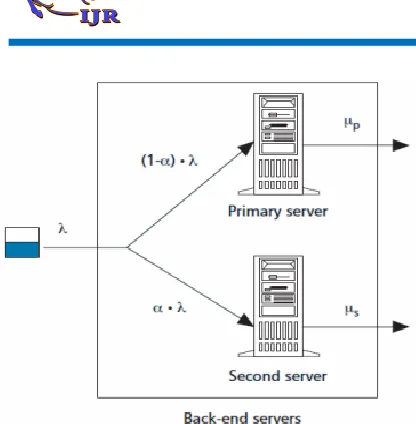
F. Reliability at BS:
Figure 5. The deployments of primary and second serversto achieve reliability [2]
IV. CONCLUSION
The recent development on the Internet of things era has been mentioned in this text. We have also centered on the various scope of IoT followed to make Green Internet of Things. Also, the assessment of various G-IoT concepts summarized. In this paper, we have studied the problems to gaininexperienced IoTcommunique by using green activity scheduling strategies for energy saving. We have alsopresented numerous procedures to address the reliability issues in IoT. Although we've got discussed the EER difficultiesin the preferred IoT paradigm to shed mild in this studiesline, further efforts are needed to discover the EER problemsin specific IoTcommunication contexts.
REFERENCES
[1] L. Atzori, A. Iera, and G. Morabito, “The Internet of Things: A survey”, Comput. Netw., Vol. 54, no. 15, pp.2787-2805, Oct. 2010.
[2] R. S. Lu, “GRS: The Green, Reliability, and Security ofEmerging Machine to Machine Communication” IEEECommunication Magazine, April 2011.
[3] S. Hattangady, “Wireless M2M the Opportunity isHere!(Part1),”http://emblazeworld.com/AttachmentsA rticles/2009-MayCellular WhitepaperPart 1.pdf
[4] R. Hodges and W. White, “Go Green in ICT,”http://www.nascio.org/committees/green/whitepap es/bdna.pdf , 2008
[5] I. Stojmenovic, “Localized Network Layer Protocols inWireless Sensor Networks based on Optimizing CostOver Progress Ratio,” IEEE Network, Vol. 20,
No.1,2006, pp. 21-27.
doi:10.1109/MNET.2006.1580915
[6] A. Gallais et al., “Localized Sensor Area Coverage WithLow Communication Overhead,” IEEE Trans. MobileComputing, Vol. 7, No. 5, 2008, pp. 661-672.doi:10.1109/TMC.2007.70793
[7] N. Katenka, E. Levina and G. Michailidis, “Local VoteDecision Fusion for Target Detection in Wireless SensorNetworks,” IEEE Transactions on Signal Processing, Vol.56, No. 1, 2008, pp. 329-338.doi:10.1109/TSP.2007.900165
[8] M.Weiser, “The computer for the 21st century. Pervasive Computing”, IEEE, vol. 1, no.1, (2002),pp.19-25.
[9] http://www.koreaittimes.com/story/defining-perfect-ubiquitous-healthcare-information-system.
[10] S.Murugesan, “Harnessing green IT: principles and practices”, IEEE IT Professional, (2008), pp. 24–33.
BIODATA
1. G Saraswathi, Assistant Professor, Dept of CSE. I have been working as Assistant Professor since one year in Stanley College of Engineering and Technology for Women. My Area of interest is Iot, Cloud Computing and Big Data.