Available online: https://edupediapublications.org/journals/index.php/IJR/ P a g e | 697
Critical failure factors in enterprise resource planning implementation at
Indian SME
K.Venkateshwarlu
Assistant Professor, Dept Of Master of Business Adminstration
Mother Theressa College of Engineering and Technology. Peddapalli, Telangana, India E-Mail:, [email protected]
ABSTRACT
Many companies in developing countries have implemented Enterprise Resource Planning (ERP), to capture its benefits; still there is a lack in examining Critical Failure Factors (CFFs) that influence failure of ERP implementation at Indian Small and Medium-size Enterprises (SMEs). This paper develops an ERP implementation failure model by identifying and ranking the twenty CFFs that differs from existing models in that it has a broader and more holistic focus. It proposes a framework in terms of recommendations for managing these CFFs. A quantitative survey based method was used to collect the data from the Indian ERP consultants. The data collected were analyzed using statistical techniques. This paper argues that Indian consultants often fail in recognizing the technology, vendor, employee, project etc related influence to the ERP implementation, as a consequence for the evaluation of ERP, instead of choosing a system supporting specific business functions. ERP is not just a technological work; it’s a socio technological challenge, which mandates modifying existing applications and redesigning processes that may put Indian SMEs on the competitive position. Findings are discussed along with the implications of the research for the future work to bridge the current literature gap and provide practical advice for both academics and practitioners.
Keywords: Enterprise Resource Planning (ERP), Critical Failure Factors (CFFs), Indian ERP, Implementation, Small and Medium-size Enterprises (SMEs).
1. Introduction
In the post liberalization and opening up of the economy business era, ease in international trade barriers, economic liberalization, globalization, privatization, disinvestments and deregulation have thrown several challenges to Small and Medium-Sized Enterprises (SMEs) in the fast developing economies like India. Compressed product development cycles, cut throat domestic and global competition, economic downturns, rapidly changing customer demands and volatile financial markets have all increased the pressure on SMEs to come up with effective and competitive capabilities to survive and succeed. Enterprise Resource Planning is often considered as one of the solutions for their survival (Rao, S.S.2000).Up to mid-1990s, SMEs sector in India had operated under a much-protected economic regime characterized by limited competition and a highly regulated business environment. This business atmosphere had resulted in limited focus on process efficiencies, centralized control structures, highly formalized
business settings and lack of professional business practices (Ranganathan, C. and Kannabiran, J., 2004).
Available online: https://edupediapublications.org/journals/index.php/IJR/ P a g e | 698
practices and strategies, which in turn can provide Indian SMEs a cutting edge over its competitors. The ERP research has so far concentrated on Large Enterprises (LEs) and the findings cannot easily be extended to Indian SMEs because of their particular characteristics. The needs, operating requirements, logistics fulfillment and financial capabilities of SMEs are vastly different from that of LEs (Huin, S .F. 2004). Recently, the ERP research on SMEs has received more attention (e.g. Gable, Guy, and Glenn, Stewart, 1999), Bernroider, E. and Koch, S. (2001). This study contributes to the ERP research in the context of Indian SMEs and provides insights that may have been overlooked in previous research. Since literature on ERP implementation at Indian SMEs is relatively sparse, this research helps to narrow this knowledge gap by investigating ERP implementation at Indian SMEs. This paper identifies & ranks the critical failure factors that influence failures of ERP implementation at Indian SMEs. ERP systems are enterprise-wide software packages that provide fully integrated business processes with shared data and visibility, and thereby hold the potential of greatly enhancing organizational performance and establishing competitive advantage (Davenport, T.H.1998). This study is based on opinion that has been obtained from 50 Indian ERP consultants who were involved in various ERP implementations of Indian industries including Indian SMEs.
1.1 Indian SMEs
As per the Ministry of Micro, Small and Medium Enterprises, recent ceilings on investment for enterprises to be classified for micro, small and medium enterprises are as follows:
Table 1: Definition of Indian SMEs (Source: MSME Development Act, 2006)
Classification Manufacturing Enterprises* Service Enterprises**
Micro Rs. 2.5 million/ Rs. 25 lakh Rs. 1 million/ Rs. 10 lakh (US$ 50,000) (US$ 20,000)
Small Rs. 50 million/ Rs. 5 crore (US$ 1 Rs. 20 million/ Rs. 2 crore million) (US$ 40,00,000)
Medium Rs. 100 million/ Rs. 10 crore (US$ 2 Rs. 50 million/ Rs. 5 crore (US$ 1 million) million)
*Investment limit in Plant & Machinery **Investment limit in equipments
1.3 ERP Implementation Phase
Available online: https://edupediapublications.org/journals/index.php/IJR/ P a g e | 699
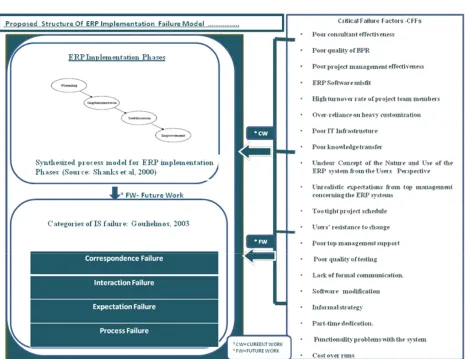
investigation on the critical failure factors for ERP implementation at Indian SMEs. This study aims at achieving these objectives by considering ERP implementation process based on “Synthesized process model for ERP implementation phases”, (Shanks et al, 2000) to identify & rank the critical failure factors for ERP implementation at Indian SMEs.
It deals with Planning > Implementation > Stabilization > Improvement
· Planning: Choosing the ERP package, scoping the project, formulating the system architecture, and approval of budget and schedule.
· Implementation: Configuring and implementing the ERP software.
· Stabilization: After initial implementation, a stabilization stage occurs when implementation problems are fixed and organizational performance improves.
· Improvement: Achieving the benefits, updating new modules, focusing on continuous improvement and transformation.
2.Research Gap
Within ERP implementation context, CFFs are defined as "as the key aspects (areas) where “things must go wrong” in order for the ERP implementation process to achieve a high level of failure " (Motwani et al., 2002). Implementing ERP systems is investigated by many researchers. Their general focus was on identifying CFFs that exist in large organization & results in ERP implementation failure. These factors have been tested in different organizations in many developed and developing countries by many researchers (Al-Mashari, M. (2001), Akkermans, H .A. and Helden, K. V. (2002)). These factors include, but not limited to, poor consultant effectiveness, ERP software misfit, unrealistic expectations from top management concerning the ERP systems, over-reliance on heavy customization, poor quality of BPR, high turnover rate of project team members, poor IT Infrastructure, functionality problems with the system, unclear concept of the nature and use of the ERP system from the users perspective, too tight project schedule, lack of formal communication, part-time dedication etc.It has to be noted that much of the attention focused on the critical failure factors for the failure of ERP implementation in the large enterprise. The failure of ERP implementation in both SMEs & LEs are equally important thus the gaps in the literature review of Indian ERP implementation are:
What are the critical factors that influence failure of ERP Implementation at Indian SMEs?
Which critical factors should get high priority in judging the failure of ERP implementation at Indian SMEs?
3.Objectives
The main objectives of this paper are:
To Identify & categories the critical factors influencing failure of ERP implementation at India SMEs.
To find out the factors that can be defined under each component with their importance.
To find out the reliability of instrument in totally for defining each factors.
Available online: https://edupediapublications.org/journals/index.php/IJR/ P a g e | 700
4. Research Methodology
The present study is exploratory in nature which identifies twenty critical failure factors for the failure of ERP implementation at Indian SMEs along with the KCFFs (Key Critical Failure Factors) by the mean ranking of those CFFs. It gives insights into the phenomenon of CFFs for the failure of ERP implementation at Indian SMEs. It does not go deep into the phenomenon of CFFs and so it cannot be determined as descriptive. Exploratory research has the goal of formulating problems more precisely, clarifying concepts, gathering explanations, gaining insights, eliminating ideas and formulating hypothesis. Exploratory research here is performed by a survey. A quantitative survey based approach was used. The ERP consultants from India have been selected for the data collection using non probability sampling method. The primary data was collected by using self structured one close ended questionnaire. A five item Likert scale was designed with each statement having five alternative to choose from Strongly Agree=5, Agree=4, Neutral=3, Disagree=2, Strongly Disagree=1 for the questionnaire.
The Likert scale is relatively easy to construct compare to other scales. The process is to collect the large number of statements that meet two criteria: (1) each statement is believed to be relevant to the attitude being studied and (2) each is believed to reflect favorable or unfavorable position on that attitude. Respondents should give their level of agreement to the statements. The pilot test was done for ten respondents. Later questionnaire was given to 50 respondents. These respondents were from different background and different genders. The questionnaire consists of 20 questions (survey items) mainly dealing with 20 critical failure factors for the failure of ERP implementation at Indian SMEs. In questionnaire, respondents were asked to indicate their perception to identify twenty CFFs for the failure of ERP implementation at Indian SMEs. The objectives of the research and the pattern of the questions were explained in detail to the respondents so that the bias will be as low as possible .Factor analysis was used to reduce the variables &detect the structure in the relationship between variables along with mean ranking of the CFFs. The analysis of data was done by applying factor analysis & descriptive statistics using SPSS V 18.0.
5. Analysis and Interpretation
5.1. The Proposed Theoretical Framework
Available online: https://edupediapublications.org/journals/index.php/IJR/ P a g e | 701
Figure 1: Proposed Theoretical Framework (Conceptual ERP Implementation Failure Model) (Source: Authors, MS-PowerPoint)
5.2 Estimation
The conceptualization of survey instrument constructs is based on preliminary literature review to form the initial items. The personal interviews with practitioners and experts views for scale purification suggest that the survey instrument has strong content validity. Construct validity is evaluated by performing factor analysis. High correlations among the CFFs are considered to indicate construct validity. Estimates greater than .75 are normally acceptable criteria to meet the reliability of instrument .In table 2, the composite reliability estimates for the measurement scales are listed. From the table 2 it is observed that reliability is above 0.78 which states that sufficient internal consistency has been judged for the reliable measure & for constructs validity.
Available online: https://edupediapublications.org/journals/index.php/IJR/ P a g e | 702
Table 2: The Composite Reliability
(Source: SPSS V 18.0)
The data collected on the critical failure factors were first perused to check whether the data could be analyzed using factor analysis or not. The results of this analysis indicate that the correlations among the factors were high and the Bartlett’s test of sphericity was significant. The data were hence found suitable to conduct factor analysis. An exploratory factor analysis was conducted on the different measures to purify the instrument & to validate the various dimensions implementation at Indian SMEs. It was also used to examine the response of the fifty Indian ERP consultants in order to define dimensional component of the instrument for ERP implementation at Indian SMEs.
It has used principle components as the extraction techniques and the rotation method was Varimax. Only factors with Eigen value (Total variance explained) more than 1 are included in final solutions. Factor loading is simple correlation between the factors & all the variables. It can be used to decide which variable belongs to which factors. This judgment can be done best in rotated factor matrix. Each variables belongs to the factors with which it has the highest loading (neglect the negative sign) See Table 4.This process is used to find out all the constituent variables of each factors. It is seen from the total variance explained table that only 7 factors have Eigen value over 1.
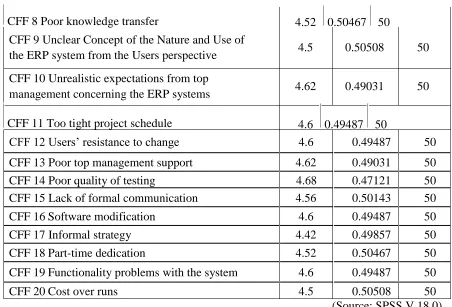
Table 3: Descriptive Statistics for Identification of Critical Failure Factors (CFFs)
Descriptive Statistics
Critical Failure Factors Mean Std. N Deviation
CFF 1 Poor consultant effectiveness 4.6 0.49487 50
CFF 2 Poor quality of BPR 4.48 0.50467 50
CFF 3 Poor project management effectiveness 4.54 0.50346 50
CFF 4ERP Software misfit 4.56 0.50143 50
CFF 5High turnover rate of project team members 4.46 0.50346 50
CFF 6Over-reliance on heavy customization 4.56 0.50143 50
CFF 7Poor IT Infrastructure 4.48 0.50467 50
Available online: https://edupediapublications.org/journals/index.php/IJR/ P a g e | 703
CFF 8 Poor knowledge transfer
CFF 9 Unclear Concept of the Nature and Use of the ERP system from the Users perspective
CFF 10 Unrealistic expectations from top management concerning the ERP systems
CFF 11 Too tight project schedule
4.52 0.50467 50
4.5 0.50508 50
4.62 0.49031 50
4.6 0.49487 50
CFF 12 Users’ resistance to change 4.6 0.49487 50
CFF 13 Poor top management support 4.62 0.49031 50
CFF 14 Poor quality of testing 4.68 0.47121 50 CFF 15 Lack of formal communication 4.56 0.50143 50
CFF 16Software modification 4.6 0.49487 50
CFF 17 Informal strategy 4.42 0.49857 50
CFF 18Part-time dedication 4.52 0.50467 50
CFF 19Functionality problems with the system 4.6 0.49487 50
CFF 20Cost over runs 4.5 0.50508 50 (Source: SPSS V 18.0)
CFF*- Item related to Identification of Critical Failure Factors, Questionnaire One. N*-Number of respondents in questionnaire
It shows cumulative variance of 76.134 % which means a good factor analysis has been done. The factor analysis performed on 20 items resulted into the extraction of 7 components See Table 4.Based on the content of each component they were suitably named. Factor analysis was used to identify the critical failure factors that influence the failure of ERP implementation at Indian SMEs.
The factors were fixed at seven. See Table 5.
They together contribute almost 76.134 % of total variance. See Table 5.
The most important factor among these is Component 1: Technology & Vendor related CFFs, which contribute almost 15.088% of the total variance. See Table 5.
The variables are divided into different factors based on the values in the rotated component matrix (the higher values are taken). The divisions of variables into different factors are given in See Table 5.
5.3 Findings
Available online: https://edupediapublications.org/journals/index.php/IJR/ P a g e | 704
Table 5 & 6. Since the grouping of variables are done on basis of data collected from the Indian ERP consultants, the results of the study are also acceptable for Indian ERP vendors & will be acknowledged by the Indian ERP consultants too. Based on the results obtained from the above analysis following ERP implementation failure model (see Figure 2) can be used to judge the failure ofERP implementation at Indian SMEs.
Table 4: Rotated Components Matrix
Rotated Component Matrix
Component
Critical Failure Factors 1 2 3 4 5 6 7
CFF 1 Poor consultant effectiveness CFF 4 ERP Software misfit
CFF10 Unrealistic expectations from top management
0.828 0.268 0.067 0.058 -0.145 0.102 0.085
0.796 0.296 -0.058 0.28 0.089 0.195 0.085
0.771 0.116 0.311 -0.055 0.329 -0.179
-0.075
CFF 6 Over-reliance on heavy customization
CFF 2 Poor quality of BPR CFF 5 High turnover rate of project team members
CFF 7 Poor IT Infrastructure
CFF 19 Functionality problems with the system
0.668 0.255 -0.126 0.258 0.305 0.325 0.159
0.144 0.874 -0.095 -0.044 -0.088 0.092
0.122
0.236 0.873 0.074 -0.072 -0.104 -0.124 0.017
0.179 0.831 0.019 -0.022 0.121 0.041 0.155
-0.371 0.049 0.834 -0.018 0.022 0.124 0.059
CFF 9 Unclear concept
CFF11 Too tight project schedule
CFF 15 Lack of formal communication
CFF18 Part-time dedication CFF 3 Poor project
management effectiveness
0.118 0.141 0.734 -0.003 0.053 -0.287 -0.13
0.202 0.003 0.601 0.324 0.208 -0.221 0.246
0.206 -0.175 0.581 0.143 0.396 0.174 0.234
0.386 -0.238 0.548 0.08 -0.157 0.08
0.144
0.143 -0.091 0.097 0.903 0.012 0.003
0.139
CFF8 Poor knowledge transfer 0.13 -0.023 0.112 0.777 0.158 0.097 0.28
CFF 14 Poor quality of testing 0.073 -0.104 0.085 0.057 0.867 0.162 0.181
-CFF 12 Users’ resistance to change 0.135 0.263 0.125 0.332 0.462 -0.233 0.38
CFF 13 Poor top management support -0.035 0.165 0.34 -0.005 -0.143 -0.762 0.107
CFF 16 Software modification 0.295 0.263 0.267 0.045 0.015 0.653 0.01
CFF 20 Cost over runs -0.038 0.037 0.039 -0.078 0.148 0.078 0.875
-CFF 17 Informal strategy 0.118 0.343 0.298 -0.441 0.191 0.2 0.484
ExtractionMethod: Principal Component Analysis.
Rotation Method: Varimax with Kaiser Normalization.
Available online: https://edupediapublications.org/journals/index.php/IJR/ P a g e | 705
CFF*- Item related to Identification of Critical Failure Factors, Questionnaire One
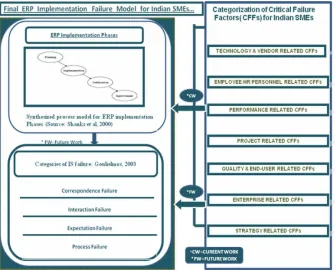
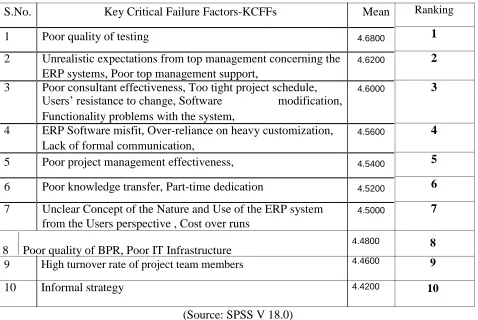
The list of Key Critical Failure Factors (KCFFs) (see Table 6) for the failure of ERP Implementation at Indian SMEs shows the ranking of all the CFFs in terms of their mean ranks on 1 to 10 points scale (Same rank is given for all the factors which have equal mean) in order to identify which factors are most important in the failure of ERP implementation at Indian SMEs & should get high priority. The ERP implementation failure model (see Figure 2)for the failure of ERP implementation at Indian SMEs along with the list of KCFFs( see Table 6) can be used during all the phases of ERP implementation at Indian SMEs to avoid ERP implementation failure because the boundaries between planning, implementation, stabilization & improvements are not rigid.
Figure 2: ERP Implementation Failure Model for Indian SMEs (Source: Authors, MS-PowerPoint)
The ERP implementation failure model (see Figure 2) simplifies the functionality of ERP implementation at Indian SMEs. The simplification of system makes easier to understand the ERP requirements. Commonly, a better system is easier to understand, implement and maintain for the users and the implementers. By using this model for small and medium-size companies ERP implementation, especially in India can achieve global business process by efficient ERP implementation.
Table 5: Interpretation of Output from the Exploratory Factor Analysis
Categorization in terms of TVE* List of CFFs for Indian SMEs RCMV**
Available online: https://edupediapublications.org/journals/index.php/IJR/ P a g e | 706
Component 1 this component was named
as Technology & Vendor related CFFs. it Consist following items:
Component 2 this component was named
as Employee/Personnel/HR & Process related CFFs. it Consist following items:
Component 3 This component was named
as Performance related CFFs it Consist following items:
Component 4 This component was named
as Project related CFFs. it Consist following items:
Component 5 This component was named
as Quality & End-user Related CFFs. it Consist following items:
Component 6 This component was named
as Enterprise related CFFs. it Consist following items:
Component 7 This component was named
as Strategy related CFFs. it Consist following items:
Poor consultant effectiveness .828
15.088% ERP Software misfit .796 Unrealistic expectations from top .771 management concerning the ERP
systems
Over-reliance on heavy customization .668
Poor quality of BPR .874
14.344% High turnover rate of project team .873
members
Poor IT Infrastructure .831
13.454% Functionalityproblems with the system .834
Unclear concept of thenature and use of .734 the ERP system from the users
perspective
Too tight project schedule .601
Lack of formal communication .581
10.127%
Part-time dedication .548
Poor project management effectiveness .903
Poor knowledge transfer .777
.799% Poor quality of testing .867
Users’ resistance to change .462
7.690%
Poor top management support (-.762)
Software modification .653
7.632 %
Cost over runs (-.875)
Informal strategy .484
TVE*-Total Variance Explain, RCMV**-Rotated Component Matrix Value
The Findings of the research are as below:
Significant relationships are found between CFFs & the failure of ERP implementation at Indian SMEs.
Available online: https://edupediapublications.org/journals/index.php/IJR/ P a g e | 707
Table 6: List of Key Critical Failure Factors (KCFFs) for Indian SMEs
S.No. Key Critical Failure Factors-KCFFs Mean
1 Poor quality of testing 4.6800
2 Unrealistic expectations from top management concerning the 4.6200
ERP systems, Poor top management support, 3 Poor consultant effectiveness, Too tight project schedule, 4.6000
Users’ resistance to change, Software modification, Functionality problems with the system, 4 ERP Software misfit, Over-reliance on heavy customization, 4.5600
Lack of formal communication, 5 Poor project management effectiveness, 4.5400
6 Poor knowledge transfer, Part-time dedication 4.5200
7 Unclear Concept of the Nature and Use of the ERP system 4.5000
from the Users perspective , Cost over runs
Ranking
1
2
3
4
5
6
7
8 Poor quality of BPR, Poor IT Infrastructure
9 High turnover rate of project team members
10 Informal strategy
4.4800 8
4.4600 9
4.4200 10
(Source: SPSS V 18.0)
Based on the above analysis ERP consultants & ERP vendors are recommended to follow these guidelines to avoid the future failure ofERP implementation at India SMEs:
Avoid the use of inexperienced & ineffective consultants they may fail ERP Implementation at Indian SMEs.
Avoid insufficient & poor quality of business process reengineering it leads to ERP failure at Indian SMEs.
Avoid improper project management for ERP implementation at Indian SMEs as it results in failure because ofthe mismanagement of resources.
One of the reasons for the failure of ERP implementation at Indian SMEs is wrong selection of ERP vendor so it should be avoided in ERP implementation.
High Turnover rate of project team members should be avoided as it makes success of ERP implementation at Indian SMEs doubtful because of the loss of trained resource.
Avoid over realization on heavy customization because it increase probability of the failure of ERP implementation at Indian SMEs due to the increase complexity & cost.
Poor IT infrastructure can’t give full benefits of ERP Implementation at Indian SMEs so it should be avoided.
Available online: https://edupediapublications.org/journals/index.php/IJR/ P a g e | 708
Unclear concept of the nature and use of the ERP system among users are the result of insufficient ERP education & the training so it should be taken care for the successful ERP implementation at Indian SMEs.
Avoid unrealistic expectation of top management & enterprise from the ERP Implementation at Indian SMEs without considering complexity as it leads to dissatisfaction.
Too Tight project schedules leads to stress & poor quality of ERP Implementation at Indian SMEs so it should be avoided.
Try to reduce and eliminate the user’s resistance to change as it can’t make ERP implementation successfulat Indian SMEs.
Lack of top management support for ERP Implementation at Indian SMEs leads to many problems & failure so it should not be there.
Poor quality of testing not only waste time & money of the enterprise but also results in ERP failure at Indian SMEs that should be avoided.
Lack of formal communication leads to misunderstanding for the successful ERP implementation at Indian SMEs & it should not be there.
Avoid too much modification in software because it increases complexity & risk along with the maintenance cost of the ERP implementation at Indian SMEs.
Lack of formal strategy leads to uncertainty & confusion during & after the ERP implementation at Indian SMEs so it should be avoided.
ERP implementation at Indian SMEs fails due to the part time dedication of team members & their less involvement so it should not be there.
Any ERP implementation at Indian SMEs can’t be consider as successful if it doesn’t provide the required functionally of the business so it should not be there.
High cost of ERP Implementation at Indian SMEs considered as ERP failure if it cross the budget of an enterprise so it should be avoided.
6.Conclusion
Available online: https://edupediapublications.org/journals/index.php/IJR/ P a g e | 709
studies will be conducted in future in order to further examine the black box of ERP
implementation in Indian SMEs to avoid the failure of ERP implementation at Indian SMEs.
6.1 Limitation
Like any research, this approach and results have some limitations.
The sample size is 50 which is comparative small & that might affect the overall reliability. Limited samples size restricted to Indian SMEs may limit generalization.
The factor analysis is only exploratory & not confirmative.
The study is limited to India and cannot be generalized.
The study is limited to only Indian SMEs and cannot be generalized.
The time available is short & that also limits the study.
The study is based on the opinion of respondents (questionnaire) and there can be bias.
The questionnaire might have excluded some important factors.
The analysis & interpretation might not be exhaustive.
The reliability of the scale is only found out. The validity & consistency are not found in too much detail.The use of convenience samples may have limited insights in the process.
There is Inconsistency between definitions ofSMEs size in various studies.
Limited choices of implementation phases are examined.
The information contained in this paper is intended only to provide a general summary. It does not support to be a complete description of the research issues.
6.2. Future Work
With respect to future research a number of different approaches could be considered. Single company case studies could be used to uncover some of the critical failure factors other than the covered twenty CFFs. Within sector case studies could be used to highlight the critical failure factors faced by particular sector. Cross-sector case studies could be used to validate these conclusions as well as to elucidate differences among sectors. Separate critical failure factors can be identified for each phase of the ERP implementation at Indian SMEs. A questionnaire-based survey could be used to validate the results of this research with the help of different theoretical framework & the large sample size for each phase of the ERP implementation. Finally, another aspect of ERP failure that is failure in adoption of ERP systems by the Indian SMEs can also be measure as an extension & validation of these works. Specific industries or organizational sizes might have different organizational characteristics and business requirements for ERP systems and this create a robust research framework and model which may be useful for understanding the critical failure factors for the failure of ERP implementation at Indian SMEs.
7.References
1. Akkermans, H .A. and Helden, K. V. (2002), "Vicious and virtuous cycles in ERP implementation: a case study of interrelations between critical success factors", European Journal of Information Systems, Vol. 11, No.1, pp. 35.
Available online: https://edupediapublications.org/journals/index.php/IJR/ P a g e | 710
3. Bernroider, E. and Koch, S. (2001), "ERP selection process in midsized and large organizations", Business Process Management Journal, Vol.7, No.3, pp. 251.
4. Davenport, T.H. (1998), "Putting the enterprise into the enterprise system", Harvard Business Review, Vol. 76 No.4, pp.121-31.
5. Gable, Guy, and Glenn, Stewart (1999), “SAP R/3 implementation issues for small to medium enterprises”, 5th Americas Conference on Information Systems.
6. Goulielmos, M. (2003).”Outlining Organizational failure in information systems development”, Disaster prevention and Management, Vol 12, No4, pp. 319327.
7. Huin, S .F. (2004),"Managing deployment of ERP systems in SMEs using multi-agents", International Journal of Project Management, Vol. 22, No.6, pp.511-517.
8. Markus, M. L. C.and Tanis, C. (2000), "Multisite ERP implementations", Association for Computing Machinery, Communications of the ACM, Vol. 43, No.4, pp. 42.
9. Motwani, J., Mirchandani, D., Madan, M., Gunasekaran, A. (2002),”Successful implementation of ERP projects: Evidence from two case studies”, International Journal of Production Economics, Vol.75, No.1, pp.83-96.
10.Ranganathan, C. and Kannabiran, J., (2004), “Effective management of information systems function: An exploratory study of Indian organizations”, International Journal of Information Management, Vol. 25, pp.247–266.
11.Rao, S. S. (2000), "Enterprise resource planning: business needs and technologies", Industrial Management + Data Systems, Vol. 100, No.2, pp. 81.