Available Online atwww.ijcsmc.com
International Journal of Computer Science and Mobile Computing
A Monthly Journal of Computer Science and Information Technology
ISSN 2320–088X
IJCSMC, Vol. 4, Issue. 6, June 2015, pg.299 – 306
RESEARCH ARTICLE
APRIORI ALGORITHM AND FILTERED
ASSOCIATOR IN ASSOCIATION RULE MINING
Himani Bathla, Ms. Kavita Kathuria
M.Tech student, Department of CSE, Shri baba masth nath engineering college
Assistant professor, Department of CSE, Shri baba masth nath engineering college
[email protected], [email protected]
Abstract:
Most algorithms used to identify large itemsets can be classified as either sequential or parallel. In most cases, it is assumed that the itemsets are identified and stored in lexicographic order (based on item name). This ordering provides a logical manner in which itemsets can be generated and counted. This is the normal approach with sequential algorithms. On the other hand, parallel algorithms focus on how to parallelize the task of finding large itemsets. Mining Associations is one of the techniques involved in the process mentioned in chapter 1 and among the data mining problems it might be the most studied ones. Discovering association rules is at the heart of data mining. Mining for association rules between items in large database of sales transactions has been recognized as an important area of database research. These rules can be effectively used to uncover unknown relationships, producing results that can provide a basis for forecasting and decision making. Today, research work on association rules is motivated by an extensive range of application areas, such as banking, manufacturing, health care, and telecommunications. It is also used for building statistical thesaurus from the text databases, finding web access patterns from web log files, and also discovering associated images from huge sized image databases.Keywords:
KDD, WWW, CAR, CHAID, AISI. INTRODUCTION
image databases. For example, the information that customers who purchase computers also tend to buy antivirus software at the same time is represented in Association Rule below:
Computer => antivirus software [support = 2%; confidence = 60%] ….(1)
Rule support and confidence are two measures of rule interestingness. They respectively reflect the usefulness and certainty of discovered rules. A support of 2% for Association Rule (1) means that 2% of all the transactions under analysis show that computer and antivirus software are purchased together. A confidence of 60% means that 60% of the customers who purchased a computer also bought the software. The rest of this chapter is organised as follows: Section II summarizes related researches. Section III gives introduction of various data mining tools, Section IV describes Apriori association mining algorithms, Section V describes Experimental results and analysis. In Section VI, we draw conclusion and give future work.
II. RELATED WORK
III. DATA MINING TOOLS
Data mining , a set of techniques used for the purpose of obtaining information from the data. Statistical analysis of data using a combination of techniques and artificial intelligence algorithms and data quality information in the disclosure of confidential information, a process of transformation. In this context, SPSS Clementine, Excel, SPSS, SAS, Angoss, KXEN, SQL Server, MATLAB, commercial and RapidMiner
(YALE), Weka, R, C4.5, Orange, KNIME developed several programs, including open source.
i)
Open Source Programs Data MiningData mining applications is necessary to use a computer program to do. In this context, most software is developed. In this section, the Open Source Data Mining Programs and RapidMiner (YALE),Weka and R
programs mentioned.
i)
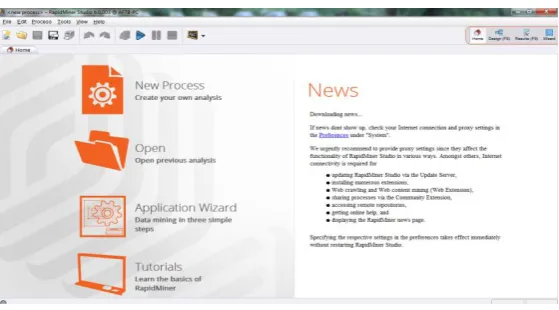
RapidMiner (YALE)By scientists from Yale University in the United States was developed using Java language. RapidMiner (previously: Rapid-I, YALE) is a mature, Java-based, general DM tool currently in development by the company RapidMiner, Germany. Previous versions (v. 5 or lower) were open source. RapidMiner also offers the option of application wizards that construct the process automatically based on the required project goals (e.g. direct marketing, churn analysis, sentiment analysis).
Figure 1 : RapidMiner Application Menu
ii) WEKA
Figure 2 : WEKA Application Menu
IV. APRIORI ASSOCIATION ALGORITHMS
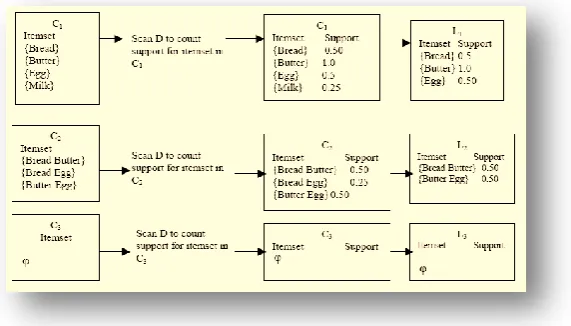
The Apriori algorithm developed by[1] is a great achievement in the history of mining association rules. It is by far the most well-known association rule algorithm. This technique uses the property that any subset of a large itemset must be a large itemset. Also, it is assumed that items within an itemset are kept in lexicographic order. The Apriori generates the candidate itemsets by joining the large itemsets of the previous pass and deleting those subsets which are small in the previous pass without considering the transactions in the database. By only considering large itemsets of the previous pass, the number of candidate large
itemsets is significantly reduced.
Figure 3 : Discovering Large Itemsets using the Apriori Algorithm
Function count(C: a set of itemsets, D: database)
begin
for each transaction T D="Di do begin forall subsets x T do
if x C then
x.count++;
end end
Algorithm . Apriori
Input:
I, D, s
Output:
L
Algorithm:
//Apriori Algorithm proposed by Agrawal R., Srikant, R. [1] //procedure LargeItemsets
1) C 1: = I; //Candidate 1-itemsets
2) Generate L1 by traversing database and counting each occurrence of an attribute in a transaction;
3) for (k = 2; Lk-1≠ φ; k++) do begin //Candidate Itemset generation
//New k-candidate itemsets are generated from (k-1)-large itemsets 4) Ck = apriori-gen(Lk-1);
//Counting support of Ck 5) Count (Ck, D)
6) Lk = {c Ck | c.count ≥ minsup} 7) end
9) L = kLk
i) Apriori-TID: Apriori-TID uses the Apriori’s candidate generating function to determine candidate itemsets before the beginning of a pass. The main difference from Apriori is that it does not use the database for counting support after the first pass. Rather, it uses an encoding of the candidate itemsets used in the previous pass denoted by Ck . In Apriori-TID, the candidate itemsets in Ck are stored in an array indexed by TIDs of the itemsets in Ck. Each Ck is stored in a sequential structure. In the kth pass, Apriori-TID needs memory space for Lk-1 and Ck during candidate generation. It was also found that Apriori-TID outperforms Apriori when there is a smaller number of Ck sets, which can fit in the memory and the distribution of the large itemsets has a long tail. That means the distribution of entries in large itemsets is high at early stage.
V.
IMPLEMENTATION AND PERFORMANCE EVALUATION
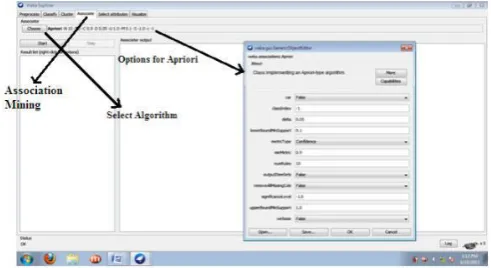
While implementing Apriori algorithm such as spend a large overhead to deal with large candidate set, many repeat comparison of itemset in join step and repeatedly scanning the transaction database requires a lot of I/O load etc. Hence to analyze the algorithm in depth, we have used WEKA tool, which is build for various kind of data mining algorithms and in respected research area.
Figure 4: Finding the association Rule
i)
Implementation of Apriori Algorithm: To perform the Apriori algorithm, the best open source data mining tool is Weka, which is developed at the University of Waikato, New Zealand, first we retrieve the dataset that is already exist in weka tool, by which we could perform the algorithms and analyze the objectives.Figure 5: Apriori Algorithm with different properties in Weka
ii) Implementation of Filter Associator
To perform the Filter Associator, we have to do same procedure as Apriori algorithm i.e. just select the Filter Associator in place of Apriori algorithm. After taking the value of support and confidence, the execution of Filter Associator is done by clicking the “Start” button and according to that it generates the best association rules.
iii) Performance Evaluation of Apriori algorithm and Filter Associator
Figure 6: Performance of Apriori and Filtered Associator algorithms
VI. CONCLUSION
Conclusion
In this paper we have discussed various association rule algorithms and compared two algorithms: Apriori algorithm and Filter Associator. We have analyzed the frequent itemsets generation and number of cycle performed over the Apriori algorithm and Filter Associator in the context of association analysis. According to the comparison of above two algorithms on weka tool, we conclude that Filter Associator is efficient algorithm than Apriori algorithm based on above two factors (Number of cycle performed, large itemsets) because the Apriori algorithm generates more number of cycle performed and generate extra large itemsets which degrades the performance of algorithm.
Future Recommendations
Some of the future enhancements of the thesis are presented below:
• The work presented in the thesis can be extended for multi-level association rule mining.
• The work can be enhanced to generate multi-dimensional association rules.
• A tool for generating association rules can be developed. This tool can choose the approach for frequent itemsets mining according to the properties of the dataset to be mined.
REFERENCES
1. Agrawal, R. and Srikant, R. 1994. Fast algorithms for mining association rules. In Proc. 20th Int. Conf. Very Large Data Bases, 487-499.
2. A. Savasere, E. Omiecinski, and S. Navathe. An efficient algorithm for mining association rules in large databases. Proceedings of the 21st International Conference on Very large Database,1995.
Series1, 9 0 2 4 6 8 10 12 upper boundsupport
Apriori algorithm (Number of cycle performed)Filter Associator (Number of cycle performed)
3. Anurag Choubey, Ravindra Patel, J.L.Rana, “A Survey of Efficient Algorithms and New Approach for Fast Discovery of Frequent itemset for Association Rule Mining”, IJSCE ,ISSN: 2231-2307, vol. 1, issue 2,May 2011.
4. Dr. Varun Kumar, Anupama Chadha, “Mining Association Rules in Student’s Assessment Data”, IJCSI International Journal of Computer Science Issues, Vol. 9, Issue 5, No 3, September 2012.
5. Du Ping, Gao Yongping, “ A New Improvement of Apriori Algorithm for Mining Association Rules”, International Conference on Computer Application and System Modeling (ICCASM 2010), Vol. 2, 529-532.
6. Farah Hanna AL-Zawaidah, Yosef Hasan Jbara, “An Improved Algorithm for Mining Association Rules in Large Databases”, World of Computer Science and Information Technology Journal (WCSIT), ISSN: 2221-0741 Vol. 1, No. 7, 311-316, 2011.
7. Hassan M. Najadat, Mohammed Al-Maolegi, Bassam Arkok, “An Improved Apriori Algorithm for Association Rules”, International Research Journal of Computer Science and Application Vol. 1, No. 1, June 2013, PP: 01 – 08.
8. H.Toivonen, “Sampling large databases for association rules”. In Proc. 2006 Int. Conf. Very Large Data Bases(VLDB'06),pages 134-145, Bombay, India, Sep.2006.
9. Hu Ji-ming, Xian Xue-feng. “ The Research and Improvement of Apriori for association rules mining”, Computer Technology and Development 2006 16(4) pp. 99-104.
10. Jiao Yabing, “Research of an Improved Apriori Algorithm in Data Mining Association Rules”, International Journal of Computer and Communication Engineering, Vol. 2, No. 1, January 2013.
11. J. Han and M. Kamber. Data Mining: Concepts and Techniques. Morgan Kaufmann, 2000.
12. Jaishree Singh, Hari Ram, Dr. J.S. Sodhi, “Improving Efficiency of Apriori Algorithm Using Transaction Reduction ”, International Journal of Scientific and Research Publications, Volume 3, Issue 1, January 2013.
13. Li Qingzhong , Wang Haiyang, Yan Zhongmin, “Efficient mining of association rules by reducing the number of passes over the database”, Computer Science and Technology, 2008, pp. 182-188.
14. L. Klemetinen, H. Mannila, P. Ronkainen, et al. (1994) “Finding interesting rules from large sets of discovered association rules”. Third International Conference on Information and Knowledge Management pp. 401-407.Gaithersburg, USA.
15. Li Yang, Mustafa Sanver; Mining Short Association Rules with One Database Scan; Int'l Conf. on Information and Knowledge Engineering; June 2004.