Volume 2007, Article ID 40154,15pages doi:10.1155/2007/40154
Research Article
Constructing Battery-Aware Virtual Backbones in
Wireless Sensor Networks
Chi Ma,1Yuanyuan Yang,2and Zhenghao Zhang3
1Department of Computer Science, Stony Brook University, Stony Brook, NY 11794, USA
2Department of Electrical and Computer Engineering, Stony Brook University, Stony Brook, NY 11794, USA
3Department of Computer Science, Carnegie Mellon University, 5000 Forbes Avenue, Pittsburgh, PA 15213-3891, USA
Received 14 October 2006; Accepted 13 March 2007
Recommended by Lionel M. Ni
A critical issue in battery-powered sensor networks is to construct energy efficient virtual backbones for network routing. Recent study in battery technology reveals that batteries tend to discharge more power than needed and reimburse the over-discharged power if they are recovered. In this paper we first provide a mathematical battery model suitable for implementation in sensor networks. We then introduce the concept of battery-aware connected dominating set (BACDS) and show that in general the minimum BACDS (MBACDS) can achieve longer lifetime than the previous backbone structures. Then we show that finding a MBACDS is NP-hard and give a distributed approximation algorithm to construct the BACDS. The resulting BACDS constructed by our algorithm is at most (8 +Δ)opt size, whereΔis the maximum node degree and opt is the size of an optimal BACDS. Simulation results show that the BACDS can save a significant amount of energy and achieve up to 30% longer network lifetime than previous schemes.
Copyright © 2007 Chi Ma et al. This is an open access article distributed under the Creative Commons Attribution License, which permits unrestricted use, distribution, and reproduction in any medium, provided the original work is properly cited.
1. INTRODUCTION
A sensor network is a distributed wireless network which is composed of a large number of self-organized unattended sensor nodes [1–3]. Sensor nodes, which are small in size and communicate untethered in short distance, consist of sens-ing, data processsens-ing, and communication components with limited battery supply. Applications of sensor networks range from outer-space exploration, medical treatment, emergency response, battlefield monitoring to habitat, and seismic ac-tivity monitoring. A typical function of sensor networks is to collect data in a sensing environment. Usually the sensed data in such an environment is routed to a sink, which is the central unit of the network [4–6]. Although a sensor net-work does not have a physical infrastructure, a virtual back-bone can be formed by constructing aconnected dominating set (CDS) [7–9] in the network for efficient packet routing, broadcasting, and data propagating.
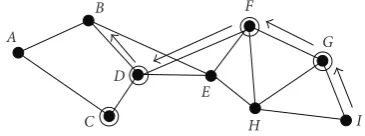
In general, a sensor network can be modeled as a graph G=(V,E), whereVandEare the sets of nodes and edges in G, respectively. A CDS is a connected subgraph ofGwhere all nodes inGare at most one hop away from some node in the subgraph.Figure 1shows a CDS for a given sensor network.
In this example, packets can be routed from the source (node I) to a neighbor in the CDS (nodeG), along the CDS back-bone to a dominating set member (nodeD), which is closest to the destination (nodeB), and then finally to the destina-tion. A node in the CDS is referred to as adominator, and a node not in the CDS is referred to as adominatee. There has been a lot of work that dedicates to construct a
mini-mum connected dominating set(MCDS) which is a CDS with
A
B
C D
E F
G
H I
Figure 1: The minimum connected dominating set (MCDS) {C,D,F,G}forms a backbone for the sensor network. A packet is forwarded from nodeIto nodeBby the backbone.
the real sensor batteries [16–19]. Recent study on battery be-havior reveals that, unlike what we used to believe, batteries tend to discharge more power than needed, and reimburse the over-discharged power later if they have appropriate rests [16–18]. The process of this reimbursement is referred to as
battery recovery. In this paper, we will present a mathemati-cal battery discharging model, which is independent of bat-tery chemistry. This model can accurately model the batbat-tery discharging/recovery behavior with online computable func-tions for implementing in wireless ad hoc networks. Based on this model, we will introducebattery-aware connected
domi-nating set(BACDS) and show that the BACDS can achieve
better network performance than the MCDS.
The rest of the paper is organized as follows. InSection 2, we discuss some background and related work to place our work in context. We study the mathematical battery model in detail and present a simplified model suitable for sensor network applications in Section 3.Section 4 first gives the BACDS model along with its performance comparison with the MCDS model, then presents a distributed approximation algorithm to construct the BACDS. We also analyze the per-formance of the algorithm and give an upper bound on the size of the BACDS obtained in this section. Finally, we give simulation results inSection 5 and concluding remarks in Section 6.
2. BACKGROUND AND RELATED WORK
Before constructing the battery-aware CDS, in this section, we provide some background on battery models and existing CDS construction algorithms.
2.1. Modeling battery discharge behavior
The most commonly used batteries in wireless devices and sensors are nickel-cadmium and lithium-ion batteries. In general, a battery consists of cells arranged in series, paral-lel, or a combination of both. Two electrodes: an anode and a cathode, separated by an electrolyte, constitute the active material of each cell. When the cell is connected to a load, a reduction-oxidation reaction transfers electrons from the an-ode to the cathan-ode. To illustrate this phenomenon,Figure 2 shows a simplified symmetric electrochemical cell. In a fully charged cell (Figure 2(a)), the electrode surface contains the maximum concentration of active species. When the cell is connected to a load, an electrical current flows through the
external circuit. Active species are consumed at the electrode surface and replenished by diffusion from the bulk of the electrolyte. However, this diffusion process cannot keep up with the consumption, and a concentration gradient builds up across the electrolyte (Figure 2(b)). A higher load elec-trical current I results in a higher concentration gradient and thus a lower concentration of active species at the elec-trode surface [20]. When this concentration falls below a cer-tain threshold, the electrochemical reaction can no longer be sustained at the electrode surface and the charge is un-available at the electrode surface (Figure 2(e)). However, the unused charge is not physically “over-consumed,” but sim-ply unavailable due to the lag between the reaction and the diffusion rates. If the battery current I is reduced to zero or a very small value, the concentration gradient flattens out after a sufficiently long time, reaching equilibrium again (Figure 2(c)). The concentration of active species near the electrode surface following this recovery period makes un-used charge available again for extraction (Figure 2(d)). We refer to the unused charge asdischarging loss. Effectively re-covering the battery can reduce the concentration gradient and recover discharging loss, hence, prolong the lifetime of battery (Figure 2(f)). Experiments on nickel-cadmium bat-tery and lithium-ion batbat-tery show that the discharging loss might take up to 30% of the total battery capacity [19]. Hence, precisely modeling battery behavior is essential for optimizing system performance in sensor networks.
Researchers have developed high-level mathematical models that capture the battery behavior and are indepen-dent of battery chemistry [17–19]. An analytical battery model was proposed in [19], however, this model requires long computing time and large precomputed look up ta-bles. We therefore provided a discrete time battery model in [17,18] with online computable functions. This model splits the time into discrete time slots with a fixed slot length and is suitable for packetized ad hoc networks. We will discuss this model in more detail inSection 3.
2.2. Distributed algorithms for MCDS construction
Electrolyte Electrode
Electroactive species
(a) Fully charged state
Electrolyte Electrode Diffusion Consumption
Electroactive species
(b) In discharging
Electrolyte Electrode Diffusion
Electroactive species
(c) In recovery
Electrolyte Electrode
Electroactive species
(d) After recovery
Electrolyte Electrode
Electroactive species
Discharging loss Battery dies as no species
reaches the electrolyte
(e) Battery dies with discharging loss
Electrolyte Electrode
Energy fully consumed
(f) Battery dies without discharging loss
Figure2: Battery operation at different states.
ratio ofO(logΔ) for a general graph. However, these algo-rithms are centralized algoalgo-rithms, which makes their appli-cations quite limited.
Distributed algorithms for CDS constructions have been proposed in recently years. They can be categorized as WCDS-based, Pruning-based and MIS-based, approaches. In these distributed algorithms, each node in the network is assigned a unique ID. Theweakly connected dominating set
(WCDS) is a dominating set of graphGsuch that WCDS and its neighbors induce a connected subgraph ofG. In a WCDS, the nodes are partitioned into a set of cluster heads and clus-ter members, such that each clusclus-ter member is within the ra-dio range of at least one cluster head. In the algorithm pro-posed in [23], nodes elect their neighbor with the lowest ID as their cluster head. Whenever a node with a lower ID moves into the range of a cluster head, it becomes the new cluster head. A problem of this algorithm is that the cluster structure is very unstable: when a lower ID node moves in, a cluster
may break into many subclusters. Apparently, this reorgani-zation is unnecessary in many situations.
Pruning-based approaches construct a CDS first and then prune the redundant nodes from this CDS [9]. In a pruning-based algorithm, any node having two disconnected neighbors is marked as a dominator. The redundant domi-nator set is post-processed by pruning nodes out of the CDS. The closed neighbor set of nodeuis defined as the set ofu’s neighbors plusuitself. A nodeuis pruned out if there exists a nodevwith higher ID such that the closed neighbor set of uis a subset of the closed neighbor set ofv. Unfortunately, the theoretical bound on the resulting CDS obtained by this algorithm remains unspecified.
Minimum independent set(MIS) is an independent set
References [13,15] gave an algorithm for unit disk graphs with performance bounds. It first constructs a rooted span-ning tree inG, then a labeling process begins from the root to the leaves by broadcasting “Dominator/Dominatee” mes-sages to form the MIS. The final phase connects the nodes in the MIS to form a CDS. The algorithm has time and mes-sage complexities of O(n) and O(nlogn), respectively, for ann-node graph. The resulting CDS has a size of at most 8 optMCDS. Reference [14] presented a multileader MIS-based algorithm by rooting the CDS in multiple sources. Its perfor-mance ratio is 192|optMCDS|+ 8.
All the existing MCDS algorithms assume that the bat-tery discharging of a sensor node is linear. This is a rough assumption as shown inSection 2.1, and it does not necessar-ily guarantee the optimal network performance from an en-ergy efficient point of view. In the following sections we will introduce an accurate battery model to describe the battery discharging behavior. Then we will use this battery model to construct energy efficient virtual backbones in wireless sen-sor networks.
3. BATTERY DISCHARGING MODELS
The battery discharging model presented in [17,18] is an online computable model for general ad hoc wireless net-works. In this section, we further reduce the computational complexity to make it implementable in sensor networks. We assume that a battery is in discharging during time [tbegin,tend] with currentI. The consumed powerαis
calcu-wheretis the current time andβis a constant parameter. The right-hand side of (1) contains two components. The first term,I×(tend−tbegin), is simply the energy consumed in de-vice during [tbegin,tend]. The second term is the discharging loss in [tbegin,tend] and it decreases astincreases. The con-stantβ(> 0) is an experimental chemical parameter which may be different from battery to battery. In general, the larger theβ, the faster the battery diffusion rate, hence, the less the discharging loss.
In ad hoc networks, currentI is a continuous variable for various applications such as operating systems, multi-media transmission, word processing, and interactive games. However, in sensor networks, the simple sensing and data propagating activities of sensor nodes may only require sev-eral constant currents [24]. We define the constant currents of dominator nodes and dominatee nodes asId andIe,
re-spectively. A dominator needs to keep active and listen to all channels at all times. Compared withId, theIe of a
domi-natee is very low. We divide the sensor lifetime into discrete time slots with slot lengthδ. In each time slot, the battery of a node is either as a dominator (I =Id) or a dominatee
Figure3: The discharging of a sensor battery. (a) The node is a dominator in slots 1 and 5 and dominatee in slots 2, 3, 4, and 6. (b) The capacityζ1(t) is discharged in slot 1 and recovered gradually in
the following slots.ζ1(t) after slot 6 is ignored. If this battery dies in
slot 5,ζ1(4δ) is permanently lost. (c) The recovery table records the
recovery statusκiatm=4. The 0 and 1 in the current column stand
We can see thatζn(t) is recovered gradually in the
follow-ing (n+1)th, (n+2)th,. . .slots untilt. It should be mentioned that discharging lossζn(t) is only a potentially recoverable
energy. InFigure 3, if the battery dies at the 5th slot, the en-ergyζ1(4δ),. . .,ζ4(4δ) do not have a chance to be recovered. Thus, the battery permanently loses them. At timet, the gross discharging loss energy of this battery is
ζ(t)= tery is recovered. To be aware of the battery recovery status, ζ(t) needs to be calculated at each slot. However, the com-putation can be simplified by observing thatζi(t) decreases
exponentially astincreases. Naturally,ζi(t) can be ignored if ζi(t) is less than a small amount of powerc, where cis the
Table1: The maximum size of the recovery table (β=0.4).
c/Id 1200 mA 800 mA 400 mA 100 mA
200 mAmin 1 2 3 4
400 mAmin 2 3 3 5
600 mAmin 3 3 4 6
800 mAmin 3 4 5 6
ζi(κiδ)< c < ζi((κi−1)δ), that is, aftert = κiδ,ζi(t) is
ig-nored. We have
κi=
1 β2δlog
π21−e−β2δ
3β2c/Ii
, (4)
whereIi=IdorIe. We maintainκiin a recovery table. At the mth slot, ifκi<(m−i), which indicates thatζi(mδ)< c, then
this entryiis removed from the table. An example is given in Figure 3(c) where the second entry is about to be removed.
Introducing this recovery table has several advantages and is also feasible for sensor networks. First, we can reduce the computational complexity of battery-awareness. Only the remained entries in the table are used for computing ζ(t). Now (3) can be rewritten as
ζ(t)=
j
ζj(t), (5)
where entryjis the entry remained in the recovery table. Sec-ond, we can reduce the complexity of table maintenance. In order to check whether an entry needs to be removed, rather than calculatingζi(t) for everyiat each time, we only need
to readκifrom the table and compare it withm. Becauseκi
is computed once, maintaining the recovery table is simple. Third, the size of the table is feasible for sensor memory. Ac-cording to (4) and (5), the total entries in the recovery ta-ble are no more than (1/β2δ) log(π2(1−e−β2δ
)/3β2c/I
d).
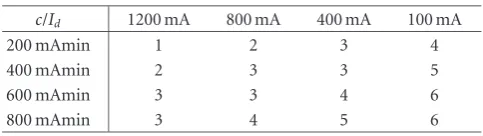
For various possible values of Id and cof sensors, Table 1
shows the maximum number of entries in a recovery table (β=0.4). Considering that the memory capacity of today’s sensor node is typically larger than 512 KB [25,26], it is ac-ceptable to store and maintain such a recovery table in sensor memory. Thus, we can reduce the computational complexity by maintaining a recovery table on a sensor node with a fea-sible table size.
In summary, in this section we use the battery model to achieve battery-awareness by capturing its recoveryζ(t). The lower theζ(t), the better the sensor node is recovered at time t. We introduce the recovery table to reduce the computa-tional complexity. We also show that maintaining such a table is feasible for today’s sensor nodes. Next we apply this battery model to construct the BACDS to prolong network lifetime.
4. BATTERY-AWARE CONNECTED DOMINATING SET
In this section, we first introduce the concept of battery-aware connected dominating set (BACDS), and show that
MCDS algorithm: Repeat
Every nodeiwithPresidual(i)≥Pthresholdis marked asqualified;
All other nodes are marked asunqualified;
CallMCDS construction algorithmfor allqualifiednodes; If successful, use the MCDS constructed as the backbone; Otherwise report “no backbone can be formed” and exit; UntilSome dominatorjhasPresidual(j)< Pthreshold; BACDS algorithm:
Repeat
Every nodeiwithPresidual(i)≥Pthresholdis marked asqualified;
All other nodes are marked asunqualified;
CallBACDS construction algorithmfor allqualifiednodes; If successful, use the BACDS constructed as the backbone; Otherwise report “no backbone can be formed” and exit; Untilδtime has elapsed or some dominatorjhas
Presidual(j)< Pthreshold;
Algorithm1: Outline of MCDS and BACDS algorithms for form-ing a virtual backbone.
the BACDS can achieve better network performance. Then we provide a distributed algorithm to construct BACDS in sensor networks.
4.1. Battery-aware dominating
Let the sensor network be represented by a graphG=(V,E) where|V| =n. For each pair of nodesu,v∈V, (u,v)∈Eif and only if nodesuandvcan communicate in one hop. The maximum node degree inGisΔ. Each nodevis assigned a unique IDv.Presidual(v) isv’s residual battery power.Pthreshold is the threshold power adopted in CDS construction algo-rithms. ζv(t) is the discharging loss ofvat time t. For any
subsetU⊆V, we defineζU
max=max{ζv(t)|v∈U}. Next we explain how to use the battery model to con-struct an energy-efficient dominating set in a sensor network. Intuitively, longer network lifetime can be achieved by always choosing the “most fully recovered” sensor nodes as domina-tors. For a graphG=(V,E) at timet, we define a BACDS as a setSB(⊆V) such that
SBis a CDS ofG, ζmaxSB =min
ζmaxS |Sis a CDS ofG
. (6)
An optimal BACDS is a BACDS with a minimum number of nodes and is denoted as MBACDS. For notational conve-nience, we let
ζBACDS≡minζS
max|Sis a CDS ofG
. (7)
0 10 20 30 40 50 60 70 Network lifetime under BACDS and MCDS models
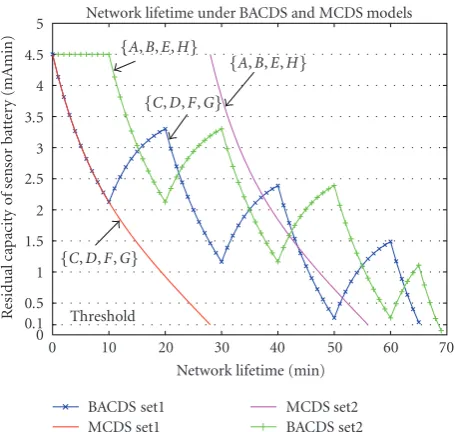
Figure4: The sensor network inFigure 1achieves longer lifetime using the BACDS model than the MCDS model. The results were simulated with the battery discharging model. In this case, the net-work lifetime is prolonged by 23.2% in the BACDS model.
A
Figure5: The battery-aware connected dominating set (BACDS) for the network inFigure 1att =10 minutes. Theζi(t) for each nodeiis listed above.
algorithms for forming a virtual backbone in a sensor net-work, where nodeiis qualified to be selected as a dominator as long as its residual battery powerPresidual(i) is no less than the threshold powerPthreshold.
We conducted simulations to compare the two algo-rithms.Figure 4shows the simulated lifetime under BACDS and MCDS models for the network in Figure 1. At the beginning, all nodes are identical with battery capacityC = 4.5×10⁴mAmin and β = 0.4. The discharging currents areId = 900 mA andIe = 10 mA. An MCDS is chosen as
Set1 = {C,D,F,G}(Figure 1). Since MCDS does not con-sider the battery behavior, Set1 remains as the dominator until the power of all nodes in Set1 drops to a threshold 0.1×10⁴mAmin. After that, another MCDS is chosen as
Set2 = {A,B,E,H}. After Set2 uses up its power, no node
in the network is qualified as a dominator. The total network lifetime is 56 min (Figure 4).
On the other hand, in the BACDS model a CDS is formed by the nodes with minimumζ(t)s. The network reorganizes
(1) Find a subset SET+inG;
Algorithm2: The outline of the BACDS construction.
the BACDS for everyδ time. Suppose at the beginning the BACDS is still Set1 = {C,D,F,G}. Afterδ = 10 min, the power of nodes in Set1 is reduced to 2.1×10⁴mAmin. At this time, a new BACDS is chosen as Set2 = {A,B,E,H} (Figure 5). During the next 10 minutes, Set2 dissipates the power to 2.1×10⁴mAmin while Set
1 recoveries its nodes’ power from 2.1×10⁴mAmin to 3.35×10⁴mAmin. Then the BACDS is organized again. As shown in Figure 4, the total network lifetime in the BACDS model is 69 minutes, which is 23.2% longer than the MCDS model.
We have seen that BACDS can achieve longer lifetime than MCDS. Next we will consider the BACDS construction algorithm.
4.2. Formalization of BACDS construction problem
The BACDS construction problem can be formalized as fol-lows: given a graphG=(V,E) andζi(t) for each nodeiinG,
find an MBACDS. For simplicity, we useζto denoteζ(t) in the rest of the paper. First, we have a theorem regarding the NP-hardness of the problem.
Theorem 1. Finding an MBACDS inGis NP-hard.
Proof. Consider a special case that all nodes in Ghave the sameζvalues. In this case, finding an MBACDS inGis equiv-alent to finding an MCDS inG. Since the MCDS problem is NP-hard, the MBACDS problem is also NP-hard.
Now since the MBACDS construction is NP-hard, we will construct a BACDS by an approximation algorithm. By def-inition, the BACDS to be constructed, SB, must satisfy the
following two conditions: (i)ζSB
max =ζBACDS; (ii)SBis a CDS
ofG. Also, the size ofSBshould be as small as possible.
Our algorithm is designed to find a set to satisfy these conditions. To satisfy condition (i), the algorithm finds a subset SET+ in G, such that for any subset S(⊆ SET+), ζS
max≤ζBACDS. We will prove that, as long as a setS(⊆SET+) is a CDS ofG, we can guarantee thatζS
max=ζBACDS.
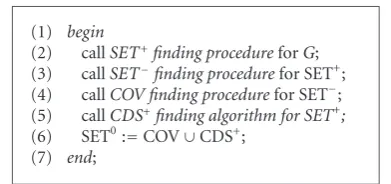
We now show that SET0 = COV∪CDS+ is indeed a BACDS.
Theorem 2. SET0=COV∪CDS+is a BACDS.
Proof. We first define SET+as
SET+=v∈V|ζv≤ζBACDS. (8)
We know that CDS+ is a CDS of SET+and COV dominates the nodes inV−SET+. To prove SET0=COV∪CDS+ is a BACDS, we need to show that set SET0is a connected domi-nating set ofG, andζSET0
max is minimized.
First, we show that SET0 is connected. Because COV ⊆ SET+, every node in COV is at most one hop away from CDS+. Also, since CDS+is connected, SET0=COV∪CDS+ is connected.
Second, we prove that SET0 is a dominating set of G. Since CDS+ is a CDS of SET+, all nodes in SET+are domi-nated by CDS+. Also, since all nodes inV−SET+are covered by COV, SET0=COV∪CDS+is a dominating set ofG.
Finally, we show thatζSET0
max is minimized, that is,ζSET 0
In summary, in this subsection we have shown that we can construct a BACDS by finding three subsets SET+, COV, and CDS+ step by step. Then SET0 = COV∪CDS+ is a BACDS. Next we will give the algorithms to construct SET+, COV, and CDS+.
4.3. A distributed algorithm for BACDS construction
Our algorithm for BACDS construction consists of three pro-cedures for constructing SET+ and COV inG. In the algo-rithm, we useN(v) to denote the set of neighbor nodes of v. each node is colored in one of the three colors: black, white, and gray.Nblack(v),Nwhite(v), andNgray(v) are the sets of black, white, and gray neighbors ofv, respectively. Also we use sets listgray(i) and list(i) to store the neighbor information for nodei.
First we consider the construction of SET+. To find SET+, we do the following: theζiof each nodeiinGis collected in
the sink; then the sink calculatesζSET+
max and broadcasts it in a beacon; on receiving the beacon, all nodes withζi ≤ζSET+ max form set SET+. The procedure is described inAlgorithm 3. Initially, all nodes inGare colored gray. Then the algorithm colors some gray nodes black. In the end, the set of black nodes is SET+.
Note that in SET+finding procedure, the sink collects in-formation from sensors only once, and broadcasts theζSET+ max in a single beacon. The overhead of information collecting and broadcasting is minimum.
Now we consider the construction of COV. This problem of constructing a minimum size COV can be formulated as the following given two graphsG1andG2. Nodes inG1and
G2are interconnected with edges. A minimum size COV is to be found inG1such thatG2⊆N(G1). We show that finding a
(1) All nodes inGare colored gray;
(2) Each gray nodeiin the network does the following: (3) begin
(4) Broadcast a packet which includes its IDi; (5) Receive neighbors’ IDs;
max thennodeiis colored black;
(10) end;
(11) The sink does the following: (12) begin/∗CalculateζSET+
max ∗/
(13) Collect packets from sensor nodes; (14) S0:= {ζi|i=1, 2,. . .,n};
(25) elsereport “no CDS can be found” (26) end;
SET+:= {black nodes};
Algorithm3: SET+finding procedure.
minimum size COV is NP-hard even in an UDG graph. If we can show that this problem is NP-hard in an UDG, it is clear that this problem is also NP-hard in a general graph. We have the following theorem regarding its NP-hardness.
Theorem 3. Finding a minimum COV in an UDG is NP-hard.
Proof. To see this, we use the fact that it is NP-hard to find a minimum dominating set in an UDG. Given any UDG instance, say,G, which has vertex setV = {v1,v2,. . .,vn},
are geographically close enough such thatvi has the same
set of neighbors as vi. Then let G1 = {v1,v2,. . .,vn} and G2 = {v1,v2,. . .,vn}. We will find the COV inG1, whereG2 is the set of vertices to be covered. It is not hard to see that the optimal solution to the COV problem in the new UDG is also a minimum dominating set in the original UDG. Be-cause constructing a minimum dominating set in UDG is an NP-hard problem [15], the problem of finding COV is there-fore NP-hard.
An approximation algorithm to construct a COV has been given in [27]. Initially,S1 =SET−andS2=V−SET+. This algorithm greedily selects nodeiinS1such that|N(i)∩
11
3
15
17 5
6
3 21
0 A
B
C D
E F
G
H I
(a)
A
B C
D
E
F
G H
I SET+
V−SET+
SET−
(b)
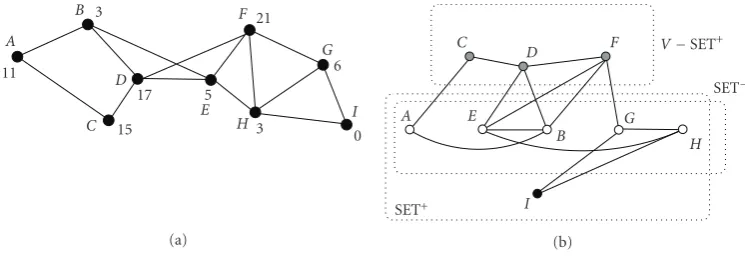
Figure6: Constructing SET+and SET−in graphG. (a) Nodes are associated with theirζvalues. (b) SET+and SET−in (a).
(1) SET−:= ∅;
(2) Each nodei∈SET+does the following:
(3)begin
(4)if ∃j∈N(i) and j∈(V−SET+)then (5) SET−:=SET−∪ {i};
(6)end;
Algorithm4: SET−finding procedure.
are removed fromS2, respectively. This algorithm can finally obtain a COV with|COV| ≤log(|SET−|). However, this ap-proximation algorithm is difficult to be implemented in our scenario, because it is a centralized algorithm. At each step, this algorithm has to select a node with a maximum num-ber of neighbors, which requires the collection and analysis of global information. Next we will present a distributed al-gorithm to construct a COV. In our alal-gorithm, nodes only need to know neighbors at most 2 hops away.
Since COV(⊆SET+) is a cover ofV−SET+, to find COV, we only need to consider the nodes which are one hop away fromV−SET+. We use SET−to denote these nodes. SET−is defined as
SET−=v∈SET+| ∃u∈V−SET+, (u,v)∈E. (9)
Figure 6gives the SET+and SET−for a given sensor network with their associatedζvalues. SET−can be found by the pro-cedure described inAlgorithm 4.
Now we construct COV from SET−. COV can be ob-tained as follows. Initially, COV = ∅,S1 = (V −SET+). Then, for nodev ∈S1 with the lowest ID number, add all nodesu∈SET−to COV, whereuandvare one hop neigh-bors. Then we removeN(u)∩S1 fromS1. Repeatedly do-ing so untilS1 is empty. Then we obtain set COV. The lo-calized procedure for finding COV from SET− is described inAlgorithm 5. There are three colors used to color a node: white, black, and gray. Initially, nodes in SET− are colored white and nodes inV−SET+are colored gray. Then the pro-cedure colors some white nodes black. In the end, the set of
(1) Each nodes in SET−∪(V−SET+) does the following:
(2) begin
(3) Nodes in SET−are colored white; (4) Nodes inV−SET+are colored gray; (5) COV := ∅;
(6) Each gray nodeibroadcasts IDito its white neighbors
Nwhite(i);
(7) Each white nodejadds the received IDs to a set listgray(j) and broadcasts listgray(j) to its gray neighbors
Ngray(j);
(8) Each gray nodeidoes the following: (9) begin
(10) Receive all listgray(Nwhite(i));
(11) list(i) := ∪listgray(Nwhite(i));
(12) whilelist(i)= ∅do
(13) if IDi=min{id|id∈list(i)}then (14) BroadcastaddblacktoNwhite(i);
(15) list(i) := ∅;
(16) else if blackmessage is receivedthen (17) broadcastremovetoNwhite(i); (18) list(i) := ∅;
(19) else if update(k) message is receivedthen (20) list(i) :=list(i)− {k};
(21) end while; (22) end;
(23) Each white nodejdoes the following: (24) begin
(25) whilelistgray(j)= ∅do
(26) if addblackmessage is receivedthen (27) Color itself black;
(28) listgray(j) := ∅;
(29) BroadcastblacktoNgray(j);
(30) else if removemessage is received fromkthen (31) Broadcastupdate(k) toNgray(j);
(32) listgray(j) :=listgray(j)− {k};
(33) end while; (34) end; (35) end;
COV := {black nodes};
Algorithm5: COV finding procedure.
A B C D E F G H I
{3} {2}
{1}
3 2
1 V−SET+ SET−
Figure7: The size of finding COV is at mostΔoptc. optcis the size of an optimal cover.
Our algorithm only requires at most 2-hop information to construct the COV. We now prove the correctness of the
COV Finding Procedure. We will show that the COV found
by this procedure is a cover ofV−SET+. We will also give an upper bound on the size of set COV.
Lemma 1. Set COV found by COV finding procedure covers
V−SET+. Its size|COV|is at mostΔoptc, whereΔis the max-imum node degree ofGandoptcis the size of an optimal cover. Proof. By contradiction. Suppose when theCOV finding pro-cedure terminates, there exists a gray node i which is not covered by COV. It indicates thatN(i)∩COV= ∅, which meansN(i)∩SET−is not colored black. SinceN(i)∩SET− is not colored black, all nodes inN(i)∩SET−should receive removemessages fromi, otherwise their listgray= ∅and the procedure does not terminate. However,ibroadcastsremove message if and only if one of its white neighbors is colored black. Thus,N(i)∩COV = ∅, which is a contradiction. Hence, COV is a cover.
Now we consider the size of COV. Initially COV is empty, and we add some nodes to it in later steps. We will show that (i) at each step, at least one node, which belongs to the op-timal cover, is added to COV; and (ii) at each step, at most Δ−1 extra nodes, which do not belong to the optimal cover, are added to the COV. By combining (i) and (ii), we obtain
that|COV|is at mostΔoptc, where optcis the size of an
op-timal cover.
We first consider (i). According to the algorithm, at each step, nodeisendsaddblackmessages toNwhite(i). Therefore, there are at mostΔnodes added to COV in each step. Among theΔnodes there must exist at least one node which is in the optimal cover, because an optimal cover has to cover node i. Next we consider (ii). Since among theΔnodes added to COV there are at least one node belonging to the optimal cover, each time we add at mostΔ−1 extra nodes not be-longing to the optimal cover to COV. Thus,|COV|is at most Δoptc.
The worst case occurs when nodes inV−SET+are not connected by nodes in SET−.Figure 7gives an example of
|COV| =Δoptc. Because node 1 has the lowest ID in list(i)=
{1}, 1 broadcastsaddblack message to its neighbors:A,B,
A {1, 2} B
{2, 3} C
Remove Addblack
Update (2) Black
{2, 3, 4} − {2} 3
{1, 2, 3} 2
{1, 2} 1 4
V−SET+ SET−
Figure8: In the worst case, the complexity of finding COV isO(n− |SET+|+|SET−|). It processes one node in each step.
C; and adds them to COV set. The same thing happens for nodes 2 and 3. Clearly optc = 3. Thus, we have|COV| = Δoptc=9, whereΔ=3 is the maximum degree of nodes in V−SET+.
Now we prove that the COV Finding Procedurecan fi-nally terminates, that is, all listgray(j) and list(i) will finally be empty. We also give the time complexity ofCOV Finding Procedure.
Lemma 2. All listgray(j)and list(i)will finally be empty. COV
finding procedure has time complexity of O(n − |SET+|+
|SET−|).
Proof. First, we show that listgray(j) will finally be empty. Suppose there is a white nodejwhere listgray(j)= ∅. With-out loss of generality, we have a node u1 ∈ listgray(j) with the lowest ID. In this procedure, u1 is the node that col-ors j black. Ifu1 does not sendaddblack to j, there must be a node u2 ∈ list(u1) such that ID(u1) > ID(u2). Then if u2 does not broadcast addblack, there must be a node
u3 ∈ list(u2) such that ID(u2) > ID(u3), and so on. Then we have ID(u1) > ID(u2)> ID(u3) > · · ·. Since there are a finite number of nodes, there must exist a node,uk, such
that ID(uk)=min{id|id∈list(uk)}. The nodeuk should
sendaddblack, which indicates that finally listgray(j) should be empty.
Second, we show that list(i) will finally be empty. By Lemma 1, each gray nodeiis finally covered by some black node, which indicates that all gray nodes receivedblack mes-sages. Therefore, finally list(i) will be∅. In this procedure, because it colors at least one node black in each step, the time complexity isO(n− |SET+|+|SET−|).
Figure 8shows the worst case of theCOV Finding Pro-cedure. With the lowest ID in list(1), node 1 broadcasts addblackmessage. NodeAis colored black and informs node 2 by broadcastingblackmessage. From the right to the left, the procedure adds one node to COV at each step.
(1) begin
(2) callSET+finding procedureforG;
(3) callSET−finding procedurefor SET+; (4) callCOV finding procedurefor SET−; (5) callCDS+finding algorithm for SET+;
(6) SET0:=COV∪CDS+; (7) end;
Algorithm6: The algorithm for finding a BACDS in graphG.
a UDG-based algorithm. However, our BACDS constructing algorithm is not restricted to a UDG. In fact, we can employ any other general graph-based MCDS algorithm to construct CDS+. The complete algorithm for finding a BACDS is given inAlgorithm 6.
Figure 9 gives an example of finding a BACDS. First, SET+ and SET− are found (Figure 9(a)); then COV is con-structed by the algorithm (Figures9(b)–9(e)); finally, CDS+ is found and SET0is formed (Figure 9(g)). In this example, compared with the MBACDS (Figure 9(h)), SET0 contains one more dominator.
In the next subsection, we will analyze the performance of our BACDS construction algorithm and give an upper bound on the size of SET0.
4.4. Complexity analysis of the algorithm
In this subsection, we analyze the approximation ratio, the time complexity, and the message complexity of the algo-rithm. We also consider mobility issues for this algoalgo-rithm. We use opt, optMCDS, optc, and optSETMCDS+ to denote the sizes of MBACDS inG, MCDS inG, the minimum cover in SET−, and the minimum CDS+in SET+, respectively.
Theorem 4. The size of SET0is at most(8 +Δ) opt. The time complexity and the message complexity of the algorithm isO(n)
andO(n(√n+ logn+Δ)), respectively, wherenis the number of nodes inG.
Proof. First, we consider the size of SET0. Note that
MBACDS∩SET− is a cover and|MBACDS| = opt. It in-dicates that
optc≤ MBACDS∩SET− ≤opt. (10)
Since we have proved inLemma 1that|COV| ≤Δoptc, we have
|COV| ≤Δopt. (11)
We employ the MIS-based CDS finding algorithm for CDS+ construction. It can obtain a CDS+ with a size of at most 8 optSET+
MCDS. Thus,
CDS+ ≤8 optSET+
MCDS. (12)
Because constructing an MBACDS needs to consider the ex-tra battery parameter, the size of the MBACDS is no less than optMCDS. Thus, we have
optMCDS≤opt. (13)
Clearly, the size of a minimum CDS+ in SET+ is at most optMCDS because it needs to consider extra nodes in V − SET+. Thus,
optSET+
MCDS≤optMCDS. (14)
By (12), (14), and (13) we obtain
CDS+ ≤8 opt. (15)
Therefore, from (11) and (15) we have
SET0 = COV∪CDS+ ≤(8 +Δ) opt. (16)
Now we analyze the complexity of the algorithm. Our al-gorithm consists of three phases: SET+ and SET− construc-tions, COV construction, and CDS+construction. In the first phase, to find SET+and SET−, each node only needs to prop-agate their messages to the sink and wait for a beacon. A node needs at most√nhops to relay a message to the sink. Hence, the time complexities for sending the message and re-ceiving a beacon areO(√n) andO(1), respectively. The time complexity of the second phase isO(n− |SET+|
+|SET−|) as Lemma 2 shows. The complexity of the third phase is O(|SET+|). Therefore, the total time complexity of the algo-rithm isO(n).
Now we consider the number of messages transmitted. In the first phase, the total number of messages relayed in the network is at mostO(n√n). The beacon hasO(1) message complexity. At the beginning of the second phase, to set up the lists, all white nodes and gray nodes need to send|SET−|
andn− |SET+|messages, respectively. After that, all the gray
nodes send at most|SET−|addblackmessages andΔ|SET−| remove messages. All the white nodes send at mostΔ(n−
|SET+|)
updatemessages, and all the black nodes send no more than|SET−|blackmessages. Thus, in the second phase, there are totally at mostO(nΔ) messages. If we employ the algorithm in [13], the message complexity in the third phase isO(n+nlogn). Hence, the total message complexity of our algorithm isO(n(√n+ logn+Δ)).
{C} C
and have largerζand lower available power. An MCDS con-taining such burden nodes is more likely to be reorganized from time to time whenever any burden node uses up its power. While the metric of our BACDS construction algo-rithm is to balance the power consumption among sensor
v
u
(a)
v u1
u2
(b)
Figure10: Mobility issue of BACDS. (a) A dominator moves away. (b) A new dominator is selected.
Furthermore, compared with MCDS construction algo-rithms, the BACDS algorithm has less overhead even during the construction. Naturally, the BACDS partitions the net-work into different sets: SET+, SET−, COV, and so forth. In each step of the construction, only the sensors in a specified set work on constructing the BACDS, and other sensors turn them into sleep or low-power state to save power. For instance, when constructing COV in SET−, the sensors in SET+−SET−turn to sleep; and when constructing the CDS+, the sensors inV−SET+turn to sleep. Thus, power dissipation is reduced. However, when constructing an MCDS, all sensor nodes have to keep active and listen to their channels all the time, even at the time they do not contribute to the MCDS construction. Consequently, more power is dissipated than the BACDS algorithm.
Our BACDS construction algorithm also considers the mobility issue. By monitoring the sensor mobility and their battery status, it can dynamically adjust the BACDS locally. There are three changes that should be handled to maintain the BACDS: (1) A dominatorv ∈ SET0 moves away from N(v); (2) A new nodevmoves in; (3) A dominator finds out that one of its dominateesvhasζv ≤ζSET+.Figure 10 illus-trates the situation. In case (1), a new dominator must be selected. Since there must exist another dominator nodeuin N(v) to connect the original dominating set, a spanning tree rooted atucan be formed among the nodes inN(v). Nodes in this spanning tree become the new dominators. In both cases (2) and (3), nodevneeds to check if making itself as a new dominator can reduce the size of the BACDS. In our algorithm,vcollects allN(ui) information from its
domina-tor neighbor nodes ui,i = 1, 2,. . .. Nodev is selected as a
new dominator if and only if there are more than oneuisuch
thatN(ui)⊂N(v). Aftervis selected as the new dominator, uiare turned to dominatees. Therefore, all nodes in this
net-work are still dominated by at least one dominator while the size of the BACDS is reduced.
0 20 40 60 80 100 120
Network lifetime (min) 0
10 20 30 40 50 60 70 80 90 100 110
Nu
m
b
er
o
f
n
o
d
es
Number of nodes during network lifetime
No CDS MCDS
SET0
MBACDS
Figure11: Comparing the network lifetime under different models.
0 20 40 60 80 100 120
Network lifetime (min) 0
0.1 0.2 0.3 0.4 0.5 0.6 0.7 0.8 0.9
No
rm
al
iz
ed
p
o
w
er
The average residual power
No CDS MCDS
SET0
MBACDS
Figure12: The average power per node in the network.
5. SIMULATION RESULTS
20 40 60 80 100 120 140 Number of nodes
0 20 40 60 80 100 120
Size
o
f
set
d=6,ζ∈[0, 50]
MBACDS SET+
SET0
SET−
20 40 60 80 100 120 140
Number of nodes 0
20 40 60 80 100 120 140 160
Size
o
f
set
d=6,ζ=[0, 100]
MBACDS SET+
SET0
SET1
20 40 60 80 100 120 140
Number of nodes 0
20 40 60 80 100 120
Size
o
f
set
d=18,ζ∈[0, 50]
MBACDS SET+
SET0
SET−
20 40 60 80 100 120 140
Number of nodes 0
20 40 60 80 100 120
Size
o
f
set
d=18,ζ∈[0, 100]
MBACDS SET+
SET0
SET−
Figure13: The size of constructed sets with differentζandd.
is uniformly randomly distributed in [0, 2×10⁴] (mAmin). For simplicity, we assume that initially the available power of nodeiisCi = 4.5×10⁴mAmin andβi = 0.4 as in the
ex-ample ofFigure 4. The discharging currents areId=900 mA
andIe=10 mA, respectively. We simulated the network
life-time under different models. Our simulation results show that the BACDS achieves longer network lifetime. Their re-organization overheads are also compared. By implementing our BACDS construction algorithm, we also compare the set sizes of SET0 with MBACDS, where the MBACDS of a net-work is computed offline. The simulation results verify the upper bound of SET0inTheorem 4.
Network lifetime
We first compare the network lifetime achieved by MCDS and BACDS. Figure 11 shows the number of nodes
de-creases with respect to the lifetime. Four models: no-CDS, MCDS, MBACDS, and SET0 are implemented. A network without a CDS infrastructure terminates at 30 minutes as all its nodes use up their power. MCDS achieves about 83 minutes total lifetime. MBACDS organizes its dominators every 10 minutes. The lifetime is prolonged by up to 52% in MBACDS model. SET0is the BACDS constructed by our al-gorithm. It obtains a lifetime prolonged up to 30%. We also note that MBACDS terminates with more nodes remained in the network. This is because MBACDS balances the power consumption of each nodes, thus, more nodes are preserved in the network.
Power dissipation
power is the total available power of the network over the number of active nodes. The average power is normalized. MBACDS achieves higher average power during the lifetime. It should be mentioned that at 30 minutes, the average power of MCDS suddenly increases. This is because many of its dominators suddenly die at that time. Consequently, the av-erage power increases as the total number of nodes decreases.
Set size
We implemented our BACDS construction algorithm to ver-ify the upper bound on the set size. The size of the generated network isn = 20,. . ., 140. Four sets are compared: SET+, SET−, SET0, and MBACDS.Figure 13compares the sizes of these sets with a different node degreedand discharging loss ζ. It shows that asdincreases, the sizes of MBACDS and SET0 are reduced. This is due to the larger degree of the domina-tors. While asζincreases its distribution space from [0, 50] to [0, 100], the sizes of MBACDS and SET0increase. The results verify the upper bound of SET0inTheorem 4.
6. CONCLUSIONS
In this paper, we have considered constructing battery-aware energy efficient backbones in sensor networks to improve the network performance. We first gave a simplified battery model in order to accurately describe the battery behavior online and reduce the computational complexity on a sen-sor node. Then by using the battery model, we have showed that an MCDS does not necessarily achieve maximum life-time in a sensor network. We introduced the BACDS model and proved that the minimum BACDS can achieve longer lifetime than the MCDS. We showed that the MBACDS con-struction is NP-hard and provided a distributed approxima-tion algorithm to construct a BACDS in general graphs. We also analyzed the size of the resulting BACDS as well as its time and message complexities. We proved that the result-ing BACDS is at most (8 +Δ) opt size, whereΔis the max-imum node degree and opt is the size of the MBACDS. The time and message complexity of our algorithm areO(n) and O(n(√n+ logn+Δ)), respectively. Our BACDS construction algorithm also considers the mobility issues to dynamically maintain the BACDS backbone. The simulation results show that the BACDS model can save a significant amount of en-ergy and achieve up to 30% longer network lifetime than the MCDS in sensor networks.
ACKNOWLEDGMENTS
This research work was supported in part by the US National Science Foundation under Grant number ECS-0427345 and by the US Army Research Office under Grant number W911NF-04-1-0439.
REFERENCES
[1] I. F. Akyildiz, W. Su, Y. Sankarasubramaniam, and E. Cayirci, “A survey on sensor networks,”IEEE Communications Maga-zine, vol. 40, no. 8, pp. 102–114, 2002.
[2] C. Ma, M. Ma, and Y. Yang, “Data-centric energy efficient scheduling for densely deployed sensor networks,” in Pro-ceedings of IEEE International Conference on Communications (ICC ’04), vol. 6, pp. 3652–3656, Paris, France, June 2004. [3] G. J. Pottie and W. J. Kaiser, “Wireless integrated network
sen-sors,”Communications of the ACM, vol. 43, no. 5, pp. 51–58, 2000.
[4] Z. Zhang, M. Ma, and Y. Yang, “Energy efficient multi-hop polling in clusters of two-layered heterogeneous sensor net-works,” in Proceedings of the 19th IEEE International Paral-lel and Distributed Processing Symposium (IPDPS ’05), p. 81b, Denver, Colo, USA, April 2005.
[5] K. Sohrabi, J. Gao, V. Ailawadhi, and G. J. Pottie, “Protocols for self-organization of a wireless sensor network,”IEEE Personal Communications, vol. 7, no. 5, pp. 16–27, 2000.
[6] S. Tilak, N. B. Abu-Ghazaleh, and W. Heinzelman, “Infras-tructure tradeoffs for sensor networks,” inProceedings of the 1st ACM International Workshop on Wireless Sensor Networks and Applications (WSNA ’02), pp. 49–58, Atlanta, Ga, USA, September 2002.
[7] S. Butenko, X. Cheng, D.-Z. Du, and P. Pardalos, “On the con-struction of virtual backbone for ad hoc wireless networks,” in Cooperative Control: Models, Applications and Algorithms, pp. 43–54, Kluwer Academic Publishers, Dordrecht, The Nether-lands, 2003.
[8] T. W. Haynes, S. Hedetniemi, and P. Slater,Fundamentals of Domination in Graphs, Marcel Dekker, New York, NY, USA, 1998.
[9] J. Blum, M. Ding, A. Thaeler, and X. Cheng, “Connected dom-inating set in sensor networks and MANETs,” inHandbook of Combinatorial Optimization, pp. 329–369, Kluwer Academic Publishers, Dordrecht, The Netherlands, 2004.
[10] B. S. Baker, “Approximation algorithms for NP-complete problems on planar graphs,”Journal of the ACM, vol. 41, no. 1, pp. 153–180, 1994.
[11] T. S. Rappaport,Wireless Communications, Prentice Hall, Up-per Saddle River, NJ, USA, 1996.
[12] B. N. Clark, C. J. Colbourn, and D. S. Johnson, “Unit disk graphs,”Discrete Mathematics, vol. 86, no. 1–3, pp. 165–177, 1990.
[13] K. M. Alzoubi, P.-J. Wan, and O. Frieder, “Distributed heuris-tics for connected dominating sets in wireless ad hoc net-works,”Journal of Communications and Networks, vol. 4, no. 1, pp. 22–29, 2002.
[14] K. M. Alzoubi, P.-J. Wan, and O. Frieder, “Message-optimal connected dominating sets in mobile ad hoc networks,” in Pro-ceedings of the 3rd ACM International Symposium on Mobile Ad Hoc Networking and Computing (MobiHoc ’02), pp. 157–164, Lausanne, Switzerland, June 2002.
[15] P.-J. Wan, K. M. Alzoubi, and O. Frieder, “Distributed con-struction of connected dominating set in wireless ad hoc networks,” in Proceedings of the 21st Annual Joint Confer-ence of the IEEE Computer and Communications Societies (INFOCOM ’02), vol. 3, pp. 1597–1604, New York, NY, USA, June 2002.
[16] C. Ma, Y. Yang, and Z. Zhang, “Constructing battery-aware virtual backbones in sensor networks,” inProceedings of the International Conference on Parallel Processing (ICPP ’05), pp. 203–210, Oslo, Norway, June 2005.
[18] C. Ma and Y. Yang, “Battery-aware routing in wireless ad hoc networks—part II: battery-aware routing,” inProceedings of the 19th International Teletraffic Congress (ITC ’05), pp. 303– 312, Beijing, China, September 2005.
[19] D. Rakhmatov and S. Vrudhula, “Energy management for battery-powered embedded systems,” ACM Transactions on Embedded Computing Systems, vol. 2, no. 3, pp. 277–324, 2003. [20] M. Doyle, T. F. Fuller, and J. Newman, “Modeling of galvano-static charge and discharge of the lithium/polymer/insertion cell,”Journal of the Electrochemical Society, vol. 140, no. 6, pp. 1526–1533, 1993.
[21] B. Chen, K. Jamieson, H. Balakrishnan, and R. Morris, “Span: an energy-efficient coordination algorithm for topology main-tenance in ad hoc wireless networks,” in Proceedings of the 7th Annual International Conference on Mobile Computing and Networking (MOBICOM ’01), pp. 85–96, Rome, Italy, July 2001.
[22] S. Guha and S. Khuller, “Approximation algorithms for con-nected dominating sets,”Algorithmica, vol. 20, no. 4, pp. 374– 387, 1998.
[23] A. Ephremides, J. E. Wieselthier, and D. J. Baker, “A design concept for reliable mobile radio networks with frequency hopping signaling,”Proceedings of the IEEE, vol. 75, no. 1, pp. 56–73, 1987.
[24] V. Raghunathan, C. Schurgers, S. Park, and M. B. Srivastava, “Energy-aware wireless microsensor networks,” IEEE Signal Processing Magazine, vol. 19, no. 2, pp. 40–50, 2002.
[25] A. Mainwaring, J. Polastre, R. Szewczyk, D. Culler, and J. An-derson, “Wireless sensor networks for habitat monitoring,” in Proceedings of the 1st ACM International Workshop on Wireless Sensor Networks and Applications (WSNA ’02), pp. 88–97, At-lanta, Ga, USA, September 2002.
[26] Telos Sensor Mote, http://www.moteiv.com/products/tmot-esky.php.