Volume 2007, Article ID 72626,20pages doi:10.1155/2007/72626
Research Article
Efficient Delay Tracking Methods with Sidelobes
Cancellation for BOC-Modulated Signals
Adina Burian, Elena Simona Lohan, and Markku Kalevi Renfors
Institute of Communications Engineering, Tampere University of Technology, P.O. Box 553, 33101 Tampere, Finland
Received 26 September 2006; Accepted 2 July 2007
Recommended by Anton Donner
In positioning applications, where the line of sight (LOS) is needed with high accuracy, the accurate delay estimation is an im-portant task. The new satellite-based positioning systems, such as Galileo and modernized GPS, will use a new modulation type, that is, the binary offset carrier (BOC) modulation. This type of modulation creates multiple peaks (ambiguities) in the envelope of the correlation function, and thus triggers new challenges in the delay-frequency acquisition and tracking stages. Moreover, the properties of BOC-modulated signals are yet not well studied in the context of fading multipath channels. In this paper, sidelobe cancellation techniques are applied with various tracking structures in order to remove or diminish the side peaks, while keep-ing a sharp and narrow main lobe, thus allowkeep-ing a better trackkeep-ing. Five sidelobe cancellation methods (SCM) are proposed and studied: SCM with interference cancellation (IC), SCM with narrow correlator, SCM with high-resolution correlator (HRC), SCM with differential correlation (DC), and SCM with threshold. Compared to other delay tracking methods, the proposed SCM ap-proaches have the advantage that they can be applied to any sine or cosine BOC-modulated signal. We analyze the performances of various tracking techniques in the presence of fading multipath channels and we compare them with other methods existing in the literature. The SCM approaches bring improvement also in scenarios with closely-spaced paths, which are the most problematic from the accurate positioning point of view.
Copyright © 2007 Adina Burian et al. This is an open access article distributed under the Creative Commons Attribution License, which permits unrestricted use, distribution, and reproduction in any medium, provided the original work is properly cited.
1. INTRODUCTION
Applications of new generations of Global Navigation Satel-lite Systems (GNSS) are developing rapidly and attract a great interest. The modernized GPS proposals have been
re-cently defined [1, 2] and the first version of Galileo (the
new European Satellite System) standards has been released
in May 2006 [3]. Both GPS and Galileo signals use direct
sequence-code division multiple access (DS-CDMA) tech-nology, where code and frequency synchronizations are im-portant stages at the receiver. The GNSS receivers estimate jointly the code phase and the Doppler spreads through a two-dimensional searching process in time-frequency plane. This delay-Doppler estimation process is done in two phases, first a coarse estimation stage (acquisition), followed by the fine estimation stage (tracking). The mobile wireless
chan-nels suffer adverse effects during transmission, such as
pres-ence of multipath propagation, high level of noise, or ob-struction of LOS by one or several closely spaced non-LOS components (especially in indoor environments). The fading of channel paths induces a certain Doppler spread, related
to the terminal speed. Also, the satellite movement induces a Doppler shift, which deteriorates the performance, if not
correctly estimated and removed [4].
Since both the GPS and Galileo systems will send several signals on the same carriers, a new modulation type has been
selected. This binary offset carrier (BOC) modulation has
been proposed in [5], in order to get a more efficient
shar-ing of the L-band spectrum by multiple civilian and military
users. The spectral efficiency is obtained by moving the signal
energy away from the band center, thus achieving a higher degree of spectral separation between the BOC-modulated signals and other signals which use the shift-keying mod-ulation, such as the GPS C/A code. The BOC performance
has been studied for the GPS military M-signal [6] and later
has been also selected for the use with the new Galileo
sig-nals [3] and modernized GPS signals. The BOC modulation
is a square-wave modulation scheme, which uses the
typi-cal non-return-to-zero (NRZ) format [7]. While this type of
modulation provides better resistance to multipath and
nar-rowband interference [6], it triggers new challenges in the
into the range of the±1 chips around the maximum peak of the correlation envelope. Since the receiver can lock on a sidelobe peak, the tracking process has to cope with these false lock points. In conclusion, the acquisition and
track-ing processes should counteract all these effects, and different
methods have been proposed in literature, in order to allevi-ate multipath propagation and/or side-peaks ambiguities.
In order to minimize the influence of multipath errors, which are the dominating error sources for many GNSS ap-plications, several receiver-internal correlation approaches have been proposed. During the 1990’s, a variety of receiver architectures were introduced in order to mitigate the multi-path for GPS C/A code or GLONASS. The traditional GPS
re-ceiver employs a delay-lock loop (DLL) with a spacingΔ
be-tween the early and late correlators of one chip. However, due to presence of multipath, this wide DLL, which should track the incoming signal within the receiver, is not able to align perfectly the local code with the incoming signal, since the presence of multipath (within a delay of 1.5 chips) creates a bias of the zero-crossing point of the S-curve function. A first approach to reduce the influences of code multipath is the narrow correlator or narrow early minus-late (NEML)
track-ing loop introduced for GPS receivers by NovAtel [8]. Instead
of using a standard (wide) correlator, the chip spacing of a
narrow correlator is less than one chip (typicallyΔ = 0.1
chips). The lower bound on the correlator spacing depends
on the available bandwidth. Correlator spacings ofΔ=0.1
andΔ=0.05 chips are commercially available for GPS.
Another family of tracking loops proposed for GPS are
the so-called double-delta (ΔΔ) correlators, which are the
general name for special code discriminators which are
formed by two correlator pairs instead of one [9]. Some
well-known implementations of ΔΔ concept are the
high-resolution correlator (HRC) [10], the Ashtech’s Strobe
Cor-relator [11], or the NovAtel’s Pulse Aperture Correlator [12].
Another similar tracking method with ΔΔ structure is the
Early1/Early2 tracking [13], where two correlators are
lo-cated on the early slope of the correlation function (with an arbitrary spacing); their amplitudes are compared with the amplitudes of an ideal reference correlation function and based on the measured amplitudes and reference amplitudes, a delay correction factor is calculated. The Early1/Early2 tracker shows the worst multipath performance for short-and medium-delay multipath compared to the HRC or the
Strobe Correlator [9].
The early late slope technique [9], also called Multipath
Elimination Technology, is based on determining the slope at both sides of autocorrelation function’s central peak. Once both slopes are known, they can be used to perform a pseu-dorange correction. Simulation results showed that in multi-path environments, the early late slope technique is
outper-formed by HRC and Strobe correlators [9]. Also, it should
be mentioned that in cases of Narrow Correlator,ΔΔ,
early-late slope, or Early1/Early2 methods the BOC(n,n)
modu-lated signal outperforms the BPSK modumodu-lated signals, for multipath delays greater than approximately 0.5 chips
(long-delay multipath) [9]. A scheme based on the slope diff
eren-tial of the correlation function has been proposed in [14].
This scheme employs only the prompt correlator and in pres-ence of multipath, it has an unbiased tracking error, unlike the narrow or strobe correlators schemes, which have a bi-ased tracking error due to the nonsymmetric property of the correlation output. However, the performance measure was solely based on the multipath error envelope curves, thus its potential in more realistic multipath environments is still an
open issue. One algorithm proposed to diminish the effect
of multipath for GPS application is the multipath estimating
delay locked loop (MEDLL) [15]. This method is different in
that it is not based on a discriminator function, but instead forms estimates of delay and phase of direct LOS signal com-ponent and of the indirect multipath comcom-ponents. It uses a reference correlation function in order to determine the best combinations of LOS and NLOS components (i.e., am-plitudes, delays, phases, and number of multipaths) which would have produced the measured correlation function.
As mentioned above, in the case of BOC-modulated sig-nals, besides the multipath propagation problem, the side-lobes peaks ambiguities should be also taken into account. In
order to counteract this issue, different approaches have been
introduced. One method considered in [16] is the partial
Sideband discriminator, which uses weighted combinations of the upper and lower sidebands of received signal, to obtain modified upper and lower signals. A “bump-jumping”
algo-rithm is presented in [17]. The “bump-jumping”
discrimi-nator tracks the ambiguous offset that arises due to
multi-peaked Autocorrelation Function (ACF), making amplitude comparisons of the prompt peak with those of neighbor-ing peaks, but it does not resolve continuously the ambigu-ity issue. An alternative method of preventing incorrect code
tracking is proposed in [18]. This technique relies on
sum-mation of two different discriminator S-curves (named here
restoring forces), derived from coherent, respectively non-coherent combining of the sidebands. One drawback is that there is a noise penalty which increases as carrier-to-noise
ratio (CNR) decreases, but it does not seem excessive [18]. A
new approach which design a new replica code and produces a continuously unambiguous BOC correlation is described
in [19].
The methods proposed in [16–19] tend to destroy the
sharp peak of the ACF, while removing its ambiguities. How-ever, for accurate delay tracking, preserving a sharp peak of the ACF is a prerequisite. An innovative unambiguous track-ing technique, that keeps the sharp correlation of the main
peak, is proposed in [20]. This approach uses two correlation
channels, completely removing the side peaks from the corre-lation function. However, this method is verified for the
par-ticular case of SinBOC(n,n) modulated signals, and its
ex-tension to other sine or cosine BOC signals is not straightfor-ward. A similar method, with a better multipath resistance, is
introduced in [21].
Another approach which produces a decrease of sidelobes
from ACF is the differential correlation method, where the
correlation is performed between two consecutive outputs of
coherent integration [22].
[23]. These techniques are named the sidelobes cancellation methods (SCM), because they are all based on the idea of suppressing the undesired lobes of the BOC correlation en-velope and they cope better with the false lock points (ambi-guities) which appear due to BOC modulation, while keeping the sharp shape of the main peak. It can be applied in both acquisition and tracking stages, but due to narrow width of the main peak, only the tracking stage is considered here.
In contrast with the approach from [20] (valid only for sine
BOC(n,n) cases), our methods have the advantage that they
can be generalized to any sine and cosine BOC(m,n)
modu-lation and that they have reduced complexity, since they are based on an ideal reference correlation function, stored at re-ceiver side. In order to deal with both sidelobes ambiguities and multipath problems, we used the sidelobes cancellation
idea in conjunction with different discriminators, based on
the unambiguous shape of ACF (i.e., the narrow correlator,
the high resolution correlator), or after applying the diff
er-ential correlation method. We also introduced here an SCM method with multipath interference cancellation (SCM IC), where the SCM is used in combination with a MEDLL unit, and also an SCM algorithm based on threshold comparison.
This paper is organized as follows:Section 2describes the
signal model in the presence of BOC modulation.Section 3
presents several representative delay tracking algorithms,
employed for comparison with the SCM methods.Section 4
introduces the SCM ideas and presents the SCM usage in conjunction with other delay tracking algorithms or based solely on threshold comparison. The performance evalua-tion of the new methods with the existing delay estimators, in terms of root mean square error (RMSE) and mean time
to lose lock (MTLL), is done inSection 5. The conclusions
are drawn inSection 6.
2. SIGNAL MODEL IN PRESENCE OF BOC MODULATION
At the transmitter, the data sequence is first spread and the pseudorandom (PRN) sequence is further BOC-modulated. The BOC modulation is a square subcarrier modulation, where the PRN signal is multiplied by a rectangular sub-carrier which has a frequency multiple of code frequency. A BOC-modulated signal (sine or cosine) creates a split spec-trum with the two main lobes shifted symmetrically from the
carrier frequency by a value of the subcarrier frequency fsc
[5].
The usual notation for BOC modulation is BOC(fsc,fc),
where fc is the chip frequency. For Galileo signals, the
BOC(m,n) notation is also used [5], where the sine and
co-sine BOC modulations are defined via two parametersmand
n, satisfying the relationshipsm = fsc/ frefandn = fc/ fref,
where fref = 1.023 MHz is the reference frequency [5,24].
From the point of view of equivalent baseband signal, BOC modulation can be defined via a single parameter, denoted
by the BOC-modulation orderNBOC1=2m/n=2fsc/ fc. The
factorNBOC1is an integer number [25].
Examples of sine BOC-modulated waveforms for
Sin-BOC(1, 1) (even BOC-modulation order NBOC1 = 2) and
1
Figure 1: Examples of time-domain waveforms for sine BOC-modulated signals.
SinBOC(15, 10) (odd BOC-modulation order NBOC1 = 3)
together with the original PRN sequence (NBOC1 = 1) are
shown in Figure 1. In order to consider the cosine
BOC-modulation case, a second BOC-BOC-modulation orderNBOC2 =
2 has been defined in [25], in a way that the case of sine
BOC-modulation corresponds toNBOC2=1 and the case of cosine
BOC modulation corresponds toNBOC2=2 (see the
expres-sions of (1) to (4)). After spreading and BOC modulation,
the data sequence is oversampled with an oversampled factor
ofNs, and this oversampling determines the desired accuracy
in the delay estimation process. Thus, the oversampling
fac-torNsrepresents the number of samples per BOC interval,
and one chip will consists ofNBOC1NBOC2Nssamples (i.e, the
chip period isTc =NsNBOC1NBOC2Ts, whereTsis the
sam-pling rate).
The BOC-modulated signalsn,BOC(t) can be written, in
its most general form, as a convolution between a PRN
wherebn is thenth complex data symbol,T is the symbol
period (or code epoch length) (T = SFTc), ck,n is thekth
chip corresponding to thenth symbol,Tc =1/ fcis the chip
period,SF is the spreading factor (i.e., for GPS C/A signal
and Galileo OS signal,SF = 1023),δ(t) is the Dirac pulse,
⊗ is the convolution operator and sPRN(t) is the
pseudo-random (PRN) code sequence (including data modulation)
of satellite of interest, and sBOC(·) is the BOC-modulated
signal (sine or cosine) whose expression is given in (2) to
(4). We remark that the term (−1)nNBOC1 is included to take
into account also odd BOC-modulation orders, similar with
[26]. The interference of other satellites is modeled as
addi-tive white Gaussian noise, and, for clarity of notations, the continuous-time model is employed here. However, the ex-tension to the discrete-time model is straightforward and all presented results are based on discrete-time implementation.
The SinBOC-CosBOC-modulated waveformssBOC(t) are
defined as in [5,25]:
respectively, that is, for SinBOC-modulation [25],
sSinBOC(t)=
and for CosBOC-modulation [25],
sCosBOC(t)=
We remark that the bandlimiting case can also be taken into
account, by setting pTB(·) to be equal to the pulse shaping
filter.
Some examples of the normalized power spectral
den-sity (PSD), computed as in [25], for several sine and cosine
BOC-modulated signals, are shown inFigure 2. It can be
ob-served that for even-modulation orders such as SinBOC(1, 1) or CosBOC(10, 5) (currently selected or proposed by Galileo Signal Task Force), the spectrum is symmetrically split into two parts, thus moving the signal energy away from DC fre-quency and thus allowing for less interference with the exist-ing GPS bands (i.e., the BPSK case). Also, it should be men-tioned that in case of an odd BOC-modulation order (i.e.,
−2 −1 0 1 2 Examples of PSD for different BOC-modulated signals
PSD
(dB/Hz)
Figure2: Examples of baseband PSD for BOC-modulated signals.
SinBOC(15, 10)), the interference around the DC frequency is not completely suppressed.
The baseband model of the received signalr(t) via a
fad-ing channel can be written as [25]
whereEbis the bit or symbol energy of signal (one symbol is
equivalent with a code epoch and typically has a duration of
T =1 ms), fDis the Doppler shift introduced by channel,L
is the number of channel paths,αn,lis the time-varying
com-plex fading coefficient of thelth path during the nth code
epoch,τl is the corresponding path delay (assuming to be
constant or slowly varying during the observation interval)
andη(·) is the additive noise component which incorporates
the additive white noise from the channel and the interfer-ence due to other satellites.
At the receiver, the code-Doppler acquisition and
track-ing of the received signal (i.e., estimattrack-ing the Doppler shift fD
and the channel delayτl) are based on the correlation with a
reference signalsref(t−τ,fD,n1), including the PRN code and
the BOC modulation (here,n1is the considered symbol
in-dex):
BPSK case, are illustrated inFigure 3. As it can be observed, for any BOC-modulated signal, there are ambiguities within
the±1 chips interval around the maximum peak.
After correlation, the signal is coherently averaged over
Ncms, with the maximum coherence integration length
dic-tated by the coherence time of the channel, by possible resid-ual Doppler shift errors and by the stability of oscillators. If the coherent integration time is higher than the coherence time of the channel, the spectrum of the received signal will be severely distorted. The Doppler shift due to satellite move-ment is estimated and removed before performing the coher-ent integration. For further noise reduction, the signal can be
noncoherently averaged overNnc blocks; however there are
some squaring losses in the signal power due to noncoher-ent averaging. The delay estimation is performed on a code-Doppler search space, whose values are averaged correlation
functions with different time and frequency lags, with
max-ima occurring at f = fDandτ=τl.
3. EXISTING DELAY ESTIMATION ALGORITHMS IN MULTIPATH CHANNELS
The presence of multipath is an important source of error for GPS and Galileo applications. As mentioned before, tra-ditionally, the multipath delay estimation block is imple-mented via a feedback loop. These tracking loop methods are based on the assumption that a coarse delay estimate is avail-able at receiver, as result of the acquisition stage. The tracking loop is refining this estimate by keeping the track of the pre-vious estimate.
3.1. Narrow early minus late (NEML) correlator
One of the first approaches to reduce the influences of code multipath is the narrow early minus late correlation method,
first proposed in 1992 for GPS receivers [8]. Instead of
us-ing a standard correlator with an early late spacus-ing Δof 1
chip, a smaller spacing (typically Δ = 0.1 chips) is used.
Two correlations are performed between the incoming
sig-nalr(t) and a late (resp., early) version of the reference code
srefEarly,Late(t−τ±Δ/2), wheresrefEarly,Late(·) is the advanced or
delayed BOC-modulated PRN code and τ is the tentative
delay estimate. The early (resp., late) branch correlations Rearly,Late(·) can be written as
These two correlators spaced atΔ(e.g.,Δ = 0.1 chips) are
used in the receiver in order to form the discriminator func-tion. If channel and data estimates are available, the NEML loops are coherent. Typically, due to low CNR and residual Doppler errors from GPS and Galileo systems, noncoherent NEML loops are employed, when squaring or absolute value are used in order to compensate for data modulation and channel variations. The performance of NEML is best illus-trated by the S-curve, which presents the expected value of error as a function of code phase error. For NEML, the two
1
Ideal ACF for BOC-modulated signals
BPSK SinBOC (1, 1)
SinBOC (15, 10) CosBOC (10, 5)
Figure 3: Examples of absolute value of the ACF for BOC-modulated signals.
branches are combined noncoherently, and the S-curve is
ob-tained as in (9),
SNEML(τ) =RLate(τ)2− |REarly(τ)2. (9)
The error signal given by the S-curve is fed back into a loop filter and then into a numeric controlled oscilla-tor (NCO) which advances or delays the timing of the
ref-erence signal generator. Figure 4 illustrates the S-curve in
single path channel, for BPSK, SinBOC(1, 1), respectively, SinBOC(10, 5) modulated signals. The zerocrossing shows the presence of channel path, that is, the zero delay er-ror corresponds to zero feedback erer-ror. However, for BOC-modulated signals, due to sidelobes ambiguities, the early late spacing should be less than the width of the main lobe of the ACF envelope, in order to avoid the false locks. Typically,
for BOC(m,n) modulation, this translates to approximately
Δ≤n/4m.
3.2. High-resolution correlator (HRC)
The high-resolution correlator (HRC), introduced in [10],
can be obtained using multiple correlator outputs from con-ventional receiver hardware. There are a variety of combi-nations of multiple correlators which can be used to imple-ment the HRC concept, which yield similar performance. The HRC provides significant code multipath mitigation for medium and long delay multipath, compared to the con-ventional NEML detector, with minor or negligible degrada-tion in noise performance. It also provides substantial carrier phase multipath mitigation, at the cost of significantly de-graded noise performance, but, it does not provide rejection
of short delay multipath [10]. The block diagram of a
non-coherent HRC is shown inFigure 5. In contrast to the NEML
1 Ideal S-curve (no multipath) for BOC-modulated and BPSK signals
BPSK SinBOC (1, 1) SinBOC (10, 5)
Figure 4: Ideal S-curves for BOC-modulated and BPSK signals (NEML,Δ=0.1 chips).
Figure5: Block diagram for HRC tracking loop.
early and, respectively, a very late branch. The S-curve for a
noncoherent five-correlator HRC can be written as in [10]:
SHRC(τ) =RLate(τ)
early correlations, with the spacing between them of 2Δ
chips, andais a weighting factor which is typically−1/2 [10].
Examples of S-curves for HRC in the presence of a
sin-gle path static channel, are shown inFigure 6, for two
BOC-modulated signals. The early late spacing isΔ = 0.1 chips
(i.e., narrow correlator), thus the main lobes around zero crossing are narrower, and it is more likely that the separa-tion between multiple paths will be done more easily.
1
Ideal S-curve (no multipath) for two BOC-modulated signals
SinBOC (1, 1) SinBOC (10, 5)
Figure6: Ideal S-curves for noncoherent HRC witha= −1/2, for two BOC-modulated signals andΔ=0.1 chips.
3.3. Multipath estimating delay locked loop (MEDLL)
A different approach, proposed to remove the multipath
ef-fects for GPS C/A delay tracking is the multipath
estima-tion delay locked l;oop [15]. The MEDLL method estimates
jointly the delays, phases, and amplitudes of all multipaths, canceling the multipath interference. Since it is not based on an S-curve, it can work in both feedback and feedforward configurations. To the authors’ knowledge, the performance of MEDLL algorithm for BOC modulated signals is still not well understood, therefore, would be interesting to study a similar approach. The steps of the MEDLL algorithm (as im-plemented by us) are summarized bellow.
(i) Calculate the correlation function Rn(t) for the nth
transmitted code epoch. Find out the maximum peak of the correlation function and the corresponding
de-layτ1, amplitudea1,n, and phaseθ1,n.
(ii) Subtract the contribution of the calculated peak, in or-der to have a new approximation of the correlation
functionR(1)n (τ)=Rn(τ)−a1,nRref(t−τ1,n)ejθ1,n. Here
Rref(·) is the reference correlation function, in the
ab-sence of multipaths (which can be, for example, stored at the receiver). Find out the new peak of the residual
functionR(1)n (·) and its corresponding delayτ2,n,
am-plitudea2,n, and phaseθ2,n. Subtract the contribution
of the new peak of residual function fromR(1)n (t) and
find a new estimate of the first peak. For more than two peaks, the procedure is continued until all desired peaks are estimated.
1
Ideal ACFs (no multipath) for SinBOC (1, 1)-modulated signal
Non-coherent integration Differential correlation
Figure7: Envelope correlation function of traditional noncoher-ent integration and differnoncoher-ential correlation for a SinBOC(1, 1)-modulated signal.
the moment when introducing a new delay does not improve the performance in the sense of root mean square error between the original correlation function and the estimated correlation function.
3.4. Differential correlation (DC)
Originally proposed for CDMA-based wireless
communi-cation systems, the differential correlation method has also
been investigated in context of GPS navigation system [22]. It
has been observed that with low and medium coherent times of the fading channel and in absence of any frequency error, this approach provides better resistance to noise than the tra-ditional noncoherent integration methods. In DC method, the correlation is performed between two consecutive out-puts of coherent integration. These correlation variables are
then integrated, in order to obtain a differential variable. The
differential detection variablezis given as
zDC=
tegration andM is the differential integration length. For a
fair comparison between the differential noncoherent and
traditional noncoherent methods, here it is assumed that
M =Nnc, whereNncis the noncoherent integration length.
Since the differential coherent correlation method was
no-ticed to be more sensitive to residual Doppler errors, only
the differential noncoherent correlation is considered here.
The analysis done in [22] is limited to BPSK modulation.
FromFigure 7, it can be noticed that applying the DC to a BOC-modulated signal, instead of the conventional nonco-herent integration, the sidelobes envelope can be decreased,
and thus this method has a potential in reducing the side peaks ambiguities.
3.5. Nonambiguous BOC(n,n) signal tracking (Julien&al. method)
A recent tracking approach, which removes the sidelobes
ambiguities of SinBOC(n,n) signals and offers an improved
resistance to long-delay multipath, has been introduced in
[20]. This method, referred here as Julien&al. method,
af-ter the name of the first author in [20], has emerged while
observing the ACF of a SinBOC(1, 1) signal with sine phas-ing, and the cross correlation of SinBOC(1, 1) signal with its
spreading sequence. The ideal correlation functionRideal
BOC(·)
for SinBOC(1, 1)-modulated signals in the absence of
multi-paths, can be written as [25]
centered inα, with a width of 1-chip,Tcis the chip period,
andτis the code delay in chips.
The cross correlation of a SinBOC(1, 1) signal with the spreading pseudorandom code, for an ideal case (no
multi-paths and ideal PRN code), can be expressed as [20]
Rideal
Two types of DLL discriminators have been considered
in [20], namely, the early-minus- late- power (EMLP)
dis-criminator and the dot-product (DP) disdis-criminator. These examples of possible discriminators result from the use of the combination of BOC-autocorrelation function and of
the BOC/PRN-correlation function [20]. Based on (12) and
(13), the ideal EMLP discriminator is constructed, as in (14),
whereτis the code tracking error [20]:
The alternative DP discriminator variant [20] does not
have a linear variation as a function of code tracking error:
SidealDP (τ)
1Our notation is equivalent with the notation tri
α(x/ y) used in [20], via
1
0.5
0
−1.5 −1 −0.5 0 0.5 1 1.5 SinBOC (1, 1) modulation, ACFs of
BOC-modulated and subtracted signals Continue line: SinBOC (1, 1) modulation, ACF of unambiguous signal
Unambiguous signal
Delay (chips)
Figure8: SinBOC(1, 1)-modulated signal: examples of the ambigu-ous correlation function and subtracted pulse (upper plot) and the obtained unambiguous correlation function (lower plot), for a single-path channel.
Since the resulting discriminators remove the effect of
SinBOC(1, 1) modulation, there are no longer false lock points, and the narrow structure of the main correlation lobe
is preserved [20]. Indeed, the side peaks of SinBOC(1, 1)
correlation function RidealBOC(τ) have the same magnitude
and same location as the two peaks of SinBOC(1,
1)/PRN-correlation functionRideal
BOC,PRN(τ). By subtracting the squares
of the two functions, a new synthesized correlation function is derived and the two side peaks of SinBOC(1, 1) correlation function are canceled almost totally, while still keeping the
sharpness of the main lobe (Figure 8). Two small negative
sidelobes appear next to the main peak (about±0.35 chips
around the global maximum), but since they point
down-wards, they do not bring any threat [20]. The correlation
val-ues spaced at more than 0.5 chips apart from the global peak are very close to zero, which means a potentially strong resis-tance to long-delay multipath.
In practice, the discriminators SEMLP(τ) or SDP(τ), as
given in [20], are formed via continuous computation, at
re-ceiver side, of correlation functionsRBOC(·) andRBOC,PRN(·)
values, not on the ideal ones. In practice, RBOC(·) is the
correlation between the incoming signal (in the presence of multipaths) and the reference BOC-modulated code, and RBOC,PRN(·) is the correlation between the incoming signal
and the pseudorandom code (without BOC modulation). This method has been applied only to SinBOC(n,n) signals. Moreover, instead of making use of the ideal reference func-tion Rideal
BOC,PRN(·) (which can be computed only once and
stored at the receiver side), the correlationRBOC,PRN(·) needs
to be computed for each code epoch in [20]. Of course, in
or-der to make use of theRidealBOC,PRN(·) shape, we also need some
information about channel multipath profile. This will be ex-plained in the next section.
4. SIDELOBES CANCELLATION METHOD (SCM)
In this section, we introduce unambiguous tracking ap-proaches based on sidelobe cancellation; all these apap-proaches
are grouped under the generic name of sidelobes
cancel-lation methods). The SCM technique removes or dimin-ishes the threats brought by the sidelobes peaks of the BOC-modulated signals. In contrast with the Julien&al.
method, which is restricted to the SinBOC(n,n) case, we
will show here how to use SCM with any sine or cosine BOC-modulated signal. The SCM approach uses an ideal reference correlation function at receiver, which resembles the shapes of sidelobes, induced by BOC modulation. In order to remove the sidelobes ambiguities, this ideal refer-ence function is subtracted from the correlation of the re-ceived BOC-modulated signal with the reference PRN code. In the Julien&al. method, the subtraction function, which approximates the sidelobes, is provided by cross-correlating the spreading PRN code and the received signal. Here, this subtraction function is derived theoretically, and computed only once per BOC signal. Then, it is stored at the receiver side in order to reduce the number of correlation operations. Therefore, our methods provide a less time-consuming and simpler approach, since the reference ideal correlation func-tion is generated only once and can be stored at receiver.
4.1. Ideal reference functions for SCM method
In this subsection, we explain how the subtraction pulses are computed and then applied to cancel the undesired side-lobes.
Following derivations similar with those from [25] and
intuitive deductions, we have derived the following ideal ref-erence function to be subtracted from the received signal af-ter the code correlation:
Rideal
is the triangular function centered at 0 and with a width
of 2TB-chips, NBOC1 is the sine BOC-modulation order
(e.g., NBOC1 = 2 for SinBOC(1, 1), or NBOC1 = 4
for SinBOC(10, 5)) [25], and NBOC2 is the second
BOC-modulation factor which covers sine and cosine cases, as
ex-plained in [25] (i.e., if sine BOC modulation is employed,
NBOC2 = 1 and, if cosine BOC modulation is employed,
NBOC2=2).
As an example, the simplest case of SinBOC(1, 1)-modulation (i.e., the main choice for Open Services in
Galileo), (16) becomes
which is similar with Julien& al. expression of (13) with the
exception of a 1/2 factor (here,TB=Tc/2).
The Sin- and CosBOC(m,n)-based ideal autocorrelation
function can be written as [25]
RidealBOC(τ)=
Again, for SinBOC(1, 1) case, the expression of (18) reduces
to
which is, again, similar to Julien& al. expression of (12) with
the exception of a 1/2 factor (for SinBOC(1, 1),TBOC=Tc/2,
NBOC1=2 andNBOC2=1).
We remark that the difference between (16) and (18)
stays in the power of−1 factor, that is, (16) stands for an
ap-proximation of the sidelobe effects (no main lobe included),
while (18) is the overall ACF (including both the main lobe
and the side lobes). The next step consists in canceling the
ef-fect of sidelobes (16) from the overall correlation (18), after
normalizing them properly.
Thus, in order to obtain an unambiguous ACF shape, the
squared function (Rideal
sin (·))2, (Ridealcos (·))2, respectively, has to
be subtracted from the ambiguous squared correlation func-tion as shown in
Rideal
wherew <1 is a weight factor used to normalize the reference
function (to achieve a magnitude of 1).
For example, for SinBOC(1, 1) andw =1, we get from
(17), (19), and (20), after straightforward computations, that
Ridealunamb(τ)=4
we get a main narrow correlation peak, without sidelobes. All the derivations so far were based on ideal assumptions (ideal correlation codes, single path static channels, etc.). However, in practice, we have to cope with the real signals,
so the ideal autocorrelation functionRidealBOC(τ) should be
re-placed with the computed correlationRBOC(τ) between the
received signal and the reference BOC-modulated
pseudo-random code. Thus, (20) becomes
Runamb(τ)=
Here comes into equation the weighting factor, since
vari-ous channel effects (such as noise and multipath) can
mod-ify the levels ofRBOC(τ) function. In order to perform the
1
0.5
0
−1.5 −1 −0.5 0 0.5 1 1.5 CosBOC (10, 5) modulation, ACFs of
BOC-modulated and subtracted signals Continue line: CosBOC (10, 5) modulation, ACF of unambiguous signal
Unambiguous signal
Delay (chips)
Figure9: CosBOC(10, 5)-modulated signal: examples of the am-biguous correlation function and subtracted pulse (upper plot) and obtained unambiguous correlation function (lower plot), in a single-path channel.
normalization of reference function (i.e., to find the weight
factorsw), the peaks magnitudes ofRBOC(·) function are first
found out and sorted in increased order. Then the weighting
factorwis computed as the ratio between the last-but-one
peak and the highest peak. We remark that the above algo-rithm does not require the computation of the BOC/PRN correlation anymore, it only requires the computation of
RBOC(τ)=Rn(τ) correlation. The pulses to be subtracted are
always based on the ideal functionsRideal
sin/cos(τ), and therefore,
they can be computed only once (via (16)) and stored at the
receiver (in order to decrease the complexity of the tracking unit).
By comparison with Julien&al. method, here the num-ber of correlations at the receiver is reduced by half (i.e., RBOC,PRN(·) computation is not needed anymore). Thus the
SCM technique offers less computational burden (only one
correlation channel in contrast to Julien&al. method, which uses two correlation channels).
Figures 8 and9 show the shapes of the ideal
ambigu-ous correlation functions and of the subtracted pulses, to-gether with the correlation functions, obtained after
subtrac-tion (SCM method). Figure 8 exemplifies a SinBOC(1,
1)-modulated signal, whileFigure 9illustrates the shapes for a
CosBOC(10, 5)-modulation case. As it can be observed, for both SinBOC and CosBOC modulations, the subtractions removes the sidelobes closest to the main peak, which are the main threats in the tracking process. Also, it should be
mentioned that theFigure 8, for a SinBOC(1, 1) modulated
signal, is also illustrative for the Julien&al. method, since the shapes of correlation functions are similar with those
pre-sented in [20].
Equation (20) is valid for single path channels.
are likely to appear. When (22) is applied in this situation, one important issue is to align the subtraction pulse to the
LOS peak (otherwise, the subtraction of (22) will not
can-cel the correct sidelobes). This can be done only if some ini-tial estimate of LOS delay is obtained. For this purpose, we employ and compare several feedback loops or feedforward algorithms, as it will be explained next.
4.2. SCM with interference cancellation (IC)
Combining the multipath eliminating DLL concept with the SCM method, we obtain an improved SCM technique with multipath interference cancellation (SCM with IC). In this method, the initial estimate of LOS delay is obtained via MEDLL algorithm. The sidelobe cancellation is applied in-side the iterative steps of MEDLL, as explained below.
(1) Calculate the correlation functionRn(τ) between the
received signal and the reference BOC-modulated
code (e.g., see the continuous line, Figure 10,
up-per plot). Find the global maximum peak (the peak
1) of this correlation function, maxτ|Rn(τ)|, and its
corresponding delay, τ1,n, amplitude a1,n and phase
θ1,n(e.g., the peak situated at the 50th-sample delay,
Figure 10, upper plot).
(2) Compute the ideal reference function centered atτ1,n:
Ridealsub (τ−τ1,n) via (16) (see the dashed line,Figure 10,
upper plot).
(3) Build an initial estimate of the channel impulse
re-sponse (CIR) based onτ1,n,a1,n, andθ1,n(e.g., the
es-timated CIR of peak 1,Figure 10, upper plot).
(4) In order to remove the sidelobes ambiguities, the
function Rideal
sub(τ −τ1,n) is then subtracted from the
multipath correlation function Rn(τ) and an
unam-biguous shape is obtained, using (22), or,
equiva-lently Rn,unamb(τ) = (Rn(τ))2−(Ridealsub (τ −τ1,n))2. In
Figure 10, the unambiguous ACFRn,unamb(·) is
plot-ted with dashed-dotplot-ted line, in both upper and lower plots.
(5) Cancel out the contribution of the strongest path
and obtain the residual function R(1)n,unamb(τ) =
Rn,unamb(τ) − a1,nRidealunamb(τ)(τ − τ1,n)ejθ1,n, where
Rideal
unmab(τ) is the unambiguous reference function
given by (20). The shape of residual function is
exemplified in Figure 10, lower plot (drawn with
continuous line).
(6) The new maximum peak of the residual function R(1)n,unamb is found out (e.g., at 44th-sample delay,
Figure 10, lower plot), with its corresponding
de-lay τ2,n, amplitude a2,n and phase θ2,n. The
con-tributions of both peaks 1 and 2 are subtracted
from unambiguous correlation function Rn,unamb(τ)
1 0.8 0.6 0.4 0.2 0
0 10 20 30 40 50 60 70 80
Samples
Exemplification of SCM IC method (steps 1 to 4)
Original ACF Estimated CIR
Subtracted ideal function Unambiguous ACF
1 0.8 0.6 0.4 0.2
−0.2 0
0 10 20 30 40 50 60 70 80
Samples
Exemplification of SCM IC method (steps 5 to 6)
Unambiguous ACF Residual function Estimated CIR, 2nd peak
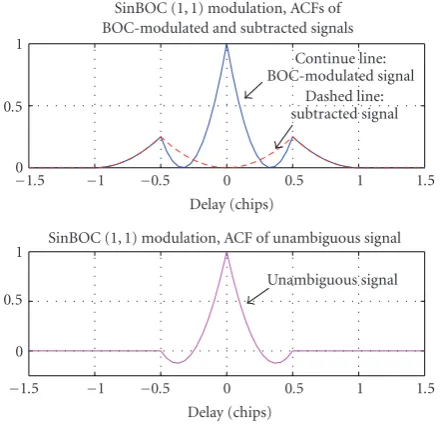
Figure 10: Exemplification of SCM IC method, 2-paths fading channel with true channel delay at 44 and 50 samples, average path powers [−2, 0] dB, SinBOC(1, 1)-modulated signal.
and the maximum global peak is re-estimated from R(2)n,unamb(τ) = (Rn,unamb(τ))2 − (a1,nRidealunamb(τ)(τ −
τ1,n)ejθ1,n+a2,nRunambideal (τ)(τ−τ2,n)ejθ2,n)2.
(7) The steps (3) to (6) are repeated until all desired peaks are estimated and until the residual function is below
a threshold value. In the example ofFigure 10, after 6
steps both path delays are estimated correctly.
These steps of SCM IC method are illustrated in
1
Ideal S-curve (no multipath), SCM NEML method
SinBOC (1, 1) SinBOC (10, 5)
Figure11: SCM NEML method: ideal S-curves (no multipath), for two BOC-modulation cases andΔ=0.1 chips.
4.3. SCM using narrow early minus lat discriminator (SCM NEML)
After obtaining an unambiguous correlation function Rn,unamb(τ) (as it was shown in the previous section, steps
(1) to (4)), a NEML S-curve is constructed, by forming the
early, respectively, late branches, spaced atΔ=0.1 chips. The
S-curve is obtained in the same way as inSection 3.1, by
sub-tracting the late and early branches of unambiguous correla-tion funccorrela-tion,
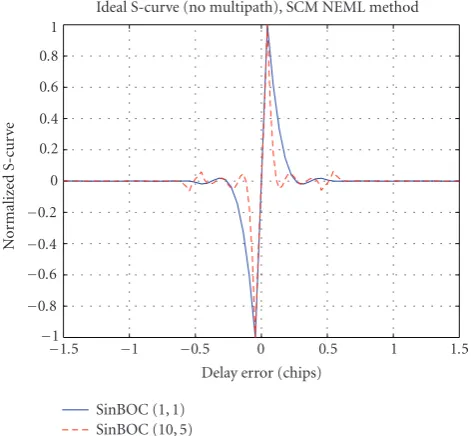
Examples of S-curves obtained with this method, in presence of a single path static channel, are presented in
Figure 11, for two BOC-modulated signals, SinBOC(1, 1)
and SinBOC(10, 5), and a spacing ofΔ = 0.1 chips.
Com-paring withFigure 4, which presents the NEML S-curves for
ambiguous signals, inFigure 11, the possibility to detect an
incorrect zero crossing, due to sidelobes peaks, is decreased. A typical measure of performance for the ability of a de-lay tracking loop to deal with multipath error is the so-called
multipath error envelope (MEE) [9,10]. The MEE is
usu-ally computed for one direct and one reflected channel paths, with a certain variable spacing. The multipath errors are cal-culated for the worst-case scenario, when the two paths are added inphase (upper MEE) and have equal strength, and also, when the two paths are out of phase (lower MEE). Com-parisons of MEEs plots, for both NEML and SCM NEML
methods, are shown inFigure 12, for two BOC-modulated
signals. A static channel with two paths of equal amplitudes and variable spacing was considered. The only interference considered here is the multipath interference, and the
addi-tive white noise effect is not taken into account. As it can be
seen inFigure 12, comparing with the NEML correlator, the
10
Figure12: Multipath error envelopes (in meters): NEML correlator versus SCM NEML method, for two BOC-modulation cases and
Δ=0.1 chips.
SCM NEML method brings a decrease in the errors of mul-tipath envelopes, for both SinBOC(1, 1) and SinBOC(10, 5) signals. We remark that the variations of the lower delay
er-ror envelope in the lower plot ofFigure 12are due to, on one
hand, the errors in the zero-crossing estimation algorithm, and, on the other hand, to the fact that worse MEE is not necessarily guaranteed when the paths are out of phase for the noncoherent NEML.
4.4. SCM using high-resolution correlator discriminator (SCM HRC)
In a similar manner as in previous section, the SCM method can be also used in conjunction with an HRC discrimina-tor, after removing the side peaks threats and obtaining an
unambiguous correlation functionRn,unamb(τ). Based on this
unambiguous function, an HRC S-curve is constructed, in an
analogous way as inSection 3.2:
SSCMHRC(τ)=R
layed unambiguous correlations, with a spacing between
them of Δ = 0.1 chips. The RVeryEarlyn,unamb(·), respectively,
RVeryLaten,unamb(·) are the very early and the very late unambiguous
correlation branches, spaced at 2Δchips and the weighting
1
Ideal S-curve (no multipath), SCM HRC method
SinBOC (1, 1) SinBOC (10, 5)
Figure13: SCM HRC method: ideal S-curves (no multipath), for two BOCmodulation cases, witha= −1/2 andΔ=0.1 chips.
Figure 14: Multipath error envelopes (in meters): HRC method versus SCM HRC method, for two BOC-modulation cases and
Δ=0.1 chips.
The ideal S-curves obtained with the SCM HRC method,
for two BOC-modulation orders, are presented inFigure 13.
The MEEs performances, for both the HRC and SCM HRC
methods, are illustrated inFigure 14, for SinBOC(1, 1) and
0.8
Ideal ACF (no multipath) for SinBOC (10, 5) modulated signal
Ambiguous correlation Differential correlation
SCM method SCM DC method
Figure15: Envelopes of correlation functions obtained with am-biguous correlation, DC method, SCM approach, and SCM DC method, for a SinBOC(10, 5)-modulated signal.
SinBOC(10, 5) cases. As it can be noticed, there is a slight im-provement brought by the SCM HRC method over the HRC correlator.
4.5. SCM using differential correlation (DC) in conjunction with feedback and feedforward tracking algorithms
It has been observed that the DC method has potential to de-crease the sidelobes amplitudes, thus lowering the possibility to detect a wrong side peak. To enhance the performance of
the DC method, we use it in conjunction with different
track-ing algorithms, such as NEML or HRC methods, or with IC method. These algorithms are applied in similar ways as
ex-plained in Sections3.1,3.2, and3.3, on the correlation
func-tions obtained after performing the noncoherent DC
tech-nique (Section 3.4).
Also, the performance may be enhanced further, by us-ing the SCM approach after applyus-ing the DC method. This is
done in the same way as explained in previous Sections (4.2,
4.3, and4.4), but after using first the DC method on the
am-biguous correlation function between the multipath received signal and the reference BOC-modulated code. Indeed, as
il-lustrated inFigure 15, in case of a SinBOC(10, 5) modulated
signal, the combination of DC and SCM algorithms can de-crease even further the sidelobes amplitudes, thus eliminat-ing more ambiguities.
4.6. SCM with threshold comparison (SCM thr)
Another approach is to test the performance of SCM
tech-nique using athresholding algorithm. Starting from the
un-ambiguous correlation functionRn,unamb(τ), an estimate of
noise varianceσ2
the out-of-peak values, similar to [4]. Using this estimated
noise variance, a linear thresholdγis computed, based on the
second peakγ2 of the ideal unambiguous correlation
func-tion Rideal
unamb(τ) (i.e., for SinBOC(1, 1)γ2 = 0.5, as seen in
Figure 3), together with the estimate of the noise varianceσ2 n:
Then the LOS delay is estimated, based on the
unambigu-ous correlation functionRn,unamb(τ), using this threshold. If
the peak of the estimated first path is too low (i.e., ten times lower than the global peak), then this path is discarded and the next estimate is considered.
5. SIMULATION RESULTS
5.1. Additive white noise Gaussian (AWGN) channel
We first test the performance of the proposed algorithms in the ideal AWGN channel (single path), in order to check whether SCM algorithm introduces a deterioration with re-spect to the standard narrow and high-resolution correla-tors (it is known that NEML is able to attain the
Cramer-Rao bound in AWGN channels [8]). We will show that no
deterioration is incurred when SCM is applied. The perfor-mance criteria are root mean square error (RMSE) and mean time to lose lock (MTLL). The simulations were carried out in Matlab. The MTLL is computed as the average value for which the estimated delay tracking error of the first path is below 1 chip. The tracking process is started, after the coarse acquisition of the signal, assuming that we are in the “lock” condition, that is, the delay error is strictly less than one chip. For all presented simulations (both in this section
and inSection 5.2), the coherent integration length is set to
Nc=20 milliseconds and the noncoherent integration is
per-formed overNnc=3 blocks (i.e., the total coherent and
non-coherent integration length is 60 milliseconds), and the
over-sampling factor is set toNs=11. We generated 5000 random
points in order to compute the RMSE and MTLL statistics. That is, the maximum observable MTLL based on these
sim-ulations is 5000NcNnc = 300 s (i.e., an MTTL value of 300
seconds reflects the fact that we never lost the lock during that particular simulation).
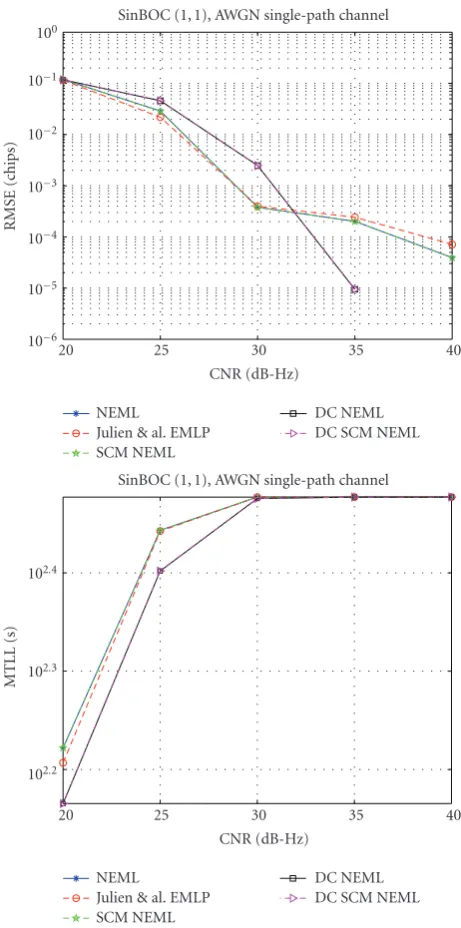
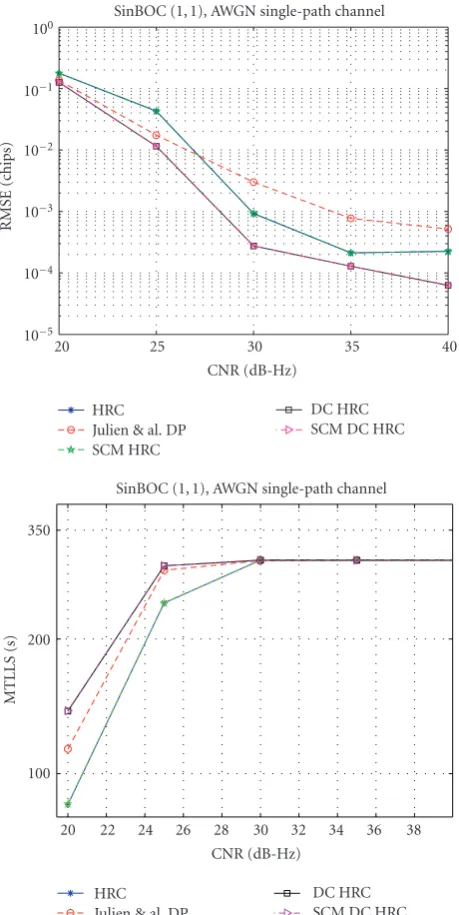
The AWGN results are shown for SinBOC(1, 1) case in
Figures16and17, for the comparison with NEML and HRC,
respectively. As seen in these figures, SCM algorithm does not deteriorate the performance in AWGN case, compared with narrow and high-resolution correlators. The sidelobe cancel-lations applied on the top of NEML and HRC give the same results as those of the original NEML and HRC algorithms, respectively, if the channel is single path AWGN channel (e.g.,
the differences in performance between SCM + NEML and
NEML are only at the third decimal, with NEML slightly bet-ter).
5.2. Fading channels
In what follows, the performance of the discussed delay es-timation algorithms is compared in multipath fading
chan-RMSE
(c
h
ips)
SinBOC (1, 1), AWGN single-path channel
20 25 30 35 40
Julien & al. EMLP SCM NEML
DC NEML DC SCM NEML
MTLL
(s)
SinBOC (1, 1), AWGN single-path channel
20 25 30 35 40
Julien & al. EMLP SCM NEML
DC NEML DC SCM NEML
Figure16: Comparison of feedback delays estimation algorithms employing the NEML discriminator and of the Julien&al. method, as a function of CNR; upper plots: RMSE, lower plots: MTLL. NEML and SCM NEML curves are overlapping. DC NEML and DC SCM NEML curves are also overlapping (differences at the 3rd dec-imal).
RMSE
(c
h
ips)
SinBOC (1, 1), AWGN single-path channel
20 25 30 35 40
Julien & al. DP SCM HRC
DC HRC SCM DC HRC
MTLLS
(s)
SinBOC (1, 1), AWGN single-path channel
20 22 24 26 28 30 32 34 36 38
Julien & al. DP SCM HRC
DC HRC SCM DC HRC
Figure17: Comparison of feedback delays estimation algorithms employing the HRC discriminator and of the Julien&al. method, as a function of CNR, upper plots: RMSE, lower plots: MTLL. HRC and SCM HRC curves are overlapping; DC HRC and DC SCM HRC curves are also overlapping (differences at the 4th decimal).
comparison, the performance of introduced feedback tech-niques is evaluated separately from that of the feedforward
methods. The same modulation types as inSection 5.1are
used here, namely, SinBOC(1, 1) and CosBOC(10, 5) mod-ulations. However, the introduced SCM method can be ex-tended to any sine or cosine BOC-modulation case.
The studied techniques have been investigated under the assumption of indoor or outdoor Rayleigh or Rician multi-path profiles (i.e., for indoor channel, the speed mobile is set
tov=3 km/h, while for outdoor profiles, the mobile speeds
of 25, 45, or 75 km/h have been selected). Two main chan-nel profiles have been considered: either with fixed Rayleigh
distribution of all paths and with average path power of−1,
−2, 0 and−3 dB, or a 2-paths decaying power delay profile
(PDP) channel, with Rician distributions for the first path and Rayleigh distribution for the next path. Similar with the
AWGN case in Section5.1, during simulations, the first path
delay of the channel is assumed to be linearly increasing, with
a slope of 0.05 chips per block ofNcNncmillisecond, thus the
tracking algorithms should capture this linear delay increase. The successive channel path delays have a random spacing with respect to the precedent delay, uniformly distributed
be-tween 1/(NsNBOC1NBOC2) andxmax, wherexmax (in chips) is
the maximum separation between successive paths (i.e., for
closed-spaced paths scenario,xmax =0.1 chips). In order to
have independent and reliable results for each method, the
search interval is different for each algorithm. which means
that once the lock is lost for one method, this will not affect
the other algorithms. The search window has few chips (typ-ically between 4 and 12 chips), depending on the number of paths, the distance between them and on the used BOC-modulation orders. The search window is sliding around the previous delay estimate and if we have erroneous estimates, the lock is lost at some point. For the feedback algorithms (i.e., NEML, HRC, or Julien&al. methods), the search for zero crossing is conditioned by the previous delay estimates. Similar with AWGN case, he coherent integration length is
set toNc = 20 milliseconds, the noncoherent integration is
performed overNnc=3 blocks, and the oversampling factor
is set toNs=11.
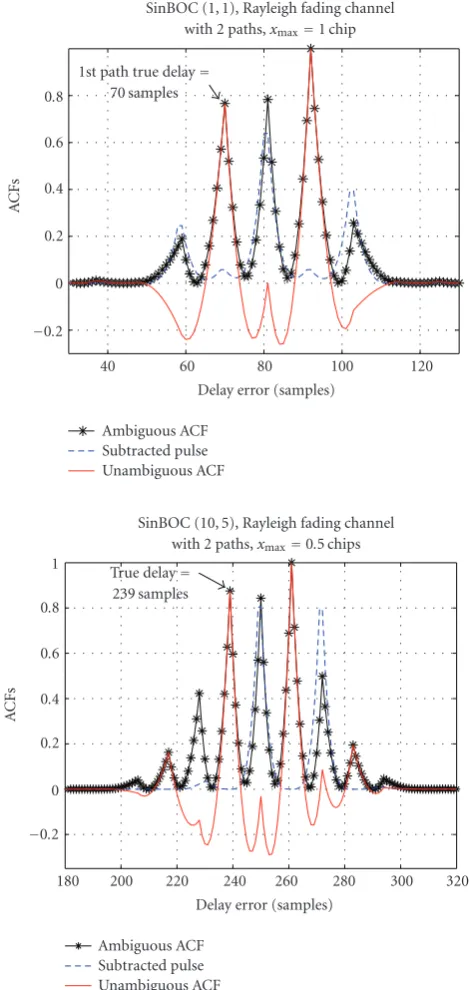
The SCM approach is exemplified in Figure 18, for a
Rayleigh 2-paths fading channel, with equal PDP. The up-per plot exemplifies a SinBOC(1, 1) modulation case, with
xmax =1 chip, while the lower plot shows the original ACF,
together with subtracted pulse and unambiguous shape, for
a SinBOC(10, 5) case andxmax = 0.5 chips. In both cases
the threat of the sidelobes is eliminated using the SCM tech-nique. For instance, in the SinBOC(1, 1) case, the correct de-lay of first path, situated at the 70th sample (in one chip, there
areNsNBOC1NBOC2samples) is more likely to be detected,
af-ter the main sidelobe (situated at the 81th sample) is removed by subtraction.
Figure 19presents the RMSE and MTLL, for the feedback algorithms which use the NEML discriminator, with an early
late spacing of Δ = 0.1 chips. The signal is SinBOC(1, 1)
modulated. Here, the Julien&al. method employs an EMLP
discriminator, as presented inSection 3.5. The channel is
4-path outdoor Rayleigh channel,v=75 km/h, with the most
challenging situation of closely-spaced paths (i.e.,xmax=0.1
chips). From both plots, it can be seen that both SCM-enhanced methods (the SCM NEML and SCM DC NEML) are performing much better than the other algorithms. Also, the Julien&al. EMLP technique brings an improvement in the results, comparing with both NEML and DC NEML meth-ods, but still not approaching the performance of the SCM algorithms.
Figures 20 and 21 illustrate the performances of the
0.8 0.6 0.4 0.2 0
−0.2
40 60 80 100 120
AC
F
s
Delay error (samples) SinBOC (1, 1), Rayleigh fading channel
with 2 paths,xmax=1 chip
Ambiguous ACF Subtracted pulse Unambiguous ACF 1st path true delay=
70 samples
0.8 0.6 0.4 0.2 0
−0.2
180 200 220 240 260 280 300 320
AC
F
s
Delay error (samples) SinBOC (10, 5), Rayleigh fading channel
with 2 paths,xmax=0.5 chips
Ambiguous ACF Subtracted pulse Unambiguous ACF
True delay=
239 samples 1
Figure18: Exemplification of SCM method for a 2-paths Rayleigh fading channel. Upper plot: SinBOC(1, 1)-modulated signal and xmax = 1 chip. Lower plot: SinBOC(10, 5)-modulated signal and
xmax=0.5 chips.
Julien&al. method employs a DP discriminator, as explained inSection 3.5. This selection is done because it has been ob-served by simulations that the Julien&al. method employing a DP discriminator exceeds the performance of the EMLP discriminator; this behavior is expected since the DP ap-proach does not vary linearly with the code tracking error
[20] as the EMLP discriminator. InFigure 20, the signal is
SinBOC(1, 1)-modulated, for a 2-path channel with Rician
RMSE
(c
h
ips)
SinBOC (1, 1), Rayleigh channel, speed mobile=75 km/h,xmax=0.1 chips
20 25 30 35 40
10−0.6
10−0.5
10−0.4
10−0.3
CNR (dB-Hz) NEML
Julien & al. EMLP SCM NEML
DC NEML SCM DC NEML
MTLL
(s)
SinBOC (1, 1), Rayleigh channel, 4 paths,xmax=0.1 chips
20 25 30 35 40
102
CNR (dB-Hz) NEML
Julien & al. EMLP SCM NEML
DC NEML SCM DC NEML
Figure19: Comparison of feedback delays estimation algorithms employing the NEML discriminator and of the Julien&al. method, as a function of CNR; SinBOC(1, 1) modulation, Rayleigh channel with an average pathspower delay profile of−1,−2, 0, and−3 dB, v=75 km/h, closely spaced paths withxmax=0.1 chips.
distribution for the first path, a mobile speed of 25 km/h and
a large separation between successive pathsxmax = 1 chip.
Figure 21presents the case of a CosBOC(10, 5)-modulated signal, for a 4-paths Rayleigh channel, with closely spaced
pathsxmax=0.1 chips andv=45 km/h.
From all plots of Figures 20 and 21, it can be
RMSE
(c
h
ips)
SinBOC (1, 1), 2-paths Rician channel, xmax=1 chip, mobile speed=25 km/h
20 25 30 35 40
10−0.5
10−0.4
10−0.3
CNR (dB-Hz) HRC
Julien & al. DP SCM HRC
DC HRC SCM DC HRC
MTLL
(s)
SinBOC (1, 1), 2-paths Rician channel, xmax=1 chip, mobile speed=25 km/h
20 25 30 35 40
101
CNR (dB-Hz) HRC
Julien & al. DP SCM HRC
DC HRC SCM DC HRC
Figure20: Comparison of feedback delays estimation algorithms employing the HRC discriminator and of the Julien&al. method, as a function of CNR; SinBOC(1, 1) modulation, 2-paths Rician chan-nel with decaying PDP of 0 and−2 dB,v = 25 km/h, maximum separation between pathsxmax=1 chip.
HRC methods, which have similar performance. For the SinBOC(1, 1) case, the performance of the Julien& al. DP method exceeds those of HRC and SCM HRC algorithms, which both give similar results. On the other hand, for the CosBOC(10, 5) modulation, the Julien& al. DP method ap-proaches the results provided by the HRC and SCM HRC
algorithms, which still offer a deterioration in performance
RMSE
(c
h
ips)
CosBOC (10, 5), Rayleigh channel, xmax=0.1 chips, mobile speed=45 km/h
20 25 30 35 40
10−0.6
10−0.7
10−0.5
10−0.4
10−0.3
CNR (dB-Hz) HRC
Julien & al. DP SCM HRC
DC HRC SCM DC HRC
MTLL
(s)
CosBOC (10, 5), 4-paths Rayleigh channel, xmax=0.1 chips
20 25 30 35 40
101
CNR (dB-Hz) HRC
Julien & al. DP SCM HRC
DC HRC SCM DC HRC
Figure21: Comparison of feedback delays estimation algorithms employing the HRC discriminator and of the Julien&al. method, as a function of CNR; CosBOC(10, 5) modulation, 4-paths Rayleigh channel, with paths PDP of−1,−2, 0, and−3 dB,v = 45 km/h, closely spaced pathsxmax=0.1 chips.
of about 1 dB, comparing to DC HRC and SCM DC HRC methods.
The comparisons between the introduced feedforward delay estimation algorithms (the MEDLL method, the IC en-hanced techniques and the SCM with threshold comparison
approach) are presented in Figures 22 to 25. In Figure 22,
RMSE
(c
h
ips)
SinBOC (1, 1), Rayleigh channel, speed mobile=3 km/h,xmax=0.1 chips
20 25 30 35 40
10−0.7
10−0.9
10−0.5
10−0.3
CNR (dB-Hz) MEDLL
SCM IC SCM thr.
DC IC SCM DC IC
MTLL
(s)
SinBOC (1, 1), Rayleigh channel, 4 paths,xmax=0.1 chips
20 25 30 35 40
100
101
CNR (dB-Hz) MEDLL
SCM IC SCM thr.
DC IC SCM DC IC
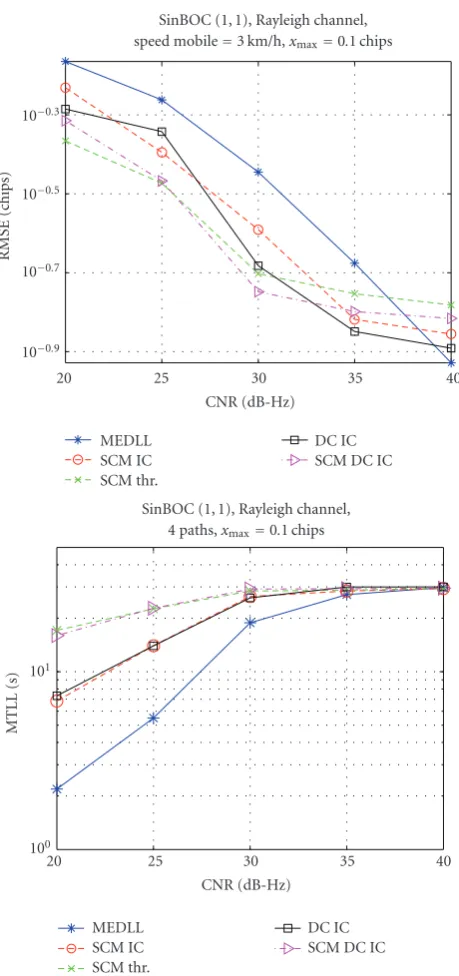
Figure 22: Comparison of feedforward delays estimation algo-rithms employing the MEDLL and IC methods and of the SCM with threshold approach, as a function of CNR; SinBOC(1, 1) mod-ulation, 4-paths indoor Rayleigh channel, with PDP of−1,−2, 0, and−3 dB,v=3 km/h, closely spaced paths withxmax=0.1 chips.
spaced paths Rayleigh channel (xmax=0.1 chips,v=3 km/h).
InFigure 23, the signal is also SinBOC(1, 1) modulated, the channel is 2-paths with Rician distribution on first path,
v=45 km/h andxmax=0.5 chips.
In all plots the performance of MEDLL algorithm is ex-ceeded by the other methods, since they eliminate or de-crease the threats of the sidelobes. In terms of RMSE, for a
Rayleigh profile with closely-spaced paths (Figure 22, upper
plot), the performances of the SCM IC and DC IC algorithms
RMSE
(c
h
ips)
SinBOC (1, 1), 2-paths Rician channel, xmax=0.5 chips, mobile speed=45 km/h
20 25 30 35 40
10−1
100
CNR (dB-Hz) MEDLL
SCM IC SCM thr.
DC IC SCM DC IC
MTLL
(s)
SinBOC (1, 1), 2-paths Rician channel, xmax=0.5 chips, mobile speed=45 km/h
20 25 30 35 40
101
102
100
CNR (dB-Hz) MEDLL
SCM IC SCM thr.
DC IC SCM DC IC
Figure 23: Comparison of feedforward delays estimation algo-rithms employing the MEDLL and IC methods and of the SCM with threshold approach, as a function of CNR; SinBOC(1, 1) modula-tion, 2-paths decaying PDP Rician channel,v=45 km/h,xmax=0.5
chips.
are exceeded by those of SCM DC IC and SCM thresholding methods, for a CNR range from 20 to 30 dB-Hz. In case of
Figure 23, for a higher spacing between successive paths up to 0.5 chips and a higher mobile speed, the SCM with thresh-old comparison gives the best results, while the SCM IC and SCM DC IC methods have similar performance, which is still better then that of DC IC, for a range of about 20 to 33 dB-Hz.
In terms of MTLL, from bothFigure 22andFigure 23,
RMSE
(c
h
ips)
CosBOC (10, 5), Rayleigh channel, speed mobile=3 km/h,xmax=0.1 chips
20 25 30 35 40
10−0.6
10−0.8
10−0.7
10−0.5
10−0.4
10−0.3
CNR (dB-Hz) MEDLL
SCM IC SCM thr.
DC IC SCM DC IC
MTLL
(s)
CosBOC (10, 5), 4-paths Rayleigh channel, xmax=0.1 chips
20 25 30 35 40
101
102
100
CNR (dB-Hz) MEDLL
SCM IC SCM thr.
DC IC SCM DC IC
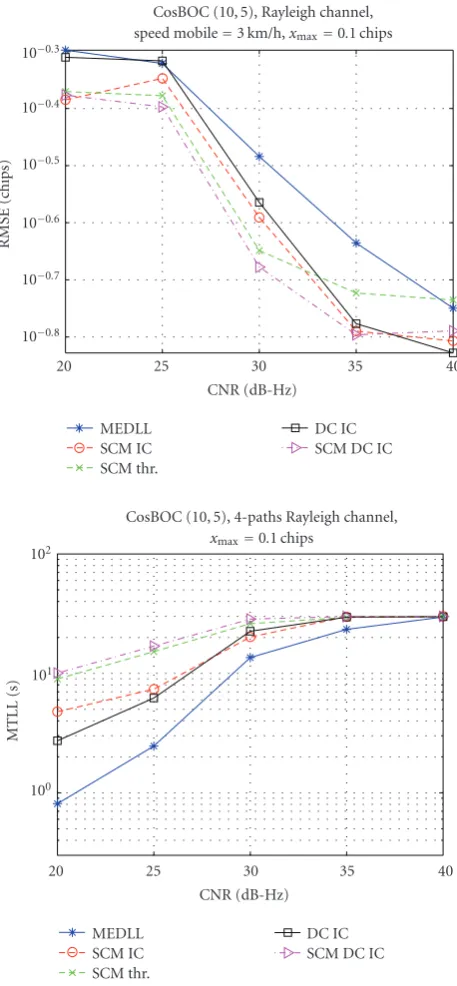
Figure 24: Comparison of feedforward delays estimation algo-rithms employing the MEDLL and IC methods and of the SCM with threshold approach, as a function of CNR; CosBOC(10, 5) modula-tion, 4-paths indoor Rayleigh channel,v=3 km/h, closely-spaced pathsxmax=0.1 chips.
(i.e., the highest MTLL) is provided by the SCM DC IC and SCM thresholding algorithms, with an improvement of about 4-5 dB-Hz comparing to SCM IC and DC IC methods, which give similar results.
Figures24and25illustrate the obtained simulation
re-sults, for a CosBOC(10, 5)-modulated signals, for a 4-closely-spaced paths indoor Rayleigh profile, respectively for a
2-paths channel, withv =45 km/h and a separation between
pathsxmaxof up to 0.5 chips. In terms of RMSE (Figure 24,
MTLL
(s)
CosBOC (10, 5), Rician channel, 2 paths,xmax=0.5 chips
20 25 30 35 40
101
102
100
10−1
CNR (dB-Hz) MEDLL
SCM IC SCM thr.
DC IC SCM DC IC
Figure 25: Comparison of feedforward delays estimation algo-rithms employing the MEDLL and IC methods and of the SCM with threshold approach, as a function of CNR; CosBOC(10, 5) modula-tion, 2-paths decaying PDP Rician channel,v=45 km/h,xmax=0.5
chips.
upper plot), the SCM DC IC method gives the best results, followed by the SCM with threshold comparison and SCM IC methods, for a CNR range of up to 33 dB-Hz. The good performance of SCM DC IC method is expected, since for a higher BOC-modulation order, it eliminates more sidelobes
than the other SCM methods (as illustrated inFigure 15).
The MEDLL technique is still outperformed by all the other methods.
In terms of MTLL (Figure 24, lower and plot and
Figure 25), for both channel profile cases, the SCM with threshold comparison and SCM DC IC approaches have the best performance, while the SCM IC technique brings an improvement over the DC IC case (in contrast with the
SinBOC(1, 1) situation, i.e., Figure 22). This is explicable,
since the SCM approach removes completely the sidelobes situated near the main peak, while the DC method just
de-creases their amplitudes (Figure 15).
Figure 26presents the effect of maximum separation
be-tween successive pathsxmax, in case of feedback delay
esti-mation algorithms which use NEML discriminator, together with the Julien&al. EMLP method. The channel has a 4-paths indoor Rayleigh profile with the mobile speed of 4 km/h and the CNR is set to 35 dB-Hz. In this case, both SCM
algo-rithms provide a decreasing in error as xmax is increasing,
while the other methods have an almost linear behavior, for
xmaxgreater than half of chip. Also, it can be observed that the
same gap between the studied methods, atxmax =0.1 chips,
is presented inFigure 19, upper plot.
6. CONCLUSIONS
![Figure 10: Exemplification of SCM IC method, 2-paths fadingchannel with true channel delay at 44 and 50 samples, average pathpowers [−2,0] dB, SinBOC(1,1)-modulated signal.](https://thumb-us.123doks.com/thumbv2/123dok_us/920951.1111577/10.600.320.539.64.537/figure-exemplication-fadingchannel-channel-average-pathpowers-sinboc-modulated.webp)