Volume 2007, Article ID 25178,11pages doi:10.1155/2007/25178
Research Article
Analysis of Filter-Bank-Based Methods for Fast Serial
Acquisition of BOC-Modulated Signals
Elena Simona Lohan
Institute of Communications Engineering, Tampere University of Technology, P.O. Box 553, 33101 Tampere, Finland
Received 29 September 2006; Accepted 27 July 2007
Recommended by Anton Donner
Binary-offset-carrier (BOC) signals, selected for Galileo and modernized GPS systems, pose significant challenges for the code ac-quisition, due to the ambiguities (deep fades) which are present in the envelope of the correlation function (CF). This is different from the BPSK-modulated CDMA signals, where the main correlation lobe spans over 2-chip interval, without any ambiguities or deep fades. To deal with the ambiguities due to BOC modulation, one solution is to use lower steps of scanning the code phases (i.e., lower than the traditional step of 0.5 chips used for BPSK-modulated CDMA signals). Lowering the time-bin steps entails an increase in the number of timing hypotheses, and, thus, in the acquisition times. An alternative solution is to transform the ambiguous CF into an “unambiguous” CF, via adequate filtering of the signal. A generalized class of frequency-based unambigu-ous acquisition methods is proposed here, namely the filter-bank-based (FBB) approaches. The detailed theoretical analysis of FBB methods is given for serial-search single-dwell acquisition in single path static channels and a comparison is made with other ambiguous and unambiguous BOC acquisition methods existing in the literature.
Copyright © 2007 Elena Simona Lohan. This is an open access article distributed under the Creative Commons Attribution License, which permits unrestricted use, distribution, and reproduction in any medium, provided the original work is properly cited.
1. INTRODUCTION
The modulation selected for modernized GPS and Galileo signals is BOC modulation, often denoted as BOC(m,n), withm = fsc/ fref, n = fc/ fref. Here, fc is the chip rate, fsc
is the subcarrier rate, and fref =1.023 MHz is the reference
chip frequency (that of the C/A GPS signal) [1]. Alterna-tively, a BOC-modulated signal can also be defined via its BOC modulation orderNBOC2fsc/ fc[2–4]. Both sine and cosine BOC variants are possible (for a detailed description of sine and cosine BOC properties, see [3,4]). The acqui-sition of BOC-modulated signals is challenged by the pres-ence of several ambiguities in CF envelope (here, CF refers to the correlation between the received signal and the reference BOC-modulated code). That is, if the so-called ambiguous-BOC (aambiguous-BOC) approach [5–7] is used (meaning that there is no bandlimiting filtering at the receiver or that this filter has a bandwidth sufficiently high to capture most energy of the incoming signal), the resultant CF envelope will exhibit some deep fades within±1 chip interval around the correct peak [5,8], as it will be illustrated inSection 4. We remark that sometimes the term “ambiguities” refers to the multi-ple peaks within±1 chip interval around the correct peak;
however, they are also related to the deep fades within this interval. The terminology used here refers to the deep fades of CF envelope.
The number of fades or ambiguities within 2-chip inter-val depends on theNBOC order (e.g., for SinBOC, we have
2NBOC−2 ambiguities around the maximum peak, while for
CosBOC, we have 2NBOCambiguities [4]). The distance
be-tween successive ambiguities in the CF envelope sets an up-per bound on the step of searching the time-bin hypotheses (Δt)bin, in the sense that if the time-bin step becomes too high, the main lobe of the CF envelope might be lost during the acquisition. Typically, a step of one-half the distance be-tween the correlation peak and its first zero value, or, equiva-lently, one quarter of the main lobe width is generally consid-ered [9]. For example, acquisition time-bin steps of 0.5 chips are used for BPSK modulation (such as for C/A code of GPS), where the width of the main lobe is 2 chips, and steps of 0.1– 0.2 chips are used for SinBOC(1,1) modulation, where the width of the main lobe is about 0.7 chips (such as for Galileo Open Service) [5,10,11].
Time uncertainty Δtmax .
. .
. .
. · · ·
· · ·
· · ·
(
Δ
f
)bin
Time-bin step (Δt)bin
F
req
uency
u
nc
er
taint
y
Δ
fmax
One time-frequency bin
Figure1: Illustration of the time/frequency search space.
the property that by reducing the signal bandwidth before correlation, we are able to increase the width of the CF main lobe. A thorough theoretical model is given for the characterization of the decision variable in single-path static channels and the theoretical model is validated via sim-ulations. The proposed FBB methods are compared with two other existing methods in the literature: the classical ambiguous-BOC processing (above-mentioned) and a more recent, unambiguous-BOC technique, introduced by Fish-man and Betz [9] (denoted here via B&F method, but also known as sideband correlation method or BPSK-like tech-nique) and further analyzed and developed in [2,6,7,10,11]. It is mentioned that FBB methods have also been studied by the author in the context of hybrid-search acquisition [12]. However, the theoretical analysis of FBB methods is newly introduced here.
2. ACQUISITION PROBLEM AND AMBIGUOUS
(ABOC) ACQUISITION
In Global Navigation Satellite Systems (GNSS) based on code division multiple access (CDMA), such as Galileo and GPS systems, the signal acquisition is a search process [13] which requires replication of both the code and the carrier of the space vehicle (SV) to acquire the SV signal. The range di-mension is associated with the replica code and the Doppler dimension is associated with the replica carrier. Therefore, the signal match is two dimensional. The combination of one code range search increment (code bin) and one velocity search increment (Doppler bin) is a cell.
The time-frequency search space is illustrated inFigure 1. The uncertainty region represents the total number of cells (or bins) to be searched [13–15]. The cells are tested by cor-relating the received and locally generated codes over a dwell or integration timeτd. The whole uncertainty region in time Δtmaxis equal to the code epoch length. The length of the
fre-quency uncertainty regionΔfmax may vary according to the
initial information: if assisted-GPS data are available,Δfmax
can be as small as couple of Hertzs or couple of tens of Hertzs. If no Doppler-frequency information exists (i.e., no assis-tance or autonomous GPS), the frequency rangeΔfmaxcan
be as large as few tens of kHz [13].
The time-frequency bin defines the final time-frequency error after the acquisition process and it is characterized by one correlator output: the length of a bin in time direction (or the time-bin step) is denoted by (Δt)bin (expressed in
chips) and the length of a bin in frequency direction is de-noted by (Δf)bin. For example, for GPS case, a typical value for the (Δt)bin is 0.5 chips [13]. The search procedure can
be serial (if each bin is searched serially in the uncertainty space), hybrid (if several bins are searched together), or fully parallel (if one decision variable is formed for the whole un-certainty space) [13]. This paper focuses on the serial search approach.
One of the main features of Galileo system is the intro-duction of longer codes than those used for most GPS sig-nals. Also, the presence of BOC modulation creates some ad-ditional peaks in the envelope of the correlation function, as well as additional deep fades within±1 chip from the main peak. For this reason, a time-bin step of 0.5 chips is typically not sufficient and smaller steps need to be used [5,10,11]. On the other hand, decreasing the time-bin step will increase the mean acquisition time and the complexity of the receiver [9].
In the serial search code acquisition process, one decision variable is formed per each time-frequency bin (based on the correlation between the received signal and a reference code), and this decision variable is compared with a threshold in order to decide whether the signal is present or absent. The
ambiguous-BOC (aBOC) processingmeans that, when
form-ing the decision variable, the received signal is directly corre-lated with the reference BOC-moducorre-lated PRN sequence (all the spectrum is used for both the received signal and refer-ence code).
3. BENCHMARK UNAMBIGUOUS ACQUISITION:
B&F METHOD
The presence of BOC modulation in Galileo systems poses supplementary constraints on code search strategies, due to the ambiguities of the CF envelope. Therefore, better strate-gies should be used to insure reasonable performance (acqui-sition time and detection probabilities) as those obtained for short codes. One of the proposed strategies to deal with the ambiguities of BOC-modulated signals is the unambiguous acquisition (known under several names, such as sideband correlation method or BPSK-like technique).
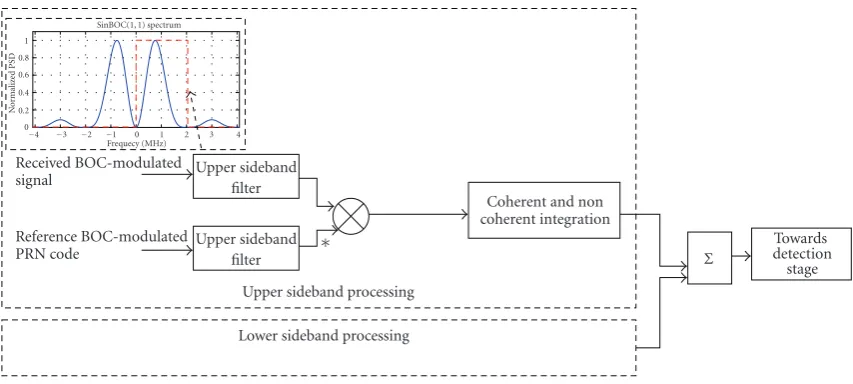
The original unambiguous acquisition technique, pro-posed by Fishman and Betz in [9,16], and later modified in [6,10], uses a frequency approach, shown inFigure 2. In what follows, we denote this technique via B&F technique, from the initials of the main authors. The block diagrams of the B&F method (single-sideband processing) is illustrated
inFigure 2, for upper sideband- (USB-) processing [9,16].
Upper sideband processing Lower sideband processing Upper sideband
filter Upper sideband
filter Received BOC-modulated
signal
Reference BOC-modulated PRN code
Coherent and non coherent integration
Σ
Towards detection
stage
∗
0
0.2
0.4
0.6
0.8
1
N
o
rm
aliz
ed
PSD
−4 −3 −2 −1 0 1 2 3 4 Frequecy (MHz)
SinBOC(1, 1) spectrum
Figure2: Block diagram of B&F method, single-sideband processing (here, upper sideband).
similar manner with the received signal, hence the autocor-relation function is no longer the CF of a BOC-modulated signal, but it will resemble the CF of a BPSK-modulated sig-nal. However, the exact shape of the resulting CF is not iden-tical with the CF of a BPSK-modulated signal, since some in-formation is lost when filtering out the sidelobes adjacent to the main lobe (this is exemplified inSection 4). This filtering is needed in order to reduce the noise power. When the B&F dual-sideband method is used, we add together the USB and LSB outputs and form the dual-sideband statistic.
4. FILTER-BANK-BASED (FBB) METHODS
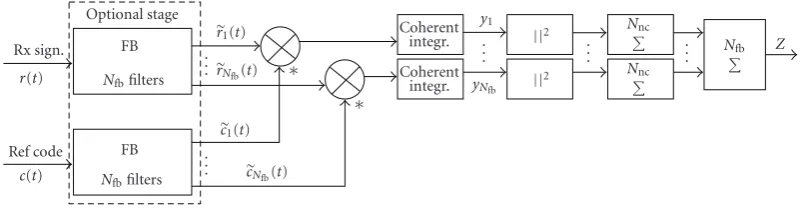
The underlying principle of the proposed FBB methods is illustrated in Figure 3and the block diagram is shown in
Figure 4. The number of filters in the filter bank is denoted
byNfband it is related to the number of frequency pieces per
sidebandNpieces via:Nfb =2Npieces if dual sideband (SB) is
used, orNfb = Npieces if single SB is used. InFigure 3, the
upper plot shows the spectrum of a SinBOC(1,1)-modulated signal, together with several filters (hereNfb=4) which cover
the useful part of the signal spectrum (the useful part is con-sidered here to be everything between the main spectral lobes of the signal, including these main lobes). Alternatively, we may select only the upper (or lower) SB of the signal (i.e., single-SB processing).
The filters may have equal or unequal frequency widths. Two methods may be employed and they have been denoted here via equal-power FBB (FBBep), where each filter lets the
same signal’s spectral energy to be passed, thus they have un-equal frequency widths (see upper plot ofFigure 3), or equal-frequency-width FBB (FBBefw), where all the filters in the
fil-ter bank have the same bandwidth (but the signal power is different from one band to another). An observation ought to be made here with respect to these denominations: indeed, before the correlation takes place and after filtering the in-coming signal (via the filter bank), the noise power density is exactly in reverse situation compared to the signal power,
since the noise power depends on the filter bandwidth (i.e., the noise power is constant from one band to another for the FBBefwcase, and it is variable for the FBBepcase).
How-ever, the incoming (filtered) signal is correlated with the ref-erence BOC-modulated code. Thus, the noise, which may be assumed white before the correlation, becomes coloured noise after the correlation with BOC signal, and its spectrum (after the correlation) takes the shape of the BOC power spectral density. Therefore, after the correlation stage at the receiver (e.g., immediately before the coherent integration block), both signal power density and noise power density are shaped by the BOC spectrum. Thus, the denominations used here (FBBepand FBBefw) are suited for both signal and
noise parts, as long as the focus is on the processing after the correlation stage (as it is the case in the acquisition).
As seen inFigure 4, the same filter bank is applied to both the signal and the reference BOC-modulated pseudo-random code. Then, filtered pieces of the signal are corre-lated with filtered pieces of the code (as shown inFigure 4) and an example of the resultant CF is plotted in the lower part ofFigure 3. For reference purpose, also aBOC and B&F cases are shown. It is noticed that, whenNpieces=1, the
pro-posed FBB methods (both FBBepand FBBefw) become
identi-cal with B&F method, and the higher theNpiecesis, the wider
the main lobe of the CF envelope becomes, at the expense of a higher decrease in the signal power.
The block diagram inFigure 4applies not only to FBB methods, but also to other GPS/Galileo acquisition meth-ods, such as single/dual SB, and ambiguous-/unambiguous-BOC acquisition methods (i.e., aambiguous-/unambiguous-BOC corresponds to the case when no filtering stage is applied to the received and reference signals, while B&F corresponds to the case when
Npieces=1). The complex outputsyi(·),i=1,. . .,Nfbof the
coherent integration block ofFigure 4can be written as
yi
τ,fD,n
= 1
Tcoh
nT+Tcoh
nT ri(t)ci(t−τ)e
−3 −2 −1 0 1 2 3 Frequency (MHz)
0 0.1 0.2 0.3 0.4 0.5 0.6 0.7
Spect
rum
Dual sideband processing, equal-power pieces
BOC PSD Filter 1 Filter 2
Filter 3 Filter 4 (a)
−3 −2 −1 0 1 2 3
Delay error (chips) 0
0.5 1 1.5 2 2.5 3 3.5
|
CF
|
2
Squared CF envelope,Npieces=2,NBOC=2
BOC B&F, dual SB
FBBep, dual SB FBBefw, dual SB (b)
Figure3: Illustration of the FBB acquisition methods, SinBOC(1,1) case. Upper plot: division into frequency pieces, viaNfb =4 filters
(FBBepmethod). Lower plot: squared CF shapes for 2 FBB
meth-ods, compared with ambiguous BOC (aBOC) and unambiguous Betz&Fishman (B&F) methods.
wherenis the symbol (or code epoch) index,Tis the symbol interval,ri(t) is the filtered signal via theith filter,ci(t) is the filtered reference code (note that the codec(t) before the filter bank is the BOC-modulated spread spectrum sequence),τ
and fDare the receiver candidates for the delay and Doppler shift, respectively, andTcohis the coherent integration length
(if the code epoch length is 1 millisecond, then the number of coherent code epochsNcmay be used instead:Tcoh=Ncms). Without loss of generality, we may assume that a pilot
chan-nel is available (such as it is the case of Galileo L1 band), thus the received signalr(t) (before filtering) has the form
r(t)=Ebc(t−τ)e−j2π fDt+ηwb(t), (2)
whereτ and fD are the delay and Doppler shift introduced by the channel,ηwb(t) is the additive white Gaussian noise at wideband level, andEbis the bit energy.
The coherent integration outputsyi(·) are Gaussian pro-cesses (since a filtered Gaussian propro-cesses is still a Gaussian processes). Their mean is either 0 (if we are in an incorrect time-frequency bin) or it is proportional to a time-Doppler deterioration factor EbF(Δτ,ΔfD) [11], with a proportion-ality constant dependent on the number of filters and of the acquisition algorithm, as it will be shown inSection 5. Here,
F(·) is the amplitude deterioration in the correct bin due to a residual time errorΔτand a residual Doppler errorΔfD [11]
FΔτ,ΔfD
=RΔτsin
πΔfDTcoh
πΔfDTcoh
. (3)
As mentioned above,Δτ=τ−τ,ΔfD =fD−fD, andR(Δτ) is the CF value at delay errorΔτ(CF is dependent on the used algorithm, as shown in the lower plot ofFigure 3). Moreover, if we normalize theyi(·) variables with respect to their max-imum power, the variance ofyi(·) variables (in both the cor-rect and incorcor-rect bins) is proportional to the postintegration noise variance
σ210−(CNR+10log10Tcoh)/10, (4)
where CNR = EbBW/N0 is the Carrier-to-Noise Ratio,
ex-pressed in dB-Hz [5,7,11],BWis the signal bandwidth after despreading (e.g.,BW =1 kHz for GPS and Galileo signals), andN0 is the double-sided noise spectral power density in
the narrowband domain (after despreading or correlation on 1 millisecond in GPS/Galileo). The proportionality constants are presented inSection 5. The decision statisticZofFigure 4
is the output of noncoherent combining ofNncNfbcomplex
Gaussian variables, whereNncis the noncoherent integration
time (expressed in blocks ofNcms):
Z= 1
Nnc
1
Nfb
Nnc
n=1
Nfb
i=1
yi
τ,fD,n2. (5)
We remark that the coloured noise impact onZ statistic is similar with the impact of a white noise; the only difference will be in the moments ofZ, as discussed inSection 5.1(since a filtered Gaussian variable is still a Gaussian variable, but with different mean and variance, according to the used fil-ter). Thus, if those Gaussian variables have equal variances,
c(t)
Figure4: Block diagram of a generic acquisition block.
5. THEORETICAL MODEL FOR FBB
ACQUISITION METHODS
5.1. Test statistic distribution
As explained above, the test statisticZfor aBOC, B&F, and proposed FBBepapproaches1is either a central or a
noncen-tralχ2-distributed variable withN
degdegrees of freedom,
ac-cording to whether we have an incorrect (bin H0) or a
correct (binH1) time-frequency bin, respectively. Its
non-centrality parameterλZand its varianceσ2Zare thus given by
λZ=ξλbinF ξλbin are two algorithm-dependent factors shown inTable 1
(they also depend on whether we are in a correct bin or in an incorrect bin). We remark that the noncentrality parameter used here is the square-root of the noncentrality parameter defined in [17], such that it corresponds to amplitude lev-els (and not to power levlev-els). The relationship between the distribution functions and their noncentrality parameter and variance will be given in (8).
All the parameters inTable 1 have been derived by in-tuitive reasoning (explained below), followed by a thorough verification of the theoretical formulas via simulations. For clarity reasons, we assumed that the bit energy is normalized toEb = 1 and all the signal and noise statistics are present with respect to this normalization.
Clearly, for aBOC algorithm,ξσ2
bin =1 and the
noncen-trality factorξλbinis either 1 (in a correct bin) or 0 (in an
in-correct bin) [5,7,19]. Also,Ndeg=2Nncfor aBOC, because
we add together the absolute-squared valued ofNnccomplex
variables (or the squares 2Nnc real variables, coming from
real and imaginary parts of the correlator outputs). For B&F, the noncentrality deterioration factor and the variance dete-rioration factor depend on the normalized power per main lobe (positive or negative) Pml of the BOC power spectral
1 The case of FBB
efwis discussed separately, later in this section.
density (PSD) function.Pml can be easy computed
analyti-cally, using, for example, the formulas for PSD given in [3,4] and some illustrative examples are shown in Figure 5; the normalization is done with respect to the total signal power, thusPml <0.5.;Pmlfactor is normalized with respect to the
total signal power, thusPml <0.5 (e.g.,Pml =0.428 for
Sin-BOC(1,1)). The decrease in the signal and noise power after the correlation in B&F method (and thus, the decrease inξλH1
andξσ2
bin parameters) is due to the fact that both the signal
and the reference code are filtered and the filter bandwidth is adjusted to the width of the PSD main lobe. Also, in dual-SB approaches, the signal power is twice the signal power for single SB, therefore, the noncentrality parameter (which is a measure of the amplitude, not of the signal power) in-creases by√2. Furthermore, in dual-SB approaches, we add a double number of noncoherent variables, thus the num-ber of degrees of freedom is doubled compared to single-SB approaches.
The derivation ofχ2parameters for FBB
epis also
straight-forward by keeping in mind that the variance of the vari-ablesyiis constant for each frequency piece (the filters were designed in such a way to let equal power to be passed through them). Thus, the noise power decrease factor is
ξσ2
Npiecesfor dual SB).
For FBBefw, the reasoning is not so straightforward
(be-cause the sum of squares of Gaussian variables of different variances is no longerχ2distributed) and the bounds given
inTable 1were obtained via simulations. It was noticed (via
simulations) that the noise variance in the correct and in-correct bins is no longer the same. It was also noticed that the distribution of FBBefwtest statistic is bounded by twoχ2
distributions. Moreover,Pmaxpp is the maximum power per
piece (in the positive or in the negative frequency band). For example, ifNpieces=2 and FBBefwapproach is used for
Sin-BOC(1,1) case, the powers per piece of the positive-sideband lobe are 0.10 and 0.34, respectively (hence,Pmaxpp = 0.34).
Again, these powers can be derived straightforwardly, via the formulas shown in [1,3,4,20].
Figure 6compares the simulation-based complementary
CDF (i.e., 1-CDF) with theoretical complementary CDFs for FBBep case (similar plots were obtained for aBOC,
Table1:χ2parameters for the distribution of the decision variableZ, various acquisition methods.
Correct bin (hypothesisH1) Incorrect bin (hypothesisH0)
ξλH1 ξσ2H1 Ndeg ξλH0 ξσ2H0 Ndeg FBBep and lower
bound of single-FBBep and lower
bound of
dual-lack of space). For the simulations shown in Figure 6, SinBOC(1,1) signal was used, with coherent integration lengthNc=20 milliseconds, noncoherent integration length Nnc = 2, CNR=24 dB-Hz, number of samples per BOC
interval Ns = 4, and single-SB filter bank with 4 fil-ters (i.e., Nfb = Npieces = 4). It was also noticed that
the bounds for FBBefw approach are rather loose.
How-ever, simulation results showed that the average behavior of FBBefw, while keeping between the bounds, is also very
similar with the average behavior of FBBep[12], therefore,
from now on, it is possible to rely on FBBep curves alone
in order to illustrate the average performance of proposed FBB methods. We remark that the plots of complementary CDF were chosen instead of CDF, in order to show bet-ter the tail matching of the theoretical and simulation-based distributions.
5.2. Detection probability and mean acquisition times
In serial search acquisition, the detection probability per binPdbin(Δτ) is the probability that the decision variable Z
is higher than the decision threshold γ, provided that we are in a correct bin (hypothesis H1). Similarly, the false
alarm probabilityPfais the probability that the decision
vari-able is higher than γ, provided that we are in an incor-rect bin (hypothesis H0). These probabilities can be easily
computed based on the cumulative distribution functions (CDFs) of Z in the correctFnc(·) and incorrect binsFc(·)
BOC modulation orderNBOC 0.36
Power per main lobe of BOC-modulated signal
Sine BOC Cosine BOC
Figure5: Normalized power per main lobePmlfor BOC-modulated
signals for variousNBOCorders.
whereFnc(·) is the CDF of a noncentralχ2variable and
in incorrect binsH0
Fnc
in correct binsH1
0 0.05 0.1 0.15 0.2 0.25 0.3 0.35 0.4
Matching toχ2complementary CDF for SSB, FBB
Sim, non-central Th, non-central
Sim, central Th, central
Figure6: Matching withχ2 distributions, (complementary CDF:
1-CDF), theory (th) versus simulations (sim), FBBep, Nfb =
Npieces=4.
with σ2Z, Ndeg, and λZ given in (6) and in Table 1, and QNdeg/2(·) being the generalized Marcum-Q function [17].
Due to the fact that the time-bin step may be smaller than the 2-chip interval of the CF main lobe, we might have several correct bins. The number of correct bins is: Nt = 2Tc/(Δt)bin, whereTcis the chip interval. Thus, the global detection probabilityPdis the sum of probabilities of detect-ing the signal in theith bin, provided that all the previous tested hypotheses for the prior correct bins gave a misdetec-tion [11]:
pling point in the two-chip interval, where we haveNt cor-rect bins. Equation (9) is valid only for fixed sampling points. However, due to the random nature of the channels, the sam-pling point (with respect to the channel delay) is randomly fluctuating, hence, the globalPdis computed as the expecta-tion E(·) over all possible initial delay errors (under uniform distribution, we simply take the temporal mean):
Pd=EΔτ0
and the worst detection probability is obtained for the worst sequence of sampling points:Pd,worst=minΔτ0(Pd(Δτ0)).
The mean acquisition timeTacq for the serial search is
computed according to the globalPd, the false alarmPfa, the
penalty timeKpenalty(i.e., the time lost to restart the
acqui-sition process if a false alarm state is reached), and the total number of bins in the search space [21]:
Tacq=
(7) to (10). An example of the theoretical average detection probabilityPdcompared with the simulation results is shown
inFigure 7, where a very good match is observed. The small
mismatch at high (Δt)binfor the dual B&F method can be
ex-plained by the number of points used in the statistics: about 5000 random points have been used to build such statistics, which seemed enough for most of (Δt)binranges. However, at
very low detection probabilities, this number is still too small for a perfect match. However, the gap is not significant, and lowPdregions are not the most interesting from the analysis point of view.
An example of performance (in terms of average and worst detection probabilities) of the proposed FBB methods is given inFigure 8. The gap between proposed FBB methods and aBOC method is even higher from the point of view of the worstPd. Here, SinBOC(1,1)-modulated signal was used, andNc=20 ms,Nnc=2. The other parameters are specified
in the figures captions. The small edge in aBOC average per-formance at around 0.7 chips is explained by the fact that a time-bin step equal to the width of the main lobe of CF en-velope (i.e., about 0.7 chips) would give worse performance than a slightly higher or smaller steps, due to ambiguities in the CF envelope. Also, the relatively constant slope in the re-gion of 0.7–1 chips can be explained by the combination of high time-bin steps and the presence of the deep fades in the CF: since the spacing between those deep fades is around 0.7 chips for SinBOC(1,1), then a time-bin step of 0.7 chips is the worst possible choice in the interval up to 1 chip. However, there is no significant difference in averagePd for time-bin steps between 0.7 and 1 chip, since two counter-effects are superposed (and they seem to cancel each other in the region of 0.7 till 1 chip from the point of view of averagePd): on one hand, increasing the time-bin step is deteriorating the performance; on the other hand, avoiding (as much as possi-ble) the deep fades of CF is beneficial. This fact is even more visible from the lower plot ofFigure 8, where worst-casePd are shown. Clearly, having a time-bin step of about 0.7 chips would mean that, in the worst case, we are always in a deep fade and lose completely the peak of the main lobe. This ex-plains the minimumPdachieved at such a step. Also, for steps higher than 1.5 chips, there is always a sampling sequence that will miss completely the main lobe of the envelope of CF (thus, the worstPdwill be zero).
It is noticed that FBB methods can work with time-bin steps higher than 1 chip, due to the increase in the main lobe of the CF envelope. Moreover, the proposed FBB methods (both single and dual SB) outperform the B&F and aBOC method if the step (Δt)bin is sufficiently high. Indeed, the
0 0.2 0.4 0.6 0.8 1 1.2 1.4 1.6 1.8 2 (Δt)bin(chips)
10−3 10−2 10−1 100
Pd
PdatPfa=0.001, dual B&F, CNR=27 dB-Hz
Sim, average Th, average
Sim, worst Th, worst (a)
0 0.2 0.4 0.6 0.8 1 1.2 1.4 1.6 1.8 2 (Δt)bin(chips)
10−2 10−1 100
Pd
PdatPfa=0.001, dual FBBep, CNR=27 dB-Hz,Npieces=2
Sim, average Th, average
Sim, worst Th, worst (b)
Figure 7: Comparison between theory and simulations for Sin-BOC(1,1). Left: dual-sideband B&F method. Right: Dual-sideband FBBepmethod,Npieces=2.Nc =10 milliseconds,Nnc=5, CNR=
27 dB-Hz,Ns=5.
due to the widening of the CF main lobe. The constantPd at higher time-bin steps is explained by the fact that, if the step increases with respect to the correlation function width, only noise is captured in the acquisition block. Thus, increas-ing the step above a certain threshold would not change the serial detection probability, since the decision variable will only contains noise samples.
On the other hand, by increasing the time-bin step in the acquisition process, we may decrease substantially the mean acquisition time, because the number of bins in the
0 0.5 1 1.5 2 2.5 3
Time-bin step (Δt)bin 0.2
0.3 0.4 0.5 0.6 0.7 0.8 0.9 1
Pd
AveragePd,Npieces=2, CNR=30 dB-Hz
aBOC Single B&F Dual B&F
Single FBB Dual FBB (a)
0 0.5 1 1.5 2 2.5 3
Time-bin step (Δt)bin 0
0.1 0.2 0.3 0.4 0.5 0.6 0.7 0.8 0.9 1
Pd
Pd,worst,Npieces=2, CNR=30 dB-Hz
aBOC Single B&F Dual B&F
Single FBB Dual FBB (b)
Figure8: Average (upper) and worst (lower) detection probabili-ties versus (Δt)binambiguous and unambiguous BOC acquisition
methods (FBBepwas used here).
search space (see (11) is directly proportional to (Δt)bin. For
example, if the code epoch length is 1023 chips and only one frequency bin is searched (assisted acquisition), q = 1023/(Δt)bin. Moreover, the computational load required
for implementing a correlator acquisition receiver per unit of time uncertainty is inversely proportional to (Δt)2bin[9], thus,
when (Δt)binincreases, the computational load decreases.
25 26 27 28 29 30 31 CNR (dB-Hz)
0 0.5 1 1.5 2
(
Δ
t
)bin
(c
hips)
Step needed to achieve a targetPd=0.9, (average case)
Dual SB, FBBep Dual SB, B&F
(a)
25 26 27 28 29 30 31
CNR (dB-Hz) 0
0.5 1 1.5
(
Δ
t
)bin
(c
hips)
Step needed to achieve a targetPd=0.9, (average case)
Single SB, FBBep Single SB, B&F
(b)
25 26 27 28 29 30 31
CNR (dB-Hz) 101
102 103
MA
T
Achieved MAT [s] at considered step
Dual SB, FBB Dual SB, B&F
(c)
25 26 27 28 29 30 31
CNR (dB-Hz) 101
102 103 104
MA
T
Achieved MAT [s] at considered step
Single SB, FBBep Single SB, B&F
(d)
Figure9: Step needed to achieve a target averagePd=0.9, at false alarmPfa=10−3and corresponding mean acquisition time, SinBOC(1,1)
signal. Code length 4092 chips, penalty factorKpenalty =1, single frequency-bin.Npieces =2 for FBBep. Left: dual sideband. Right: single
sideband.
assume a SinBOC(1,1)-modulated signal, a CNR=30 dB-Hz, and a target average detection probability ofPd=0.9 at Pfa=10−3. For these values, we need a step of (Δt)bin=1.2
chips for the dual-sideband B&F method (which will cor-respond to a mean acquisition timeTacq =86.24 s for
sin-gle frequency serial search and 4092-chip length code) and a step of (Δt)bin =1.7 chips for dual-sideband FBBepmethod
withNpieces =2 (i.e.,Tacq =58.14 s). Thus, the step can be
about 50% higher for sideband FBB case than for dual-sideband B&F case, and we may gain about 48% in the MAT (i.e., MAT is 48% less in dual-SB FBB case than in dual-SB B&F case). For single-sideband approaches, the differences between FBB and B&F methods are smaller. An illustrative plots is shown inFigure 9, where the needed steps and the achievable mean acquisition times are given with respect to CNR. We notice that FBB methods outperform B&F meth-ods at high CNRs. Below a certain CNR limit (which, of course, depends on the (Nc, Nnc) pair), B&F method may
be better than FBB method.
The optimal number of pieces or filters to be used in the filter bank depends on the CNR, on the method (single or dual SB), and on the BOC modulation orders. From simu-lation results (not included here due to lack of space), best values between 2 and 6 have been observed. This is due to the fact that a too highNpieces parameter would deteriorate
the signal power too much.
We remark that the choice of the penalty factor has not been documented well in the literature. The penalty time
se-lection is in general related to the quality of the following code tracking circuit. There is a wide range of values that
Kpenalty may take and no general rule about the choice of Kpenaltyhas been given so far, to the author’s knowledge. For
example, in [22] a penalty factorKpenalty = 1 was
consid-ered; in [23] simulations were carried out forKpenalty=2, in
[24] a penalty factor ofKpenalty=103was used, while in [25]
we haveKpenalty=106. Penalty factors with respect to dwell
times were also used in the literature, for example:Kpenalty=
105/(N
cNnc) [26,27], orKpenalty=107/(NcNnc) [27] (in our
simulations,NcNnc =40 ms). Therefore,Kpenaltymay spread
over an interval of [1, 106], therefore, in our simulations we
considered the 2 extreme cases:Kpenalty = 1 (Figure 9) and Kpenalty = 106 (Figure 10). Figure 10uses exactly the same
parameters as Figure 9, with the exception of the penalty factor, which is now Kpenalty = 106. For Kpenalty = 106 of
Figure 10, MAT for the dual-sideband B&F method becomes
Tacq = 8.62 ∗104, which is still higher than MAT for the
dual-sideband FBBep(Tacq =5.8∗104s). Similar
improve-ments in MAT times via FBB processing (as forKpenalty=1)
are observed if we increase the penalty time.
The plots with respect to the receiver operating charac-teristics (ROC) are shown inFigure 11for a CNR of 30 dB-Hz. ROC curves are obtained by plotting the misdetection probability 1−Pdversus false alarm probabilityPfa[28]. The
25 26 27 28 29 30 31 CNR (dB-Hz)
104 105 106
MA
T
Achieved MAT [s] at considered step
Dual SB, FBBep Dual SB, B&F
(a)
25 26 27 28 29 30 31
CNR (dB-Hz) 104
105 106 107
MA
T
Achieved MAT [s] at considered step
Single SB, FBBep Single SB, B&F
(b)
Figure10: Mean acquisition time corresponding to the step needed to achieve a target averagePd =0.9, at false alarmPfa =10−3,
Sin-BOC(1,1) signal. Code length 4092 chips, penalty factorKpenalty=106, single frequency-bin.Npieces=2 for FBBep. Left: dual sideband. Right:
single sideband.
10−10 10−8 10−6 10−4 10−2 False alarm probabilityPfa 0
0.1 0.2 0.3 0.4 0.5 0.6 0.7 0.8 0.9 1
M
is-det
ection
p
ro
babilit
y
1
-Pd
ROC, (Δt)bin=0.5 chips, CNR=30 dB-Hz
aBOC Single BF Dual BF
Single FBB Dual FBB (a)
10−10 10−8 10−6 10−4 10−2 False alarm probabilityPfa 0
0.1 0.2 0.3 0.4 0.5 0.6 0.7 0.8 0.9 1
M
is-det
ection
p
ro
babilit
y
1
-Pd
ROC, (Δt)bin=1.5 chips, CNR=30 dB-Hz
aBOC Single BF Dual BF
Single FBB Dual FBB (b)
Figure11: Receiver operating characteristic for CNR=30 dB-Hz, SinBOC(1,1) signal,Nc =20,Nnc=2. Left: (Δt)bin=0.5 chips; right
(Δt)bin=1.5 chips.
At low time-bin steps (e.g., (Δt)bin=0.5 chips), the FBB and
B&F methods behave similarly, as it has been seen before also
inFigure 8. The main advantage of FBB methods is observed
for time-bin steps higher than one chip, as shown in the left plot ofFigure 11. For both time-bin steps considered here, the single sideband unambiguous methods have a threshold false alarm, below which their performance becomes worse than that of ambiguous BOC approach. This threshold
de-pends on the CNR, on the integration times, and on the time-bin step and it is typically quite low (below 10−5).
6. CONCLUSIONS
new method has been given and theoretical curves were val-idated via simulations. The performance comparison with other methods (i.e., ambiguous BOC and Betz&Fishman sideband correlator) showed that FBB techniques can be suc-cessfully employed if the target is to increase the time-bin step of the acquisition process and to minimize the mean ac-quisition times and the computational load of the correlator.
ACKNOWLEDGMENTS
This work was carried out in the project “Advanced Tech-niques for Personal Navigation (ATENA)” funded by the Finnish Funding Agency for Technology and Innovation (Tekes). This work has also been supported by the Academy of Finland.
REFERENCES
[1] J. W. Betz, “The offset carrier modulation for GPS moderniza-tion,” inProceedings of the International Technical Meeting of the Institute of Navigation (ION-NTM ’99), pp. 639–648, San Diego, Calif, USA, January 1999.
[2] A. Burian, E. S. Lohan, and M. Renfors, “BPSK-like methods for hybrid-search acquisition of Galileo signals,” inProceedings of the IEEE International Conference on Communications (ICC ’06), vol. 11, pp. 5211–5216, Istanbul, Turkey, June 2006. [3] E. S. Lohan, A. Lakhzouri, and M. Renfors, “Binary-off
set-carrier modulation techniques with applications in satel-lite navigation systems,”Wireless Communications and Mobile Computing, vol. 7, no. 6, pp. 767–779, 2006.
[4] E. S. Lohan, A. Lakhzouri, and M. Renfors, “Spectral shap-ing of Galileo signals in the presence of frequency offsets and multipath channels,” inProceedings of 14th IST Mobile & Wire-less Communications Summit, Dresden, Germany, June 2005, CDROM.
[5] S. Fischer, A. Gu´erin, and S. Berberich, “Acquisition concepts for Galileo BOC(2,2) signals in consideration of hardware lim-itations,” inProceedings of the 59th IEEE Vehicular Technology Conference (VTC ’04), vol. 5, pp. 2852–2856, Milan, Italy, May 2004.
[6] N. Martin, V. Leblond, G. Guillotel, and V. Heiries, “BOC(x,y) signal acquisition techniques and performances,” in Proceed-ings of the 16th International Technical Meeting of the Satellite Division of the Institute of Navigation (ION GPS/GNSS ’03), pp. 188–198, Portland, Ore, USA, September 2003.
[7] B. Bandemer, H. Denks, A. Hornbostel, A. Konovaltsev, and P. R. Coutinho, “Performance of acquisition methods for Galileo SW receivers,” inProceedings of the European Navi-gation Conference (ENC-GNSS ’05), Munich, Germany, July 2005, CDROM.
[8] B. C. Barker, J. W. Betz, J. E. Clark, et al., “Overview of the GPS M code signal,” inProceedings of the International Tech-nical Meeting of the Institute of Navigation (ION-NTM ’00), Anaheim, Calif, USA, January 2000, CDROM.
[9] P. Fishman and J. W. Betz, “Predicting performance of direct acquisition for the M-code signal,” inProceedings of the Inter-national Technical Meeting of the Institute of Navigation (ION-NTM ’00), pp. 574–582, Anaheim, Calif, USA, January 2000. [10] V. Heiries, D. Roviras, L. Ries, and V. Calmettes, “Analysis of
non ambiguous BOC signal acquisition performance,” in Pro-ceedings of the 18th International Technical Meeting of the Satel-lite Division of the Institute of Navigation (ION-GNSS ’05), Long Beach, Calif, USA, September 2005, CDROM.
[11] E. S. Lohan, “Statistical analysis of BPSK-like techniques for the acquisition of Galileo signals,” inProceedings of the 23rd AIAA International Communication Systems Conference (IC-SSC ’05), Rome, Italy, September 2005, CDROM.
[12] E. S. Lohan, “Filter-bank based technique for fast acquisition of Galileo and GPS signals,” inProceedings of the 17th IEEE International Symposium on Personal, Indoor and Mobile Ra-dio Communications (PIMRC ’06), pp. 1–5, Helsinki, Finland, September 2006.
[13] E. D. Kaplan,Understanding GPS: Principles and Applications, Artech House, London, UK, 1996.
[14] P. W. Ward, “GPS receiver search techniques,” inProceedings of the IEEE Position Location and Navigation Symposium, pp. 604–611, Atlanta, Ga, USA, April 1996.
[15] M. Katz,Code acquisition in advanced CDMA networks, Ph.D. thesis, University of Oulu, Oulu, Finland, 2002.
[16] J. Betz and P. Capozza, “System for direct acquisition of re-ceived signals,” US patent no. 2004/0071200 A1, April 2004. [17] J. Proakis,Digital Communications, McGraw-Hill, New York,
NY, USA, 4th edition, 2001.
[18] R. R. Rick and L. B. Milstein, “Optimal decision strate-gies for acquisition of spread-spectrum signals in frequency-selective fading channels,”IEEE Transactions on Communica-tions, vol. 46, no. 5, pp. 686–694, 1998.
[19] F. Bastide, O. Julien, C. Macabiau, and B. Roturier, “Analysis of L5/E5 acquisition, tracking and data demodulation thresh-olds,” inProceedings of the International Technical Meeting of the Satellite Division of the Institute of Navigation (ION-GPS ’02), pp. 2196–2207, Portland, Ore, USA, September 2002. [20] S. H. Raghavan and J. K. Holmes, “Modeling and simulation of
mixed modulation formats for improved CDMA bandwidth efficiency,” inProceedings of the 60th IEEE Vehicular Technol-ogy Conference (VTC ’04), vol. 6, pp. 4290–4295, Los Angeles, Calif, USA, September 2004.
[21] J. Holmes and C. Chen, “Acquisition time performance of PN spread-spectrum systems,”IEEE Transactions on Communica-tions, vol. 25, no. 8, pp. 778–784, 1977.
[22] G. J. R. Povey, “Spread spectrum PN code acquisition using hybrid correlator architectures,”Wireless Personal Communi-cations, vol. 8, no. 2, pp. 151–164, 1998.
[23] W. Zhuang, “Noncoherent hybrid parallel PN code acquisition for CDMA mobile communications,”IEEE Transactions on Ve-hicular Technology, vol. 45, no. 4, pp. 643–656, 1996.
[24] E. A. Homier and R. A. Scholtz, “Hybrid fixed-dwell-time search techniques for rapid acquisition of ultra-wideband sig-nals,” inProceedings of the International Workshop on Ultra-Wideband Systems, Oulu, Finland, June 2003.
[25] B.-J. Kang and I.-K. Lee, “A performance comparison of code acquisition techniques in DS-CDMA system,” Wireless Per-sonal Communications, vol. 25, no. 2, pp. 163–176, 2003. [26] O.-S. Shin and K. B. Lee, “Utilization of multipaths for
spread-spectrum code acquisition in frequency-selective Rayleigh fad-ing channels,”IEEE Transactions on Communications, vol. 49, no. 4, pp. 734–743, 2001.
[27] D. DiCarlo and C. Weber, “Multiple dwell serial search: perfor-mance and application to direct sequence code acquisition,”
IEEE Transactions on Communications, vol. 31, no. 5, pp. 650– 659, 1983.