R E S E A R C H
Open Access
Performance analysis of bi-directional
relay selection strategy for wireless
cooperative communications
Samer Alabed
Abstract
This paper proposes a new two-way double-relay selection strategy for wireless cooperative communication systems with its bit error rate (BER) performance analysis. In this work, two relays are first chosen to maximize the overall system performance in terms of BER. Then, either the two-phase or three-phase protocol is performed to achieve two-directional communications between the communicating terminals through the selected relay nodes that apply orthogonal space-time coding (STC) scheme in a distributed fashion to improve the overall system performance with linear decoding complexity. In other words, the proposed strategy offers an improvement in the reliability of the system and enjoys very low decoding complexity by enabling a symbol-wise decoder. On the other hand, another improvement in the performance at the communication terminals is achieved by performing a network coding method at the selected relay nodes. Furthermore, we offer also analytical approximation of the BER performance for the proposed strategy where the simulation results match perfectly the analytical ones. From the simulation results section, the proposed strategy shows a substantially improved BER performance as compared to the current ones.
Keywords: Two-way relay networks, Cooperative diversity techniques, Distributed space-time coding, Relay selection, Network coding
1 Introduction
In wireless communication systems, a major challenge is to overcome the effect of small-scale fading cased by Doppler spread and multi-path propagation. Cooperative communication strategies, e.g., distributed beamforming strategies, distributed STC strategies and relay selection strategies, can be used to mitigate these effects. By using the latter strategies, the destination terminal receives many copies of the same information signal from sev-eral paths with different amplitudes and phases which improves the overall system performance of the whole network in terms of BER and data rate. Making use of relay nodes in cooperative communication networks is attractive, especially if there is no direct link among the communicating terminals. Relays can jointly process
Correspondence:[email protected]
Samer Alabed is working as an assistant professor in the electrical engineering department, college of engineering and technology, American University of the Middle East, Kuwait
Department of Electrical Engineering, College of Engineering and Technology, American University of the Middle East, Kuwait
the received information symbol vectors before broad-casting the resulting signal vector to the communicating terminals by sharing their antennas and forming a vir-tual antenna arrayto offer a substantial spatial diversity gain. In other words, relay nodes increase the number of independent paths resulting in increasing the number of received copies of the same information signal at the destination to improve the diversity gain. By doing this, the reliability and throughput of the whole system can improve. Recently, several wireless cooperative communi-cation strategies using either one-way or two-way relaying protocols are suggested to offer extra coding or diver-sity gain and improve the whole system performance in terms of BER and data rate of the wireless cooperative communication networks [1–7].
Some strategies are implemented assuming perfect channel state information (CSI) at all nodes to be used in case of slow fading channels [7–12]. Other strategies were considered the case of perfect or partial CSI at the receiving antennas only [2, 13]. Recent approaches have also been implemented based on the assumption of no CSI
at both the transmitting and the receiving antennas such as the non-coherent strategies and differential strategies, e.g., differential chaos shift keying (DCSK), [2–6,14–21]. The latter strategies overcome the overhead involved with channel estimation, however, they suffer from low BER performance, low spectral efficiency, and a comparably high latency and decoding complexity for more than two transmit antennas due to unavailable CSI at any node.
In two-way relaying strategies, two terminals commu-nicate with each other through many relays in a bi-directional fashion [2–7]. According to the number of time slots required for exchanging the symbols between the communicating terminals, two-way relaying proto-cols can be categorized into three classes: the four-phase protocols, the three-phase protocols, and the two-phase protocols. The cooperative diversity strategies performed according to the two- and the three-phase protocols reduce the transmission period from four phases to three or two phases, thus resulting in higher spectral efficiency. Therefore, the cooperative diversity strategies performed according to the two- and the three-phase protocols outperform the conventional strategies using those per-formed according to the four-phase protocols due to the increase in the achievable rate associated with the former strategies [2–4,14].
In order to offer more coding gain and improve the overall system performance for a two-way relay network, network coding is performed. Network coding schemes can be classified into two categories based on the num-ber of time slots required for exchanging the symbols between the communicating terminals: (i) direct network coding, (ii) analog network coding or physical-layer net-work coding. In the first category, two terminals send their information symbols to relay nodes during the first two time slots. During the third time slot, relay nodes decode the information symbols of the two terminals and then combine them into a single information symbol before broadcasting the resulting signal back to the terminals [3,8,12]. In the second category, the communicating ter-minals send their symbols simultaneously to the relays to reduce the number of time slots required for transmitting the information symbols of the communicating terminals from three time slots to two time slots, thus resulting in higher spectral efficiency. However, analog network cod-ing or physical-layer network codcod-ing requires accurate synchronization and suffers from high decoding complex-ity at the relays [2,8,12]. In this paper, both networking coding schemes are used.
In the normal wireless communication strategies, relay nodes can forward the received information symbol vec-tors on orthogonal channels or process the received sig-nal vectors using orthogosig-nal strategies, e.g., orthogosig-nal STC strategy [13], before broadcasting them to enjoy the highest coding and diversity gain without increasing
the decoding complexity. Relay nodes can also pro-cess the received information symbol vectors using non-orthogonal strategies before forwarding them. However, these strategies suffer from high decoding complexity. As an alternative to the previous wireless communication strategies, relay selection strategies in non-orthogonal wireless cooperative communication networks can be per-formed [8–10] to have the highest diversity gain and use a symbol-wise decoder which enjoys a linear decod-ing complexity. Recently, many novel one- and two-relay selection strategies are suggested [8–12]. Some strategies choose one relay among several relay nodes distributed randomly among the communicating terminals based on either the measured signal to noise ratio (SNR) or the achievable throughput [9, 10]. Other strategies choose one or two relay nodes according to a certain criterion, e.g., the max-min criterion or the double-max criterion [9,12]. It has recently been proven that double-relay selec-tion strategies enjoy higher performance than that of the single-relay strategies [8, 9,12, 14]. In this paper, novel dual-relay selection strategy based STC using the two-and the three-phase protocol is proposed. In addition to that, the concept of network coding is applied at relays to combine the symbols of the communicating terminals in one symbol of the same constellation in order not to waste power for broadcasting redundant information and hence offer additional coding gain. In this work, we offer also analytical approximation of the BER performance for the proposed strategy where the simulation results match perfectly the analytical ones. From the simulation results, the proposed strategy shows a substantially improved BER performance as compared to the current ones.
2 System model
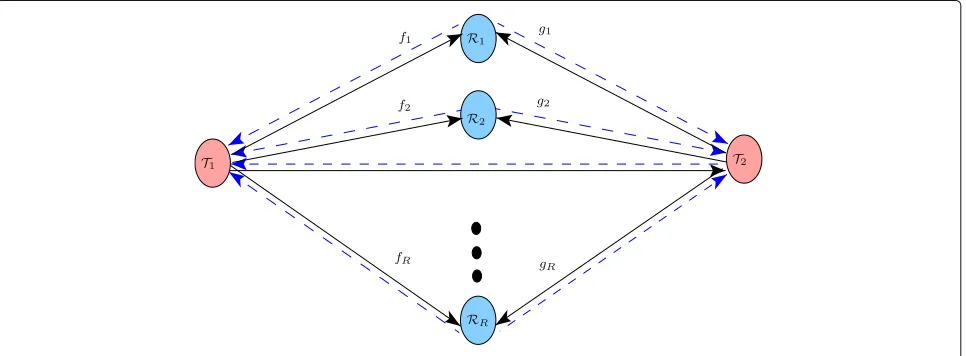
In this paper, we consider a conventional centralized half-duplex wireless cooperative communication network similarly as in [8–12,15]. The considered wireless coop-erative communication network consisting of (R + 2) single-antenna nodes. Two of them act as communicat-ing terminals, i.e.,T1andT2, andRnodes are utilized as
respectively, and to slowly change outside the respec-tive period. Remark that the considered Rayleigh fading channel model is a commonly used fading model that reasonably describes the channel observed in environ-ments with several scattering objects and no line of sight. All channels between the communicating terminals and relay nodes are assumed to be reciprocal. Let us denote the link fromT1 to Rr and from T2 to Rr asfr andgr,
respectively. The average transmitted power of the com-municating terminal and relay nodes T1,T2,R1,. . .,RR
arePT1,PT2,PR1,. . .,PRR, respectively. Throughout this
work,⊕,|·|,·,(·)∗, mod(a,b),·, [a]i,IT,σ2, and E{·}
denote the exclusive OR (XOR) operation, the absolute value, the floor operation which rounds toward zero, the complex conjugate, the remainder of the division of a
byb, the Frobenius norm, theith element of a vectora, the T × T identity matrix, the noise variance, and the statistical expectation, respectively.
3 Two-phase bi-directional relay selection strategy
In this strategy, communicating terminals exchange their information signals via two time slots. In the first time slot of this strategy, both communicating terminals, i.e.,T1and
T2, broadcast their information signal vectors, i.e.,sT1and
sT2. Therefore, therth relayRrreceives
yR,r =
2PT1frsT1+2PT2grsT2+nR,r (1)
where [sT1]i∈ ST1, [sT2]i∈ ST2, E|[sT1]i|2 =
1, E|[sT2]i|2
=1,ST1 andST2denote two, possibly dif-ferent, constellations, andnR,r is the noise signal vector
received at therth relayRrduring the first time slot. The rth relay Rr decodes the received information symbol
vector using the following maximum likelihood (ML) decoder
arg min sT1,sT2
yR,r−2PT1frsT1 +2PT2grsT2. (2)
To improve the overall system performance, therth relay Rr performs digital network coding by combining the
decoded information signal vectors of both terminals, ˜
sT1,r and ˜sT2,r, in one vector in order not to broadcast
known symbols to the communicating terminals, such that
sR,r =F(˜sT1,r,s˜T2,r) (3)
whereF(·,·)denotes a function used for combining the information symbols. Many functions have recently been suggested, e.g., modular arithmetic (MA) function [2]. Remark thatsR,r ∈ SR whereSR denotes the
constel-lation of the information symbols from relay nodes and |SR| = max{|ST1|,|ST2|}. Let us consider thejth entrys of a constellationS asS(j) wherej ∈ {0, 1,. . .,|S| −1} and the inverse asS−1(s) = j. Let definekT1 andkT2 as ST1(kT1) = sT1 andST2(kT2) = sT2, the MA function
can be expressed asFm(sT1,sT2) = SR(mod(ST1−1(sT1)+ S−1
T2(sT2),|SR|))=SR(mod(kT1+kT2,|SR|)). The XOR function proposed in [1] and the function suggested in [2] can also be applied to combine the information signal vec-tors. In the suggested strategy, two relays, theath relayRa
and the bth relay Rb, are selected amongRrelay nodes
according to a dual relay selection method. The first relay, i.e., theath relayRa, is selected amongRrelay nodes using
max-min criterion which is the optimal single-relay selec-tion method [8–10,12]. The second relay, i.e., thebth relay Rb, is selected among (R−1) relay nodes, after excluding
theath relayRa, using also max-min criterion, where
a = arg max
a min(|fa|,|ga|), b = arg max
b min(|fb|,|gb|),b=a. (4)
We observe that the suggested method chooses two relays, i.e.,RaandRb, according to the max-min selection
cri-terion. The first relay, i.e., Ra, is chosen amongR relay
nodes based on the max-min selection criterion which is the optimal single-relay selection method in both direc-tions [10] while the second relay, i.e.,Rb, is chosen among
R−1 relay nodes based also on the optimal single-relay selection method, i.e., max-min selection criterion [10]. In the following, we consider the received vectors at the second terminalT2. The received vectors at the first
termi-nalT1can be reconstructed correspondingly. Thus, during
the first time slot, the selected single-antenna relays, i.e., RaandRb, decode the information symbol vector of the
first and the second terminal before combining them into a single vector. During the second time slot, the antenna of the first relay, i.e.,Ra, and the antenna of the second relay,
i.e.,Rb, perform orthogonal STC using the following 2×2
Alamouti STC matrices
Aa =
1 0
0 1 , Ab=
0 1
−1 0 , (5)
˘
sR,a = sR,a, ˘sR,b=(sR,b)∗ (6)
before broadcasting the output signal vector to the desti-nations. Thus, the second terminalT2receives the
follow-ing signal vector
yT2 =PRagaAas˘R,a+
PRbgbAbs˘R,b+nT2 (7) wherenT2stands for noise signal vector at the second ter-minalT2. Let us consider the case of error-free decoding
on all relay nodes i.e.,sR,a = sR,b = sR. Therefore, the ML decoder of the second terminalT2can be expresses as
ˆ
sR,T2 =arg mins
R
yT2−
r={a,b}
PRrgrAr˘sR
. (8)
The second terminalT2reconstructs the information
symbol vectorsT2and by inverting the combination func-tion F (expressed as F−1), i.e., sˆT1 = F−1(ˆsR,T2,sT2) . When MA function is performed on the relay nodes,
ˆ
kR,T2 can be expressed asSR(kˆR,T2) = ˆsR,T2; therefore, the second terminalT2decodes the information signals of
the first terminal T1 by usingsˆT1 = Fm−1(sˆR,T2,sT2) = ST1(mod(kˆR,T2 −kT2,|ST1|)) where Fm−1 stands for the
inverse of the MA function.
4 Three-phase bi-directional relay selection strategy
In this part, three-phase protocol is performed. In the first two time slots, both terminals,T1andT2, transmit their
information symbol vectors,sT1andsT2, such that therth relayRrreceives
yR1,r=
3PT1frsT1+nR1,r (9)
yR2,r=
3PT2grsT2+nR2,r (10)
wherenR1,r andnR2,r denote as the noise signal vectors
received at the rth relayRr in the first and the second
time-slot, respectively. Similarly as in Section3and using (9) and (10), the rth relay Rr decodes the information
symbol vectors of the first and the second terminal,T1and
T2, using the following ML decoders ˆ
sT1,r = arg min sT1
yR1,r−
3PT1frsT1, (11)
ˆ
sT2,r = arg min sT2
yR2,r−
3PT2grsT2. (12)
We observe from the previous equations, i.e., (11) and (12), that the relay decoding complexity is very low where a symbol-wise decoder, that enjoys a linear decoding complexity, can be applied to decode the information symbols. However, the relay decoders of the proposed strategy using the two-phase relaying protocol, explained
in Section3, suffer from high decoding complexity which increases quadratically with the increase of the constel-lation size. Similar to Section 3, the decoded symbol vectors,s˜T1,rands˜T2,r, of the first terminalT1and the
sec-ond terminalT2are combined in a single symbol vector as
follows
sR,r=F(s˜T1,r,˜sT2,r). (13)
Similar to Section3, the relays,Ra andRb, are chosen
according to the suggesteddualrelay-selection criterion given in (4). The selected relays, Ra and Rb, perform
orthogonal STC technique using Almouti scheme in order to improve the diversity and coding gain without adding extra decoding complexity, where the information sym-bol vectors of the selected relays,sR,aand(sR,b)∗given in
(13), are encoded using the 2×2 Alamouti STC matrices,
Aa andAb, defined in (5) before sending the combined
symbol vector to both terminals during the third time-slot. Thus, the second terminalT2receives
yT2 =PRagaAasR,a+
PRbgbAb(sR,b)∗+nT2 (14)
where nT2 stands for the noise signal vector received at the second terminalT2in the third time slot. Similar to
Section 3, the ML decoder given in (8) is performed to recover the information vector at the second terminalT2.
Remark that the second terminalT2can recover the
infor-mation symbol vector via a symbol-by-symbol decoder which enjoys a linear decoding complexity instead of applying the ML decoder given in (8). The second termi-nalT2uses the knowledge of its own information vector sT2and the inverse of the combination function, i.e.,F−1, in order to reconstruct the information symbol vector of the first terminalˆsT1, i.e.,sˆT1 =F−1(sˆR,T2,sT2).
5 BER performance analysis
In this section, let us derive the theoretical BER perfor-mance of the suggested strategy using BPSK modulation according to the assumptions in Section 2 and assum-ing that all relays are ideal similar to [2,9,12]. Based on the previous assumptions, the strategies that use the two-phase and the three-two-phase protocol enjoy the same BER performance. In the derivations of the average BER perfor-mance, we consider that the noise signals are drawn from independent and identically distributed Gaussian random variables having zero mean and covarianceσ2IT. The
sug-gested relay- selection strategy defined in (4) selects the
ath andbth relay withPRa = PRb = PR. Let us
rear-distribution function, expressed as [9,10,12]
fwl(wl)=
based on the max-min relay selection method explained in (4), such thatga and fa are the link between theath
out ofR−1 relays based on the max-min relay selection method explained in (4), such thatgbandfb are the link
BER for the suggested double-relay selection strategy can be written as
We can observe that Eq.16contains four terms where the first oneT1 could be found via the moment-generation
function (MGF), such that
Q1=γRT2/2+γT2(R−1)/2=
Thus,T1in (16) can be expressed using (19) as [12,22]
Similarly as in the previous Eqs. 17–(21) and by con-sideringu1 ≥ u2and making use of the MGF of Q2 =
Similarly as in the previous Eq. 18, (23) is given using partial fraction expansion by
MQ2(s)=
Similarly as in (20), the second termT2can be expressed
using the MGF as
T2=
Similarly as in the previous Eqs.17–(21), and by consid-ering u2 ≥ R/2and making use of the MGF ofQ3 =
Similarly as in the previous Eq. 18, (28) is given using partial fraction expansion by
MQ3(s)=
Similarly as in (20), the third termT3can be expressed
using the MGF as
Making use of (29) and (30),T3in (16) is given by
Similarly as in the previous equations, (17)–(21), and con-sideringu1 ≥ (R−1)/2, and making use of the MGF
Similarly as in the previous Eq. 18, (33) is given using partial fraction expansion by
MQ4(s)= u1!(−1)
Similarly as in (20), the fourth termT4can be expressed
using the MGF as
T4= the average BER for the suggested double-relay selection strategy can be expressed as
P(γ )= 1
4(T1+T2+T3+T4). (36)
6 Methods/experimental
In the simulation results, let us consider a wireless coop-erative communication network consisting of (R + 2) single-antenna nodes, two of them act as communicating terminals andRof them act as relay nodes. The commu-nicating terminals use the relay nodes to exchange their symbol vectors. In this simulations, we consider the case of R = {2, 4, 6} relay nodes with a power distribution
PT1 = PT2 =
r=m,n
PRr. To fairly compare the
per-formance in terms of BER of the suggested and current strategies, the same average power, i.e., PT =PT1+PT2+
r=m,n
PRr wherePRm = PRn, and data rate are assumed.
The following abbreviations “SRS,” “DRS,” “2-phase,” “3-phase,” and “Proposed” denote the single-relay selection strategy suggested in [10], the double-relay selection strat-egy suggested in [9], the strategy that performs the two-phase relaying protocol, the strategy that performs the three-phase relaying protocol, and the suggested strategy, respectively.
7 Simulation results and discussion
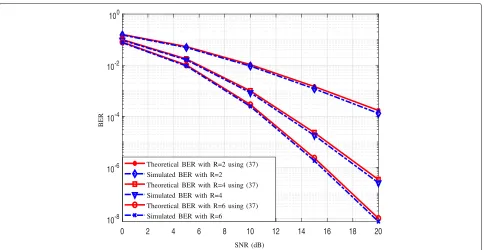
In Fig. 2, let us consider wireless cooperative networks with R = {2, 4, 6} relay nodes using BPSK constellation and assuming no direct link available between the first terminal T1 and the second terminal T2. In this figure,
Fig. 2Theoretical and simulated BER performance versus SNR for the suggested strategy withR = 2,R= 4, andR = 6
observe that the simulated performance of the suggested strategy in terms of BER is very close to the theoretical BER performance attained from Eq.36in Section5.
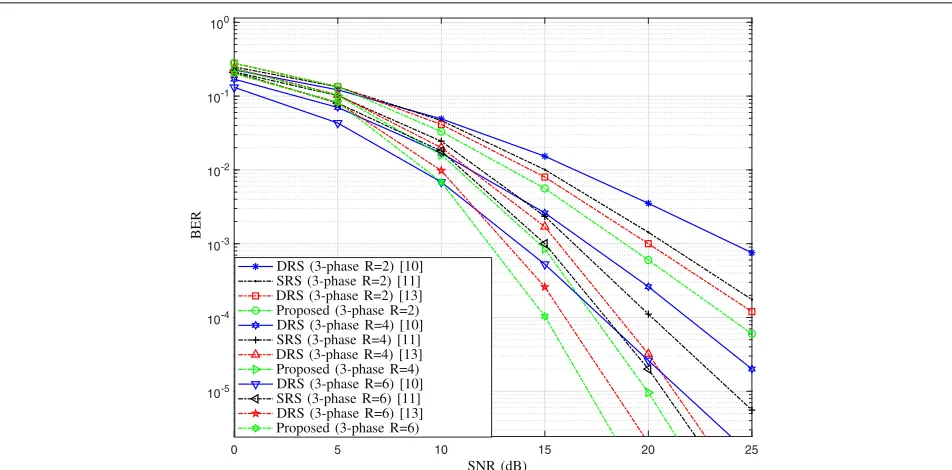
In Figs. 3 and 4, let us consider wireless cooperative networks withR = {2, 4}relay nodes using 4-QAM con-stellation and R = {2, 4, 6} relay nodes using 8-QAM
constellation, respectively, and assuming no direct link available between the first terminalT1and the second
ter-minalT2. In the latter figures, we compare the suggested
strategy that performs the three-phase relaying protocol with the double-relay selection strategy that performs the three-phase relaying protocol suggested in [9] and the
Fig. 4BER versus SNR for several single and dual relay selection strategies using the three-phase relaying protocol with 8-QAM modulation and R = 2,R = 4, andR = 6
single-relay selection strategy that performs the three-phase relaying protocol suggested in [10]. In Figs.3and
4, it can be observed that the suggested strategy that uses the three-phase relaying protocol outperforms the current state-of-the-art strategies that perform the same relaying protocol.
In Fig. 5, we consider a wireless cooperative communication network with R = {2, 4} relay nodes and assume that there is no direct link between the first terminalT1 and the second terminalT2. In Fig. 5,
the performance in terms of BER at the first terminal T1 is shown with respect to the SNR with a bit rate
of 1 bit per channel use (bpcu), respectively, where the suggested strategy that performs the two- and the three-phase relaying protocol using 4-QAM and 8-QAM constellation, respectively, has been compared with the double-relay selection strategy that performs the two-and the three-phase relaying protocol suggested in [9] using 4-QAM and 8-QAM constellation, respectively and the single-relay selection strategy that performs the two- and three-phase relaying protocol suggested in [10] using 4-QAM and 8-QAM constellation, respectively. In Fig.5, the strategy that performs the two-phase relaying protocol outperforms those which use the three-phase relaying protocol due to the increase of the symbol rate as discussed in Section3. We also observe that the suggested strategy that performs the two- and the three-phase relaying protocol outperforms the current state-of-the-art strategies that perform the same relaying protocol. From all simulation figures related to theoretical and simulated results, we can also observe that the proposed strategy enjoys full diversity order, especially at high SNR values.
8 Conclusion
In this work, we suggested a new dual-relay selection strategy according to orthogonal space time coding using the two-phase two-way relaying protocol and the three-phase two-way relaying protocol with its performance analysis. In the suggested strategy, two relays have been chosen according to the suggested dual relay selection criterion. The chosen relay nodes perform the concept of digital network coding to further improve the cod-ing gain by combincod-ing the information symbol vectors of both terminals in a single vector in order not to send known symbols to the communicating terminals. Since an orthogonal space time coding technique, i.e., Alamouti scheme, is performed on the wireless cooperative net-work, a symbol-wise decoder, which enjoys a linear decod-ing complexity, can be used to recover the information vectors.
Abbreviations
BER: Bit error rate; bpcu: Bit per channel use; BPSK: Binary phase shift key; CSI: Channel state information; MGF: Moment generation function; QAM: Quadrature amplitude modulation; SNR: Signal to noise ratio; STC: Space-time coding; XOR: Exclusive OR
Funding
This work was supported by the American University of the Middle East, Kuwait.
Availability of data and materials
A part of the simulation data used or analyzed during the current study is available from the corresponding author on reasonable request.
Authors’ contributions
All contributions are done by the corresponding author, SA, starting from proposing the system model, analyzing the system performance, optimizing the system model, verifying the correctness of the derivations, till writing and modifying the paper, writing and smoothing the words in the paper. The author, SA, read and approved the final manuscript.
Authors’ information
Samer Alabed joined American University of the Middle East as an assistant professor of electrical engineering in 2015. He was a researcher in the communication systems group at Darmstadt University of Technology, Darmstadt, Germany from 2008 to 2015. He received his PhD degree in electrical engineering and information technology with great honor (“magna cum laude”), from Darmstadt University of Technology, Darmstadt, Germany and his Bachelor and Master degree with great honor. During the last 13 years, he has worked as an assistant professor, (post-doctoral) researcher, and lecturer in several universities in Germany and Middle East and supervised tens of master theses and several PhD students. Dr. Alabed received several awards from IEE, IEEE, DAAD ... etc., where the last one was the best paper award from the International IEEE WSA in March, 2015. Dr. Alabed has worked as a researcher in several universities and companies and was invited to many conferences and workshops in Europe, US, and North Africa. The main idea of his research is to develop advanced DSP algorithms in the area of wireless communication systems and networks including (Massive) MIMO systems, distributed systems, co-operative communications, relay networks, space-time block and trellis coding, differential and blind multi-antenna techniques, MIMO channel estimation, MIMO decoders, channel coding and modulation techniques, distributed communication systems, two-way relaying, baseband communications, multi-carrier transmission (OFDM), modeling of wireless channel characteristics, adaptive beamforming, sensor array processing, transceiver design, multi-user and multi-carrier wireless communication systems, convex optimization algorithms for signal processing communications, channel equalization, and other kinds of distortion and interference mitigation. Further info on his homepage:http://drsameralabed. wixsite.com/samer.
Competing interests
The author declares no competing interests.
Publisher’s Note
Springer Nature remains neutral with regard to jurisdictional claims in published maps and institutional affiliations.
Received: 29 November 2018 Accepted: 28 March 2019
References
1. P. Larsson, N. Johansson, K. Sunell, inThe 63rd IEEE Vehicular Technology Conference (VTC Spring 2006). Coded bi-directional relaying, vol. 2, (Melbourne, 2006), pp. 851–855
2. S. Alabed, J. Paredes, A. B. Gershman, A simple distributed space-time coded strategy for two-way relay channels. IEEE Trans. Wirel. Commun. 11(4), 1260–1265 (2012)
3. S. Alabed, M. Pesavento, A. Klein, Non-coherent distributed space-time coding techniques for two-way wireless relay networks. EURASIP Spec. Issue Sensor Array Process.93(12), 3371–3381 (2013)
4. S. Alabed, M. Pesavento, inThe 16th International IEEE/ITG Workshop on Smart Antennas (WSA). A simple distributed differential transmit beamforming technique for two-way wireless relay networks, (Dresden, 2012), pp. 243–247.https://doi.org/DOI:10.1109/WSA.2012.6181214
5. A. Schad, S. Alabed, H. Degenhardt, M. Pesavento, inIEEE International Conference on Acoustics, Speech and Signal Processing (ICASSP). Bi-directional differential beamforming for multi-antenna relaying., (Brisbane, 2015).https://doi.org/DOI:10.1109/ICASSP.2015.7178498
6. S. Alabed, Performance analysis of differential beamforming in
decentralized networks. Int. J. Electr. Comput. Eng.8(3), 1692–1700 (2018) 7. S. Alabed, Computationally efficient multi-antenna techniques for
multi-user two-way wireless relay networks. Int. J. Electr. Comput. Eng. 8(3), 1684–1691 (2018).http://doi.org/10.11591/ijece.v8i3.pp1684-1691
8. S. Alabed, M. Pesavento, A. Klein,Relay selection based space-time coding for two-way wireless relay networks using digital network coding. Proceedings of the 10th International Symposium on Wireless Communication Systems (IEEE ISWCS 2013), (Ilmenau, 2013), pp. 27–30 9. Y. Li, R. Louie, B. Vucetic, Relay selection with network coding in two-way
relay channels. IEEE Trans. Veh. Technol.59(9), 4489–4499 (2010) 10. S. Atapattu, Y. Jing, H. Jiang, C. Tellambura, Relay selection schemes and
11. G. Chen, Z. Tian, Y. Gong, Z. Chen, J. Chambers, Max-ratio relay selection in secure buffer-aided cooperative wireless networks. IEEE Trans. Info. Forensics Secur.4, 9 (2014)
12. S. Alabed, Performance analysis of two-way DF relay selection techniques. Special Issue ICT Converg. Internet of Things (IoT), Elsevier.2(3), 91–95 (2016).https://doi.org/10.1016/j.icte.2016.08.008
13. S. Alabed, J. Paredes, A. Gershman, A low complexity decoder for quasi-orthogonal space-time block codes. IEEE Trans. Wirel. Commun.3, 10 (2011)
14. G. Cai, Y. Fang, G. Han, J. Xu, G. Chen, Design and analysis of
relay-selection strategies for two-way relay network-coded DCSK systems. IEEE Trans. Veh. Technol.67(2), 1–13 (2017)
15. T. Nguyen, T. Minh, P. Tran, M. Voznak, T. Duy, T. Nguyen, P. Tin, Performance enhancement for energy harvesting based two-way relay protocols in wireless ad-hoc networks with partial and full relay selection methods. Ad Hoc Netw.84, 178–187 (2019)
16. S. Zhou, J. Xu, Z. Niu, Interference-aware relay selection scheme for two-hop relay networks with multiple source-destination pairs. IEEE Trans. Veh. Technol.62(5), 2327–2338 (2013)
17. M. Ju, K. Hwang, H. Song, Relay selection of cooperative diversity networks with interference-limited destination. IEEE Trans. Veh. Technol. 62(9), 4658–4665 (2013)
18. Y. Fang, G. Han, P. Chen, F. C. M. Lau, G. Chen, L. Wang, A survey on DCSK-based communication systems and their application to UWB scenarios. IEEE Commun. Surveys Tuts.18(3), 1804–1837 (2016) 19. G. Cai, Y. Fang, G. Han, Design of an adaptive multiresolution M-ary DCSK
system. IEEE Commun. Lett.21(1), 60–63 (2017)
20. G. Cai, Y. Fang, G. Han, F. C. M. Lau, L. Wang, A square constellation-based M-ary DCSK communication system. IEEE Access.4, 6295–6303 (2016) 21. G. Cai, L. Wang, L. Kong, G. Kaddoum, inIEEE 83rd Vehicular Technology
Conference (VTC Spring). SNR estimation for FM DCSK system over multipath Rayleigh fading channels, (Nanjing, 2016), pp. 1–5