P R O C E E D I N G S
Open Access
Modeling of multivariate longitudinal phenotypes
in family genetic studies with Bayesian
multiplicity adjustment
Lili Ding
1,2*, Brad G Kurowski
1,2, Hua He
1, Eileen S Alexander
3, Tesfaye B Mersha
1,2, David W Fardo
4, Xue Zhang
1,
Valentina V Pilipenko
1, Leah Kottyan
1, Lisa J Martin
1,2From
Genetic Analysis Workshop 18
Stevenson, WA, USA. 13-17 October 2012
Abstract
Genetic studies often collect data on multiple traits. Most genetic association analyses, however, consider traits separately and ignore potential correlation among traits, partially because of difficulties in statistical modeling of multivariate outcomes. When multiple traits are measured in a pedigree longitudinally, additional challenges arise because in addition to correlation between traits, a trait is often correlated with its own measures over time and with measurements of other family members. We developed a Bayesian model for analysis of bivariate quantitative traits measured longitudinally in family genetic studies. For a given trait, family-specific and subject-specific random effects account for correlation among family members and repeated measures, respectively. Correlation between traits is introduced by incorporating multivariate random effects and allowing time-specific trait residuals to correlate as in seemingly unrelated regressions. The proposed model can examine multiple single-nucleotide variations simultaneously, as well as incorporate familyspecific, subject-specific, or time-varying covariates. Bayesian multiplicity technique is used to effectively control false positives. Genetic Analysis Workshop 18 simulated data illustrate the proposed approach’s applicability in modeling longitudinal multivariate outcomes in family genetic association studies.
Background
High-throughput genotyping advances have generated large amounts of genetic data. At the same time, numer-ous related phenotypes are often collected in genetic studies of complex traits. To understand how genetic variants influence multiple traits, it is necessary to con-sider correlation among variants and multiple traits jointly [1,2]. However, most genetic studies have focused on single variant-single trait association. Analysis per-formed in this fashion faces at least 3 issues. First, it leads to concerns regarding false discoveries. Bonferroni andother types of correction may limit false discoveries, but implementing these methods on correlated traits limits the power to detect true associations. Second,
same genetic variants may influence multiple related traits [3]. Thus, modeling traits separately may misre-present the underlying biology. Lastly, failure to inte-grate correlation among variants because of linkage disequilibrium (LD) dilutes the association. Longitudinal studies provide an additional challenge because traits measured over time are likely to be correlated.
We propose a Bayesian joint modeling of longitudinally measured multiple traits in family genetic studies. Expli-citly considering the correlation structure between multi-ple traits using multivariate random effects [4] and seemingly unrelated regression techniques [5], this model studies simultaneously multiple single-nucleotide varia-tions (SNVs) and their associavaria-tions with multiple traits measured longitudinally. Bayesian multiplicity [6] correc-tion controls false positives. Our method uniquely demon-strates the ability of Bayesian methods to account for the complexity of multivariate, longitudinal data in the context
* Correspondence: [email protected]
1
Department of Pediatrics, Cincinnati Children’s Hospital Medical Center, 3333 Burnet Avenue, Cincinnati, OH 45229, USA
Full list of author information is available at the end of the article
of genetic family data while controlling for false positives. Simulated data from Genetic Analysis Workshop 18 (GAW18) illustrate the application of the proposed method. The analysis was performed with knowledge of the simulation model.
Methods
Bayesian bivariate model
We consider SNV association models with a longitudinal bivariate quantitative outcome in family studies. Letykijt
be thekthoutcome of subject jof pedigreeiat timet.
Here k= 1or 2 for bivariate outcomes; i= 1, 2,. . .,I
indexesIfamilies in the study; j= 1, 2,. . .,niindexesni
subjects in pedigreei; andt= 1, 2,. . .mijindexes time points where outcomes are measured for subject jof ped-igreei. Here, the number of measurementmijdoes not need to be equal for different subjects, but we assume the 2 outcomes are measured at the same set of time points for the same individual. We jointly model the outcomes as follows:
ykijt=β0k+XijTβxk+ZTijtβzk+gG=1γgkβgkSNVijg+pki+skij+ekijt
Here, Xis a vector of subject-specific time-invariant covariates and Zis a vector of time-varying covariates.
SNVijg,g= 1, 2,. . .G,is the gthSNV of subject jof pedi-greei, coded as 0, 1, or 2 indicating the number of minor alleles andGis the number of SNVs in the model.βsare regression coefficients (including an intercept) for the cov-ariates or genetic variants.γsare SNV-specific indicator variables, which take values 1 or 0, depending on whether the SNV has an effect on the given outcome or not. Let
pi={p1i,p2i}, a pedigree-specific random effect common to
all the individuals in the same family and accounts for cor-relation within families. Letsij={s1ij,s2ij}, a subject-specific random effect accounting for the correlation between measures taken repeatedly on the same subject. Let
eijt={e1ijt,eijt2},the residual error. Additionally,pi,sijandeijt
are assumed to be independent, and
Random family : pi∼N2
This Bayesian bivariate model uses bivariate normal random family and subject effects, and a bivariate nor-mal distribution for the residual errors, as in seemingly unrelated regressions, to jointly model the 2 traits and allow them to be correlated.
Bayesian multiplicity adjustment
Bayesian multiplicity adjustment is a Bayesian solution to multiplicity problems [6]. Through appropriate choices of priors on model probabilities, this Bayesian solution will not inflate type I error in the face of multiple com-parisons. In our model, we use prior distributions on SNV inclusion to provide correction for multiplicity. For each SNV in the model, 2 parameters are present–the inclusion indicator and the regression coefficient. We assume that the inclusion indicators follow a Bernoulli distribution with an unknown inclusion probability
q, while q follows a Beta distribution, that is, γk
g ∼Bernoulli
1,q and q∼Beta(a,b). Here, we set
a= 1,b=G, which represents a sceptical prior such that the marginal prior odds of an association is1/G[7]. This Beta-Bernoulli type of prior provides an intrinsic multi-plicity correction in the face of multiple comparisons. The significance of the Bayesian analysis is the posterior inclusion probability.Unlike traditionalpvalues, a higher posterior inclusion probability indicates greater confi-dence of a true result. For each SNV, we estimate poster-ior inclusion probability as
Here,Sis the model space being visited by the Markov chain Monte Carlo (MCMC);ˆpMγk—D,S
is the esti-mated posterior probability of model Mγk, where γk={γk
and 0 otherwise. True- and false-positive rates are based on the median probability model, which is the model that includes variants with a posterior inclusion probability lar-ger or equal to 0.5. We use noninformative, independent, univariate normal priors for all regression coefficients βk
0,βxk,βzk, andβ k
g, and noninformative inverse Wishart
priors for variance-covariance matricesp,s, ande.
Analysis of GAW18 data
Two outcomes, diastolic (DBP) and systolic blood pres-sure (SBP), were evaluated. Covariates included sex, age, and smoking status. To adjust for antihypertensive med-ications use, we calculated the mean difference of blood pressure (BP) between observations with medication use (med = 1) and those without medication (med = 0) among observations with hypertension (htn = 1);that is,
(BPhtn= 1,med= 1)−(BPhtn= 1,med= 0).
Observed BP values were adjusted using mean differ-ences for observations with htn = 1 and med = 1 to impute DBP and SBP measures without medication use. These adjusted outcomes were used in the analysis [8].
Each individual has 3 observations. Our focus is on SNVs inMAP4on chromosome 3. There are 894 SNVs in the gene; 14 influence both DBP and SBP, and 1 influences SBP. Among the 15 causal SNVs, three are common (minor allele frequency [MAF]>0.05); all others are rare. All analyses were based on replication set 1. To investigate effectiveness of Bayesian multiplicity adjustment, a ran-dom set of noise variants of size 1, 15, 30, 60, and 90 were added fromMAP4. Selection of noise variants was truly random and did not account for LD with causal SNVs. After burn-in and thinning every 10thiteration, 50,000 samples were drawn for MCMC simulations.
We compared our method with two other methods. One method is a Bayesian univariate model where the off diagonal of the variance and covariance matrices in equations (1), (2), and (3) are zero, thus the 2 traits are modeled independently. The univariate model can han-dle longitudinal data and multi-variants, and uses Baye-sian multiplicity techniques to adjust for multiple comparisons. The other is the family-based measured genotype approach (MGA), which is a standard approach to analyze family genetic studies and compares polygenic models with or without each SNV as a covari-ate [9]. MGA models a single outcome and single SNV,
and cannot handle longitudinal data from multiple out-comes jointly. Thus, only the first pair of DBP and SBP measures, adjusted for medication use, of each indivi-dual was used and modeled separately. Bonferroni correction was used for multiple comparisons after accounting for 105 tests (90 noises and 15 causal).
Results
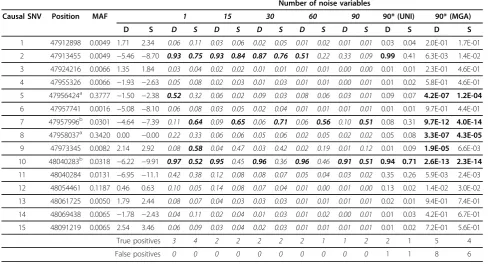
Using a threshold of 0.5 for the posterior inclusion prob-ability, the Bayesian bivariate model detected 5 of the 15 SNVs between SBP and DBP with 1 noise variant (Table 1). As the number of noise variants increased, the number of true positives identified was reduced, such that by 90 noise variants, only two causal variants were identified. True posi-tives had relatively low MAFs and large effect sizes (Table 1). False negatives either were rare, had small effect size, or both. Importantly, Bayesian multiplicity adjustment yielded no false positives. This suggests that a lower poster-ior probability threshold may be appropriate to yield a family-wise error rate of 0.05.
Using the same set of 90 noise variants, MGA detected five causal SNVs (4 for SBP and 1 additional for DBP). However, MGA identified 8 and 6 false positives for DBP and SBP, respectively. The Bayesian univariate model
Table 1 Posterior inclusion probabilities of the causal SNVs
Number of noise variables
Causal SNV Position MAF 1 15 30 60 90 90* (UNI) 90* (MGA)
D S D S D S D S D S D S D S D S
1 47912898 0.0049 1.71 2.34 0.06 0.11 0.03 0.06 0.02 0.05 0.01 0.02 0.01 0.01 0.03 0.04 2.0E-01 1.7E-01 2 47913455 0.0049 −5.46 −8.70 0.93 0.75 0.93 0.84 0.87 0.76 0.51 0.22 0.33 0.09 0.99 0.41 6.3E-03 1.4E-02 3 47924216 0.0066 1.35 1.84 0.03 0.04 0.02 0.02 0.01 0.01 0.01 0.01 0.00 0.00 0.01 0.01 2.3E-01 4.6E-01 4 47955326 0.0066 −1.93 −2.63 0.05 0.08 0.02 0.03 0.01 0.03 0.01 0.01 0.00 0.01 0.01 0.02 5.8E-01 4.6E-01 5 47956424a 0.3777 −1.50 −2.38 0.52 0.32 0.06 0.02 0.09 0.03 0.08 0.06 0.03 0.01 0.09 0.07 4.2E-07 1.2E-04 6 47957741 0.0016 −5.08 −8.10 0.06 0.08 0.03 0.05 0.02 0.04 0.01 0.01 0.01 0.01 0.01 0.01 9.7E-01 4.4E-01 7 47957996b 0.0301 −4.64 −7.39 0.11 0.64 0.09 0.65 0.06 0.71 0.06 0.56 0.10 0.51 0.08 0.31 9.7E-12 4.0E-14
8 47958037a 0.3420 0.00 −0.00 0.22 0.33 0.06 0.06 0.05 0.06 0.02 0.05 0.02 0.02 0.05 0.08 3.3E-07 4.3E-05
9 47973345 0.0082 2.14 2.92 0.08 0.58 0.04 0.47 0.03 0.42 0.02 0.19 0.01 0.12 0.01 0.09 1.9E-05 6.6E-03 10 48040283b 0.0318 −6.22 −9.91 0.97 0.52 0.95 0.45 0.96 0.36 0.96 0.46 0.91 0.51 0.94 0.71 2.6E-13 2.3E-14 11 48040284 0.0131 −6.95 −11.1 0.42 0.38 0.12 0.08 0.08 0.07 0.05 0.04 0.03 0.02 0.35 0.26 5.9E-03 2.4E-03 12 48054461 0.1187 0.46 0.63 0.10 0.05 0.14 0.08 0.07 0.04 0.01 0.00 0.01 0.00 0.13 0.02 1.4E-02 3.0E-02 13 48061725 0.0050 1.79 2.44 0.08 0.07 0.04 0.03 0.03 0.03 0.01 0.01 0.01 0.01 0.02 0.01 9.4E-01 7.4E-01 14 48069438 0.0065 −1.78 −2.43 0.04 0.11 0.02 0.04 0.01 0.03 0.01 0.02 0.00 0.01 0.01 0.03 4.2E-01 6.7E-01 15 48091219 0.0065 2.54 3.46 0.06 0.09 0.03 0.04 0.02 0.03 0.01 0.01 0.01 0.01 0.01 0.02 7.2E-01 5.6E-01
True positives 3 4 2 2 2 2 2 1 1 2 2 1 5 4
False positives 0 0 0 0 0 0 0 0 0 0 1 1 8 6
Numbers in italics show the results of the Bayesian bivariate model, that is, estimated posterior inclusion probabilities of the 15 causal SNVs and numbers of true and false positives based on the median probability model. Posterior inclusion probabilities≥0.5 are in bold. The last 4 columns are the results of the model where DBP and SBP are modeled independently (*) using either the Bayesian univariate model (UNI, posterior inclusion probability) or measured genotype approach (MGA,pvalue), wherepvalues in bold are below the cutoff with Bonferroni correction (0.05/105 = 4.76E-04). In the table,Drepresents DBP,Srepresents SBP. SNVs 5 and 8 (a
) and SNVs 7 and 10 (b
identified 2 causal SNVs and 1 false positive for both DBP and SBP.
As the 90 noise variants were randomly selected, exam-ining the LD structure is also important. Among the true positives, two pairs (SNVs 5 and 8 and SNVs 7 and 10) have a high LD(r2≥0.8). SNVs 7 and 10 were both identified by the Bayesian bivariate model and MGA, but only SNV 10 was identified by the Bayesian univariate model. SNVs 5 and 8 were identified by MGA, but none was identified by either the Bayesian bivariate or univari-ate approach. For MGA, six of the false positives of DBP and four of the false positives of SBP had relatively high LD (r2≥0.8) with identified true positives. After discounting false positives caused by indirect effects, MGA had 2 false positives for both DBP and SBP.
Overall the Bayesian bivariate model resulted in poster-ior estimates of beta values very similar to the reported effect size from Genetic Analysis Workshop (GAW) data
generators (Figure 1). However, estimates of effect sizes were inflated when only 1of the 2 variants in high LD and having the same effect direction was included in the model during MCMC simulation (e.g.SNVs 7 and 10). The estimated effect size for SNV 8 (true effect size≈0) was also inflated because it is in high LD with SNV 5 (true effect size <0). In addition, for many causal SNVs there was a high posterior exclusion probability (the proportion of times the variant was not included in the model), sug-gesting that some beta estimates were based on a small number of MCMC runs.
Discussion
We developed a novel Bayesian model for analysis of mul-tiple longitudinal traits and multi-variant models in family genetic studies. This is a significant advance because pre-vious studies have looked at bivariate models, longitudinal data, or multi-SNV models separately. For the first time,
we have developed an analytic approach that can incorpo-rate all of these issues jointly. The model considers bivari-ate random family and random subject effects to account for correlation between outcomes, family members, and repeated measures of the same individual. The seemingly unrelated regression technique is used to correlate the residuals of the 2 outcomes measured at the same time for the same individual. Inherent in this method is Bayesian multiplicity for the control of false positives. Using the GAW18 simulated data set, we demonstrated the feasibil-ity of the proposed model.
Compared to the Bayesian univariate model in which the 2 outcomes are modeled separately, our method had simi-lar power, but fewer false positives. Compared to MGA, our Bayesian bivariate approach had fewer false positives regardless of LD between causal and noise SNVs. While the noise variants in LD with our causal variants did not result in increased false positives using the Bayesian approach, given the multi-variant nature of the analysis it is possible that the LD in these noise parameters may have reduced power to detect causal effects. Although different from our proposed method in many aspects, MGA repre-sents a standard practice for analysis of family-based genetic studies. This comparison of different approaches is important because it demonstrates that given the low false positives, the Bayesian model is potentially better than current standard practice.
Several other studies have shown improved power of joint modeling of multiple traits over univariate analyses [10-13]. However, we saw a modest reduction in false posi-tives without much increase in power. This may be a result of the fact that although the correlation between SBP and DBP is modest(r2= 0.55), these 2 outcomes depend on almost exactly the same set of variants; efficiency gains by utilizing a multivariate approach in this case are negligible. In contrast, large efficiency gains are expected when the outcomes depend on different covariate sets [11]. Further-more, our model does not explicitly model the genetic rela-tionship between individuals; instead, we used a random family effect. Although we do not expect the inclusion of a kinship coefficient matrix to influence the results, future studies should examine this further.
It is important to note that the model inference is based on computationally expensive MCMC simulation. Although we didn’t use any special algorithms to effi-ciently sample the model space and the number of itera-tions was relatively small given the extremely large model space, the posterior inclusion probabilities became stable very early in the MCMC chain. This suggests that poster-ior inclusion probabilities can provide valid model infer-ence. Sensitivity analyses with more optimistic priors on inclusion probabilities gave more power while controlling false positives. However, prior knowledge or evidence must support the use of this type of prior.
Conclusions
In summary, we introduced a Bayesian model for analysis of bivariate quantitative traits measured longitudinally in family genetic studies. This method extends the previous joint modeling methods and permits simultaneous analy-sis of multiple traits with longitudinal data. Furthermore, this method incorporates multi-variant effects while effectively controlling the false-positive rate.
Competing interests
The authors declare that they have no competing interests.
Authors’contributions
LD conceived and performed the statistical analysis and drafted the manuscript. LJM contributed to the design of the statistical analysis.HH helped with statistical analysis. BGK, ESA, TBM, DWF, HH, XZ, VP, LK, and LJM helped with the writing of the manuscript. All authors read and approved the final manuscript.
Acknowledgements
This work was supported in part by NIH grants 8P20GM103436-12 (DWF), K25AG043546(DWF), NS36695 (LD, LJM), AI070235 (HH, LJM), AI066738 (LJM), HL111459 (LJM, VP), T32-ES10957 (ESA), K12 HD001097-16 (BGK),
K01HL103165 (TBM). This paper was also support by an Institutional Clinical and Translational Science Award (LD), NIH/NCATS Grant Number 8UL1TR000077-04. Its contents are solely the responsibility of the authors and do not necessarily represent the official views of the NIH. The GAW18 whole genome sequence data were provided by the T2D-GENES Consortium, which is supported by NIH grants U01 DK085524, U01 DK085584, U01 DK085501, U01 DK085526, and U01 DK085545. The other genetic and phenotypic data for GAW18 were provided by the San Antonio Family Heart Study and San Antonio Family Diabetes/Gallbladder Study, which are supported by NIH grants P01 HL045222, R01 DK047482, and R01 DK053889. The Genetic Analysis Workshop is supported by NIH grant R01 GM031575.
This article has been published as part ofBMC ProceedingsVolume 8 Supplement 1, 2014: Genetic Analysis Workshop 18. The full contents of the supplement are available online at http://www.biomedcentral.com/bmcproc/ supplements/8/S1. Publication charges for this supplement were funded by the Texas Biomedical Research Institute.
Authors’details
1
Department of Pediatrics, Cincinnati Children’s Hospital Medical Center, 3333 Burnet Avenue, Cincinnati, OH 45229, USA.2Department of Pediatrics,
University of Cincinnati College of Medicine, 3235 Eden Avenue,Cincinnati, OH 45267, USA.3Department of Environmental Health, University of
Cincinnati College of Medicine, 3223 Eden Avenue, Cincinnati, OH 45267, USA.4Department of Biostatistics, University of Kentucky, 725 Rose Street,
Lexington, KY 40536, USA.
Published: 17 June 2014
References
1. Shriner D:Moving toward system genetics through multiple trait analysis in genome-wide association studies.Front Genet2012,3:1.
2. Zhu WS, Zhang HP:Why do we test multiple traits in genetic association studies?J Korean Stat Soc2009,38:1-10.
3. Almasy L, Dyer TD, Blangero J:Bivariate quantitative trait linkage analysis: pleiotropy versus co-incident linkages.Genet Epidemiol1997,14:953-958. 4. Reinsel G:Multivariate repeated-measurement or growth curve models
with multivariate random-effects covariance structure.J Am Stat Assoc
1982,77:190-195.
5. Zellner A:An efficient method of estimating seemingly unrelated regressions and tests for aggregation bias.J Am Stat Assoc1962,
57:348-368.
7. Wilson MA, Iversen ES, Clyde MA, Schmidler SC, Schildkraut JM:
Bayesianmodel search and multilevel inference for SNP association studies.Ann Appl Stat2010,4:1342-1364.
8. Tobin MD, Sheehan NA, Scurrah KJ, Burton PR:Adjusting for treatment effects in studies of quantitative traits: antihypertensive therapy and systolic blood pressure.Stat Med2005,24:2911-2935.
9. Boerwinkle E, Chakraborty R, Sing CF:The use of measured genotype information in the analysis of quantitative phenotypes in man.1. Models and analytical methods.Ann Hum Genet1986,50:181-194.
10. Liu JF, Pei YF, Papasian CJ, Deng HW:Bivariate association analyses for the mixture of continuous and binary traits with the use of extended generalized estimating equations.Genet Epidemiol2009,33(3):217-227. 11. Teixeira-Pinto A, Normand SL:Correlated bivariate continuous and binary
outcomes: issues and applications.Stat Med2009,28:1753-1773. 12. Verzilli CJ, Stallard N, Whittaker JC:Bayesianmodelling of multivariate
quantitative traits using seemingly unrelated regressions.Genet Epidemiol
2005,28:313-325.
13. Yang F, Tang ZH, Deng HW:Bivariate association analysis for quantitative traits using generalized estimation equation.J Genet Genomics2009,
36:733-743.
doi:10.1186/1753-6561-8-S1-S69
Cite this article as:Dinget al.:Modeling of multivariate longitudinal phenotypes in family genetic studies with Bayesian multiplicity adjustment.BMC Proceedings20148(Suppl 1):S69.
Submit your next manuscript to BioMed Central and take full advantage of:
• Convenient online submission
• Thorough peer review
• No space constraints or color figure charges
• Immediate publication on acceptance
• Inclusion in PubMed, CAS, Scopus and Google Scholar
• Research which is freely available for redistribution