Characterizing and Predicting Bursty Events:
The Buzz Case Study on Twitter
Mohamed Morchid, Georges Linar`es, Richard Dufour
LIA - University of Avignon (France)
{mohamed.morchid, georges.linares, richard.dufour}@univ-avignon.fr
Abstract
The prediction of bursty events on the Internet is a challenging task. Difficulties are due to the diversity of information sources, the size of the Internet, dynamics of popularity, user behaviors. . . On the other hand, Twitter is a structured and limited space. In this paper, we present a new method for predicting bursty events using content-related indices. Prediction is performed by a neural network that combines three features in order to predict the number of retweets of a tweet on the Twitter platform. The indices are related to popularity, expressivity and singularity. Popularity index is based on the analysis of RSS streams. Expressivity uses a dictionary that contains words annotated in terms of expressivity load. Singularity represents outlying topic association estimated via a Latent Dirichlet Allocation (LDA) model. Experiments demonstrate the effectiveness of the proposal with a 72% F-measure prediction score for the tweets that have been forwarded at least 60 times.
Keywords:Bursty events detection; Latent Dirichlet Allocation; Neural network
1. Introduction
Information disseminated in micro-blogging platforms may become very popular and massively shared depending on the interest of the users for this information. This study deals with this particular information behavior by propos-ing to prior characterize and detect these bursty events (calledbuzz). Thebuzz is defined by (Yi, 2005) as a me-dia activity explosion triggered by an information.
Predicting these bursty events is a difficult task since this phenomenon depends on various features related to the in-formation itself, the public awareness and also the media dynamic aspects that tend to self-sustaining. These diffi-culties increase with the size, the dispersion and the frag-mentation of the Web information.
Authors in (Bass, 2004; Goldenberg et al., 2001) study the impact of themouth-to-earand theviral advertisement
in the context of information propagation. Others studies focused on information propagation using threshold-based models (Kempe et al., 2003). From this point-of-view, Twitter is an experimental space that is easier to study than the global Internet network. In this article, we propose to predict the retransmission peaks of the posted messages in Twitter. By this way, the number of retransmissions (i.e. retweets) is used as a measure of the performance ofbuzz
prediction. Concretely, we consider that a message is con-sidered as abuzzif its retweet number is higher than ana prioridefined threshold.
In the context of the Twitter platform, its popularity is due to the capability to relay messages (i.e. tweets) posted by users. This particular mechanism, called retweet, allow users to massively share tweets1 they consider as poten-tially interesting for others. The description of Twitter user behavior is a recent case study (Larceneux, 2007; Yang et al., 2010; Morchid et al., 2013). Various applications have then been made: prediction of natural disasters (Vieweg
1Atweetis a short text message composed of up to 140
char-acters.
et al., 2010), learning support (Grosseck and Holotescu, 2008), political analysis (Tumasjan et al., 2010; Golbeck et al., 2010), or marketing (Wright, 2009). Studies also fo-cused on the particular retweet mechanism. Usually, three types of features contribute to the retweet behavior: the content and the context in which the tweet is produced and shared (Kwak et al., 2010; Suh et al., 2010; Peng et al., 2011), the popularity of users (Cha et al., 2010; Romero et al., 2011), and the relation between users (Peng et al., 2011).
Nonetheless, few works are related to thebuzzprediction. In (Hong et al., 2011), authors use the number of retweets not to predict the bursty events but to evaluate their pop-ularity. Authors in (Kleinberg, 2003) propose a statistical hierarchical model of bursty text streams evaluated in the particular context of e-mails.
In this article, we focus on the buzz prediction using the textual content of the messages. We propose an approach based on the mapping of source documents in a reduced semantic space in which some descriptors could be de-termined by a Latent Dirichlet Allocation (LDA) analy-sis (Blei et al., 2003). Three features are particularly stud-ied: the popularity, the thematic singularity, and the ex-pressivity of the tweet content. Prediction is performed by a neural network that combines the three features. We demonstrate that this approach allows to detect information that may generate a buzz in large collection of heteroge-neous data.
The article is organized as follows. Section 2. described the proposed system, while section 3. presents the experimen-tal protocol. Results are then detailed in section 4. before concluding in section 5.
2. Buzz prediction system
The proposed system includes three main steps. The first one extracts keywords associated to a tweet. This key-word selection step lies on a thematic model estimated from the Latent Dirichlet Allocation (LDA) approach. Then the
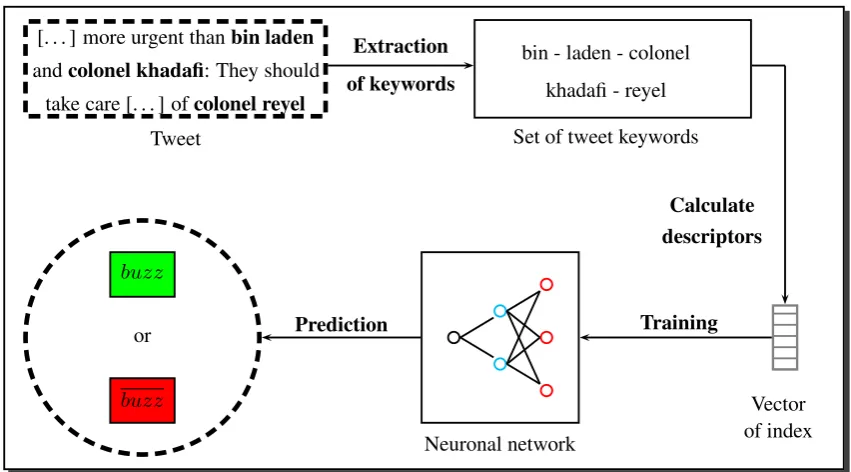
popularity, singularity and expressivity descriptors are ex-tracted from the message and its thematic representation. Finally, a neuronal network is used to determine the number of retweets for each tweet using the considered descriptors. Figure 1 presents the architecture of thebuzzprediction sys-tem, where 6 successive steps are needed:
1. Representation of a tweettwith a feature vectorWt.
2. Estimation of a LDA model on a large corpus D of documents to produce a topic spaceTspc.
3. Projection ofWtintoT
spcto select a subset of topics
Sz
⊂Tspcrepresenting the tweet.
4. Extraction of a subsetSwrepresenting the tweet
key-words fromSzregardingWt.
5. Extraction of an index vector fromSwwhere each
co-efficient represents the score of popularity, expressiv-ity and singularexpressiv-ity.
6. Training of a neuronal network to predict the tweet
buzzability.
The three main steps are described below.
2.1. Extraction of keywords
The Twitter platform limits the size of messages to 140 characters. This constraint causes the use of a particular vocabulary that is often unusual, noisy, full of new words, including misspelled or even truncated words (Choudhury et al., 2007). Only using the tweet words is insuffi-cient (Morchid et al., 2013).
In order to compensate these particularities, two methods are compared to increase the initial tweet lexicon from an additional corpus of documents: a classical word repre-sentation with the TF-IDF-RP method (Salton, 1989) and a topic space representation with the LDA approach (Blei et al., 2003). In our experiments, this additional corpus is composed of 100,000 Wikipedia and AFP documents con-taining around 1 billion words.
2.1.1. TF-IDF-RP
Let’sD be a corpus ofnddocumentsdandnwbe the
vo-cabulary size. Each tweettcan be represented as a point ofIRnwby the vectorWt
i of sizenwwhere theithfeature
(i= 1,2, . . . , nw) combines: the Term Frequency (TF), the
Inverse Document Frequency (IDF) and the Relative Posi-tion (RP) (Salton, 1989) of a wordwioft:
Wit=tfi.idfi.rpi, (1)
where
tfi=
|{wi:wi∈t}|
|t| , idfi=log
|C| |{d:wi∈d}|
, rpi=
|t|
f p(wi)
.
(2)
Here,| · |is the number of elements in the corresponding set andf pi is the position of the first occurrence ofwi in
the tweett.
This approach allows a simple extraction of thenmost
rep-resentative words inWtof a tweet. The system extracts the
10 words that obtain the highest TF-IDF-RP scores (Zhang et al., 2010).
2.1.2. Combination of latent topics
Latent Dirichlet Allocation (LDA) is a generative model which considers a document model (seen as a bag of words(Salton, 1989)) as a mixture probability of latent top-ics. These latent topics are characterized by a distribution of word probabilities which are associated with them. At the end of LDA analysis, we obtain a set of topics with, for each, a set of words and their emission probabilities. LDA is applied on a corpus D containing a vocabulary of mw words. Firstly, a topic model is built using a
fea-ture vectorVz
i associated with each topiczof the semantic
spaceTspc. Eachithfeature (i= 1,2, . . . , m
w) ofViz
rep-resents the probability of the word wi knowing the topic
z.
A semantic space of 5,000 topics is obtained (empirically defined). For each LDA class, the 50 words with the maxi-mum weights are selected.
The tweettis then mapped intoTspc. A similarity measure
is computed between a tweet (Wt
i) and a topic (Viz) using
the cosine metric:
δ(t, z) =
P wi∈t
Vz i .Wit r P
wi∈z
Vz i
2. P
wi∈t
Wt i
2 . (3)
Finally, the keywords associated to a tweet are ob-tained by searching the intersection between the main
topics and the tweet. This intersection Sw =
{s(w1), s(w2), . . . , s(w|Sw|)} is composed with the |Sw|
wordswiwith the higher scores:
s(wi) = X
z∈Sz
δ(t, z).P(wi|z). (4)
2.2. Buzzabilitydescriptors
We propose to study the contribution of three indicators to thebuzzphenomenon. The first one is the recent “popular-ity” of words based on a statistical analysis of RSS feeds. The second one is based on the probability of associating dominant themes of thetweet; this is a measure of saliency that uses unlikely thematic associations as a factor favoring the audience. The last indicator assesses the expressivity of thetweetwords from asensitivity lexiconpreviously anno-tated.
2.2.1. Popularity
This dynamic descriptor provides the frequency of the “re-cent” popular words of a tweet in the media. Thus, the RSS feedsRof four French major national newspapers (Le Monde, Lib´eration, Le Figaro and L’Equipe) are extracted between 2009/01/01 and 2011/07/01. Thepopularitypof
each wordw∈Swin the RSS feeds is calculated by:
p(w) = 1 ˆ p(w)
X
d∈R
p(w|d), p(t) = argmax w∈Sw
(p(w)) , (5)
wheredis a page ofR,pˆ(w)is the maximum number of
occurrences of w in R andp(w|d)is the number of
oc-currences ofwin the paged. Thus, a classification of the
words found inRfrom the most “popular” (p(w) = 1) and
[. . . ] more urgent thanbin laden
andcolonel khadafi: They should take care [. . . ] ofcolonel reyel
Tweet
Extraction of keywords
bin - laden - colonel khadafi - reyel
Set of tweet keywords
Calculate descriptors
Vector of index
Training
Neuronal network or
buzz
buzz
[image:3.595.83.509.70.306.2]Prediction
Figure 1: Architecture of the
buzz
prediction system.
Here,
| · |
is the number of elements in the corresponding
set and
f p
iis the position of the first occurrence of
w
iin
the tweet
t
.
This approach allows a simple extraction of the
n
most
rep-resentative words in
W
tof a tweet. The system extracts the
10 words that obtain the highest TF-IDF-RP scores (Zhang
et al., 2010).
2.1.2. Combination of latent topics
Latent Dirichlet Allocation (LDA) is a generative model
which considers a document model (seen as a
bag of
words
(Salton, 1989)) as a mixture probability of latent
top-ics. These latent topics are characterized by a distribution
of word probabilities which are associated with them. At
the end of LDA analysis, we obtain a set of topics with, for
each, a set of words and their emission probabilities.
LDA is applied on a corpus
D
containing a vocabulary
of
m
wwords. Firstly, a topic model is built using a
fea-ture vector
V
zi
associated with each topic
z
of the semantic
space
T
spc. Each
i
thfeature (
i
= 1
,
2
, . . . , m
w) of
V
izrep-resents the probability of the word
w
iknowing the topic
z
:
A semantic space of 5,000 topics is obtained (empirically
defined). For each LDA class, the 50 words with the
maxi-mum weights are selected.
The tweet
t
is then mapped into
T
spc. A similarity measure
is computed between a tweet (
W
ti
) and a topic (
V
iz) using
the cosine metric:
δ
(
t, z
) =
!
wi∈t
V
iz.W
it" !
wi∈z
V
iz2.
!
wi∈t
W
it2.
(3)
Finally, the keywords associated to a tweet are
ob-tained by searching the intersection between the main
topics and the tweet.
This intersection
S
w=
{
s
(
w
1)
, s
(
w
2)
, . . . , s
(
w
|Sw|)
}
is composed with the
|
S
w|
words
w
iwith the higher scores:
s
(
w
i) =
#
z∈Sz
δ
(
t, z
)
.P
(
w
i|
z
)
.
(4)
2.2.
Buzzability
descriptors
2.2.1. Popularity
This dynamic descriptor provides the frequency of the
“re-cent” popular words of a tweet in the media. Thus, the
RSS feeds
R
of four French major national newspapers (
Le
Monde, Lib´eration, Le Figaro and L’Equipe
) are extracted
between 2009/01/01 and 2011/07/01. The
popularity
p
of
each word
w
∈
S
win the RSS feeds is calculated by:
p
(
w
) =
1
ˆ
p
(
w
)
#
d∈R
p
(
w
|
d
)
, p
(
t
) = argmax
w∈Sw
(
p
(
w
))
,
(5)
where
d
is a page of
R
,
p
ˆ
(
w
)
is the maximum number of
occurrences of
w
in
R
and
p
(
w
|
d
)
is the number of
oc-currences of
w
in the page
d
. Thus, a classification of the
words found in
R
from the most “popular” (
p
(
w
) = 1
) and
the less “popular” (
p
(
w
)
≈
0
) words is formed. The RSS
feeds studied are prior to the emission of the tweets.
2.2.2. Singularity
We consider that an ordinary subject (
i.e.
frequent) is less
likely to be released than a more unusual one. The idea
de-veloped behind is that the salience of a document promotes
its popularity.
The most natural approach is to empirically estimate, from
a large corpus, the probability of topic co-occurrences. Due
to the overall complexity (semantic space of 5,000 topics)
the number of representative topics of a tweet is limited to
two. The aim is then to determine the probability
P
(
z
i∈
t, z
j∈
t
)
(
i
̸
=
j
) that these two topics are present in the
same tweet
t
. Rather than attempting to directly estimate
this probability in the semantic space (
5
,
000
×
5
,
000
), we
use the fact that the classes themselves come from a
co-occurrences analysis of words.
In this case, we consider that the probability of two
top-ics to appear in a tweet depends of the intersection of their
most representative words. We construct a graph whose
Figure 1: Architecture of thebuzzprediction system.
the less “popular” (p(w)≈ 0) words is formed. The RSS feeds studied are prior to the emission of the tweets.
2.2.2. Singularity
We consider that an ordinary subject (i.e. frequent) is less likely to be released than a more unusual one. The idea de-veloped behind is that the salience of a document promotes its popularity.
The most natural approach is to empirically estimate, from a large corpus, the probability of topic co-occurrences. Due to the overall complexity (semantic space of 5,000 topics) the number of representative topics of a tweet is limited to two. The aim is then to determine the probabilityP(zi ∈
t, zj ∈ t)(i 6= j) that these two topics are present in the
same tweett. Rather than attempting to directly estimate this probability in the semantic space (5,000×5,000), we use the fact that the classes themselves come from a co-occurrences analysis of words.
In this case, we consider that the probability of two top-ics to appear in a tweet depends of the intersection of their most representative words. We construct a graph whose vertex is a topic. Arc values are evaluated by the symmet-ric Kullback-Lieber divergenceψnormalized between each
of the two topics:
ψ(zi, zj) =
1 2
X
w∈zi
pilog
pi
pj
+ X
w∈zj
pjlog
pj
pi
, (6)
wherepnis the probability that the wordwappears in the
topiczn.
Overall, the distance nbetween any of the two topics is
then determined using the shortest path connecting them with the Dijkstra algorithm (Dijkstra and Eindhoven, 1971)
φnormalized by the number of arcs. This yields to a
de-scriptord(0≤d≤1):
n(zi, zj) = 1
|a(i, j)|φ(zi, zj), and
d(t) = argmax zi,zj∈Sz
(n(zi, zj)) . (7)
2.2.3. Expressivity
The expressivity of a tweet is measured using a sensitiv-ity lexicon (Paroubek, 2010) containing 976 words from ANEW (Affective Norms of English Words) (Bradley and Lang, 1999). To determine the sensitivity of a word, the authors introduce a new specific measure namedvalence. This measure is defined for each word and is calculated as the number of times that this word appears near a positive:)
or a negative:(emoticon. This value is calculated consid-ering the probability that the word is in a positive context
P(M+|w). The valence v gives a sensitivity score of a
wordw:
v(w) = 8×P(M+
|w) + 1. (8) The valence value varies from 1 (negative context) to 9 (positive context). If a word appears in a positive or neg-ative context, this word can be considered as a sensitive word. For this reason, we introduce a measureδ(w). This
measureδ(w)shows if a wordwappears in a sensitive
con-text (positive or negative) and if it is centered between 0
(any) and1(sensitive):
δ(w) = 2× |P(M+|w)−1 2|,
and
δ(t) = argmax
w∈Sw (δ(w)) . (9)
2.3. Predictive model
The prediction is realized with a neuronal network that evaluates thebuzzabilityfrom the three descriptors (p, d, δ) described above. This is a multi-layer perceptron with one hidden layer. This neuronal network is trained with the gra-dient algorithm.
All networks have a 2-cells in the hidden layer and the put/output layers are limited to one cell. In all cases, the in-put cells receive the descriptors and the outin-put cells product a value between0and1. The training of these networks
de-pends on the behavior expected. In particular, we adopted the rule that a tweet is considered as abuzzif it exceeds a defined number of retweets.
A thresholdtb(number of minimal retweets tobuzz) is then
varied from 0to90retweets in our experiments. For
ex-ample, a threshold of10means that a tweet retweeted more
than10times generates abuzz.
3. Experimental protocol
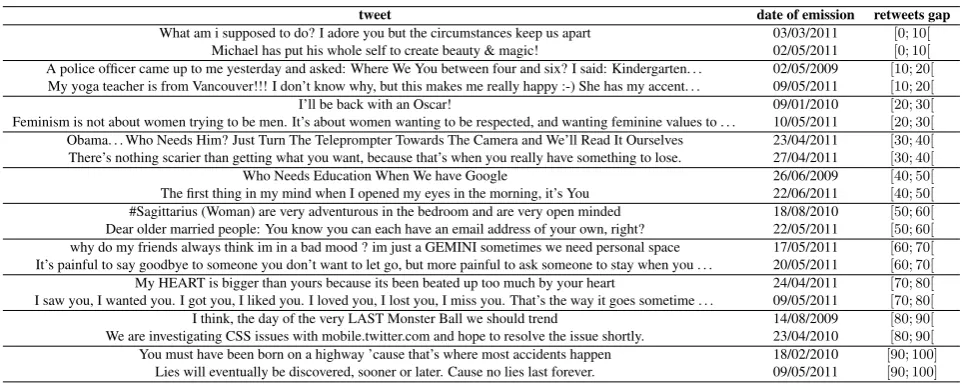
A corpus of 4,500 French tweets extracted with the Twitter API2is used (90%for training and10%for testing). All the processed data (corpus and tweets) are lemmatized and fil-tered trough a stop list. Table 1 shows examples of tweets. Experiments consist in evaluating the variation of the F-measure according to a threshold (i.e. number of retweets, see section 2.3.). We can expect an easier detection of “extreme” examples that are either very few or widely retweeted. The system is evaluated with two methods: TF-IDF-RP (see section 2.1.1.) and intersection of topics (see section 2.1.2.). Each descriptor is evaluated separately and then combined with the others.
4. Results
The figures 2 and 3 present the evolution of the F-score depending on the number of retweets3, for the intersection of topics (figure 2) and TF-IDF-RP (figure 3) methods. We can firstly note that keyword extraction performance using a LDA approach (figure 2) is better than the one obtained with a classical TF-IDF-RP method. These results confirm the idea that have motivated this approach: passing trough an intermediate representation improves the robustness of the system for the “noisy” Twitter language.
The LDA results are more consistent than those obtained with the TF-IDF-RP approach which tend to produce un-stable results for all individual descriptors. The results ob-tained with the combination of the three descriptors (fig-ure 2) also show their complementarity, although individual results are quantitatively similar.
Moreover, the “sensitivity” descriptor obtains the best indi-vidual results and, more surprisingly, outperforms the com-bination of low retweet thresholds . This phenomenon in-dicates the ability of this descriptor to detect the retweets (even low) rather than the buzz. The table 1 shows that most of the tweets contain at least a “sensitive” word (see figure 4).
2dev.twitter.com
3A threshold beyond considers the tweet as abuzz
vertex is a topic. Arc values are evaluated by the
symmet-ric Kullback-Lieber divergence
ψ
normalized between each
of the two topics:
ψ(zi, zj) = 1
2
⎛ ⎝#
w∈zi
pilogpi
pj +
#
w∈zj
pjlogpj
pi
⎞ ⎠ , (6)
where
p
nis the probability that the word
w
appears in the
topic
z
n.Overall, the distance
n
between any of the two topics is
then determined using the shortest path connecting them
with the Dijkstra algorithm (Dijkstra and Eindhoven, 1971)
φ
normalized by the number of arcs. This yields to a
de-scriptor
d
(
0
≤
d
≤
1
):
n
(
z
i, z
j) =
1
|
a
(
i, j
)
|
φ
(
z
i, z
j)
,
and
d
(
t
) = argmax
zi,zj∈Sz(
n
(
z
i, z
j))
.
(7)
2.2.3. Expressivity
The expressivity of a tweet is measured using a
sensitiv-ity lexicon (Paroubek, 2010) containing
976 words
from
ANEW (Affective Norms of English Words) (Bradley and
Lang, 1999). To determine the sensitivity of a word, the
authors introduce a new specific measure named
valence
.
This measure is defined for each word and is calculated as
the number of times that this word appears near a positive
:)
or a negative
:(
emoticon. This value is calculated
consid-ering the probability that the word is in a positive context
P
(
M
+|
w
)
. The valence
v
gives a sensitivity score of a
word
w
:
v
(
w
) = 8
×
P
(
M
+|
w
) + 1
.
(8)
The valence value varies from 1 (negative context) to 9
(positive context). If a word appears in a positive or
neg-ative context, this word can be considered as a sensitive
word. For this reason, we introduce a measure
δ
(
w
)
. This
measure
δ
(
w
)
shows if a word
w
appears in a sensitive
con-text (positive or negative) and if it is centered between
0
(any) and
1
(sensitive):
δ
(
w
) = 2
× |
P
(
M
+|
w
)
−
1
2
|
,
and
δ
(
t
) = argmax
w∈Sw(
δ
(
w
))
.
(9)
2.3. Predictive model
The prediction is realized with a neuronal network that
evaluates the
buzzability
from the three descriptors (
p, d, δ
)
described above. This is a multi-layer perceptron with one
hidden layer. This neuronal network is trained with the
gra-dient algorithm.
All networks have a 2-cells in the hidden layer and the
put/output layers are limited to one cell. In all cases, the
in-put cells receive the descriptors and the outin-put cells product
a value between
0
and
1
. The training of these networks
de-pends on the behavior expected. In particular, we adopted
the rule that a tweet is considered as a
buzz
if it exceeds a
defined number of retweets.
A threshold
t
b(number of minimal retweets to
buzz
) is then
varied from
0
to
90
retweets in our experiments. For
ex-ample, a threshold of
10
means that a tweet retweeted more
than
10
times generates a
buzz
.
3. EXPERIMENTS
A corpus of 4,500 French tweets extracted with the Twitter
API
1is used (
90%
for training and
10%
for testing). All the
processed data (corpus and tweets) are lemmatized and
fil-tered trough a stop list. Table 1 shows examples of tweets.
Experiments consist in evaluating the variation of the
F-measure according to a threshold (
i.e.
number of retweets,
see section 2.3.). We can expect an easier detection of
“extreme” examples that are either very few or widely
retweeted. The system is evaluated with two methods:
TF-IDF-RP (see section 2.1.1.) and intersection of topics (see
section 2.1.2.). Each descriptor is evaluated separately and
then combined with the others.
4. RESULTS
The figures 2 and 3 presents the evolution of the F-score
depending of the number of retweets
2, for the intersection
of topics (figure 2) and TF-IDF-RP (figure 3) methods. We
can firstly note that keyword extraction performance using
a LDA approach (figure 2) is better than the one obtained
with a classical TF-IDF-RP method. These results confirm
the idea that have motivated this approach: passing trough
an intermediate representation improves the robustness of
the system for the “noisy” Twitter language.
The LDA results are more consistent than those obtained
with the TF-IDF-RP approach which tend to produce
un-stable results for all individual descriptors. The results
ob-tained with the combination of the three descriptors
(fig-ure 2) also show their complementarity, although individual
results are quantitatively similar.
30
40
50
60
70
0 20 40 60 80 100
t
dF1
-s
co
re
(%)
Salience Expressivity Popularity CombinationFigure 2: F-score performance when varying the number of
retweets threshold using the LDA-based methods.
Moreover, the “sensitivity” descriptor obtains the best
indi-vidual results and, more surprisingly, outperforms the
com-bination of low retweet thresholds . This phenomenon
in-dicates the ability of this descriptor to detect the retweets
(even low) rather than the
buzz
. The table 1 shows that
most of the tweets contain at least a “sensitive” word (see
figure 4).
1dev.twitter.com
2A threshold beyond considers the tweet as abuzz
Figure 2: F-score performance when varying the number of retweets threshold using the LDA-based methods.
Table 1: Examples of tweets with the date of emission and the number of retweets gap.
tweet date of emission retweets gap
What am i supposed to do ,? I adore you but the circumstances keep us apart 03/03/2011 [0; 10[
Michael has put his whole self to create beauty & magic! 02/05/2011 [0; 10[
A police officer came up to me yesterday and asked: Where We You between four and six? I said: Kindergarten. . . 02/05/2009 [10; 20[
My yoga teacher is from Vancouver!!! I don’t know why, but this makes me really happy :-) She has my accent. . . 09/05/2011 [10; 20[
I’ll be back with an Oscar! 09/01/2010 [20; 30[
Feminism is not about women trying to be men. It’s about women wanting to be respected, and wanting feminine values to . . . 10/05/2011 [20; 30[
Obama. . . Who Needs Him? Just Turn The Teleprompter Towards The Camera and We’ll Read It Ourselves 23/04/2011 [30; 40[
There’s nothing scarier than getting what you want, because that’s when you really have something to lose. 27/04/2011 [30; 40[
Who Needs Education When We have Google 26/06/2009 [40; 50[
The first thing in my mind when I opened my eyes in the morning, it’s You 22/06/2011 [40; 50[
#Sagittarius (Woman) are very adventurous in the bedroom and are very open minded 18/08/2010 [50; 60[
Dear older married people: You know you can each have an email address of your own, right? 22/05/2011 [50; 60[
why do my friends always think im in a bad mood ? im just a GEMINI sometimes we need personal space 17/05/2011 [60; 70[
It’s painful to say goodbye to someone you don’t want to let go, but more painful to ask someone to stay when you . . . 20/05/2011 [60; 70[
My HEART is bigger than yours because its been beated up too much by your heart 24/04/2011 [70; 80[
I saw you, I wanted you. I got you, I liked you. I loved you, I lost you, I miss you. That’s the way it goes sometime . . . 09/05/2011 [70; 80[
I think, the day of the very LAST Monster Ball we should trend 14/08/2009 [80; 90[
We are investigating CSS issues with mobile.twitter.com and hope to resolve the issue shortly. 23/04/2010 [80; 90[
You must have been born on a highway ’cause that’s where most accidents happen 18/02/2010 [90; 100]
Lies will eventually be discovered, sooner or later. Cause no lies last forever. 09/05/2011 [90; 100]
30
40
50
60
70
0 20 40 60 80 100
t
dF1
-s
co
re
(%)
Salience Expressivity Popularity CombinationFigure 3: F-score performance when varying the number of
retweets threshold using the TF-IDF-RP method.
0 10 20 30 40
0 20 40 60 80 100
td
%of tweets
Figure 4: Proportion (%) of tweets containing at least a
“sensitive” word regarding
t
d.
5. CONCLUSION AND PERSPECTIVES
In this paper, we proposed a method for predicting the
buzz
(
i.e.
bursty events) on the Twitter platform. Three
descrip-tors have been evaluated and results show their
complemen-tarity: the best system achieved a
72%
F-score. The
buzz
is a dynamic phenomenon where the prediction could be
based on models that include not only the content (this is
the way that we explore in this work) but also the
informa-tion speed spreads. Incorporate the dynamic and/or
struc-tural aspects of the diffusion mechanism could significantly
improve the quality of the prediction.
6. References
D.M. Blei, A.Y. Ng, and M.I. Jordan. 2003. Latent
dirich-let allocation.
The Journal of Machine Learning
Re-search
, 3:993–1022.
M.M. Bradley and P.J. Lang. 1999. Affective norms for
english words (anew): Instruction manual and affective
ratings.
University of Florida: The Center for Research
in Psychophysiology
.
M. Choudhury, R. Saraf, V. Jain, S. Sarkar, and A. Basu.
2007. Investigation and modeling of the structure of
texting language. In
IJCAI-Workshop on Analytics for
Noisy Unstructured Text Data
, pages 63–70.
E.W. Dijkstra and Technische Hogeschool Eindhoven.
1971. A short introduction to the art of programming.
L. Hong, O. Dan, and B.D. Davison. 2011. Predicting
pop-ular messages in twitter. In
ACM international
confer-ence companion on World wide web
, pages 57–58.
J. Kleinberg. 2003. Bursty and hierarchical structure
in streams.
Data Mining and Knowledge Discovery
,
7(4):373–397.
F. Larceneux. 2007. Buzz et recommandations sur
inter-net: quels effets sur le box-office?
Recherche et
applica-tions en marketing
, pages 45–64.
M. Morchid, R. Dufour, and G. Linar`es. 2013. Thematic
representation of short text messages with latent topics:
Application in the twitter context. In
PACLING
.
A.P.P. Paroubek. 2010. Construction d’un lexique affectif
pour le franc¸ais `a partir de twitter.
G. Salton. 1989. Automatic text processing: the
transfor-mation.
Analysis and Retrieval of Information by
Com-puter
.
Z. Yang, J. Guo, K. Cai, J. Tang, J. Li, L. Zhang, and Z. Su.
2010. Understanding retweeting behaviors in social
net-works. In
ACM international conference on Information
and knowledge management
, pages 1633–1636.
J. Yi. 2005. Detecting buzz from time-sequenced
doc-ument streams. In
IEEE International Conference on
e-Technology, e-Commerce and e-Service (EEE)
, pages
347–352.
W. Zhang, T. Yoshida, and X. Tang. 2010. A comparative
Figure 3: F-score performance when varying the number ofretweets threshold using the TF-IDF-RP method.
5. Conclusion and perspectives
In this paper, we proposed a method for predicting thebuzz
(i.e. bursty events) on the Twitter platform. Three descrip-tors have been evaluated alone, and then combined. Re-sults show their complementarity: the best system achieved a72%F-score.
The buzzis a dynamic phenomenon where the prediction could be based on models that include not only the content (this is the way that we explore in this work) but also the information speed spreads. Incorporate the dynamic and/or
Table 1: Examples of tweets with the date of emission and the number of retweets gap.
tweet date of emission retweets gap
What am i supposed to do ,? I adore you but the circumstances keep us apart 03/03/2011 [0; 10[
Michael has put his whole self to create beauty & magic! 02/05/2011 [0; 10[
A police officer came up to me yesterday and asked: Where We You between four and six? I said: Kindergarten. . . 02/05/2009 [10; 20[
My yoga teacher is from Vancouver!!! I don’t know why, but this makes me really happy :-) She has my accent. . . 09/05/2011 [10; 20[
I’ll be back with an Oscar! 09/01/2010 [20; 30[
Feminism is not about women trying to be men. It’s about women wanting to be respected, and wanting feminine values to . . . 10/05/2011 [20; 30[
Obama. . . Who Needs Him? Just Turn The Teleprompter Towards The Camera and We’ll Read It Ourselves 23/04/2011 [30; 40[
There’s nothing scarier than getting what you want, because that’s when you really have something to lose. 27/04/2011 [30; 40[
Who Needs Education When We have Google 26/06/2009 [40; 50[
The first thing in my mind when I opened my eyes in the morning, it’s You 22/06/2011 [40; 50[
#Sagittarius (Woman) are very adventurous in the bedroom and are very open minded 18/08/2010 [50; 60[
Dear older married people: You know you can each have an email address of your own, right? 22/05/2011 [50; 60[
why do my friends always think im in a bad mood ? im just a GEMINI sometimes we need personal space 17/05/2011 [60; 70[
It’s painful to say goodbye to someone you don’t want to let go, but more painful to ask someone to stay when you . . . 20/05/2011 [60; 70[
My HEART is bigger than yours because its been beated up too much by your heart 24/04/2011 [70; 80[
I saw you, I wanted you. I got you, I liked you. I loved you, I lost you, I miss you. That’s the way it goes sometime . . . 09/05/2011 [70; 80[
I think, the day of the very LAST Monster Ball we should trend 14/08/2009 [80; 90[
We are investigating CSS issues with mobile.twitter.com and hope to resolve the issue shortly. 23/04/2010 [80; 90[
You must have been born on a highway ’cause that’s where most accidents happen 18/02/2010 [90; 100]
Lies will eventually be discovered, sooner or later. Cause no lies last forever. 09/05/2011 [90; 100]
30
40
50
60
70
0 20 40 60 80 100
t
dF1
-s
co
re
(%)
Salience Expressivity Popularity CombinationFigure 3: F-score performance when varying the number of
retweets threshold using the TF-IDF-RP method.
0 10 20 30 40
0 20 40 60 80 100
td
%of tweets
Figure 4: Proportion (%) of tweets containing at least a
“sensitive” word regarding
t
d.
5. CONCLUSION AND PERSPECTIVES
In this paper, we proposed a method for predicting the
buzz
(
i.e.
bursty events) on the Twitter platform. Three
descrip-tors have been evaluated and results show their
complemen-tarity: the best system achieved a
72%
F-score. The
buzz
is a dynamic phenomenon where the prediction could be
based on models that include not only the content (this is
the way that we explore in this work) but also the
informa-tion speed spreads. Incorporate the dynamic and/or
struc-tural aspects of the diffusion mechanism could significantly
improve the quality of the prediction.
6. References
D.M. Blei, A.Y. Ng, and M.I. Jordan. 2003. Latent
dirich-let allocation.
The Journal of Machine Learning
Re-search
, 3:993–1022.
M.M. Bradley and P.J. Lang. 1999. Affective norms for
english words (anew): Instruction manual and affective
ratings.
University of Florida: The Center for Research
in Psychophysiology
.
M. Choudhury, R. Saraf, V. Jain, S. Sarkar, and A. Basu.
2007. Investigation and modeling of the structure of
texting language. In
IJCAI-Workshop on Analytics for
Noisy Unstructured Text Data
, pages 63–70.
E.W. Dijkstra and Technische Hogeschool Eindhoven.
1971. A short introduction to the art of programming.
L. Hong, O. Dan, and B.D. Davison. 2011. Predicting
pop-ular messages in twitter. In
ACM international
confer-ence companion on World wide web
, pages 57–58.
J. Kleinberg. 2003. Bursty and hierarchical structure
in streams.
Data Mining and Knowledge Discovery
,
7(4):373–397.
F. Larceneux. 2007. Buzz et recommandations sur
inter-net: quels effets sur le box-office?
Recherche et
applica-tions en marketing
, pages 45–64.
M. Morchid, R. Dufour, and G. Linar`es. 2013. Thematic
representation of short text messages with latent topics:
Application in the twitter context. In
PACLING
.
A.P.P. Paroubek. 2010. Construction d’un lexique affectif
pour le franc¸ais `a partir de twitter.
G. Salton. 1989. Automatic text processing: the
transfor-mation.
Analysis and Retrieval of Information by
Com-puter
.
Z. Yang, J. Guo, K. Cai, J. Tang, J. Li, L. Zhang, and Z. Su.
2010. Understanding retweeting behaviors in social
net-works. In
ACM international conference on Information
and knowledge management
, pages 1633–1636.
J. Yi. 2005. Detecting buzz from time-sequenced
doc-ument streams. In
IEEE International Conference on
e-Technology, e-Commerce and e-Service (EEE)
, pages
347–352.
W. Zhang, T. Yoshida, and X. Tang. 2010. A comparative
Figure 4: Proportion (%) of tweets containing at least a“sensitive” word regardingtd.
tweet date of emission retweets gap What am i supposed to do? I adore you but the circumstances keep us apart 03/03/2011 [0; 10[
Michael has put his whole self to create beauty & magic! 02/05/2011 [0; 10[ A police officer came up to me yesterday and asked: Where We You between four and six? I said: Kindergarten. . . 02/05/2009 [10; 20[ My yoga teacher is from Vancouver!!! I don’t know why, but this makes me really happy :-) She has my accent. . . 09/05/2011 [10; 20[
I’ll be back with an Oscar! 09/01/2010 [20; 30[
Feminism is not about women trying to be men. It’s about women wanting to be respected, and wanting feminine values to . . . 10/05/2011 [20; 30[ Obama. . . Who Needs Him? Just Turn The Teleprompter Towards The Camera and We’ll Read It Ourselves 23/04/2011 [30; 40[ There’s nothing scarier than getting what you want, because that’s when you really have something to lose. 27/04/2011 [30; 40[
Who Needs Education When We have Google 26/06/2009 [40; 50[
The first thing in my mind when I opened my eyes in the morning, it’s You 22/06/2011 [40; 50[ #Sagittarius (Woman) are very adventurous in the bedroom and are very open minded 18/08/2010 [50; 60[ Dear older married people: You know you can each have an email address of your own, right? 22/05/2011 [50; 60[ why do my friends always think im in a bad mood ? im just a GEMINI sometimes we need personal space 17/05/2011 [60; 70[ It’s painful to say goodbye to someone you don’t want to let go, but more painful to ask someone to stay when you . . . 20/05/2011 [60; 70[ My HEART is bigger than yours because its been beated up too much by your heart 24/04/2011 [70; 80[ I saw you, I wanted you. I got you, I liked you. I loved you, I lost you, I miss you. That’s the way it goes sometime . . . 09/05/2011 [70; 80[ I think, the day of the very LAST Monster Ball we should trend 14/08/2009 [80; 90[ We are investigating CSS issues with mobile.twitter.com and hope to resolve the issue shortly. 23/04/2010 [80; 90[ You must have been born on a highway ’cause that’s where most accidents happen 18/02/2010 [90; 100]
[image:5.595.55.541.66.261.2]Lies will eventually be discovered, sooner or later. Cause no lies last forever. 09/05/2011 [90; 100]
Table 1: Examples of tweets with the date of emission and the number of retweets gap.
structural aspects of the diffusion mechanism could signif-icantly improve the quality of the prediction.
6. References
F.M. Bass. 2004. Comments on ”a new product growth for model consumer durables the bass model”. Management science, 50(12 supplement):1833–1840.
D.M. Blei, A.Y. Ng, and M.I. Jordan. 2003. Latent dirich-let allocation. The Journal of Machine Learning Re-search, 3:993–1022.
M.M. Bradley and P.J. Lang. 1999. Affective norms for english words (anew): Instruction manual and affective ratings. University of Florida: The Center for Research in Psychophysiology.
M. Cha, H. Haddadi, F. Benevenuto, and K.P. Gummadi. 2010. Measuring user influence in twitter: The million follower fallacy. In 4th International AAAI Conference on Weblogs and Social Media (ICWSM).
M. Choudhury, R. Saraf, V. Jain, S. Sarkar, and A. Basu. 2007. Investigation and modeling of the structure of texting language. In IJCAI-Workshop on Analytics for Noisy Unstructured Text Data, pages 63–70.
E.W. Dijkstra and Technische Hogeschool Eindhoven. 1971. A short introduction to the art of programming. J. Golbeck, J.M. Grimes, and A. Rogers. 2010. Twitter use
by the us congress. Journal of the American Society for Information Science and Technology, 61(8):1612–1621. J. Goldenberg, B. Libai, and E. Muller. 2001. Using
com-plex systems analysis to advance marketing theory devel-opment: Modeling heterogeneity effects on new product growth through stochastic cellular automata.Academy of Marketing Science Review, 9:1–18.
G. Grosseck and C. Holotescu. 2008. Can we use twit-ter for educational activities. In International Conf. on e-Learning and software for education, Bucharest, Ro-mania.
L. Hong, O. Dan, and B.D. Davison. 2011. Predicting pop-ular messages in twitter. InACM international confer-ence companion on World wide web, pages 57–58. D. Kempe, J. Kleinberg, and ´E. Tardos. 2003.
Maximiz-ing the spread of influence through a social network. In
ACM SIGKDD International Conf. on Knowledge dis-covery and data mining, pages 137–146.
J. Kleinberg. 2003. Bursty and hierarchical structure in streams. Data Mining and Knowledge Discovery, 7(4):373–397.
H. Kwak, C. Lee, H. Park, and S. Moon. 2010. What is twitter, a social network or a news media? In Proceed-ings of the 19th international conference on World wide web, pages 591–600. ACM.
F. Larceneux. 2007. Buzz et recommandations sur inter-net: quels effets sur le box-office? Recherche et applica-tions en marketing, pages 45–64.
M. Morchid, R. Dufour, and G. Linar`es. 2013. Thematic representation of short text messages with latent topics: Application in the twitter context. InPACLING. A.P.P. Paroubek. 2010. Construction d’un lexique affectif
pour le franc¸ais `a partir de twitter.
H.K. Peng, J. Zhu, D. Piao, R. Yan, and Y. Zhang. 2011. Retweet modeling using conditional random fields. In
Data Mining Workshops (ICDMW), 2011 IEEE 11th In-ternational Conference on, pages 336–343. IEEE. D. Romero, W. Galuba, S. Asur, and B. Huberman. 2011.
Influence and passivity in social media. Machine Learn-ing and Knowledge Discovery in Databases, pages 18– 33.
G. Salton. 1989. Automatic text processing: the transfor-mation. Analysis and Retrieval of Information by Com-puter.
B. Suh, L. Hong, P. Pirolli, and E.H. Chi. 2010. Want to be retweeted? large scale analytics on factors impacting retweet in twitter network. InSocial Computing (Social-Com), 2010 IEEE Second International Conference on, pages 177–184. IEEE.
A. Tumasjan, T.O. Sprenger, P.G. Sandner, and I.M. Welpe. 2010. Predicting elections with twitter: What 140 char-acters reveal about political sentiment. InInternational AAAI Conf. on Weblogs and Social Media, pages 178– 185.
S. Vieweg, A.L. Hughes, K. Starbird, and L. Palen. 2010. Microblogging during two natural hazards events: what
twitter may contribute to situational awareness. InACM International Conf. on Human factors in computing sys-tems, pages 1079–1088.
A. Wright. 2009. Mining the web for feelings, not facts.
New York Times, 24.
Z. Yang, J. Guo, K. Cai, J. Tang, J. Li, L. Zhang, and Z. Su. 2010. Understanding retweeting behaviors in social net-works. InACM international conference on Information and knowledge management, pages 1633–1636.
J. Yi. 2005. Detecting buzz from time-sequenced doc-ument streams. In IEEE International Conference on e-Technology, e-Commerce and e-Service (EEE), pages 347–352.
W. Zhang, T. Yoshida, and X. Tang. 2010. A comparative study of tf*idf, lsi and multi-words for text classification.
Expert Systems With Applications.