Using Large Biomedical Databases as Gold Annotations for Automatic Relation
Extraction
Tilia Ellendorff, Fabio Rinaldi, Simon Clematide
University of ZurichInstitute of Computational Linguistics, Binzm¨uhlestrasse 14, 8050 Z¨urich, Switzerland [email protected], [email protected], [email protected]
Abstract
We show how to use large biomedical databases in order to obtain a gold standard for training a machine learning system over a corpus of biomedical text. As an example we use the Comparative Toxicogenomics Database (CTD) and describe by means of a short case study how the obtained data can be applied. We explain how we exploit the structure of the database for compiling training material and a testset. Using a Naive Bayes document classification approach based on words, stem bigrams and MeSH descriptors we achieve a macro-average F-score of 61% on a subset of 8 action terms. This outperforms a baseline system based on a lookup of stemmed keywords by more than 20%. Furthermore, we present directions of future work, taking the described system as a vantage point. Future work will be aiming towards a weakly supervised system capable of discovering complete biomedical interactions and events.
Keywords:Biomedical Textmining, Biomedical Databases, Relation Extraction, Distant Supervision
1.
Introduction
In order to use approaches of supervised machine learning within the area of biomedical textmining, annotated lguage resources are necessary. However, the amount of an-notated corpora in this area is still limited and not easy to obtain: the human effort involved in linguistic annotations of biomedical text is expensive and not time-efficient. Fur-thermore, an expert trained to perform such a task needs not only to possess the necessary knowledge of linguistics but also a biomedical background. For this reason, it makes sense to investigate the exploitation of alternative resources. A wide range of manually created scientific databases con-taining relational data between biomedical entities are al-ready available and most academic publications exist in electronic format and can be accessed relatively easily.
The structured data of scientific databases in combination with the unstructured textual data of publications can be exploited as language resources for constructing and opti-mizing text mining applications. Methods using the data of a database in connection with textual data are commonly re-ferred to as weakly or distant supervised methods, as there is no direct annotation as there would be with a manually annotated corpus. On the other hand, the system is also not completely unsupervised as a database is used for pro-viding additional information that is linked to the text in a more indirect way.
One very large database which is especially useful for biomedical relation extraction is the Comparative Toxi-cogenomics Database (CTD) (Davis et al., 2009). It con-tains data about gene-chemical interactions from so far al-most 50,000 publications and is growing continuously. The objective of this paper is to show by means of a case study how this database can be used for building a system to dis-cover relations between biomedical entities.
2.
Biomedical Text Mining and Relation
Extraction
For promoting research in the field of biomedicine and life science, it is indispensable for scientists to get fast and easily to the information relevant to their research. For a long time, scientific findings contained in biomedical pub-lications have been extracted, organized and stored into databases solely by human manual work. This so-called curation process is performed by human biocurators who are experts in their field and whose task is to expand and maintain the knowledge repository. However, the number of publications in the biomedical domain is continuously increasing and thus, text mining tools are more and more required to speed up the process and support the curation of knowledge contained in scientific publications.
Nowadays most biomedical databases, such as Phar-mGKB1 (Klein et al., 2001), IntAct2 (Hermjakob et al., 2004) and Uniprot3 (UniProt Consortium, 2007), to name
just a few, contain relational data. Many biomedical inter-actions take place on a molecular level and a huge amount of different entities are involved. Focus and categorization of entities differ between relational databases. The entities which are described in CTD can be categorized into three general groups: genes/proteins, chemical and diseases. Au-tomatic relation extraction represents the current approach for extracting knowledge specific to interactions and associ-ations between different entities of the biomedical domain. As biomedical entities are very diverse and highly ambigu-ous, relation extraction in the biomedical domain normally has to rely on powerful tools for named entity extraction. This is not always easy, as entities are not always expressed explicitly and unambiguously in the text. But even if the entities have been discovered, one more big challenge of biomedical text mining is finding the relation between these entities. Relations between two or more entities are not
al-1https://www.pharmgkb.org/ 2
http://www.ebi.ac.uk/intact/ 3
<ixn id="2892024">
<taxon id="9606">Homo sapiens</taxon> <reference pmid="12035877"/>
<axn code="exp" degreecode="+" position="1" parentid="2892024">results in increased expression of</axn> <actor type="chemical" id="MESH:C081309" parentid="2892024" position="1">irbesartan</actor>
<actor type="gene" id="GENE:4878" parentid="2892024" form="protein" position="2">NPPA</actor> </ixn>
Figure 1: XML Entry for the abstract with the Pubmed ID 12035877 (Kotridis et al., 2002)
ways expressed within sentence boundaries. Furthermore, relations themselves are also often not always stated in an explicit way.
2.1.
Related Work
Our approach of using knowledge database entries and their bibliographic references to unstructured text as a replace-ment for hand-labeled data is related to other information extraction research. (Mintz et al., 2009) uses the large se-mantic knowledge database Freebase for adistant supervi-sionapproach to optimize information extraction patterns. (Morgan et al., 2004) used the FlyBase database and refer-enced PubMed abstracts to improve the recognition of gene names by machine learning. (Craven and Kumlien, 1999) present early work on exploiting biomedical databases as weakly labeled training data to improve relation extraction. They also use Naive Bayes classifiers for their task. Similar techniques have already been used in previous ap-plications of the OntoGene system. One example is a ver-sion of the system used for the participation of the Onto-Gene group in the 2006 BioCreative competitive evaluation of text mining systems (Krallinger et al., 2008). For this competition, the OntoGene group generated a training set of positive and negative sentences using techniques of dis-tant supervision. This training set was used for training a classifier able to distinguish between ”background” and ”novel” statements, i.e. sentences reporting previous work as opposed to sentences reporting the actual results gener-ated by the experiment described in the paper. The applied method becomes clear in the following citation:“A sentence is considered positive if it contains at least one pair of pro-teins belonging to one of the gold standard interactions for the abstract to which the sentence belongs”(Rinaldi et al., 2008). Furthermore, a similar approach was also applied successfully in the version of the OntoGene system used for participation in the 2009 BioCreative competition (Leit-ner et al., 2010), which obtained the best results among all participants in the extraction of protein-protein interactions from scientific literature (Rinaldi et al., 2010).
3.
The Toxicogenomics Database and its
Utility in Language Applications
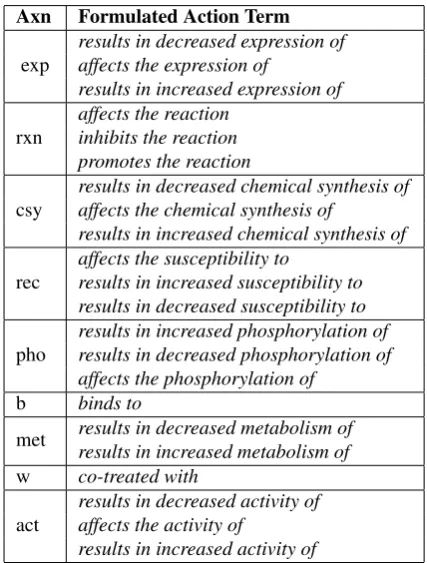
The Comparative Toxicogenomics Database (CTD) is a continuously growing database which is an important re-source and scientific tool for researchers from all biomedi-cal fields. The database was first launched in 2004 and has the aim of promoting”understanding about the effects of environmental chemicals on human health” (Davis et al., 2009). It contains manually curated data as well as in-ferred data, which is added based on logical conclusionsAxn Formulated Action Term
exp
results in decreased expression of affects the expression of
results in increased expression of
rxn
affects the reaction inhibits the reaction promotes the reaction
csy
results in decreased chemical synthesis of affects the chemical synthesis of
results in increased chemical synthesis of
rec
affects the susceptibility to
results in increased susceptibility to results in decreased susceptibility to
pho
results in increased phosphorylation of results in decreased phosphorylation of affects the phosphorylation of
b binds to
met results in decreased metabolism of
results in increased metabolism of
w co-treated with
act
results in decreased activity of affects the activity of
results in increased activity of
Table 1: Formulated action terms for a given set of action term abbreviations (Axn)
drawn from curated data. It presents scientists with a tool that can be used not only for looking up interactions but also for building new hypothesis based on the data that it contains. Apart from dealing with associations between diseases and chemicals as well as proteins, it also con-tains data about biomolecular interactions between chem-icals and genes. The interactions between chemchem-icals and genes are the most interesting part of the database from the point of view of biomedical relation extraction. Associa-tions describe relaAssocia-tions that are not as strongly defined as it is the case with real interactions. Furthermore, in CTD associations can be automatically inferred whereas interac-tions are always manually curated and therefore more reli-able. For this reason, we chose the interactions as the focus of our work.
The downloadable xml data, which is freely available on the official CTD webpage4, currently contains 611,241 dif-ferent entries5. Each entry within the xml file describes
one interaction together with its actors. One example for
4
http://ctdbase.org/ 5
Figure 2: Entity annotation of the abstract with the PubMed ID 12035877, displayed in the ODIN interface
Action Term Abbreviation Freq. of PMIDs in CTD Freq. of PMIDs in Test Set
expression exp 564434 257
reaction rxn 93725 140
activity act 59333 161
cotreatment w 43778 46
binding b 33593 82
phosphorylation pho 19657 22
response to substance rec 19289 180
secretion sec 9507 32
methylation myl 8923 1
abundance abu 6018 50
localization loc 5861 23
metabolic processing met 5309 11
cleavage clv 4262 8
transport trt 2444 6
chemical synthesis csy 2331 13
uptake upt 2068 5
degradation deg 1873 6
oxidation oxd 1171 3
mutagenesis mut 847 6
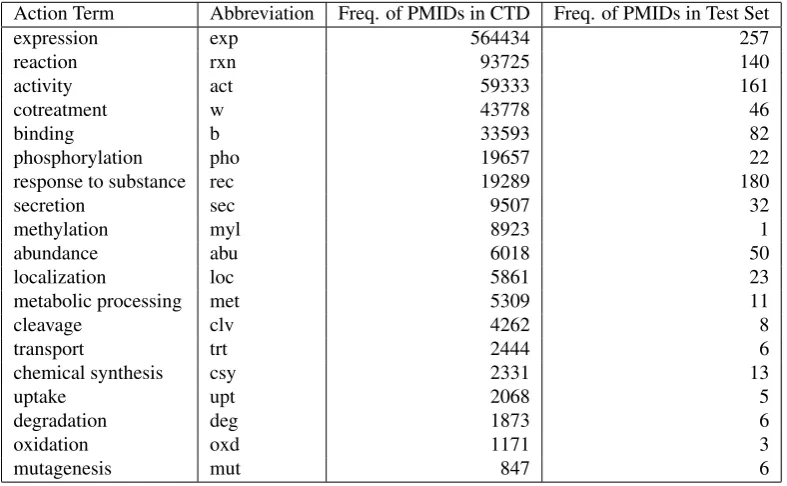
Table 2: Number of associated PubMed IDs in CTD and in the Test Set for the most frequent action terms (Sorted by Overall Frequency in CTD)
an entry from the xml file can be seen in Figure 1. Fur-thermore, each entry in the xml file is connected to at least one reference publication in the format of a PubMed Doc-ument Identifier (PubMed ID). This identifier is encoded in the xml data by using the reference tag. With the help of this unique identifier, a scientific abstract can be easily re-trieved from the PubMed webpage. Altogether 45,833 dif-ferent abstracts from PubMed are referenced in the context of gene-chemical interactions.
Within CTD, each interaction is assigned an interaction type which has the format of an action term. Action terms constitute a very central element of each entry in the xml data file. They form a controlled vocabulary used by CTD to describe the nature and type of interactions. An overview of the most frequent action terms is given in Figure 2. There are currently around 50 different action terms in the CTD database. In the xml data, the action term is listed in the axn tags. The action term itself is encoded as its abbreviations as an attribute. The actual content of the tag is represented by a formulation of the action term. In the example in Fig-ure 1 this formulation isresults in increased expression of ’. For each action term, there are one to three different possi-ble formulations in the xml data. These formulations con-stitute a combination of the action term itself and the
“de-greecode” attribute, which represents the directionality of the interaction. An overview of action term formulations can be seen in Table 1.
The other main elements of an entry are the actors as argu-ments of an interaction. Apart from genes and chemicals, other sub-interactions can also have the function of actors within subordinate interaction. In the xml file, genes and chemicals are mostly not encoded in the same format as found in the referred abstract but in a normalized format in order to avoid ambiguities and missunderstandings for the users and also with the aim of facilitating derivation of new interactions. Furthermore, as a reference to other databases, identification numbers are given for chemicals and genes/proteins. It depends very much on the action term if sub-interactions are possible as actors. These so-called nested interactions are most frequent with the action terms “cotreatment” and “reaction” describing the superor-dinate interaction. Other action terms tend to occur more frequently in the subordinate interactions of nested interac-tion.
ab-stract for the same PubMed ID can be seen in Figure 2. For displaying the annotated entities, we use ODIN (Ri-naldi et al., 2013b), an interface designed by the Ontogene group for supporting the curation process of human manual curation of biomedical articles. It uses methods of informa-tion extracinforma-tion for displaying named entities and possible relations between them to a curator and thus providing im-portant hints as to where in the text an interaction could be present. However, the suggestions of possible interactions given by ODIN, do not yet include the interaction type. In the example in Figure 2, the chemical is marked in green colour and the gene in blue. Comparing the xml entry with the text of the abstract, it can be clearly seen, that the sur-face form in the text does not correspond to the term used in CTD but a normalized form is given. This depicts well how in many cases background knowledge is needed in order to infer the entities from CTD and find them in the actual ab-stract: the surface form in the text describes a gene product, more precisely a hormon (atrial natriuretic peptide = ANP), while CTD lists the gene from which this gene product is encoded. Furthermore, it also shows how the concrete in-teraction between the two actors is not mentioned explictly in the text but has to be concluded from the context. If the percentage to the protein (ANP) is observed to be increas-ing, this means that the chemical ibesartan must have an effect on the gene which is used for encoding the protein.
4.
Case Study of using CTD as a Linguistic
Resource for biomedical relation
extraction
In the following paragraphs we will present a case study for using CTD together with the referenced PubMed ab-stracts as a language resource for relation extraction. Both sources in combination provide us with annotated gold data for training and evaluating a machine learning system for action term recognition.
The aim of our system, which we developed in the course of the BioCreative 2013 competition6, and which is part of
a bigger system for the detection of CTD entities (Rinaldi et al., 2013a), was to discover action terms describing inter-actions within PubMed abstracts. Given a PubMed ID, the system is designed to deliver all action terms that describe interactions found in this specific abstract.
4.1.
Dataset and Methods
After collecting PubMed IDs from all entries of the CTD download data, we downloaded the abstracts from PubMed and preprocessed them, using sentence splitting and tok-enization. By relating the PubMed abstracts to their anno-tated action terms, we collected the training data used for training the machine learning system.
Our training data consisted of all abstracts which are refer-enced in CTD . This amounts to a total of 45,836 abstracts. However, for training our system, we took random sam-ples of 4000 abstracts for each action term, of these 2000 positive examples and 2000 negative examples. For action terms for which there were not enough positive examples,
6http://www.biocreative.org/tasks/ biocreative-iv/
we took the highest possible number of abstracts for train-ing.
Our system consisted of several binary classifiers, one for each action term to be classified. These classifiers were built using the Naive Bayes classifiers included in the Nat-ural Language Processing Toolkit (NLTK) (Bird et al., 2009).
We experimented with different feature sets and found that a combination of bag-of-words (the 5000 most frequent words from all abstracts), stem bigrams and MeSH de-scriptors gave the best results. Medical Subject Headings (MeSH)7 descriptors are meta-data of PubMed abstracts providing keywords for the main topics of a PubMed ab-stract.
Furthermore, in order to put our results into a wider con-text, we built a simple baseline. Our baseline assigned an action term to an abstract if the stem of the action term was present in the abstract. For stemming the action terms as well as the words of each abstract, we used the Lancaster Stemming Algorithm8, which is also part of NLTK. We
de-cided on using this stemming algorithm for our baseline, as it is more aggressive than, for example, the Porter stem-mer and makes sure that the stems of action terms match the stems of corresponding verbs. For multi word action terms, as for example“response to substance” (abbrevia-tion: “rec”), we chose a representative word from the ac-tion term formulaac-tions, in this case “susceptibility”, which we stemmed in order to provide an action term stem. The results of our baseline can also be seen in Table 3.
4.2.
Evaluation and Results
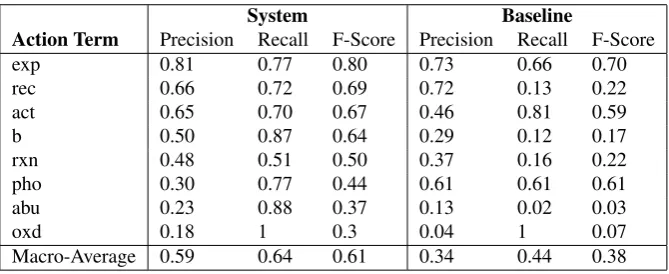
We evaluated our system on the official gold standard data set from the BioCreative competition. This gold standard consists of a list of 510 PubMed abstracts. For these ab-stracts we retrieved the correct action terms from the CTD database and compared them to the action terms discovered by our own system. In this way, we were able to determine evaluation scores in terms of overall average precision, re-call and F-score for our system but also for each of the clas-sifiers separately (Table 3).
We discovered that including only the 8 best-performing classifiers results in the highest overall F-score of the sys-tem. Comparing these 8 classifiers which showed the best performance on their own to the most frequent action terms, it becomes clear that there is a connection between quality of performance of a classifier and the number of abstract for an action term that are referenced by their PubMed ID. Naturally, action terms with more training material avail-able show a better performance. However, some action term classifiers do not show a very good performance even though there is a decent amount of training material avail-able. An example for such an action term is ”cotreatment” (abbreviation: “w”). It can be assumed that for cotreatment, the fact that there is a high frequency of subordinate inter-actions, taking the role of actors within the interaction, had an impact on the performance of the classifier. On the other hand, classifiers such as for the action term “oxidation”, did
7http://www.nlm.nih.gov/mesh/
System Baseline
Action Term Precision Recall F-Score Precision Recall F-Score
exp 0.81 0.77 0.80 0.73 0.66 0.70
rec 0.66 0.72 0.69 0.72 0.13 0.22
act 0.65 0.70 0.67 0.46 0.81 0.59
b 0.50 0.87 0.64 0.29 0.12 0.17
rxn 0.48 0.51 0.50 0.37 0.16 0.22
pho 0.30 0.77 0.44 0.61 0.61 0.61
abu 0.23 0.88 0.37 0.13 0.02 0.03
oxd 0.18 1 0.3 0.04 1 0.07
Macro-Average 0.59 0.64 0.61 0.34 0.44 0.38
Table 3: Evaluation scores of the action term recognition system (System) as compared to the stem baseline (Baseline)
not have a lot of training material available (for example for oxidation only 1171 abstracts) but still show a satisfactory performance. This can be due to the fact that this particular classifier showed a high recall an there were only 3 occur-rences of “oxidation” to be found in the test set. Further-more, for the classifiers for which there is significantly less training material than the default of 2000 abstracts, it can be assumed that the classifier suffers from overfitting since in these cases, the same abstracts that are part of the test set have already been used for training the classifier. This is due to the fact that within the BioCreative competition, the PubMed IDs of the test set have only been released at a point when the classifiers had already been built. However, with the continuous growth of CTD, it is very likely that for most action terms overfitting will not be an issue anymore.
5.
Outlook: Future Work
As a next step, we are implementing a system capable of discovering the full interactions, composed of action term and actors. The CTD database, consisting of 328.230 man-ually curated interactions, constitutes a valuable resource in training such a system. The work presented in this paper represents an important step in this direction.
The classification system that we described can, in a fol-lowing step, be used for discovering where exactly an in-teraction is located in the text. After an abstract has been categorized this can be done in two possible ways. Firstly, the system itself can be used for classifying shorter pieces of text, as for example sentences, to find out if an inter-action is present. Secondly, the classifier delivers a list of most informative features for a specific action term. These most informative features can also be used separately for identifying the immediate context of an interaction. To-gether with a powerful tool for named entity extraction in the biomedical domain, such as for example Gimli (Cam-pos et al., 2013), Metamap (Aronson, 2001) or the Onto-gene NER module (Kaljurand et al., 2009), our aim is to be able to locate the exact anchorings of the interaction in CTD in the text of an abstract. As soon as the exact anchor-ing of an interaction from CTD together with all its actors can be found in the text of an abstract, the obtained data can in turn be used as training data for a weakly supervised system. The aim of such a system is to be able to discover complete biomedical interactions from unseen abstracts.
6.
Conclusion
As could be seen by the description of CTD, large databases of the biomedical domain can provide a good and applica-ble alternative to annotated corpora. The big advantages over traditional annotation methods are the efficiency re-garding time and money as well as the amount of available information. We showed how the data can be combined rel-atively easily with the abstracts of the scientific papers from which it was curated, in order to obtain a language resource that can be used in building statistical systems for biomedi-cal text mining. These systems, in turn, can then be used in the future for supporting the process of biocuration. The system that we presented as a case study has the pur-pose of recognizing interactions in the form of action terms within scientific abstracts from the biomedical domain. We treated this task as a problem of text classification and found that the resource was very suitable for this approach. The work presented in this paper will be taken as a starting point for finding complete biomedical interaction. Within this future work, CTD will serve as an important resource for providing distant supervision of the interaction detec-tion system.
7.
Acknowledgements
The OntoGene group is partially supported by the Swiss National Science Foundation (grant 105315−130558/1 to Fabio Rinaldi) and by the Data Science Group at Hoffmann-La Roche, Basel, Switzerland.
8.
References
Aronson, A. R. (2001). Effective mapping of biomedical text to the umls metathesaurus: the metamap program.
Proc AMIA Symp, pages 17–21.
Bird, S., Klein, E., and Loper, E. (2009). Natural Lan-guage Processing with Python: Analyzing Text with the Natural Language Toolkit. O’Reilly, Beijing.
Campos, D., Matos, S., and Oliveira, J. L. (2013). Gimli: open source and high-performance biomedical name recognition.BMC Bioinformatics, 14(1):54.
Davis, A. P., Murphy, C. G., Saraceni-Richards, C. A., Rosenstein, M. C., Wiegers, T. C., and Mattingly, C. J. (2009). Comparative toxicogenomics database: a knowledgebase and discovery tool for chemical-gene-disease networks.Nucleic Acids Research, 37(Database-Issue):786–792.
Hermjakob, H., Montecchi-Palazzi, L., Lewington, C., Mudali, S., Kerrien, S., Orchard, S. E., Vingron, M., Roechert, B., Roepstorff, P., Valencia, A., Margalit, H., Armstrong, J., Bairoch, A., Cesareni, G., Sherman, D. J., and Apweiler, R. (2004). Intact: an open source molecular interaction database.Nucleic Acids Research, 32(Database-Issue):452–455.
Kaljurand, K., Rinaldi, F., Kappeler, T., and Schneider, G. (2009). Using existing biomedical resources to detect and ground terms in biomedical literature. In Combi, C., Shahar, Y., and Abu-Hanna, A., editors,AIME, volume 5651 ofLecture Notes in Computer Science, pages 225– 234.
Klein, T., Chang, J., Cho, M., Easton, K., Fergerson, R., Hewett, M., Lin, Z., Liu, Y., Liu, S., Oliver, D., Ru-bin, D., Shafa, F., Stuart, J., and Altman, R. (2001). Integrating genotype and phenotype information: An overview of the PharmGKB project. The Pharmacoge-nomics Journal, 1:167–170.
Kotridis, P., Kokkas, B., Karamouzis, M., Sakadamis, G., Kanonidis, I., Dadous, G., Karantona, C., Gouli, O., Karadoumanis, J., Papadopoulos, P. C., and Papadopou-los, C. L. (2002). Plasma atrial natriuretic peptide in essential hypertension after treatment with irbesartan.
Blood Press., 11(2):91–94.
Krallinger, M., Leitner, F., Rodriguez-Penagos, C., and Va-lencia, A. (2008). Overview of the proteprotein in-teraction annotation extraction task of BioCreative II.
Genome Biology, 9(Suppl 2):S4.
Leitner, F., Mardis, S. A., Krallinger, M., Cesareni, G., Hirschman, L. A., and Valencia, A. (2010). An overview of biocreative ii.5. IEEE/ACM Transactions on Compu-tational Biology and Bioinformatics, 7(3):385–399. Mintz, M., Bills, S., Snow, R., and Jurafsky, D. (2009).
Distant supervision for relation extraction without la-beled data. Proceedings of the Joint Conference of the 47th Annual Meeting of the ACL and the 4th Interna-tional Joint Conference on Natural Language Processing of the AFNLP Volume 2 ACLIJCNLP 09, 2(2005):1003. Morgan, A. A., Hirschman, L., Colosimo, M., Yeh, A. S.,
and Colombe, J. B. (2004). Gene name identification and normalization using a model organism database.
Journal of Biomedical Informatics, 37(6):396–410. Rinaldi, F., Kappeler, T., Kaljurand, K., Schneider, G.,
Klenner, M., Clematide, S., Hess, M., von Allmen, J.-M., Parisot, P., Romacker, J.-M., and Vachon, T. (2008). OntoGene in BioCreative II. Genome Biology, 9(Suppl 2):S13.
Rinaldi, F., Schneider, G., Kaljurand, K., Clematide, S., Vachon, T., and Romacker, M. (2010). OntoGene in BioCreative II.5. IEEE/ACM Transactions on Computa-tional Biology and Bioinformatics, 7(3):472–480. Rinaldi, F., Clematide, S., Ellendorff, T. R., and Marques,
H. (2013a). Ontogene: Ctd entity and action term recog-nition. In Proceedings of the Fourth BioCreative Chal-lenge Evaluation Workshop, volume 1, pages 90–94. Rinaldi, F., Davis, A. P., Southan, C., Clematide, S.,
El-lendorff, T. R., and Schneider, G. (2013b). ODIN: a customizable literature curation tool. InProceedings of the Fourth BioCreative Challenge Evaluation Workshop, volume 1, pages 219–223.