R E S E A R C H
Open Access
A concurrent access MAC protocol for cognitive
radio ad hoc networks without common control
channel
Sunil K Timalsina, Sangman Moh
*, Ilyong Chung and Moonsoo Kang
Abstract
Cognitive radio ad hoc networks (CRAHNs) consist of autonomous nodes that operate in ad hoc mode and aim at efficient utilization of spectrum resources. Usually, the cognitive nodes in a CRAHN exploit a number of available channels, but these channels are not necessarily common to all nodes. Such a network environment poses the problem of establishing a common control channel (CCC) as there might be no channel common to all the network members at all. In designing protocols, therefore, it is highly desirable to consider the network
environment with no CCC. In this article, we propose a MAC protocol called concurrent access MAC (CA-MAC) that operates in the network environment with no CCC. The two devices in a communication pair can communicate with each other even if they have only one common channel available. Therefore, the problems with CCC (such as channel saturation and denial of service attacks) can also be resolved. In CA-MAC, channel accesses are distributed over communication pairs, resulting in increased network connectivity. In addition, CA-MAC allows different communication pairs to access multiple channels concurrently. According to our performance study, CA-MAC provides higher network connectivity with shorter channel access delay compared to SYN-MAC, which is the conventional key MAC protocol for the network environment with no CCC, resulting in better network throughput.
Keywords:Cognitive radio, Cognitive radio ad hoc network, Medium access control, Heterogeneous channel, Common control channel
1. Introduction
Cognitive radio networks have been devised to opportun-istically access the available spectrum being underutilized by users who are licensed to use that spectrum. These users are commonly called primary users (PUs). Federal Communications Commission [1] pointed out that the licensed spectrums are underutilized by PUs in vast amount. Therefore, a need was felt to utilize the valuable resource effectively. Mitola and Maguire Jr [2] introduced the concept of cognitive radio (CR), which could intelli-gently find out the spare spectral areas and use them for benefit. The opportunistic users are called as secondary users (SUs).
SUs are equipped with CR capability that can be classi-fied intocognitive capabilityandre-configurability. Cogni-tive capability refers to the ability to sense opportunities in
spectrum where and when channels are not utilized by PUs. These opportunities are called spectrum holes. Re-configurability means the capability to reconfigure communication parameters and utilize the spectrum hole. However, SUs should access channels such that there is no interference with PUs. Therefore, whenever the PU tries to re-access the channel, the SU should immediately refrain from its transmission. This is because we assume that the SUs can access a channel only if PU is idle.
An SU can sense a number of available channels before accessing them. Each of participating SUs in a network senses for opportunities. But, as they are sparsely located in a certain area and PUs’activities vary with location, it is likely that a channel available to an SU at one location might not be available to an SU at another location [3,4]. In addition, a node should avoid transmitting in some channels for preventing potential interference to/ from other SUs and PUs in range [5]. Therefore,channel availabilityis not common throughout the network. This
* Correspondence:[email protected]
Department of Computer Engineering, Chosun University, Gwangju 501-759, South Korea
is the practical scenario for cognitive radio ad hoc networks (CRAHNs) and therefore should be taken into consideration. In this article, the channel availability is defined as a probability that a channel is accessible to an SU after sensing.
With the“uncommon”channel availability, opportunis-tic spectrum access cannot be done with legacy wireless MAC protocols. Although some of the MAC protocols as in [6–8] are designed by taking “uncommon” channels into account, most of the existing MAC protocols for CRAHNs assume that a common channel exists through-out the network to be used as a control channel. Brandon [9] has provided a thorough discussion on several CCC design issues and techniques. Furthermore, the existing MAC protocols for CRAHNs with uncommon channel availability lag either by adding up high overhead to the network or fail to solve the issues. A more comprehensive overview of MAC protocols for CRAHNs is presented in Section 2.
In this article, we propose a MAC protocol called con-current access MAC (CA-MAC) for CRAHNs capable of concurrent transmissions on multiple channels by different pairs of devices. The proposed CA-MAC does not require any CCC for transferring control informa-tion, alleviates fairness in channel access between SUs, and increases network connectivity. The performance evaluation results show that CA-MAC provides shorter end-to-end delay with higher network connectivity compared to a conventional key MAC protocol for the network environment with no CCC [6]. With a number of nodes in a network, average network throughput is also shown to be increased. The major contributions of this study are summarized below:
Nodes can communicate with each other even if they have only one channel in common.
Multiple pairs can transmit concurrently. Waiting time to channel access is remarkably
decreased and
Channel utilization and network connectivity are increased.
The remainder of the article is organized as follows: In the following section, related existing works are reviewed. The proposed CA-MAC is presented in detail in Section 3. The performance of CA-MAC is evaluated and compared in Section 4. Finally, the article is concluded in Section 5.
2. Related works
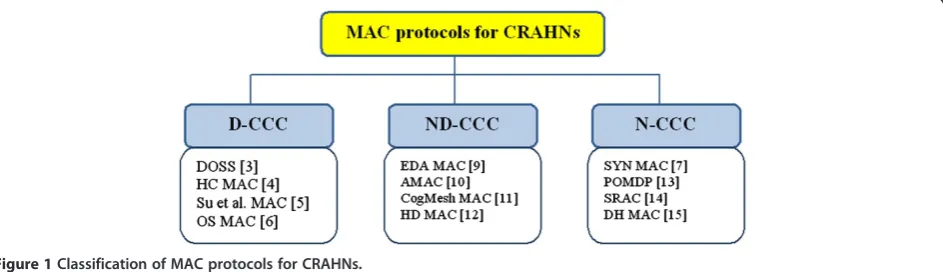
Many researchers have proposed various MAC protocols for CRAHNs in the literature. Due to the complexity in ad hoc networks, there are various issues to be addressed while designing a MAC protocol. Major issues are the spectrum sensing technique, dynamic spectrum allocation, spectrum sharing, and establishing a common control channel (CCC). On the basis of a CCC, CRAHN MAC protocols can be classified into three categories: dedicated CCC (D-CCC), dedicated CCC (ND-CCC), and non-CCC (N-non-CCC) as shown in Figure 1.
2.1. D-CCC
The D-CCC-based protocols assume that a CCC is avail-able in a network. The CCC is a licensed channel or exists in some unlicensed band such as the Industrial, Scientific, and Medical band. SUs exchange their control information by using the D-CCC. Therefore, network startup, node joining, and information exchange are quite easy in this type of protocols. In Figure 1, four MAC protocols belong to D-CCC. DOSS MAC [10] operates by using three chan-nels: CCC, a data channel and a busy tone band. HC MAC proposed by Jia et al. [11] considers the hardware constraints in a node. In the cross-layer opportunistic MAC [12], the spectrum sensing policy at the physical layer and the packet scheduling at the MAC layer are integrated. OS MAC [13] is based on a group of nodes (SU group) using the same data channel.
2.2. ND-CCC
Although the D-CCC-based MAC protocols are easy to realize, assigning a fixed CCC might not be practical in some scenarios. Besides, the fixed CCC might cause CCC saturation problems and jamming effects [6]. ND-CCC
protocols do not have any CCC assigned at the network startup. Also, in case of a large number of SUs, the CCC can get saturated.
In general, an ND-CCC is established by selecting one of available channels in a network or by dividing SUs into different groups or clusters that have different ND-CCCs. In C-MAC [14] and EDA MAC [15], a rendez-vous channel is established and channels are divided into a number of superframes. The superframes consist of a beacon period and a data transmission period. In AMAC [16], communication pairs exchange the priori-tized channel list and select a different ND-CCC in the list. So, different SU pairs have different ND-CCCs. A network can be divided into groups and an ND-CCC is selected within a group in CogMesh MAC [17] and HD MAC [18] protocols. This is because it is less likely to find a common channel throughout the whole network. However, it has to be noted that ND-CCCs can still be affected by problems in the D-CCC. Unlike D-CCCs, however, ND-CCCs are not fixed. In addition, there can be many ND-CCCs in a network. So, the extent of adverse effects is smaller.
2.3. N-CCC
Usually, the channel availability is uncommon in CRAHNs. Therefore, the probability of a channel being com-mon to nodes is comparatively small. N-CCC-based MAC protocols do not require any CCC for exchan-ging the control signals. They are effectively run by implementing synchronization between nodes. Using channel-hopping for control and data transmission has been also proposed. Zhao et al. [19] proposed the DC-MAC protocol in which the spectrum access is done by combining spectrum sensing at the phys-ical layer with historphys-ical statistics. But, it assumes that PU slots and transmission probability are known in advance. The SRAC protocol [7] is based on the cross-channel communication in single-radio multi-hop ad hoc networks. Each of the nodes selects a stable receive channel among available channels for receiving data. However, it requires extra control signal transmission and multiple broadcasts of packets. In DH-MAC [8], nodes hop among available channels in a cyclic pattern. There is a need for synchronization for dissimilar parameters and extra overhead of fast switching between channels. In the SYN MAC protocol [6], a group of time slots is established and repeated over time, where the number of slots in a group is equal to the number of channels. But, only one pair can start a transmission in a particular slot.
As a result, there are relatively few MAC protocols that consider the uncommon channel availability. How-ever, they have some operational shortcomings includ-ing the extra requirement of control signal exchanges
and the overhead of channel switching. Also, nodes are affected by long transmission delay and waiting time. Furthermore, it is not preferable to use CCC for preventing CCC saturation and denial of service attacks.
3. Proposed CA-MAC protocol
Although majority of contributions in the literature assume the common channel distribution where most of the channels are available to network nodes, this might not be the case in a practical scenario of CRAHNs. In practice, channel availability varies node-by-node.
The idea behind the proposed protocol is to have little network access delay and waiting time. That is, as many communication pairs as possible should be able to start transmission at the same time and as early as possible. For transmitting early, nodes should get a chance to re-serve a channel as early as possible. Also, it is required that nodes gather information on the channel reserva-tions of other nodes. For this, the channel used for data channel contention should be the one that it is most common to all member nodes. On the other hand, a communication pair should reserve a data channel which is least common to all member nodes, so that there is a good chance of winning the contention for that channel.
To facilitate these principles, we make use of two different channel lists, namely (i) the sorted channel list (SCL), which is a global list of all the channels in the network, sorted such that the first channel is most com-mon and the last channel is least comcom-mon to all mem-ber nodes, and (ii) the common channel list (CCL), which is a local list of all the channels common to a given communication pair, sorted in the reverse order. To illustrate these principles, we start with a simple example:
N5–N6, N7–N8, and N9–N10 are pairs, CCLs are as andN7–N8reserve channelsC3,C4, andC1for transmis-sion, respectively, and all three pairs start transmission at T2slot. And, at slot T2, on channel C2, pairsN3–N4 and N9–N10 reserve channels C2 and C5 respectively, and start transmission at T3 slot. This process is explained in more detail in the following sections.
3.1. Assumptions
Our protocol does not require any CCC. It is assumed that different nodes have a different set of channels available to access. Therefore, a communication pair has very few common channels for communicating with each other. The channel availability of each node is shared within a network and, thus, every node knows the channel availability of all the nodes in the network. Each node is assumed to possess two radio front-ends. One of them is for listening to control signals (listening radio) and another is for data transmission (data radio). So, data transmission and control signal overhearing are possible at the same time. In this way, nodes can receive signaling information on the first radio front-end while transmitting or receiving data on the other one. There-fore, the re-appearance of PU on a channel can effect-ively be detected while data are transmitted or received. Furthermore, two radio front-ends are also helpful on overhearing other pairs’communication and the hidden terminal problem can be avoided as well. It is assumed that both radio front-ends operate in frequency ranges that are well separated, so as to avoid self-interference effects. Unlike other MAC protocols for CRAHNs, the proposed CA-MAC protocol requires only one common channel for a communication pair. In other words, all nodes are assumed to have at least one channel in com-mon with the desired communication partner (otherwise, communication is not possible).
3.2. Network architecture and synchronization
Channel distribution is considered to be“uncommon”. This means that, given N channels in total, only n (n≤N) channels may be available to a particular node. At the beginning of network formation, each node gains knowledge about the channel availability of other member nodes.
At the beginning, a group of time slots is established and repeated over time, where the number of slots in a group is equal to the number of channels. In each time slot, a beacon is broadcasted using one of available channels in one-by-one manner. By listening to beacons, subsequent nodes synchronize and exchange the avail-able channel sets. Every node examines the channel sets in order to prepare a Node Channel Matrix (NCM) which will be described later.
3.3. Channel architecture
The channel structure of CA-MAC is based on the split phase multichannel MAC protocols described in [20,21], where time is divided into a number of phases for con-trol and data transmission. Unlike them, CA-MAC does not use a CCC and has two radio interfaces. Therefore, CA-MAC is able to overlap control and data transmis-sion on different channels at the same time slot.
There may be N available channels. These channels are ranked according to defined priority and then reordered according to their rank. The mechanism of ranking and ordering is described in detail in Section 3.6. Time slots are synchronized and occupied by the chan-nels. The number of time slot in a cycle (or period) is equal to the number of channels. The cycle is repeated in time. According to the channel assignment, rank 1 channel refers to time slot 1, rank 2 channel refers to time slot 2, and so on.
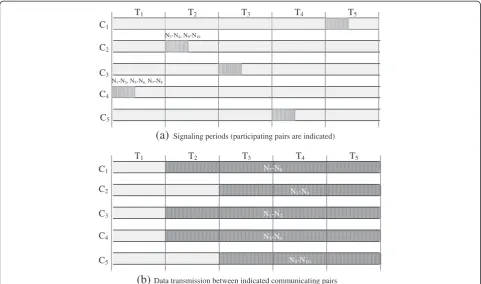
Figure 2 shows the channel structure in CA-MAC. The representative slot (the slot with slot number being equal to the channel rank number) of a channel starts with a signaling period. For example, for the channel ranked as 1, the first slot starts with a signaling period (channel C4 in Figure 2); similarly, for the channel
ranked as 3, signaling period is at the third slot (channel C3 in Figure 2). The rest of the period in a channel is
the data transmission period. The signaling period con-sists of signaling slots for negotiation. These signaling slots are used by intending communication pairs to con-tend for reserving a channel. These slots can also be used for transmitting other control information such as PU arrival notification.
3.4. NCM
Before explaining the NCM, it is necessary to define some new terms. The channel indicator or channel access indicator, λij, is the bivalent which represents
whether node i can access channel j (1) or not (0). Hence, for node i, formchannels, we can form a list of channels as {{C1, λi1}, {C2, λi2}, {C3, λi3}, . . ., {Cm, λim}},
where for eachj from 1 tom, λijis equal to 1 if node i
can access channel Cj and 0 otherwise. Again, for n
Now, the channel availability or channel access probability,pij, is the probability thatλij= 1.The channel
availability is the probability that a channel is available to a node. In other words, it is the probability that a PU is inactive in a channel from the viewpoint of a node. Each of the entries in the NCM takes value either 0 or 1 according to the channel availability. For simplicity, we assume that this probability is the same for all the node-channel combinations and can be represented byp. For smaller values of p, few or none of the channels are common between nodes. On the other hand, if the value
of p is larger, most of the channels are available to almost all nodes. Finally, if pis an intermediate value, only few channels are common between nodes but at the same time, there is the possibility that none of the channels is common for all the network nodes.
To find the total number of nodes which have a particular channel available, we can sum all the 0’s and 1’s along the column in the NCM corresponding to that channel. If this value is large, then it means that the corresponding channel is available to a large number of nodes. Therefore, the probability of accessing that chan-nel by a larger number of nodes would be relatively high. On the other hand, if that value is a small number, then only few nodes have that particular channel available to access. So, chances of contention for that channel would be low.
3.5. Communication initialization
It will be easier to discuss this mechanism with an example of an NCM in Figure 4. Let us assume that each the member nodes N1to N10 want to establish 5 point-to-point links, i.e., communicate in pairs. Let us say the communication pairs are corresponding to odd and even numbered nodes such asN1–N2,N3–N4,. . .,N9–N10.
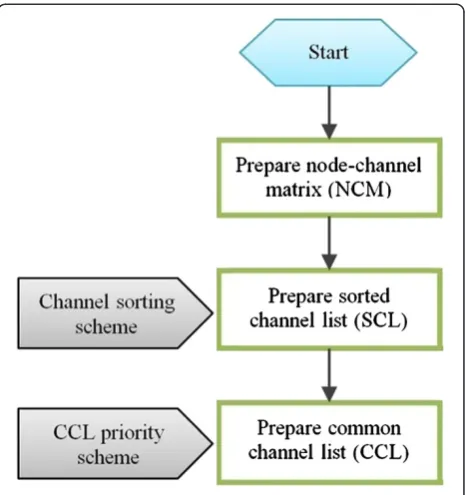
Now each pair forms a CCL as shown in Figure 5. The ordering of the list depends on the CCL priority scheme
(a)
Signaling periods (participating pairs are indicated)(b)
Data transmission between indicated communicating pairsC1
C2
C3
C4
C5
T1 T2 T3 T4 T5
N1-N2, N5-N6, N7-N8
N3-N4, N9-N10
C1
C2
C3
C4
C5
T1 T2 T3 T4 T5
N7-N8
N1-N2
N5-N6
N3-N4
N9-N10
Figure 2Channel structure. (a)Signaling periods (participating pairs are indicated).(b)Data transmission between indicated communicating pairs.
as shown in Figure 6. The reason that we have designed this as a modular scheme is that different networks have different objectives. The objectives can be high through-put, short delay, seamless connection, etc. So, the objec-tives can be modeled as a certain utility functionu(x). In multichannel networks, different channels have different characteristics in different scenarios. Hence, the utility functions differ from network-to-network. And, different priorities can be given to channels based on the utility function. This can result in a prioritized list with the ‘best’channel as the first entry, and so on. We call CCL as a prioritized list of the ‘best’ channels common to transmitter and receiver. Therefore, a CCL of pair kcan be represented as follows:
CCLk¼ Chk1;u1
; Chk2;u2
; Chk3;u3
; ::::; Chkl;ul
g;
ð1Þ
where u1 to ul are the utilities of channels Chk1 to Chkl
such thatuc≥uc+1∀c(1 <c<l) and lcan take value from 0 tom(the number of channels).
Statistically, the probability that channelcis common to both the transmittertand receiverris given as follows:
P cð Þ ¼pctpcr: ð2Þ
Within the scope of this article, our policy concerning channel prioritization for data transmission is to give higher priority to the channel that is least common such that there is lesser chance of contention between nodes for the same channel. This can be found out from the last row in the NCM. Correspondingly, entries in the CCL are in ascending order of the values in the last row in the NCM and, thus, it is common to both nodes in a communication pair. The numerals in the last row can be taken as the representation of the “commonness” of the channel in a network as explained in Section 3.4.
By continuing our numerical example from Figure 4, let us consider a communication pair N1–N2. Looking at the last row, the least value is 4 corresponding to channelC1. But, this channel is available to neitherN1 norN2. The next value is 5 for channelC5, which is also not common to both of the nodes. Finally, channelsC3 and C4 have values 6 and 8, respectively, and they are common to both nodes N1 and N2. Going on this manner, CCL of theN1–N2pair would include channels C3andC4in the same order, because, as mentioned, we give higher priority to those channels that are‘less com-mon’ throughout the network, so as to increase the probability of winning contentions. The CCL of all com-munication pairs for the considered example is shown in Figure 5. Note that some communication pairs might not have common channels.
Figure 4An example of NCM (p= 60%).
Figure 5An example of CCL.
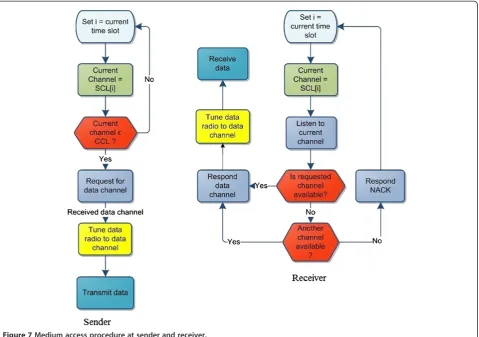
As we have considered a network in which the avail-able channel set is not common between nodes, entries in the CCL vary for each communication pair. For chan-nel access, each node will attempt to access chanchan-nels on the order they appear in the CCL. If the first channel can be accessed, it will be selected for transmission. In case the channel is inaccessible, the next accessible channel in the CCL is selected. Figure 6 shows the initialization phase of both sender and receiver.
3.6. Channel access
In CA-MAC, channels are accessed in a time-slotted manner. Hence, all channels and node timers are syn-chronized. As shown in Figure 6, the SCL is prepared according to a channel sorting scheme. This scheme can be designed in various ways according to the object-ive of the network. Within the scope of this article, our policy concerning channel prioritization for control sig-nal exchange is such that the maximum control sigsig-nals are exchanged as early as possible and channels are reserved in advance. This is advantageous as there is shorter channel access delay throughout the network.
First of all, channels are ranked. A channel ranks highest if it is common to the maximum number of nodes in the network. In our scheme, the SCL is prepared with the help of the NCM (similar to the CCL). In Figure 3, we can see that the last row of the NCM is the sum of all the values (1’s and 0’s) along the column. As the columns represent channels, the values give the‘commonness’of the channel in the network. If this value is large, the channel is avail-able to more nodes. Hence, by selecting the channel com-mon to the most nodes as the first channel used for data channel contention, most of the nodes can reserve the channel for data transmission in advance and reduce the channel access delay. The SCL is the sorted list of channels and time slots such that each channel is used for control information transmission at the corresponding slot. It can be shown as
SCL¼ fft1;Ch1g;ft2;Ch2g;ft3;Ch3g;. . .;
tm;Chm
f gg;
ð3Þ
where,t1totmare the time slots and Ch1to Chmare the
channels such that for everyk(1 tom),
Xn
Note here that the number of time slots is equal to the number of channels, m. Also, the similar channel notations Ch1, Ch2, etc., in the CCL and SCL should not be confused withC1,C2, etc. The CCL and SCL are the sorted list ofC1,C2, etc. sorted according to priority and channel sorting scheme as shown in Figure 6.
Therefore, for example, C3 is not necessarily equal to Ch3in the CCL or SCL.
For the NCM in Figure 4, the SCL would be {C4,C2, C3, C5, C1}. As there are five channels, there are five slots. Each of the five slots is associated with a channel according to channel rank. In our example, time slot 1 is for channelC4(ranked 1), time slot 2 is for channelC2, time slot 4 is for C5, and so on. Each of the time slots associated with channels differs from other slots in that channel.
All of the nodes tune their listening radio to the chan-nel associated with the current time slot. Hence, on every time slot, a listening radio hops to a channel according to its rank on respective time slot. If a node intends to transmit on a certain channel and has the channel represented by the slot in its CCL (intended for signaling) (that means both sender and receiver have this channel in common), it would contend for the intended channel during the signaling period. Nodes listen to the channel reservation of other nodes during signaling periods. So, the sender would select the first channel in the CCL for reservation which is not already reserved by other members.
On receiving a channel reservation request from the sender during the signaling period, the receiver sends an acknowledgement to the sender if the channel is not reserved. Otherwise, it will offer the next entry in CCL as the candidate channel. As the other nodes are overhearing this reservation, they update their information (that the channel is reserved) and would not attempt to access the channel in a similar way as the network allocation vector is used in the 802.11 MAC protocol. The medium access procedure of sender and receiver is shown in Figure 7.
After reserving a channel for transmission during the signaling period, communication pairs tune their data radio to the reserved channel and start data transmission at the next slot. It should be noted that during a signaling period, multiple pairs can reserve disjoint channels and thus multiple transmissions can start at the same time (i.e., concurrent transmission on multiple channels). For instance, for a communication pair to transmit after the first slot, following criteria is to be met:
Channel is common to both sender and receiver. Channel is the first entry in SCL.
The first criterion has been derived in the previous section. Since all the channels have equal chance to be the first entry in SCL (for simplicity), the probability of a communication pair to transmit after the first slot is
As per our example, the first time slot is for channel C4(see Figure 2). All the nodes tune their listening radio to this channel. As channel C4is in CCL of nodes N1, N2, N5 to N8(see Figure 5), pairs N1–N2, N5–N6, and N7–N8reserve channelsC3,C4, andC1for transmission, respectively. The other nodes (N3andN9) overhear the current reservation. During time slot 2, the signaling period is on channelC2which is in CCL of N3–N4and N9–N10, where they reserve channels C2and C5. Note that during signaling period in the first time slot, N5 would have requestedN6to reserve channelC3(the first entry in their CCL). But, during the same time slot, it has already overheard that C3 is reserved by N1–N2, it requests N6to access channel C4(the second entry in CCL). During slot 2, pairs N1–N2, N5–N6, and N7–N8 start their transmissions (see Figure 2). During slot 3, nodes N3, N4, N9, andN10 start their transmissions. In this way, a number of concurrent transmissions in different channels have been made possible.
3.7. Stochastic analysis
Now we analyze the channel access delay of CA-MAC by building a Markovian model. The channels are opportun-istic in CR environment. Due to this nature, the ith
channel is available to a node following a Bernoulli process with time invariant probabilitypi. And the
indi-cator function can be defined as
λj
i¼
1 if channeliis available to nodej 0 otherwise:
ð6Þ
Hence, pi can simply be stated as the probability that λijtakes value 1
During each time slot, one of the channels is used for the control phase by the nodes which hold the channel and contend for data channel reservation. The channels for the control phase are assigned in a round robin fashion, and each device tunes its control radio to the channel used for the control phase and its data radio to its data channel.
Let the number of channels be M and the number of nodes beN. We form a Markov chain with states {Xt} as
shown in Figure 8. Here,Xtdenotes the number of
com-munication pairs during timet. Note that it is the same as the number of busy channels and ifXt= k(the number
Now the state space ofXtcan be given as follows:
S:¼f0;1;. . .;minðM;N=2Þg: ð7Þ
At any state, the probability pi that i (0≤i≤min(M,
N/2)) agreements are made is given by
pi¼pSRpidle; ð8Þ
wherepSRis the probability that a pair of sender (sayS)
and receiver (say R) have the current control channel and thus pSR=pSpR, and pidle is the probability that i
exclusive channels are idle and thuspidleis given by the product of the probability thatM–i channels are busy (i.e., (kC(M–i)×M–kCi)/kCM since k channels are busy)
and the probability that i channels out of k available channels are exclusive (i.e.,kCi/k+i–1Ci), resulting inpidle=
((kC(M–i)×M–kCi)/kCM) × (kCi/k+i–1Ci). Here, terms asnCm
represents n-combinations of m. For instance, kCMgives
the combinations ofkchannels out ofMchannels in total. Whenever a new agreement is made or the current transmission ends, a state transition would occur. IfSki is
the probability that i new agreements are made at the current state Xt (or k) in the next slot and Tkj is the
probability that jtransmissions terminate at the current state Xt(ork) in the next slot, the transition probability
from statekto statel,pkl, can be expressed as follows:
pkl¼
We can simplify the above equations by using set theory notation to make the equations more understandable. In every time slott, a representative channel is used for con-trol signal exchange by the nodes which tune their listening radio to this particular channel. Hence, if the current channel is Ct, then communication pairs (S, R)
would contend for reserving a channel ifCt∈CCL(S,R).
Note that CCL(S,R) is obtained by set intersection of the sender’s and receiver’s channel sets. Now, let us say thatRt
is the set of the channels reserved by the contenders until time slott, then the total number of channels utilized in the next slot would be equal to cardinality of setRtgiven
as|Rt|. This is also the channel utilization of the network.
Hence, throughput Th(t) in time slottcan be obtained by
Th tð Þ ¼j jRt ðtotal packetsÞ=ðslot durationÞ: ð10Þ
Moreover, the overall system throughput Thsis obtained
by
accessing the channels. As a result, N/2–|Rt| pairs
would be idle. Therefore, the average network access delay in time slots of the system,Davg, is given by
Davg ¼
Here,Ntis the total number of time slots.
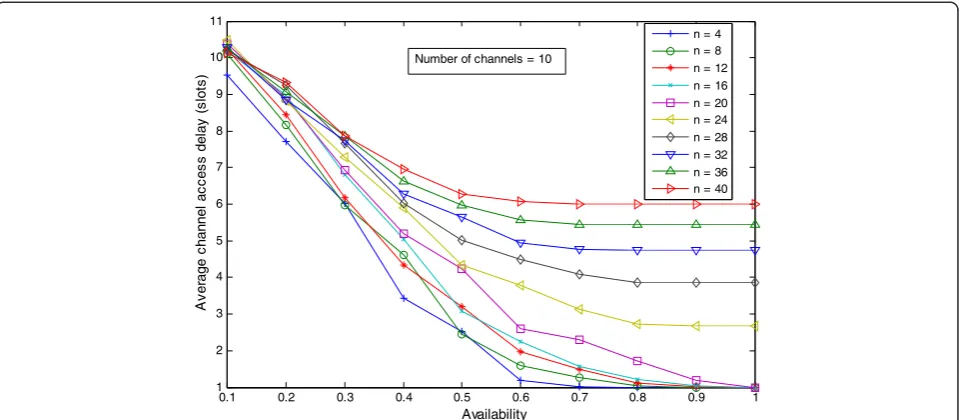
Figure 10 shows the same relation by varying the num-ber of available channels. These analysis results will be validated by the ns-2 simulation results which will be discussed in Section 4.
4. Performance evaluation 4.1. Simulation environment
The performance study of MAC protocols for CRAHNs is challenging due to the unavailability of a reliable evaluation tool even though special features are added above legacy wireless MAC protocols. In our perform-ance study, the network simulator ns-2 is used. The cog-nitive radio cogcog-nitive network (CRCN) simulator patch [22] is combined in ns-2. It provides additional function-ality to ns-2 with cognitive capabilities of multichannel
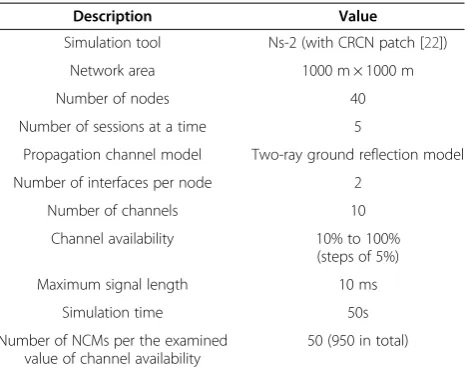
environment, channel selection at MAC or routing layer and multi-radio interface. We have used the ns-2.31 ver-sion with the CRCN patch for simulation. Although some sample MAC protocols have been provided for tests, we have modified the existing 802.11 MAC proto-col to suite the CA-MAC characteristics. The simulation parameters are summarized in Table 1.
The CA-MAC protocol requires node-channel informa-tion obtained through the sensing phase, or exchanged be-tween nodes. This phase is assumed to be passed. The channel availability (as described in Section 3.4) is varied from 10 to 100% with step of 5% to represent harsh“ un-common” and “common” channel environments as explained earlier. So, there are 19 examined values of channel availability (i.e., 10, 15, . . ., 100%) in total. For
Number of channels = 10
Figure 9Average channel access delay versus channel availability with the varying number of nodes.
0.1 0.2 0.3 0.4 0.5 0.6 0.7 0.8 0.9 1
Average channel access delay (slots)
C = 1 C = 2 C = 3 C = 4 C = 5 Number of nodes = 10
each value of channel availability, 50 NCMs are generated to create 950 NCMs in total. The CA-MAC protocol has been implemented in ns-2 by modifying the 802.11 MAC. Around 40 nodes are deployed randomly in a 1000 × 1000 m2area. Out of them, ten nodes are randomly se-lected as sender and receiver. The number of channels is set to 10. For making multiple users able to contend in a single slot, slot length is set to 10 ms. Simulations are re-peated 20 times for the same setting in order to mitigate the effect due to randomness. The other parameters are the same as those in the 802.11 MAC protocol.
4.2. Simulation results and discussion
Based on the simulation results, the proposed CA-MAC protocol is compared with the SYN-MAC protocol. The SYN-MAC protocol differs from CA-MAC protocol in
the sense that the channel hopping order is according to the channel index and only one new transmission can be started in a time slot [6]. It offers the good connectiv-ity between network nodes and outperforms the existing CCC-based protocols. Hence, it can be considered as a key MAC protocol for an uncommonly distributed channel architecture in CRAHNs. Although it solves the several problems related to a CCC, it has a shortcoming as only one transmission can be started in a slot. Our target in the CA-MAC protocol is to overcome this by allowing multiple concurrent transmissions to start at a time and thus decreasing the overall channel access delay in the network. For fair comparison, SYN-MAC was simulated using the same procedure under the same network environments with the same inputs as CA-MAC.
Figure 11 shows the observed end-to-end delay in terms of slots in SYN-MAC and CA-MAC under the same network scenarios (i.e., with the same NCMs). We can observe that CA-MAC has shorter delay in channel access compared to SYN-MAC. In the SYN-MAC protocol, only one new transmission is allowed per slot and, thus, forn transmissions, at leastn× (n–1)/2 slots are lost in total. Hence, the average delay fornchannels is at least (n–1)/ 2 slots. In the CA-MAC protocol, however, multiple trans-missions can start concurrently in the same slot and, thus, the minimum delay would be one slot per transmission. Hence, average delay would be around one slot for an ideal case where all the transmissions start at the begin-ning. Also, comparing Figure 11 to the theoretical results in Figure 9 (obtained by MATLAB), we can see that both results coincide.
Figure 12 compares SYN-MAC and CA-MAC in terms of session connectivity. In this article,session connectivity Table 1 Simulation parameters
Description Value
Simulation tool Ns-2 (with CRCN patch [22])
Network area 1000 m × 1000 m
Number of nodes 40
Number of sessions at a time 5
Propagation channel model Two-ray ground reflection model
Number of interfaces per node 2
Number of channels 10
Channel availability 10% to 100% (steps of 5%)
Maximum signal length 10 ms
Simulation time 50s
Number of NCMs per the examined value of channel availability
50 (950 in total)
10 20 30 40 50 60 70 80 90 100
1 2 3 4 5 6 7 8 9 10
Channel availability (%)
End-to-end delay (slots)
SYN MAC CA-MAC
in a network is defined as the ratio of the number of communication pairs over the total number of enabled sessions. We can see that session connectivity is higher in CA-MAC compared to SYN-MAC. It is mainly because, in SYN-MAC, a node selects a channel randomly out of available common channels and, if it loses the contention, it has to wait for the next available common channel. However, in CA-MAC, the sender can contend for any channel in any slot and the receiver could even notify the sender of the next available channel during the same slot. For instance, let {C1, C3, C5} be the CCL and let the current slot be third slot. In SYN-MAC, nodes would contend to access channel 3. If they lose, they need to wait until the fifth slot for the next contention (where there is no guarantee of winning). On the other hand, ifC5is not available, they cannot contend for C1after losing C3 be-cause the first slot representing channel C1 has already passed. In CA-MAC, however, nodes can contend for C3 in the current slot on the current channel and, if it loses, it can claimC1to be accessed in the next slot.
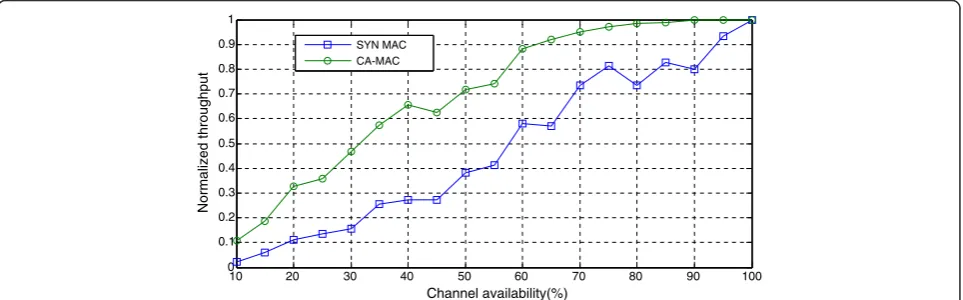
Figure 13 highlights that, with shorter access delay and higher connectivity, CA-MAC offers better throughput compared to SYN-MAC. In Figure 13, the normalized
throughput represents the normalized ratio of the max-imum throughput obtained in all the examined values of channel availability over the throughput obtained at a given channel availability. We can see from the graph that the normalized throughput is equal to one when channel availability is around 100% for both protocols, which corresponds to the maximum throughput obtained. There are some rises and falls in the plot of throughput because the channel selection is a random process and the channel availability itself is random.
5. Conclusion
In this article, we presented a concurrent access MAC protocol for CRAHNs where the channel is uncommon among nodes. This is the practical case in CRAHNs where available channels might not be the same to all the nodes in a network. The proposed CA-MAC protocol does not require any CCC. Hence, the network members can com-municate with each other even if they do not have even a single channel common in the whole network. In addition, the problems of CCC can be avoided. We have simulated the CA-MAC protocol using the ns-2 simulator with CRCN patch for CRAHNs and compared the CA-MAC Figure 12Session connectivity at different channel availability.
10 20 30 40 50 60 70 80 90 100
0 0.1 0.2 0.3 0.4 0.5 0.6 0.7 0.8 0.9 1
Channel availability(%)
Normalized throughput
SYN MAC CA-MAC
and SYN-MAC protocols. The performance study shows that CA-MAC outperforms SYN-MAC by improving overall network access delay and network connectivity. The significant improvement is achieved by allowing mul-tiple communication pairs to transmit data concurrently at the same time on different channels.
As future works, we are planning to add additional optimization techniques such as minimizing the NCM size. Also, since the choice of channels to be selected depends on the network type (especially on the under-lying utility function), the study and identification of ap-propriate utility functions for various kinds of networks would be included in our future works.
Competing interests
The authors declare that they have no competing interests.
Acknowledgments
The authors would like to thank the editor and anonymous reviewers for their valuable comments for improving the quality of this article.
Received: 1 June 2012 Accepted: 7 March 2013 Published: 4 April 2013
References
1. FCC,Spectrum Policy Task Force Report, No. 02–155, 2009
2. J Mitola III, GQ Maguire Jr, Cognitive radio: making software radios more personal. IEEE Pers Comm6(4), 13–18 (1999). doi:10.1109/98.788210 3. H Zheng, C Peng, Collaboration and fairness in opportunistic spectrum access,
inProceedings of IEEE International Conference on Communications (ICC 2005), vol. 5(, Seoul, Korea, 2005), pp. 3132–3136. doi:10.1109/ICC.2005.1494982 4. W Wang, X Liu, List-coloring based channel allocation for open-spectrum
wireless networks, inProceedings of the IEEE 62nd Vehicular Technology Conference (VTC-2005-Fall), vol. 62(, Dallas, Texas, USA, (2005), pp. 690–694. doi:10.1109/VETECF.2005.1558001
5. Q Zhao, BM Sadler, A survey of dynamic spectrum access. IEEE Signal Process. Mag. (2007). doi:10.1109/MSP.2007.361604
6. YR Kondareddy, P Agrawal, Synchronized MAC protocol for multi-hop cognitive radio networks, inIEEE International Conference on Communications, 2008 (ICC'08)(, Beijing, China, 2008), pp. 3198–3202. doi:10.1109/ICC.2008.602
7. L Ma, C-F Shen, B Ryu, Single-radio adaptive channel algorithm for spectrum agile wireless ad hoc networks, inProceedings of 2nd IEEE International Symposium on New Frontiers in Dynamic Spectrum Access Networks (DySPAN 2007)(, Dublin, Ireland, 2007), pp. 547–558. doi:10.1109/ DYSPAN.2007.78
8. C-F Shih, TY Wu, W Liao, DH-MAC: a dynamic channel hopping MAC protocol for cognitive radio networks, inProceedings of the IEEE International Conference on Communications (ICC’10)(, Cape Town, South Africa, 2010), pp. 1–5. doi:10.1109/ICC.2010.5502694
9. FL Brandon, A survey of common control channel design in cognitive radio networks. Phys Comm4, 26–39 (2011)
10. L Ma, X Han, C-C Shen, Dynamic open spectrum sharing MAC protocol for wireless ad hoc networks, inProceedings of 1st IEEE International Symposium on New Frontiers in Dynamic Spectrum Access Network (DySPAN 2005)(Baltimore, Maryland, USA, 2005), pp. 203–213. doi:10.1109/DYSPAN.2005.1542636 11. J Jia, Q Zhang, X Shen, HC-MAC: a hardware-constrained cognitive MAC for
efficient spectrum management. IEEE J Sel Area Comm26(1), 106–117 (2008). doi:10.1109/JSAC.2008.080110
12. H Su, X Zhang, Cross-layer based opportunistic MAC protocols for QoS provisionings over cognitive radio wireless networks. IEEE J Sel Area Comm
26(1), 118–129 (2008). doi:10.1109/JSAC.2008.080111
13. B Hamdaoui, KG Shin, OS-MAC: an efficient MAC protocol for spectrum-agile wireless networks. IEEE Trans. Mob. Comput.7(8), 915–930 (2008). doi:10.1109/TMC.2007.70758
14. C Cordeiro, K Challapali, C-MAC: a cognitive MAC protocol for multi-channel wireless networks, inProceedings of the 2nd International Symposium on New
Frontiers in Dynamic Spectrum Access Networks (DySPAN 2007)(, Dublin, Ireland, (2007), pp. 147–157. doi:10.1109/DYSPAN.2007.27
15. C-S Hsu, Y-S Chen, C-E He, An efficient dynamic adjusting MAC protocol for multichannel cognitive wireless networks, inProceedings of IEEE International Conference on Wireless Communications, Networking and Information Security (WCNIS 2010)(, Beijing, China, 2010), pp. 556–560. doi:10.1109/
WCINS.2010.5544148
16. GP Joshi, SW Kim, B-S Kim, An efficient MAC protocol for improving the network throughput for cognitive radio networks, inProceedings of Third International Conference on Next Generation Mobile Applications, Services and Technologies (NGMAST’09)(, Cardiff, Wales, UK, 2009). doi:10.1109/ NGMAST.2009.38
17. T Chen, H Zhang, GM Maggio, I Chlamtac, CogMesh: a cluster-based cognitive radio network, inProceedings of 2nd IEEE International Symposium on New Frontiers in Dynamic Spectrum Access Networks (DySPAN 2007) (Dublin, Ireland, 2007), pp. 168–178. doi:10.1109/DYSPAN.2007.29 18. J Zhao, H Zheng, G-H Yang, Distributed coordination in dynamic spectrum
allocation networks, inProceedings of the 1st IEEE International Symposium on New Frontiers in Dynamic Spectrum Access Networks (DySPAN 2005) (Baltimore, Maryland, USA, 2005)), pp. 259–268. doi:10.1109/ DYSPAN.2005.1542642
19. Q Zhao, L Tong, A Swami, Y Chen, Decentralized cognitive MAC for opportunistic spectrum access in ad hoc networks: A POMDP framework. IEEE J Sel Area Comm25(3), 589–600 (2007). doi:10.1109/JSAC.2007.070409 20. J Mo, H-SW So, J Walrand, Comparison of multichannel MAC protocols. IEEE
Trans. Mob. Comput.7(1), 50–65 (2008). doi:10.1109/TMC.2007.1075 21. AK-L Yau, P Komisarczuk, PD Teal, On multi-channel MAC protocols in
cognitive radio networks, inAustralasian Telecommunication Networks and Applications Conference (ATNAC’08)(, Adelaide, Australia, 2008), pp. 300–305 22. J Zhong, J Li, Cognitive radio cognitive network simulator. (2011). http://
stuweb.ee.mtu.edu/~ljialian/. Accessed 9 September 2011
doi:10.1186/1687-6180-2013-69
Cite this article as:Timalsinaet al.:A concurrent access MAC protocol for cognitive radio ad hoc networks without common control channel.
EURASIP Journal on Advances in Signal Processing20132013:69.
Submit your manuscript to a
journal and benefi t from:
7Convenient online submission
7Rigorous peer review
7Immediate publication on acceptance
7Open access: articles freely available online
7High visibility within the fi eld
7Retaining the copyright to your article