P R O C E E D I N G S
Open Access
Identification of genes and variants associated with
quantitative traits using Bayesian factor screening
Kith Pradhan
1, Seungtai Chris Yoon
2, Tao Wang
1, Kenny Ye
1*From
Genetic Analysis Workshop 17
Boston, MA, USA. 13-16 October 2010
Abstract
We propose a factor-screening method based on a Bayesian model selection framework and apply it to Genetic Analysis Workshop 17 simulated data with unrelated individuals to identify genes and SNP variants associated with the quantitative trait Q1. A Metropolis-Hasting algorithm is implemented to generate a posterior distribution in a restricted model space and thus the marginal posterior distribution of each variant. Our framework provides flexibility to make inferences on either individual variants or genes. We obtained results for 10 simulated data sets. Our methods are able to identifyFTP1andKDR, two genes that are associated with Q1 in a majority of replicates.
Background
Yoon [1] proposed a Bayesian framework for factor screening, based on Bayesian model selection. In sum-mary, given a total ofpcandidate factors, we evaluate a model space ofKmodels. Each model involvesmfactors (usuallymis much smaller thanpfor the Pareto principle of factor scarcity and is specified by the user), is of the same class, and is assigned a prior probabilityp(Mk). The prior probabilities are usually the same if the models have the same number of parameters. Note that a modelMk
corresponds to a binary vectorg= (g1,g2,…,gp), where
∑
1 . Given observed datay, the posteriorprobabil-ities are given by: unknown parameters. To evaluate the importance of each factor, we can summarize its marginal posterior probability by:
Here, we apply this method to the Genetic Analysis Workshop 17 (GAW17) simulated data, of which the gen-otypes of 697 individuals at 3,205 genes are based on exome sequencing data of the 1000 Genomes Project [2]. In principle, the general framework described applies to any class of parametric or nonparametric models, so long as the model posterior probability is well defined and can be computed. However, here we consider only linear mod-els, and we apply our method to analyze quantitative trait Q1 of the GAW17 data set. This trait was simulated to be associated with 39 single-nucleotide polymorphisms (SNPs) in 9 genes. In the first part of our analysis, we treat each SNP as a factor to evaluate the association at the SNP level. In the second part of our analysis, we treat each gene as a factor and evaluate the association at the gene level. Because each gene contains a different number of SNPs, unequal prior probabilities are assigned to candidate models to penalize models with more parameters based on the Bayesian information criterion (BIC) [3].
Methods
Use SNPs as factors
Consider a linear model with quantitative responses y= Xb+ε, wherey is a quantitative trait andX is a matrix derived from genotypes from m SNP variants, with * Correspondence: [email protected]
1
Department of Epidemiology and Population Health, Albert Einstein College of Medicine, 1300 Morris Park Avenue, Bronx, NY 10461, USA
Full list of author information is available at the end of the article
details to be given later, and ε~ N(0, s2I). The prior distribution of b and s2 is given as b| s2 ~ N(0, s2 (l2Σ
)) andp(s2)∝1/s2, where lis a tuning parameter that controls the flatness of the prior distribution andΣ can be specified to reflect the relation between the can-didate variables. In this notation, we omit the subscript vector g that represents each model Mk in the model space. Under these prior distributions, the posterior dis-tribution ofgcan be easily computed by integrating out bands2:
p( | )g y ∝p y( | ) ( )g pg = s−/ ⎣⎡y I′
(
−l Xg gs X− ′g)
y⎤⎦ n/ p( ),g −1 2 2 Σ 1 2 (3)
where s=l2X X′g gΣg +I. Brown and Vannuci [4] developed a method that further improves the computa-tional efficiency of the posterior distribution, because it can be written as: of using QR decomposition for least-squares estimates of linear models are given by Seber [5].
However, even with efficient evaluation of the model posterior distribution, the model space containspchoose mmodels and is usually too big to be exhaustively evalu-ated. For example, withp= 24,478 variants, there are almost 2.5 trillion models whenm= 3. If 1 million models are evaluated in a second, it will take almost a month to evaluate all 2.5 trillion models. Therefore a Monte Carlo Markov chain (MCMC) method is used to obtain the pos-terior probability. We used a simple Metropolis-Hasting algorithm, which we briefly described in what follows. Let g(j)
be the model at thejth step. At the (j+ 1)th step, a model g* is randomly selected by replacing a random active factor (i.e.,gi(j)= 1) ing(j)with a random inactive
factor (i.e.,gi(j)= 0) ing(j). Setg(j+1)=g*with probability min{p(g*|y) /p(g(j)|y),1}; otherwise, setg(j+1)=g(j). To estimate the marginal posterior distribution of each factor,
we simply count the number of times the factor appears in the chain. To determine if the MCMCs have reached convergence, we usually compare two chains run with dif-ferent seeds given to the pseudo–random number generator.
Given a vector of active factors (genotypes variants) g, each column of X is the number of minor alleles of each (active) variant in the 697 subjects, centralized to mean 0. Note that all models with a fixed number of active factors have the same number of parameters. This avoids the complication of comparing models with dif-ferent numbers of unknown parameters; thus all candi-date models have the same prior distribution. Our framework can consider factor-factor interactions by including interaction terms in the model matrix X, but we do not include them here.
The effects of the three covariates, Smoke, Age, and Sex, are removed by taking a regression of the quantitative traits to the covariates. The residuals are then used as the quantitative response to be associated with genetic var-iants. Because Q1 is simulated with interaction effects between variants in theKDRgene and smoking, by ignor-ing such interactions, our power for detectignor-ing theKDR gene would be lower.
Use genes as factors
Using SNP variants as factors does not take into consid-eration genes on which variants are sitting. Statistical inference on a gene can be made indirectly by averaging the marginal posterior distribution of all variants within it. Alternatively, we can treat each gene as a factor in our factor screen framework by forcing all variants in a gene in and out of a linear regression model together. The inferences are then made directly on each gene, but no inference is made on individual SNPs.
More specifically, in the linear modely=Xb+ε,Xis a matrix derived from genotypes of all SNP variants ofm
“active”genes. The number of columns ofX is the total number of SNP variants of themgenes. A binary vectorg = (g1,g2,…,gp) now represents the active or inactive state
Results
Running a MCMC procedure is computationally expen-sive. Therefore we run our analysis on only the first 10 replicates of the 200 replicates simulated by the GAW17 data set. However, we believe that the results of these 10 replicates are sufficient to evaluate our method.
Use SNP as factors
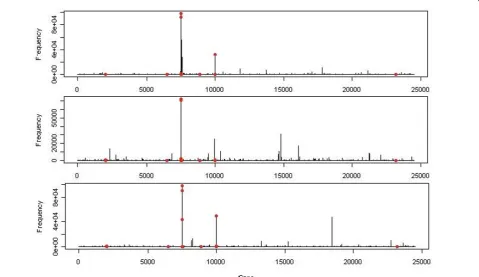
We analyzed Q1 withm= 10. That is, our model space contains all models with 10 active SNP variants. In the prior distribution ofb, we setl= 1 as the effects of the Q1-associated variants in the simulation range from 0.13 to 1.35. We also setΣas an identity matrix to reflect no prior information on how effects of those variants are associated. We ran a MCMC of length 100,000 (after a burn-in run of 1,000) on each replicate and computed the marginal posterior probabilities. To check whether the length of the MCMC was good enough, we ran another independent MCMC of length 100,000 on the first repli-cate. The marginal posterior probabilities estimated from the two chains were highly correlated, suggesting conver-gence at such a length. The marginal posterior probability of the first three replicates is illustrated in Figure 1. The red dots represent SNPs associated with Q1. From Figure 1, one can see that several Q1-associated SNPs consis-tently have high posterior probabilities, but most have low
posterior probabilities and are not detected. In addition, in each replicate, some SNPs that are not associated with Q1 also have high posterior probabilities, which could lead to false positives, but such false positives are largely not repeated in the replicates.
The purpose of factor screening is to select a set of fac-tors for further investigations. Therefore a certain level of false positives can be tolerated. There are in general two ways to make a cutoff. One is to take a certain number of factors from the analysis; the other is to take factors with a certain level of marginal posterior probability. Table 1 shows the list of variants that ever appeared among the top 20 SNPs in 10 replicates and the number of times they appeared. Four SNPs that appeared most frequently were all Q1 SNPs. They are C13S523, C13S522, and C13S524 of FLT1and C4S1884 ofKDR. Ten variants appeared twice in 10 replicates, among which only two are Q1 associated. One hundred fifty-three variants appeared only once, among which only three are Q1 associated. Out of the top 20, we have on average 3.3 Q1 variants per replicate. Overall, 30 of 39 Q1-associated variants never appeared in the top 20 in any of the 10 replicates. However, among the seven Q1 variants with a minor allele frequency (MAF) greater than 0.01, only one (C14S1734 of HIF1A) with an MAF of 0.012195 was never detected in 10 replicates. Among nine Q1 variants
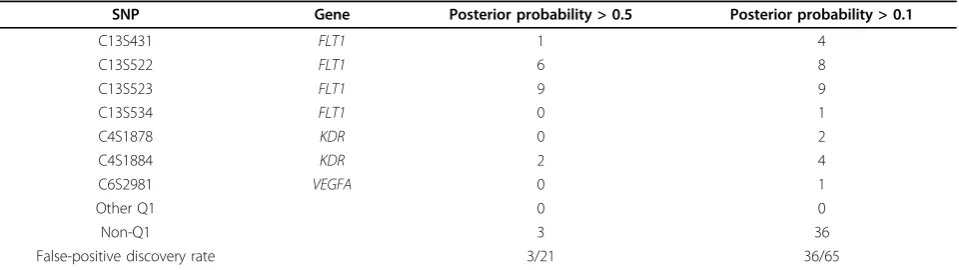
that appeared in the top 20, C6S22981 (VEGFA) has the least MAF, 0.002152, corresponding to three alleles among the 697 subjects. Table 2 lists seven Q1 SNP variants with marginal posterior probabilities larger than 0.1 in any of the 10 replicates, all of which are also listed in Table 1. There are only 3 occurrences of non-Q1 SNPs with a posterior probability greater than 0.5 and 36 occurrences with a posterior probability greater than 0.1. That is, only 0.3 and 3.6 per replicate.
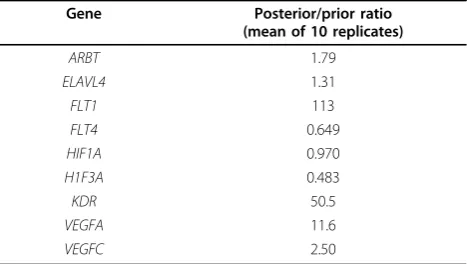
From the results of the analysis at the SNP level, it is also possible to make inferences about the genes by computing the average marginal posterior probability per SNP for the genes. Table 3 shows the ratio between this average marginal posterior probability of the nine Q1-associated genes to the prior probability (which equals 10/24,487). Six out of nine genes had a posterior probability greater than the prior probability, withFLT1 and KDR on average 113 times and 50 times greater, respectively.
Use genes as factors
For the first 10 replicates, we analyze Q1 withm= 3 and m= 6. We run 10,000 iterations of MCMCs after a burn-in period of 1,000. A comparison between the two burn- inde-pendent chains for the first replicate suggests that the marginal posterior probabilities of the individual factors converge at such length. For the prior probability ofb,
we set l = 1, as previously, and set Σas an identity matrix. We also run our analysis with aΣthat imposes a slight correlation (at 0.1) among the effects of variants within a gene. The results are similar and hence are not presented here.
Similar to Table 1, Table 4 lists the genes that ranked in the top 10 marginal posterior probabilities in any of the 10 replicates. We can see that the results atm= 3 andm= 6 are similar. In fact,FLT1always had the high-est marginal posterior probability in all 10 replicates. At m= 3,KDRappeared five times andHIF1AandARNT appeared once. Eighty-one genes not associated with Q1 also appeared, with 79 appearing only once and 2 twice. At m = 6, KDR appeared six times, and HIF1A and VEGFAappeared once. Seventy-eight genes not asso-ciated with Q1 also appeared, with 74 appearing once and 4 twice. To see whether or not our BIC-based adjust-ment of the prior probability was fair, we compared the number of SNPs of those 78 genes with the other 3,118 genes that are not Q1 associated. The number of SNPs per gene is much lower among the 78 genes (3.45) than among the rest of the genes not associated with Q1 (7.73). This suggests that our prior probability assign-ment overcorrects and favors genes that have fewer var-iants. One reason for this could be high correlation between the variants and singularity of some model matrices, making the effective number of parameters less
Table 1 SNPs with high marginal posterior probabilities
Appearances in top 20 SNPs among 10 replicates SNPs (genes),m=10
9 C13S523 (FLT1)
8 C13S522 (FLT1)
5 C13S431 (FLT1)
4 C4S1884 (KDR)
2 C4S1878 (KDR), C6S2981 (VEGFA), 8 SNPsnotassociated with Q1
1 C13S524 (FLT1), C1S6533 (ARNT), C4S1890 (KDR), 151 SNPsnotassociated with Q1
The SNP variants that have posterior probabilities in the top 20, including both Q1-associated SNPs and false positives, are listed. The symbols of Q1-associated variants are given and those not associated with Q1 are omitted. The first column shows the frequency of a variant in the top 20 among 10 replicates.
Table 2 SNPs with high marginal posterior probabilities
SNP Gene Posterior probability > 0.5 Posterior probability > 0.1
C13S431 FLT1 1 4
C13S522 FLT1 6 8
C13S523 FLT1 9 9
C13S534 FLT1 0 1
C4S1878 KDR 0 2
C4S1884 KDR 2 4
C6S2981 VEGFA 0 1
Other Q1 0 0
Non-Q1 3 36
False-positive discovery rate 3/21 36/65
than the number of variants in the model. Better prior probability assignment will be further investigated.
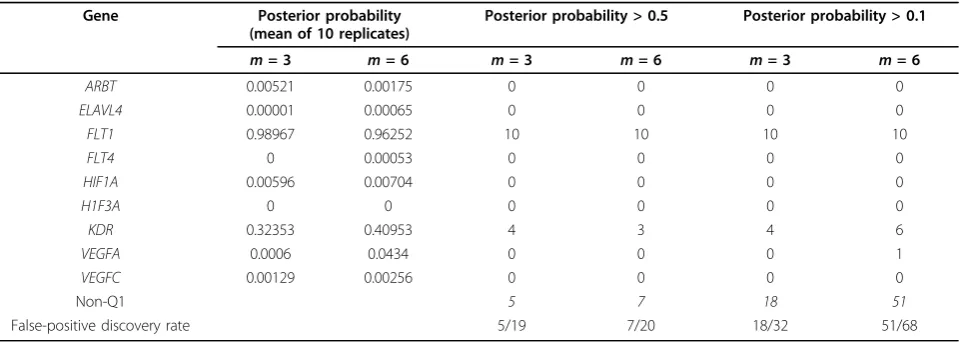
Table 5 shows the marginal posterior probabilities of the nine Q1-associated genes averaged over 10 replicates and the number of times they are greater than 0.5 and 0.1. The marginal posterior probability for FLT1 is almost 1 in every replicate.KDR has an average poster-ior probability greater than 0.32 whenm= 3 and about 0.4 when m = 6. VEGFA is the only other gene that ever has a marginal posterior probability greater than 0.1, which occurs once in 10 replicates. But the number of false positives is also low. Atm= 3, the false-positive discovery rate is 5/19 and 18/32 at the 0.5 and 0.1 cut-offs, respectively. Atm= 6, higher false-positive discov-ery rates are observed at 7/20 and 51/68. We also observe that the posterior probability ofARBTis some-what higher at m = 3 than at m = 6. This could be explained by ARBT having a large number of variants (18 SNPs), and our procedure penalizes genes with many variants more harshly atm= 6 than atm= 3. For the same reason,VEGFA(6 SNPs) andVEGFC (1 SNP) fair better atm= 3 than atm= 6.
Conclusions
We presented a simple method of Bayesian factor screening and applied it to analyze Q1, a quantitative trait simulated to be associated with 39 SNP variants in 9 genes. We applied two implementations: One treats each SNP as a factor; the other treats each gene as a factor. Our computational framework is simple, straight-forward, and efficient. The prior probabilities require few assumptions and are as noninformative as possible. Based on our experience, the results are not sensitive to the choice of l and Σin the prior probability and are not sensitive to the choice ofmwhen SNPs are treated as factors. No biological information was used, except in the second implementation, where we grouped the SNPs of the same gene together.
Our method is quite effective. In the gene-level analysis, when all SNPs in a gene are treated as a group, we are able to identifyFTL1consistently as the top candidate and we find KDRabout half of the time. Beyond these two genes, we are not able to identify other Q1 genes without dramatically increasing our false-positive discovery rate. Our prior probability assignment penalizes models with more parameters and tends to overly favor genes with fewer variants; it requires further adjustment. The false-positive discovery rate tends to increase asmincreases. In the SNP-level analysis, we have a good chance of identify-ing most Q1-associated SNPs with MAF > 0.01, at a rea-sonable false-positive discovery rate. The rarer variants are difficult to identify, even allowing for a high false-positive discovery rate. It might be unreasonable to expect variants with a low MAF to be identified in a sample size of 697 and a low false-positive discovery rate when there are almost 25,000 candidate variants, unless some degree of biological knowledge is used. The inference on genes derived from SNP-level analysis seems reasonable effec-tive, findingFLT1andKDRfrequently. When we take a fixed number of top factors for further investigations, the false discovery rate tends to be high. However, multistage designs can be used to gradually weed out false positives that pass the early rounds, because the chance for them to luck out twice is very low.
Table 3 Average marginal posterior/prior probability ratio per variants for Q1-associated genes
Gene Posterior/prior ratio
For each of the Q1-associated genes, the average marginal posterior probability over all its SNP variants is computed and divided by the average marginal prior probability 10/24,487. The second column lists such ratios averaged over 10 replicates. A higher ratio indicates more importance of the gene.
Table 4 Genes with high marginal posterior probabilities
Appearances in the top 10 genes among 10
replicates m
= 3 m= 6
10 FLT1 FLT1
6 − KDR
5 KDR −
2 Two genesnotassociated with Q1 Four genesnotassociated with Q1
1 ARNT,HIF1A, 79 genesnotassociated with
Q1
HIF1A,VEGFA, 74 genesnotassociated with Q1
Acknowledgments
KP is supported by the National Institutes of Health (NIH) grant
5U01HG005209. The Genetic Analysis Workshop is supported by NIH grant R01 GM031575. The authors would like to thank all participants of Group 1 of GAW17 for their constructive comments and discussions.
This article has been published as part ofBMC ProceedingsVolume 5 Supplement 9, 2011: Genetic Analysis Workshop 17. The full contents of the supplement are available online at http://www.biomedcentral.com/1753-6561/5?issue=S9.
Author details
1
Department of Epidemiology and Population Health, Albert Einstein College of Medicine, 1300 Morris Park Avenue, Bronx, NY 10461, USA.2Seaver Autism Center, Department of Psychiatry, Mount Sinai School of Medicine, Box 1668, One Gustave L. Levy Place, New York, NY 10029, USA.
Authors’contributions
KP and KY draft the manuscript. KP carried out the computational aspect of the work. SY helped in developing the algorithm and provided part of the codes. TW helped on the design of the study. KY conceived, designed and directed the study.
Competing interests
The authors declare that there are no competing interests.
Published: 29 November 2011
References
1. Yoon S:Bayesian factor screening.Ph.D. dissertation, State University of New York at Stony Brook; 2006.
2. 1000 Genomes Project Consortium, Durbin RM, Abecasis GR, Altshuler DL, Auton A, Brooks LD, Durbin RM, Gibbs RA, Hurles ME, McVean GA,et al:A map of human genome variation from population-scale sequencing.
Nature2010,467:1061-1073.
3. Schwarz , Gideon E:Estimating the dimension of a model.Ann Stat1978, 6:461-464.
4. Brown PJ, Vannuci M:Multivariate Bayesian variable selection and prediction.J R Stat Soc B1998,60:627-641.
5. Seber GAF:Multivariate observations.Wiley, New York; 2004, 497-498.
doi:10.1186/1753-6561-5-S9-S4
Cite this article as:Pradhanet al.:Identification of genes and variants associated with quantitative traits using Bayesian factor screening.BMC Proceedings20115(Suppl 9):S4.
Submit your next manuscript to BioMed Central and take full advantage of:
• Convenient online submission
• Thorough peer review
• No space constraints or color figure charges
• Immediate publication on acceptance
• Inclusion in PubMed, CAS, Scopus and Google Scholar
• Research which is freely available for redistribution
Submit your manuscript at www.biomedcentral.com/submit
Table 5 Marginal posterior probability for Q1-associated genes
Gene Posterior probability
(mean of 10 replicates)
Posterior probability > 0.5 Posterior probability > 0.1
m= 3 m= 6 m= 3 m= 6 m= 3 m= 6
ARBT 0.00521 0.00175 0 0 0 0
ELAVL4 0.00001 0.00065 0 0 0 0
FLT1 0.98967 0.96252 10 10 10 10
FLT4 0 0.00053 0 0 0 0
HIF1A 0.00596 0.00704 0 0 0 0
H1F3A 0 0 0 0 0 0
KDR 0.32353 0.40953 4 3 4 6
VEGFA 0.0006 0.0434 0 0 0 1
VEGFC 0.00129 0.00256 0 0 0 0
Non-Q1 5 7 18 51
False-positive discovery rate 5/19 7/20 18/32 51/68