Volume 2007, Article ID 48158,5pages doi:10.1155/2007/48158
Research Article
High Girth Column-Weight-Two LDPC Codes Based on
Distance Graphs
Gabofetswe Malema and Michael Liebelt
School of Electrical and Electronic Engineering, The University of Adelaide, North Terrace, Adelaide 5005, SA, Australia
Received 12 November 2005; Revised 2 September 2006; Accepted 25 October 2006
Recommended by Wolfgang Gerstacker
LDPC codes of column weight of two are constructed from minimal distance graphs or cages. Distance graphs are used to represent LDPC code matrices such that graph vertices that represent rows and edges are columns. The conversion of a distance graph into matrix form produces an adjacency matrix with column weight of two and girth double that of the graph. The number of 1’s in each row (row weight) is equal to the degree of the corresponding vertex. By constructing graphs with different vertex degrees, we can vary the rate of corresponding LDPC code matrices. Cage graphs are used as examples of distance graphs to design codes with different girths and rates. Performance of obtained codes depends on girth and structure of the corresponding distance graphs.
Copyright © 2007 G. Malema and M. Liebelt. This is an open access article distributed under the Creative Commons Attribution License, which permits unrestricted use, distribution, and reproduction in any medium, provided the original work is properly cited.
1. INTRODUCTION
Low-density parity-check (LDPC) codes have been shown to have very good error correcting capability performing close to the Shannon limit [1]. It was also shown in [2] that LDPC codes with column weight j ≥ 3 have a mini-mum distance that grows linearly with code length,N, for given j and row-weightk and that minimum distance for codes with j = 2 grows logarithmically withN. However, column-weight-two codes have shown potential in partial re-sponse channels [3,4]. They also require less computational complexity compared to codes of higher column weights. Performance of LDPC codes depends on several factors in-cluding minimum distance, rate, diameter of graph, code length, and girth (minimum cycle length). There are several methods of constructing column-weight-two LDPC codes, some of which are found in [3–5]. We propose a method for constructing column-weight-two codes with very large girths.
In this paper, we show how column-weight-two LDPC codes can be derived from distance graphs called cages (graphs with minimum number of vertices given vertex de-gree and minimum cycle length in graph). Using already known cage graphs, very high girths codes are obtained com-pared to previous methods. Cage graphs of varying girths and valencies (vertex degrees) could be used to construct LDPC codes over a wide range of girths and rates.
This paper is organized as follows. Section 2 describes LDPC code representation using a nonbipartite graph or row connections. The nonbipartite graphs are in the form of dis-tance graphs.Section 3presents some examples of distance graphs found in literature. Bit error rate performances of some codes were simulated and evaluated. Hardware im-plementation complexity of these codes is also discussed.
Section 4has concluding remarks.
2. GRAPH REPRESENTATION OF LDPC CODES
AnM×NLDPC code matrixH is usually represented by a bipartite or Tanner graph on which one set of vertices repre-sents rows (check nodes) and the other set represent columns (variable nodes). There is an edge between the vertices repre-senting check nodecxand variable nodevyif and only if the corresponding element of the code matrixhxyis set to 1.
1
Figure1: LDPC matrix derived from a distance graph.
distance graphs to form LDPC codes of column-weight-two with each edge representing a column.
Figure 1(a)shows a distance graph of five vertices. Tak-ing each vertex as a row and each edge as a column, a corre-sponding matrix is formed as shown in part (b) of the figure. The matrix is formed by putting a “1” in each of the rows (vertices) that form a column (edge). Vertices 1 to 5 of the graph correspond to rows 1 to 5 in the matrix, respectively. The minimum cycle length in the graph is three. A cycle is formed by a closed path of edges or vertices. A cycle in the graph is formed by moving between vertices or edges. In an LDPC matrix, a cycle is formed by alternatively moving be-tween rows and columns. The graph form represents half of a matrix cycle. Hence, a cycle ofgin the graph is of length 2g in matrix form. A cycle of three, shown in dotted lines inFigure 1, between vertices 1, 2, and 3 in the graph corre-sponds to a cycle of six between rows 1, 2, 3, and columns 1, 2, 5 in matrix form.
The main objective of this paper is to use known distance graphs to construct column-weight-two LDPC codes. Dis-tance graphs of varying vertex degrees and girths produce column-weight-two LDPC codes of different girths and rates. For a graph of sizen, vertex degree ofk, and girth ofg, the corresponding LDPC code matrix is of size n×nk/2, rate 1−(2/k), and girth of 2g.
3. CAGES
A (k,g)-cage is ak-regular graph of girthg with the fewest possible number of vertices. The lower bound (Moore bound) on the number of vertices for a givenk andn de-pends on whethergis odd or even [6,7].
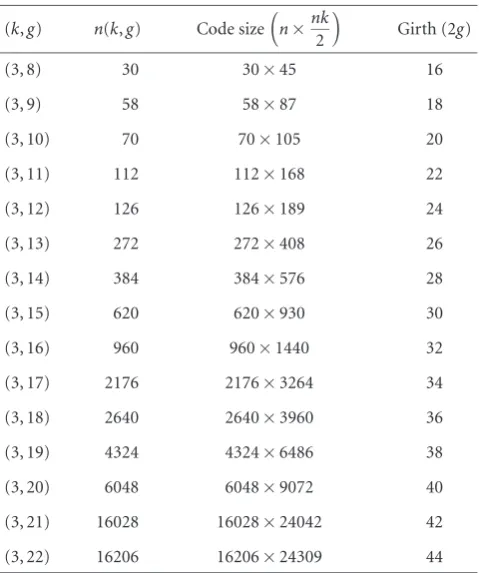
Table1: Sizes of some known cubic cages.
(k,g) n(k,g) Code size
However, these bounds are met very infrequently [8]. Though there is no uniform approach to constructing arbi-trary cages, there are many cages constructed for some vertex degrees and girths. The mathematics behind the construc-tion of cages is beyond the scope of this paper. Examples of cage graphs and construction methods could be found in cited references in this paper. In [9], some methods of gener-ating regular graphs and cages are described. There is also an associated software by the same author at [10] that generates cages.
3.1. Cubic cages
Cages with vertex degree of three are called cubic cages.
Table 1shows the number of vertices for some of the known cubic cages obtained from [11]. Cubic cages construction methods could be found in [6,7,11,12]. These graphs pro-duce an adjacency matrix with girth twice the corresponding graph girth, column weight of two and rate 1/3.
3.2. Cages of higher vertex degrees
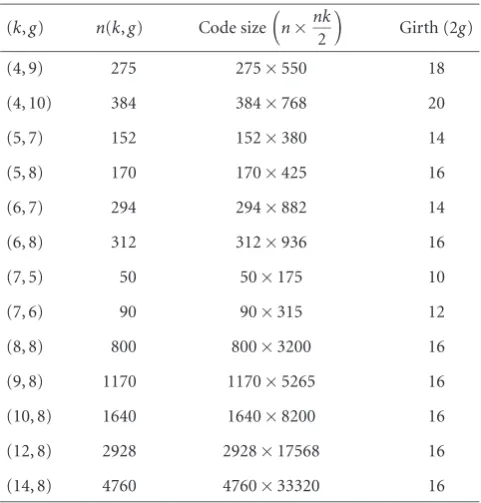
Table2: Some of known cages’ graphs with vertex degree higher
Cyclic column-weight-two codes of girth 12 were con-structed in [4]. The size of the code is given byn=k(k2−k+
1) wherekis the row weight andk−1 is a prime. In [5], two codes with girth 16 and 20 of rates 1/2 and 1/3, respectively, are constructed form graphical models. Both codes have size over 4000. From cage graphs with sizes shown in Tables1and
2, LDPC codes with much high girths could be constructed. The graphs would also produce codes of higher rates. We noted that codes constructed in [4] have the same size as that of (k, 6)-cage graphs. However, using known cages, more codes could be constructed even whenk−1 is not prime.
3.4. Performance simulations
Some cage graphs result in too small codes for practical use. An expansion method is therefore needed to get larger codes. We suggest the expansion method used in [14]. The code ob-tained from a cage graph can be used as a base matrix. Each “0” entry in the matrix is replaced by a p×pzero subma-trix and each “1” entry is replaced by a shiftedp×pidentity submatrix. The expanded code is larger than the base matrix by a factor of pand has girth at least that of the base ma-trix. Using shifted identity submatrices simplifies addressing in hardware implementation. Obtained codes were expanded using the described method in our experiments. The expan-sion factors (p) are shown in brackets in the performance graphs.
Decoding performances of obtained codes was measured using bit-error rate (BER) simulations on AWGN channel with BPSK modulation. Obtained codes show good BER
per-10 7
Figure2: BER performances of high girth LDPC codes from dis-tance graphs (25 iterations).
formances approaching BER of 10−6between 5 and 6 dB for
some codes.Figure 2shows performance curves for codes de-rived from (3, 17), (4, 9), and (4, 10) cage graphs. The codes from (4, 9) and (4, 10) cages are expanded by 8 and 4, re-spectively. The codes perform better than a random code free of four cycles. The (3, 17)-cage LDPC code has the best per-formance which could be attributed to its large girth of 34.
Figure 3shows performances of codes with higher rates de-rived from a family of (k, 5) cages. Both codes are expanded by a factor of 2. The code from the (12, 5) cage performs bet-ter than that from the (11, 5) cage and a random code of about the same size free of four cycles. Though the (11, 5) cage code has lower rate and same girth as the (12, 5)-cage, its performance is the worst. Performance differences between (12, 5) and (11, 5) cages may be attributed to structural dif-ferences of the graphs.
3.5. Hardware implementation
Codes obtained from cage graphs have low implementation complexity in that they are structured and have only two entries per column. However, not all structured codes are easily implementable. It is therefore important to study the structure of each graph to best exploit it for implementation. Cage graphs differ in construction methods and structure.
10 7
Figure3: BER performances of (k, 5) cage codes (25 iterations).
1 2 ing reduces the interconnect complexity between processing nodes. There are fewer groups than individual columns or rows. The number of interconnections and destinations is re-duced. Addressing within a group is also simplified. With one known row-column connection in submatrix, the rest of the submatrix connections could be deduced.
Column-weight-two codes also have reduced number of elements in the code matrix. This results in less computa-tions and memory requirements. The variable node (col-umn) computation involves the summation of the incoming messages and the channel estimate of the information bit. With two incoming messages, the computation is reduced to exchanging incoming messages and adding them to the chan-nel estimation before sending them as outgoing messages.
100000 100000 100000 100000 100000 100000 010000 010000 010000 010000 010000 010000 001000 001000 001000 001000 001000 001000 000100 000100 000100 000100 000100 000100 000010 000010 000010 000010 000010 000010 000001 000001 000001 000001 000001 000001
100000 000001 000010 000100 001000 010000 010000 100000 000001 000010 000100 001000 001000 010000 100000 000001 000010 000100 000100 001000 010000 100000 000001 000010 000010 000100 001000 010000 100000 000001 000001 000010 000100 001000 010000 100000
Figure5: Matrix representation of a (6, 4) cage graph.
4. CONCLUSIONS
An approach for constructing LDPC codes with column weight of two has been described. Cage graphs are used to represent the code matrix, where vertices are rows and edges are columns. From known cage graphs, codes with very high girths and rates could be constructed. Some derived codes have good bit error rates compared to random codes. However, performance of each code depends on the structure of individual cage graphs from which the codes are derived.
REFERENCES
[1] S.-Y. Chung, G. D. Forney Jr., T. J. Richardson, and R. Ur-banke, “On the design of low-density parity-check codes within 0.0045 dB of the Shannon limit,”IEEE Communications Letters, vol. 5, no. 2, pp. 58–60, 2001.
[2] R. G. Gallager, “Low-density parity-check codes,”IRE Trans-actions on Information Theory, vol. 8, no. 1, pp. 21–28, 1962. [3] H. Song, J. Liu, and B. V. K. Vijaya Kumar, “Low
complex-ity LDPC codes for partial response channels,” in Proceed-ings of IEEE Global Telecommunications Conference (GLOBE-COM ’02), vol. 2, pp. 1294–1299, Taipei, Taiwan, November 2002.
[4] H. Song, J. Liu, and B. V. K. Vijaya Kumar, “Large girth cy-cle codes for partial response channels,”IEEE Transactions on Magnetics, vol. 40, no. 4, part 2, pp. 3084–3086, 2004. [5] J. M. F. Moura, J. Lu, and H. Zhang, “Structured low-density
parity-check codes,”IEEE Signal Processing Magazine, vol. 21, no. 1, pp. 42–55, 2004.
[6] N. Biggs, “Cubic graphs with large girth,” inProcessdings of the 3rd International Conference on Combinatorial Mathemat-ics, pp. 56–62, New York, NY, USA, June 1989.
[7] G. Exoo, “A simple method for constructing small cubic graphs of girths 14, 15, and 16,”Electronic Journal of Combi-natorics, vol. 3, no. 1, pp. 1–3, 1996.
[8] P. Wong, “Cages—a survey,”Journal of Graph Theory, vol. 6, pp. 1–22, 1982.
[9] M. Meringer, “Fast generation of regular graphs and construc-tion of cages,”Journal of Graph Theory, vol. 30, no. 2, pp. 137– 146, 1999.
[10] M. Meringer,Genreg-download manual,http://www.mathe2. unibayreuth.de/markus/genreg.html.
[12] N. Biggs, “Constructions for cubic graphs with large girth,” Electronic Journal of Combinatorics, vol. 5, no. 1, 1998. [13] E. Weisstein, “Cage graph,” From MathWorld-A Wolfram Web
Resource, http://www.mathworld.wolfram.com/CageGraph. html.