We present a novel mechanical model for the extraction of outer core material upwards across the CMB into the mantle side region of Dand subsequent interaction with the post-perovskite (ppv) phase transition. A strong requirement of the model is that the D region behaves as a poro-viscoelastic granular material with dilatant properties. Using new ab-initio estimates of the ppv shear modulus, we show how shear-enhanced dilation promoted by downwelling mantle sets up an instability that drives local fluid flow. If loading rates locally exceed c. 10−12s−1, calculated core metal upwelling rates are>10−4m/s, far in excess of previous estimates based on static percolation or capillary flow. Associated mass flux rates are sufficient to deliver 0.5% outer core mass to D in<106yr, provided the minimum required loading rate is maintained. Core metal transported upwards into D may cause local rapid changes in electrical and thermal conductivity and rheology that if preserved, may account for some of the observed small wavelength heterogeneties (e.g. PKP scattering) there.
Key words:Post-perovskite, dilatancy, D, core metal transport, strain rate, deformation.
1.
Introduction
The extent and mechanisms by which material from the earth’s liquid outer core interacts with overlying lower mantle is currently unresolved and controversial. Re-cent 187Os/188Os isotopic models (Brandon et al., 2003) and Fe/Mn ratios (Humayun et al., 2004) suggest that the Hawaiian plume may have sampled c. 0.5% core material, inherited from a thermal or Fe-enriched chemical boundary layer at the core-mantle interface. This picture appears con-sistent with the recent discovery of a post-perovskite (ppv) silicate in the Dlayer whose phase transition is more sen-sitive to composition (Fe content) than pressure (Murakami et al., 2004; Maoet al., 2004) but inconsistent with W-Hf isotope data, also from Hawaii and apparently contradicting the hypothesis that evidence of core-mantle interaction is preserved in surface rocks (Scherstenet al., 2004). Clearly, the absence of a detectable core component in erupted mag-mas is not in itself evidence against core-mantle interac-tion, the most obvious expression of which is heat trans-fer (e.g. Gibbons and Gubbins, 2000; Olson, 2003). How-ever, Dis also a mechanical boundary layer capable of de-forming (e.g. Garnero, 2000). The strain-field measured by seismic methods has revealed a detectable anisotropy due to the alignment of crystals or lateral changes in material (elastic) properties (Karato, 1998), while numerical simu-lations show that large strain deformation can accumulate at high stresses along the core mantle boundary (CMB) in
Copy right cThe Society of Geomagnetism and Earth, Planetary and Space Sci-ences (SGEPSS); The Seismological Society of Japan; The Volcanological Society of Japan; The Geodetic Society of Japan; The Japanese Society for Planetary Sci-ences; TERRAPUB.
the region of downwelling slab material (McNamaraet al., 2002). In addition, seismic data further suggest the pres-ence of a silicate melt fraction at Din the range c. 6–30% (Garnero, 2000). The latter can be explained by in-situ par-tial melting of perovskite (Layet al., 2004). However, den-sity arguments make emplacing outer core material into D via buoyancy fluxing problematic, and quantification of the material transfer process(es) responsible remain speculative (Stevenson, 2003).
Motivated by the challenge of providing a physical mech-anism of material transfer across the CMB, we have under-taken a set of zeroth order calculations that derive estimates of the pressure changes and subsequent fluid flow rates rel-evant to a deformable poro-viscoelastic matrix as a func-tion of applied shearing stress. In this purely mechanical model, we argue that episodic, high deformation rates at the CMB, and the presence of core liquid metal in Dmay be intimately coupled, with mass and heat transfer across the interface driven by downwelling of more dense material from higher levels in the mantle. The macroscopic part of the problem has been modelled successfully in recent large scale numerical simulations of whole mantle flow (Kellogg et al., 1999; McNamara et al., 2002), and the deforma-tion effects arising from this are summarised elegantly by Karato (1998). Our approach combines a microscale, shear-dilatancy sensitive material deformation model for the solid component of Didealised to a set of constant moduli to simplify the analytical solutions (Koenders and Petford, 2000), coupled to the macroscale dynamics. A comparable microscale formalism for two-phase flow with Maxwellian viscoelastic rheology in the upper mantle has been
460 N. PETFORDet al.: SHEAR-INDUCED MATERIAL TRANSFER ACROSS THE CORE-MANTLE BOUNDARY
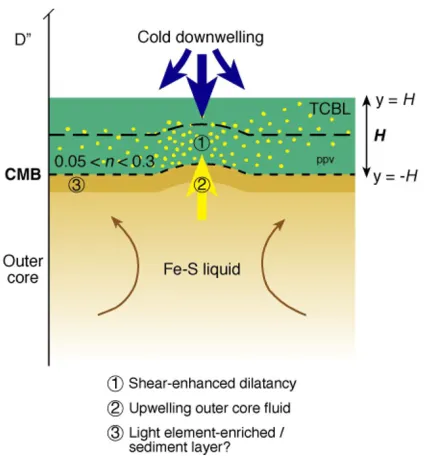
Fig. 1. Diagram showing the simplified geometry of a thermal and chem-ical boundary layer (TCBL) of thickness H undergoing loading by downwelling dense material (blue arrows), inspired by Kellogget al. (1999), and Karato (1998). Three zones are identified: (1) region of shear-enhanced (poroviscoelastic) dilatancy, (2) upwelling outer core fluid shown as yellow arrow, and (3) Compositionally buoyant upper layer of uncertain thickness and extent that may contain sediments (Buf-fettet al., 2000; Alfeet al., 2002). The thermal effect of upwelling core material on the positioning of the pv-ppv phase bounary is approximated by the upper dashed line.
oped recently (Vasilyev et al., 1998), and we expect the Deborah number (De), which measures the importance of elasticity in this phenomenon, to be of order 1 or greater in the Dlayer. For reasons outlined below, knowledge of the shear modulus (G) of the new post perovskite phase is most helpful in this respect.
Previous numerical simulations of Dsuggest that dense material, concentrated in regions of downwelling, can also be entrained in upwellings. The result is to impose a to-pography on Dthat is steep and of large amplitude, and whose structure is most likely coupled to the overlying man-tle (Loper and Lay, 1995; Olson, 2003). As discussed in more detail below, calculated core fluid upwelling velocities scale with the rate of deformation, and because the problem is phrased in terms of shear strain rates are independent of key intensive fluid (Fe metal alloy) properties.
2.
Analysis
Our analysis is based on a material deformation model of the linear-elastic, isotropic relations first proposed by Biot (1941), but modified to include the effects of dilatancy un-der deviatoric (pure shearing) motion. Details of the model, including full analytical solutions to the governing differ-ential equations, are given in Koenders and Petford (2000) and Petford and Koenders (2003) and not repeated in de-tail here. A key feature of this analysis is the coupling of pure shearing stress to volumetric strain, so that the modi-fied Biot equation captures many important parameters rel-evant to deforming porous layers including the average melt displacement, melt (fluid) pressure, permeability and the set
Fig. 2. Plot showing post-perovskite shear modulus (G) as a function of temperature corresponding to a pressure of 136 GPa, calculated using a molecular dynamicsab-initioapproach (Stackhouse et al., 2005). The estimated temperature interval in the region of the CMB is shown (shaded) for reference.
of general moduli of the solid framework. Although the lat-ter are a source of error due to uncertainties in mantle rhe-ology at appropriate pressures and temperatures (Mitrovica and Forte, 2004), molecular dynamics simulations of the newly discovered post-perovskite phase (Oganov and Ono, 2004; Tsuchiyaet al., 2004; Stackhouse et al., 2005) en-able estimates of some key material properties of a ppv-dominated lower mantle, specifically the bulk and shear moduli as a function of temperature, to be made with some degree of confidence. The dilatancy instability which drives fluid flow by reducing the local intergranular pressure, re-quires a porosity field as an initial condition. This is pro-vided by a background silicate melt fraction of up to 30%, located in discrete regions of high heat flow close to the CMB, and responsible for observed heterogeneity in seis-mic velocity there (Garnero, 2000; Layet al., 2004). The porous matrix is assumed to be granular in nature so that external deformation results in a dilatant effect that can be captured mathematically. Biot’s equation for the consoli-dation of compressible fluid flow in a porous material with position-dependent permeability takes the form
∂ ∂y
k(y)∂p ∂y
=nβ∂p ∂t +
∂v˙
∂y (1) wheren is the porosity andβ is the fluid compressibility. The permeability is assumed constant, and depends on the granular (ppv) length scaled, outer core fluid viscosity (η) and the melt fraction. The total stress isσi j =σi j −pδi j,
where pis the excess pore pressure andσi j is the skeletal
stress (Terzaghi, 1943). The vertical coordinate isy, the two horizontal coordinates arexandz. The stress equilibrium requires that∂σi j/∂xi j =0, which for a problem that does
not depend onxandzresults inσx y =c(t)andσyy −p=
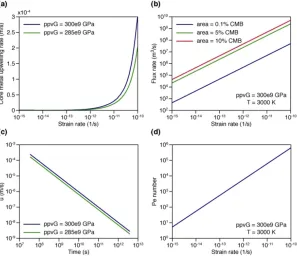
Fig. 3. (a) Calculated core liquid metal flow rates (m/s) as a function of strain rate assuming a ppv shear modulus of 300 and 285 GPa (3000<T<4000 K, cf. Fig. 1). The strain rate interval relevant to the problem lies in the region 10−15<e˙<10−10s. Note that flow of outer core material into Dwill
only be active while loading is constant. Relaxation to strain rates<10−12s−1will slow the rate of flow considerably, or even prevent it altogether.
(b) Volumetric flux rate (m3/s) into Das a function of loading rate for three cross sectional areas of the core mantle boundary corresponding to 0.1, 5 and 10% of the total surface area. (c). Transport (residence) time of core fluid in a 10 km deep mantle layer overlying the CMB for two values of the ppv shear modulusG. (d). Thermal Peclet number (Pe=u H/κ) whereuis the average fluid flow velocity andκis the thermal diffusivity of liquid Fe at 1673 K (5.7×10⁻⁶m2s).Pe>>1 wheree˙10−13s−1.
As the thickness of Dis variable, for simplicity we define a zone within Dof height H, where the behaviour of the top and bottom zones are represented by suitable boundary conditions (Fig. 1). These are an impermeable top layer (∂p/∂y = 0) and a permeable (fluid) base, corresponding to the core-mantle interface where no excess pore pressure is expected.
Fluid flow accompanying the dilatancy effect in uncon-solidated, densely packed granular material is independent of fluid density (see Reynolds, 1885; Rowe, 1962). Our hypothesis rests on the assumption that dilatancy can oper-ate in a broadly similar way in the deep earth in regions of elevated background porosity (melt fraction). In this respect it is relatively controversial. The attraction how-ever is that Reynolds dilatancy provides a plausible mech-anism, grounded in standard physics, capable of modifying locally the stable density gradient that defines the CMB re-gion. A shear-enhanced melt migration model also over-comes problems relating to percolation of Fe-liquid metal through a silicate matrix constrained by high dihedral an-gles (Rushmeret al., 2000; Bruhnet al., 2000; Terasakiet al., 2005). Experimental evidence for the shear-enhanced mobility of liquid metal (although not at the required PT conditions), comes from rock deformation studies on natu-ral Fe-bearing H-chondrites loaded at laboratory strain rates (c. 10−5s−1) where a dilation effect is observed, causing partially molten liquid metal to flow into sites of low pres-sure (Rushmer et al., 2005). Clearly any model of fluid transfer between the outer core and Dbased on buoyancy forces alone (e.g. McKenzie, 1984),wouldneed significant
modification (Kanda and Stevenson, 2004).
2.1 Time constants and flow rates
Typical values for the time constant of the process are now estimated. The maximum value of the pressure at the top of the region is obtained att =t∗H2(1+nβθ) / (θk). The stiffness θ is the dilatant modulus for the densely packed ppv granular layer, currently a poorly known quan-tity, and taken in the range 109−1010Pa. The lengthscale H under investigation is of the order 10 km, chosen to cor-respond with the lower end of wavelength scattering (e.g. the range in smallest scale heterogeneities) observed seis-mically at the CMB (Garnero, 2000). Taking a mean ppv grain size of 1 mm in the vicinity of the CMB gives a char-acteristic timescale of the problem of some 102−104yrs. Note that the time constant of the problem is independent of the shear ratec˙0.
The flow rate at the end (the steady state) of the process in the vicinity ofy = H/2 (Fig. 1) is now considered (the short time solution is given in Koenders and Petford, 2000). The outcome is
t → ∞:k∂p ∂y =
−H Rc˙0
2θ =
−H Ge˙
θ (2)
462 N. PETFORDet al.: SHEAR-INDUCED MATERIAL TRANSFER ACROSS THE CORE-MANTLE BOUNDARY
Fig. 4. Plot showing mass flux rate (ρ=104kg/m3) as a function of loading rate interval and area of CMB deformed (defined arbitrarily as 0.1 to 10%
total CMB surface area). Mass flux rates during constant loading wherePe>>1 are in excess of 1011kg/s.
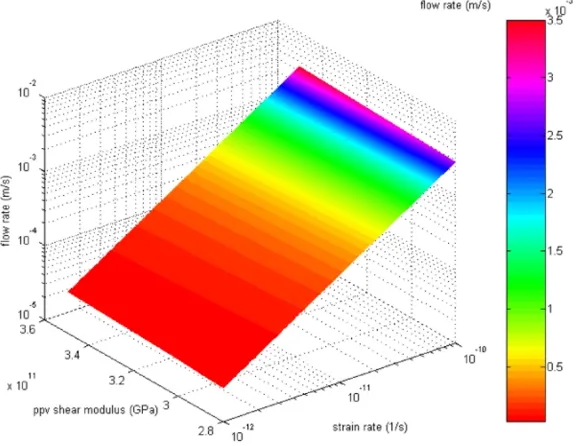
Fig. 5. Plot showing the effect of changing ppv shear modulus (G) on average upwelling flow velocity. The rate of flow appears relatively insensitive to the precise value ofG.
the CMB (P =136 GPa) the calculated ppv shear modulus ranges from 285 GPa (T = 4000 K) to 300 GPa atT = 3000 K (Stackhouseet al., 2005). These values are used to inform the analytical calculations that follow.
3.
Results
Specimen calculations that illustrate the consequences of dilational instability and explore the sensitivity of outer core fluid upwelling over a strain rate interval 10−15 < e˙ < 10−10 s−1 are now given. The lower limit is characteris-tic of background mantle convection (Turcotte and Schu-bert, 2002), while the upper limit corresponds to a total strain in layer thickness H of 10% in 10 years. Figure 3 summarises the results of several calculations aimed at
de-termining order of magnitude flow and mass flux rates of upwelling outer core liquid across the CMB in response to deformation-driven dilatancy in D. The flow rate cal-culations are shown for two values of the post-perovskite shear modulus that correspond to a temperature difference of 1000 K at constant pressure (136 GPa).
scale characteristic of the observed small scale geophysi-cal heterogeneity in D(Garnero, 2000). Outer core mate-rial could in principle be transported this distance in 102to 103 years provided loading remains constant ate˙= 10−12 s−1. If higher rates of strain (10−10 s−1) can be achieved, transport times are of the order 108 s (several years). We do emphasise however that these results are tentative and should be treated accordingly. Indeed, an important aspect of the infiltration process not considered in detail here are thermal effects, in particular the possibility that liquid core metal will freeze during upwards flow. A crude analysis of the thermal regime is shown in Fig. 3(d), where the ther-mal Peclet number (Pe) is plotted against strain rate. For plate tectonic loading rates, Peis close to 1, and does not significantly exceed unity until strain rates exceed c. 10−12 s−1.
The corresponding mass flux can also be estimated, as-suming a constant value for the liquid metal density. Re-sults are summarised in Fig. 4, which shows the changing mass flux as a function of loading rate and CMB area de-formed. For example, provided flow is continuous (itself a major assumption), a mass flux rate of 1011 kg/s, corre-sponding to a strain rate of order 10−12 s−1 andPe >> 1 would in principle deliver 0.5% outer core material by mass into the lowermost mantle, a requirement based on geo-chemical arguments (Brandon et al., 2003), in << 106 yrs. Clearly the flux rate is sensitive to the cross sectional area and strain rate, (although relatively insensitive to exact value of the ppv shear modulus, Fig. 5), and could vary by several orders of magnitude around this value. Cessation of loading might prolong the process indefinitely. The point is made however, that the viscoelastic dilatancy instability, while sustained, offers a means of transporting substantial amounts of material across the CMB on geologically very short timescales.
4.
Discussion
While acknowledging that further experimental and com-putational mineral physics work is needed to constrain and test the validity of the proposed dilatancy mechanism, a strong feature of the model as it stands is that a dynamic coupling between the liquid outer core and overlying low-ermost mantle is a necessary (albeit transient) condition. Here, the lower mantle responds on the microscale (char-acteristic lengthscale mm to m), to macroscopic convective motions (characteristic lengthscale>>km). This contrasts
large scale mantle flow processes with recent geochemical observations for core-mantle interactions (e.g. Humayunet al., 2004). Secondly, given the strong dependence of the post-perovskite phase transition on composition, periodic excursions of infiltrating Fe-rich fluid from the uppermost outer core into the lowermost mantle, possibly enriched in incompatible elements (Alfeet al., 2002), may have pro-foundly affected the positioning of this transition over time. For example, Fe can stabilise the ppv structure at pressures of c. 10 to 20 GPa lower than the pure MgSiO3end member for a given CMB temperature (Maoet al., 2004), with the estimated drop in inversion temperature along an isotherm of c.−1 GPa per 1 mol% Fe. Charged coupled substitutions analogous to those described for Mg-perovskite (Walteret al., 2004) may also help to modify the chemical potential of Dclose to the CMB. Large amounts of Fe may be re-sponsible for ultra low velocity zones (Mao et al., 2004), although other mechanisms related to topography such as sedimentation in CMB basins should not be ruled out (Buf-fett et al., 2000; Olson, 2003). In this case, the analogy between sedimentary ULVZs and the granular deformation model proposed here is striking and worthy of further in-vestigation. Indeed, the dilatant effect may be more pro-nounced in outer core sediments, should they exist, than in the overlying silicate mantle.
Even if upwelling core metal does not install a surface measurable, radiogenic isotopic potential in D, it is likely to produce a rheological effect that could influence the elas-tic properties of ppv and produce changes in electrical and thermal conductivity (Manga and Jeanloz, 1996). In par-ticular, trapping by surface tension effects of pockets of isolated, immiscible core melt as the loading event wanes, provides a both a mechanism and resulting geometry to ac-count for the intense small-scale heterogeneity (large PKP precursors) at the CMB in addition to any seismic hetero-geneity and anisotropy due to ferromagnesian ppv silicate (e.g. Tsuchiyaet al., 2004). Finally, we emphasise that the ppv phase transition itself will aid the extraction mechanism due to stress changes related to negative volumetric changes in downwelling regions and positive (expansive) changes during upwelling. Critically, no similar phase transitions occur in the lithosphere or upper mantle.
464 N. PETFORDet al.: SHEAR-INDUCED MATERIAL TRANSFER ACROSS THE CORE-MANTLE BOUNDARY
helpful comments. NP thanks the University of Vermont for a visiting scholarship. TR thanks NASA (grant NAGS-10463) for supporting the deformation study of the Kernouve meteorite.
References
Alfe, D., G. D. Price, and M. J. Gillan, Composition and temperature of the Earth’s core constrained by combining ab initio calculations and seismic data,Earth Planet. Sci. Lett.,195, 91–98, 2002.
Biot, M. A., General theory of three dimensional consolidation,J. Appl. Phys.,12, 155–164, 1941.
Brandon, A. D., R. J. Walker, I. S. Puchtel, H. Becker, M. Humayun, and S. Revillon,186Os-187Os systematics of Gorgona Island komatiites: Implications for early growth of the inner core,Earth Planet. Sci. Lett., 206, 411–426, 2003.
Buffett, B. A., E. J. Garnero, and R. Jeanolz, Sediments at the top of the Earth’s core,Science,290, 1338–1342, 2000.
Bruhn, D., N. Groebner, and D. L. Kohlstedt, An interconnected network of core-forming melts produced by shear deformation,Nature,403, 883–886, 2000.
Garnero, E. J., Heterogeneities in the lowermost mantle,Annu. Rev. Earth Planet Sci.28, 509–537, 2000.
Gibbons, S. J. and D. Gubbins, Convection in the Earth’s core driven by lateral variations in the core-mantle boundary heat flux,Geophys. J. Int., 142, 631–642, 2000.
Humayun, M., L. Qin, and M. D. Norman, Geochemical evidence for excess iron in the mantle beneath Hawaii,Science,306, 91–94, 2004. Kanda, R. V. and D. J. Stevenson, A suction mechanism for iron
entrain-ment from the outer core into the lower mantle,EOS Trans AGU,85, Fall Meet. Suppl., MR43A-0880, 2004.
Karato, S., Seismic anisotropy in the deep mantle, boundary layers and the geometry of mantle,Pure and Applied. Geophys.,151, 565–587, 1998. Kellogg, L. H., B. H. Hager, and R. D. van der Hilst, Compositional
stratification in the deep mantle,Science,283, 1881–1884, 1999. Koenders, M. A. and N. Petford, Quantitative analysis and scaling of
sheared granitic magmas,Geophys. Res. Lett.,27, 1231–4, 2000. Lay, T., E. J. Garnero, and Q. Williams, Partial melting in a
thermo-chemical boundary layer at the base of the mantle,Phys. Earth. Planet. Interior,146, 441–467, 2004.
Loper, D. E. and T. Lay, The core-mantle boundary region,J. Geophys. Res.,100, 6397–6420, 1995.
Manga, M. and R. Jeanloz, Implications of a metal-bearing chemical boundary layer in D for mantle dynamics,Geophys. Res. Lett.,23, 3091–3094, 1996.
Mao, W., G. Shen, V. Prakapenka, Y. Meng, A. Campbell, D. Heinz, J. Shu, R. Hemley, and H. K. Mao, Ferromagnesian postperovskite silicates in the D layer of the earth,Proc. Natl. Acad. Sci.,101, 15867–15869, 2004.
McKenzie, D., The generation and compaction of partially molten rock,J. Petrol.,25, 713–765, 1984.
McNamara, A. K., P. E. van Keken, and S. Karato, Development of anisotropic structure in the Earth’s lower mantle by solid-state convec-tion,Nature,416, 310–314, 2002.
Mitrovica, J. X. and A. M. Forte, A new inference of mantle viscosity based upon joint inversion of convection and glacial isostatic adjustment data,Earth Planet. Sci. Lett.,225, 177–189, 2004.
Murakami, M., K. Hiorse, K. Kawamura, N. Sata, and Y. Ohishi, Post-perovskite phase transition in MgSiO3,Science,304, 855–858, 2004.
Oganov, A. R. and S. Ono, Theoretical and experimental evidence for a post-perovskite phase of MgSiO3in Earth’s Dlayer,Nature,430, 445–
448, 2004.
Olson, P., Thermal interaction of the core and mantle, inEarth’s Core and Lower Mantle, edited by C. A. Jones, A. M. Soward, and K. Zhang, pp. 1–29, Taylor and Francis, London, 2003.
Petford, N. and M. A. Koenders, Shear-induced pressure changes and seepage phenomena in a deforming porous layer-I,Geophys. J. Int.155, 857–869, 2003.
Poirier, Core-infiltrated mantle and the nature of the Dlayer,J. Geomag. Geoelectr.,45, 1221–1227, 1995.
Reynolds, O., On the dilatancy of media composed of rigid particles in contact,Phil. Mag.,20, 469–481, 1885.
Rowe, P. W., The stress dilatancy of media composed of rigid particles in contact, with experimental illustrations.Proc. R. Soc. London,269, 500–527, 1962.
Ringwood, A. E., On the chemical evolution and densities of the planets, Geochimica et Cosmochimica Acta,15, 257–283, 1959.
Rushmer, T., W. G. Minarik, and G. I. Taylor, Physical processes of core formation, inOrigin of the Earth and Moon, edited by K. Righter and R. Canup, pp. 227–245, Lunar Planetary Institute and University of Arizona Publishers, 2000.
Rushmer, T., N. Petford, and H. Humayun, Shear-induced segregation of Fe-liquid in planetesimals: coupling core forming compositions with transport phenomena,Lunar and Planetary Science XXXV1,1320, Hus-ton, 2005.
Schersten, A., T. Elliott, C. Hawkesworth, and M. Norman, Tungsten isotope evidence that mantle plumes contain no contribution from the Earth’s core,Nature,427, 234–237, 2004.
Stackhouse, S., J. P. Brodholt, J. Wookey, J-M. Kendall, and D. Price, The effect of temperature on the seismic anisotropy of the perovskite and post-perovskite polymorphs of MgSiO3,Earth Planet. Sci. Lett.,230,
1–10, 2005.
Stevenson, D., Material transfer across the core-mantle boundary, Geo-phys. Res. Abstracts,5, 03290, 2003.
Terasaki, H., D. J. Frost, D. C. Rubie, and F. Langenhorst, The effect of oxygen and sulphur on the dihedral angle between Fe-O-S melt and silicate minerals at high presure: Implications for Martian core formation,Earth Planet. Sci. Lett., 2005 (in press).
Terzaghi, K.,Theoretical Soil Mechanics, John Wiley and Sons, New York, 528 pp., 1943.
Tsuchiya, T., J. Tsuchiya, K. Umemoto, and R. M. Wentzcovitch, Phase transition in MgSiO3 perovskite in the Earth’s lower mantle, Earth
Planet. Sci. Lett.,224, 241–248, 2004.
Turcotte, D. L. and G. Schubert,Geodynamics: Applications of Continuum Physics to Geological Problems(2nd Edition), Cambridge University Press, 456 pp., 2002.
Vasilyev, O. V., Y. Y. Podladchikov, and D. A. Yuen, Modeling of com-paction driven flow in poro-viscoelastic medium using adaptive wavelet collocation method,Geophys. Res. Lett.,25, 3239–3243, 1998. Walter, M. J., A. Kubo, T. Yoshino, J. Brodholt, K. T. Koga, and Y.
Ohishi, Phase relations and equation-of-state of aluminous Mg-silicate perovskite and implications for Earth’s lower mantle,Earth Planet Sci. Lett.,222, 501–516, 2004.