Universal Dependencies for Ainu
Hajime Senuma
†‡
, Akiko Aizawa
‡†
†University of Tokyo,‡National Institute of Informatics{senuma, aizawa}@nii.ac.jp
Abstract
This paper reports an on-going effort to create a dependency tree bank for the Ainu language in the scheme of Universal Dependencies (UD). The task is crucial both language-internally (language revitalization) and language-externally (providing sources for new features and insights to UD). Since the language shows many of the representative phenomena of a type of languages called polysynthetic languages, an annotation schema to Ainu can be used as a basis to extend the current specification of UD. Our language resource comprises an annotation guideline, dependency bank based on UD, and a mini-lexicon. Although the size of the dependency bank will be small and contain only around 10,000 word tokens, it can serve as a base annotation for the next step. Our mini-lexicon is encoded under the W3C OntoLex specification with UD and UniMorph (UM) features with the system-friendly JSON-LD format and thus bearable to future extensions. We also provide a brief description of dependency relations and local features used in the bank such as pronominal cross-indexing and alienability.
1.
Introduction
The project of Universal Dependencies (UD) (Nivre et al., 2016) marks a milestone in the history of natural lan-guage processing (NLP), as it unifies syntactic annota-tion schemes across languages/corpora and enables cross-lingual processing. At the CoNLL Shared Task 2017 for UD, 33 teams participated in the task, proving that the com-munity is quickly thriving (Zeman et al., 2017).
We are currently working on the UD annotation scheme and corpus of Ainu, a language spoken by the Ainu people, an ethnic minority in Japan. A part of the work was presented elsewhere (Senuma and Aizawa, 2017). The task aims to tackle two purposes:
1. to promote the language revitalization of Ainu, as it is a highly endangered language but has a rich amount of the records of oral literature, and
2. to serve as a basis to test if universal specifications in NLP such as UD and UniMorph (UM) (Sylak-Glassman, 2016) can encode the world’s languages.
The first issue is urgent because Ethnologue classifies the languages as nearly extinct (Lewis et al., 2016), and scholars have been alerting the status of language usages (DeChicchis, 1995; Sato, 2012). To mitigate the situation, Bugaeva (2011) created a freely-accessible Ainu dictionary for daily conversation based on the old dictionary published in 1898 by Kotora Jimb¯o and Sh¯ozaburo Kanazawa. Our work will be in line of these movements.
Whereas the first motivation is language-internal, the sec-ond motivation is external, as it contributes to our deep understanding of natural languages. Being a member of polysynthetic languages (Baker, 1996), the language ex-hibits many peculiar properties from the view point of the speakers of major languages. Complex verb forma-tion rules called noun incorporaforma-tion (Mithun, 1984) may be the hallmark of such properties. Other properties (some of which will be discussed later) include pluractionality, possessed case, alienability, and multiple pronominal mark-ers. These “peculiar” properties are, however, actually very common in world’s languages, if we look at typological
data such as WALS Online (Dryer and Haspelmath, 2013). Through the examination of annotating Ainu, it may be pos-sible to be used to extend the current specifications of NLP including UD.
2.
Dataset and System Description
We are currently working on the annotation of a collection of traditional Ainu songsAinu Shin’y¯osh¯u, transcribed by Yukie Chiri into latin scripts, including Japanese transla-tions by herself (Chiri, 1923). We also consulted the work of (Kirikae, 2003), which retranscribed Yukie Chiri’s writ-ing into one close to modern orthographic system and ap-pended a lexicon for all words appeared in the text. The work consists of thirteen mythological songs in the style ofkamuyyukartype poetry, typical in the Ainu oral litera-ture. Since the work is the most famous Ainu literature, dis-tributing resources to read it in the open format will be use-ful for language revitalization. Furthermore, Ainu poetry is usually told byatomte itak“Adorned Speech”, a variant of Ainu which has more polysynthetic nature than yayan itak“Common Speech”, so it serves as a good resource to expand the inventory of UD and UM.
At this stage, the annotation process has been mainly done by the first author alone, since it is experimental and re-quires the quality of linguistic efforts rather than the quan-tity of human power. Although the annotation process is behind schedule, but we plan to release the data set until camera-ready. We estimate the size of the resulting corpus will be around 10,000. It is very small in comparison with other corpora, but still it is enough to create a sound docu-mentation for annotating the language.
Although Ainu did not have orthographic systems in an-cient times, two writing systems have been used in these 200 years: one based on latin scripts and one based on Japanese katakana. Latin-based one reflects the phonology of Ainu more accurately, while katakana-based system is more friendly for elder people and young children in Japan. the Foundation of Research and Promotion of Ainu Culture (FRPAC) provides instructions for both systems.
latin-based modern orthographic system , almost equivalent to FRPAC. We, however, adopted two orthography rules not seen in FRPAC, following Tamura (2000):
1. irregular accent positions are marked by an acute, as inh´ure, and
2. irregular positions of glottal stops are marked by apos-trophe, as inyay’eyukar.
Our data set contains three items:
1. UD annotation guideline, in the form of Markdown texts, the official format for UD documentation,
2. dependency tree bank formatted in JSON, and
3. mini-lexicon formatted in JSON-LD, following the W3C OntoLex/lemon inventory.
3.
Data Format
This section briefly discusses the design of data format and system used in our annotation.
3.1.
Dependency bank
Our dependency bank is written in JSON format. It has a similar style to sd-parse, the official UD annotation format for documentation, although it is still JSON, maintaining easiness to be used in systems.
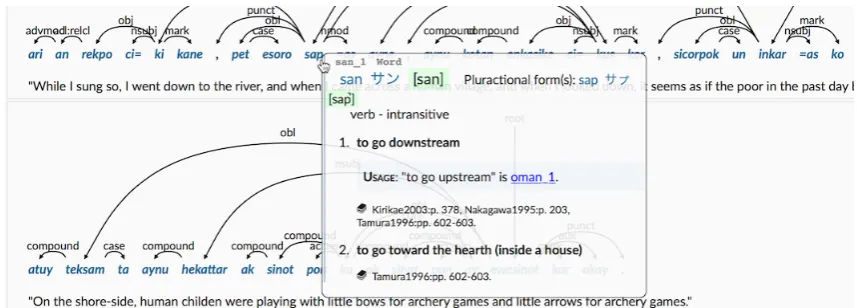
By using a converter, we translate data into CoNLL-U, the official format of UD. We also developed a dependency bank viewer for our dataset (Figure 1). A tooltip pops up to show the contents of our lexicon by pointing to a word that the reader does not know. The viewer will serve as a handy tool to learn the Ainu language.
3.2.
Lexicon
Each entry of our lexicon contains basic information such as word forms, pronunciations, and the concise defini-tions of its senses. It also contains bibliographic ref-erences to three dictionaries: Kirikae (2003; Nakagawa (1995; Tamura (1996). It is formatted in JSON. For ex-ample:
"prefLabel": "to go toward ..."
},
In reality it is in W3C JSON-LD (Sporny et al., 2017), the specification for linking data. By using a context file it is possible to expand each element into the RDF triples, en-abling ontological data exchange. For example, in our con-text file, there are mappings like the following.
"ontolex": "http://www.w3.org/ns/lemon/ontolex#", "latn": {
"@id": "ontolex:writtenRep", "@language": "ain-Latn" },
Then we can convert it into expanded triples as
_:b0
http://www.w3.org/ns/lemon/ontolex#writtenRep "san"@ain-latn .
This way we can link our lexicon to the vocabulary of On-toLex/Lemon (W3C Ontology-Lexicon Community, 2017), bridging gaps.
Our lexicon has features associated to the inventory of UM (Sylak-Glassman, 2016; Cotterell et al., 2017) which also allows morphosyntactic descriptions.
Figure 1: Screen shot of the dependency bank viewer with linking to the lexicon
4.
Linguistic Properties
Ainu is abundant for linguistic phenomena not seen in ma-jor languages. In this extended abstract we mention two of such properties.
In this section, the style of interlinear glossings are roughly based on the Leipzig Glossing Rules (Comrie et al., 2008).
4.1.
Pronominal cross-indexing
The first one is related to pronominal agreement (or pronominal indexing in the functionalist terminology (Croft, 2003)). The Ainu language has two sets of pronomi-nal markers: clitics (such ase=, “you”) and pronouns (such aseani“you”). Nevertheless, in almost all cases, pronouns do not occur in texts, and only clitics are realized.
horkew e= ne
wolf 2= COP
“You are a wolf.”
However, in some cases (especially if we want to emphasize who involved a topic), pronouns can be optionally used, although clitics are obligatory.
eani anak horkew e= ne
2SG.S INT wolf 2SG.S= COP
“(As for you), you a wolf.”
This kind of phenomena prohibits us to annotate even for simple declarative sentences, because we do not know which tokens should be counted as subject. In previous work (Senuma and Aizawa, 2017), we annotated this phe-nomenon in the following strategy.
eani anak horkew e= ne
root
nsubj
advmod aux cop
The problem of this approach is that the pronominal clitic e= is treated as an auxiliary, rather than an argument.
This approach contradicts to formalists and functionalists in orthodox linguistics. Some formalists in the Chom-skyan tradition claim that clitics (such as e=) are true ar-guments to predicates in some polysynthetic languages and pronouns are mere adjuncts (Jelinek, 1984; Baker, 1996). On the other hand, functionalists reject the idea of argu-ments/adjuncts dichotomy in the first place; Haspelmath (2013) called pronouns/nominals ascominalsand claimed that in thesecross-indexingconstructions both are real ar-guments . At any rate, a clitic e=must be treated as an argument, for cross-lingual comparisons, although at the same time we should also adhere to UD’s approach that there should be no more than one nsubj(nominal sub-ject).
A solution suggested by the UD community is the usage of
dislocated, a relation originally used to encode dislo-cated pronouns, commonly seen in informal French. De-scriptively, the approach is also justified by the fact that in an Ainu grammar published in 1936, Mashiho Chiri “likens the use of the Ainu personal pronouns to those of Latin and French, and contends that the following expressions are parallel in their use of the over pronoun (Ainukuani ‘I’, Latinego, and Frenchmoi)” (Shibatani, 1990, p. 30). However, unlike the inherent informality of French, Ainu systematically uses this system. According to Haspel-math (2013, p. 8), French dislocation is not counted as conominals, because pronominal indexes (such as e= in Ainu) and conominals must be in the same nar-row phrases, while French dislocation occurs outside these phrases. We thus introduce language-specific
fea-tures dislocated:nsubj, dislocated:obj, and
dislocated:iobjto indicate that they are conominals with valid status as subjects and objects, without violating UD’s restriction that a predicate must not have more than one argument per role.
eani anak horkew e= ne
root
dislocated:nsubj advmod nsubj
cop
re-ported that pronominal clitics were dropped, possibly due to the influence of Japanese (Izutsu, 2006). Since UD has the realization-first approach, in these cases conominals are promoted to common arguments, as in:
eani anak horkew ne
root
nsubj
advmod cop
4.2.
Alienability and possessed case
In most major languages, syntactic information is marked on its dependent, e.g., “my head” (rather than “I head-have”). The Ainu language, however, marks it on the head (possessum(Croft, 2003) orpossessee), as inku=sapa-ha “I=head-PSSD” in some circumstances.
ku= sapa-ha
I head-PSSD
nmod:poss
“my head”
Such phenomenon is called the possessed case (Sylak-Glassman, 2016). In reality, out of 236 languages recorded in the WALS Online, the number of languages with dependent-marking is 98 (42%) and that with head-marking possession is 78 (33%), and therefore it is by no means a minor construction.
The UD corpus for a Uralic language Hungarian, be-ing an exceptional language in Europe which has head-marking possession, utilizes UD’s “layered feature” (e.g.,
Person[psor]=3“it is possessed by 3rd person”) to an-notate possessed cases. Ainu possessees do not, however, inflect on number/person, and its meaning is only realized on a clitic such as ku=, thereby prohibiting the usage of these systems. We thus borrowed PSSD (possessed case) from the UniMorph inventory, and used a language-specific featureCase=Pssd.
In addition, Ainu has another possessive construction with a relative clause (the phrase was taken from Shibatani (1990, p. 44)).
pon a= kor yup-i
be.small I have older.brother-PSSD
acl:relcl nsubj
acl:relcl
“my young older brother” (lit. “older brother that is young and that I=have”)
In the above case, the form a=kor yupi (“older brother I have”) is optional, and in common speech the form a=yupihi is preferred. But not all nouns have possessed forms. Only two classes of nouns called inalienable nouns (such as body parts and kins) and locative nouns (such as or“place” and enka“higher place (above)”) have pos-sessed cases. If nouns are alienable, relative clause based
constructions are mandatory. We use language-specific lexical featuresAlienability=Naln(inalienable) and
Alienability=Aln(alienable), borrowed from the in-ventory of UniMorph, andLocativity=Yesto annotate these words.
It is interesting to see that the pronominal clitic can reside in anywhere in the relative-clause construction, exhibiting crossing dependencies in some cases (the phrase was taken from Shibatani (1990, p. 44), too).
a= wen kor sap-o
I bad have older.sister-PSSD
nsubj
acl:relcl
acl:relcl
“my dear older sister” (lit. “older sister I=that is bad and (...) have”)
5.
Conclusion
In this paper, we presented an attempt to construct UD bank and lexicon for Ainu, including dataset description, data format description, and explanations for some linguistic properties. Compared with previous work published from the UD Workshop, we created a system and viewer to anno-tate Ainu more easily, and a lexicon which can be also used as a bridge to the community of morphology and the com-munity of ontology/lexicon. We furthermore refined our annotation scheme so that it meets the standards of both linguistic typology and UD. We plan to publish the dataset in permissible open licenses such as CC-BY and MIT in the near future.
6.
Acknowledgements
This work was supported by CREST, Japan Science and Technology Agency. We are also grateful to the follow-ing researchers for valuable information and suggestions: William Croft, Teresa Lynn, Hiroshi Nakagawa (Chiba University), Joakim Nivre, Sebastian Schuster, and Francis Tyers.
7.
Bibliographical References
Baker, M. C. (1996). The Polysynthesis Parameter. Ox-ford University Press.
Bugaeva, A. (2011). Internet Applications for Endangered Languages: A Talking Dictionary of Ainu. Waseda In-stitute for Advanced Study Research Bulletin, 3:73–81. Chiri, Y. (1923). Ainu Shin’y¯osh¯u [Collection of Ainu
Ka-muyyukar]. Kyodo Kenkyusha.
Comrie, B., Haspelmath, M., and Bickel, B. (2008). The Leipzig Glossing Rules. Technical report, Max Planck Institute for Evolutionary Anthropology and University of Leipzig.
Morphological Reinflection in 52 Languages. In Pro-ceedings of the CoNLL SIGMORPHON 2017 Shared Task: Universal Morphological Reinflection, pages 1– 30, Stroudsburg, PA, USA. Association for Computa-tional Linguistics.
Croft, W. (2003). Typology and Universals, 2nd ed. Cam-bridge University Press.
DeChicchis, J. (1995). The current state of the Ainu lan-guage. Journal of Multilingual and Multicultural Devel-opment, 16(1-2):103–124, January.
Dryer, M. S. and Haspelmath, M. (2013). WALS Online. Technical report, Max Planck Institute for Evolutionary Anthropology.
Haspelmath, M. (2013). Argument indexing: a concep-tual framework for the syntactic status of bound person forms. In Dik Bakker et al., editors,Languages Across Boundaries: Studies in Memory of Anna Siewierska, pages 197–226. Walter de Gruyter.
Izutsu, K. (2006). Ainugo no Hinshi Bunrui Saik¯o: Iwayuru Ninsh¯o Daimeishi o Megutte [Ainu Parts of Speech Revisited: with Special Reference to So-called Personal Pronouns]. Journal of Hokkaido University of Education: Humanities and Social Sciences, 56(2):13– 27.
Jelinek, E. (1984). Empty Categories, Case, and Con-figurationality. Natural Language & Linguistic Theory, 2(1):39–76, January.
Kirikae, H. (2003). Ainu Shin’y¯oshu Jiten [Lexicon to Ainu Shin’y¯osh¯u]. Daigaku Shorin.
Lewis, M. P., Simons, G. F., and Fennig, C. D. (2016). Ethnologue: Languages of the World, Nineteenth edition. SIL International.
Mithun, M. (1984). The Evolution of Noun Incorporation. Language, 60(4):847–894.
Nakagawa, H. (1995). Ainugo Chitose H¯ogen Jiten [The AinuJapanese Dictionary: Chitose Dialect]. S¯of¯ukan. Nivre, J., de Marneffe, M.-C., Ginter, F., Goldberg, Y.,
Hajiˇc, J., Manning, C. D., McDonald, R., Petrov, S., Pyysalo, S., Silveira, N., Tsarfaty, R., and Zeman, D. (2016). Universal Dependencies v1: A Multilingual Treebank Collection. InProceedings of the Tenth Inter-national Conference on Language Resources and Evalu-ation (LREC 2016), pages 1659–1666.
Sato, T. (2012). Ainugo no Genj¯o to Fukk¯o [The Present Situation of the Ainu Language and Its Revitalization]. Gengo Kenkyu, 142:29–44.
Senuma, H. and Aizawa, A. (2017). Toward Universal Dependencies for Ainu. InProceedings of the NoDaL-iDa 2017 Workshop on Universal Dependencies (UDW 2017).
Shibatani, M. (1990). The Languages of Japan. Cam-bridge University Press.
Sporny, M., Longley, D., Kellogg, G., Lanthaler, M., and Lindstr¨om, N. (2017). JSON-LD 1.1: A JSON-based Serialization for Linked Data, Draft Community Group Report 12. Technical report, W3C.
Sylak-Glassman, J. (2016). The Composition and Use of the Universal Morphological Feature Schema (Uni-Morph Schema), Working Draft, v. 2. Technical report.
Tamura, S. (1996). Ainugo Saru H¯ogen Jiten [The Ainu-Japanese Dictionary: Saru Dialect]. S¯of¯ukan.
Tamura, S. (2000). The Ainu Language. ICHEL Linguistic Studies. Sanseid¯o.
W3C Ontology-Lexicon Community. (2017). Lexicon
Model for Ontologies. Technical report.