Supervised Learning of Lexical Semantic Verb Classes
Using Frequency Distributions
S u z a n n e S t e v e n s o n R u t g e r s U m v e r s l t y s u z a n n e © c s r u t g e r s e d u
Paola Merlo
Umverslty of Geneva
merlo©lettres unlge chNatalia Kariaeva
Rutgers Umverslty
k a r l a e v a @ r c l r u t g e r s e d uKamin Whitehouse
Rutgers Umverslty
kamlnw©rcl rutgers eduA b s t r a c t
Vve zeport a number of c o m p u t a t m n a l ex- periments m supervised learning whose goal Is to automatmally classify a set of verbs into lexmal semanUc classes, based on frequency d l s t n b u t m n approxlmatmns of g r a m m a t i c a l features extracted from a very large annotated corpus DlstnbuUons of five syntactic features that approximate tranmUvlty alternatmns and thematic role assignments are sufficient to reduce error rate by 56% over chance We conclude t h a t corpus d a t a is a usable repository of verb class mformatmn, and t h a t corpus- driven extraction of grammaUcal features Is a promising methodology for a u t o m a t m lexmal acqum,Uon
1
I n t r o d u c t i o n
Recent years have witnessed a shift in g r a m m a r de- velopment methodology, from crafting large gram- mars, to annotation of corpora Correspondingly, there has been a change from developing rule-based parsers to developing statmUcal methods for reduc- ing g r a m m a t m a l knowledge from annotated corpus d a t a T h e shift has mostly occurred because build- mg w~de-coverage g r a m m a r s is ume-consummg, er- ror prone, and difficult The same can be said for crafting the rich lexlcal representatmns that are a central component of hngmstlc knowledge, and re- search m automaUc lexmal acquisition has sought to address this ((Doff and Jones, 1996, Dorr, 1997), among others) Yet there have been few a t t e m p t s to learn fine-grained lexical classifications from the sta- tlsUcal analysis of d l s t n b u t m n a l data, analogously to the induction of syntacUc knowledge (though see, e g , (Brent, 1993, Klavans and Chodorow, 1992,
Resmk, 1992)) In this paper, we propose such a~ approach for the automaUc classfficauon of ~erbs into lexlcal semantic classes l
We can express the Issues raised by this apploach as follows
1 Whmh hngulstlc dlstmcUons among [exlcsl classes can we expect to find m a corpus ~ 2 How easily can we extract the frequency distri-
butions t h a t approximate the relevant hngmstlc properttes?
3 Which frequency dlstnbuUons work best to dis- tinguish the verb classes ~
In exploring these quesUons, we focus on verb clas- slficaUon for several reasons Verbs are very impor- tant sources of knowledge in many language engi- neering tasks, and the relationships among verbs ap- pear to play a m a j o r role m the orgamzatmn and use of this knowledge Knowledge about verb classes is crucml for lex,cal acqmsltton m support of language generation and machine translatmn (Dolt, 1997) and document cl~sfficatmn (Klavans and Kan, 1998), yet manual classfficauon of large numbers of verbs is a difficult and resource intensive task (Levm, 1993 Miller et al , 1990, Dang et a l , 1998)
to semantic classes, hence they can be more easily captured by corpus-based techniques Second, using verb d~atheses reduces no,se There ~s a certain con- sensus (Bnscoe and Copestake, 1995, Pustejovsky, 1995, Palmer, 1999) that verb dmtheses are regular sense extensmns Hence focussing on thin type of classfficatmn allows one to abstract from the prob- lem of word sense dmamb,guatmn and treat remdual d~fferences m word senses as no~se m the classffica- tmn task
We present an m-depth case study, m which we apply machine learning techmques to automaUcally classify a set of verbs based on d~stnbutmns of gram- m a u c a l indicators of dmtheses, extracted from a very large corpus We look at three very mterest- mg classes of verbs unergaUves, unaccusauves, and obJect-drop verbs (Levm, 1993) These are Interest- mg classes because they all parUcapate m the trans~- u v l t y alternatmn, and they are minimal parrs - that as, a small number of well-defined dmtmctmns d~ffer- entmte their trans,tlve/mtranmUve behavmr Thus, we expect the differences m their dmtnbuttons to be small, entailing a fine-grained dlscr,mmaUon task t h a t prowdes a challenging testbed for automatic classfficatmn
The specffic theoretical questmn we mvesUgate ~s whether the factors underlying the verb class dm- tmctmns are reflected m the statmttcal dmtnbutmns of lex~cal features related to dmtheses presented by the md,v~dual verbs m the corpus In doing th~s, we address the questmns above by determining what are the lexmal features t h a t could d~stmgmsh the behav- tor of the classes of verbs w~th respect to the relevant dmtheses, ~hmh of those features can be gleaned from the corpus, and which of those, once the sta- Ustmal d m t n b u t m n s are available, can be used suc- cessfully by an a u t o m a t i c classifier
In m~ttal work (Stevenson and Merlo, 1999), ~e found t h a t hngmstlcally motivated features that d~s- t m g m s h the verb classes can be extracted from an annotated, and m one case parsed, corpus These features are sufficient to almost halve the error rate c o m p a r e d to chance (45% reductmn) m auto- maUc verb classtficaUon, suggesting that d~stnbu- Uonal d a t a prowdes knowledge useful to the class~- ficaUon of verbs The focus of our original stud~ was tho d e m o n s t r a t i o n m prmctple of l~a.nmg verb classes from frequency d~stnbutmns ofsyntactm fea- tures, and an analysm of the relaUve contrtbutmn of the various features to learmng Th~s paper turns to the n n p o r t a n t next steps of rephcatmg our find- rags using other training methods and learning al- gorithms, and analyzing the performance on each of tbe three classes of verbs This more detailed anal- ys~s of accuracy within each class m turn leads to
the development of a new dlstrtbutmnal feature m- tended to improve dlscnmmabthty among t~o of the classes The addltmn of the ne~ feature successfully reduces the error rate of out mltml results m classl- ficatmn by 19%, for a 56% overall reductmn m error rate compared to chance
2 D e t e r m i n i n g t h e F e a t u r e s
In this sectmn, we present mouvatmn for the mttml features t h a t we mvesUgated m terms of their role m learmng the verb classes We first present the hngmstlcally den~ed features then turn to e~tdence from experimental psychohngutstlcs to e \ t e n d the set of potentially relevant features
2.1 F e a t u r e s o f t h e V e l b C l a s s e s
The three verb classes under mvesugatmn - unerga- Uves, unaccusaUves, and object-drop - d i f f e r m the properties of their translttve/mtranslhve a[terna- Uons, which are exemphfied below
UnergaUve
( l a ) The horse raced past the barn
( l b ) The jockey raced the horse past the barn Wnaccusatave
(2a) The butter melted m the pan
(2b) The cook melted the butter m the pan ObJect-drop
(3a) The boy washed the hall (3b) The boy washed
The sentences m (1) use an unergatwe velb. ,accd
Unergatlves are mttansluve actmn verbs whose tran- sttlve form is the causattve counterpart of the m- transluve form Thus, the subject of the intransi- tive ( l a ) becomes the object of the translh~e ( l b ) (Brousseau and Rltter 1991, Hale and ke~set 1993 Levm and R a p p a p o r t Ho~,av, 1995) The sentences m (2) use an unaccusaUve verb, melted Lnac- cusatlves are intransitive change of state ~et bs (2a) hke unergauves, the translu~e counterpart for the.,e verbs ts also causative (2b) The sentence~ m (3) use an o b j e c t - d t o p verb washed, the~e ','elt:,~ haxe a n o n - c a u s a U ~ e tran'~ltl~,e/intransltl~,,e al[eln¢ltton in ~ hlch the object is sm~pl~ opttonal
with the addition of a Causal Agent (the causer of the event) as subject in both cases Object-drop verbs s i m p l y assign Agent to the subject and Theme to the optional o b j e c t
We expect the differing semantic role assignments of the verb classes to be reflected m their syntac- tic behavior, and consequently in the distributional d a t a we collect from a corpus The three classes can be characterized by their occurrence in two alter- nations the transittve/mtrans~tive alternation and the causative alternation Unergatives are distin- guished from the other classes m being rare in the transitive form (see (Stevenson and Merlo, 1997) for an explanation of this fact) Both unergatives and unaccusatives are dlstmgmshed from obJect-drop m being causative in their transitive form, and sun- d a r l y we expect this to be reflected in amount of detectable causative use Furthermore, since the caus&tlve is a transitive use, and the transitive use of unergatlves is expected to be rare, causativity should p r i m a r i l y distinguish unaccusatlves from object- drops In conclusion, we expect the defining features of the verb c l a s s e s - - t h e intransitive/transitive and causative ~ l t e r n a t l o n s - - t o lead to distributional dif- ferences m the observed usages of the verbs in these alternations
2 2 Psychollngmst~cally R e l e v a n t F e a t u r e s The verbs under s t u d y not only differ in their t h e m a t i c properties, they also differ in their pro- cessmg properties Because these verbs can occur both in a trans~tive and an intransitive form, they have been particularly studied in the context of the mare verb/reduced relative (MV/I:tR) ambiguity il- lustrated below (Bever, 1970)
The horse raced past the barn fell
The verb ~aced can be interpreted as either a past tense main verb, or as a past participle w~thm a re- duced relative clause (l e , the horse [that was] raced past the barn) Because fell is the main verb, the le- duced relative l n t e r p r e t a t m n of raced is required for a coherent analysis of the complete sentence But the m a i n verb interpretation of raced is so strongly preferred that people experience great difficulty at the verb fell, unable to integrate it with the inter- pretation t h a t has been developed to that point
However, the reduced relative interpretation is not difficult for all verbs, as in the follo~mg example
The boy washed in the tub was angry
The difference in ease of interpreting the lesolu- tions of this a m b i g u i t y has been shown to be sen- sitive to both frequency differentials (MacDonald
1994, Trueswell, 1996) and to verb class d~stmctmns (Stevenson and Merlo, 1997, Flhp et al , 1999)
Consider the features that d~stmguish the t~o res- olutions of the M \ , / R R ambiguity
MV The horse raced past the barn quickly RR The horse raced past the barn fell
In the main verb resolution, the ambiguous ~erb
raced is used in its intransitive form, while in the re- duced relative, it is used in its transitive, causative form These features correspond directly to the defining alternations of the three verb classes un- der study (intransitive/transitive, causative) ~,ddl- tionally, we see that other related features to these usages serve to distinguish the two resolutions of the ambiguity The mare verb form Is active and a mare verb part-of-speech (labeled as VBD by automatic POS taggers), by contrast, the reduced relative foim is passive and a past partic~ple (tagged as \ BN) Since these features (active/passive and VBD/VBN) are related to the intransitive/transitive alteination, we expect them to also exhibit d~stributloaal differ- ences among the verb classes Specifically, ~e expect the unergatives to yield a higher proportion of a c t ~ e and "vBD usage, since, as noted above, the transitive use of unergatwes is rare
3
Frequency Distributions of the
Features
We assume t h a t currently available large cotpoLa are a reasonable approximation to language (Pul- lum, 1996) Using a combined corpus of 65-mllhon words, we measured the relative frequenc) distribu- tions of the four linguistic features (VBD/~ BN ac- tive/passive, Intransitive/transitive, causative/non- causative) over a sample of verbs from the three lex- tcal semantic classes
3 1 M a t e r i a l s
mg procedure, we made the assumptron that counts on this single verb form would approximate the dis- tribution of the features across all forms of the verb
Most counts were performed on the tagged versron of the Brown Corpus and on the portion of the Wall Street Journal distmbuted by the ACL/DCI (years 1987, 1988, 1989), a combined corpus m excess of 65 m d h o n words, with the exceptmn of causatrv- lty which was counted only for the 1988 year of the WSJ, a corpus of 29 million words
3 2 M e t h o d
We counted the occurrences of each verb token in a transrtlve or mt~ansltr~e u s e (INTR), m an active or passive u s e (ACT), rn a past pamcrple or smaple past use (VBD), and in a causative or non-causative use (CAUS) More precrsely, features were counted as follows
INTR a verb occurrence was counted as transrtlve if rmmediately followed by a nominal group, else rt was counted as mtransitrve
ACT mare verbs (tagged VBD) were counted as actrve, participles (tagged V BN) counted as actrve ff the closest preceding auxiliary was have, as passive ff the closest preceding auxiliary was be
VBD occurrences tagged VBD were simple past, VBN were past participle
(Each of the above three counts was normalized over all occurrences of the verb, yielding a single relative frequency measure for each verb for that fea- ture )
CAUS The causative feature was approximated by the followmg steps Frrst, for each verb, all cooc- currmg subjects and objects were extracted from a parsed corpus (Colhns, 1997) Then the propor- tmn of overlap between the two multrsets of nouns was calculated, m e a n t to capture the causative al- ternation, ~here the subject of the mtransrtrve can occur as the object of the trans~trve Vve define overlap as the largest multiset of elements belong- mg to both the subjects and the object multisets, e g { a , a , a , b } ( 3 {a} = { a , a , a } The proportron is the ratio between the o~erlap and the sum of the subject and object multrsets (For example, for the rumple sets above, the ratio would be 3/5 or 60 )
All ra~ and normahzed corpus data ale a~adable from the authors, a n d more detarl concerning data collectron can be found m (Stevenson and Merto,
1999)
4 E x p e r i m e n t s i n V e r b C l a s s i f i c a t i o n
The frequency drstnbutrons of the verb alternatmn features yield a vector for each verb that represents the relative frequency values for the verb on each
drmensron, the set of 59 vectors constrtute the d a t a for our machine learmng experiments
Template [verb, VBD, ACT, INTR, CADS, class]
Example [opened, 79, 91, 31, 16, unacc]
Our goal was to determine whether automatm clas- sfficatlon techniques could determine the class of a verb from the distributional propertms represented m this vector
In related work (Stevenson and Merlo, 1999) ~e describe initial unsupervised and supervised lealnmg experiments on this data, and discuss the contllbu- tlon of the four different features (the frequenc.~ dis- tributions) to accurac~ m verb classfficatlon In thzs paper, we extend the work in several ~ays Fu~t, ~e report further analysis of rephcauons of our m m a l supervised learning results Next, we demonstrate srmdar performance using different training methods and learning algorithms, mdmatmg that the perfor- mance rs Independent of the particular learning ap- proach Furthermore, these addrtronal e~penments allow us to evaluate the performance separately on each of the three verb classes Finally, based on tins evaluation, we suggest a new feature to better drs- tmgmsh the thematic propertms of the classes, and present experimental results showing that its use rm- proves our original accuracy rate
4.1 I n i t m l E x p e r i m e n t s
Imtial experiments were carried out using a decrsron tree induction algorithm, the C5 0 system avadable from h t t p / / w w w rulequest corn/ (Qumlan, 1992), to automatmally create a classfficatron program flora a training set of verb vectois with known classffica- tron 2 In our earhei experiments ~e ran [0-fold cross-vahdatrons repeated 10 times hele ~e repeat the ctoss-vahdatrons 50 tmles, and the numbeis te- polted are averages over all the tuns 3
Table 1 shows the results of our experiments on the four features we counted m the corpora (x BD ACT, INTR, CAUS), a s well as all three-feature subsets of those four The basehne (chance) performance m th~s task rs 33 8%, since thele are 59 ~ectors and
~The s~stem generates both declsmn trees aml rule sets for use m classfficatmn Since the d~fferencc m pet- formance between the t~o zs ne~er s~gmficant ~xe repoKt here J a b the results using the extracted rules The rules provide a confidence level foz each classfficatmn ~ hmh Is unavailable with the decmon tree data structure
Features Acc% SE%
VBD ACT INTR CAUS 63 7 0 6 VBD INTR CAUS 62 7 0 6
ACT INTR CAUS 59 9 0 5 VBD ACT CAUS 56 8 0 5
VBD ACT INTR 54 5 0 5 f ,
Table 1 Percentage Accuracy (Acc%) and S t a n d a r d Error (SE%) of C5 0 (33 8% baselrne)
3 possible classes ( T h a t is, assigning one of the two most c o m m o n c l a s s e s - - o f 20 verbs e a c h - - t o all cases would ymld 20 out of 59 correct, or 33 8% ) As seen m the table, classrficatmn based on the four fea- tures performs at 63 7%, or 30% over chance The true mean of the s a m p l e cross-vahdatlons lies wd, hm plus or remus two s t a n d a r d errors of the reported mean (dr=49, t = 2 01, p < 05) In all cases, the range is plus or mmus I 0 or 12, yreldmg a very nat- row predrcted accuracy range Furthermore, we per- formed t-tests c o m p a r i n g the results of the 50 cross- v a h d a t m n s for each of the different feature subsets All pairs were srgmficantly different (p< 05) except for the results using all four features (first row m the table) and those excluding ACT (second row m the table) We conclude t h a t all features except ACT contribute posrtlvely to classrficatmn performance, and t h a t ACT does not degrade performance In our rephcatrons, then, we focus on all four features 4 2 R e p h c a t m n w i t h D i f f e r e n t T r a i n i n g a n d
L e a r n i n g M e t h o d s
There are conceptual and practical reasons for in- vestigating the performance of other training ap- proaches and learning algorithms applied to our verb distribution d a t a Conceptually, it is desrrable to know whether a particular learning algorithm or training techmque affects the level of performance Practically, drfferent methods enable us to evalu- ate more easily the performance of the classification method within each verb class (When we run re- peated cross-validations with t keg.C5 0..system, we d o n ' t have access to the accuracy rage for each class, the system only o u t p u t s an overall mean error rate ) To preview, we find t h a t the different training and learning methods we tried all, gave similar perfor- mance to our original results, and m addltron al- lowed us to evaluate the accuracy wlthrn each verb class
In one set of experiments, we used the same C5 0 system, but employed a training and testing method- ology t h a t used a single hold-out case We held out a single verb vector, trained on the remaining ,58 cases, then tested the resulting classffier on the
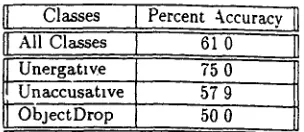
II Classes [[ All Classes
I Unergatv~e Unaccusatwe I O b j e c t D r o p
Percent ~ccuracy 61 0 75 0 57 9 50 0
Table 2 Percentage Accuracy of C5 0 With Single Hold-Out Training
single hold-out case, and recorded the collect and assigned classes for that verb Tius was then ze- peated for each of the 59 verbs This approach ~ raids both an overall accuracy rate (when the results are averaged across all 59 trials), as well as pio~ldmg the d a t a necessary for determining accuracy fol each verb class (because we have the classification of each verb when It is the test case) The results ale pre- sented m Table 2 The overall accuracy IS a little less than that achieved with the 10-fold cross-validation methodology (61 0% versus 63 7%) However, we can see clearly now that the unergatlve verbs ate dassffied with much greater accuracy (75%), Mule the unaccusatwe and obJect-drop verbs are classified with much lower accuracy (57 9% and 50% respec- trvely) The distributional features we have appear to be much better at dmtmgmshmg unergatwes than unaccusatlve or obJect-drop verbs
To test thrs drrectly under our original t i a m m g assumptrons, we ran two different experiments, u~- mg 10-fold cross-vahdation repeated 10 time~ The first experiment tested the abdit:~ of the classifier to distinguish between unergatlves and the other t ~ o verb types, wrthout having to distinguish bct~een the latter two The d a t a included the 20 unerga- rive ,,erbs and a random sample of 10 unaccusatave and 10 obJect-drop verbs, 10 different random ~am- pies were selected to form 10 such d a t a sets In these d a t a sets, the ~erbs were labeled as unerga- tire or "of;her" The baseline (chance) classzficatmn accuracy for this d a t a is 50%, the mean accmac~ achmved across all d a t a sets was 78 5% (standard el- lot 0 8%), a srzable improvement o~er chance The second expeim~ent ~as intended to det, etmme ho~ well the classifier can dlstmgm~h.unaccusatl~e from object-drop verbs The d a t a consisted of one ~et that included all the unaccusative and object-drop verbs, with no unergatives Because there ate only i9 unaceusauve verbs, the basehne accuracy l a t e is 51% (20/39), here the classifier achieved an accuracy only slightly above chance, at 58 3% (standard elror 1 8%) These results, summarized in Table 3 clearly confirm the higher accuracy of classifying uneigatlvo verbs with the current feature set
[image:5.612.109.281.51.127.2] [image:5.612.340.492.52.118.2]Classes Acc% SE% [I Unergatlve vs Other 78 5 0 8 ] Unaccusatlve vs O b j e c t D r o p 58 3 1 8
I
Table 3 Percentage Accuracy (Ace%) and S t a n d a r d Error (SE%) of C5 0 (50-51% baseline)
II
Cl es [PCA%[ FMP% II
[l All Classes
[ 65 0 1 63 9 II
Unergatlve 85 0 71 7 Unaccusative 60 0 55 0 O b j e c t D r o p 50 0 65 0
Table 4 Percentage Accuracy of P C A (PCA%) and Feature Map ( F M P % ) Neural Networks
different type of learning algorithm as well We per- formed a set of neural network experiments, using NeuroSolutlons 3 0 (see h t t p / / w w w nd corn), and report here on the networks t h a t achieve the best performance on our d a t a These are principal com- ponents analysis and a u t o m a t i c feature m a p net- works, which are essentially feed-forward percep- trons with pre-processmg units t h a t transform the existing features r a t a a more useful format In our tests, both m e t h o d s performed best overall when there were no hidden layer units, and the networks were trained for 1000 epochs The mean accuracy rates of 10-fold cross-validations with these p a r a m - eter settings are s u m m a r i z e d in Table 4 Again, the overall percentage accuracy is in the low sixties, with better performance on the unergattves than on the other two verb classes, the difference was particu- larly striking with the PCA networks This overall p a t t e r n doesn't change with further training, in fact, training up to 10,000 epochs resulted in very low accuracy (of 45%) for either unaccusatives, object- drops, or both
To summarize, following a different training ap- proach with C5 0 (the single hold-out method), and applying very different learning approaches (two kinds of neural networks), resulted in mmllai o~er- all performance to our original C5 0 results This indicates that the accurac3 achieved is at lea.st somewhat independent of specific learning or train- Ing techniques Moreover, these different methods, along with experiments directly testing unergative versus u n a c c u s a t l v e / o b j e c t - d r o p classification, allow us to examine more closely where the resulting clas- sifters have the most serious problems In all cases, the accuracy is best for unergattves, and the accu- racy of unaccusatives, object-drops, or both, is de- graded If this performance is indeed a reliable mdi-
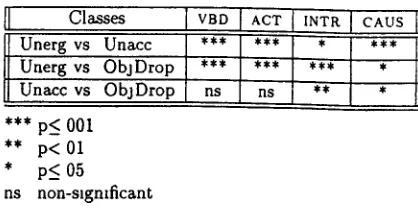
C l a s s e s
Unerg vs Unacc Uaerg vs O b j D r o p Unacc vs O b j D r o p
I vBo I AcT I INTR I CAI'S
II
n s n s * * *
*** p < 001 ** p < 01
* p_< 05
as non-significant
Table 5 Significance Levels of T-Tests C o m p a r i n g Feature Values Between Verb Classes
cation of the inherent dtscnmmabd~ty of tile dastn- butlonal data, then we must examine more closely the properties of the d a t a itself to understand (and potentially improve) the performance
4 3 D s s c r l m m a t m g U n a c c u s a t i v e a n d O b J e c t - D r o p V e r b s
To understand why the d a t a discriminates unerga- ttves reasonably well, but not unaccusatlves and object-drops, we need to directly test the d i s c n m - i n a b i l i t y o f the features across the classes We do so by using t-tests to compare the values of the differ- ent features--VBD, ACT, INTR., CAUS--for unergattve and unaccusattve verbs, unergatlve and object-drop verbs, and unaccusatlve and object-drop verbs In each case, the t-test is giving the likelihood t h a t the two sets of v a l u e s - - e g , the VBD feature values for unergatives and for unaccusatives--are d r a ~ n from different populations Table 5 shows that all sets of features are significantly different for unergatlve and unaccusattve verbs, and for unergattve and object- drop verbs Ho~ever, only INTR. and CAUS ate slg- mficantly different for unaccusattve and o b j e c t - d t o p verbs, indicating that we need additional featules that have different values across these two classes
[image:6.612.315.524.55.164.2] [image:6.612.122.272.142.210.2]II
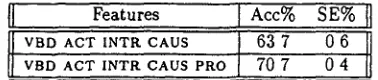
Features
[Acc% SE% II
I VBD ACT INTR CAUS
I 63 7
0 6 ]
VBD ACT INTR CAUS PRO
70 7
0 4
Table 6 Percentage Accuracy (Acc%) and S t a n d a r d Error (SE%) of C5 0, W~th and W~thout New PRO Feature, All Verb Classes (33 8% basehne)
making use of frequency d m t n b u t m n s - - t h e clatm ~s not t h a t only Agents can be a m m a t e , but rather that nouns t h a t receive the Agent role will more often be a m m a t e than nouns t h a t receive the Theme role
A problem w~th a feature hke a m m a c y ~s that ~t requires etther manual d e t e r m m a t m n of the antmacy of extracted subjects, or reference to an on-hne re- source such as WordNet for determining a m m a c y To a p p r o x i m a t e a m m a c y w~th a feature that can be extracted automatically, and w~thout reference to a resource external to t h e corpus, we instead count pronouns (other than ~t) m subject positron The assumptmn ~s that the words I, we, you, she, he,
and they most often refer to a m m a t e ent~tms The values for the new feature, P~.O, were d e t e r m i n e d by a u t o m a t m a l l y extracting all s u b j e c t / v e r b tuples including our 59 examples verbs (from the WSJ88 parsed corpus), and c o m p u t i n g the ratm of occur- rences of pronouns to all subjects
We again apply t-tests to our new d a t a to deter- mine whether the sets of PRo values d~ffer across the verb classes Interestingly, we find t h a t the Prto values for unaccusat~ve verbs (the only class to as- s~gn Theme role to the sub tect m one of tts alterna- tmns) are s~gmficantly dtffe~ent from those for both unergatlve and object-drop verbs (p< 05) More- over, the PRo values for unergat~ve and object-drop verbs (whose subjects are Agents m bo~h alterna- tmns) are not s~gmficantly d~fferent Th~s pattern confirms the abd~ty of the feature to capture the thematm d~stmctmn between unaccusat~ve verbs and the other two classes
Table 6 shows the result of applying C5 0 (10-fold eross-vahdatmn repeated 50 t~mes) to the three-x~ay classfficatmn task using the PRo feature m conjunc- tmn w~th the four previous features ~.ccuracy ran- proves to over 70%, a teductmn m the error rate of almost 20% due to th~s single nex~ feature Mote- over, classifying the unaccusat~ve an2 object-drop verbs using the new feature m conjunctmn w~th the prevmus four leads to accuracy of over 68% (com- pared to 58% w~thout PRo) We conclude that this feature ~s ~mportant in d~stmgmshlng unaccusat~ve and object-drop verbs, and hkely contributes to the tmprovement m the three-way classtficatton because of th~s Future work wdl examine the performance
w~thm the verb classes of th~s new set of features to see whether accuracy has also tmproved for unerga- tire verbs
5
C o n c l u s i o n s
In thin paper, we have presented an m-depth case study, m whmh we investigate varmus machine learn- mg techmques to automatically classify a set of verbs, based on dlstnbutmnal features extracted from a very large corpus Results show that a small number of hngmstlcally motivated grammatical fea- tures are sufficmnt to reduce the error rate by mote than 50% over chance, acluevmg a 70% acctuacy rate m a three-way classfficatmn task Tins leads us to conclude that corpus d a t a is a usable reposi- tory of verb class mformatmn On one hand ~e ob- serve that semantlc propemes of verb classes (such as causatlvlty, or ammacy of subject) may be use- fully a p p r o x i m a t e d through countable syntactic fea- tures Even with some noise, lexmal propertms are reflected m the corpus robustly enough to positively contribute m classlficatmn On the other hand, how- ever, we remark that deep hngumtm analysis cannot be e h m m a t e d - - m our approach, it is embedded m the selection of the features to count We also think that using hngumtlcally motivated features makes the approach very effective and easdy scalable we report a 56% reductmn m error rate, w~th only five features that are relatwely straightforward to count
Acknowledgements
This research was partly sponsored by the S~ lss Na- tmnal Scmnce Foundatmn, under fello~slup 8210- 46569 to Paola Merlo, by the US Natmnal Scmnce Foundatmn, under grants #9702331 and #9818322 to $uzanne Stevenson, and by the Infotmatton Sci- ences Councd of Rutgers Umverslty ~,~,e thank M a r t h a Palmer for getting us started on tlus ~ork and Mmhael Colhns for gwmg us access to the out- put of his parser We gratefully acknowledge the help of Ixlva Dickinson, ~ho calculated no~mahza- tmns of the corpus d a t a
A p p e n d i x A
The une~gatx~es are manner of morton ~erbs
jumptd
rushed, malched, leaped floated, laced, huslwd uan- dered, vaulted, paraded, galloped, gl,ded, hzked hopped jogged, scooted, ncurlzed, ~kzpped, hptoed, trottedThe unaccusau~es are verbs of change of state
opened, exploded, flooded, dzs~olved, cracked, hardened bozled, melted, .fractured, ,ol,dzfied, collapsed cooled folded, w~dened, changed, clealed, dzwded, ~,mmered stabdzzed
[image:7.612.99.288.52.92.2]tted, organtzed, rented, sketched, cleaned, packed, stud- ted, swallowed, called
R e f e r e n c e s
Thomas G Bever 1970 The cogmtwe basis for hngms- tlc structure In J R Hayes, e&tor, Cognttson and the Development of Language John Wdey, New York
Michael Brent 1993 From grammar to le~con Un- supervmed learmng of [ex~cal syntax Computational Linguistics, 19(2) 243-262
Edward Bnscoe and Ann Copestake 1995 Lex~cal rules m the T D F S framework Techmcal report, Acquflex- I I Working" Papers
Anne-Marm Brousseau and Ehzabeth R~tter 1991 A non-umfied analysis of agent~ve verbs In West Coast Conference on Formal Lmgutstzcs, number 20, pages 53-64
M~chael John Colhns 1997 Three generaUve, lexa- cahsed models for statistical parsmg In Proc of the
~5th Annual Meeting of the ACL, pages 16-23
Hoa Trang Dang, Kann K~pper, Martha Palmer, and Joseph Rosenzwe~g 1998 Investtgatmg regular sense extenmons based on mteresecttve Levm classes In Proc of the 361h Annual Meeting of the ACL and the 171h [nternatwnal Conference on Computatwnal L,ngu,st,cs (COLING-A CL '98), pages 293-299, Mon- treal, Canada Umvers~t6 de Montreal
Bonme Dorr and Doug Jones 1996 Role of word sense d~samb~guatmn m lexacal acqms~tmn Predmtmg se- mantics from syntactic cues In Proc of the 161h In- ternattonal Conference on Computat*onal Lmgutsttcs, pages 322-327, Copenhagen, Denmark
Bonnie Dorr 1997 Large-scale chctmnary constructmn for foreign language tutonng and mterhngual machine translatmn Machine Translatton, 12 1-55
Hana Fd~p M~chael Tanenhaus, Greg Carlson, Paul AI- lopenna, and Joshua Blatt 1999 Reduced rela- tives judged hard require constraint-based analyses In P Merlo and S Stevenson, echtors, Sentence Pro- cessmg and the Lextcon Formal, Computational, and Ezpertmental Perspectives, John Benjamms, Holland
Ken Hale and Jay Keyser 1993 On argument struc- ture and the lexacal representatmn of s:~ ntact~c rela- tmns In K Hale and J Keyser, editors, The t',ew from Budding ~0, pages 53-110 MIT Press
Juchth L Ixlavans and Martin Chodorow 1 9 9 2 De- grees of stat~vlty The lexacal representatmn of verb aspect In Proceedmg~ of the Fourteenth International
Conference on Computahonal Lmgmst,cs
Juchth Ixlavans and Mm-Yen Kan 1998 Role of ~erbs m document analysis In Proc of the 361h Annual Meeting of the ACL and the 171h [nternatzonal Con-
Beth Levm and/Vlalka Rappapti(t'Hovav 1995 (Jnac- cusatwlty MIT Press, Cambridge, MA
Beth Le~m 1993 Enghsh Verb Clas~e~ and 4lterna- twns Chacago Umvers~ty Press, Chicago, IL
Maryellen C MacDonald 1 9 9 4 Probablhstlc con- stramts and syntactic amblgtuty resolution Language and Cognltzve Processes, 9(2) 157-201
Paola Merlo and Suzanne Stevenson 1998 What gram- mars tell us about corpora the case of reduced rela- tive clauses In P1oceedmgs of the Slzth Workshop on
Very Large Corpora, pages 134-142, Montreal, CA
George Miller, R Beckw~th, C Fellbaum, D Gross, and Ix I~hller 1990 Fwe papers on Wordnet Techmcal report, Cogmtzve Scmnce Lab, Princeton Ual~erstt~
Martha Palmer 1999 Coasmtent criteria for sense dis- tmctmns Computmg ]or the Hamamttes
Fernando Perelra, Naftah Tlshby, and Ldhan Lee 1993 Dlstrabutmnal clustering of enghsh words [n Proc of the 31th 4nnual Meeting of the 4CL, pages 183-190
Fernando Perexra, Ido Dagan, and Lalhan Lee 1997 Slmdanty-based methods for word sense dlsamblgua- tmn In Proc of the 35th Annual Meeting of the
4 CL and the 8th Conf of the E 4 CL (A CL/EA CL '97) pages 56 -63
Geoffrey K Pullum 1 9 9 6 Learnabthty, hyperlearn- rag, and the poverty of the sttmulus In Jan John- son, Matthew L Jute, and Jen L Moxley, editors, ~ n d Annual Meeting of the Berkeley Lmgutstzcs So- ctety General Sesston and Parasesswn on the Role of Learnabdzty m Grammatzcal Theory, pages 498-513, Berkeley, Cahforma Berkeley Linguistics Socmty
James Pustejovsky 1995 The Generatwe Lexicon MIT Press
J Ross Qumlan 1992 C$ 5 Programs fo~ Machine Learning Series m Machme Learning Morgan Ixauf- mann, San Mateo, C 4.
Phdlp Resnik 1992 Vv'ordnet and dmtnbutmnal anal- ysis a class-based approach to lex~cal dlsco~er~ In 4 4 4 I Workshop m Statz~tzcally-ba~ed NLP Tech- ntqu_e~, pages 56-64
Doug Roland and Dan Juxafsk:~ 1998 How ~ed~ subcat- egonzatmn fiequencms are affected b~ corpu~ choice In Proc of the ~6th 4nnual I[eetmg of the 4CL, \Ion- treal, CA
Suzanne Stevenson and Paola \lerlo 1997 Lexlcal structure and parsing comple~lt~ Language and ('og- mtwe Proce~e~, 12(2/3) 3t9-399
Suzarme Stevenson and Paola Merlo 1999 4.utomauc verb classfficatton using distmbutmns of grammatical features In Proc of the 9th Conference of the Eu- ropean Chapter of the A CL, Bergen, Norway, pages 45-52