263
A Performance Evaluation of Energy Conservation
Clustering Algorithm to Prolong the Lifetime of
Wireless Sensor Networks
1
S. Manikandan,
Research Scholar, Department of Computer and Information Science, Annamalai University, Tamilnadu, India, [email protected]
2
Dr.M.Jeyakarthic,
Assistant Professor/Programmer, Department of Computer and Information Science, Annamalai University, Tamilnadu, India, [email protected]
Abstract—Wireless sensor network encompasses billions of nodes that work collaboratively, to collect data,
and transmit to sink. Energy fissure or hotspot problem is a phenomenon in which nodes near to the sink die prematurely, which causes the network partition. An inequity of the consumption of energy by the nodes in wireless sensor networks shrinkages the network's lifetime. Energy conservation clustering is a technique to cope up the balance consumption of energy by each node. In this paper, we evaluate the performance of Energy Conservation Clustering approaches to prolong the lifetime of the network. All the clustering head sensor nodes are show an effective technique in wireless sensor networks which can increase network energy efficiency, scalability and lifetime. Simulations results demonstrated that Energy Conservation Clustering Algorithm is able to prolong the time interval of the death of the first node in the sensor filed that enhances the system lifetime and stability over the existing protocols. The Energy conservation clustering performance allowed any cluster to activate multiple rounds that based on data aggregation approaches to Wireless Sensor Networks.
Keywords—clustering sensor nodes, data sink, conservation clustering, wireless sensor networks
I. INTRODUCTION
A cluster is a sort of equal or scattered PC framework, which comprises of an accumulation of composed method for remain solitary PCs cooperating as a solitary bound together registering resource[1]. The key components of a cluster incorporate various independent PCs (Personal PCs, Workstations or Symmetric Multiprocessing),
working frameworks, elite interconnects,
middleware, parallel program planning conditions, and applications. Clusters need to join quick interconnection advancements with a specific end goal to help high-transfer speed and low dormancy inter-processor correspondence between cluster nodes[2]. Moderate interconnection advancements had dependably been a basic execution bottleneck for cluster computing[3]. Choosing a cluster interconnection to arrange innovation relies upon a few components, for example, the similarity with the cluster equipment and working framework, cost, and performance[4]. There are two measurements to assess execution for imparting the bandwidth transmission capacity and latency. Transmission
capacity is the amount of data that can be communicated over the interconnect equipment in a constant timeframe, though inactivity is an ideal opportunity to arrange and transmit data from a source node to a goal node[5]. A node is any physical gadget inside a system of different gadgets that is ready to send, get, or potentially forward data. The PC is the most the basic node and is frequently called the PC node or internet node. Modems, switches, center points, extensions, servers, and printers are likewise nodes, as are different gadgets that associate with Wi-Fi or Ethernet[6]. Nodes inside a PC organize must have some type of distinguishing proof, similar to an IP address[7] or MAC address, for it to be perceived by other system devices[8]. A node without this data, or one that has been taken disconnected, never again works as a node.
II. RELATED WORKS
264
conventions, which are for the most part IP-based conventions, are not appropriate. Consequently, interesting routing conventions have been proposed to adapt to the uniqueness of WSNs. The greater part of the routing conventions falls essentially into three principal classes: information-driven, various levelled or area based routing protocols[9]. In various levelled routing class, nodes are assembled into clusters and after that select a particular node in light of a criteria to go about as a cluster head (CH) which more often than not performs more vitality expending errands, out of which cluster individuals' information gathering, information accumulation and correspondence with the base station (BS), than typical nodes which primarily sense the encompassing zone and report the detected information back to their comparing CHs[10].
Low Energy Adaptive Clustering Hierarchy (LEACH) [11] is viewed as a standout amongst the most famous and moving hierarchal routing conventions. In LEACH, nodes are gathered into clusters in which the quantity of nodes, which discuss specifically with the BS, is diminished. In LEACH, the lifetime is isolated into rounds where each round is additionally partitioned into stages, specifically, set-up and relentless state phases[12]. In set-up stage, clusters are made in view of a circulated randomized strategy while, in the relentless state stage, nodes send their information to their CHs which thusly total them and therefore report them back to the BS in perhaps one message. Shockingly, LEACH isn't reasonable for expansive scale networks as a lot of weaknesses exist. Right off the bat, all CHs discuss specifically with the BS. The LEACH does not utilize any information transferring methods. In this manner, CHs that are far from BS exhaust their vitality quicker than those closer. This prompts decreasing the system lifetime particularly from the point of view of the primary node to pass on (FND) execution metric Secondly, CH determination process depends on a randomized method[13] which does not ensure to choose the best nodes to go about as CHs per round. In conclusion, choosing CHs per round diminishes the system vitality use in light of the fact that a lot of the vitality is deducted for control messages as opposed to being utilized for information messages.
To deal with LEACH drawbacks, M.Tong and M.Tangs are introduced a centralized version of LEACH, named as LEACH-C[14]. In LEACH-C, BS is responsible for discovering the optimal
number of CHs in the network along with the best nodes to handle this. In a few words, there are neither distributed nor randomized techniques employed. To accomplish this task, BS requests the location of the nodes along with their remaining energy levels in the set-up phase of every round (i.e., before forming the clusters) which puts a
heavy burden on sensors nodes as of
communicating directly with the BS.
To manage LEACH-C disadvantages, a Fixed Low Energy Adaptive Clustering Hierarchy (LEACH-F) to dispose of the system set-up overhead. In particular, the BS picks CHs and cluster individuals out of the blue and after that the system will continue working until the point when it kicks the bucket. To adjust the vitality utilization inside clusters, CH part turns around all cluster individuals. Despite the fact that this might be proficient and may draw out the system lifetime, it presents different disabilities. Especially, clusters are static. In this manner, no nodes can be included or expelled from the clusters once they are set. Furthermore, nodes portability can't be taken care of by this approach.
265
a Threshold-based CH trade for wireless sensor networks (T-LEACH) is proposed. T-LEACH[17] limits the quantity of CH re-determination by utilizing remaining vitality edge. In particular, the cluster renewal process can be deferred until the vitality of the current CH plunges beneath the remaining vitality edge worked. Enhanced LEACH routing correspondence convention for a wireless sensor organize is proposed in as an expansion for the CH determination process considered in LEACH in which interesting recipe is utilized to
choose suitable CHs. The Moghaddam,
A.S.Zahmatis utilize the idea of bad habit CH which predominantly assumes control over the part of CH in the later times of the unfaltering state stage. Utilizing this thought (bad habit CH) lessens the recurrence of re-clustering, delays the season of the consistent state stage, and expands the lifetime of the entire system and exchanging information before kick the bucket. Decreasing the recurrence is the benefit of Vice Ch[18].
Unequal Cluster-based Routing Protocol (UCR)[19] is proposed which goes for delaying the system lifetime by presenting a vitality productive unequal clustering and routing algorithms. UCR utilizes a disseminated clustering algorithm in light of a race procedure where the best node, which goes about as a CH, is picked on a round premise. Interestingly, UCR partitions the system zone into unequal size clusters in a way that clusters nearer to the BS have littler cluster size and this is for the reason of expending less vitality in the intra-cluster correspondence part. To accomplish a decent dissemination of CHs in the sensor field, each speculative CH has an opposition go while, toward the finish of the race procedure, no CHs must be accessible inside the focused scope of any another CH. Moreover, UCR presents vitality productive transferring convention where each CH is equipped for choosing whether to hand-off its movement specifically to the BS or to an intermediate CH in the downstream way. In[20], the P.Zhang and G, Xia proposed a Constructing Optimal Clustering Architecture (COCA) to limit the vitality consumption among sensors nodes. In detail, it utilizes a unit-based system topology where the quantity of units is picked in a way that certifications to devour the base vitality of all sensor nodes. Notwithstanding the system topology, creators proposed an algorithm to locate the ideal number of clusters per unit where they demonstrated that accomplishing a superior load
adjusting requires an expansion in the quantity of clusters per unit particularly when the separation toward the BS winds up shorter. To delay the system lifetime, the creators likewise proposed a lightweight CH choice method and inter-cluster correspondence algorithm. As it were, CHs are chosen utilizing a decision procedure. Interestingly, the principle basis in choosing the CHS is the rest of the vitality. Then again, COCA gives a multi-jumping method to hand-off the detected information toward the BS.
An incorporated routing convention, called Base-Station Controlled Dynamic Clustering Protocol (BCDCP)[21], which conveys the vitality dispersal equitably among all the sensor nodes to enhance the system lifetime, and its normal vitality reserve funds are displayed. The base station gets the leftover vitality of each node, and afterward, it registers the ordinary vitality level of the considerable number of nodes. At that point, it chooses as competitor cluster heads an assortment of nodes, that have a superior lingering vitality than this esteem. This convention gives vitality utilization. Notwithstanding, the decision of the node with the most noteworthy vitality as a cluster head at around may make the contrary nodes pay a considerable measure of vitality to send more vitality to send information to this node.The determination of a node that allows the contrary nodes inside the cluster to spend less vitality is a superior arrangement. All the previously mentioned conventions endeavour to limit the vitality utilization utilizing distinctive algorithms[22]. These algorithms offer a decent arrangement since they select the node with the higher remaining vitality in the cluster as the cluster head for the following round. Be that as it may, this does not guarantee the most extreme prolongation of the general system lifetime. Accordingly, if the node with the most elevated leftover energy[23] is a node situated along the edge of the cluster, this can lead different nodes to spend extensive measures of vitality to achieve that node, which can't be vitality productive for the whole system. This is the reason we assess the execution of a convention that chooses as cluster heads nodes that limit the aggregate vitality utilization in a cluster.
III. NETWORKMODEL
266
M × M =M2 area. The accompanying qualities of sensor node:
o Sensor nodes are sent in a around geography with distance D
o After arrangement of sensor node in district are stationary
o The base station of this system is situated at the focal point of the field
o All nodes have same handling capacities and correspondence officer
o Initial vitality for all nodes are same is EJ
o Sensor node sends bundle of information to CH by one jump eradicate
IV. PROPOSEDMETHOD
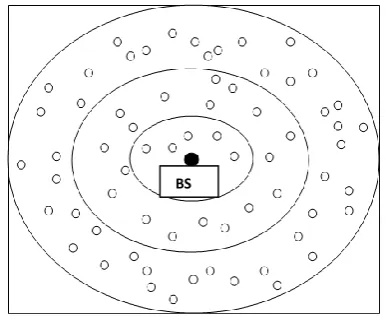
In the vitality preservation clustering calculation execution investigation the levels in light of the quantity of nodes. It comprises of levels where the CH is named as the primary cluster head(PCH) and secondary cluster head(SCH) appeared in figure 1. The primary cluster head is sited at first level of system topology in which PCH send specifically information to base station. while secondary cluster head gets information from part node, process it and send information to the PCH or closer node which is sited at the main Network.
[image:4.595.322.517.406.573.2]Figure 1. Primary and Secondary Cluster Head in WSN.
Figure 2. Data transmission in clustered WSN.
Assumption Scenarios:
1. Sensor nodes are arbitrarily appropriated. 2. The base station is settled at focus position and
territory is separated in the level by specific range.
3. By figuring the Euclidian separation of every node
with the base station and contrasting the level range
the node position is chosen.
4. Cluster development. PCH and SCH are elected.SCH finds close level node or CH to send
[image:4.595.68.290.466.628.2]information appeared in figure3.
Figure 3. Clustered formation in WSN.
5. PCH send information to BS
We think about two sorts of nodes in the framework for the sake of sensor nodes and
less-vitality compelled passage or CH. All
correspondence is over remote connections. A remote connection is built up between two nodes given that just in the event that they at interims shift from each option. Passages directing are able to do whole deal correspondence contrasted with the sensor nodes. All nodes are thought to know about their situation through Global Positioning
Sensor Nodes
Cluster Head
Base Station
267 System (GPS). System setup is performed in two
stages; bootstrapping and clustering. Amid the bootstrapping procedure, all the sensor nodes and passages are allocated one of a kind IDs. Sensor nodes communicate their area and IDs to the passages inside correspondence scope of each other. In this way, the separation from a sensor node to all the doors inside its range is figured. In the clustering stage sink executes the clustering calculation. At the point when the clustering is finished, every one of the sensors are educated about the ID of the entryway they have a place with. Contingent upon the correspondence run between the sensor nodes and the entryways, there can be two sorts limited node and open node. Limited nodes are those sensor nodes, which can speak with one and just a single passage. The confined set is the arrangement of every single limited node in the performance evaluation of the clustering algorithm is as follows. In typical WSNs, sensor nodes are usually resource constrained and battery-limited. Just to save lots of resources and energy, data need to be aggregated to avoid overwhelming selection of traffic within the network. There was extensive give attention to data aggregation schemes in sensor networks. The objective of data aggregation is the fact eliminates redundant data transmission and enhances the duration of energy in the wireless sensor network. Data aggregation is the process of only one or a number of sensors then collects the detection is considered a consequence of another sensor. The collected data must be by the sensor to ease burden before they're towards base station or sink. The wireless sensor network has consisted of three various kinds of nodes, Simple regular sensor nodes, aggregator node, and querier. Regular sensor
nodes sense data packet through the
environmental surroundings and send towards the aggregator nodes basically these aggregator nodes collect data from multiple sensor owned by the network, aggregates the data packet with a couple aggregation functions like sum, average, count, max min and sends aggregates cause upper aggregator node or possibly the querier node who generate the query. It might be the base station or sometimes an additional user having permission to keep in touch with the network. Data transmission between sensor nodes,aggregators combined with querier consumes a large amount of energy in the wireless sensor network. Two models, the original one is data aggregation model And the next reason
is none data aggregation type of which sensor nodes 1, 2, 3,4,5,6 are regular nodes that collecting data packet and reporting reduce it towards the top of nodes where sensor nodes 7, 8 are aggregators that perform sensing and aggregating along the exact same time. In this kind of aggregation model 4 data packet traveled through the entire network and a certain data packet is transmitted towards base station (sink) along with other none data aggregation model also 4 data packet traveled across the network and the thing data packets are brought to the base station (sink), means by utilizing data aggregation process we decrease the quantity of data packet transmission and furthermore save energy in the sensor node inside wireless sensor network. By making use of data aggregation to enhance the duration of the wireless sensor network. Sink possess a data packet with the energy-efficient manner with minimum data latency. So data latency is vital in several applying wireless sensor network as an example environment monitoring, health, monitoring, from where in fact the freshness of information can be quite a necessary factor. This really is important to be able to develop energy efficient data-aggregation algorithms so as that network lifetime is enhanced. There are many kinds of data aggregation approaches to WSN:
1. Cluster-Based Approach: In the vitality obliged sensor systems of gigantic size, it could be wasteful for sensors to give the information right away to the sink. The cluster-based approach is the various leveled approach. In the cluster-based approach, the entire system is separated into various clusters. Each cluster has a cluster-head which is clearly chosen among cluster individuals. Cluster-heads do the part of an aggregator which total information got from cluster individuals locally and transmit the reason base station (sink). As of late, a few cluster-based system association and information conglomeration conventions have just been totally proposed for anybody remote sensor organize. The cluster heads can speak with the sink specifically by means of long-extend transmissions or multi jumping through other cluster heads.
268
conglomeration tree. The kind of tree is least spreading over tree, sink node considers to wind up a root and Source node consider as takes off. Data streaming of data begin with leaves node as much as root implies sink (base station). The disadvantage to the system, similar to remote sensor organize, are regularly not far from add up to disappointment, in the occasion, there's information bundle misfortune at any higher measure of tree, the result will be lost not confined to single level aside from entire related sub tree too. This system is appropriate for outlining ideal collection strategies.
3. Hybrid-Based Approach: The mixture approach took after between the tree and cluster-based plan. In this, the vital point's accumulation structure can alter in regard with specific system circumstance and by some execution. The Routing Algorithm can be comprehensively separated into two stages: 1. Inter-Cluster Routing 2. Intra Cluster Routing. Intra Cluster Routing: Cluster Head checks whether the goal node is inside the Cluster or not.If the node is available inside the cluster than the cluster head sends the RREP answer parcel with its ID implanted in the bundle. Presently, the node advances every one of the information bundles required to be sent to the goal node to the cluster head which advances to the goal. Inter-Cluster Routing: The node is available inside the cluster then the cluster head advances the bundle to the goal node. On the off chance that the node is absent inside a similar cluster then the cluster head finds the area of the goal from GPS and send a RREQ bundle to the entryway nodes toward the goal. The goal is available inside the Cluster of the Gateway nodes. The goal is absent inside the Cluster of the Gateway nodes. Recuperation Routing Whenever a connection separates in a way while sending an information bundle the node at which Link Broken Event happens it stores the information parcel in its reserve and starts a nearby repair method in which the node takes up the errand to discover the course to the specific goal. At the point when the neighborhood node does not get any RREP parcels then it sends a RRER bundle to the source showing the Route disappointment
V. SIMULATION PERFORMANCE
The recreation is utilized OMNet++ to assess
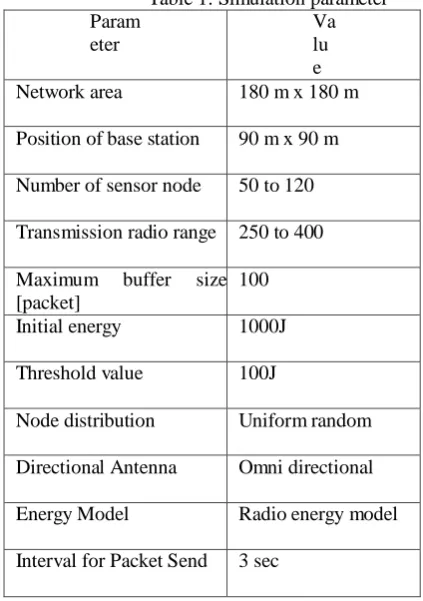
[image:6.595.313.525.266.567.2]the execution of multi-level clustering technique. Parameters utilized for the assessment are appeared in Table1. Rely upon the quantity of node and system zone levels are chosen. The base station is settled at the focal point of the system region. Contingent upon transmission go clusters are shaped. For the assessment, we differ the transmission run by 50 intervals and node number by 10 intervals.
Table 1: Simulation parameter Param
eter
Va lu e
Network area 180 m x 180 m
Position of base station 90 m x 90 m
Number of sensor node 50 to 120
Transmission radio range 250 to 400
Maximum buffer size
[packet]
100
Initial energy 1000J
Threshold value 100J
Node distribution Uniform random
Directional Antenna Omni directional
Energy Model Radio energy model
Interval for Packet Send 3 sec
269
Table 2: Transmission Range Increasing the nodes
Transmissi on range
250 30
0
350 400
No of Nodes
50 8.
89
11.09 21.0
5
26.05
60 8.
73
11.23 19.3
5
24.18
70 9.
32
12.27 18.8
9
22.40
80 9.
58
11.93 17.0
2
20.92
90 9.
25
12.11 15.9
3
19.36
100 9.
61
11.67 15.1
5
19.49
110 9.
39
12.72 14.8
7
18.51
120 9.
33
12.75 14.8
3
17.87
As it saves the vitality of sensor node which prompts an expansion in the system lifetime. Figure 4 demonstrates the relating results in a chart.
A. Execution Metrics
I. Bundle Delivery proportion: It shows the quantity of information parcel effectively exchanged to the separate goal nodes. It is characterized as the proportion of the aggregate number of bundles that have achieved the goal nodes to the aggregate number of parcels sent by the source. ii. System Lifetime: This metric demonstrates the normal measure of time after which the vitality of a node diminishes beneath a limit which in a roundabout way tells that the node is dead. iii. Control overhead: This in a roundabout way the versatility of the convention in light of the fact that lesser is the quantity of control parcels higher is the adaptability of the convention. Here we standardize it with the quantity of information bundles effectively gotten by the goal nodes.
Figure 4: Transmission Range Increasing Graph
VI. CONCLUSION AND FUTURE WORK
Clustering algorithms are vitality productive methodologies for remote sensor arranges as the
algorithm correspondence separations and
endeavour information repetition by information accumulation. Cluster head determination is an imperative issue for vitality productivity of clustering plans. Protection Clustering and Routing Protocol can be actualized with any current dispersed clustering algorithm. This convention parcel the system into two sections: outskirt territory and internal region. Cluster head choice is confined to nodes of inward zone nodes. This
diminishes the intra-cluster correspondence
remove. Recreation investigation demonstrates that Conservation Clustering and Routing Protocol broadened the lifetime of the system as node passing rate and vitality utilization rate of nodes. Our future arrangement incorporates stretching out the clustering model to permit passage versatility. Additionally, we intend to ponder distinctive disappointment situations in sensor organizes and present adaptation to internal failure by giving reinforcement portals in the framework.
REFERENCES
270
[2] J. K. Deepak Keynes and D. S.
Punithavathani, ―Clustering methodology to prolong lifetime in wireless sensor networks,‖ in 2017 International Conference on
Information Communication and Embedded Systems (ICICES), Chennai, India, 2017, pp. 1–8.
[3] S. He, Y. Dai, R. Zhou, and S. Zhao, ―A Clustering Routing Protocol for Energy Balance of WSN based on Genetic Clustering Algorithm,‖ IERI Procedia, vol. 2, pp. 788– 793, 2012.
[4] Kashibai Navale College of Engg, M. S. R.Kuche, and R. . Borhade, ―Enhancing Lifetime of Wireless Sensor Network with Cluster Technique,‖ International Journal of Engineering Trends and Technology, vol. 47, no. 1, pp. 56–59, May 2017.
[5] S. M. Koriem and M. A. Bayoumi, ―Detecting and measuring holes in Wireless Sensor Network,‖ Journal of King Saud University - Computer and Information Sciences, Aug. 2018.
[6] J. N. Al-Karaki and A. E. Kamal, ―Routing techniques in wireless sensor networks: a survey,‖ IEEE Wireless Communications, vol. 11, no. 6, pp. 6–28, Dec. 2004.
[7] N. Rahmani, H. Kousha, L. Darougaran, and F. Nematy, ―CAT: The New Clustering Algorithm Based on Two-Tier Network Topology for Energy Balancing in Wireless Sensor Networks,‖ pp. 275–278, Nov. 2010. [8] O. Younis and S. Fahmy, ―HEED: a hybrid,
energy-efficient, distributed clustering approach for ad hoc sensor networks,‖ IEEE Transactions on Mobile Computing, vol. 3, no. 4, pp. 366–379, Oct. 2004.
[9] G. Raval, M. Bhavsar, and N. Patel, ―Analyzing the Performance of Centralized Clustering Techniques for Realistic Wireless Sensor Network Topologies,‖ Procedia Computer Science, vol. 57, pp. 1026–1035, 2015.
[10] A. A. and E. Al-Zboun, ―EDAC: A Novel Energy-Aware Clustering Algorithm for Wireless Sensor Networks,‖ International Journal of Advanced Computer Science and Applications, vol. 7, no. 5, 2016.
[11] V. Geetha, P. V. Kallapur, and S. Tellajeera, ―Clustering in Wireless Sensor Networks: Performance Comparison of LEACH & LEACH-C Protocols Using NS2,‖ Procedia Technology, vol. 4, pp. 163–170, 2012.
[12] S. Sharma, D. Puthal, S. K. Jena, A. Y. Zomaya, and R. Ranjan, ―Erratum to: Rendezvous based routing protocol for wireless sensor networks with mobile sink,‖ J Supercomput, vol. 73, no. 3, pp. 1189–1191, Mar. 2017.
[13] D. Agrawal and S. Pandey, ―FUCA: Fuzzy-based unequal clustering algorithm to prolong the lifetime of wireless sensor networks,‖
International Journal of Communication Systems, vol. 31, no. 2, p. e3448, Jan. 2018.
[14] M. Tong and M. Tang, ―LEACH-B: An Improved LEACH Protocol for Wireless Sensor Network,‖ in 2010 International Conference on Computational Intelligence and Software Engineering, Chengdu City, China, 2010, pp. 1–4.
[15] Z. Ji, L. Cai, and L. Hong, ―Load-Balanced Unequal Clustering Algorithm in UWB-Based Wireless Sensor Network,‖ in 2009
International Conference on Information Technology and Computer Science, Kiev, Ukraine, 2009, pp. 196–200.
[16] A. Mahboub, M. Arioua, E. M. En-Naimi, and I. Ez-Zazi, ―PERFORMANCE EVALUTION OF ENERGY-EFFICIENT CLUSTERING ALGORITHMS IN WIRELESS SENSOR NETWORKS,‖ . Vol., p. 8, 2005.
[17] V. Pal, G. Singh, and R. P. Yadav, ―SCHS: Smart Cluster Head Selection Scheme for Clustering Algorithms in Wireless Sensor Networks,‖ Wireless Sensor Network, vol. 04, p. 273, Nov. 2012.
[18] N. M. Moghaddam, A. S. Zahmati, and B. Abolhassani, ―Lifetime Enhancement in WSNs using Balanced Sensor Allocation to Cluster Heads,‖ in 2007 IEEE International Conference on Signal Processing and Communications, Dubai, United Arab Emirates, 2007, pp. 101–104.
[19] R. Raj Priyadarshini and N. Sivakumar, ―Cluster head selection based on Minimum Connected Dominating Set and Bi-Partite inspired methodology for energy conservation in WSNs,‖ Journal of King Saud University - Computer and Information Sciences, Aug. 2018.
271
[21] A. Pawar, ―Secure and Efficient Data
Transmission in Cluster based Wireless Sensor Network,‖ p. 11, 2015.
[22] Huang Lu, Jie Li, and M. Guizani, ―Secure and Efficient Data Transmission for Cluster-Based Wireless Sensor Networks,‖ IEEE Transactions on Parallel and Distributed Systems, vol. 25, no. 3, pp. 750–761, Mar. 2014.