TAGARAB: A Fast, Accurate Arabic Name Recognizer
Using High-Precision Morphological Analysis
J o h n M a l o n e y a n d M i c h a e l N i v
SRA International Corp.
4300 Fair Lakes Court
Fairfax, VA 22033
{j o h n u n a l o n e y , m i c h a e l _ n i v } @ s r a , c o m
Abstract
W e describe a fast, high-performance n a m e rec- ognizer for Arabic texts. It combines a pattern- matching engine and supporting data with a mor- phological analysis component. The role of the mor- phological analysis in accurate n a m e recognition is discussed. VCe also provide evaluations of both mor- phological analysis and n a m e recognition.
1 Introduction
1,1 R o a d m a p
Arabic n a m e d entity recognition in texts in Arabic script is, to our knowledge, a little researched topic. I In this paper we describe a system, T A G A R A B , that uses a generic pattern-matching engine, SRA's NetOwl TurboTag
TM,
combined with an integrated morphological analysis process, which recognizes names at a high level of accuracy. 2 W e first discuss the factors involved in recognizing names in Arabic. W e then present a system description, focussing on the morphological analysis and the n a m e recogni- tion components. W e also report the results of our evaluations of each component's performance.Finally, we discuss the contribution of the mor- phological analysis to the n a m e recognition. 1.2 B a c k g r o u n d to Arabic N a m e
R e c o g n i t i o n
N a m e r e c o g n i t i o n has e m e r g e d as a n N L P technol- o g y t h a t is effective a n d can p r o v i d e high value t o several different k i n d s o f a p p l i c a t i o n s , such as clus- t e r i n g a n d s u m m a r i z a t i o n ( A o n e a n d M a l o n e y , 1997; A o n e et al., 1997). D e v e l o p m e n t o f such a c a p a b i l i t y for A r a b i c involved m e e t i n g s o m e new challenges.
Like o t h e r S e m i t i c w r i t i n g s y s t e m s , A r a b i c does n o t e x h i b i t differences in o r t h o g r a p h i c case. Un-
1 "Named entity recognition" is meant in the sense familiar from the Message Understanding Conferences (MUC) and the Muhilingual Entity Task (MET). It refers to the identification and categorizing by type in unformatted text of names of persons, entities, and locations, as well as of numerics such as percentages and times/dates. In the following, we use "name" loosely in the same s e n s e .
2 This work has been funded by the Department of Defense, Contract No. MDA904-97-C-3065.
like in English-language mixed-case texts, therefore,
there is no obvious clue such as initial capitalized let-
ters
to i n d i c a t e t h e presence o f a n a m e c o n s t i t u e n t . In o u r e x p e r i e n c e w i t h T h a i a n d o t h e r non-case w r i t i n g s y s t e m s , t h i s seems t o effectively i m p o s e a r e q u i r e m e n t t h a t t h e r e b e s o m e u n d e r s t a n d i n g o f t h e m o r p h o l o g i c a l n a t u r e o f each token - - espe- cially p a r t - o f - s p e e c h i n f o r m a t i o n . H a v i n g some m o r - p h o l o g i c a l i n f o r m a t i o n allows one to m a k e distinc- t i o n s b e t w e e n likely a n d u n l i k e l y n a m e c o n s t i t u e n t s , which is p a r t i c u l a r l y i m p o r t a n t when deciding where a n a m e ends a n d t h e n o n - n a m e c o n t e x t begins.W e p a r t i a l l y m o t i v a t e this for A r a b i c as follows: 3
• Closed-class i t e m s are rarely, if ever, p a r t o f an A r a b i c p r o p e r n a m e : [Hasan f% w i t h a p r e p o s i - tion in s e c o n d p o s i t i o n , seems an unlikely A r a - bic n a m e . 4
• Inflected forms o f verbs are r a r e l y p a r t of p r o p e r n a m e s : [ y a t a 9 a l l a m u ] , "he learns," is n o t a per- m i s s i b l e n a m e c o n s t i t u e n t . 5
• M a n y lexical i t e m s , o f course, are n o t used, or h i g h l y u n l i k e l y t o b e used, in p r o p e r n a m e s : verbs o f s p e a k i n g or c o g n i t i o n , for e x a m p l e , d o n o t a p p e a r to o c c u r in n a m e s a n d t h e y do n o t f r e q u e n t l y o v e r l a p in a p p e a r a n c e w i t h p r o p e r n a m e c o n s t i t u e n t s : [ m u H a m m a d qultu] is an u n l i k e l y n a m e .
• I t e m s w i t h s u b j e c t or o b j e c t suffixes are rarely, if ever, p a r t o f n a m e s : [ y u k a a t i b u h u ] , "He will c o r r e s p o n d w i t h h i m . ''6
SThe Arabic source used in this work was the newspaper
AI-Hayat
4 We will usually vocalize Arabic for the sake of ease of com- prehension (marked with square brackets), but will present it in consonantal transliteration when appropriate (marked with italics). Unobvious symbols: t = t h a , H = voiceless pharyn- gem fricative; 9 = voiced pharyngeal fricative; $ = alif without h~rt'tza.
SThere are some ism names that contain, at least histor- ically, imperfect verb forms, such as [yaz~d], "he increases." cf. Schimmel 1 9 8 8 , (p. 1).
In addition, there are many positive cues, such as titles, frequent given names, and so forth, that allow a system to identify names, but some morphological characterization of non-name portions is of critical importance. We will discuss this in more detail be- low in Section 4.
2 S y s t e m D e s c r i p t i o n
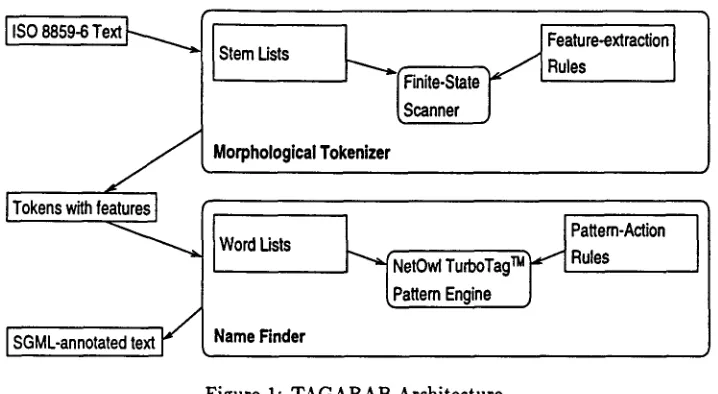
Figure 1 contains the architecture of TAGARAB. Our system has two major modules: a Morpho- logical Tokenizer and a Name Finder. The Mor- phological Tokenizer has the ability, in addition to performing lexical scanning that establishes word- level units, to add morphological features to tokens. Text encoded in ISO-8859-6 is first passed through this tokenizer and then the tokenized stream is pro- cessed by the Name Finder module which identifies names and other extraction targets and annotates the text with appropriate SGML tags for each ex- tracted item.
2.1 M o r p h o l o g i c a l Tokenlzer 2.1.1 D e s c r i p t i o n
The Morphological Tokenizer's basic task is to iden- tify the sequences of words, punctuation symbols, numbers, existing SGML tags, etc., that comprise the input text. For each such "token," a descrip- tion of what it has found is returned as a vector of up to 32 application-definable bits (e.g., PUNC- TUATION, WORD, NUMBER). The Tokenizer is a very fast program, generated using the Flex scanner- generator from a tokenizer specification.
We decided to augment the tokenizer's usual role. While it still finds numbers and punctuation tokens, it treats an Arabic word (a contiguous sequence of Arabic letters) as a collection of one or more mor- pheme tokens, each with its own bit-vector of prop- erties. The properties include those listed above, as well as morphology-specific properties whose nature and linguistic motivation is discussed in the next sec- tion.
Making the morphological analysis part of tok- enization has the advantage of maintaining the high speed of SRA's TurboTag. An external morphol- ogy module - - with a high computation overhead
- - would degrade performance.
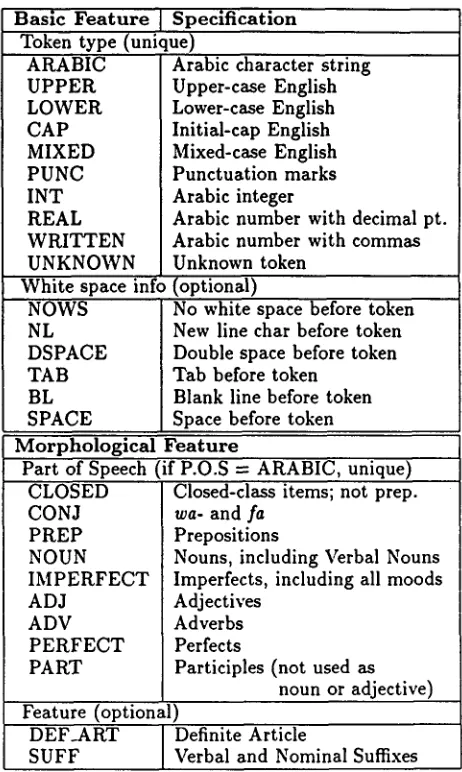
Table 1 contains the features identified by the to- kenizer.
Each token in the text receives some subset of the lexical types in Table 1. For example, a string such as
$rbh,
phonetically [~aribahu], "he drank it," receives the tokenizer types ARABIC, PERFECT, and SUFFIX. The first type means that the token comprises Arabic letters, the second that it is a Per- fect verb form, and the third that there is a suffix attached. Note that in this case, the string is not broken up into pieces, such as stem and suffix. It re-B a s i c F e a t u r e [ Specification Token type (unique)
A R A B I C U P P E R L O W E R C A P M I X E D P U N C INT R E A L W R I T T E N U N K N O W N White space info
NOWS NL DSPACE TAB BL SPACE
Arabic character string Upper-case English Lower-case English Initial-cap English Mixed-case English Punctuation marks Arabic integer
Arabic number with decimal pt. Arabic number with commas Unknown token
(optional)
No white space before token New line char before token Double space before token Tab before token
Blank line before token Space before token M o r p h o l o g i c a l F e a t u r e
Part of Speech (if P.O.S -- ARABIC, unique) C L O S E D
C O N J P R E P N O U N I M P E R F E C T A D J
A D V P E R F E C T P A R T
Closed-class items; not prep.
wa-
andfa
Prepositions
Nouns, including Verbal Nouns Imperfects, including all moods Adjectives
Adverbs Perfects
Participles (not used as noun or adjective) Feature (optional)
DEF_ART Definite Article
SUFF Verbal and Nominal Suffixes Table 1: Tokenizer Features for Arabic
mains a single token with information being added as to what the component pieces are. The only cases where the tokenizer splits off pieces of a string are where there is an attached conjunction
(wa
or fa) or an attached preposition(la, ba, ka),
or both. In these cases, in place of an original string such as orthographicwq$1,
phonetic [waq£1a], "and he said," there will he two separate tokens: [wa] with the type information ARABIC and CONJ, and [q~la] with the type information ARABIC and PERFECT.Some of these tokenizer types are exclusive, such as P E R F E C T and I M P E R F E C T . A token cannot be both simultaneously. Others, however, such as N O U N and D E F _ A R T , can both be applied to a token.
2.1.2 Implementation
[image:2.612.304.535.70.456.2]I ISO 8859-6 Text I" ~ . .
f
I Tokens with features
]I SGML-annotated
text
Stem Usts
Morphological Tokenizer
~
Feature-extraction
Rules
Word Usts
Name Finder
~rNetOwl
_ J Pattern-Action
TurboTagTM
~.t I Rules
( Pattem Engine J
Figure 1: TAGARAB Architecture
develop and refine the patterns needed to recognize the various morphological word-shapes. When we plugged this version of the morphological analyzer into the original tokenizer, however, processing was quite slow due to the sequential nature of our mor- phological patterns and the backtracking nature of Perl's regular expression matcher. To compensate, we incorporated the morphological functionality di- rectly into the Flex specification of the tokenizer. Whenever the Flex-generated scanner identifies an Arabic word, it dispatches the appropriate regular- expression to extract the separate morphemes from that word - - a task that is beyond the capability of Flex.
The result is the fastest Arabic morphological an- alyzer we are aware of: The overall processing rate for TAGARAB is approximately 46 megabytes/hour on a Sun Ultra 1. Morphological processing by itself runs at about 190 megabytes/hour.
2.1.3 L i n g u i s t i c D e s i g n
We had originally planned to develop a morpholog- ical capability that would be helpful in improving name recognition, as discussed in Section 1.2. In the following, we discuss the linguistic design of the morphological analysis.
Arabic is a highly inflected language. We be- lieved that there are frequently enough surface cues in the shape of an Arabic word ~ to allow the as- signment of the kind of morphological information described in Section 2.1.1. For example, inflected forms of derived verb stems such as [yaftatiHu], "he inaugurates," would seem to have an orthographic "shape" that is fairly unique in an Arabic text. We felt that this information could be exploited to sue- cessfully identify tokens as nouns, verbs (perfects or
imperfects), etc., to a sufficiently reliable extent that the later name-recognition patterns could effectively make use of it.
The morphological analysis process consists of a series of regular expressions partially supported by lists of noun, verb, and adjective stems, as well as closed-class items. The regular expressions cover all allowable prefixes and suffixes for each stem type. Infixation phenomena, however, such as the infixed of the Eighth Verbal Form, s are handled as variant forms in the verb stem list e.g.,
'gtbr,
"he consid- ered" and9br,
"he crossed." No attempt is made to handle co-occurrence constraints among prefixes and suffixes, nor to assign voice. Likewise, no at- tempt is made to include contextual information, as is done with standard part-of-speech taggers. There is no attempt to handle ambiguity: The regular ex- pression patterns are ordered, and the search for an analysis of a word stops at the first match. The token types are then assigned, and the form is not submitted to any other regular expressions.Not all Arabic tokens are hit by one of these regular-expression patterns that provide morpholog- ical features. Although there is a mix of patterns supported by lexical information and patterns that operate entirely by rule (no supporting lexical data), the vast majority of matches appear to occur with the former set of patterns. In other words, the cover- age of the morphological analysis is crucially depen- dent on the lexical data. There are 1051 noun forms, 813 verb forms, and 241 adjective forms. There is also a comprehensive list of closed-class items. The notion of "lexical item" in TAGARAB's lists is somewhat similar to the listing principle found in Landau : broken plural forms for nouns and ad-
rTAGAFtAB deals exclusively with t h e w r i t t e n forth, i.e., w i t h o u t i n d i c a t i o n o f s h o r t vowels.
SWe use t h e usual t e r m s for t h e s e forms found in W e s t e r n
g r a m m a r s .
[image:3.612.119.478.71.268.2]jectives receive an independent entry, much like dif- ferent stems of verbs as mentioned previously. We make no effort to distinguish I and II forms of verbs, as these are not usually distinguished orthographi- cally in AI-Hayat. In general, if there is no visible orthographic distinction in normal Arabic prose, we do not make a distinction in the lexical data.
We also entered forms both with and without
hamza, as in AbHayat any form that may receive
a hamza may also appear without it (even in t h e same text!).
Another important feature is that we entered only what seemed to us to be frequent lexical items in the lexical lists, and tried to do it in such a manner that what seemed intuitively the most likely reading of a form would be the one selected. This makes sense in the case of such a highly deterministic morphology and also given our time and resource constraints. We wanted to ensure that we got the right readings for a large number of highly frequent items, as this would be the most useful way to constrain the name- recognition patterns. Many high-frequency common nouns, verbs, adjectives, and other parts of speech in Arabic do not usually form part of names. As it turned out (See Section 4 below), this strategy worked quite well with person names but was less significant for organization names.
We also decided not to enter items that are used directly by the later name-recognition patterns, such as locations and given names, as these are accessed by the patterns through that module's own word lists and therefore having a morphological reading for them is not important (see Section 2.2).
In addition to the supporting lexical data, the or- dering of the regular expressions also aided in de- termining the analysis selected. T h e regular ex- pressions are grouped functionally, and in general the ones pertaining to closed class items apply first, then nouns, adjectives, perfects, and imperfects in that order. This had the effect that items which are highly "marked" as belonging to one category (e.g., verbs with a double pronominal object) would be captured appropriately by a verb-recognizing regu- lar expression that looks for such suffixes, but that items that are not so highly marked (e.g., a simple third-person masculine perfect form) would be bi- ased towards a reading according to the order of the regular expressions.
We were pleasantly surprised to learn that this kind of approach - - although obviously simplistic in some ways - - produces a very high level of precision in analysis (i.e., the parts of speech assigned tend strongly to be correct) and surprisingly good recall (i.e., there is good coverage of the corpus). We dis- cuss our empirical results in Section 3.
In addition, the morphological information thus produced contributed substantially to the effective-
ness of the name-recognition patterns. We discuss this in Section 4.
2.2 N a m e F i n d e r
The Name Finder module of TAGARAB (see Fig- ure 1) uses as input the tokens found by the Mor- phological Tokenizer with the basic and morpholog- ical features attached. The pattern-matching engine is SRA's NetOwl TurboTag T M . It uses data con- sisting of a set of Pattern-Action rules supported by Word Lists. The latter consists of items such as personal titles that are used by the patterns to recognize names. The Pattern-Action rules use con- textual and structural information about names to recognize them dynamically. They also make exten- sive use of the feature information coming from the Morphological Tokenizer. There is minimal perma- nent storage of names.
The Pattern-Action rules are written in a conve- nient specification language. They are not compiled, but are read at run time as part of engine initializa- tion.
3 E v a l u a t i o n 3.1 M o r p h o l o g y 3.1.1 P r e p a r a t i o n
To evaluate the quality of the morphological anal- ysis, we used SRA's tagging tool, TagTool TM, to manually tag a set of documents for morphological analysis and part of speech. 9
For this test document set, we randomly selected fourteen texts from the AI-Hayat CD-ROM not be- longing to the name recognition training or testing sets. In addition to manually tagging them, we also ran TAGARAB over these fourteen texts and used a standard MUC-style scoring program to compare the morphological output of TAGARAB with the "answers" in the hand-tagged version.
3.1.2 T a g g i n g R u l e s
We hand-tagged every token in the text, except for: s Punctuation, Digits
s Tokens within person names • Person titles
* Locations
• Location adjectives (e.g., [kuwayd], ~ubn~n;])
• Adverbs or accusative forms of nouns or adjec- tives m a r k e d by
fatHafayn.
°Because of staiTmg constraints and need for knowledge of Arabic, the same person worked on both the development of the morphology component, the name patterns, and also h a n d - t a g g e d t h e test set. To r e m o v e as far as possible any taint, we did not change the s y s t e m or any supporting data
These exceptions exist because the morphology component did not attach features to these items for the reasons given in Section 2.1.3. As a result of not hand-tagging them, the scoring program judged as spurious any morphological features found by the system for such items.
We tagged the test set contextually, again in ac- cordance with the design of the morphological com- ponent. The most important effect was on the fea- ture PART. We found participles which act usu- ally as a noun, (e.g., [al-ma~rfig], "the plan", [al- muwaz.z.af], "the employee"), usually as an adjective (e.g., [al-bayt al-majhfil], "the unknown house") or seem to be freely used in either reading (e.g., [mus- lim], "Muslim,"). We tagged these participles con- textually as nouns or adjectives. One effect of this was that the number of items tagged as participles was quite low (in effect, only when they are used predicatively).
In all, the evaluation corpus contains 3214 tokens, of which 2324 are Arabic words. 1879 of the latter received morphological features when hand-tagged. 3.1.3 M o r p h o l o g y E v a l u a t i o n
The scores for the morphology component are given in Table 2. l°
Since we did not have access to a morphologi- cal analyzer that produces all possible readings for forms based on a large lexicon, we do not have a pic- ture of the total morpho-lexical ambiguities in our evaluation texts. However, despite the small lexicon we manually built, the overall recall is reasonable (73.0%), and it also holds up well for most of the major open class items: perfects (72.7%), imperfects (60.2%), and nouns (66.8%). The low recall in ad- jectives (28.8%) is due to the fact that we did not make many lexical entries for adjectives. Since ad- jectives do not come first in the Arabic noun phrase, and since we use the morphological information to constrain the name patterns, tagging the head noun in a noun phrase is what is generally necessary, not tagging the adjective.
What is striking in the above table is the high pre- cision across all the categories, with the exception of adjectives and participles, the latter a very small set for the reasons set out in Section 3.1.2. Preci- sion is consistently above 90%. We interpret this to mean that a manually built system with a moderate lexicon, having the capacity to only select one read- ing for a given form and not paying any attention l°The colunm headings are the standard ones from MUC: POS: possible number of points (one point for identifying a constituent boundary, another for identifying its category), ACT: actual responses given, COP,: correct answers, PAR: boundary errors, INC: category labelling errors, SPU: re- sponses given that are not in answer key, MIS: items in key missing from response, REC: recall (COR/POS), PRE: preci- sion (COR/ACT), F-M: f-measure ((2. PRE. REC)/(PRE + REC)).
to a word's context, is capable of a very significant amount of morphological disambiguation in Arabic. Our results are also consistent with the results of Levinger et al. for the structually similar He- brew. Levinger et ai. discovered that non-context- based morphological analysis preferring the most likely morpho-lexical analysis (generated using a sta- tistical algorithm) gives extremely good results.
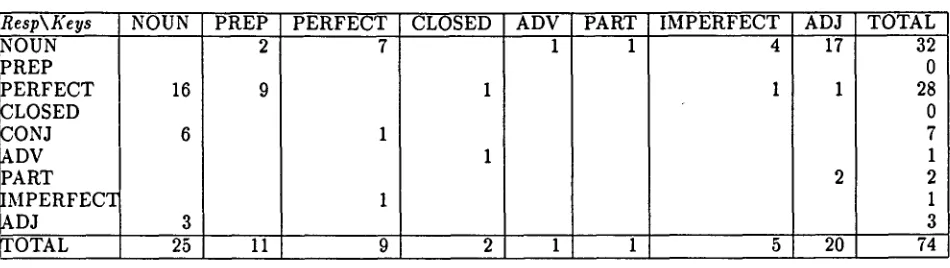
Table 3 shows the collisions among the tags. The most common confusions were between per- fects and nouns in both directions. The system tagged the following tokens as nouns where the human tagged them as perfects: n~r (2x), "he/it published," bgJ, "he/it sent," Hd_t, "it happened,"
w.sflhm, "we described them," 11 .sdrt, "was issued, appeared," wSs.l, "he/it continued."*2
Conversely, there were 16 cases where TAGARAB considered a token as a perfect, and the human tagged it as a noun. As with the previous case, the great majority were confusions of the perfect with a derivationally related noun or verbal noun (e.g.,
qtl, "he killed" or "killing.") Despite the small num- bers of such collisions in the sample, it seems to us that this is the most difficult disambiguation task, at least at the part of speech level, since verbal nouns plus the semantic subject or object in an i.d~fa con- struction can look much like a finite verb plus sub- ject or object. Clearly, context or a higher level of s y n t a c t i c / s e m a n t i c understanding is required to dif- ferentiate the two readings.
On the other hand, the other major confusion revealed by this table, Noun/Adjective and Adjec- tive/Noun, is one that seems easily remedied by building in some knowledge of short context into the morphology component. For example, the fol- lowing three examples (and the rest resemble these) are cases where the system selects a noun reading for the adjective within the scope of a noun phrase: [lgji'fina muslimfin], "Muslim refugees," [bi.sfiratin x a ~ a ] , "in a special form," [mu'tamaruhu al-s.iHgfi], "his news conference." In these cases, the adjectives also have noun readings, but the local context shows clearly which reading is correct.
These results identify specific areas of morpho- lexical ambiguity bringing into focus where addi- tional contextual cues are needed for better ambi- guity resolution.
3 . 2 E v a l u a t i o n o f N a m e P a t t e r n s
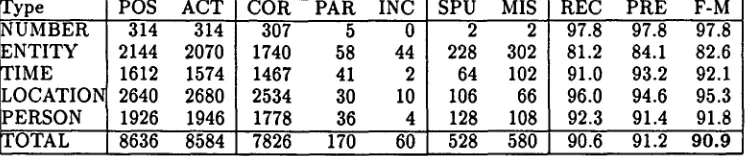
The scores for the name recognition in TAGARAB over the training set of texts are given in Table 4. T h e blind scores are given in Table 5.
n I n this case, TAGARAB had identified the initial w as the conjtmtion wa and the rest of the string as a noun, #flhm,
"their property."
nSimilar to w.sflhm. TAGARAB took the inital w as the conjunction and took the rest of the string as a noun.
V
Type ZLOSED P E R F E C T ~ONJ PREP ADJ
PARTICIPLE [MPERFEC• A D V
N O U N FOTAL
POS A C T 336 326 300 240 286 306 772 696 320 136
12 8
186 124
32 28
1514 1072 3758 2936
COR PAR INC
322 0 4
218 0 18
284 0 0
674 0 22
92 0 40
6 0 2
112 0 10
26 0 2
1011 1 50
2745 1 148
SPU MIS
0 10
4 64
22 2
0 76 4 188
0 4
2 64
0 4
10 452 42 864
R E C PRE F-M 95.8 98.8 97.3 72.7 90.8 80.7 99.3 92.8 95.9 87.3 96.8 91.8 28.8 67.6 40.4 50.0 75.0 60.0 60.2 90.3 72.3 81.2 92.9 86.7 66.8 94.3 78.2 73.0 9 3 . 5 82.0
Table 2: Final Scores for Morphological Tokenizer (see footnote 10)
Resp\Keys
NOUN PREP PERFECT CLOSED CONJ ADV PART IMPERFEC~I ~ D J
NOUN PREP
2 16
6
PERFECT CLOSED
7
3
~OTAL 25 11 9
ADV PART IMPERFECT
1 1 4
1
2 1 1
ADJ 17
5 20
TOTAL 32 0 28 0 7 1 2 1 3 74
Table 3: Morphological Tag Collisions (Rows=System Responses; Columns=Keys)
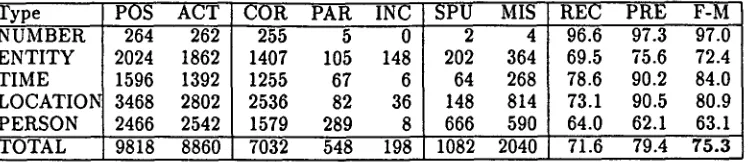
Pattern performance followed our experience with other languages, except for the recognition of time expressions. Usually, these scores run in the mid- to high-nineties on a test corpus, but the rich vari- ety of time and date formulas hindered scoring very high here. The scores for Arabic are consistent with scores for other languages (Thai, Chinese, Japanese) where there is no orthographic case information.
4
Contribution of Morphology to
Name Recognition
As described in Section 2.2, name recognition is per- formed by a set of Pattern-Action rules ("patterns") supported by data in the form of word lists, and in the case of TAGARAB, reliance on morphological information.
To investigate the role of the latter in support- ' ing name recognition, we performed an experiment where we turned off the morphological analyzer por- tion of the tokenizer to see what the impact on the patterns would be. "Turning off" the morphology simply means that we substituted a tokenizer that does not cleave off clitics, and only generates the to- ken types under Basic Feature in Table 1 and none of those under Morphological Feature. This had the effect that name-finding patterns which had previ- ously accessed the morphological features provided
by the tokenizer could no longer do so. The pat- terns themselves were not changed in any way. The results are contained in Table 6. It should be com- pared with Table 5.
NUMBER and TIME do not show much change with morphological token information removed. This is not surprising, since the patterns identifying these elements rely on word lists of month names, written-out numerals, etc. We handled the different inflected forms of such items as words for time units ([9~m], "year," etc.) by simply listing all possibilites (singular, dual, plural, masculine, feminine) as sepa- rate entries. This is a reasonable strategy given the relatively small number of inflected forms for these items. In addition, relying on "static" word lists rather than "dynamically" generated morphological information coming from the tokenizer reduces the risk of error.
[image:6.612.106.487.59.188.2] [image:6.612.67.542.221.355.2]t y p e NUMBER ENTITY rIME LOCATIOI~ PERSON
POS A C T 314 314 2144 2070 1612 1574 2640 2680 1926 1946
COR P A R INC
307 5 0
1740 58 44
1467 41 2
2534 30 I0
1778 36 4
SPU MIS
2 2
228 302 64 102 106 66 128 108
REC P R E F-M 97.8 97.8 97.8 81.2 84.1 82.6 91.0 93.2 92.1 96.0 94.6 95.3 92.3 91.4 91.8
TOTAL 8636 8584 7826 170 60 528 580 90.6 91.2 90.9
t y p e NUMBER E N T I T Y TIME LOCATIOtq PERSON TOTAL
Table 4: Name Recognition POS
264 2024 1596 3468 2466 9818
ACT COR PAR
262 256 4
1880 1557 77 1416 1288 60 3128 2957 61 2180 1879 157 8866 7937 359
Scores for Arabic: Training Set INC
0 84 4 20 16 124
SPU 2 162 64 90 128 446
MIS REC P R E 4 97.0 97.7 306 76.9 82.8 244 80.7 91.0 430 85.3 94.5 414 76.2 86.2 1398 80.8 89.5
F-M 97.3 .... 79.8 85.5 89.7 80.9 85.0
Table 5: Name Recognition
available a list of titles and given names which served as the major indicators of the presence of a personal name. For the remainder of the name, consisting of an uncertain number of tokens extending out beyond the given name, there was not much to distinguish where the name ended and the non-name context be- gan, except the morphological information provided by the tokenizer.
Islamic names involving elements such as [ibn], [bin], [abu], etc., were exploited as much as possi- ble, but names with these elements were surprisingly rare in the
AI-Hayat
articles. 13In effect, the patterns recognizing person names relied heavily on the presence of any morphological feature to rule out a given token as being part of the personal name. Without this information, there was, for example, a huge increase in the number of spu- rious names (names tagged by TAGARAB but with no equivalent in the human-tagged keys; under the SPU column in the score reports): One typical ex- ample is the vocalized string [mudir al-9amaliygt al- siy~s~ya], "Director of Political Operations," which the system took as a name, but which is actually an appositive to a preceding actual person name. T h e word [mud~r] is on the title list signalling the onset of a name and there is nothing to constrain the next two tokens from being consumed. If morphological type information were available signalling that [al- 9amaliy~t] is not a likely name constituent, then the pattern would not have succeeded.
There was also increase in boundary errors (un-
lZWe do n o t h a v e direct s t a t i s t i c s o n different n a m e t y p e s in the source (e.g., Islamic, R u s s i a n ) . However, we do h a v e
s t a t i s t i c s on the relative yields of t h e p a t t e r n s , which are or- ganized themselves in t e r m s of n a m e t y p e s .
Scores for Arabic: Blind Set
der the PAR column in the score reports). These were those cases where the name pattern "didn't know where to stop," as in [al-sayyid muHammad al- baGd~d~ ka'annahu], where the last element would have received the feature CLOSED from the Mor- phological Tokenizer since it is a subordinating con- junction with a person suffix. A further side-effect of such a boundary error, as well as the spurious names, is that an element such as [ka'annahu], once it is considered part of a name by the system, will be used to recognize variant short forms of that name. This has the result that any [ka'annahu] in the arti- cle is subject to being classified as a person name.
By contrast with person names, the patterns gen- erating entity names were less affected by the lack of morphological information since they were able to exploit more specific name structure. For example, a pattern for a specific class of entity names might include both the initial word [majlis], "council," and have as final boundary marker an element such as a location adjective. The latter is a separate word list independent of the morphological component of the system. In effect, there are more specific structural indicators of entity names than there are of person names, so the patterns are written differently, with less reliance on morphological information.
T h e final category of names, LOCATION, shows a large increase in missing names (under the column MIS in the score reports). The reason for this might not be obvious, since location names do not receive any morphological features (see 2.1.3). However, the morphological capability within TAGARAB identi- fies clitic items such as the conjunctions [wa] and [fa], as well as the prepositions [ba], [la], and [ka], as described above in Section 2.1.1. If there is no mot-
[image:7.612.112.486.62.140.2]Type
N U M B E R ENTITY T I M ELOCATION P E R S O N tOTAL
POS ACT
264 262 2024 1862 1596 1392 3468 2802 2466 2542 9818 8860
COR PAR INC
255 5 0
1407 105 148
1255 67 6
2536 82 36
1579 289 8
7032 548 198
SPU MIS
2 4
202 364 64 268 148 814 666 590 1082 2040
R E C P R E F-M 96.6 9 7 . 3 97.0 69.5 7 5 . 6 72.4 78.6 9 0 . 2 84.0 73.1 9 0 . 5 80.9 64.0 6 2 . 1 63.1 71.6 79.4 75.3
Table 6: Name Recognition Scores for Arabic Without Morphological Features: Blind Set
phological capability, then these clitics are not rec- ognized anywhere. This has the effect that location names with a clitic attached will not be recognized, since the system no longer tokenizes the location as a separate item.
Annemarie Schimmel, Islamic Names. Edinburgh University Press. Edinburgh, 1989.
5
Summary
We have described a system for recognizing names, dates, times, and numerics in Arabic-language text through a combination of high-precision morpholog- ical analysis and a subsequent component that iec- ognizes the named entities. Although highly deter- ministic and not taking account of context, the mor- phological analysis component removes a great deal of morpho-lexical ambiguity and has the side-effect of demonstrating that the true difficulties in Arabic morphological ambiguity might be limited to specific contexts.
In addition, we have shown that named entity recognition in Arabic can be performed at levels con- sistent with other non-case languages despite great differences in structure between them. Finally, we have shown that morphological information is cru- cially important to effective Arabic name recogni- tion.
R e f e r e n c e s
Chinatsu Aone and John Maloney: "Reuse of a Proper Noun Recognition System in Commercial and Operational NLP Applications," in Proceed- ings of ACL'97 Workshop on From Research to Commercial Applications: Making NLP Technol- ogy Work in Practice, Madrid, Spain, 1997. Chinatsu Aone, Mary Ellen Okurowski, James Gor-
linsky, and Bjornar Larsen: "A Scalable Summa- rization System Using Robust NLP," in Proceed- ings of ACL'97 Workshop on Intelligent Scalable Text Summarization, Madrid, Spain, 1997. Jacob Landau. A Word Count of Modern Arabic
Prose. American Council of Learned Societies, New York, 1959.
Moshe Levinger et al. "Learning Morpho-Lexieal Probabilities from an Untagged Corpus with an Application to Hebrew." Computational Linguis- tics, Vol. 2113, 1995.
[image:8.612.113.487.56.137.2]