Extracting structured data from invoices
Xavier Holt * Sypht
Andrew Chisholm * Sypht
Abstract
Business documents encode a wealth of information in a format tailored to human consumption – i.e. aesthetically disbursed natural language text, graphics and tables.
We address the task of extracting key fields (e.g. the amount due on an invoice) from a wide-variety of potentially unseen document formats. In contrast to tradi-tional template driven extraction systems, we introduce a content-driven machine-learning approach which is both robust to noise and generalises to unseen docu-ment formats. In a comparison of our ap-proach with alternative invoice extraction systems, we observe an absolute accuracy gain of 20% across compared fields, and a 25%–94% reduction in extraction latency.
1 Introduction
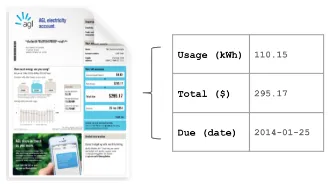
To unlock the potential of data in documents we must first interpret, extract and structure their con-tent. For bills and invoices, data extraction enables a wide variety of downstream applications. Ex-traction of fields such as the amount due and biller information enable the automation of in-voice payment for businesses. Moreover, extrac-tion of informaextrac-tion such as thedaily usageor
supply chargeas found on an electricity bill (e.g. Figure 1) enables the aggregation of usage statistics over time and automated supplier switch-ing advice. Manual annotation of document con-tent is a time-consuming, costly and error-prone process (Klein et al., 2004). For many organi-sations, processing accounts payable or expense claims requires ongoing manual transcription for
[image:1.595.333.497.220.312.2]* Authors contributed equally to this work
Figure 1: Energy bill with extracted fields.
verification of payment, supplier and pricing in-formation. Template and RegEx driven extrac-tion systems address this problem in part by shift-ing the burden of annotation from individual doc-uments into the curation of extraction templates which cover a known document format. These ap-proaches still necessitate ongoing human effort to produce reliable extraction templates as new sup-plier formats are observed and old formats change over time. This presents a significant challenge – Australia bill payments provider BPAY covers 26,000 different registered billers alone1.
We introduce SYPHT – a scaleable machine-learning solution to document field extraction. SYPHTcombinesOCR, heuristic filtering and a su-pervised ranking model conditioned on the con-tent of document to make field-level predictions that are robust to variations in image quality, skew, orientation and content layout. We evaluate sys-tem performance on unseen document formats and compare 3 alternative invoice extraction systems on a common subset of key fields. Our system achieves the best results with an average accuracy of 92% across field types on unseen documents and the fastest median prediction latency of 3.8 seconds. We make our system available as anAPI2 – enabling low latency key-field extraction scal-able to hundreds of document per second.
1
2 Background
Information Extraction (IE) deals broadly with the problem of extracting structured information from unstructured text. In the domain of invoice and bill field extraction, document input is often bet-ter represented as a sparse arrangement of multiple text blocks rather than a single contiguous body of text. As financial documents are often themselves machine-generated, there is broad redundancy in this spatial layout of key fields across instances in a corpus. Early approaches exploit this structure by extracting known fields based on their relative position to extracted lines (Tang et al.,1995) and detected forms (Cesarini et al.,1998). Subsequent work aims to better generalise extractions patterns by constructing formal descriptions of document structure (Co¨uasnon, 2006) and developing sys-tems which allow non-expert end-users to dynam-ically build extraction templates ad-hoc (Schuster et al.,2013). Similarly, theITESOFTsystem (
Ru-siol et al.,2013) fits a term-position based extrac-tion model from a small sample of human labeled samples which may be updated iteratively over time. More recently,D’Andecy et al.(2018) build upon this approach by incorporating an a-priori model of term-positions to their iterative layout-specific extraction model, significantly boosting performance on difficult fields.
While these approaches deliver high-precision extraction on observed document formats they cannot reliably or automatically generalise to un-seen field layouts. Palm et al.(2017) present the closest work to our own with theirCloudScan sys-tem for zero-shot field extraction from unseen in-voice document forms. They train a recurrent neu-ral network (RNN) model on a corpus of over 300K invoices to recognize 8 key fields, observing an ag-gregate F-score of 0.84 for fields extracted from held-out invoice layouts on their dataset. We con-sider a similar supervised approach but address the learning problem as one of value ranking in-place of sequence tagging. As they note, system comparison is complicated by a lack of a pub-licly available data for invoice extraction. Given the sensitive nature of invoices and prevalence of personally identifiable information, well-founded privacy concerns constrain open publishing in this domain. We address this limitation in part by rig-orously anonymising a diverse set of invoices and submit them for evaluation to publicly available systems — without making public the data itself.
3 Task
We define the extraction task as follows: given a document and set of fields to query, provide the value of each field as it appears in the document. If there is no value for a given field present re-turn null. This formulation is purely extractive – we do not consider implicit or inferred field val-ues in our experiments or annotation. For exam-ple, while it may be possible to infer the value of tax paid with high confidence given the net
and gross amount totals on an invoice, without
this value being made explicit in text the correct system output isnull. We do however consider inference over field names. Regardless of how a value is presented or labeled on a document, if it meets our query field definition systems must ex-tract it. For example, validinvoice number
val-ues may be labeled as “Reference”, “Document ID” or even have no explicit label present. This canonicalization of field expression across docu-ment types is the core challenge addressed by ex-traction systems.
To compare system extractions we first nor-malise the surface form of extracted values by type. For example, dates expressed under a variety of formats are transformed toyyyy-mm-dd and numeric strings or reference number types (e.g.
A B N, invoice number) have spaces and
extrane-ous punctuation is removed. We adopt the eval-uation scheme common to IE tasks such as Slot Filling (McNamee et al., 2009) and relation ex-traction (Mintz et al., 2009). For a given field predictions are judged true-positive if the pre-dicted value matches the label; false-positive if the predicted value does not match the label; true-negativeif both system and label are null; and
false-negativeif the predicted value isnull and label is notnull. In each instance we consider the type-specific normalised form for both value and label in comparisons. Standard metrics such asF-score or accuracy may then be applied to as-sess system performance.
same value (i.e. no applicable tax) a system may be marked correct for predicting either token for each field.
3.1 Fields
SYPHT provides extraction on a range of fields. For the scope of this paper and the sake of compar-ison, we restrict ourselves to the following fields relevant to invoices and bill payments:
Supplier ABN represents the Australian Busi-ness Number (ABN) of the invoice or bill supplier. For example,16 627 246 039.
Document Date the date at which the document was released or printed. Generally distinct from the due date for bills and may be presented in a va-riety of formats, e.g. 11st December, 2018
or11-12-2018.
Invoice number a reference generated by the supplier which uniquely identifies a document, e.g. INV-1447. Customer account numbers are not considered invoice references.
Net amount the total amount of new charges for goods and services, before taxes, discounts and other bill adjustments, e.g.$50.00.
GST the amount of GSTcharged as it relates to the net amount of goods and services, e.g.$5.00.
Gross amount the total gross cost of new charges for goods and services, including GST or any adjustments, e.g. $55.00.
4 SYPHT
In this section we describe our end-to-end system for key-field extraction from business documents. We introduce a pipeline for field extraction at a high level and describe the prediction model and field annotation components in detail.
Although our system facilitates human-in-the-loop prediction validation, we do not utilise human-assisted predictions in our evaluation of system performance in Section5.
Preprocessing documents are uploaded in a va-riety of formats (e.g. PDFor image files) and nor-malised to a common form of one-JPEGimage per page. In development experiments we observe faster performance without degrading prediction accuracy by capping the rendered page resolution (∼8MP) and limiting document colour channels to black and white.
OCR each page is independently parsed by an Optical Character Recognition (OCR) system in parallel which extracts textual tokens and their corresponding in-document positions.
Filtering for each query field we filter a subset of tokens as candidates in prediction based on the target field type. For example, we do not consider currency denominated values as candidate fills for a date field.
Prediction OCRed tokens and page images make up the input to our prediction model. For each field we rank the most likely value from the document for that field. If the most likely predic-tion falls below a tuned likelihood threshold, we emitnullto indicate no field value is predicted. We describe our model implementation and train-ing in Section4.1.
Validation (optional) — consumers of the SYPHT APImay specify a confidence threshold at which uncertain predictions are human validated before finalisation. We briefly describe our predic-tion assisted annotapredic-tion and verificapredic-tion work-flow system in Section4.2.
Output a JSONformatted object containing the extracted field-value pairs, model confidence and bounding-box information for each prediction is returned via anAPIcall.
4.1 Model and training
Given an image andOCRed content as input, our model predicts the most likely value for a given query field. We use Spacy3 to tokenise the OCR output. Each token is then represented through a wide range of features which describe the token’s syntactic, semantic, positional and visual content and context. We utilise part-of-speech tags, word-shape and other lexical features in conjuction with a sparse representation of the textual neighbour-hood around a token to capture local textual con-text. In addition we capture a broad set of posi-tional features including thexandy coordinates, in-document page offset and relative position of a token in relation to other predictions in the doc-ument. Our model additionally includes a range of proprietary engineered features tailored to field and document types of interest.
Field type information is incorporated into the model through token-level filtering. Examples of
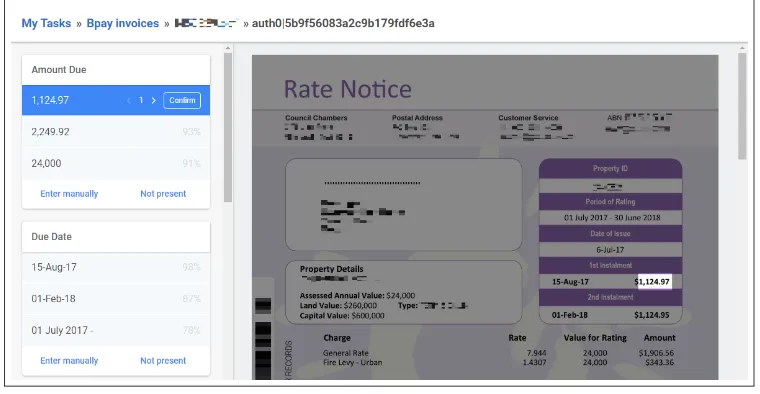
Figure 2: Our annotation and prediction verification tool — SYPHT VALIDATE. Tasks are presented with fields to annotate on the left and the source document for extraction on the right. We display the top predictions for each target field as suggestions for the user. In this example the most likelyAmount duehas been selected and the position of this prediction in the source document has been highlighted for
confirmation.
field types which benefit from filtering are date, currency and integer fields; and fields with check-sum rules. To handle multi-token field outputs, we utilise a combination of heuristic token merg-ing (e.g. pattern based string combination for
Supplier ABNs) and greedy token aggregation
under a minimum sequence likelihood threshold from token level predictions (e.g. name and ad-dress fields).
We train our model by sampling instances at the token level. Matcher functions perform normali-sation and comparison to annotated document la-bels for both for single and multi-token fields. All tokens which match the normalised form of the human-agreed value for a field are used to gen-erate positive instances in a process analogous to distant supervision (Mintz et al.,2009). Other to-kens in a document which match the field-type fil-ter are randomly sampled as negative training in-stances. Instances of labels and sparse features are then used to train a gradient boosting decision tree model (LightGBM)4. To handlenull predic-tions, we fit a threshold on token-level confidence which optimises a given performance metric; i.e. F-score for the models considered in this work. If the maximum likelihood value for a predicted token-sequence falls below the threshold for that field, anullprediction is returned instead.
4github.com/Microsoft/LightGBM
4.2 Validation
An ongoing human annotation effort is often cen-tral to the training and evaluation of real-world machine learning systems. Well designed user-experiences for a given annotation task can sig-nificant reduce the rate of manual-entry errors and speed up data collection (e.g. Prodigy5). We de-signed a predication-assisted annotation and val-idation tool for field extraction – SYPHT V ALI-DATE. Figure2shows a task during annotation.
Our tool is used to both supplement the train-ing set and optionally – where field-level confi-dence does not meet a configurable threshold; pro-vide human-in-the-loop prediction verification in real time. Suggestions are pre-populated through SYPHTpredictions, transforming an otherwise te-dious manual entry task into a relatively simple decision confirmation problem. Usability features such as token-highlighting and keyboard naviga-tion greatly decrease the time it takes to annotate a given document.
We utilise continuous active learning by priori-tising the annotation of new documents from our unlabeled corpus where the model is least confi-dent. Conversely we observe high-confidence pre-dictions which disagree with past human annota-tions are good candidates for re-annotation; often indicating the presence of annotation errors.
4.3 Service architecture
SYPHT has been developed with performance at scale as a primary requirement. We use a micro-service architecture to ensure our system is both robust to stochastic outages and that we can scale up individual pipeline components to meet de-mand. Services interact via a dedicated message queue which increases fault-tolerance and ensure consistent throughput. Our system is capable of scaling to service a throughput of hundreds of re-quests per second at low latency to support mobile and other near real-time prediction use-cases. We consider latency a core metric for real-world sys-tem performance and include it in our evaluation of comparable systems in Section5.
5 Evaluation
In this section we describe our methodology for creating the experimental dataset and system eval-uation. We aim to understand how a variety of alternative extraction systems deals with various invoice formats. As a coarse representation of vi-sual document structure, we compute a perceptual hash (Niu and Jiao, 2008) from the first-page of each document in a sample of Australian invoices. Personally identifiable information (PII) was then manually removed from each invoice by a human reviewer. SYPHTVALIDATEwas used to generate the labels for the task, with between two and four annotators per field dependent on inter-annotator agreement. Annotators worked closely to ensure consistency between their labels and the data defi-nitions listed in Section3.1, with all fields having a sampled Cohen’s kappa greater that0.8, and all fields except net amounthaving a kappa greater
than 0.9. During the annotation procedure four documents were flagged as low quality and ex-cluded from the evaluation set, resulting in a final count of 129. In each of these cases annotators could not reliably determine field values due to poor image quality. We evaluated against our de-ployed system after ensuring that all documents in the evaluation set were excluded from the model’s training set.
5.1 Compared systems
ABBYY6 We ran ABBYY FlexiCapture 12 in
batch mode on a modern quad-core desktop com-puter. While ABBYY software provides tools for creating extraction templates by hand, we utilised
6www.abbyy.com/en-au/flexicapture/
the generic invoice extraction model for parity with other comparison systems. By contrast with other systems which provided seamless API ac-cess, we operated the user interface manually and were unable to reliably record the distribution of prediction time per document. As such we only note the average extraction time aggregated over all test documents in Table2
EzzyBills 7 automate data entry of invoice and account-payable in buisness accounting systems. We utilised theEzzyBills REST API.
Rossum8 advertise a deep-learning driven data extractionAPIplatform. We utilised their Python API9in our experiments.
6 Results
Table1presents accuracy results by field for each comparison system. SYPHT delivers the highest performance across measures fields with a macro averaged accuracy exceeding our comparable re-sults by 23.7%, 22.8% and 20.2% (forEzzy, AB-BYY, Rossum respectively). Interestingly we ob-serve low scores across the board on the net amount field with every systems performing
sig-nificantly worse than the closely related gross amount. This field also obtained the lowest level
of annotator agreement and was notoriously diffi-cult to reliably assess – for example, the inclusion or exclusion of discounts, delivery costs and other adjustments to various sub totals on an invoice of-ten complicates extraction.
The next best system Rossum performed sur-prising well considering their coverage of the the European market; excluding support for Australian-specific invoice fields such as ABN.
Still, even after excluding ABN, net amount and GSTwhich may align to different field definitions,
SYPHT maintains an 8 point accuracy advantage and more than 14 times lower median prediction latency.
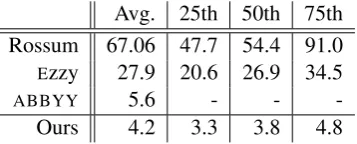
Table 2 summarises the average prediction la-tency in seconds for each system alongside the times for documents at the 25th, 50th and 75th percentile of the response time distribution. Un-der the constraint of batch processing within the desktop ABBYY extraction environment we were unable to reliable record per-document prediction
7www.ezzybills.com/api/ 8
www.rossum.ai
Field Ezzy ABBYY Rossum Ours
Supplier ABN 76.7 80.6 - 99.2 Invoice Number 72.1 82.2 86.8 94.6 Document Date 67.4 45.0 90.7 96.1 Net Amount 53.5 51.2 55.8 80.6 GST Amount 69.8 72.1 45.0 90.7 Gross Amount 75.2 89.1 84.5 95.3
[image:6.595.173.426.62.177.2]Avg. 69.1 70.0 72.6 92.8
Table 1: Prediction accuracy by field.
Avg. 25th 50th 75th Rossum 67.06 47.7 54.4 91.0 Ezzy 27.9 20.6 26.9 34.5
ABBYY 5.6 - -
-Ours 4.2 3.3 3.8 4.8
Table 2: Prediction latency in seconds.
times and thus do not indicate their prediction re-sponse percentiles. SYPHT was faster than all comparison systems, and significantly faster rel-ative to the other SaaS based API services. Even with the lack of network overhead inherent to AB-BYY’s local extraction software, SYPHTmaintains a 25% lower average prediction latency. In a di-rect comparison with otherAPIbased products we demonstrate stronger results still, with EzzyBills and Rossum being slower than SYPHT by a fac-tor of 6.6 and 15.9 respectively in terms of mean prediction time per document.
7 Discussion and future work
While it is not a primary component of our cur-rent system, we have developed and continue to develop a number of solutions based on neural network models. Models for sequence labelling, such as LSTM (Gers et al.,1999) or Transformer (Vaswani et al.,2017) networks can be directly en-sembled into the current system. We are also ex-ploring the use of object classification and detec-tion models to make use of the visual component of document data. Highly performant models such as YOLO (Redmon and Farhadi,2018), are partic-ularly interesting due to their ability to be used in real-time. We expect sub-5 second response times to constitute a rough threshold for realistic deploy-ment of extraction systems in real time applica-tions, making SYPHTthe best system in contrast to either of the other two API-based services.
We also see an exciting opportunity to provide self-service model development – the ability for a customer to use their own documents to generate a model tailored to their set of fields. This would allow us to offer SYPHT for use cases where ei-ther we cannot or would not collect the prerequi-site data. SYPHT VALIDATEprovides a straight-forward method for bootstrapping extraction mod-els by providing rapid data annotation and efficient use of annotator time through active learning.
8 Conclusion
We present SYPHT, a SaaS API for key-field ex-traction from business documents. Our compar-ison with alternative extraction systems demon-strate both high accuracy and lower latency across extracted fields – enabling applications in real time for invoices and bill payment.
Acknowledgements
We would like to thank members of the SYPHT team for their contributions to the system, annota-tion and evaluaannota-tion effort: Duane Allam, Farzan Maghami, Paarth Arora, Raya Saeed, Saskia Parker, Simon Mittag and Warren Billington.
References
Francesca Cesarini, Marco Gori, Simone Marinai, and Giovanni Soda. 1998. Informys: A flexible invoice-like form-reader system. IEEE Trans. Pattern Anal. Mach. Intell.20(7):730–745.
Bertrand Co¨uasnon. 2006. Dmos, a generic doc-ument recognition method: application to table structure analysis in a general and in a spe-cific way. International Journal of Document Analysis and Recognition (IJDAR) 8(2):111–122.
[image:6.595.93.272.216.288.2]Vincent Poulain D’Andecy, Emmanuel Hartmann, and Marc¸al Rusi˜nol. 2018. Field extraction by hybrid incremental and a-priori structural tem-plates. In 13th IAPR International Workshop on Document Analysis Systems, DAS 2018, Vi-enna, Austria, April 24-27, 2018. pages 251–256.
https://doi.org/10.1109/DAS.2018.29.
Felix A Gers, J¨urgen Schmidhuber, and Fred Cummins. 1999. Learning to forget: Continual prediction with lstm .
Bertin Klein, Stevan Agne, and Andreas Dengel. 2004. Results of a study on invoice-reading systems in ger-many. In Simone Marinai and Andreas R. Dengel, editors, Document Analysis Systems VI. Springer Berlin Heidelberg, Berlin, Heidelberg, pages 451– 462.
Paul McNamee, Heather Simpson, and Hoa Trang Dang. 2009. Overview of the TAC 2009 Knowledge Base Population Track. InProceedings of the 2009 Text Analysis Conference.
Mike Mintz, Steven Bills, Rion Snow, and Dan Jurafsky. 2009. Distant supervision for relation extraction without labeled data. In Proceed-ings of the Joint Conference of the 47th Annual Meeting of the Association for Computational Linguistics and the 4th International Joint Con-ference on Natural Language Processing of the Asian Federation of Natural Language Process-ing. Association for Computational Linguistics, Stroudsburg, PA, USA, volume 2, pages 1003–1011.
http://dl.acm.org/citation.cfm?id=1690219.1690287.
Xia-mu Niu and Yu-hua Jiao. 2008. An overview of perceptual hashing. Acta Electronica Sinica
36(7):1405–1411.
Rasmus Berg Palm, Ole Winther, and Florian Laws. 2017. Cloudscan - A configuration-free invoice analysis system using recurrent neural networks. In 14th IAPR International Conference on Docu-ment Analysis and Recognition, ICDAR 2017, Ky-oto, Japan, November 9-15, 2017. pages 406–413.
https://doi.org/10.1109/ICDAR.2017.74.
Joseph Redmon and Ali Farhadi. 2018. Yolov3: An incremental improvement. arXiv preprint arXiv:1804.02767.
Maral Rusiol, Tayeb Benkhelfallah, and Vin-cent Poulain D’Andecy. 2013. Field extraction from administrative documents by incremental structural templates. In Proceedings of the 12th International Conference on Document Analysis and Recognition. IEEE Computer Society, pages 1100–1104.
Daniel Schuster, Klemens Muthmann, Daniel Esser, Alexander Schill, Michael Berger, Christoph Wei-dling, Kamil Aliyev, and Andreas Hofmeier. 2013.
Intellix – end-user trained information extraction for document archiving. In Proceedings of the
2013 12th International Conference on Document Analysis and Recognition. IEEE Computer Society, Washington, DC, USA, ICDAR ’13, pages 101–105.
https://doi.org/10.1109/ICDAR.2013.28.
Y. Y. Tang, C. Y. Suen, Chang De Yan, and M. Cheriet. 1995.Financial document processing based on staff line and description language. IEEE Transactions on Systems, Man, and Cybernetics 25(5):738–754.
https://doi.org/10.1109/21.376488.