Classification of Verb-Particle Constructions with the Google Web1T
Corpus
Jonathan K. Kummerfeld and James R. Curran School of Information Technologies
University of Sydney NSW 2006, Australia
{jkum0593,james}@it.usyd.edu.au
Abstract
Manually maintaining comprehensive databases of multi-word expressions, for example Verb-Particle Constructions (VPCs), is infeasible. We describe a new type level classifier for potential VPCs, which uses information in the Google Web1T corpus to perform a simple lin-guistic constituency test. Specifically, we consider the fronting test, comparing the frequencies of the two possible orderings of the given verb and particle. Using only a small set of queries for each verb-particle pair, the system was able to achieve an F-score of 75.7% in our evaluation while processing thousands of queries a second.
1 Introduction
Creating comprehensive linguistic resources manually is an expensive and slow process, making it infeasible for maintaining up-to-date resources of constantly evolving linguistic fea-tures, such as Multi-Word Expressions (MWEs). These resources are crucial for a range of Natural Language Processing (NLP) tasks, such as ac-curate parsing. Identification of MWEs does not prevent the production of syntactically accurate parses, but the extra information can improve results. Since manually creating these resources is a challenge, systems are needed that can automatically classify expressions accurately. Also, because these systems will be running during parsing, they need to be fast to prevent the creation of an additional bottleneck.
Here we focus on Verb-Particle Constructions (VPCs), a type ofMWEcomposed of a verb and a particle. Villavicencio (2003a) showed that VPCs
are poorly covered by corpus data and constantly growing in number, making them a suitable can-didate for an automatic classification system.
Pre-vious work on VPCs has mainly focused either on their compositionality (McCarthy et al., 2003), or on using sophisticated parsers to perform ex-traction from corpora (Baldwin and Villavicencio, 2002). While parser based methods have been very successful (Kim and Baldwin, 2006) they rely on contextual knowledge and complex pro-cessing. The Web has been used as a corpus previ-ously by Villavicencio (2003b), who used search engines as a source of statistics for classification, but her aim was to create new resources, rather than a tool that can be used for identification. We have constructed a high-throughput query system for the Google Web1T data, which we use to col-lect information to perform the fronting linguistic constituency test. The results of this process are used to train a classifier, which can then quickly and accurately classify a given verb-particle pair.
The Google Web1T corpus is over twenty-four gigabytes of plain text in compressed form, mak-ing it infeasible to store the entire data-set in memory and perform queries directly. To han-dle the data we have aggregated the frequency counts for n-grams by using templates that con-tain a mixture of wild-cards and words, where the words are all possibilities taken from three sets. The new data this process produces is stored in a hash-table distributed across several computers, making fast queries possible. These queries pro-vide the frequency of templates such as verb
? particleandparticle ? verb, which
2 Background
VPCs are MWEs composed of a verb and a par-ticle, where particles are derived from two cat-egories, prepositions and spatial adverbs (Quirk et al., 1985). However, most research on VPCs has focused on prepositions only, because they are more productive. Semantically, the composi-tionality of multi-word expressions varies greatly. Often they have the property of paraphrasability, being replacable by a single verb of equivalent meaning, and exhibit prosody, having a distinc-tive stress pattern.
Previous work concerningVPCs can be broadly divided into two groups, compositionality analy-sis, and classification. Our work is entirely con-cerned with classification, but we will briefly de-scribe previous work on compositionality as the two areas are closely linked.
2.1 Compositionality
Determining how much the simplex meaning of individual words in aMWEcontribute to the over-all meaning is chover-allenging, and important for pro-ducing semantically correct analysis of text. A range of methods have been considered to differ-entiate examples based on their degree of seman-tic idiosyncrasy.
Initial work by Lin (1999) considered the com-positionality of MWEs by comparing the distri-butional characteristics for a givenMWEand po-tentially similar expressions formed by synonym substitution. This was followed by Bannard et al. (2003), who used human non-experts to construct a gold standard dataset ofVPCs and their
compo-sitionality, which was used to construct a classi-fier that could judge whether the two words used contributed their simplex meaning. McCarthy et al. (2003) used an automatically acquired the-saurus in the calculation of statistics regarding the compositionality of VPCs and compared their re-sults with statistics commonly used for extract-ing multiwords, such as latent semantic analysis. Bannard (2005) compared the lexical contexts of
VPCs and their component words across a corpus to determine which words are contributing an in-dependent meaning.
Light Verb Constructions (LVCs) are another example of an MWE that has been considered in
compositionality studies. The challenge of dis-tinguishingLVCs from idioms was considered by Fazly et al. (2005), who proposed a set of statis-tical measures to quantify properties that relate to the compositionality of an MWE, ideas that were then extended in Fazly and Stevenson (2007).
Recently, Cook and Stevenson (2006) ad-dressed the question of which sense of the compo-nent words is being used in a particularVPC. They focused on the contribution by particles and con-structed a feature set based on the properties of
VPCs and compared their effectiveness with stan-dard co-occurrence measurements.
2.2 Classification
A range of methods for automatic classification of
MWEs have been studied previously, in particular
the use of parsers, applying heuristics to n-grams, and search engine queries.
Possibly the earliest attempt at classification, was by Smadja (1993), who considered verb-particle pairs, separated by up to four other words, but did not perform a rigorous evaluation, which prevents us from performing a comparison.
Recent work has focused on using parsers over raw text to gain extra information about the con-text of the verb-particle pair being considered. In particular, the information needed to identify the head noun phrase (NP) for each potential VPC. Early work by Blaheta and Johnson (2001) used a parsed corpus and log-linear models to identify
VPCs. This was followed by Baldwin and Villavi-cencio (2002) who used a range of parser outputs and other features to produce a better informed classifier. Other forms of linguistic and statistical unsupervised methods were considered by Bald-win (2005), such as Pointwise Mutual Informa-tion. This work was further extended by Kim and Baldwin (2006) to utilise the sentential context of verb-particle pairs and their associated NP to im-prove results.
The closest work to our own in terms of the cor-pus used is that of Villavicencio (2003b), in which the web is used to test the validity of candidate
1993) with the particle up. Each potential VPC
was passed to the search engine Google to ob-tain an approximate measure of their frequency, first on their own, then in the form Verb up forto prevent the inclusion of prepositional verb forms. The measurement is only approximate be-cause the value is a document count, not an actual frequency as in the Web1T data. This led to the identification of many new VPCs, but the results were not evaluated beyond measurements of the number of identified VPCs attested in current re-sources, making comparison with our own work difficult.
When a verb-particle pair is being classified the possibilities other than a VPC are a prepositional
verb, or a free verb-preposition combination. A variety of tests exist for determining which of these a candidate verb-particle pair is. For the transitive case, Baldwin and Villavicencio (2002) applied three tests. First, thatVPCs are able to un-dergo particle alternation, providing the example thathand in the paperandhand the paper inare both valid, whilerefer to the bookis, but*refer the book to is not. Second, that pronominal objects must be expressed in the split configuration, providing the example thathand it inis valid, where as*hand in itis not. And finally, that manner adverbs can-not occur between the verb and particle. The first two of these tests are context based, and there-fore not directly usable in our work, and the third is particularly specific. Instead, for now we have focused on the ‘fronting’ constituency test, which involves a simple rearrangement of the phrase, for example hand in the paperwould be compared to *in the paper hand.
2.3 The Google Web1T corpus
The Google Web1T corpus is an extremely large collection of n-grams, extracted from slightly more than one trillion words of English from pub-lic web pages (Brants and Franz, 2006). This dataset poses new challenges for data processing systems, as it is more than twenty-four gigabytes in compressed form.
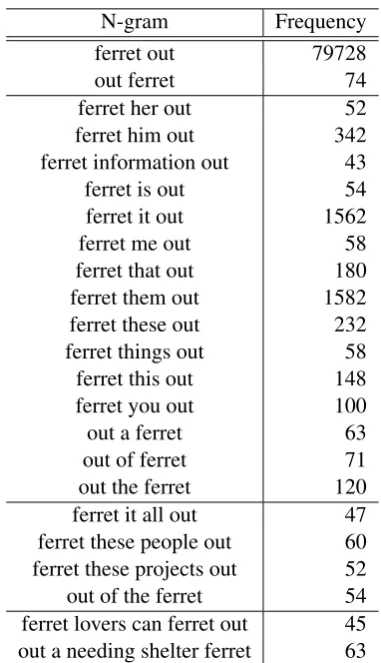
The corpus contains n-grams up to 5-grams, such as in Table 1. This example considers the pair of words ‘ferret’ and ‘out’, showing all en-tries in the corpus that start and end with the two words, excluding those that contain
non-N-gram Frequency
ferret out 79728
out ferret 74
ferret her out 52
ferret him out 342
ferret information out 43
ferret is out 54
ferret it out 1562
ferret me out 58
ferret that out 180 ferret them out 1582 ferret these out 232 ferret things out 58 ferret this out 148
ferret you out 100
out a ferret 63
out of ferret 71
[image:3.595.318.509.60.392.2]out the ferret 120 ferret it all out 47 ferret these people out 60 ferret these projects out 52 out of the ferret 54 ferret lovers can ferret out 45 out a needing shelter ferret 63
Table 1: N-grams in the Web1T corpus for the VPC
ferret out.
alphabetical characters.
One approach to this dataset is to simply treat it as a normal collection of n-gram frequencies, scanning the relevant sections for answers, such as in Bergsma et al. (2008) and Yuret (2007). Another approach is used by Talbot and Brants (2008), pruning the corpus to a third of its size and quantising the rest, reducing the space used by frequency counts to eight bits each. These methods have the disadvantages of slow execu-tion and only providing approximate frequencies respectively.
representa-tion. While this avoids the cost of processing the entire dataset for each query, it does produce less accurate results. The second method described is intelligent batching queries, then performing a single pass through the data to answer them all.
The Web1T corpus is not the only resource for n-gram counts on the web. Lapata and Keller (2005) use Web counts, the number of hits for a search term, as a measure of the frequency of n-grams. This approach has the disadvantage that the frequency returned is actually a document fre-quency, where as the Web1T values are counts of the occurrences of the actual n-gram, including repetitions in a single page.
2.4 Weka
Weka is a collection of machine learning algo-rithms for data mining tasks (Witten and Frank, 2005). From the range of tools available we have used a selection of the classifiers: ZeroR, OneR, Id3, J48, Naive Bayes and Multilayer Perceptron. As a baseline measure we used the ZeroR clas-sifier, which always returns the mode of the set of nominal options. Next we considered the OneR classifier, which compares the information gain of each of the features and chooses the most ef-fective. Two decision tree classifiers were con-sidered, Id3 (Quinlan, 1993b) and J48 (Quinlan, 1993a). Both initially construct the tree in the same way, using information gain to choose the feature to split on next, until either no features re-main, or all samples are of the same class. The difference is that J48 attempts to prune the tree.
We also considered two non-decision based classifiers, Naive Bayes and Multilayer Percep-tron. The Naive Bayes classifier assumes fea-tures are independent and applies Bayes’ The-orem to calculate the probability of an exam-ple belonging to a particular class. The Multi-layer Perceptron uses multiple Multi-layers of sigmoid nodes, whose links are adjusted during training by back-propagation of corrections (Rumelhart et al., 1986).
3 Classifying verb-particle pairs
Our aim was to construct a system capable of classifying a given verb-particle pair as a poten-tial VPC or not. To do this we currently apply the fronting test to the verb-particle pair. We
de-scribe the classification given by the system as ‘potential’ because the system only uses the verb-particle pair and not the specific context being considered. The system also needed a simple in-terface for making fast queries.
The fronting test is a linguistic constituency test that gauges whether words function as a sin-gle unit in a phrase by breaking the phrase in half between the words and swapping the order of the two halves (Quirk et al., 1985). In the case ofVPCs this means the following rearrangement (note thatNP2may not always be present):
• NP1 Verb Particle NP2
• Particle NP2 NP1 Verb
If the rearranged form of a phrase is also valid it implies the verb and particle are not functioning as a single unit in the phrase, and so we do not classify them as aVPC.
In this structure there are two forms of verbs to consider. For the intransitive case aVPC always results (Baldwin and Villavicencio, 2002), for ex-ample:
• He gets around.
• *Around he gets.
However, in the transitive case there are three possibilities, for example:
• The mafia ran down Joe.
• *Down Joe the mafia ran.
• What did you refer to?
• To what did you refer?
• I walked to the house.
• To the house, I walked.
The last two examples are notVPCs, but rather examples of a prepositional verb and a free verb-preposition combination respectively. Note that both orders are valid for these, where as for the
VPCs the second is not.
4 Implementation
4.1 Structure
At the core of our system is a hash table that al-lows random access to the parts of the Web1T data that are relevant to our queries. The table uses linear probing based on a 64bit key that is a numerical representation of each word pattern, in-terpreted in base thirty-seven. The initial position considered is the key value modulo the size of our table (which may vary to allow support for differ-ent amounts of system RAM). While there is the possibility of collisions, the probability of their occurrence is extremely small, and none were ob-served during testing.
Word patterns are used to generate the key, and at the location specified by the key (or a position that is probed to) we store the complete key and four integers. The system is designed to process any string to generate the key, rather than specif-ically VPCs, and the four integers stored are
re-turned directly, to be manipulated as desired. We use these four integers to hold aggregated counts and the string used is based on word patterns con-taining wildcards.
The word patterns used to create the keys may contain two types of symbols, a wildcard, or a set reference. Wildcards represent any word not in the given sets, where we do not include punctu-ation, numbers or sentence boundaries as words. Set references indicate that the word at that po-sition must come from one of the provided sets. Currently the system handles up to three sets, each of which can be referenced at most once. Also note that patterns with leading or trailing wildcards do not need to be considered, since they are already included in the count for the equiva-lent n-gram without the leading or trailing wild-cards.
For two sets, the four patterns used are as fol-lows, where represents a wildcard, andAandB are set references:
1. A B 2. A B
3. A B
4. A B
For three sets we cannot store the frequency of each pattern separately as there are six possible
patterns, but only four spaces in each entry of the table. We chose to aggregate the values further, accepting the following patterns:
1. A B C
2. A B C or A B C
3. A B C or A B C
4. A B C
All data in the Web1T corpus that does not con-form to one of these patterns is ignored. This means the size of the hash table needed, and there-fore the amount of memory needed, depends en-tirely on the sizes of the word sets provided.
The hash table, word sets, and their interface, are written in C++, but are wrapped up inside a Python extension. This python extension is used by a server-client interface, where each server holds a single hash table that has all the aggre-gated counts for words within a specific alpha-betic range. To perform queries a client con-nects to a set of servers, receives their ranges, and then requests frequency counts directly from the appropriate server. This structure effectively in-creases the size of the system memory that is ac-cessible, but also has the side effect that multiple clients can query the system at the same time at high speed.
4.2 Statistics
We performed our experiments using three sets of words, verbs, particles and pronouns. The sizes and sources of the sets were:
• Verbs - 19,046 - all words with a VB based tag in the Wall Street Journal section of the Penn Treebank
• Possible Particles - 257 - all words with ei-ther an IN or RP tag in the Wall Street Jour-nal section of the Penn Treebank
• Pronouns - 77 - from Wikipedia
Pattern Frequency
Verb Particle 2 436 566
Verb Particle 747 492
Verb Particle 78 569
Verb Particle 19 549
Particle Verb 2 606 582
Particle Verb 2 326 720
Particle Verb 68 540
[image:6.595.87.278.63.190.2]Particle Verb 14 016
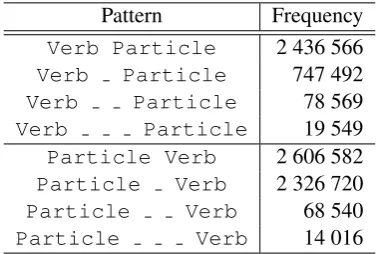
Table 2: Word patterns and example aggregated fre-quencies for theVPChand in.
Since one of our aims was to produce a quick method for classification, the speed of the sys-tem is also worth considering. Once running, the servers were able to handle between five and ten thousand queries per second. The time to start the servers, which includes reading all of the Web1T data, was between sixty and ninety minutes. However, this time could be drastically reduced for subsequent runs by writing the con-structed hash table out to disk and reading it di-rectly into memory the next time the system needs to be started.
4.3 Hash table queries forVPCs
Once the hash table is constructed the system is able to take two or three words and return the four values corresponding to their position in the hash table (where the words are considered in the order they are given). A simplified form of the fronting test considers the patterns in Table 2.
The word patterns in the top half of Table 2 correspond toNP1 Verb Particle NP2. We
have considered the cases with wildcards between the verb and particle since mostVPCs can occur in the split configuration. The patterns in the bot-tom half of Table 2 correspond to Particle NP2 NP1 Verb. We allow the case with a single wildcard to cover examples without a secondNP. To get the vales for these patterns the system is queried twice, once withVerb Particleand then withParticle Verb.
As mentioned previously, it is difficult to quan-tify the absolute values returned by these queries, but by comparing them we are able to measure the relative validity of the two orderings, as described in the following section.
Name Comparison
[image:6.595.312.519.64.162.2]vp-1 v ? ? ? p > p ? v vp-2 v p > p v nv p-1 n v ? ? p > p n v nv p-2 n v ? ? p > p ? ? n v n vp-1 n ? v ? p > p n ? v n vp-2 n ? v ? p > p ? n ? v
Table 3: Comparisons for judging whether a verb and particle form aVPC.
One problem with this comparison is that the contributions to the values could be coming from different uses of the pair, such as in Table 1, where ferret is out and ferret it out will both con-tribute to the frequency for the pattern Verb
Particle. To deal with this we added queries
that used the three set patterns. As the third set we used pronouns, which can approximate single word NPs. This method does have the drawback that frequencies will be lower, leading to more unattested examples, but does provide extra infor-mation in most cases.
5 Results
For the purposes of classification we created a set of questions that have true or false answers and can be answered based on queries to our system. In many of these cases we consider the sum of a collection of values from our hash table. To keep the descriptions here concise we have used the symbol ‘?’ to denote the optional presence of an-other wildcard. The value for patterns containing ‘?’s is the sum of all the possible patterns, with or without wildcards at those positions. Also, rather than using the entire words, we have used ‘v’ for Verbs, ‘p’ for Particles and ‘n’ for pronouns.
To produce a set of invalid VPCs we used our lists of verbs and particles to generate a random list of two thousand verb-particle pairs not in our set of VPCs. The set of two thousand trueVPCs was constructed randomly from a large set con-taining 116 from McCarthy et al. (2003) and 7140 from Baldwin and Villavicencio (2002).
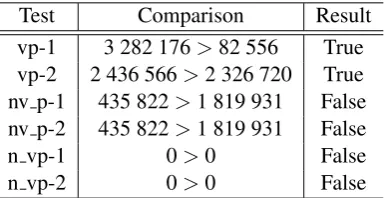
Test Comparison Result vp-1 3 282 176>82 556 True vp-2 2 436 566>2 326 720 True nv p-1 435 822>1 819 931 False nv p-2 435 822>1 819 931 False
n vp-1 0>0 False
[image:7.595.87.280.63.162.2]n vp-2 0>0 False
Table 4: Example comparisons for theVPChand in.
then used to generate and evaluate a range of classification techniques. All methods were ap-plied with the standard settings and using ten fold cross-validation.
6 Discussion
This lightweight method of classification does not match up to results from parser based methods, such as Kim and Baldwin (2006), who acheived an F-score of 97.4%. However, this high per-formance relies on context awareness and only applied to the identification of frequent VPC ex-amples. In contrast, by drawing on the Web1T dataset our system overcomes the data spares-ness problem. The cost of attempting to classify without knowledge of context is that we apply a linguistic poor approach, achieving lower perfor-mance, but there is plenty of scope for extension. The system as it stands is very flexible and can easily scale to support larger sets of words, mak-ing a broader range of queries possible. Also, the post-processing of query results could become more sophisticated, and the classifiers used could be tweaked to be more effective. The system itself could also be modified to store other information, making different types of queries possible.
One challenge that remains unaddressed is how to handle multiple uses of the same word pair. For example, the following are both valid:
• The deadline is coming up.
• Joe is an up and coming athlete.
In these two cases the wordscominganduphave different semantic meanings, but both forms will contribute to the frequency counts for the word pair. While this does skew the results of our queries, we should be able to limit the effect by
using the third set to constrain how the words are being used.
Despite the support for three sets of words, we only really have flexibility in one of them, as we must use the other two for Verbs and Particles. Here we chose Pronouns because they could act as single word NPs, allowing us to perform the fronting test more effectively. However, there are other linguistic tests for VPCs. In particu-lar, two of the tests performed by Baldwin and Villavicencio (2002) could be adapted to our sys-tem. One is that transitive VPCs must be ex-pressed in the split configuration when the sec-ond NP is pronominal, such as hand it in, which is valid, and *hand in it, which is not. Our third set already contains pronouns, all that needs to be done is a comparison of the frequency of Verb
Pronoun Particle and Verb Particle
Pronoun, giving a measure of which is more
valid. The other test is that manner adverbs cannot occur between the verb and the particle. This could be tested by expanding our third set to include manner adverbs, and then compar-ing the frequency of Verb Manner Adverb
ParticleandVerb Particle.
So far we have only considered a small num-ber of ways to combine the results of the queries to produce features for classifiers. All of the fea-tures we considered here were true/false answers to simple questions, constructed intuitively, but without much experimentation. By breaking up our training set and using a part of it to explore the statistical properties of the results from queries we may be able to identify unexpected, but effec-tive, discriminating factors. We may also be able to improve performance by considering a broader range of classifiers, and by adjusting their input parameters to suit our task.
Classifier Accuracy Precision Recall F score
ZeroR 50.0% 25.0% 50.0% 33.3%
OneR 74.4% 76.4% 74.4% 75.4%
Id3 74.7% 76.8% 74.7% 75.7%
J48 74.4% 76.4% 74.4% 75.4%
[image:8.595.151.447.63.163.2]Naive Bayes 74.7% 76.8% 74.7% 75.7% MultilayerPerceptron 73.4% 73.6% 73.4% 73.5%
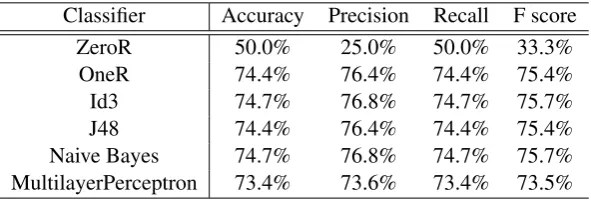
Table 5: Results using Weka on simple query answers.
as a single block of memory. This means the fread and fwrite functions could easily be used to save it on disk, which would drastically reduce the sys-tem restart time (assuming the same word sets are being used).
7 Conclusion
We have constructed a system for quickly query-ing the Web1T corpus, providquery-ing the informa-tion needed to perform the fronting linguistic con-stituency test. By performing this test on poten-tialVPCs, on their own, and in combination with
a range of pronouns, we produce a feature vector that can be used to construct a classifier. The clas-sifiers produced are accurate and fast, as the only information they need can be quickly accessed from the Web1T corpus by our system. The vari-ation in performance between classifiers is small, but the best performance is by the Id3 and Naive Bayes classifiers, which have a recall of 74.7%, and precision of76.8%.
A range of other linguistic tests exist, which our system could be extended to support. Adding this extra information to our feature vectors and exploring classification methods further could lead to improved performance. Another area for further investigation is the interpretation of the raw frequency counts and the way comparisons are performed.
Our system is capable of scaling to support a larger proportion of the Web1T data, while retain-ing the ability to respond quickly to many queries. Also, by adjusting the word sets provided and/or the templates that are used to aggregate frequency counts, our system could be altered to support dif-ferent types of queries. This flexibility means it could be useful in other tasks that involve query-ing the Web1T corpus.
8 Acknowledgement
We would like to thank the anonymous reviewers for their helpful feedback and corrections. J. K. K. thanks The University of Sydney for the sup-port of a Merit Scholarship and the Talented Stu-dent Program that enabled this work.
References
Timothy Baldwin and Aline Villavicencio. 2002. Ex-tracting the unextractable: a case study on verb-particles. InProceedings of the 2002 Conference
on Natural Language Learning, pages 1–7, Taipei,
Taiwan, August.
Timothy Baldwin. 2005. Looking for prepositional verbs in corpus data. In Proceedings of the 2005 Meeting of the Asociation for Computational Lin-guistics: Workshop on the Linguistic Dimensions of Prepositions and their Use in Computational
Lin-guistics Formalisms and Applications, pages 115–
126, Colchester, UK, April.
Colin Bannard, Timothy Baldwin, and Alex Las-carides. 2003. A statistical approach to the se-mantics of verb-particles. In Proceedings of the 2003 Meeting of the Asociation for Computational Linguistics: Workshop on Multiword Expressions: Analysis, Acquisition and Treatment, pages 65–72, Sapporo, Japan, July.
Colin Bannard. 2005. Learning about the meaning of verb-particle constructions from corpora. Journal
of Computer Speech and Language, 19(4):467–478.
Shane Bergsma, Dekang Lin, and Randy Goebel. 2008. Distributional identification of non-referential pronouns. In Proceedings of the 2008 Meeting of the Asociation for Computational
Lin-guistics: Human Languages Technologies, pages
10–18, Columbus, Ohio, June.
Compu-tational Extraction, Analysis and Exploitation of Collocations, pages 54–60, Toulouse, France, July. Thorsten Brants and Alex Franz. 2006. Web1t 5-gram corpus version 1.1. Technical report, Google Re-search.
Paul Cook and Suzanne Stevenson. 2006. Classify-ing particle semantics in English verb-particle con-structions. InProceedings of the 2006 Meeting of the Asociation for Computational Linguistics and the International Committee on Computational Lin-guistics Workshop on Multiword Expressions: Iden-tifying and Exploiting Underlying Properties, pages 45–53, Sydney, Australia, July.
Afsaneh Fazly and Suzanne Stevenson. 2007. Dis-tinguishing subtypes of multiword expressions us-ing lus-inguistically-motivated statistical neasures. In
Proceedings of the 2007 Meeting of the Asocia-tion for ComputaAsocia-tional Linguistics: Workshop on
A Broader Perspective on Multiword Expressions,
pages 9–16, Prague, Czech Republic, June. Afsaneh Fazly, Ryan North, and Suzanne Stevenson.
2005. Automatically distinguishing literal and fig-urative usages of highly polysemous verbs. In Pro-ceedings of the 2005 Meeting of the Asociation for Computational Linguistics: Workshop on Deep Lexical Acquisition, Ann Arbor, USA, July. Tobias Hawker, Mary Gardiner, and Andrew
Ben-netts. 2007. Practical queries of a massive n-gram database. InProceedings of the 2007 Australasian
Language Technology Workshop 2007, pages 40–
48, Melbourne, Australia, December.
Su Nam Kim and Timothy Baldwin. 2006. Automatic identification of english verb particle constructions using linguistic features. In Proceedings of the 2006 Meeting of the Asociation for Computational
Linguistics: Workshop on Prepositions, pages 65–
72, Trento, Italy, April.
Mirella Lapata and Frank Keller. 2005. Web-based models for natural language processing. ACM
Transactions on Speech and Language Processing,
2(1):1–33.
Beth Levin. 1993. English Verb Classes and Alter-nations: A Preliminary Investigation. University of Chicago Press.
Dekang Lin. 1999. Automatic identification of non-compositional phrases. InProceedings of the 1999 Annual Meeting of the Association for
Computa-tional Linguistics, pages 317–324, College Park,
Maryland, USA.
Diana McCarthy, Bill Keller, , and John Carroll. 2003. Detecting a continuum of compositionality in phrasal verbs. InProceedings of the 2003 Meet-ing of the Asociation for Computational LMeet-inguis- Linguis-tics: Workshop on Multiword Expressions:
Anal-ysis, Acquisition and Treatment, Sapporo, Japan,
July.
John Ross Quinlan. 1993a. C4.5: Programs for
Ma-chine Learning. Morgan Kaufmann Publishers Inc.,
San Francisco, CA, USA.
John Ross Quinlan, 1993b. Induction of decision
trees, pages 349–361. Morgan Kaufmann
Publish-ers Inc., San Francisco, CA, USA.
Randolph Quirk, Sidney Greenbaum, Geoffrey Leech, and Jan Svartvik. 1985. A Comprehensive
Gram-mar of the English Language. Longman, London.
David Rumelhart, Geoffrey Hinton, and Ronald Williams, 1986. Learning internal representations
by error propagation, pages 318–362. MIT Press,
Cambridge, MA, USA.
Frank Smadja. 1993. Retrieving collocations from text: Xtract. Journal of Computational Linguistics, 19(1):143–177.
David Talbot and Thorsten Brants. 2008. Random-ized language models via perfect hash functions.
In Proceedings of the 2008 Meeting of the
Asoci-ation for ComputAsoci-ational Linguistics: Human
Lan-guages Technologies, pages 505–513, Columbus,
Ohio, June.
Aline Villavicencio. 2003a. Verb-particle construc-tions and lexical resources. InProceedings of the Meeting of the Asociation for Computational Lin-guistics: 2003 workshop on Multiword expressions, pages 57–64, Sapporo, Japan, July.
Aline Villavicencio. 2003b. Verb-particle construc-tions in the world wide web. In Proceedings of the 2003 Meeting of the Asociation for Computa-tional Linguistics: Workshop on the Linguistic Di-mensions of Prepositions and their use in Compu-tational Linguistics Formalisms and Applications, Sapporo, Japan, July.
Ian H. Witten and Eibe Frank. 2005. Data Mining:
Practical machine learning tools and techniques.
Morgan Kaufmann, San Fransisco, 2nd edition. Deniz Yuret. 2007. KU: Word sense disambiguation
by substitution. InProceedings of the 2007
Interna-tional Workshop on Semantic Evaluations, Prague,