Using Morphology and Syntax Together
in Unsupervised Learning
Yu Hu
and
Irina Matveeva
Department of
Computer Science
The University of Chicago
Chicago IL 60637
matveeva
@uchicago.edu
John Goldsmith
Departments of Linguistics and
Computer Science
The University of Chicago
Chicago IL 60637
ja-goldsmith
@uchicago.edu
Colin Sprague
Department of Linguistics
The University of Chicago
Chicago IL 60637
sprague
@uchicago.edu
Abstract
Unsupervised learning of grammar is a problem that can be important in many areas ranging from text preprocessing for information retrieval and classification to machine translation. We describe an MDL based grammar of a language that contains morphology and lexical categories. We use an unsupervised learner of morphology to bootstrap the acquisition of lexical categories and use these two learning processes iteratively to help and constrain each other. To be able to do so, we need to make our existing morphological analysis less fine grained. We present an algorithm for collapsing morphological classes (signatures) by using syntactic context. Our experiments demonstrate that this collapse preserves the relation between morphology and lexical categories within new signatures, and thereby minimizes the description length of the model.
1
Introduction
Our long term goal is the development of methods which will allow one to produce optimal analyses from arbitrary natural language corpora, where by optimization we understand an MDL (minimum description length;
Rissanen, 1989) interpretation of the term: an optimal analysis is one which finds a grammar which simultaneously minimizes grammar length and data compression length. Our specific and primary focus is on morphology, and on
how knowledge of morphology can be a useful step towards a more complete knowledge of a language’s linguistic structure.
Our strategy is based on the following observation: knowing the rightmost suffix of a word is very useful information in inferring (or guessing) a word’s part of speech (POS), but due to the ambiguity of many suffixes, it is even better to know both a word’s suffix and the
range of other suffixes that the word’s stem appears with elsewhere, i.e., its signature. As we will see below, this conjunction of “better” information is what we call the signature transform, and in this paper, we explore how
knowledge of signature transform can be merged with knowledge of the context vector to draw conclusions about morphology and syntax.
In the distant future, we would like to be able to use the signature transform in a general process of grammar induction, but that day is not here; we therefore test our experiments by
seeing how well we are able to predict POS as assigned by an available tagger (TreeTagger; Schmid 1994). In particular, we wish to decrease the uncertainty of a word’s POS through the morphological analysis described here. This decrease of uncertainty will enter into our calculation through an increase in the
process: we analyze a completely raw text
morphologically, and use the POS tags from TreeTagger only to evaluate the signature transforms that we generate.
We assume without argument here that any adequate natural language grammar will contain a lexicon which includes both lexical stems which are specified for morphological properties, such as the specific affixes with which they may occur, and affixes associated with lexical categories. We also explicitly note that many affixes are homophonous: they are pronounced (or written) identically, but have different morphological or syntactic characteristics, such as the English plural –s and
the verbal 3rd person singular present –s.
We focus initially on unsupervised learning of morphology for three reasons: first, because
we already have a quite successful unsupervised morphological learner; second, the final suffix of a word is typically the strongest single indicator of its syntactic category; and third, analysis of a word into a stem T plus suffix F allows us (given our knowledge that the suffix F is a stronger indicator of category than the stem T) to collapse many distinct stems into a single cover symbol for purposes of analysis, simplifying our task, as we shall see.1 We
eschew the use of linguistic resources with hand-(i.e., human-)assigned morphological infor-mation in order for this work to contribute, eventually, to a better theoretical understanding of human language acquisition.
We present in this paper an algorithm that modifies the output of the morphology analyzer by combining redundant signatures. Since we ultimately want to use signatures and signature transforms to learn syntactic categories, we developed an algorithm that uses the syntactic contextual information. We evaluate the changes to the morphological analysis from the standpoint of efficient and adequate representation of lexical categories. This paper presents a test conducted on English, and thus can only be considered a preliminary step in the
1 See Higgins 2002 for a study similar in some ways; Higgins uses morphology as a bootstrap heuristic in one experimental set-up. This paper is heavily indebted to prior work on unsupervised learning of position categories such as Brown et al 1992, Schütze 1997, Higgins 2002, and others cited there.
eventually development of a language-independent tool for grammar induction based on morphology. Nonetheless, the concepts that motivate the process are language-independent, and we are optimistic that similar results would be found in tests based on texts from other languages.
In section 2 we discuss the notion of signature and signature transform, and section 3 present a more explicit formulation of the general problem. In section 4 we present our algorithm for signature collapse. Section 5 describes the experiments we ran to test the signature collapsing algorithm, and section 6 presents and discusses our results.
2
Signatures and signature transforms
We employ the unsupervised learning of morphology developed by Goldsmith (Goldsmith, 2001). Regrettably, some of the discussion below depends rather heavily on material presented there, but we attempt to summarize the major points here.
Two critical terms that we employ in this analysis are signature and signature transform.
A signature found in a given corpus is a pair of
lists: a stem-list and a suffix-list (or in the
appropriate context, a prefix-list). By definition
of signature σ, the concatenation of every stem in the stem-list of σ with every suffix in the suffix-list of σ is found in the corpus, and a morphological analysis of a corpus can be viewed as a set of signatures that uniquely analyze each word in the corpus. For example, a corpus of English that includes the words jump, jumps, jumped, jumping, walk, walks, walked,
and walking might include the signature σ1
whose stem list is { jump, walk } and whose
suffix list is { Ø, ed, ing , s }. For convenience, we label a signature with the concatenation of its suffixes separated by period ‘.’. On such an analysis, the word jump is analyzed as belonging
to the signature Ø.ed.ing.s, and it bears the
suffix Ø. We say, then, that the signature transform of jump is Ø.ed.ing.s_ Ø, just as the
signature transform of jumping is Ø.ed.ing.s_ing; in general, the signature
In many of the experiments described below, we use a corpus in which all words whose frequency rank is greater than 200 have been replaced by their signature transforms. This move is motivated by the observation that high frequency words in natural languages tend to have syntactic distributions poorly predictable by any feature other than their specific identity, whereas the distribution properties of lower frequency words (which we take to be words whose frequency rank is 200 or below) are better predicted by category membership.
In many cases, there is a natural connection between a signature transform and a lexical category. Our ultimate goal is to exploit this in the larger context of grammar induction. For example, consider the signature Ø.er.ly, which
occurs with stems such as strong and weak; in
fact, words whose signature transform is
Ø.er.ly_ Ø are adjectives, those whose signature
transform is Ø.er.ly_er are comparative
adjectives, and those whose signature transform is Ø.er.ly_ly are adverbs.
The connection is not perfect, however. Consider the signature Ø.ed.ing.s and its four
signature transforms. While most words whose σ -transform is Ø.ed.ing.s_s are verbs (indeed,
3rd person singular present tense verbs, as in he walks funny), many are in fact plural nouns (e.g., walks in He permitted four walks in the eighth inning is a plural noun). We will refer to this
problem as the signature purity problem–it is
essentially the reflex of the ambiguity of suffixes.
In addition, many 3rd person singular present tense verbs are associated with other signature transforms, such as Ø.ing.s_s, Ø.ed.s_s, and so
forth; we will refer to this as the signature-collapsing problem, because all other things
being equal, we would like to collapse certain
signatures, such as Ø.ed.ing.s and Ø.ed.ing,
since a stem that is associated with the latter signature could have appeared in the corpus with
an -s suffix; removing the Ø.ed.ing signature and
reassigning its stems to the Ø.ed.ing.s signature
will in general give us a better linguistic analysis of the corpus, one that can be better used in the
problem of lexical category induction. This is the reflex of the familiar data sparsity concern.2
Since we ultimately want to use signatures and signature transforms to learn syntactic categories, we base the similarity measure between the signatures on the context.
3
A more abstract statement of the
problem
A minimum description length (MDL) analysis is especially appropriate for machine learning of linguistic analysis because simultaneously it puts a premium both on analytical simplicity and on goodness of fit between the model and the data (Rissanen 1989).
We will present first the mathematical statement of the MDL model of the morphology, in (1), following the analysis in Goldsmith (2001), followed by a description of the meaning of the terms of the expressions, and then present the modified version which includes additional terms regarding part of speech (POS) information, in (2) and (3).
(1) Morphology
a. Grammar g =
[
( ) log ( | )]
min
arg
Length g prob Data gG g
−
∈
b.
Length
(
g
)
=
∑
∑
=
∈ ≤< ⎥⎦
⎤ ⎢
⎣ ⎡
+
stems of set T
t t i t freqt i
W
| |
0 []
1 log )]
( [
] [ log
σ
∑
∑
=
∈ ≤< +
affixes of set F
f 0 i |f| freqf[i] 1 log
∑ ∑
Σ
∈ ∈
⎥
⎦
⎤
⎢
⎣
⎡
+
∩
+
σ σ
σ
σ
f
f
W
f
[
]
]
[
log
]
[
]
[
log
2 The signature-collapsing problem has another side to it as well. An initial morphological analysis of English will typically give rise to a morphological analysis of words such as move, moves, moved, moving with a signature
whose stems include mov and whose affixes are e.ed.es.ing. A successful solution to the signature-collapsing problem will collapse Ø.ed.ing.s with e.ed.es.ing, noting that Ø ~ e,
c.
log
prob
(
Data
|
g
)
=
∑
+ = ∈ ⎥⎥ ⎥ ⎦ ⎤ ⎢ ⎢ ⎢ ⎣ ⎡ + + σσ
σ
σ
, log ( | , )
) | ( log ) ( log f t w Data w t f prob t prob prob
Equation (1a) states that our goal is to find the (morphological) grammar that simultaneously minimizes the sum of its own length and the compressed length of the data it analyzes, while (1b) specifies the grammar length (or model length) as the sum of the lengths of the links between the major components of the morphology: the list of letters (or phonemes) comprising the morphemes, the morphemes (stems and affixes), and the signatures. We use square brackets “[.]” to denote the token counts in a corpus containing a given morpheme or word. The first line of (1b) expresses the notion that each stem consists of a pointer to its signature and a list of pointers to the letters that comprise it; σ(t) is the signature
associated with stem t, and we take its
probability to be
] [ )] ( [ W t
σ , the empirical count of
the words associated with σ(t) divided by the
total count of words in the data. The second line expresses the idea that the morphology contains a list of affixes, each of which contains a list of pointers to the letters that comprise it. The third line of (1b) expresses the notion that a signature consists of a list of pointers to the component affixes. (1c) expresses the compressed length of each word in the data.3
We now consider extending this model to include part of speech labeling, as sketched in (2). The principal innovation in (2) is the addition of part of speech tags; each affix is associated with one or more POS tags. As we
3 We do not sum over all occurrences of a word in the corpus; we count the compressed length of each word type found in the corpus. This decision was made based on the observation that the (compressed length of the) data term grows much faster than the length of the grammar as the corpus gets large, and the loss in ability of the model to predict word frequencies overwhelms any increase in model simplicity when we count word tokens in the data terms. We recognize the departure from the traditional understanding of MDL here, and assume the responsibility to explain this in a future publication.
have seen, a path from a particular signature σ to a particular affix f constitutes what we have
called a particular signature transform σ_f ; and
we condition the probabilities of the POS tags in the data on the preceding signature transformation. As a result, our final model takes the form in (3).
(2) t1 t2 t3 tn ...
Stems Signatures Affixes POSs
σ1 σ2 σm ... f1 f2 f3 fk ... π1 π2 π3 πl ... (3)
a. Grammar g =
[
( ) log ( | )]
min
arg Length g prob Data g
G g
− ∈
b.
Length
(
g
)
=
∑
∑
=
∈ ≤< ⎥⎦
⎤ ⎢ ⎣ ⎡ + stems of set T
t t i t freqti
W
| |
0 []
1 log )] ( [ ] [ log
σ
∑
∑
=∈ ≤< +
affixes of set F
f 0 i |f| freqf[i] 1 log
∑ ∑
∑
Σ ∈ ∈ Π ∈⎥
⎥
⎥
⎥
⎦
⎤
⎢
⎢
⎢
⎢
⎣
⎡
∩
∩
∩
+
+
∩
+
σ σπ
σ
π
σ
σ
σ
ff
f
f
W
f
]
[
]
[
log
]
[
]
[
log
]
[
]
[
log
c.
log
prob
(
Data
|
g
)
=
∑
+ = ∈ ⎥⎥ ⎥ ⎦ ⎤ ⎢ ⎢ ⎢ ⎣ ⎡ + + +σ
π
σ
σ
σ
σ
, log ( | , )
) , | ( log ) | ( log ) ( log f t w Data w f prob t f prob t prob prob
transform, and the corresponding term in the corpus compression expression (3c).
The model in (3) implicitly assumes that the true POSs are known; in a more complete model, the POSs play a direct role in assigning a higher probability to the corpus (and hence a smaller compressed size to the data). In the context of such a model, an MDL-based learning device searches for the best assignment of POS tags over all possible assignments. Instead of doing that in this paper, we employ the TreeTagger (Schmid, 1994) based tags (see section 5 below), and make the working assumption that optimization of description length over all signature-analyses and POS tags can be approximated by optimization over all signature-analyses, given the POS tags provided by TreeTagger.
4
The collapsing of signatures
We describe in this section our proposed algorithm, using context vectors to collapse signatures together, composed of a sequence of operations, all but the first of which may be familiar to the reader:
Replacement of words by
signature-transforms: The input to our algorithm for
collapsing signatures is a modified version of the corpus which integrates the (unsupervised) morphological analyses in the following way. First of all, we leave unchanged the 200 most frequent words (word types). Next, we replace
words belonging to the K most reliable signatures (where K=50 in these experiments) by their associated signature transforms, and we
in effect ignore all other words, by replacing
them by a distinguished “dummy” symbol. In the following, we refer to our high frequency words and signature transforms together as
elements—so an element is any member of the
transformed corpus other than the “dummy”.
Context vectors based on mutual
information: By reading through the corpus, we
populate both left and right context vectors for each element (=signature-transform and high-frequency word) by observing the elements that occur adjacent to it. The feature indicating the appearance of a particular word on the left is
always kept distinct from the feature indicating the appearance of the same word on the right.
The features in a context vector are thus associated with the members of the element vocabulary (and indeed, each member of the element vocabulary occurs as two features: one on the left, one on the right). We assign the value of each feature y of x’s context vector as the pointwise mutual information of the corresponding element pair (x, y), defined as
) ( ) (
) , ( log
y pr x pr
y x
pr .
Simplifying context vectors with “idf”: In
addition, because of the high dimensionality of the context vector and the fact that some features are more representative than others, we trim the original context vector. For each context vector, we sort features by their values, and then keep the top N (in general, we set N to 10) by setting these values to 1, and all others to 0. However, in this resulting simplified context vector, not all
features do equally good jobs of distinguishing syntactical categories. As Wicentowski (2002) does in a similar context, we assign a weight
i
f
w
to each feature fi in a fashion parallel toinverse document frequency (idf; see Sparck
Jones 1973), or
in appears feature this elements
elements distinct
total
# #
log .
We view these as the diagonal elements of a matrix M (that is, mi,i =
w
fi). We then check thesimilarity between two simplified context vectors by computing the weighted sum of the dot product of them. That is, given two simplified context vectors c and d, their similarity is defined as cTMd. If this value is
larger than a threshold θ that is set as one parameter, we deem these two context vectors to be similar. Then we determine the similarity between elements by checking whether both left and right simplified context vectors of them are similar (i.e., their weighted dot products exceed a threshold θ). In the experiments we describe below, we explore four settings θ for this threshold: 0.8 (the most “liberal” in allowing greater signature transform collapse, and hence greater signature collapse), 1.0, 1.2, and 1.5.
Calculate signature similarity: To avoid
lengths of the signatures in the collapsed pairs, so that the difference in number of affixes
cannot exceed 2. For each such pair, if all corresponding signature transforms are similar
in the sense defined in the preceding paragraph, we deem the two signatures to be similar.
Signature graph: Finally, we construct a
signature graph, in which each signature is
represented as a vertex, and an edge is drawn between two signatures iff they are similar, as just defined. In this graph, we find a number of cliques, each of which, we believe, indicates a cluster of signatures which should be collapsed. If a signature is a member of two or more cliques, then it is assigned to the largest clique (i.e., the one containing the largest number of signatures).4
5
Experiments
We obtain the morphological analysis of the Brown corpus (Kučera and Francis, 1967) using the Linguistica software (http://linguistica. uchicago.edu), and we use the TreeTagger to assign a Penn TreeBank-style part-of-speech tag to each token in the corpus. We then carry out our experiment using the Brown corpus modified in the way we described above. Thus, for each token of the Brown corpus that our morphology analyzer analyzed, we have the following information: its stem, its signature
4 Our parameters are by design restrictive, so
that we declare only few signatures to be similar, and therefore the cliques that we find in the graph are relatively small. One way to enlarge the size of collapsed signatures would be to loosen the similarity criterion. This, however, introduces too many new edges in the signatures graph, leading in turn to spurious collapses of signatures. We take a different approach, and apply our algorithms iteratively. The idea is that if in the first iteration, two cliques did not have enough edges between their elements to become a single new signature, they may be more strongly connected in the second iteration if many of their elements are sufficiently similar. On the other hand, cliques that were dissimilar in the first iteration remain weakly connected in the second.
(i.e., the signature to which the stem is assigned), the suffix which the stem attains in this occurrence of the word (hence, the signature-transform), and the POS tag. For example, the token polymeric is analyzed into
the stem polymer and the suffix ic, the stem is
assigned to the signature Ø.ic.s, and thus this
particular token has the
signature
transformØ.ic.s_ic. Furthermore, it was assigned POS-tag JJ, so that we have the following entry:
“polymeric JJ Ø.ic.s_ic”.
Before performing signature collapsing, we calculate the description length of the morphology and the compressed length of the words that our algorithm analyzes and call it
baseline description length (DL0).
Now we apply our signature collapsing algorithm under several different parameter settings for the similarity threshold θ, and calculate the description length DLθ of the resulting morphological and lexical analysis using (3). We know that the smaller the set of signatures, the smaller is the cost of the model. However, a signature collapse that combines signatures with different distributions over the lexical categories will result in a high cost of the data term (3c). The goal was therefore to find a method of collapsing signatures such that the reduction in the model cost will be higher than the increase in the compressed length of the data so that the total cost will decrease.
As noted above, we perform this operation iteratively, and refer to the description length of the ith iteration, using a threshold θ, as θ
i iter
DL
= .We used random collapsing in our experiments to ensure the expected relationship between appropriate collapses and description length. For each signature collapsing, we created a parallel situation in which the number of
signatures collapsed is the same, but their choice
is random. We calculate the description length using this “random” analysis as
DL
θrandom. We6
Results and discussion
Table 1 presents the description length, broken into its component terms (see (3)), for the baseline case and the alternative analyses resulting from our algorithm. The table shows the total description length of the model, as well as the individual terms: the signature term DL(σ), the suffix term DL(F), the lexical categories term, DL(P), total morphology, DL(M), and the compressed length of the data, DL(D). We present results for two iterations for four threshold values (θ=0.8,1.0,1.2,1.5) using our collapsing algorithm.
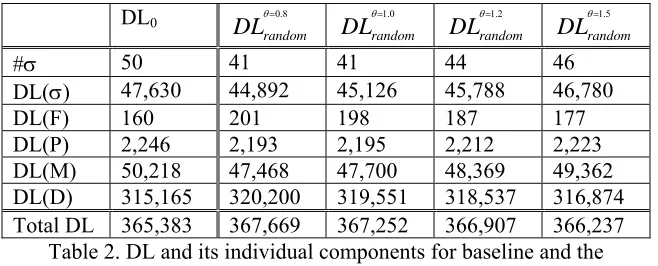
Table 2 presents
DL
θrandom derived from therandom collapsing, in a fashion parallel to Table 1. We show the results for only one iteration of
random collapsing, since the first iteration already shows a substantial increase in description length.
Figure 1 and Figure 2 present graphically the total description length from Tables 1 and 2 respectively. The reader will see that all
collapsing of signatures leads to a shortening of the description length of the morphology per se,
and an increase in the compressed length of the data. This is an inevitable formal consequence of the MDL-style model used here. The empirical question that we care about is whether the combined description length increases or decreases, and what we find is that when collapsing the signatures in the way that we propose to do, the combined description length decreases, leading us to conclude that this is, overall, a superior linguistic description of the data. On the other hand, when signatures are collapsed randomly, the combined description length increases. This makes sense; randomly decreasing the formal simplicity of the grammatical description should not improve the
overall analysis. Only an increase in the formal simplicity of a grammar that is grammatically sensible should have this property. Since our goal is to develop an algorithm that is completely data-driven and can operate in an
Compa rison of DL
362,500 363,000 363,500 364,000 364,500 365,000 365,500 366,000
DL0 DL1 DL2
[image:7.612.74.280.357.480.2]θ=0.8 θ=1 θ=1.2 θ=1.5
Figure 1 Comparison of DL, 2 iterations and 4 threshold values
Compa rison of ra ndomly c olla psing DL
364,000 364,500 365,000 365,500 366,000 366,500 367,000 367,500 368,000
DL0 Drandom
DL
θ=0.8 θ=1 θ=1.2 θ=1.5
Figure 2 Comparison of DLs with random collapse of signatures (see text)
DL0 θ=0=.81
iter
DL
DL
θiter=0=.82DL
θiter=1=.01DL
θiter=1=.02DL
θiter=1=.21DL
θiter=1=.22DL
θiter=1=.51DL
θiter=1=.52#σ 50 41 35 41 34 44 42 46 45
DL(σ) 47,630 45,343 42,939 45,242 43,046 44,897 44,355 46,172 45,780
DL(F) 160 156 156 153 143 158 147 163 164
DL(P) 2,246 2,087 1,968 2,084 1,934 2,158 2,094 2,209 2,182 DL(M) 50,218 47,768 45,244 47,659 45,304 47,395 46,777 48,724 48,306 DL(D) 315,165 316,562 318,687 316,615 318,172 316,971 317,323 315,910 316,251 Total
DL
365,383 364,330 363,931 364,275 363,476 364,367 364,101 364,635 364,558
[image:7.612.324.522.358.482.2]DL0 θ=0.8
random
DL
DL
θrandom=1.02 . 1
= θ
random
DL
DL
θrandom=1.5#σ 50 41 41 44 46
DL(σ) 47,630 44,892 45,126 45,788 46,780
DL(F) 160 201 198 187 177
[image:8.612.143.472.65.198.2]DL(P) 2,246 2,193 2,195 2,212 2,223 DL(M) 50,218 47,468 47,700 48,369 49,362 DL(D) 315,165 320,200 319,551 318,537 316,874 Total DL 365,383 367,669 367,252 366,907 366,237
Table 2. DL and its individual components for baseline and the resulting cases when collapsing signatures randomly.
unsupervised fashion, we take this evidence as supporting the appropriateness of our algorithm as a means of collapsing signatures in a grammatically and empirically reasonable way.
We conclude that the collapsing of signatures on the basis of similarity of context vectors of signature transforms (in a space consisting of high frequency words and signature transforms) provides us with a useful and significant step towards solving the signature collapsing problem. In the context of the broader project, we will be able to use signature transforms as a more effective means for projecting lexical categories in an unsupervised way.
As Table 1 shows, we achieve up to 30% decrease in the number of signatures through our proposed collapse. We are currently exploring ways to increase this value through powers of the adjacency matrix of the signature graph.
In other work in progress, we explore the equally important signature purity problem in
graph theoretic terms: we split ambiguous
signature transforms into separate categories when we can determine that the edges connecting left-context features and right-left-context features can be resolved into two sets (corresponding to the distinct categories of the transform) whose left-features have no (or little) overlap and whose right features have no (or little) overlap. We employ the notion of minimum cut of a weighted graph to detect this situation.
References
Brown, Peter F., Vincent J. Della Pietra, Peter V. deSouza, Jennifer C. Lai, and Robert L. Mercer. 1992. Class-based n-gram models of natural language. Computational Linguistics, 18(4): 467-479.
Goldsmith, John. 2001. Unsupervised learning of the morphology of a natural language. Computational Linguistics, 27(2): 153-198.
Higgins, Derrick. 2002. A Multi-modular Approach to Model Selection in Statistical NLP. University of Chicago Ph.D. thesis.
Schmid, Helmut. 1994. Probabilistic part-of-speech tagging using decision trees.. International Conference on New Methods in Language Processing
Kucera, Henry and W. Nelson Francis. 1967. Computational Analysis of Present-day American English. Brown University Press.
Rissanen, Jorma. 1989. Stochastic Complexity in Statistical Inquiry. Singapore: World Scientific. Schütze, Hinrich. 1997. Ambiguity Resolution in
Language Learning. CSLI Publications. Stanford CA.
Sparck Jones, Karen. 1973. Index term weighting. Information Storage and Retrieval 9:619-33.