Modifying a Natural Language Processing System for
European Languages to Treat Arabic in Information Processing
and Information Retrieval Applications
Gregory Grefenstette, Nasredine Semmar, Faïza Elkateb-Gara
Multilingual Multimedia Knowledge Engineering Laboratory (LIC2M)
Commissariat à l’Energie Atomique, Laboratoire d’Intégration des Systèmes et des Technologies (CEA LIST)
B.P. 6, 92265 Fontenay-aux-Roses Cedex, France
{gregory.grefenstette,nasredine.semmar,faiza.gara}@cea.fr
Abstract
The goal of many natural language proc-essing platforms is to be able to someday correctly treat all languages. Each new language, especially one from a new lan-guage family, provokes some modifica-tion and design changes. Here we present the changes that we had to introduce into our platform designed for European guages in order to handle a Semitic lan-guage. Treatment of Arabic was successfully integrated into our cross lan-guage information retrieval system, which is visible online.
1 Introduction
When a natural language processing (NLP) system is created in a modular fashion, it can be relatively easy to extend treatment to new languages (May-nard, et al. 2003) depending on the depth and completeness desired. We present here lessons learned from the extension of our NLP system that was originally implemented for Romance and Germanic European1 languages to a member of the Semitic language family, Arabic. Though our sys-tem was designed modularly, this new language posed new problems. We present our answers to
1
European languages from non indo-European families (Basque, Finnish and Hungarian) pose some of the same prob-lems that Arabic does.
these problems encountered in the creation of an Arabic processing system, and illustrate its integra-tion into an online cross language informaintegra-tion re-trieval (CLIR) system dealing with documents written in Arabic, English French and Spanish.
2 The LIMA natural language processor
Our NLP system (Besançon et al., 2003), called LIMA2, was built using a traditional architecture involving separate modules for
1. Morphological analysis:
a. Tokenization (separating the input stream into a graph of words). b. Simple word lookup (search for
words in a full form lexicon). c. Orthographical alternative lookup
(looking for differently accented forms, alternative hyphenisation, concatenated words, abbreviation recognition), which might alter the original non-cyclic word graph by adding alternative paths.
d. Idiomatic expressions recognizer (detecting and considering them as single words in the word graph). e. Unknown word analysis. 2. Part-of-Speech and Syntactic analysis:
a. After the morphological analysis, which has augmented the original graph with as many nodes as there
are interpretations for the tokens, part-of-speech analysis using lan-guage models from a hand-tagged corpus reduces the number of pos-sible readings of the input.
b. Named entity recognizer.
c. Recognition of nominal and verbal chains in the graph.
d. Dependency relation extraction. 3. Information retrieval application:
a. Subgraph indexing.
b. Query reformulation (monolingual reformulation for paraphrases and synonymy; multilingual for cross language information retrieval). c. Retrieval scoring comparing
par-tial matches on subgraphs and en-tities.
Our LIMA NLP system (Besançon et al., 2003) was first implemented for English, French, German and Spanish, with all data coded in UTF8. When we extended the system to Arabic, we found that a number of modifications had to be introduced. We detail these modifications in the next sections.
3 Changes specific to Semitic languages
Two new problems posed by Arabic (and common to most Semitic languages) that forced us to alter our NLP system are the problem of incomplete vowelization of printed texts3 and the problem of agglutinative clitics. We discuss how these new problems influenced our lexical resources and lan-guage processing steps.
Lexical Resources
The first task for introducing a new language is to create the lexical resources for this language. Since Arabic presents agglutination of articles, preposi-tions and conjuncpreposi-tions at the beginning of words as well as pronouns at the end of words, and these phenomena were not treated in our existing
3 Since the headwords of our monolingual and cross-lingual
reference dictionaries for Arabic possess voweled entries, we hope to attain greater precision by treating this problem. An alternative but noisy approach (Larkey et al. 2002) is to reduce to unvoweled text throughout the NLP application.
pean languages4, we had to decide how this feature would be handled in the lexicon. Solutions to this problem have been proposed, ranging from genera-tion and storage of all agglutinated words forms (Debili and Zouari, 1985) to the compilation of valid sequences of proclitics, words and enclitics into finite-state machines (Beesley, 1996). Our system had already addressed the problem of com-pounds for German in the following way: if an in-put word is not present in the dictionary, a compound-searching module returns all complete sequences of dictionary words (a list of possible compound joining "fogemorphemes" is passed to this module) as valid decompositions of the input word. Though theoretically this method could be used to treat Arabic clitics, we decided against us-ing this existus-ing process for two reasons:
1. Contrary to German, in which any noun may theoretically be the first element of a compound, Arabic clitics belong to a small closed set of articles, conjunc-tions, prepositions and pronouns. Al-lowing any word to appear at the beginning or end of an agglutinated word would generate unnecessary noise. 2. Storing all words with all possible cli-tics would multiply the size of lexicon proportionally to the number of legal possible combinations. We decided that this would take up too much space, though others have adopted this ap-proach as mentioned above.
We decided to create three lexicons: two additional (small) lists of proclitic and enclitic combinations, and one large lexicon of full form5 voweled words (with no clitics), the creation of the large lexicon from a set of lemmas using classic conjugation rules did not require any modification of the exist-ing dictionary buildexist-ing and compilation compo-nent. Since our NLP system already possessed a mechanism for mapping unaccented words to ac-cented entries, and we decided to use this existing
4
Spanish, of course, possesses enclitic pronouns for some verb forms but these were not adequately treated until the solution for Arabic was implemented in our system.
5 Our dictionary making process generates all full form
mechanism for later matching of voweled and un-voweled versions of Arabic words in applications. Thus the only changes for lexical resources involve adding two small clitic lexicons.
Processing Steps: Morphological analysis
Going back to the NLP processing steps listed in section 2, we now discuss new processing changes needed for treating Arabic. Tokenization (1a) and simple word lookup (2a) of the tokenized strings in the dictionary were unchanged as LIMA was coded for UTF8. If the word was not found, an existing orthographical alternative lookup (1c) was also used without change (except for the addition of the language specific correspondence table be-tween accented and unaccented characters) in order to find lexical entries for unvoweled or partially voweled words. Using this existing mechanism for treating the vowelization problem does not allow us to exploit partial vowelization as we explain in a later section.
At this point in the processing, a word that contains clitics will not have been found in the dictionary since we had decided not to include word forms including clitics. We introduced, here, a new proc-essing step for Arabic: a clitic stemmer. This stemmer uses the following linguistic resources:
• The full form dictionary, containing for
each word form its possible part-of-speech tags and linguistic features (gender, num-ber, etc.). We currently have 5.4 million entries in this dictionary6.
• The proclitic dictionary and the enclitic
dictionary, having the same structure of the full form dictionary with voweled and unvoweled versions of each valid combi-nation of clitics. There are 77 and 65 en-tries respectively in each dictionary.
The clitic stemmer proceeds as follows on tokens unrecognized after step 1c:
• Several vowel form normalizations are
performed (َ ً ُ ٌ ِ ٍ are removed, أ إ are replaced by ا and final ؤ ئ ي or ة are replaced by ءو ءى ى or ).
6
If we generated all forms including appended clitics, we would generate an estimated 60 billion forms (Attia, 1999).
• All clitic possibilities are computed by us-ing proclitics and enclitics dictionaries.
• A radical, computed by removing these clitics, is checked against the full form lexicon. If it does not exist in the full form lexicon, re-write rules (such as those de-scribed in Darwish (2002)) are applied, and the altered form is checked against the full form dictionary. For example, consider the token هاهو and the included clitics (و,
ه), the computed radical اه does not exist in the full form lexicon but after applying one of the dozen re-write rules, the modi-fied radical ىه is found the dictionary and the input token is segmented into root and clitics as: ه + ىه + و = هاهو.
• The compatibility of the morpho-syntactic
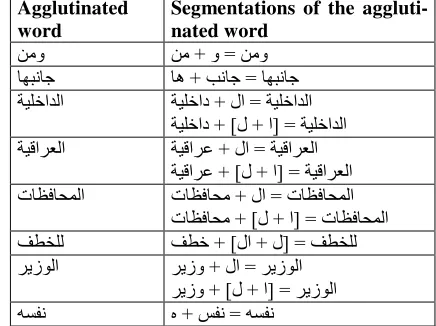
tags of the three components (proclitic, radical, enclitic) is then checked. Only valid segmentations are kept and added into the word graph. Table 1 gives some examples of segmentations7 of words in the sentence اا ا!ا ةرازو ت!آأ &'()&* +,
Agglutinated word
Segmentations of the aggluti-nated word
+,و +, + و = +,و &'()&* &ه + -)&* = &'()&* ا!ا اد + لا = ا!ا
ا!ا ] = ا + ل + [ اد
اا ا2 + لا = اا اا ] = ا + ل + [ ا2
ت&34&56ا ت&34&5, + لا = ت&34&56ا ت&34&56ا ] = ا + ل + [ ت&34&5,
789 78 + [لا + ل] = 789 یزا یزو + لا = یزا
یزا ] = ا + ل + [ یزو
[image:3.612.326.544.369.532.2];<=) + >=) = ;<=)
Table 1: Segmentations of some agglutinated words.
Producing this new clitic stemmer for Arabic al-lowed us to correctly treat a similar (but previously ignored) phenomenon in Spanish in which verb forms can possess pronominal enclitics. For exam-ple, the imperative form of “give to me” is written as “dame”, which corresponds to the radical “da” followed the enclitic “me”. Once we implemented this clitic stemmer for Arabic, we created an
7
clitic dictionary for Spanish and then successfully used the same stemmer for this European language. At this point, the treatment resumes as with Euro-pean languages. The detection of idiomatic8 ex-pressions (step 1d) is performed after clitic separation using rules associated with trigger words for each expression. Once a trigger is found, its left and right lexical contexts in the rule are then tested. The trigger must be an entry in the full form lexicon, but can be represented as either a surface form or a lemma form combined with its morpho-syntactic tag. Here we came across another prob-lem specific to Semitic languages. Since Arabic lexicon entries are voweled and since input texts may be partially voweled or unvoweled, we are forced to only use lemma forms to describe Arabic idiomatic expressions rules with the existing mechanism, or else enter all the possible partial vowelizations for each word in an idiomatic ex-pression. Since, at this point after step 1c, each recognized word is represented with all its possible voweled lemmas in the analysis graph, we devel-oped 482 contiguous idiomatic voweled expression rules. For example one of the developed rules rec-ognizes in the text ?)&@ا ن)&آ (January) as a whole and tags the expression as a being a month.
After idiomatic expression recognition, any nodes not yet recognized are assigned (in step 1e) default linguistic values based on features recognized dur-ing tokenization (e.g. presence of uppercase or numbers or special characters). Nothing was changed for this step of default value assignment in order to treat Arabic, but since Semitic languages do not have the capitalization clues that English and French have for recognizing proper and since Arabic proper names can often be decomposed into simple words (much like Chinese names), the cur-rent implementation of this step with our curcur-rent lexical resources poses some problems.
For example, consider the following sentence:
+<)&یدB رو!یإ ;,زو ?<CD EF<D&ﺏ E=D5ی در&(,H I)ا4 ﺡ=ا ;آر&CیFrank Lampard celebrates the score by Chelsea and his team mate Eidur Gudjohnsen shares his elation. The name I)ا4 (Frank) is
8 An idiom in our system is a (possibly non-contiguous
se-quence) of known words that act as a single unit. For example, made up in He made up the story on the spot. Once an idiomatic expression is recognized the individual words nodes are joined into one node in the word graph.
tified as such because it is found in the lexicon; the name در&(,H (Lampard) is not in the lexicon and incorrectly stemmed as در&(, + H (plural of the noun
د(, (grater)); the name رو!یإ (Eidur) is incorrectly tagged as a verb; and +<)&یدB (Gudjohnsen), which is not in the dictionary and for which the clitic stemmer does not produce any solutions receives the default tags adjective, noun, proper noun and verb, to be decided by the part-of-speech tagger. To improve this performance, we plan to enrich the Arabic lexicon with more proper names, using ei-ther name recognition (Maloney and Niv, 1998) or a back translation approach after name recognition in English texts (Al-Onaizan and Knight, 2002).
Processing Steps: Part-of-speech analysis
For the succeeding steps involving part-of-speech tagging, named entity recognition, division into nominal and verbal chains, and dependency extrac-tion no changes were necessary for treating Arabic. After morphological analysis, as input to step 2a, part-of-speech tagging, we have the same type of word graph for Arabic text as for European text: each node is annotated with the surface form, a lemma and a part-of-speech in the graph. If a word is ambiguous, then more than one node appears in the graph for that word. Our part-of-speech tagging involves using a language model (bigrams and tri-grams of grammatical tags) derived from hand-tagged text to eliminate unattested or rare sub paths in the graph of words representing a sentence. For Arabic, we created a hand-tagged corpus, and where then able to exploit the existing mechanism.
One space problem that has arisen in applying the existing processing designed for European lan-guages comes from the problem of vowelization. With our previous European languages, it was ex-tremely rare to have more than one possible lem-matization for a given pair: (surface form, grammatical part-of-speech tag)9. But, in Arabic this can be very common since an unvoweled string can correspond to many different words, some with the same part-of-speech but different lemmas. The effect of this previously unseen type of ambiguity on our data structures was to greatly increase the word graph size before and after part-of-speech tagging. Since each combination of
9
face-form, part-of-speech-tag, and lemma) gives rise to a new node, the graph becomes larger, in-creasing the number of paths that all processing steps must explore. The solution to this for Arabic and other Semitic languages is simple, though we have not yet implemented it. We plan to modify our internal data structure so that each node will correspond to the surface form, a part-of-speech tag, and a set of lemmas: (surface-form, part-of-speech-tag, {lemmas}). The inclusion of a set of possible lemmas, rather than just one lemma, in a node will greatly reduce the number of nodes in the graph and speed processing time.
The next step in our NLP system, after part-of-speech tagging, is named entity recognition (Abuleil and Evans, 2004) using name triggers (e.g., President, lake, corporation, etc.). Beyond the problem mentioned above of distinguishing possi-ble proper nouns, here we had an additional prob-lem since our recognizer extracted the entity in its surface form. Since in Arabic, as in other Semitic languages, the input text is usually only partially voweled, this gave rise to many different forms (corresponding to different surface forms) for the same entity. This minor problem was solved by storing the fully voweled forms of the entities (for application such as information retrieval as shown below) rather than the surface form.
After named entity recognition, our methods of verbal and nominal chain recognition and depend-ency extraction did not require any modifications for Arabic. But since the sentence graphs, as men-tioned above, are currently large, we have re-stricted the chains recognized to simple noun and verb chunks (Abney, 1991) rather than the more complex chains (Marsh, 1984) we recognize for European languages. Likewise, the only depend-ency relations that we extract for the moment are relations between nominal elements. We expect that the reduction in sentence graph once lemmas are all collected in the same word node will allow us to treat more complex dependency relations.
4 Integration in a CLIR application
The results of the NLP steps produce, for all lan-guages we treat, a set of normalized lemmas, a set of named entities and a set of nominal compounds (as well as other dependency relations for some
languages). These results can be used for any natu-ral language processing application. For example, we have integrated LIMA as a front-end for a cross language information retrieval system. The inclu-sion of our Arabic language results into the infor-mation retrieval system did not necessitate any modifications to this system.
This information retrieval (IR) application in-volves three linguistic steps, as shown in section 2. First, in step 3a, subgraphs (compounds and their components) of the original sentence graph are stored. For example, the NLP analysis will recog-nize an English phrase such as “management of water resources” as a compound that the IR system will index. This phrase and its sub-elements are normalized and indexed (as well as simple words) in the following head-first normalized forms:
• management_water_resource • resource_water
• management_resource
Parallel head-first structures are created for differ-ent languages, for example, the French “gestion des ressource en eau” generates:
• gestion_ressource_eau • ressource_eau
• gestion_ressource.
The corresponding Arabic phrase: &6ا درا, ةرادإ
is likewise indexed with voweled forms:
• ةَراَدِإ _ دِرْLLLَ,_ ء&َ, • دِرْLLLَ,_ ء&َ,
• ةَراَدِإ _ دِرْLLLَ,
When a question is posed to our cross language IR (CLIR) system it undergoes the same NLP treat-ment as in steps 1a to 3a. Then the query is refor-mulated using synonym dictionaries and translation dictionaries in step 3b. For Arabic, we have not yet acquired any monolingual synonym dictionaries, but we have purchased and modified cross-lingual transfer dictionaries between Arabic and English, Arabic and French, and Arabic and Spanish10. When a compound is found in a query, it is normalized and its sub elements are extracted as shown above. Using the reformulation dictionar-ies, variant versions of the compound are generated (monolingual, then cross-lingual versions) and
10
tested variants are retained as synonyms to the original compound11 (Besançon et al., 2003). To integrate the Arabic version into our CLIR system, no modifications were necessary beyond acquiring and formatting the cross language reformulation dictionaries.
The final NLP step (3c) involving in our CLIR system involves ranking relevant documents. Con-trary to a bag of word system, which uses only term frequency in queries and documents, our sys-tem (Besançon et al., 2003) returns documents in ranked weighted classes12 whose weightings in-volve the presence of named entities, the com-pleteness of the syntactic subgraphs matched, and the database frequencies of the words and sub-graphs matched.
Example
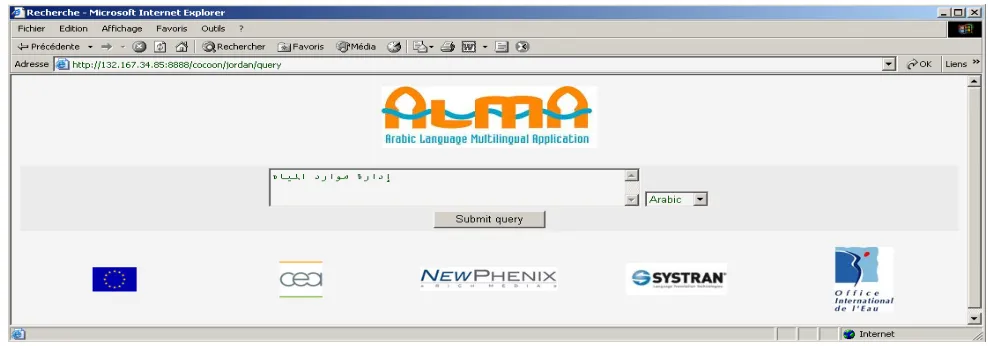
An online version of our cross language retrieval system involving our Arabic processing is visible online at a third party site: http://alma.oieau.fr. This base contains 50 non-parallel documents about sustainable development for each of the fol-lowing languages: English, Spanish, French and Arabic. The user can enter a query in natural lan-guage and specify the lanlan-guage to be used. In the example of the Figure 1, the user entered the query “ &6ا درا, ةرادإ” and selected Arabic as the language of the query.
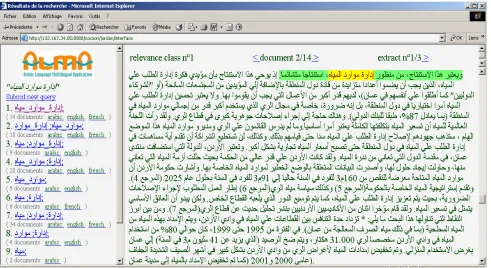
Relevant documents are grouped into classes char-acterized by the same set of concepts (i.e., refor-mulated subgraphs) as the query contains. Figure 2 shows some classes corresponding to the query “
&6ا درا, ةرادإ”. The query term &,_ درا,_ةرادإ is a term composed of three words: &,, درا, and ةرادإ. This compounds, its derived variants and their sub elements are reformulated into English, French, and Spanish and submitted to indexed versions of documents in each of these languages (as well as against Arabic documents). The highest ranking
11
This technique will only work with translations which have at least one subelement that is has a parallel between lan-guages, but this is often the case for technical terms.
12 This return to a mixed Boolean approach is found in current
research on Question Answering systems (Tellex et al., 2003). Our CLIR system resembles such systems, which return the passage in which the answer is found, since we highlight the most significant passages of each retrieved document.
classes (as seen in Figure 2 for this example) match the following elements:
Class Query terms Number of retrieved documents
1 &,_درا,_ةرادإ 14 2 &,_درا,، درا,_ةرادإ 18 3 درا,_ةرادإ، &, 9
Terms of the query or the expansion of these terms which are found in the retrieved documents are highlighted as illustrated in Figures 2 and 3.
5 Conclusion
References
Steven Abney. Parsing by Chunks. 1991. In R. C. Ber-wick, S. P. Abney, and C. Tenny, editors, Principle-Based Parsing: Computation and Psycholinguistics, Kluwer Academic Publishers, Boston.
Saleem Abuleil, Martha Evens. 2004. Named Entity Recognition and Classification for Text in Arabic. IASSE 2004, pp. 89-94
Mohamed Attia. 1999. A large-Scale Computational Processor of Arabic Morpholofy, and Applications. M.S. thesis in Computer Engineering, Cairo Univer-sity, pp. 28-32.
Y. Al-Onaizan and K. Knight. 2002. Machine Translit-eration of Names in Arabic Text. Proc. of ACL Workshop on Computational Approaches to Semitic Languages, pp. 400-408
Kenneth Beesley. 1996. Arabic Finite-State Morpho-logical Analysis and Generation. Proc. of COLING-96, pp. 89-94.
Romaric Besançon, Gaël de Chalendar, Olivier Ferret, Christian Fluhr, Olivier Mesnard, and Hubert Naets. 2003. Concept-Based Searching and Merging for Multilingual Information Retrieval: First Experi-ments at CLEF 2003. CLEF-2003, pp. 174-184.
K. Darwish. 2002. Building a Shallow Arabic Morpho-logical Analyzer in One Day. In Proc. ACL-02, pp. 47-54
Fathi Debili and Lotfi Zouari. 1985. Analyse morpholo-gique de l’arabe écrit voyellé ou non fondée sur la construction automatique d’un dictionnaire arabe, Cognitiva, Paris.
Leah S. Larkey, Lisa Ballesteros, Margaret E. Connell. 2002. Improving stemming for Arabic information retrieval: light stemming and co-occurrence analysis. Proc. ofSIGIR 2002, pp. 275-282
Krister Lindén and Jussi Piitulainen. 2004. Discovering Synonyms and Other Related Words. CompuTerm 2004, Geneva, Switzerland, August 29.
John Maloney and Michael Niv. 1998. TAGARAB: A Fast, Accurate Arabic Name Recogniser Using High Precision Morphological Analysis. Proc. of the Workshop on Computational Approaches to Semitic Languages. Montreal, Canada. August.
Elain Marsh. 1984. A Computational Analysis of Com-plex Noun Phrases in Navy Messages. In Proc. of COLING '84, Stanford, pp. 505-508.
Diana Maynard, Valentin Tablan, Kalina Bontcheva, Hamish Cunningham. 2003. Rapid Customization of an Information Extraction System for a Surprise Lan-guage. ACM Trans. Asian Lang. Inf. Process. 2(3) pp. 295-300.
[image:7.612.68.562.465.638.2]Stefanie Tellex, Boris Katz, Jimmy Lin, Gregory Mar-ton, and Aaron Fernandes. 2003. Quantitative Evaluation of Passage Retrieval Algorithms for Question Answering. Proc. Of SIGIR 2003, pp. 41-47
Figure 2: Search results user interface. Results can appear in many languages.
[image:8.612.73.564.353.621.2]