Designing an Extensible API for
Integrating Language Modeling and Realization
Michael White
School of Informatics University of Edinburgh Edinburgh EH8 9LW, UK
http://www.iccs.informatics.ed.ac.uk/~mwhite/
Abstract
We present an extensible API for inte-grating language modeling and realiza-tion, describing its design and efficient implementation in the OpenCCG sur-face realizer. With OpenCCG, language models may be used to select realiza-tions with preferred word orders, pro-mote alignment with a conversational partner, avoid repetitive language use, and increase the speed of the best-first anytime search. The API enables a vari-ety of n-gram models to be easily com-bined and used in conjunction with ap-propriate edge pruning strategies. The n-gram models may be of any order, operate in reverse (“right-to-left”), and selectively replace certain words with
their semantic classes. Factored
lan-guage models with generalized backoff may also be employed, over words rep-resented as bundles of factors such as form, pitch accent, stem, part of speech, supertag, and semantic class.
1 Introduction
The OpenCCG1 realizer (White and Baldridge,
2003; White, 2004a; White, 2004c) is an open source surface realizer for Steedman’s (2000a; 2000b) Combinatory Categorial Grammar (CCG). It is designed to be the first practical, reusable re-alizer for CCG, and includes implementations of
1http://openccg.sourceforge.net
CCG’s unique accounts of coordination and infor-mation structure–based prosody.
Like other surface realizers, the OpenCCG re-alizer takes as input a logical form specifying the propositional meaning of a sentence, and returns one or more surface strings that express this mean-ing accordmean-ing to the lexicon and grammar. A dis-tinguishing feature of OpenCCG is that it imple-ments a hybrid symbolic-statistical chart realiza-tion algorithm that combines (1) a theoretically grounded approach to syntax and semantic com-position, with (2) the use of integrated language models for making choices among the options left open by the grammar (thereby reducing the need for hand-crafted rules). In contrast, previous chart realizers (Kay, 1996; Shemtov, 1997; Car-roll et al., 1999; Moore, 2002) have not included a statistical component, while previous statisti-cal realizers (Knight and Hatzivassiloglou, 1995; Langkilde, 2000; Bangalore and Rambow, 2000; Langkilde-Geary, 2002; Oh and Rudnicky, 2002; Ratnaparkhi, 2002) have employed less general approaches to semantic representation and com-position, and have not typically made use of fine-grained logical forms that include specifications of such information structural notions as theme, rheme and focus.
by integrating language model scoring into the search, it also becomes possible to use more accu-rate models to improve realization times, when the realizer is run in anytime mode (White, 2004b).
To allow language models to be combined in flexible ways—as well as to enable research on how to best combine language modeling and realization—OpenCCG’s design includes inter-faces that allow user-defined functions to be used for scoring partial realizations and for pruning low-scoring ones during the search. The design also includes classes for supporting a range of language models and typical ways of combining them. As we shall see, experience to date indi-cates that the benefits of employing a highly gen-eralized approach to scoring and pruning can be enjoyed with little or no loss of performance.
The rest of this paper is organized as follows. Section 2 gives an overview of the realizer archi-tecture, highlighting the role of the interfaces for plugging in custom scoring and pruning functions, and illustrating how n-gram scoring affects accu-racy and speed. Sections 3 and 4 present Open-CCG’s classes for defining scoring and pruning functions, respectively, giving examples of their usage. Finally, Section 5 summarizes the design and concludes with a discussion of future work.
2 Realizer Overview
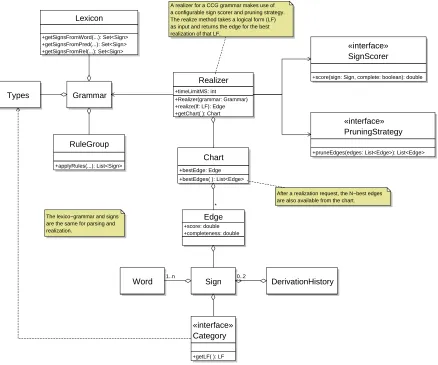
The UML class diagram in Figure 1 shows the high-level architecture of the OpenCCG realizer; sample Java code for using the realizer appears in Figure 2. A realizer instance is constructed with a reference to a CCG grammar (which supports both parsing and realization). The grammar’s lex-icon has methods for looking up lexical items via their surface forms (for parsing), or via the prin-cipal predicates or relations in their semantics (for realization). A grammar also has a set of hierar-chically organized atomic types, which can serve as the values of features in the syntactic categories, or as ontological sorts for the discourse referents in the logical forms (LFs).
Lexical lookup yields lexical signs. A sign pairs a list of words with a category, which itself pairs a syntactic category with a logical form. Lexical signs are combined into derived signs using the
rules in the grammar’s rule group. Derived signs maintain a derivation history, and their word lists share structure with the word lists of their input signs.
As mentioned in the introduction, for general-ity, the realizer makes use of a configurable sign scorer and pruning strategy. A sign scorer imple-ments a function that returns a number between 0 and 1 for an input sign. For example, a stan-dard trigram language model can be used to im-plement a sign scorer, by returning the probability of a sign’s words as its score. A pruning strat-egy implements a method for determining which edges to prune during the realizer’s search. The input to the method is a ranked list of edges for signs that have equivalent categories (but different words); grouping edges in this way ensures that pruning cannot “break” the realizer, i.e. prevent it from finding some grammatical derivation when one exists. By default, an N-best pruning strategy is employed, which keeps the N highest scoring in-put edges, pruning the rest (where N is determined by the current preference settings).
The realization algorithm is implemented by the
realize method. As in the chart realizers cited
earlier, the algorithm makes use of a chart and an agenda to perform a bottom-up dynamic pro-gramming search for signs whose LFs completely cover the elementary predications in the input log-ical form. See Figure 9 (Section 3.1) for a real-ization trace; the algorithm’s details and a worked example appear in (White, 2004a; White, 2004c).
Therealizemethod returns the edge for the best
realization of the input LF, as determined by the sign scorer. After a realization request, the N-best complete edges—or more generally, all the edges for complete realizations that survived pruning— are also available from the chart.
Realizer
+timeLimitMS: int
+Realizer(grammar: Grammar)
+realize(lf: LF): Edge +getChart( ): Chart
Grammar
Chart
+bestEdge: Edge +bestEdges( ): List<Edge>
«interface»
SignScorer
+score(sign: Sign, complete: boolean): double
«interface»
PruningStrategy
+pruneEdges(edges: List<Edge>): List<Edge>
Lexicon
+getSignsFromWord(...): Set<Sign> +getSignsFromPred(...): Set<Sign> +getSignsFromRel(...): Set<Sign>
RuleGroup
+applyRules(...): List<Sign>
Types
Edge
+score: double +completeness: double
Sign
«interface»
Category
+getLF( ): LF
Word DerivationHistory
A realizer for a CCG grammar makes use of a configurable sign scorer and pruning strategy. The realize method takes a logical form (LF) as input and returns the edge for the best realization of that LF.
After a realization request, the N−best edges
are also available from the chart.
The lexico−grammar and signs
are the same for parsing and realization.
*
1..n 0..2
// l o a d grammar , i n s t a n t i a t e r e a l i z e r URL g r a m m a r U R L = . . . ;
G r a m m a r g r a m m a r = new G r a m m a r ( g r a m m a r U R L ); R e a l i z e r r e a l i z e r = new R e a l i z e r ( g r a m m a r );
// c o n f i g u r e r e a l i z e r w i t h t r i g r a m b a c k o f f m o d e l // and 10 - b e s t p r u n i n g s t r a t e g y
r e a l i z e r . s i g n S c o r e r = new S t a n d a r d N g r a m M o d e l (3 , " lm .3 bo " ); r e a l i z e r . p r u n i n g S t r a t e g y = new N B e s t P r u n i n g S t r a t e g y ( 1 0 ) ;
// ... then , for e a c h r e q u e s t :
// get LF f r o m i n p u t XML D o c u m e n t i n p u t D o c = . . . ;
LF lf = r e a l i z e r . g e t L f F r o m D o c ( i n p u t D o c );
// r e a l i z e LF and get o u t p u t w o r d s in XML E d g e b e s t E d g e = r e a l i z e r . r e a l i z e ( lf );
D o c u m e n t o u t p u t D o c = b e s t E d g e . s i g n . g e t W o r d s I n X m l ();
// r e t u r n o u t p u t ... o u t p u t D o c . . . ;
Figure 2: Example realizer usage
of all possible realizations is created in the first stage; then in the second stage, the packed repre-sentation is unpacked in bottom-up fashion, with scores assigned to the edge for each sign as it is unpacked, much as in (Langkilde, 2000). In both modes, the pruning strategy is invoked to deter-mine whether to keep or prune newly constructed edges. For single-best output, the anytime mode can provide signficant time savings by cutting off the search early; see (White, 2004c) for discus-sion. For N-best output—especially when a com-plete search (up to the edges that survive the prun-ing strategy) is desirable—the two-stage mode can be more efficient.
To illustrate how n-gram scoring can guide the best-first anytime search towards preferred real-izations and reduce realization times, we repro-duce in Table 1 and Figures 3 through 5 the
cross-validation tests reported in (White, 2004b). In
these tests, we measured the realizer’s accuracy and speed, under a variety of configurations, on the regression test suites for two small but linguis-tically rich grammars: the English grammar for
the COMIC2dialogue system—the core of which
is shared with the FLIGHTS system (Moore et al., 2004)—and the Worldcup grammar discussed in
2http://www.hcrc.ed.ac.uk/comic/
(Baldridge, 2002). Table 1 gives the sizes of the test suites. Using these two test suites, we timed how long it took on a 2.2 GHz Linux PC to realize each logical form under each realizer configura-tion. To measure accuracy, we counted the num-ber of times the best scoring realization exactly matched the target, and also computed a modified version of the Bleu n-gram precision metric (Pap-ineni et al., 2001) employed in machine translation evaluation, using 1- to 4-grams, with the longer n-grams given more weight (cf. Section 3.4). To rank candidate realizations, we used standard n-gram backoff models of orders 2 through 6, with semantic class replacement, as described in Sec-tion 3.1. For smoothing, we used Ristad’s nat-ural discounting (Ristad, 1995), a parameter-free method that seems to work well with relatively small amounts of data.
LF/target Unique up
pairs to SC Mean Min Max Mean Min Max
COMIC 549 219 13.1 6 34 8.4 2 20
Worldcup 276 138 9.2 4 18 6.8 3 13
Input nodes Length
Table 1: Test suite sizes.
Folds Baseline 1 Baseline 2 N2 N3 N4 N5 N6 Topline
1.04 459.464 370.889 460.454 450.548 450.843 458.592 460.228 147.818
1.1 459.464 370.889 406.743 365.058 360.705 370.678 372.869 147.818
1.2 459.464 370.889 366.007 305.226 306.098 314.825 308.131 147.818
1.33 459.464 370.889 349.035 279.426 266.956 274.539 275.559 147.818
1.5 459.464 370.889 342.078 272.148 256.851 260.654 262.124 147.818
2 459.464 370.889 320.536 238.563 217.597 222.8 221.709 147.818
3 459.464 370.889 311.634 234.106 210.492 211.816 212.674 147.818
5 459.464 370.889 307.725 225.306 202.372 203.661 201.568 147.818
10 459.464 370.889 302.233 223.579 199.632 200.148 198.929 147.818
25 459.464 370.889 302.286 220.612 197.918 199.415 196.361 147.818
COMIC: First
Folds Baseline 1 Baseline 2 N2 N3 N4 N5 N6 Topline 1.04 151.819 115.243 159.754 156.134 158.022 160.493 160.38 49.127
1.1 151.819 115.243 158.638 152.946 154.062 155.007 154.71 49.127 1.2 151.819 115.243 145.496 130.123 131.138 130.167 131.674 49.127 1.33 151.819 115.243 138.312 119.837 119.029 119.754 119.815 49.127 1.5 151.819 115.243 136.243 121.29 120.185 120.757 121.083 49.127 2 151.819 115.243 128.822 102.221 98.844 97.772 97.54 49.127 3 151.819 115.243 124.475 97.652 92.931 92.373 93.493 49.127 5 151.819 115.243 122.656 94.051 90.649 89.957 90.627 49.127 10 151.819 115.243 125.087 92.471 88.446 87.96 88.928 49.127 25 151.819 115.243 121.076 92.623 88.043 86.149 87.293 49.127
Worldcup: First
Figure 3: Mean time (in ms.) until first realization is found using n-grams of different orders and Ristad’s natural discounting (N), for cross-validation tests with increasing numbers of folds.
Folds Baseline 1 Baseline 2 N2 N3 N4 N5 N6 Topline 1.04 241 41 524 512 513 513 513 549
Folds Baseline 1 Baseline 2 N2 N3 N4 N5 N6 Topline
1.04 86 70 112 114 114 114 114 276
Figure 4: Number of realizations exactly matching target using n-grams of different orders.
Folds Baseline 1 Baseline 2 N2 N3 N4 N5 N6 Topline 1.04 0.754 0.379 0.974 0.963 0.963 0.963 0.963 1
1.1 0.754 0.379 0.967 0.953 0.942 0.942 0.942 1 1.2 0.754 0.379 0.996 0.996 0.996 0.996 0.996 1 1.33 0.754 0.379 0.992 0.995 0.995 0.995 0.995 1
1.5 0.754 0.379 1 0.996 0.996 0.996 0.996 1
2 0.754 0.379 1 0.999 0.999 0.999 0.999 1
3 0.754 0.379 1 0.999 0.999 0.999 0.999 1
5 0.754 0.379 1 0.999 0.999 0.999 0.999 1
10 0.754 0.379 1 0.999 0.999 0.999 0.999 1
25 0.754 0.379 1 0.999 0.999 0.999 0.999 1
COMIC: Score
Folds Baseline 1 Baseline 2 N2 N3 N4 N5 N6 Topline 1.04 0.6 0.538 0.646 0.658 0.656 0.656 0.656 1
1.1 0.6 0.538 0.766 0.767 0.764 0.768 0.768 1 1.2 0.6 0.538 0.806 0.794 0.8 0.804 0.803 1 1.33 0.6 0.538 0.833 0.849 0.852 0.859 0.856 1 1.5 0.6 0.538 0.87 0.877 0.873 0.873 0.877 1 2 0.6 0.538 0.875 0.888 0.886 0.894 0.895 1 3 0.6 0.538 0.901 0.923 0.92 0.924 0.924 1 5 0.6 0.538 0.9 0.93 0.925 0.927 0.931 1 10 0.6 0.538 0.905 0.93 0.915 0.928 0.922 1 25 0.6 0.538 0.915 0.938 0.917 0.932 0.935 1
Worldcup: Score
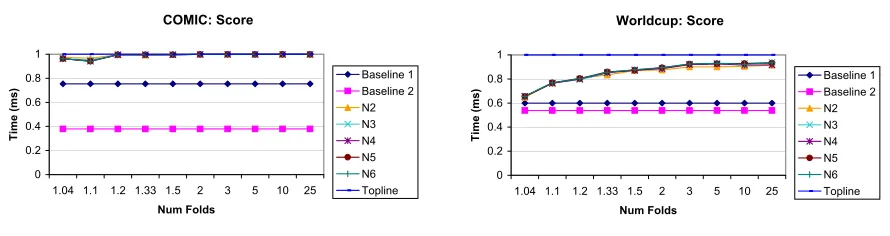
second baseline uses the same scorer, but adds new edges at the front of the agenda, corresponding to depth-first search. The topline uses the modified Bleu score, computing n-gram precision against just the target string. With this setup, Figures 3-5 show how initial realization times decrease and accuracy increases when longer n-grams are em-ployed. Figure 3 shows that trigrams offer a sub-stantial speedup over bigrams, while n-grams of orders 4-6 offer a small further improvement. Fig-ures 4 and 5 show that with the COMIC test suite, all n-gram orders work well, while with the World-cup test suite, n-grams of orders 3-6 offer some improvement over bigrams.
To conclude this section, we note that together with OpenCCG’s other efficiency methods, n-gram scoring has helped to achieve realization times adequate for interactive use in both the COMIC and FLIGHTS dialogue systems, along
with very high quality. Estimates indicate that
n-gram scoring typically accounts for only 2-5% of the time until the best realization is found, while it can more than double realization speed by accurately guiding the best-first anytime search. This experience suggests that more complex scor-ing models can more than pay for themselves, efficiency-wise, if they yield significantly more ac-curate preference orders on edges.
3 Classes for Scoring Signs
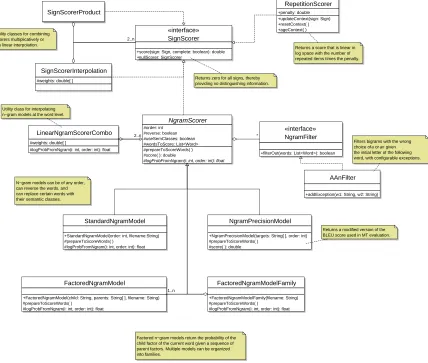
The classes for implementing sign scorers appear in Figure 6. In the diagram, classes for n-gram scoring appear towards the bottom, while classes for combining scorers appear on the left, and the class for avoiding repetition appears on the right.
3.1 Standard N-gram Models
The StandardNgramModel class can load
stan-dard n-gram backoff models for scoring, as shown
earlier in Figure 2. Such models can be
con-structed with the SRILM toolkit (Stolcke, 2002), which we have found to be very useful; in princi-ple, other toolkits could be used instead, as long as their output could be converted into the same file formats. Since the SRILM toolkit has more re-strictive licensing conditions than those of Open-CCG’s LGPL license, OpenCCG includes its own
classes for scoring with n-gram models, in order to avoid any necessary runtime dependencies on the SRILM toolkit.
The n-gram tables are efficiently stored in a trie data structure (as in the SRILM toolkit), thereby avoiding any arbitrary limit on the n-gram order. To save memory and speed up equality tests, each string is interned (replaced with a canonical in-stance) at load time, which accomplishes the same purpose as replacing the strings with integers, but without the need to maintain a separate mapping from integers back to strings. For better gener-alization, certain words may be dynamically re-placed with the names of their semantic classes when looking up n-gram probabilities. Words are assigned to semantic classes in the lexicon, and the semantic classes to use in this way may be config-ured at the grammar level. Note that (Oh and Rud-nicky, 2002) and (Ratnaparkhi, 2002) make simi-lar use of semantic classes in n-gram scoring, by deferring the instantiation of classes (such as
de-parture city) until the end of the generation
pro-cess; our approach accomplishes the same goal in a slightly more flexible way, in that it also allows the specific word to be examined by other scoring models, if desired.
As discussed in (White, 2004c), with dialogue systems like COMIC n-gram models can do an excellent job of placing underconstrained adjec-tival and adverbial modifiers—as well as bound-ary tones—without resorting to the more com-plex methods investigated for adjective ordering in (Shaw and Hatzivassiloglou, 1999; Malouf, 2000). For instance, in examples like those in (1), they correctly select the preferred positions for here and
also (as well as for the boundary tones), with
re-spect to the verbal head and sister dependents:
(1) a. HereL+H∗ LH% we have a design in
the classicH∗style LL% .
b. ThisL+H∗design LH% hereL+H∗LH%
is alsoH∗classic LL% .
We have also found that it can be useful to use reverse (or “right-to-left”) models, as they can help to place adverbs like though, as in (2):
(2) The tiles are alsoH∗from the JazzH∗series
«interface» SignScorer
+score(sign: Sign, complete: boolean): double +nullScorer: SignScorer
SignScorerInterpolation
#weights: double[ ] SignScorerProduct
RepetitionScorer +penalty: double +updateContext(sign: Sign) +resetContext( ) +ageContext( )
Returns zero for all signs, thereby providing no distinguishing information.
NgramScorer #order: int
#reverse: boolean #useSemClasses: boolean #wordsToScore: List<Word> #prepareToScoreWords( ) #score( ): double
#logProbFromNgram(i: int, order: int): float
«interface» NgramFilter
+filterOut(words: List<Word>): boolean
AAnFilter
+addException(w1: String, w2: String) LinearNgramScorerCombo
#weights: double[ ]
#logProbFromNgram(i: int, order: int): float
Returns a score that is linear in log space with the number of repeated items times the penalty.
StandardNgramModel
+StandardNgramModel(order: int, filename:String) #prepareToScoreWords( )
#logProbFromNgram(i: int, order: int): float
NgramPrecisionModel
+NgramPrecisionModel(targets: String[ ], order: int) #prepareToScoreWords( )
#score( ): double
FactoredNgramModel
+FactoredNgramModel(child: String, parents: String[ ], filename: String) #prepareToScoreWords( )
#logProbFromNgram(i: int, order: int): float
FactoredNgramModelFamily
+FactoredNgramModelFamily(filename: String) #prepareToScoreWords( )
#logProbFromNgram(i: int, order: int): float Utility classes for combining
scorers multiplicatively or via linear interpolation.
Utility class for interpolating n−gram models at the word level.
N−gram models can be of any order, can reverse the words, and can replace certain words with their semantic classes.
Returns a modified version of the BLEU score used in MT evaluation.
Filters bigrams with the wrong choice of a or an given the initial letter of the following word, with configurable exceptions.
Factored n−gram models return the probability of the child factor of the current word given a sequence of parent factors. Multiple models can be organized into families.
2..n
* 2..n
1..n
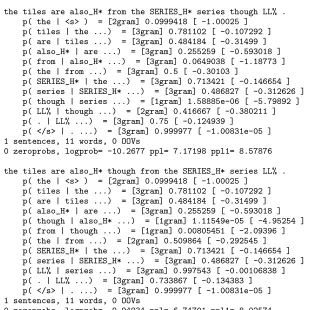
In principle, the forward and reverse probabilities should be the same—as they are both derived via the chain rule from the same joint probability of the words in the sequence—but we have found that with sparse data the estimates can differ substan-tially. In particular, since though typically appears at the end of a variety of clauses, its right context is much more predictable than its left context, and thus reverse models yield more accurate estimates of its likelihood of appearing clause-finally. To il-lustrate, Figures 7 and 8 show the forward and re-verse trigram probabilities for two competing real-izations of (2) in a 2-fold cross-validation test (i.e. with models trained on the half of the test suite not including this example). With the forward tri-gram model, since though has not been observed following series, and since series is a frequently occurring word, the penalty for backing off to the unigram probability for though is high, and thus the probability is quite low. The medial placement
(following alsoH∗) also yields a low probability,
but not as low as the clause-final one, and thus the forward model ends up preferring the medial placement, which is quite awkward. By contrast, the reverse model yields a very clear preference for the clause-final position of though, and for this reason interpolating the forward and reverse mod-els (see Section 3.3) also yields the desired prefer-ence order.
Figure 9 shows a trace of realizing (2) with such an interpolated model. In the trace, the
interpo-lated model is loaded by the classMyEvenScorer.
The input LF appears at the top. It is flattened into a list of elementary predications, so that cov-erage of these predications can be tracked using bit vectors. The LF chunks ensure that the subtrees
underh1ands1are realized as independent
sub-problems; cf. (White, 2004a) for discussion. The edges produced by lexical lookup and instantiation
appear next, under the heading Initial Edges,
with only the edges for alsoH∗ and though shown
in the figure. For each edge, the coverage percent-age and score (here a probability) appear first, fol-lowed by the word(s) and the coverage vector, then the syntactic category (with features suppressed), and finally any active LF chunks. The edges added to the chart appear (unsorted) under the heading All Edges. As this trace shows, in the best-first
search, high probability phrases such as the tiles
are alsoH∗ can be added to the chart before
low-frequency words such as though have even left the agenda. The first complete realization, cor-responding to (2), also turns out to be the best one here. As noted in the figure, complete realiza-tions are scored with sentence delimiters, which— by changing the contexts of the initial and final words—can result in a complete realization hav-ing a higher probability than its input partial real-izations (see next section for discussion). One way to achieve more monotonic scores—and thus more efficient search, in principle—could be to include sentence delimiters in the grammar; we leave this question for future work.
3.2 N-gram Scorers
TheStandardNgramModelclass is implemented
as a subclass of the base class NgramScorer.
All NgramScorer instances may have any
num-ber of NgramFilter instances, whose
filter-Outmethods are invoked prior to n-gram scoring;
if any of these methods return true, a score of zero
is immediately returned. TheAAnFilterprovides
one concrete implementation of theNgramFilter
interface, and returns true if it finds a bigram con-sisting of a followed by a vowel-inital word, or an followed by a consonant-initial word, subject to a configurable set of exceptions that can be culled from bigram counts. We have found that such n-gram filters can be more efficient, and more reli-able, than relying on n-gram scores alone; in par-ticular, with a/an, since the unigram probability for a tends to be much higher than that of an, with unseen words beginning with a vowel, there may not be a clear preference for the bigram beginning with an.
The base class NgramScorer implements the
bulk of thescoremethod, using an abstract
log-ProbFromNgrammethod for subclass-specific
cal-culation of the log probabilities (with backoff) for
individual n-grams. The score method also
in-vokes theprepareToScoreWordsmethod, in
or-der to allow for subclass-specific pre-processing
of the words in the given sign. With
Standard-NgramModel, this method is used to extract the
the tiles are also_H* from the SERIES_H* series though LL% . p( the | <s> ) = [2gram] 0.0999418 [ -1.00025 ]
p( tiles | the ...) = [3gram] 0.781102 [ -0.107292 ]
p( are | tiles ...) = [3gram] 0.484184 [ -0.31499 ]
p( also_H* | are ...) = [3gram] 0.255259 [ -0.593018 ]
p( from | also_H* ...) = [3gram] 0.0649038 [ -1.18773 ]
p( the | from ...) = [3gram] 0.5 [ -0.30103 ]
p( SERIES_H* | the ...) = [3gram] 0.713421 [ -0.146654 ]
p( series | SERIES_H* ...) = [3gram] 0.486827 [ -0.312626 ]
p( though | series ...) = [1gram] 1.58885e-06 [ -5.79892 ]
p( LL% | though ...) = [2gram] 0.416667 [ -0.380211 ]
p( . | LL% ...) = [3gram] 0.75 [ -0.124939 ]
p( </s> | . ...) = [3gram] 0.999977 [ -1.00831e-05 ] 1 sentences, 11 words, 0 OOVs
0 zeroprobs, logprob= -10.2677 ppl= 7.17198 ppl1= 8.57876
the tiles are also_H* though from the SERIES_H* series LL% . p( the | <s> ) = [2gram] 0.0999418 [ -1.00025 ]
p( tiles | the ...) = [3gram] 0.781102 [ -0.107292 ]
p( are | tiles ...) = [3gram] 0.484184 [ -0.31499 ]
p( also_H* | are ...) = [3gram] 0.255259 [ -0.593018 ]
p( though | also_H* ...) = [1gram] 1.11549e-05 [ -4.95254 ]
p( from | though ...) = [1gram] 0.00805451 [ -2.09396 ]
p( the | from ...) = [2gram] 0.509864 [ -0.292545 ]
p( SERIES_H* | the ...) = [3gram] 0.713421 [ -0.146654 ]
p( series | SERIES_H* ...) = [3gram] 0.486827 [ -0.312626 ]
p( LL% | series ...) = [3gram] 0.997543 [ -0.00106838 ]
p( . | LL% ...) = [3gram] 0.733867 [ -0.134383 ]
p( </s> | . ...) = [3gram] 0.999977 [ -1.00831e-05 ] 1 sentences, 11 words, 0 OOVs
0 zeroprobs, logprob= -9.94934 ppl= 6.74701 ppl1= 8.02574
the tiles are also_H* from the SERIES_H* series though LL% . p( . | <s> ) = [2gram] 0.842366 [ -0.0744994 ]
p( LL% | . ...) = [3gram] 0.99653 [ -0.00150975 ]
p( though | LL% ...) = [3gram] 0.00677446 [ -2.16913 ]
p( series | though ...) = [1gram] 0.00410806 [ -2.38636 ]
p( SERIES_H* | series ...) = [2gram] 0.733867 [ -0.134383 ]
p( the | SERIES_H* ...) = [3gram] 0.744485 [ -0.128144 ]
p( from | the ...) = [3gram] 0.765013 [ -0.116331 ]
p( also_H* | from ...) = [3gram] 0.0216188 [ -1.66517 ]
p( are | also_H* ...) = [3gram] 0.5 [ -0.30103 ]
p( tiles | are ...) = [3gram] 0.432079 [ -0.364437 ]
p( the | tiles ...) = [3gram] 0.9462 [ -0.0240173 ]
p( </s> | the ...) = [3gram] 0.618626 [ -0.208572 ] 1 sentences, 11 words, 0 OOVs
0 zeroprobs, logprob= -7.57358 ppl= 4.27692 ppl1= 4.88098
the tiles are also_H* though from the SERIES_H* series LL% . p( . | <s> ) = [2gram] 0.842366 [ -0.0744994 ]
p( LL% | . ...) = [3gram] 0.99653 [ -0.00150975 ]
p( series | LL% ...) = [3gram] 0.0948425 [ -1.023 ]
p( SERIES_H* | series ...) = [3gram] 0.733867 [ -0.134383 ]
p( the | SERIES_H* ...) = [3gram] 0.744485 [ -0.128144 ]
p( from | the ...) = [3gram] 0.765013 [ -0.116331 ]
p( though | from ...) = [1gram] 3.50735e-08 [ -7.45502 ]
p( also_H* | though ...) = [1gram] 0.00784775 [ -2.10525 ]
p( are | also_H* ...) = [2gram] 0.2291 [ -0.639975 ]
p( tiles | are ...) = [3gram] 0.432079 [ -0.364437 ]
p( the | tiles ...) = [3gram] 0.9462 [ -0.0240173 ]
p( </s> | the ...) = [3gram] 0.618626 [ -0.208572 ] 1 sentences, 11 words, 0 OOVs
0 zeroprobs, logprob= -12.2751 ppl= 10.5421 ppl1= 13.0594
Input LF:
@b1:state(be ^ <info>rh ^ <mood>dcl ^ <tense>pres ^ <owner>s ^ <kon>- ^
<Arg>(t1:phys-obj ^ tile ^ <det>the ^ <num>pl ^ <info>rh ^ <owner>s ^ <kon>-) ^ <Prop>(h1:proposition ^ has-rel ^ <info>rh ^ <owner>s ^ <kon>- ^
<Of>t1:phys-obj ^
<Source>(s1:abstraction ^ series ^ <det>the ^ <num>sg ^ <info>rh ^ <owner>s ^ <kon>- ^ <HasProp>(j1:series ^ Jazz ^ <kon>+ ^ <info>rh ^ <owner>s))) ^
<HasProp>(a1:proposition ^ also ^ <kon>+ ^ <info>rh ^ <owner>s) ^ <HasProp>(t2:proposition ^ though ^ <info>rh ^ <owner>s ^ <kon>-))
Instantiating scorer from class: MyEvenScorer
Preds:
ep[0]: @a1:proposition(also) ep[1]: @a1:proposition(<info>rh) ep[2]: @a1:proposition(<kon>+) ep[3]: @a1:proposition(<owner>s) ep[4]: @b1:state(be)
ep[5]: @b1:state(<info>rh) ...
LF chunks:
chunk[0]: {14, 15, 16, 17, 18, 19, 20, 21, 22, 23, 24, 25, 26, 27, 28, 29, 30} chunk[1]: {20, 21, 22, 23, 24, 25, 26, 27, 28, 29, 30}
Initial Edges:
{0.12} [0.011] also_H* {0, 1, 2, 3, 12} :- s\.s {0.12} [0.011] also_H* {0, 1, 2, 3, 12} :- s\np/^(s\np) {0.12} [0.011] also_H* {0, 1, 2, 3, 12} :- s/^s ...
{0.12} [6E-4] though {13, 37, 38, 39, 40} :- s\np/^(s\np) {0.12} [6E-4] though {13, 37, 38, 39, 40} :- s\.s {0.12} [6E-4] though {13, 37, 38, 39, 40} :- s/^s ...
Uninstantiated Semantically Null Edges: {0.00} [0.073] LL% {} :- s$1\*(s$1) {0.00} [0.011] L {} :- s$1\*(s$1)
All Edges:
{0.02} [0.059] . {7} :- sent\*s {0.02} [0.059] . {7} :- sent\*(s\np) {0.02} [0.052] the {25} :- np/^n < 0 1 > {0.02} [0.052] the {32} :- np/^n
{0.12} [0.032] tiles {31, 33, 34, 35, 36} :- n {0.02} [0.018] from {19} :- n\n/<np < 0 >
{0.15} [0.018] from {14, 15, 16, 17, 18, 19} :- s\!np/<np < 0 > {0.17} [0.017] is {4, 5, 6, 8, 9, 10, 11} :- s\np/(s\!np) ...
{0.15} [0.009] the tiles {31, 32, 33, 34, 35, 36} :- np {0.15} [0.009] the tiles {31, 32, 33, 34, 35, 36} :- s/@i(s\@inp) {0.15} [0.009] the tiles {31, 32, 33, 34, 35, 36} :- s$1\@i(s$1/@inp) ...
{0.44} [0.001] the tiles are also_H* {0, 1, 2, 3, 4, 5, 6, 8, 9, 10, 11, 12, 31, 32, 33, 34, 35, 36} :- s/(s\!np) ...
{0.12} [6E-4] though {13, 37, 38, 39, 40} :- s\np/^(s\np) {0.12} [6E-4] though {13, 37, 38, 39, 40} :- s\.s {0.12} [6E-4] though {13, 37, 38, 39, 40} :- s/^s ...
{0.85} [1.32E-5] the tiles are also_H* from the Jazz_H* series {...} :- s {0.85} [1.32E-5] the tiles are also_H* from the Jazz_H* series LL% {...} :- s ...
{0.24} [2.64E-6] also_H* though {0, 1, 2, 3, 12, 13, 37, 38, 39, 40} :- s\np/^(s\np) {0.24} [2.64E-6] also_H* though {0, 1, 2, 3, 12, 13, 37, 38, 39, 40} :- s\.s ...
{0.88} [5.44E-8] the tiles are from the Jazz_H* series though LL% . {...} :- sent ...
{0.85} [4.85E-8] the tiles are from the Jazz_H* series also_H* {...} :- s ...
{0.88} [3.14E-9] the tiles also_H* are from the Jazz_H* series LL% . {...} :- sent ...
{0.98} [2.96E-9] the tiles are also_H* from the Jazz_H* series though {...} :- s ...
{0.98} [1.51E-9] the tiles are also_H* from the Jazz_H* series though LL% {...} :- s {1.00} [1.34E-8] the tiles are also_H* from the Jazz_H* series though LL% . {...} :- sent
****** first complete realization; scored with <s> and </s> tags ******
...
{0.24} [1.44E-9] also_H* though L {...} :- s\np/^(s\np) ...
{0.56} [2E-10] though the tiles are also_H* LL% {...} :- s/(s\!np) ...
Complete Edges (sorted):
{1.00} [1.34E-8] the tiles are also_H* from the Jazz_H* series though LL% . {...} :- sent {1.00} [1.33E-8] the tiles are also_H* from the Jazz_H* series LL% though LL% . {...} :- sent ...
word forms or semantic classes, effectively treat-ing them as integral parts of the words.
Since the realizer builds up partial realizations bottom-up rather than left-to-right, it only adds start of sentence (and end of sentence) tags with
complete realizations. As a consequence, the
words with less than a full n−1 words of history
are scored with appropriate sub-models. For ex-ample, the first word of a phrase is scored with a unigram sub-model, without imposing backoff penalties.
Another consequence of bottom-up realization is that both the left- and right-contexts may change when forming new signs from a given input sign. Consequently, it is often not possible (even in prin-ciple) to use the score of an input sign directly in computing the score of a new result sign. If one could make assumptions about how the score of an input sign has been computed—e.g., by a bigram model—one could determine the score of the re-sult sign from the scores of the input signs together with an adjustment for the word(s) whose context has changed. However, our general approach to sign scoring precludes making such assumptions. Nevertheless, it is still possible to improve the effi-ciency of n-gram scoring by caching the log prob-ability of a sign’s words, and then looking up that log probability when the sign is used as the first input sign in creating a new combined sign—thus retaining the same left context—and only recom-puting the log probabilities for the words of any in-put signs past the first one. (With reverse models, the sign must be the last sign in the combination.) In principle, the derivation history could be cosulted further to narrow down the words whose n-gram probabilities must be recomputed to the
min-imum possible, thoughNgramScoreronly
imple-ments a single-step lookup at present.3 Finally,
note that a Java WeakHashMap is used to
imple-ment the cache, in order to avoid an undesirable buildup of entries across realization requests.
3.3 Interpolation
Scoring models may be linearly interpolated in two ways. Sign scorers of any variety may be
3Informal experiments indicate that caching log
probabil-ities in this way can yield an overall reduction in best-first realization times of 2-3% on average.
combined using theSignScorerInterpolation
class. For example, Figure 10 shows how forward and reverse n-gram models may be interpolated.
With n-gram models of the same direction, it is also possible to linearly interpolate models at the
word level, using theLinearNgramScorerCombo
class. Word-level interpolation makes it easier to use cache models created with maximum likeli-hood estimation, as word-level interpolation with a base model avoids problems with zero probabil-ities in the cache model. As discussed in (Brock-mann et al., 2005), cache models can be used to promote alignment with a conversational partner, by constructing a cache model from the bigrams in the partner’s previous turn, and interpolating it
with a base model.4 Figure 11 shows one way to
create such an interpolated model.
3.4 N-gram Precision Models
TheNgramPrecisionModelsubclass of
Ngram-Scorercomputes a modified version of the Bleu
score used in MT evaluation (Papineni et al., 2001). Its constructor takes as input an array of target strings—from which it extracts the n-gram sequences to use in computing the n-gram preci-sion score—and the desired order. Unlike with the Bleu score, rank order centroid weights (rather than the geometric mean) are used to combine scores of different orders, which avoids problems with scoring partial realizations which have no n-gram matches of the target order. For simplicity, the score also does not include the Bleu score’s bells and whistles to make cheating on length dif-ficult.
We have found n-gram precision models to be very useful for regression testing the grammar, as an n-gram precision model created just from the target string nearly always leads the realizer to choose that exact string as its preferred realiza-tion. Such models can also be useful for evaluating the success of different scoring models in a cross-validation setup, though with high quality output, manual inspection is usually necessary to deter-mine the importance of any differences between
4At present, such cache models must be constructed with
// c o n f i g u r e r e a l i z e r w i t h 4 - g r a m f o r w a r d and r e v e r s e b a c k o f f models , // i n t e r p o l a t e d w i t h e q u a l w e i g h t
N g r a m S c o r e r f o r w a r d M o d e l = new S t a n d a r d N g r a m M o d e l (4 , " lm .4 bo " ); N g r a m S c o r e r r e v e r s e M o d e l = new S t a n d a r d N g r a m M o d e l (4 , " lm - r .4 bo " ); r e v e r s e M o d e l . s e t R e v e r s e ( t r u e );
r e a l i z e r . s i g n S c o r e r = new S i g n S c o r e r I n t e r p o l a t i o n ( new S i g n S c o r e r [] { f o r w a r d M o d e l , r e v e r s e M o d e l } );
Figure 10: Example interpolated n-gram model
// c o n f i g u r e r e a l i z e r w i t h 4 - g r a m b a c k o f f b a s e model ,
// i n t e r p o l a t e d at the w o r d l e v e l w i t h a b i g r a m maximum - l i k e l i h o o d // c a c h e model , w i t h m o r e w e i g h t g i v e n to the b a s e m o d e l
N g r a m S c o r e r b a s e M o d e l = new S t a n d a r d N g r a m M o d e l (4 , " lm .4 bo " );
N g r a m S c o r e r c a c h e M o d e l = new S t a n d a r d N g r a m M o d e l (2 , " lm - c a c h e . mle " ); r e a l i z e r . s i g n S c o r e r = new L i n e a r N g r a m S c o r e r C o m b o (
new S i g n S c o r e r [] { b a s e M o d e l , c a c h e M o d e l } , new d o u b l e [] { 0.6 , 0.4 }
);
Figure 11: Example word-level interpolation of a cache model
the preferred realization and the target string.
3.5 Factored Language Models
A factored language model (Bilmes and Kirch-hoff, 2003) is a new kind of language model that
treats words as bundles of factors. To support
scoring with such models, OpenCCG represents words as objects with a surface form, pitch accent, stem, part of speech, supertag, and semantic class. Words may also have any number of further at-tributes, such as associated gesture classes, in or-der to handle in a general way elements like pitch accents that are “coarticulated” with words.
To represent words efficiently, and to speed up equality tests, all attribute values are interned, and
theWordobjects themselves are interned via a
fac-tory method. Note that in Java, it is straightfor-ward to intern objects other than strings by
em-ploying a WeakHashMap to map from an object
key to a weak reference to itself as the canonical instance. (Using a weak reference avoids accu-mulating interned objects that would otherwise be garbage collected.)
With the SRILM toolkit, factored language models can be constructed that support
general-ized parallel backoff : that is, backoff order is
not restricted to just dropping the most temporally
distant word first, but rather may be specified as a path through the set of contextual parent vari-ables; additionally, parallel backoff paths may be specified, with the possibility of combining these paths dynamically in various ways. In OpenCCG,
theFactoredNgramModelclass supports scoring
with factored language models that employ gen-eralized backoff, though parallel backoff is not yet supported, as it remains somewhat unclear whether the added complexity of parallel backoff is worth the implementation effort. Typically, sev-eral related factored language models are specified
in a single file and loaded by a
FactoredNgram-ModelFamily, which can multiplicatively score
models for different child variables, and include different sub-models for the same child variable.
(3)
P(hW,A,GC,GIi | hW,A,GC,GIi−1. . .)≈ P(W|W−1W−2A−1A−2)×
P(GC|W)× P(GI|GC)
In (3), the probability of the current word is ap-proximated by the probability of the current word form given the preceding two word forms and pre-ceding two pitch accents, multiplied by the proba-bility of the current gesture class given the current word form, and by the probability of the current gesture instance given the current gesture class. Note that in the COMIC grammar, the choice of pitch accent is entirely rule governed, so the cur-rent pitch accent is not scored separately in the model. However, the preceding pitch accents are taken into account in predicting the current word form, as perplexity experiments have suggested that they do provide additional information be-yond that provided by the previous word forms.
The specification file for this model appears in Figure 12. The format of the file is a restricted form of the files used by the SRILM toolkit to build factored language models. The file specifies four models, where the first, third and fourth mod-els correspond to those in (3). With the first model, since the previous words are typically more infor-mative than the previous pitch accents, the backoff
order specifies that the most distant accent,A(-2),
should be dropped first, followed by the previous
accent,A(-1), then the most distant word,W(-2),
and finally the previous word, W(-1). The
sec-ond model is considered a sub-model of the first— since it likewise predicts the current word—to be used when there is only one word of context avail-able (i.e. with bigrams). Note that when scoring a bigram, the second model will take the previous pitch accent into account, whereas the first model would not. For documentation of the file format as it is used in the SRILM toolkit, see (Kirchhoff et al., 2002).
Like StandardNgramModel, the
Factored-NgramModelclass stores its n-gram tables in a trie data structure, except that it stores an interned fac-tor key (i.e. a facfac-tor name and value pair, or just a string, in the case of the word form) at each node, rather than a simple string. During scoring, the
logProbFromNgram method determines the log
probability (with backoff) of a given n-gram by
extracting the appropriate sequence of factor keys, and using them to compute the log probability as
with standard n-gram models. The
Factored-NgramModelFamilyclass computes log
probabil-ities by delegating to its component factored n-gram models (choosing appropriate sub-models, when appropriate) and summing the results.
3.6 Avoiding Repetition
While cache models appear to be a promising av-enue to promote lexical and syntactic alignment with a conversational partner, a different mech-anism appears to be called for to avoid “self-alignment”—that is, to avoid the repetitive use of words and phrases. As a means to experiment with avoiding repetition, OpenCCG includes the
RepetitionScorer class. This class makes use
of a configurable penalty plus a set of methods for dynamically managing the context. It returns a
score of 10−cr×p, where c
ris the count of repeated
items, and p is the penalty. Note that this formula returns 1 if there are no repeated items, and returns a score that is linear in log space with the number of repeated items otherwise.
A repetition scorer can be combined multiplica-tively with an n-gram model, in order to discount realizations that repeat items from the recent con-text. Figure 13 shows such a combination, to-gether with the operations for updating the con-text. By default, open class stems are the consid-ered the relevant items over which to count rep-etitions, though this behavior can be specialized
by subclassing RepetitionScorer and
overrid-ing theupdateItemsmethod. Note that in
count-ing repetitions, full counts are given to items in the previous words or recent context, while fractional counts are given to older items; the exact details may likewise be changed in a subclass, by
over-riding therepeatedItemsmethod.
4 Pruning Strategies
## Simplified COMIC realizer FLM spec file
## Trigram Word model based on previous words and accents, dropping accents first,
## with bigram sub-model;
## Unigram Gesture Class model based on current word; and ## Unigram Gesture Instance model based on current gesture class
4
## 3gram with A
W : 4 W(-1) W(-2) A(-1) A(-2) w_w1w2a1a2.count w_w1w2a1a2.lm 5
W1,W2,A1,A2 A2 ndiscount gtmin 1
W1,W2,A1 A1 ndiscount gtmin 1
W1,W2 W2 ndiscount gtmin 1
W1 W1 ndiscount gtmin 1
0 0 ndiscount gtmin 1
## bigram with A
W : 2 W(-1) A(-1) w_w1a1.count w_w1a1.lm 3
W1,A1 A1 ndiscount gtmin 1
W1 W1 ndiscount gtmin 1
0 0 ndiscount gtmin 1
## Gesture class depends on current word GC : 1 W(0) gc_w0.count gc_w0.lm 2
W0 W0 ndiscount gtmin 1
0 0 ndiscount gtmin 1
## Gesture instance depends only on class GI : 1 GC(0) gi_gc0.count gi_gc0.lm 2
GC0 GC0 ndiscount gtmin 1
0 0
Figure 12: Example factored language model family specification
// set up n - g r a m s c o r e r and r e p e t i t i o n s c o r e r S t r i n g l m f i l e = " n g r a m s / c o m b i n e d . flm " ;
b o o l e a n s e m C l a s s e s = t r u e ;
N g r a m S c o r e r n g r a m S c o r e r = new F a c t o r e d N g r a m M o d e l F a m i l y ( lmfile , s e m C l a s s e s ); n g r a m S c o r e r . a d d F i l t e r ( new A A n F i l t e r ( ) ) ;
R e p e t i t i o n S c o r e r r e p e t i t i o n S c o r e r = new R e p e t i t i o n S c o r e r ();
// c o m b i n e n - g r a m s c o r e r w i t h r e p e t i t i o n s c o r e r r e a l i z e r . s i g n S c o r e r = new S i g n S c o r e r P r o d u c t (
new S i g n S c o r e r [] { n g r a m S c o r e r , r e p e t i t i o n S c o r e r } );
// ... then , a f t e r e a c h r e a l i z a t i o n request , E d g e b e s t E d g e = r e a l i z e r . r e a l i z e ( lf );
// ... u p d a t e r e p e t i t i o n c o n t e x t for n e x t r e a l i z a t i o n : r e p e t i t i o n S c o r e r . a g e C o n t e x t ();
r e p e t i t i o n S c o r e r . u p d a t e C o n t e x t ( b e s t E d g e . g e t S i g n ( ) ) ;
of custom strategy, the abstract class
Diversity-PruningStrategy provides an N-best pruning
strategy that promotes diversity in the edges that are kept, according to the equivalence relation
established by the abstract
notCompellingly-Differentmethod. In particular, in order to
de-termine which edges to keep, a diversity pruning strategy clusters the edges into a ranked list of equivalence classes, which are sequentially
sam-pled until the limit N is reached. If the
single-BestPerGroupflag is set, then a maximum of one
edge per equivalence class is retained.
As an example, the COMIC realizer’s diversity pruning strategy appears in Figure 15. The idea behind this strategy is to avoid having the N-best lists become full of signs whose words differ only in the exact gesture instance associated with one or more of the words. With this strategy, if two signs differ in just this way, the edge for the lower-scoring sign will be considered “not compellingly different” and pruned from the N-best list, mak-ing way for other edges whose signs exhibit more interesting differences.
OpenCCG also provides a concrete subclass
ofDiversityPruningStrategynamed
Ngram-DiversityPruningStrategy, which
general-izes the approach to pruning described in (Langk-ilde, 2000). With this class, two signs are consid-ered not compellingly different if they share the
same n−1 initial and final words, where n is the
n-gram order. When one is interested in single-best output, an n-gram diversity pruning strategy can increase efficiency while guaranteeing no loss in quality—as long as the reduction in the search space outweighs the extra time necessary to check for the same initial and final words—since any
words in between an input sign’s n−1 initial and
final ones cannot affect the n-gram score of a new sign formed from the input sign. However, when N-best outputs are desired, or when repeti-tion scoring is employed, it is less clear whether it makes sense to use an n-gram diversity pruning strategy; for this reason, a simple N-best strategy remains the default option.
5 Conclusions and Future Work
In this paper, we have presented OpenCCG’s ex-tensible API for efficiently integrating language modeling and realization, in order to select realiza-tions with preferred word orders, promote align-ment with a conversational partner, avoid repeti-tive language use, and increase the speed of the
best-first anytime search. As we have shown,
the design enables a variety of n-gram models to be easily combined and used in conjunction with appropriate edge pruning strategies. The n-gram models may be of any order, operate in re-verse (“right-to-left”), and selectively replace cer-tain words with their semantic classes. Factored language models with generalized backoff may also be employed, over words represented as bun-dles of factors such as form, pitch accent, stem, part of speech, supertag, and semantic class.
In future work, we plan to further explore how to best employ factored language models; in particular, inspired by (Bangalore and Rambow, 2000), we plan to examine whether factored lan-guage models using supertags can provide an ef-fective way to combine syntactic and lexical prob-abilities. We also plan to implement the
capabil-ity to useone-ofalternations in the input logical
forms (Foster and White, 2004), in order to more efficiently defer lexical choice decisions to the lan-guage models.
Acknowledgements
«interface»
PruningStrategy
+pruneEdges(edges: List<Edge>): List<Edge>
NBestPruningStrategy
#CAT_PRUNE_VAL: int
DiversityPruningStrategy
+singleBestPerGroup: boolean
+notCompellinglyDifferent(sign1: Sign, sign2: Sign): boolean
NgramDiversityPruningStrategy
#order: int
+notCompellinglyDifferent(sign1: Sign, sign2: Sign): boolean
Returns the edges pruned from the given ones, which always have equivalent categories and are sorted by score.
Keeps only the n−best edges.
Prunes edges that are not compellingly different.
Defines edges to be not compellingly different
when the n−1 initial and final words are the same
(where n is the order).
Figure 14: Classes for defining pruning strategies
// c o n f i g u r e r e a l i z e r w i t h g e s t u r e d i v e r s i t y p r u n e r
r e a l i z e r . p r u n i n g S t r a t e g y = new D i v e r s i t y P r u n i n g S t r a t e g y () { /* *
* R e t u r n s t r u e iff the g i v e n s i g n s are not c o m p e l l i n g l y d i f f e r e n t ; * in p a r t i c u l a r , r e t u r n s t r u e iff the w o r d s d i f f e r o n l y in t h e i r * g e s t u r e i n s t a n c e s . */
p u b l i c b o o l e a n n o t C o m p e l l i n g l y D i f f e r e n t ( S i g n sign1 , S i g n s i g n 2 ) { L i s t w o r d s 1 = s i g n 1 . g e t W o r d s (); L i s t w o r d s 2 = s i g n 2 . g e t W o r d s (); if ( w o r d s 1 . s i z e () != w o r d s 2 . s i z e ()) r e t u r n f a l s e ;
for ( int i = 0; i < w o r d s 1 . s i z e (); i ++) {
W o r d w1 = ( W o r d ) w o r d s 1 . get ( i ); W o r d w2 = ( W o r d ) w o r d s 2 . get ( i ); if ( w1 == w2 ) c o n t i n u e ;
if ( w1 . g e t F o r m () != w2 . g e t F o r m ()) r e t u r n f a l s e ;
if ( w1 . g e t P i t c h A c c e n t () != w2 . g e t P i t c h A c c e n t ()) r e t u r n f a l s e ; if ( w1 . g e t V a l ( " GC " ) != w2 . g e t V a l ( " GC " )) r e t u r n f a l s e ;
// nb : a s s u m i n g t h a t t h e y d i f f e r in the val of GI at t h i s p o i n t }
r e t u r n t r u e ; }
};
References
Jason Baldridge. 2002. Lexically Specified
Deriva-tional Control in Combinatory Categorial Gram-mar. Ph.D. thesis, School of Informatics, University
of Edinburgh.
Srinivas Bangalore and Owen Rambow. 2000. Ex-ploiting a probabilistic hierarchical model for gen-eration. In Proc. COLING-00.
Jeff Bilmes and Katrin Kirchhoff. 2003. Factored lan-guage models and general parallelized backoff. In
Proc. HLT-03.
Carsten Brockmann, Amy Isard, Jon Oberlander, and Michael White. 2005. Variable alignment in affec-tive dialogue. In Proc. UM-05 Workshop on
Affec-tive Dialogue Systems. To appear.
John Carroll, Ann Copestake, Dan Flickinger, and Vic-tor Pozna´nski. 1999. An efficient chart generaVic-tor for (semi-) lexicalist grammars. In Proc.
EWNLG-99.
Mary Ellen Foster and Michael White. 2004. Tech-niques for Text Planning with XSLT. In Proc. 4th
NLPXML Workshop.
Martin Kay. 1996. Chart generation. In Proc. ACL-96.
Katrin Kirchhoff, Jeff Bilmes, Sourin Das, Nico-lae Duta, Melissa Egan, Gang Ji, Feng He, John Henderson, Daben Liu, Mohamed Noamany, Pat Schone, Richard Schwartz, and Dimitra Vergyri. 2002. Novel Approaches to Arabic Speech Recogni-tion: Report from the 2002 Johns-Hopkins Summer Workshop.
Kevin Knight and Vasileios Hatzivassiloglou. 1995. Two-level, many-paths generation. In Proc.
ACL-95.
Irene Langkilde-Geary. 2002. An empirical verifi-cation of coverage and correctness for a general-purpose sentence generator. In Proc. INLG-02.
Irene Langkilde. 2000. Forest-based statistical sen-tence generation. In Proc. NAACL-00.
Robert Malouf. 2000. The order of prenominal adjec-tives in natural language generation. In Proc.
ACL-00.
Johanna Moore, Mary Ellen Foster, Oliver Lemon, and Michael White. 2004. Generating tailored, com-parative descriptions in spoken dialogue. In Proc.
FLAIRS-04.
Robert C. Moore. 2002. A complete, efficient sentence-realization algorithm for unification gram-mar. In Proc. INLG-02.
Alice H. Oh and Alexander I. Rudnicky. 2002. Stochastic natural language generation for spoken dialog systems. Computer, Speech & Language,
16(3/4):387–407.
Kishore Papineni, Salim Roukos, Todd Ward, and Wei-Jing Zhu. 2001. Bleu: a Method for Automatic Evaluation of Machine Translation. Technical Re-port RC22176, IBM.
Adwait Ratnaparkhi. 2002. Trainable approaches to surface natural language generation and their appli-cation to conversational dialog systems. Computer,
Speech & Language, 16(3/4):435–455.
Eric S. Ristad. 1995. A Natural Law of Succession. Technical Report CS-TR-495-95, Princeton Univ.
James Shaw and Vasileios Hatzivassiloglou. 1999. Or-dering among premodifiers. In Proc. ACL-99.
Hadar Shemtov. 1997. Ambiguity Management in
Nat-ural Language Generation. Ph.D. thesis, Stanford
University.
Mark Steedman. 2000a. Information structure and the syntax-phonology interface. Linguistic Inquiry, 31(4):649–689.
Mark Steedman. 2000b. The Syntactic Process. MIT Press.
Andreas Stolcke. 2002. SRILM — An extensible lan-guage modeling toolkit. In Proc. ICSLP-02.
Michael White and Jason Baldridge. 2003. Adapting Chart Realization to CCG. In Proc. EWNLG-03.
Michael White. 2004a. Efficient Realization of Coor-dinate Structures in Combinatory Categorial Gram-mar. Research on Language and Computation. To appear.
Michael White. 2004b. Experiments with multimodal output in human-machine interaction. IST Project COMIC Public Deliverable 7.4.