Direkt Pro
fi
l: A System for Evaluating Texts of Second Language Learners
of French Based on Developmental Sequences
Jonas Granfeldt1 Pierre Nugues2 Emil Persson1 Lisa Persson2
Fabian Kostadinov3 Malin Ågren1 Suzanne Schlyter1
1Dept. of Romance Languages 2Dept. of Computer Science 3Dept. of Computer Science
Lund University Lund University University of Zurich Box 201, 221 00 Lund, Sweden Box 118, 221 00 Lund, Sweden CH-8057 Zurich, Switzerland
{Jonas.Granfeldt, Malin.Agren, Suzanne.Schlyter}@rom.lu.se [email protected] [email protected]
[email protected] [email protected]
Abstract
Direkt Profil is an automatic analyzer of texts written in French as a second lan-guage. Its objective is to produce an eval-uation of the developmental stage of stu-dents under the form of a grammatical learner profile. Direkt Profil carries out a sentence analysis based on developmen-tal sequences, i.e. local morphosyntactic phenomena linked to a development in the acquisition of French.
The paper presents the corpus that we use to develop the system and briefly, the de-velopmental sequences. Then, it describes the annotation that we have defined, the parser, and the user interface. We con-clude by the results obtained so far: on the test corpus the systems obtains a recall of 83% and a precision of 83%.
1 Introduction
With few exceptions, systems for evaluating lan-guage proficiency and for Computer-Assisted guage Learning (CALL) do not use Natural Lan-guage Processing (NLP) techniques. Typically, ex-isting commercial and non-commercial programs apply some sort of pattern-matching techniques to analyze texts. These techniques not only reduce the quality and the nature of the feedback but also limit the range of possible CALL applications.
In this paper, we present a system that imple-ments an automatic analysis of texts freely written by learners. Research on Second Language Acqui-sition (SLA) has shown that writing your own text in a communicative and meaningful situation with a feedback and/or an evaluation of its quality and its form constitutes an excellent exercise to develop second language skills.
The aim of the program, called Direkt Profil, is to evaluate the linguistic level of the learners’ texts in the shape of a learner profile. To analyze sen-tences, the program relies on previous research on second language development in French that item-ized a number of specific constructions correspond-ing todevelopmental sequences.
2 The CEFLE Lund Corpus
For the development and the evaluation of the sys-tem, we used the CEFLE corpus (Corpus Écrit de
Français Langue Étrangère de Lund“Lund Written
Corpus of French as a Foreign Language”). This corpus currently contains approximately 100,000 words (Ågren, 2005). The texts are narratives of varied length and levels. We elicited them by ask-ing 85 Swedish high-school students and 22 young French to write stories evoked by a sequence of im-ages. Figure 1 shows pictures corresponding to one of them: Le voyage en Italie“The journey to Italy”. The goal of the system being to analyze French as a foreign language, we used the texts of the French native speakers as control group.
The following narrative is an example from a
ginner learner:
Elles sont deux femmes. Elles sont a italie au une vacanse. Mais L’Auto est très petite. Elles va a Italie. Au l’hothel elles demande une chambre. Un homme a le clé. Le chambre est grande avec deux
lies. Il fait chaud. C’est noir. Cette
deux femmes est a une restaurang. Dans une bar cet deux hommes. Ils amour les femmes. Ils parlons dans la bar. Ils ont tres bien. Le homme et la femme partic-ipat a un sightseeing dans la Rome. Ils achetons une robe. La robe est verte. La femme et l’homme reste au un banqe. Ils c’est amour. La femme et l’homme est au une ristorante. es hommes va avec les femmes. L’auto est petite.
This text contains a certain number of typical constructions for French as a foreign language: parataxis, very simple word order, absence of ob-ject pronouns, basic verb forms, agreement errors, spelling mistakes. Research on the acquisition of French as a foreign language has shown that these constructions (and others) appear in a certain sys-tematic fashion according to the proficiency level of the learners. WithDirekt Profil, we aim at detecting automatically these structures and gathering them so that they represent a grammatical learner profile. This learner profile can ultimately be used to assess learners’ written production in French.
3 Direkt Profiland Previous Work
Direkt Profilis an analyzer of texts written in French as a foreign language. It is based on the linguistic constructions that are specific to developmental se-quences. We created an annotation scheme to mark up these constructions and we used it to describe them systematically and detect them automatically. The analyzer parses the text of a learner, annotates the constructions, and counts the number of occur-rences of each phenomenon. The result is a text pro-file based on these criteria and, possibly, an indica-tion of the level of the text. A graphical user inter-face (GUI) shows the results to the user and visual-izes by different colors the detected structures. It is important to stress thatDirekt Profilis not a gram-mar checker.
The majority of the tools in the field can be de-scribed as writing assistants. They identify and sometimes correct spelling mistakes and grammat-ical errors. The line of programs leading toPLNLP
(Jensen et al., 1993) and NLPWin (Heidorn, 2000) is one of the most notable achievements. The gram-matical checker of PLNLP carries out a complete parse. It uses binary phrase-structure rules and takes into account some dependency relations. PLNLPis targeted primarily, but not exclusively, to users writ-ing in their mother tongue. It was created for En-glish and then applied to other languages, including French.
Other systems such as FreeText (Granger et al., 2001) and Granska (Bigert et al., 2005) are rele-vant to the CALL domain. FreeText is specifically designed to teach language and adopts a interactive approach. It uses phrase-structure rules for French. In case of parsing failure, it uses relaxed constraints to diagnose an error (agreement errors, for exam-ple). Granska, unlike FreeText, carries out a par-tial parsing. The authors justify this type of analysis by a robustness, which they consider superior and which makes it possible to accept more easily incor-rect sentences.
4 An Analysis Based on Developmental Sequences
The current systems differ with regard to the type of analysis they carry out: complete or partial. The complete analysis of sentences and the correction of errors are difficult to apply to texts of learners with (very) low linguistic level since the number of un-known words and incorrect sentences are often ex-tremely high.
We used a test corpus of 6,842 words to evalu-ate their counts. In the texts produced by learners at the lowest stage of development, Stage 1, nearly 100% of the sentences contained a grammatical er-ror (98.9% were incorrect1) and 24.7% of the words were unknown.2 At this stage of development, any complete analysis of the sentences seems very diffi-cult to us. On the other hand, in the control group the
1An “incorrect sentence” was defined as a sentence
contain-ing at least one spellcontain-ing, syntactic, morphological, or semantic error.
2An “unknown word” is a token that does not appear in the
Figure 1:Le voyage en Italie“The journey to Italy”.
corresponding figures are 32.7% for incorrect sen-tences and 10.6% for unknown words. More impor-tantly, this analysis shows that using a quantification of “unknown words” and “incorrect sentences” only is insufficient to define the linguistic level of learn-ers’ texts. Learners at Stage 3 have in fact fewer in-correct sentences than learners from Stage 4 (70.5% vs. 80.2%). Moreover, the percentage of unknown words in the control group (the natives) is slightly higher than that of learners from the Stage 4 (10.6% vs. 10.4%). Thus, the simple count of errors is also insufficient to distinguish more advanced learn-ers from natives. To identify properly and to define learners of various linguistic levels, we need more detailed analyses and more fine-grained measures. This is exactly the purpose of the developmental se-quences and learner profiles implemented inDirekt Profil.
5 Developmental Sequences in French
Direkt Profilcarries out an analysis of local phenom-ena related to a development in the acquisition of French. These phenomena are described under the form of developmental sequences. The sequences are the result of empirical observations stemming
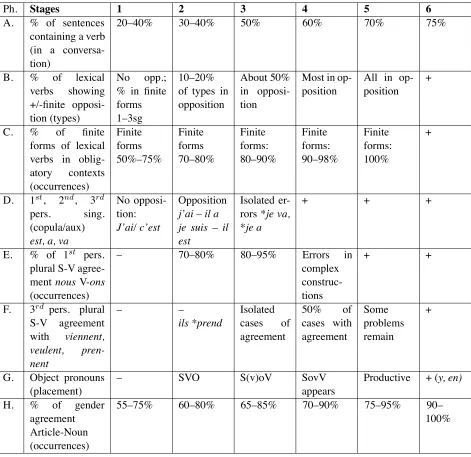
from large learner corpora of spoken language (Bart-ning and Schlyter, 2004). They show that certain grammatical constructions are acquired and can be produced in spontaneous spoken language in afixed order. Clahsen and al. (1983) as well as Piene-mann and Johnston, (1987) determined developmen-tal sequences for German and spoken English. For spoken French, Schlyter (2003) and Bartning and Schlyter (2004) proposed 6 stages of development and developmental sequences covering more than 20 local phenomena. These morphosyntactic phenom-ena are described under the form of local structures inside the verbal or nominal domain. Table 1 shows a subset of these phenomena. It is a matter of current debate infield of SLA to what extent these devel-opmental sequences are independent of the mother tongue.
At Stage 1, thefinite and infinitive forms coexist infinite contexts. As the main verb of the sentence, we find in the learners’ production je parle (tran-scription of /je parl/ analyzed as a “finite form”) as well as /je parle/ i.e.*je parleror*je parlé. The cur-rent estimation is that in Stage 1, there are between 50 and 75% of finite forms in finite contexts. At Stage 4, the percentage offinite forms has increased to 90–98%. For this morphological phenomenon, the developmental sequence describes a successive “morphologization”.
The G phenomenon concerns the developmental sequence of object pronouns. The first object pro-nouns are placed in a postverbal position according to the scheme Subject-Verb-Object (SVO), e.g. *je vois le/la/lui (instead ofje le/la vois). At Stage 3, learners can produce phrases according to the SvOV scheme (Pronoun-Auxiliary-Object-Verb): Je veux le voir (correct) but also *j’ai le vu(incorrect). At Stage 5, we observeje l’ai vu. For this syntactic phe-nomenon, the developmental sequence describes a change in the linear organization of the constituents.
6 Annotation
The concept of group, either noun group or verb group, correct or not, represents the essential gram-matical support of our annotation. The majority of syntactic annotation standards for French takes such groups into account in one way or another. Gendner et al. (2004) is an example that reconciles a great number of annotations. These standards are how-ever insufficient to mark up all the constructions in Table 1.
We defined a text annotation specific to Direkt Profilbased on the inventory of the linguistic phe-nomena described by Bartning and Schlyter (2004) (Table 1). We represented these phenomena by de-cision trees whosefinal nodes correspond to a cate-gory of analysis.
The annotation uses the XML format and anno-tates the texts using 4 layers. Only the 3rdlayer is really grammatical:
• Thefirst layer corresponds to the segmentation of the text in words.
• The second layer annotates prefabricated ex-pressions or sentences (e.g. je m’appelle).
These structures correspond to linguistic ex-pressions learned “by heart” in a holistic fash-ion. It has been shown that they have a great importance in thefirst years of learning French.
• The third layer corresponds to a chunk anno-tation of the text, restricted to the phenomena to identify. This layer marks up simulta-neously each word with its part-of-speech and the verb and noun groups to which they belong. The verb group incorporates subject clitic pronouns. The XML element span marks the groups and features an attribute to indicate their class in the table. The tag element annotates the words with attributes to indicate the lemma, the part-of-speech, and the grammatical features. The verb group in the sentence Ils parlons dans la barextracted from the learner text above is annotated as: <span class="p1_t1_c5131"><tag pos="pro:nom:pl:p3:mas">Ils</tag> <tag pos="ver:impre:pl:p1">
parlons </tag></span> dans la
bar. The class denoted p1_t1_c5131
corresponds to a “finite lexical verb, no agreement”.
• The fourth layer counts structures typical of an acquisition stage. It uses thecounterXML element, <counter id="counter.2" counter_name="passe_compose" rule_id="participe_4b"
value="1"/>.
7 Implementation
The running version ofDirekt Profilis restricted to the analysis of the verb groups and clitic pronouns. For each category in Table 1, the program identifies the corresponding constructions in a text and counts them.
Ph. Stages 1 2 3 4 5 6 A. % of sentences
containing a verb (in a conversa-tion)
20–40% 30–40% 50% 60% 70% 75%
B. % of lexical
verbs showing +/-finite opposi-tion (types)
No opp.;
% in finite forms 1–3sg
10–20% of types in opposition
About 50% in opposi-tion
Most in op-position
All in op-position
+
C. % of finite
forms of lexical verbs in oblig-atory contexts (occurrences)
Finite forms 50%–75%
Finite forms 70–80%
Finite forms: 80–90%
Finite forms: 90–98%
Finite forms: 100%
+
D. 1st, 2nd, 3rd
pers. sing.
(copula/aux)
est, a, va
No opposi-tion:
J’ai/ c’est
Opposition
j’ai – il a je suis – il est
Isolated er-rors *je va,
*je a
+ + +
E. % of 1st pers. plural S-V agree-mentnous V-ons
(occurrences)
– 70–80% 80–95% Errors in
complex construc-tions
+ +
F. 3rd pers. plural S-V agreement
with viennent,
veulent,
pren-nent
– –
ils *prend
Isolated
cases of
agreement
50% of
cases with agreement
Some problems remain
+
G. Object pronouns (placement)
– SVO S(v)oV SovV
appears
Productive + (y, en)
H. % of gender
agreement Article-Noun (occurrences)
55–75% 60–80% 65–85% 70–90% 75–95% 90–
[image:5.612.75.546.128.585.2]100%
Table 1: Developmental sequences adapted from Schlyter (2003); Bartning and Schlyter (2004).
values. The recognition of the group boundaries is done by a set of closed-class words and heuristics inside the rules. It thus follows an old but robust strategy used in particular by Vergne (1999), inter alia, for French.
Direkt Profil applies a cascade of three sets of rules to produce the four annotation layers. The first unit segments the text in words. An interme-diate unit identifies the prefabricated expressions. The third unit annotates simultaneously the parts-of-speech and the groups. Finally, the engine creates a group of results and connects them to a profile. It should be noted that the engine neither annotates all the words, nor all segments. It considers only those which are relevant for the determination of the stage. The engine applies the rules from left to right then from right to left to solve certain problems of agree-ment.
The rules represent partial structures and are di-vided into a condition part and an action part. The condition part contains the search parameters. It can be a lemma, a regular expression, or a class of inflec-tion. The engine goes through the text and applies the rules using a decision tree. It tests the condition part to identify the sequences of contiguous words. Each rule produces a positive (“match”) or negative (“no match”) result. The rules are applied accord-ing to the result of the condition part and annotate the text, count the number of occurrences of the phe-nomenon, and connect to another rule. By traversing the nodes of the tree, the engine memorizes the rules it has passed as well as the results of the condition parts of these rules. When arriving at afinal node, the engine applies the action parts of all the rules.
The engine finds the words in a dictionary of inflected terms. It does not correct the spelling mistakes except for the accents and certain stems. Learners frequently build erroneous past participles inferring a wrong generalization of stems. An exam-ple is the word *prendu(taken) formed on the stem
prend|reand of the suffix -u.
We used a lexicon available from the As-sociation des Bibliophiles Universels’ web site (http://abu.cnam.fr/) that we corrected and trans-posed into XML. We also enriched it with verb stems.
8 Interface
Direkt Profilmerges the annotation levels in a result object. This object represents the original text, the annotation, the trace of the rule application, and the counters. The result object, which can be saved, is then transformed by the program to be presented to the user. The display uses the XHTML 1.1 spec-ifications which can be read by any Web browser.
Direkt Profilhas a client-server architecture where the server carries out the annotation of a text and the client collects the text with an input form and inter-acts with the user.
Figure 2 shows a screenshot of Direkt Profil’s GUI displaying the analysis of the learner text above. The interface indicates to the user by dif-ferent colors all the structures that the analyzer de-tected.
9 Results and Evaluation
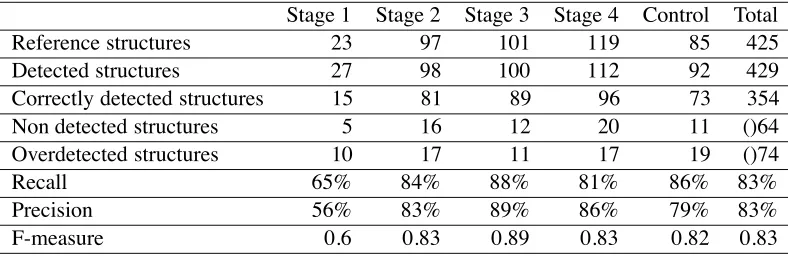
We evaluatedDirekt Profilwith a subset of the CE-FLE corpus. We chose 20 texts randomly distributed on 4 learner stages. We also used 5 texts coming from the control group. In this version, we did not test the correction of the misspelled words: accent and stems. Table 2 shows some statistics on the size of the texts and Table 3 shows the results in the form of recall and precision.
The results show that Direkt Profil detects well the desired phenomena. It reveals also interesting differences according to the levels of the texts. The results show that Direkt Profil analyzes better the learner texts than the texts from the native French adolescents (control group). Without knowing ex-actly why, we note that it suggests that the adopted strategy, which aims at analyzing texts in French as a foreign language, seems promising.
10 Conclusion and Future Work
We presented a system carrying out a machine anal-ysis of texts based on developmental sequences. The goal is to produce a learner profile. We built a parser and developed a set of rules to annotate the texts. Di-rekt Profilis integrated in a client-server architecture and has an interface allowing the interaction with the user.
Figure 2: The graphical user interface.
Stage 1 Stage 2 Stage 3 Stage 4 Control Total
Number of analyzed texts 5 5 5 5 5 25
Word count 740 1233 1571 1672 1626 6842
Sentence count 85 155 166 126 107 639
Average text length (in words) 148 247 314 334 325 274
[image:7.612.89.531.337.425.2]Average length of sentences (in words) 8.7 7.9 9.5 13.3 15.2 10.9
Table 2: Test corpus.
Stage 1 Stage 2 Stage 3 Stage 4 Control Total
Reference structures 23 97 101 119 85 425
Detected structures 27 98 100 112 92 429
Correctly detected structures 15 81 89 96 73 354
Non detected structures 5 16 12 20 11 ()64
Overdetected structures 10 17 11 17 19 ()74
Recall 65% 84% 88% 81% 86% 83%
Precision 56% 83% 89% 86% 79% 83%
F-measure 0.6 0.83 0.89 0.83 0.82 0.83
[image:7.612.109.503.522.650.2]developmental sequences under the form of rules.
Direkt Profilcan then detect them and automatically analyze them. We can thus check the validity of the acquisition criteria.
In the future, we intend to test Direkt Profil in teaching contexts to analyze and specify, in an au-tomatic way, the grammatical level of a learner. The program could be used by teachers to assess student texts as well as by the students themselves as a self-assessment and as a part of their learning process.
A preliminary version of Direkt
Pro-fil is available on line from this address http://www.rom.lu.se:8080/profil
References
Malin Ågren. 2005. Le marquage morphologique du nombre dans la phrase nominale. une étude sur l’acquisition du français L2 écrit. Technical report, In-stitut d’études romanes de Lund. Lund University.
Inge Bartning and Suzanne Schlyter. 2004. Stades et itinéraires acquisitionnels des apprenants suédophones en français l2. Journal of French Language Studies, 14(3):281–299.
Johnny Bigert, Viggo Kann, Ola Knutsson, and Jonas Sjöbergh. 2005. Grammar checking for Swedish sec-ond language learners. InCALL for the Nordic Lan-guages, Copenhagen Studies in Language, pages 33– 47. Copenhagen Business School, Samfundslitteratur.
Harald Clahsen, Jürgen M. Meisel, and Manfred Piene-mann. 1983. Deutsch als Fremdsprache. Der Spracherwerb ausländischer Arbeiter. Narr, Tübin-gen.
Véronique Gendner, Anne Vilnat, Laura Mon-ceaux, Patrick Paroubek, and Isabelle Robba. 2004. Les annotations syntaxiques de référence peas. Technical report, LIMSI, Orsay. http://www.limsi.fr/Recherche/CORVAL/easy/ PEAS_reference_annotations_v1.6.html.
Sylviane Granger, Anne Vandeventer, and Marie-Josée Hamel. 2001. Analyse de corpus d’apprenants pour l’ELAO basé sur le TAL. Traitement automatique des langues, 42(2):609–621.
George E. Heidorn. 2000. Intelligent writing assistance. In Robert Dale, Hermann Moisl, and Harold Somers, editors, Handbook of Natural Language Processing. Marcel Dekker.
Karen Jensen, George E. Heidorn, and Stephen D. Richardson. 1993. Natural Language Processing: The PLNLP Approach. Kluwer Academic Publishers.
Manfred Pienemann and Malcolm Johnston. 1987. Fac-tors influencing the development of second language proficiency. In David Nunan, editor, Applying sec-ond language acquisition research, pages 45–141. Na-tional Curriculum Resource Centre, Adelaide.
Suzanne Schlyter. 2003. Stades de développe-ment en français L2. Technical report, Insti-tut d’études romanes de Lund, Lund University. http://www.rom.lu.se/durs/
STADES_DE_DEVELOPPEMENT_EN _FRANCAIS_L2.PDF.