Semantically Rich Human-Aided Machine Annotation
Marjorie McShane, Sergei Nirenburg, Stephen Beale, Thomas O’Hara
Department of Computer Science and Electrical Engineering University of Maryland Baltimore County
1000 Hilltop Circle, Baltimore, Maryland, 21250 USA {marge, sergei, sbeale, tomohara}@umbc.edu
Abstract
This paper describes a semantically rich, human-aided machine annotation system created within the Ontological Semantics (OntoSem) environment using the DEKADE toolset. In contrast to main-stream annotation efforts, this method of annotation provides more information at a lower cost and, for the most part, shifts the maintenance of consistency to the sys-tem itself. In addition, each tagging effort not only produces knowledge resources for that corpus, but also leads to im-provements in the knowledge environ-ment that will better support subsequent tagging efforts.
1
Introduction
Corpus tagging is a prerequisite for many machine learning methods in NLP but has the drawbacks of high cost, inter-annotator inconsistency and the insufficient treatment of meaning. A tagging ap-proach that strives to ameliorate all of these draw-backs is semantically rich, human-aided machine annotation (HAMA), implemented in the OntoSem (Ontological Semantics) environment using a tool-set called DEKADE: the Development, Evaluation, Knowledge Acquisition and Demonstration Envi-ronment of OntoSem.
In brief, the OntoSem text analyzer takes as in-put open text and outin-puts a text-meaning represen-tation (TMR) that represents its meaning using an ontologically grounded, language-independent metalanguage (see Nirenburg and Raskin 2004). Since the processing leading up to the production of TMR includes, in addition to semantic analysis proper, preprocessing (roughly, segmentation, treatment of named entities and morphology) and
syntactic analysis, the overall annotation of text in this approach includes tags relating to all of the above levels. Since the typical input for analysis in our practice is genuine sentences, which are on average 25 words long and contain all manner of complex phenomena, it is not uncommon for the automatically generated TMRs to contain errors. These errors—which can occur at the level of pre-processing, syntactic analysis or semantic analy-sis—can be corrected manually using the DEKADE environment, yielding “gold standard” output. Making a human the final arbiter in the process means that such long-term complexities as treatment of metaphor, metonymy, PP-attachment, difficult cases of reference resolution and others can be resolved locally while we work on funda-mental, implementable automatic solutions.
In this paper we describe the Onto-Sem/DEKADE environment for the creation of gold standard TMRs, which supports the first ever annotation effort that:
• produces structures that can be used as input for both text generators and general reason-ing systems: semantically rich representa-tions of the meaning of text written in a language-independent metalanguage; these representations cover entities, propositions, relations, attributes, speaker attitudes, mo-dalities, polarity, discourse relations, time, reference relations, and more;
• produces semantic tagging of text largely automatically, thus making more realistic and affordable the tagging of large amounts of text in finite time;
• almost fully circumvents the pitfalls of man-ual tagging, including human tagger errors and inconsistencies;
knowl-edge sources would be impossible for hu-mans if starting from scratch (i.e., our meth-odology effectively turns an essay question into a multiple choice one, with most of the correct answers already provided);
• incorporates humans as final arbiters for out-put of three stages of text analysis (preproc-essing, syntactic analysis and semantic analysis), thus maximally leveraging the automated capacity of the system but not re-quiring of it blanket coverage at this point in its development;
• promises to reduce, over time, the depend-ence on human input because an important side effect of the operation of the human-assisted machine annotation approach is en-hancement of the static knowledge resources – the lexicon and the ontology – underlying the OntoSem analyzer, so that the quality of automatic text analysis will grow as the HAMA system operates, leading to an ever improving quality of raw, unedited TMRs;
• (as a corollary to the previous point) be-comes more cost-efficient over time; and
• can be cost-effectively extended to other languages (including less commonly taught languages), with much less work than was required for the first language since many of the necessary resources are language-independent.
Our approach to text analysis is a hybrid of knowledge-based and corpus-based, stochastic methods.
In the remainder of the paper we will briefly de-scribe the lay of the land in text annotation (Sec-tion 2), the OntoSem environment (Sec(Sec-tion 3), the DEKADE environment for creating gold-standard TMRs from automatically generated ones (Section 4), the portability of OntoSem to other languages (Section 5), and the broader implications of this R&D effort (Section 6).
2
The Lay of the Land in Annotation
In addition to the well-known bottlenecks of cost and inconsistency, it is widely assumed that low-level (only syntactic or “light semantic”) tagging is either sufficient or inevitable due to the complexity
of semantic tagging. Past and ongoing tagging ef-forts share this point of departure.
Numerous projects have striven to achieve text annotation via a simpler task, like translation, sometimes assuming that one language has already been tagged (e.g., Pianta and Bentivogli 2003, and references therein). But results of such efforts are either of low quality, light semantic depth, or re-main to be reported. Of significant interest is the porting of annotations across languages: for exam-ple, Yarowsky et al. 2001 present a method for automatic tagging of English and the projection of the tags to other languages; however, these tags do not include semantics.
Post-editing of automatic annotation has been pursued in various projects (e.g., Brants 2000, and Marcus et al. 1993). The latter group did an ex-periment early on in which they found that “man-ual tagging took about twice as long as correcting [automated tagging], with about twice the inter-annotator disagreement rate and an error rate that was about 50% higher” (Marcus et al. 1993). This conclusion supports the pursuit of automated tag-ging methods. The difference between our work and the work in the above projects, however, is that syntax for us is only a step in the progression toward semantics.
Interesting time- and cost-related observations are provided in Brants 2000 with respect to the manual correction of automated POS and syntactic tagging of a German corpus (semantics is not ad-dressed). Although these tasks took approximately 50 seconds per sentence, with sentences averaging 17.5 tokens, the actual cost in time and money puts each sentence at 10 minutes, by the time two tag-gers carry out the task, their results are compared, difficult issues are resolved, and taggers are trained in the first place. Notably, however, this effort used students as taggers, not professionals. We, by contrast, use professionals to check and correct TMRs and thus reduce to practically zero the train-ing time, the need for multiple annotators (pro-vided the size of a typical annotation task is commensurate with those in current projects), and costly correction of errors.
Among past projects that have addressed se-mantic annotation are the following:
trained on 50,000 words of hand-annotated text (produced by the FrameNet project). When tasked to segment constituents and identify their semantic roles (with fillers being undisambiguated textual strings) the system scored in the 60’s in precision and recall. Limitations of the system include its reliance on hand-annotated data, and its reliance on prior knowledge of the predicate frame type (i.e., it lacks the capacity to disambiguate productively). Semantics in this project is limited to case-roles. 2. The goal of the “Interlingual Annotation of Multilingual Text Corpora” project (http://aitc.aitcnet.org/nsf/iamtc/) is to create a syn-tactic and semantic annotation representation methodology and test it out on six languages (Eng-lish, Spanish, French, Arabic, Japanese, Korean, and Hindi). The semantic representation, however, is restricted to those aspects of syntax and seman-tics that developers believe can be consistently handled well by hand annotators for many lan-guages. The current stage of development includes only syntax and light semantics – essentially, the-matic roles.
3. In the ACE project (http://www.ldc.upenn.edu/Projects/ACE/intro.htm
l), annotators carry out manual semantic annotation of texts in English, Chinese and Arabic to create training and test data for research task evaluations. The downside of this effort is that the inventory of semantic entities, relations and events is very small and therefore the resulting semantic representa-tions are coarse-grained: e.g., there are only five event types. The project description promises more fine-grained descriptors and relations among events in the future.
4. Another response to the insufficiency of syn-tax-only tagging is offered by the developers of PropBank, the Penn Treebank semantic extension. Kingsbury et al. 2002 report: “It was agreed that the highest priority, and the most feasible type of semantic annotation, is coreference and predicate argument structure for verbs, participial modifiers and nominalizations”, and this is what is included in PropBank.
To summarize, previous tagging efforts that have addressed semantics at all have covered only a relatively small subset of semantic phenomena. OntoSem, by contrast, produces a far richer anno-tation, carried out largely automatically, within an environment that will improve over time and with use.
3
A Snapshot of OntoSem
OntoSem is a text-processing environment that takes as input unrestricted raw text and carries out preprocessing, morphological analysis, syntactic analysis, and semantic analysis, with the results of semantic analysis represented as formal text-meaning representations (TMRs) that can then be used as the basis for many applications (for details, see, e.g., Nirenburg and Raskin 2004, Beale et al. 2003). Text analysis relies on:
• The OntoSem language-independent ontology, which is written using a metalanguage of de-scription and currently contains around 6,000 concepts, each of which is described by an aver-age of 16 properties.
• An OntoSem lexicon for each language proc-essed, which contains syntactic and semantic zones (linked using variables) as well as calls for procedural semantic routines when necessary. The semantic zone most frequently refers to on-tological concepts, either directly or with prop-erty-based modifications, but can also describe word meaning extra-ontologically, for example, in terms of modality, aspect, time, etc. The cur-rent English lexicon contains approximately 25,000 senses, including most closed-class items and many of the most frequent and polysemous verbs, as targeted by corpus analysis. (An exten-sive description of the lexicon, formatted as a tu-torial, can be found at http://ilit.umbc.edu.)
• An onomasticon, or lexicon of proper names, which contains approximately 350,000 entries.
• A fact repository, which contains real-world facts represented as numbered “remembered in-stances” of ontological concepts (e.g., SPEECH -ACT-3366 is the 3366th instantiation of the
con-cept SPEECH-ACT in the world model constructed
during the processing of some given text(s)).
basic grammar with transformations triggered by words or features present in the input sentence.
• The TMR language, which is the metalanguage for representing text meaning.
Creating gold standard TMRs involves running text through the OntoSem processors and check-ing/correcting the output after three stages of analysis: preprocessing, syntactic analysis, and semantic analysis. These outputs can
be viewed and edited as text or as vis-ual representations through the DEKADE interface. Although the gold standard TMR itself does not reflect the results of preprocessing or syntactic analysis, the gold standard results of those stages of processing are stored in the system and can be converted into a more traditional annotation format.
4
TMRs in DEKADE
TMRs represent propositions con-nected by discourse relations (since
space permits only the briefest of descriptions, in-terested readers are directed to Nirenburg and Raskin 2004, Chapter 6 for details). Propositions are headed by instances of ontological concepts, parameterized for modality, aspect, proposition time, overall TMR time, and style. Each proposi-tion is related to other instantiated concepts using ontologically defined relations (which include case roles and many others) and attributes. Coreference links form an additional layer of linking between instantiated concepts. OntoSem microtheories de-voted to modality, aspect, time, style, reference, etc., undergo iterative extensions and improve-ments in response to system needs as diagnosed during the processing of actual texts.
We use the following sentence to walk through the processes of automatically generating TMRs and viewing/editing those TMRs to create a gold-standard annotated corpus.
The Iraqi government has agreed to let U.S. Representative Tony Hall visit the country to assess the humanitarian crisis.
Preprocessor. The preprocessor identifies the root word, part of speech and morphological fea-tures of each word; recognizes sentence
bounda-ries, named entities, dates, times and numbers; and for named entities, determines the ontological type (i.e. HUMAN, PLACE, ORGANIZATION, etc.) of the
entity as well as its subparts (e.g., the first, last, and middle names of a person). For the semi-automatic creation of gold standard TMRs, much ambiguity can be removed at small cost by allow-ing people to correct spurious part-of-speech tags, number and date boundaries, etc., through the
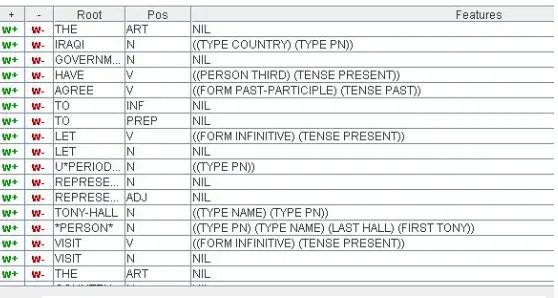
[image:4.612.262.541.185.334.2]DEKADE environment at the preprocessor stage (see Figure 1). Clicking on w+ permits a new POS tag/analysis, and clicking on w-, the more common action, removes spurious analyses. Preprocessor correction is a conceptually simple and logistically fast task that can be carried out by less trained, and therefore less expensive, annotators.
Figure 1. Preprocesor Output Editor.
Syntax. Syntax output can be viewed and ed-ited in text or graphic form. The graphic viewer/editor presents the sentence using the tradi-tional metaphor of color-coded labeled arcs. Mouse clicks show the components of arcs, permit arcs to be deleted along with the orphans they would leave, allow for the edges of arcs to be moved, etc. (no graphic of the syntax or semantics browsers/editors are provided due to space con-straints).
not likely to be solved computationally in the short term, they can be easily resolved when humans are used as the final arbiters in the creation of gold standard TMRs.
When the correct parse is not included in the syntactic output, either the necessary lexical knowledge is lacking (i.e. there is an unknown word or word sense), or an unknown grammatical construction has been used. While the syntax-editing interface permits spot-correction of the problem by the addition of the necessary arc(s), a more fundamental knowledge-building approach is generally preferred – except when the input is non-standard, in which case systemic modifications are avoided.
Semantics. Within the OntoSem environment, there are two stages of text-meaning representa-tions (TMRs): basic and extended. The basic TMR shows the basic ontological mappings and depend-ency structure, whereas the extended TMR shows the results of procedural semantics, including ref-erence resolution, reasoning about time relations, etc. The basic and extended stages of TMR crea-tion can be viewed and edited separately within DEKADE.
TMRs can be viewed and edited in text format or graphically. In the latter, concepts are shown as nodes and properties are shown as lines connecting them. A pretty-printed view of the textual extended TMR for our sample sentence, repeated for con-venience, is as follows (concept names are in small caps; instance numbers are appended to them).
The Iraqi government has agreed to let U.S. Representative Tony Hall visit the country to assess the humanitarian crisis.
AGREE-268
textpointer agree
THEME MODALITY-200
AGENT GOVERNMENTAL-ORGANIZATION-41 TIME (< FIND-ANCHOR-TIME)
GOVERNMENTAL-ORGANIZATION-41
textpointer government
RELATION NATION-56 AGENT-OF AGREE-268
NATION-56
textpointer Iraq
RELATION GOVERNMENTAL-ORGANIZATION-41
MODALITY-200 textpointer let
TYPE permissive
SCOPE TRAVEL-EVENT-272
VALUE 1
TRAVEL-EVENT-272
textpointer visit
AGENT SENATOR-4471 DESTINATION NATION-57
PURPOSE EVALUATE-69 SCOPE-OF MODALITY-200 SENATOR-447
textpointer Representative Tony Hall2
REPRESENTATIVE-OF NATION-40 NATION-40
textpointer U.S.
REPRESENTED-BYSENATOR-447
NATION-57
textpointer country
COREFER NATION-56 EVALUATE-69
AGENT SENATOR-447
THEME DISASTER-EVENT-2 DISASTER-EVENT-2
BENEFICIARY SET-23
THEME-OF EVALUATE-69 SET-23
MEMBER-TYPE HUMAN-1342 BENEFICIARY-OF DISASTER-EVENT-2
Within the graphical browser, clicking on concept names or properties permits them to be deleted, edited, or permits new ones to be added. It also shows the expansion of any concept in text format. Evaluating and editing the semantic output is the most challenging aspect of creating gold stan-dard TMRs, since creating formal semantic repre-sentations is arguably one of the most difficult tasks in all of NLP. If a knowledge engineer de-termines that some aspect of the semantic repre-sentation is incorrect, the problems can be corrected locally or by editing the knowledge re-sources and rerunning the analyzer. Local correc-tions are used, for example, in cases of metaphor and metonymy, which we do not record in our knowledge resources (we are working on a mi-crotheory of tropes but it is not yet implemented). In all other cases, resource supplementation is pre-ferred; it can be carried out either immediately or the problem can be fixed locally, in which case a request will be sent to a knowledge acquirer to carry out the necessary resource enhancements.
1 The concept
SENATOR is defined as a member of a legislative assembly.
2 Collocations of
Striking the balance between short-term goals (a gold standard TMR for the given text) and long-term goals (better analysis of any text in the future) is always a challenge. For example, if a text con-tained the word grass in the sense of ‘marijuana’, and if the lexicon lacked the word ‘grass’ alto-gether, we would want to acquire the meaning ‘green lawn cover’ as well; however, doing this without constraint could mean getting bogged down by knowledge acquisition (as with the doz-ens of idiomatic uses of ‘have’) at the expdoz-ense of actually producing gold-standard TMRs. There are also cases in which a local solution to semantic representation is very easy whereas a fundamental, machine-reproducible solution is very difficult. Consider the case of relative expressions, like
re-spective and respectively, as used in Smith and
Matthews pleaded innocent and guilty,
respec-tively. Manually editing a TMR such that the ap-propriate properties are linked to their heads is quite simple, whereas writing a program for this non-trivial case of reference resolution is not. Thus, in some cases we push through gold standard TMR production while keeping track of – and de-veloping as time permits – the more difficult as-pects of text processing that will enhance TMR output in the future.
The gold standard TMR for the sentence dis-cussed at length here was produced with only a few manual corrections: changing two part of speech tags and selecting the correct sense for one word. Work took less than the 10 minutes reported by Brants 2000 for their non-semantic tagging.
5
Porting to Other Languages
Recently the need for tagged corpora for less commonly taught languages has received much attention. While our group is not currently pursu-ing such languages, it has in the past: TMRs have been automatically generated for languages such as Chinese, Georgian, Arabic and Persian. We take a short tangent to explain how OntoSem/DEKADE can be extended, at relatively low cost, to the anno-tation of other languages – showing yet another way in which this approach to annotation reaches beyond the results for any given text or corpus.
Whereas it is typical to assume that lexicons are language-specific whereas ontologies are lan-guage-independent, most aspects of the semantic structures (sem-strucs) of OntoSem lexicon entries
are actually language-independent, apart from the linking of specific variables to their counterparts in the syntactic structure. Stated differently, if we consider sem-strucs – no matter what lexicon they originate from – to be building blocks of the repre-sentation of word meaning (as opposed to concept meaning, as is done in the ontology), then we un-derstand why building a large OntoSem lexicon for English holds excellent promise for future porting to other languages: most of the work is already done. This conception of cross-linguistic lexicon development derives in large part from the Princi-ple of Practical Effability (Nirenburg and Raskin 2004), which states that what can be expressed in one language can somehow be expressed in all other languages, be it by a word, a phrase, etc. (Of course, it is not necessary that every nuanced meaning be represented in the lexicon of every language and, as such, there will be some differ-ences in the lexical stock of each language: e.g., whereas German has a word for white horse which will be listed in its lexicon, English will not have such a lexical entry, the collocation white horse being treated compositionally.) We do not intend to trivialize the fact that creating a new lexicon is a lot of work. It is, however, compelling to consider that a new lexicon of the same quality of our On-toSem English one could be created with little more work than would be required to build a typi-cal translation dictionary. In fact, we recently car-ried out an experiment on porting the English lexicon to Polish and found that a) much of it could be done semi-automatically and b) the manual work for a second language is considerably less than for the first language (for further discussion, see McShane et al. 2004).
To sum up, the OntoSem ontology and the DEKADE environment are equally suited to any language, and the OntoSem English lexicon and analyzer can be configured to new languages with much less work required than for their initial de-velopment. In short, semantic-rich tagging through TMR creation could be a realistic option for lan-guages other than English.
6
Discussion
interannotator disagreement since people only cor-rect the output of the analyzer, which is responsi-ble for consistent and correct deployment of the large and complex static resources: if the knowl-edge bases are held constant, the analyzer will pro-duce the same output every time, ensuring reproducibility of the annotation.
Evaluation of annotation has largely centered upon the demonstration of interannotator agree-ment, which is at best a partial standard for evalua-tion. On the one hand, agreement among annotators does not imply the correctness of the annotations: all annotators could be mistaken, par-ticularly as students are most typically recruited for the job. On the other hand, there are cases of genu-ine ambiguity, in which more than one annotation is equally correct. Such ambiguity is particularly common with certain classes of referring expres-sions, like this and that, which can refer to chunks of text ranging from a noun phrase to many para-graphs. Genuine ambiguity in the context of corpus tagging has been investigated by Poesio and Art-stein (ms.), among others, who conclude, reasona-bly, that a system of tags must permit multiple possible correct coreference relations and that it is useful to evaluate coreference based on corefer-ence chains rather than individual entities.
The abovementioned evidence suggests the need for ever more complex evaluation metrics which are costly to develop and deploy. In fact, evalua-tion of a complex tagging effort will be almost as complex as the core work itself. In our case, TMRs need to be evaluated not only for their correctness with respect to a given state of knowledge re-sources but also in the abstract. Speed of gold standard TMR creation must also be evaluated, as well as the number of mistakes at each stage of analysis, and the effect that the correction of output at one stage has on the next stage. No methods or standards for such evaluation are readily available since no work of this type has ever been carried out.
In the face of the usual pressures of time and manpower, we have made the programmatic deci-sion not to focus on all types of evaluation but, rather, to concentrate our evaluation metrics on the correctness of the automated output of the system, the extent to which manual correction is needed, and the depth and robustness of our knowledge resources (see Nirenburg et al. 2004 for our first evaluation effort). We do not deny the ultimate
desirability of additional aspects of evaluation in the future.
The main source of variation among knowledge engineers within our approach lies not in review-ing/editing annotations as such, but in building the knowledge sources that give rise to them. To take an actual example we encountered: one member of our group described the phrase weapon of mass
destruction in the lexicon as BIOLOGICAL-WEAPON
or CHEMICAL-WEAPON, while another described it
as a WEAPON with the potential to kill a very large
number of people/animals. While both of these are correct, they focus on different salient aspects of the collocation. Another example of potential dif-ferences at the knowledge level has to do with grain size: whereas one knowledge engineer re-viewing a TMR might consider the current lexical mapping of neurosurgeon to SURGEON perfectly acceptable, another might consider that this grain size is too rough and that, instead, we need a new concept NEUROSURGEON,whose special properties are ontologically defined.Such cases are to be ex-pected especially as we work on new specialized domains which put greater demands on the depth of knowledge encoded about relevant concepts.
There has been some concern that manual edit-ing of automated annotation can introduce bias. Unfortunately, completely circumventing bias in semantic annotation is and will remain impossible since the process involves semantic interpretation, which often differs among individuals from the outset. As such, even agreements among annota-tors can be questioned by a third (fourth, etc.) party.
At the present stage of development, the TMR together with the static (ontology, lexicons) and dynamic (analyzer) knowledge sources that are used in generating and manipulating it, already provide substantial coverage for a broad variety of semantic phenomena and represent in a compact way practically attainable solutions for most issues that have concerned the computational linguistics and NLP community for over fifty years. Our TMRs have been used as the substrate for ques-tion-answering, MT, knowledge extraction, and were also used as the basis for reasoning in the question-answering system AQUA, where they supplied knowledge to enable the operation of the JTP (Fikes et al., 2003) reasoning module.
will be a boon to machine learning research. Re-peatedly within the ML community, the creation of a high quality dataset (or datasets) for a particular domain has sparked development of applications, such as learning semantic parsers, learning lexical items, learning about the structure of the underly-ing domain of discourse, and so on. Moreover, as the quality of the raw TMRs increases due to gen-eral improvements to the static resources (in part, as side effects of the operation of the HAMA proc-ess) and processors (a long-term goal), the net benefit of this approach will only increase, as the production rate of gold-standard TMRs will in-crease thus lowering the costs.
TMRs are a useful medium for semantic repre-sentation in part because they can capture any con-tent in any language, and even concon-tent not expressed in natural language. They can, for ex-ample, be used for recording the interim and final results of reasoning by intelligent agents. We fully expect that, as the actual coverage in the ontology and the lexicons and the quality of semantic analy-sis grows, the TMR format will be extended to ac-commodate these improvements. Such an extension, we believe, will largely involve move-ment toward a finer grain size of semantic descrip-tion, which the existing formalism should readily allow. The metalanguage of TMRs is quite trans-parent, so that the task of converting them into a different representation language (e.g., OWL) should not be daunting.
References
Stephen Beale, Sergei Nirenburg and Marjorie McShane. 2003. Just-in-time grammar. Proceedings of the 2003 International Multiconference in Com-puter Science and ComCom-puter Engineering. Las Ve-gas, Nevada.
Thorsten Brants. 2000. Inter-annotator agreement for a German newspaper corpus. LREC-2000. Athens, Greece.
Richard Fikes, Jessica Jenkins and Gleb Frank. 2003. JTP: A system architecture and component library for hybrid reasoning. Proceedings of the Seventh World Multiconference on Systemics, Cybernetics, and In-formatics. Orlando, Florida, USA.
Daniel Gildea and Daniel Jurafsky. 2002. Automatic labeling of semantic roles. Computational Linguistics 28:3, 245-288.
Paul Kingsbury, Martha Palmer and Mitch Marcus. 2002. Adding semantic annotation to the Penn Tree-Bank. (http://www.cis.upenn.edu/~ace/
HLT2002-propbank.pdf.)
Marcus, Mitchell P., Beatrice Santorini and Mary Ann Marcinkiewicz. 1993. Building a large annotated corpus of English: the Penn Treebank. Computa-tional Linguistics 19.
Marjorie McShane, Margalit Zabludowski, Sergei Ni-renburg and Stephen Beale. 2004. OntoSem and SIMPLE: Two multi-lingual world views. Proceed-ings of ACL-2004 Workshop on Text Meaning and Interpretation. Barcelona, Spain.
Sergei Nirenburg, Stephen Beale and Marjorie McShane. 2004. Evaluating the performance of the OntoSem semantic analyzer. Proceedings of the ACL Workshop on Text Meaning Representation. Barce-lona, Spain.
Sergei Nirenburg and Victor Raskin. 2004. Ontological Semantics. The MIT Press.
Emanuele Pianta and Luisa Bentivogli. 2003. Transla-tion as annotaTransla-tion. Proceedings of the AI*IA 2003 Workshop "Topics and Perspectives of Natural Lan-guage Processing in Italy." Pisa, Italy.
Massimo Poesio and Ron Artstein. 2005. The reliability of anaphoric annotation, reconsidered: Taking ambi-guity into account. Proceedings of the ACL 2005 Workshop “Frontiers in Corpus Annotation II, Pie in the Sky”.