R. Dale et al. (Eds.): IJCNLP 2005, LNAI 3651, pp. 366–377, 2005. © Springer-Verlag Berlin Heidelberg 2005
Gumwon Hong
University of Michigan, Ann Arbor, MI 48109
Abstract. This paper presents a supervised approach for relation extraction. We apply Support Vector Machines to detect and classify the relations in Automatic Content Extraction (ACE) corpus. We use a set of features including lexical to-kens, syntactic structures, and semantic entity types for relation detection and classification problem. Besides these linguistic features, we successfully utilize the distance between two entities to improve the performance. In relation detec-tion, we filter out the negative relation candidates using entity distance thresh-old. In relation classification, we use the entity distance as a feature for Support Vector Classifier. The system is evaluated in terms of recall, precision, and F-measure, and errors of the system are analyzed with proposed solution.
1 Introduction
The goal of Information Extraction (IE) is to pull out pieces of information that are salient to the user’s need from large volume of text. With the dramatic increase of World Wide Web, there has been growing interest in extracting relevant information from large textual documents. The IE tasks may vary in detail and reliability, but two subtasks are very common and closely related: named entity recognition and relation extraction. Named entity recognition identifies named objects of interest such as per-son, organizations or locations. Relation extraction involves the identification of ap-propriate relations among these entities. Examples of the specific relations are em-ployee-of and parent-of. Employee-of relation holds between a particular person and a certain organization and parent-of holds between a father and his child. According to Message Understanding Conferences (MUC), while named entities can be extracted with 90% or more in F measure with a state of the art system, relation extraction was not so successful [8].
performance of both the relation detection and classification. We apply Support Vec-tor Machines (SVMs) partly because it represents the state of the art performance for many classification tasks [3]. As we will discuss in section 3 about features, we are working on very high dimensional feature space, and this often leads to overfitting. Thus, the main reason to use SVMs is that this learning algorithm has a robust ration-ale for avoiding overfitting [11].
This paper is structured in the following manner. In section 2, we survey the previ-ous work on relation extraction with emphasis on supervised machine learning ap-proaches. In section 3, the problem formalization, the description of dataset and the feature extraction methods will be discussed. In section 4, we conduct a performance evaluation of the proposed approach and error analysis on ACE dataset. Finally, in section 5, a conclusion and discussion of future work will be followed.
2 Related Work
Relation extraction was formulated as part of Message Understanding Conferences (MUC) [8], which has focused on a series of information extraction tasks, including analyzing free text, recognizing named entities, and identifying relations of a speci-fied type. Work on relation extraction over the last two decades has progressed from linguistically unsophisticated models to the adaptation of NLP techniques that use shallow parsers or full parsers and complicated machine learning methods.
[7] addressed the relation extraction problem by extending the statistical parsing model which simultaneously recovers syntactic structures, named entities, and rela-tions. They first annotated sentences for entities, descriptors, coreference links and re-lation links, and trained the sentences from Penn Treebank. Then they applied to new training sentences and enhanced the parse trees to include the IE information. Finally they re-retrained the parser on newly enriched training data.
More recently, [12] introduced the kernel methods to extract relations from 200 news articles from different publications. The kernels are defined over shallow parse representations of text and computed through a dynamic programming fashion. They generated relation examples from shallow parses for two relations: person-affiliation and organization-location. Performance of the kernel methods was compared with feature-based methods and it showed that kernels have promising performance.
[4] extended work in [12] to estimate kernel functions between augmented depend-ency trees. Their experiment has two steps. Relations were first detected and then classified in cascading manner. However, the recall was relatively low because many positive examples of relations were dropped during detection phase. Detecting rela-tions is hard job for kernel methods because, in detection, all negative examples are heterogeneous and it is difficult to use similarity function.
Our approach to relation extraction adapts some feature extraction methods from [13] but differs from [13] in two important aspects. First, instead of only classifying relations by assuming all candidate relations are detected, we perform relation detec-tion before classifying reladetec-tions by regarding every pair of entities in a sentence as a target of classification. Second, we used total 7652 (6140 for training and 1512 for development testing) relation examples in ACE dataset, but in [13] only 4238 rela-tions were used for training and 1022 for testing. We increase the performance by us-ing more trainus-ing data and reducus-ing errors in data processus-ing stage.
3 Data Processing
3.1 Problem Definition
Our task is to extract relations from unstructured natural language text. Because we determine the relationship for every pair of entities in a sentence, our task is formal-ized with a standard classification problem as follows:
(e1 ,e2, s) → r
where e1 and e2 are two entities existing in sentence s, and r is a label of the relation. Every pair of entities in a sentence can be a relation or not, so we call the triple (e1, e2, s) a relation candidate. With the possible set of values of r, there can be at least three tasks.
1. Detection only: For each relation candidate, we predict whether it constitutes an actual relation or not. In this task, a label r can be either +1 (two entities are re-lated) or -1 (not rere-lated).
2. Combined detection and classification: For each relation candidate, we per-form N+1 way classification, where N is the number of relation types. Five rela-tion types are specified in next subsecrela-tion. The addirela-tional class is -1 (two enti-ties are not related).
3. Classification only: For each relation, we perform N way classification. In this task, we assume that all relation candidates in test data are manually labeled with N+1 way classification. We only consider the classifier’s performance on the N relation types.
We use a supervised machine learning technique, specifically Support Vector Ma-chine classifiers, and we empirically evaluate the performance in terms of recall, pre-cision and F measure. To make the problem more precisely, we constrain the task of relation extraction with following assumptions:
1. Entities should be tagged beforehand so that all information regarding entities is available when relations are extracted.
2. Relations are binary, i.e., every relation takes exactly two primary arguments. 3. The two arguments of a relation, i.e., an entity pair, should explicitly occur
within a sentence.
A relation is basically an ordered pair, thus “Sam was flown to Canada” contains the relation AT(Sam, Canada) but not AT(Canada, Sam). However, 7 relations in NEAR (relative location) and SOCIAL (associate, other-personal, other-professional, other-relative, sibling, and spouse) types are symmetric. For example, the sentences such as ”Bill is the neighbor of Sarah.” and “The park is two blocks from Walnut Street” do not distinguish the order of entities.
Table 1. Relation types and their subtypes in ACE 2 corpus
AT BASED-IN, LOCATED, RESIDENCE NEAR RELATIVE-LOCATION
PART OTHER, PART-OF, SUBSDIARY
ROLE AFILIATE-PARTNER, CITIZEN-OF, CLIENT, FOUNDER, GENERAL-STAFF, MANAGEMENT, MEMBER, OTHER, OWNER
SOCIAL ASSOCIATE, GRANDPARENT, OTHER-PERSONAL, OTHER-PROFESSIONAL, OTHER-RELATIVE, PARENT, SIBLING, SPOUSE
3.2 Data Set
We extract relations from the Automatic Content Extraction (ACE) corpus, specifi-cally version 1.0 of the ACE 2 corpus, provided by the National Institute for Stan-dards and Technology (NIST). ACE corpora consist of 519 annotated text documents assembled from a variety of sources selected from broadcast news programs, newspa-pers, and newswire reports [1].
According to the scope of the LDC ACE program 1, current research in informa-tion extracinforma-tion has three main objectives: Entity Detecinforma-tion and Tracking (EDT), Rela-tion DetecRela-tion and CharacterizaRela-tion (RDC), and Event DetecRela-tion and CharacterizaRela-tion (EDC). This paper focuses on the second sub-problem, RDC. For example, we want to determine whether a particular person is at certain location, based on the contextual evidence. According to the RDC guideline version 3.6, Entities are limited to 5 types (PERSON, ORGANIZATION, GEO-POLITICAL ENTITY (GPE), LOCATION, and FACILITY), and relations are also classified into 5 types:
Role: Role relations represent an affiliation between a Person entity and an Organiza-tion, Facility, or GPE entity.
Part: Part relations represent part-whole relationships between Organization, Facility and GPE entities.
At: At relations represent that a Person, Organization, GPE, or Facility entity is lo-cated at a Location entity.
Near: Near relations represent the fact that a Person, Organization, GPE or Facility entity is near (but not necessarily “at”) a Location or GPE entity.
Social: Social relations represent personal and professional affiliations between Per-son entities.
Table 2. Breakdown of the ACE dataset (#f and #r means number of files and number of relations respectively)
Training data Held-out data Test data
#f # r #f # r #f # r
325 4628 97 1512 97 1512
Table 2 shows the breakdown of the ACE dataset for our task. Training data takes about 60% of all ACE corpora, and each held-out data and test data contains about 20% of the whole distribution in the number of files as well as in the number of relations.1
3.3 Data Processing
We start with entity marked data and the first step is to detect the sentence boundary using the sentence segmenter provided by DUC competition2. Performance of the sen-tence segmentater is crucial for relation detection because the number of entity pairs combinatorially increases as a sentence grows in size. The original DUC segmenter fails to detect sentence boundary if the last word of a sentence is a named entity and annotated with brackets, i.e., ‘<’ and ‘>’. We modified the DUC segmenter by adding simple rules where we mark sentence boundary if every bracket is followed by ‘?’, ‘!’, or ‘.’. At this step, we drop the sentences if the sentence has less than two entities.
Sentence parsing is then performed using Charniak parser [6] on these target sen-tences in order to obtain the necessary linguistic information. To facilitate the feature extraction, parse trees are converted into chunklink format [2]. Chunklink format con-tains the same information as the original parse tree, but it provides for each word the chunk to which it belongs, its grammatical function, grammatical structure hierarchy, and trace information.
3.4 Features
We are ready to introduce our feature sets. The following features include lexical to-kens, part of speech, syntactic features, semantic entity types, and the distance be-tween two entities (we will say “entity distance” to refer to distance bebe-tween two enti-ties in the remaining part of this paper). These features are selectively used for three tasks defined in section 3.1.
1. Words. Lexical token of both entity mentions3 as well as all the words between them. If two or more words constitute an entity, each individual word in an entity is a separate feature.
2. Part of speech. Part of speech corresponding to each word feature described above.
1
Training data and held-out data together are called "train", and test data is called "devtest" in the ACE distribution.
2 http://duc.nist.gov/past_duc/duc2003/software/ 3
3. Entity type. Entities have one of five types (person, location, organization, geo-political entity, or facility).
4. Entity mention type. An entity mention can be named, nominal, or pronominal. En-tity mention type is also called the level of a mention.
5. Chunk tag. A word is inside (I), outside (O) or in the beginning (B) of a chunk. A chunk here stands for a standard phrase. Thus, the word “George” at the beginning of NP chunk “George Bush” has B-NP tag. Similarly, the word “named” has I-VP tag in VP chunk “was named”.
6. Grammatical function tag. If a word is the head word of a chunk, it has function of whole chunk. The other words in a chunk that are not the head have "NOFUNC" as their function. For example, the word “task” is head of NP chunk “the task” and it has grammatical function tag “NP”, while “the” has “NOFUNC”.
7. IOB chain. The syntactic categories of all the constituents on the path from the root node to the leaf node of a parse tree. For example, a word’s IOB chain I-S/I-NP/B-PP means that it is inside a sentence, inside a NP chunk, and in the beginning of PP chunk.
8. Head word Path. The head word sequence in the path between two entity mentions in the parse tree. This feature is used after removing duplicate elements.
9. Distance. The number of words between two entity mentions.
10. Order. Relative position of two relation arguments.
Two entities and all words between them have separate features of chunk tags (5), grammatical function tags (6), and IOB chains (7), and these three features are all automatically computed by chunklink.pl. See [2] for further description of these three terminologies. We use the same method as in [13] to use the features described in 3, 5, 6, 7, and 10. The concept of the head word path is adapted from [10].
Let us take a sentence “Officials in New York took the task” for an example. Two entity mentions, officials and New York, constitute a relation AT(officials, New York). For the noun phrase “officials in New York”, the corresponding parse tree is shown in Fig 2.
To compute the head word path, we need to know what a head word is. At the ter-minal nodes, the head word is simply the word from the sentence the node represents. At non-terminal nodes in the parse tree, “The head of a phrase is the element inside the phrase whose properties determine the distribution of that phrase, i.e. the envi-ronments in which it can occur.” [9]
Fig. 1. Parse tree for the fragment “officials in NewYork”. The path between two entity men-tions is in bold.
Table 3 shows the features for the noun phrase “officials in New York”. Note that all features are binary and they are assigned 1 or -1 depending on whether an example contains the feature or not. We could have n+1 possible distance features, where n is the entity distance threshold.
Table 3. Example of features for Officials in New York. e1 and e2 are two entities that constitute a relation AT(officials, New York).
Features Example Words officials(e1), in, New(e2-1), York(e2-2)
Part-of-speech NNS(e1), IN, NNP(e2-1), NNP(e2-2) Entity type officials: PERSON, New York: GPE Entity mention type officials: NOMINAL, New York: NAME Chunk tag B-NP, B-PP,B-NP, I-NP
Grammatical function tag NP, PP, NOFUNC, NP
IOB chain officials: B-S/B-NP/B-NP, in: I-S/I-NP/B-PP, New: I-S/I-NP/I-PP/B-NP York: I-S/I-NP/I-PP/I-NP
Head word path PERSON-in-GPE
Distance Distance=1
Order e1 before e2
Besides the linguistic features, we apply entity distance to each task. When detect-ing actual relations, we use the entity distance to filter the unnecessary examples. To achieve the optimal performance, we set a threshold to keep the balance between re-call and precision. We choose the threshold of entity distance based on the detection performance on held-out data. When classifying the individual relation types, the en-tity distance is also successfully used as a feature. We will discuss how the enen-tity dis-tance is utilized as a feature in the next section.
When performing combined detection and classification, we use two-staged extrac-tion: we first detect relations in the same way as detection only task, and then perform classification on detected relations to predict the specific relation types. There are two important reasons that we choose this two-staged extraction.
York
New took Officials
NNS
in …
IN NNP NNP
First, we detect relations to increase the recall for whole extraction task. Because every combination of two entities in a sentence can construct a relation, we have far more negative examples of relation4 in our training data. If we perform single-staged N+1 classification, the classifier is more likely to identify a testing instance as a non-relation because of the disproportionate size in samples which often decreases the per-formance. Thus in detection stage (or detection only task), we perform binary classifi-cation by enriching our training samples by assuming 5 types of relations to be one positive class.
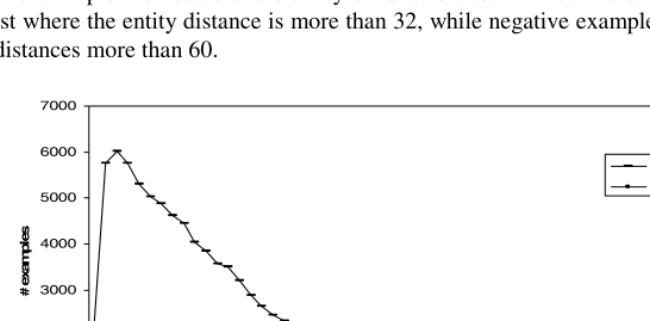
Second, before performing relation classification, we can reduce a significant number of negative examples with only limited sacrifice of the detection performance by using a filtering technique with entity distance threshold. Fig. 2 shows the positive and negative examples distributed over the entity distances in training data. As we can see from the positive example curve (lower curve in the graph), the number of posi-tive examples decreases as the entity distance exceeds 1. Posiposi-tive examples do not ex-ist where the entity dex-istance is more than 32, while negative examples can have entity distances more than 60.
0 1000 2000 3000 4000 5000 6000 7000
0 5 10 15 20 25 30 35 40 45 50 55 60
distance between e ntities
# e
xam
p
les
negative example
positive example
Fig. 2. Distribution of samples over entity distances in training data
We can also discover that almost 99% of the positive examples are distributed below the entity distance 20. If we restrict an entity distance threshold to 5, that is if we remove samples whose entity distances are more than 5, then whereas 71% of negative examples are dropped out, we can still maintain 80% of the positive exam-ples. As can be seen in the graph, negative relations take more than 95% of whole entity pairs. This class imbalance makes the classifier less likely to identify a test-ing instance as a relation. The threshold makes relation detection easier because we can remove the large portion of negative examples, and we can get the result in reasonable time.
4
In our experiment we tested the following 3 sets of features:
F1: words + entity type + entity mention type + order
F2: F1 + all syntactic features (2, 5, 6, 7 and 8)
F3: F2 + distance
F1 is the set of simple features that can be obtained directly from the ACE corpus without applying any NLP techniques. Features in F2 require sentence boundary tection and parsing to acquire the syntactic structure of a sentence. F3 is used to de-termine whether an entity distance can be successfully used for our task.
4 Experiments and Error Analysis
We applied Support Vector Machines (SVMs) classifier to the task. More specifically, we used LIBSVM with RBF (Radial Basis Function) kernel [3]. SVMs attempt to find a hyperplane that split the data points with maximum margin, i.e., the greatest dis-tance between opposing classes [11].
The system performance is usually reflected using the performance measures of in-formation retrieval: precision, recall, and F-measure. Precision is the ratio of the number of correctly predicted positive examples to the number predicted positive examples. Re-call is the ratio of the number of correctly predicted positive examples to the number of true positive examples. F-measure combines precision and recall as follows:
F-measure = 2 * precision * recall / (precision + recall)
We report precision, recall, and F-measure for each experiment.
We use different features for relation detection and relation classification. In rela-tion detecrela-tion, which is either in detecrela-tion only task or in the first stage of combined detection and classification, we do not use entity distance as a feature. Instead, we get rid of the negative examples of relations by setting a threshold value of the entity dis-tances. The threshold is chosen in a way that we could achieve the best F-measure score of relation detection performance on held-out data with a classifier trained on training data. We have fixed the entity distance threshold to be 7 by this experiment, and this threshold enables us to remove 67% of the negative examples and keep 93% of the positive example. We will use this value in the remaining experiments.
In relation classification, which is either in the second stage of combined extraction or in classification only task, we use all the features described in Table 3. Entity dis-tance is successfully used as a feature to classify the individual relation types. Let us take a relation type NEAR for an example to see why entity distance is useful. As shown in table 4, the average entity distance of NEAR relations is relatively greater than the average distances of any other types of relations.
Table 4. Average entity distance for 5 relation types in training data. The first row indicates the average entity distances over the relations whose entity distances are less than or equal to 7.
Relation ROLE PART AT NEAR SOCIAL ALL
Table 5. Frequency of misclassification of relations (R: ROLE, A: AT, S: SOCIAL, N: NEAR, P: PART). Model was trained on training data with F2 features and tested on held-out data.
System R A S P P A P P A R N R N
Gold A R R R N P P A N S A N P
Frequency 46 34 29 23 21 19 12 11 7 6 1 1 1
This does not necessarily mean that we can choose NEAR when the entity distance in an example is close to 3.23. However, there is an interesting result about NEAR when we apply the classifier trained on training data to held-out data. Table 5 shows classifi-cation errors discovered after testing on held-out data. As shown in table 5, NEAR is misclassified as PART relatively often (almost 60% of the times). We also find by look-ing at samples in trainlook-ing data that only a small portion (about 5%) of the PART rela-tions have entity distance more than 4, while more than 50% of NEAR relarela-tions have entity distance more than 4. This discovery suggests that we can prevent the misclassifi-cation by adding the distance features to original feature set to increase the performance.
Table 6. Detection only performance trained on training + held-out data and applied on test data (P: preprocessed with distance threshold = 7, N: no threshold is used)
Features Precision Recall F-measure
F1 (N) 82.6 43.2 56.7
F2 (N) 69.4 62.1 65.5
F1 (P) 92.3 44.1 59.6
F2 (P) 77.8 69.3 73.3
Table 6 shows the performance of detection only task. The filtering process with distance threshold resulted in performance increase in all measurements.
As described in previous section, we divide the corpus into three different sets: training data, held-out data, and test data. We first build the classifier on training data, and applied the classifier to held-out data. In this experiment, we choose the threshold of entity distance until we get the optimal performance of relation detection on held-out data. We also count the misclassification of relations on held-held-out data. Next, we retrained the data on whole training set, i.e., training data plus held-out data, and then applied to the test data.
Table 7. Combined detection and classification performance. Model is trained on training data + held-out data and tested on test data (trained over 6140 relations and tested on 1512 relations)
Features Precision Recall F-measure
F1 76.2 38.3 50.9 F2 65.2 49.7 56.4
F3 68.8 51.4 58.8
Table 8. Classification only performance. Model is trained on training data + held-out data and tested on test data (trained over 6140 relations and tested on 1512 relations).
Relation Type Precision Recall F-measure
ROLE 85.7 84.3 85.0
PART 67.8 73.6 70.6
AT 81.5 82.9 82.2
NEAR 43.2 62.6 51.1
SOCIAL 74.9 88.2 81.0
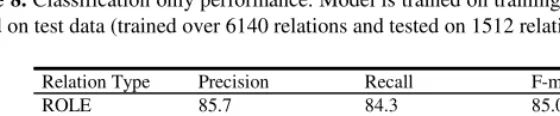
We perform classification only task to compare the result with [13]. Table 8 shows the performance evaluation on 5 types of relation in test data. Direct comparison with [13] at each relation type is not a relevant process because the published result in [13] regarded a reduced set of relations (5,260 relations) as total relations tagged in the ACE data set. Nevertheless, our system performs better in F-measure in all relation types by capable of using much more relation examples and by utilizing entity distance feature.
5 Conclusion
We have presented a supervised approach for relation extraction where we apply Support Vector Machines to detect actual relations and to classify the specific types of those relations. We combine diverse lexical, syntactic and semantic features as well as entity distance.
Our system benefits from performing two-staged extraction as well as using the en-tity distance. In detection, we use binary classification to use more positive examples, and entity distance threshold also helps to remove large part of negative candidates for relations in reasonable time. Furthermore, entity distance is successfully used as a feature in classifying specific relations to increase the performance of the system.
The most immediate extension is to include semantic information such as seman-tic indexing and disambiguating the sense of entities. For example, as in table 5, SOCIAL relations are always confused with ROLE relations which often have simi-lar lexical pattern. Moreover, NEAR and AT relations often have very simisimi-lar syn-tactic structures. These examples do not benefit from lexical or synsyn-tactic features alone.
References
1. ACE. 2004. The NIST ACE evaluation website. http://www.nist.gov/speech/tests/ace/. 2. Buchholz, S.: The chunklink script (2000) http://ilk.uvt.nl/~sabine/chunklink/
3. Chang, C.-C. and Lin, C.-J.: LIBSVM: a library for support vector machines (2001) Soft-ware available at. http://www.csie.ntu.edu.tw/~cjlin/libsvm.
4. Culotta, A. and Sorensen, J.: Dependency tree kernels for relation extraction. Proceedings of the 42nd Annual Meeting of the Association for Computational Linguistics, Barcelona (2004)
5. Cortes, C. and Vapnik, V.: Supportvector networks. Machine Learning, (1995) 20(3):273– 297
6. Charniak, E.: A maximum-entropy-inspired parser. Technical Report CS-99-12, Computer Scicence Department, Brown University (1999)
7. Miller, S., Crystal, M., Fox, H., Ramshaw, L., Schwartz, R., Stone, R., Weischedel, R., and The Annotation Group.: Algorithms that learn to extract information, bbn: Description of the sift system as used for muc-7. Technical report, BBN Technologies (2000)
8. National Institute of Standars and Technology. Proceedings of the 6th Message Under-tanding Conference (MUC-7) (1998)
9. Sag, I., Wasow, T., and Bender, E.: Syntactic Theory: A Formal Introduction, volume 152 of CSLI Lecture Notes. CSLI Publications, Stanford, California, 2 edition (2003)
10. Singh, Natasha.: Syntactic features in relation extraction. MEng thesis. MIT. (2004) 11. Vapnik, V.: Statistical Learning Theory. John Wiley, (1998)
12. Zelenko, D., Aone, C., and Richardella, A.: Kernel methods for relation extraction. Journal of Machine Learning Research (2003) 1083–1106