R. Dale et al. (Eds.): IJCNLP 2005, LNAI 3651, pp. 694–706, 2005. © Springer-Verlag Berlin Heidelberg 2005
CTEMP: A Chinese Temporal Parser for Extracting
and Normalizing Temporal Information
Wu Mingli, Li Wenjie, Lu Qin, and Li Baoli Department of Computing,
The Hong Kong Polytechnic University, Kowloon, Hong Kong
{csmlwu, cswjli, csluqin, csblli}@polyu.edu.hk
Abstract. Temporal information is useful in many NLP applications, such as information extraction, question answering and summarization. In this paper, we present a temporal parser for extracting and normalizing temporal expres-sions from Chinese texts. An integrated temporal framework is proposed, which includes basic temporal concepts and the classification of temporal expressions. The identification of temporal expressions is fulfilled by powerful chart-parsing based on grammar rules and constraint rules. We evaluated the system on a sub-stantial corpus and obtained promising results.
1 Introduction
Temporal information processing is valuable in many NLP applications, such as in-formation extraction, machine translation, question-answering and multi-document summarization. However, a wide scope of linguistic means, from lexical to syntactic phenomena, can represent this information. It is hard to catch the internal temporal meanings which are behind surface texts. The potential applications and the flexibil-ities of temporal representations motivate our research in this direction.
In this paper, temporal information is defined as the knowledge about time or dura-tion. This information is crucial for both temporal reasoning and anchoring events on the time line. Temporal expressions are defined as chunks of text which convey direct or indirect temporal information. TIMEX2 annotating guidelines [4, 6] give good descriptions about temporal expressions. According to the guidelines, temporal ex-pressions include dates, times of day, durations, set-denoting exex-pressions, event-anchored expressions, and so on. To retrieve the useful temporal information con-tained in these temporal expressions, we need to identify the extents of temporal ex-pressions in raw text and then represent temporal information according to some stan-dard. The two tasks are called temporal extraction and temporal normalization, re-spectively. We have implemented a full system CTEMP, which consists of two mod-ules: extractor and normalizer. The two modules fulfill temporal extraction and tem-poral normalization, respectively.
the flexibilities of the temporal expressions, we have built the temporal parser based on chart-parsing and effective constraints. Experiments with respect to a substantial corpus show that the temporal parser achieves promising results. We took part in TERN 2004 Chinese temporal expression extraction with this temporal parser and our performance is the highest in that track.
The rest of the paper is organized as follows: In Section 2 we give a brief discus-sion on related works; Section 3 describes the temporal framework, which is the basis of the whole temporal parser; extractor and normalizer of the temporal parser are discussed in Section 4 and Section 5, respectively; Section 6 gives the description about experiments and evaluations. Finally, conclusion and future work are presented in Section 7.
2 Related Work
Motivated by the potential applications, temporal information processing has ab-sorbed more attention recently than ever, such as ACL 2001 workshop on temporal and spatial information processing, LREC 2002 and TERN 2004 [14]. Mani [10] gives a good review about the recent trend. Research works in this area can be classi-fied into four types: designing annotation scheme for temporal information represen-tation [4, 6, 12]; developing temporal ontology which covers temporal objects and their relationships between each other [2, 7]; Identifying time-stamps of events or temporal relationships between events [5, 9]; Identifying and normalizing temporal expressions from different languages [1, 3, 8, 11, 13, 15].
Temporal annotation, temporal ontology and temporal reasoning are not the fo-cuses in this paper. Among the research works on temporal expression extraction and normalization, most of them are based on hand-written rules or machine-learnt rules. Mani and Wilson [11] resolve temporal expressions by hand-crafted and machine-learnt rules. Their focus is resolving temporal expressions, especially indexical ex-pressions, which designate times that are dependent on the speaker and some refer-ence time. We concentrate on the procedure of extraction and normalization, and try to cover more temporal expressions. Schilder and Habel [13] employ several finite state transducers based on hand-written rules to extract and normalize time-denoting and event-denoting temporal expressions. Evaluation of the system is presented on a small corpus.
3 Temporal Framework
The goal of the temporal parser is to extract and normalize temporal expressions. First we should realize the elements involved in this procedure. We propose a temporal framework to describe temporal concepts, the measurement and all kinds of temporal expressions in the surface text. Our temporal parser is based on this comprehensive framework.
3.1 Basic Objects and Relations
In the field of time, basic objects are just time and durations. Time is a point or inter-val on the time line. Given the origin and a measurement, it can be einter-valuated with a real number. If there is no extra specification in Chinese text, the calendar is the Gre-gorian calendar. Duration is the distance between some two times. We can anchor duration by the start time and the end time, or by one of them and the length of the duration. However, if duration is referred to just length, it cannot be anchored on the time line. In temporal field, relations between objects are also defined. Between two times, relations are “before”, “same”, “include”, “after”. These objects and relation-ships are internal concepts behind surface text and we hope to fetch them.
3.2 The Measurement
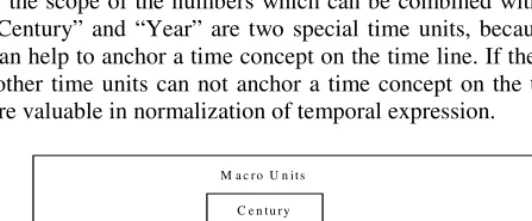
To represent lengths on the time line, a measurement should be given. The temporal units consist of two types, macro units and micro units, shown in Fig. 1. To represent a time, the scope of the numbers which can be combined with temporal units is lim-ited. “Century” and “Year” are two special time units, because only these two time units can help to anchor a time concept on the time line. If there is no help from con-texts, other time units can not anchor a time concept on the time line. These limita-tions are valuable in normalization of temporal expression.
M o n th [ 1 ... 1 2 ] C e n t u r y
Y e a r
[image:3.512.83.349.401.511.2]Q u a r t e r [ 1 ...4 ]
W e e k [ 1 .. .5 3 ]
D a y [ 1 ... 3 1 ]
M in u t e [ 1 .. .6 0 ] H o u r [ 1 .. .2 4 ]
S e c o n d [ 1 .. .6 0 ] M a c r o U n i t s
M i c r o U n i t s
Fig. 1. The scheme of time units
3.3 Representation in Chinese Text
E x p
M o n th P a rt
D a y T im e D a te D u ra tio n S e t P o s D a te E v e n tA n
T e m p W o rd C o m p o s ite
B a s ic C a lc u la te d S p e c ia l
[image:4.512.54.381.57.158.2]Y e a r P a r t D a y P a r t
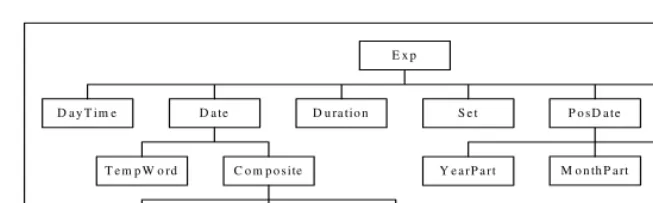
Fig. 2. The classification of temporal expression
In Chinese, if people do not know the exact number at an inferior time level, they may append an imprecise description to denote a position in a larger scope, such as “去年春天/the spring of last year”. We named these temporal expressions “PosDate”. These expressions consist of date expressions and imprecise appendix.
“TempWord” expressions are some Chinese words which contained temporal meanings, such as “春节/the lunar new year”, “目前/now”. “Composite” expressions include basic temporal expressions, calculated expressions and special expressions, such as “1999年4月28日/April 28, 1999”, and “两年后/after two years” and “1999
年
财 / the fiscal year 1999”. “Set” expressions denote a set of time and most of them are about frequency, such as “每年/every year” and “每两天/every two days”. “Even-tAn” expressions are relevant to the times of events, such as “当他演讲时/when he was speaking”. “EventAn” expressions can be anchored on the time line only after the times of the events are resolved.
4 Extractor Based on Grammar and Constraints
The task of extractor is to identify the extents of temporal expressions in the surface text. A set of context free grammar rules is designed to describe the basic form of all kinds of temporal expressions and a bottom-up chart parser is employed to parse tem-poral expressions. Word segmentation is a preliminary step in many Chinese NLP applications. However, the performance of word segmentation is not perfect and it may introduce some extra errors. In our system, each possible combination of Chinese characters in a sentence will be looked up, and then all of the constituents are fed into the char parser. If the dictionaries are comprehensive enough, then all the possible explanations of all the possible combinations of characters can be gotten. Ambiguities and overlaps between multiple temporal expressions are left to constraint rules and combination rules.
4.1 Temporal Grammar Rules
section.Given these grammar rules, “15时24分/15:24” and “15时24分39秒/15:24:39” can be recognized. In these examples, “时/o’clock”, “分/minute”, “秒/second” are all constituents of the type “Time_Unit”.
Table 1. Grammar rules for DayTime expressions
No.1. Exp -> Time_Of_Day No.2. Time_Of_Day -> Time_Base No.3. Time_Base -> Time_Temp + No.4. Time_Temp -> Integer Time_Unit No.5. Integer -> Digit +
4.2 Constraint Rules
There are many complex and variable phenomena in natural language. Even the domain is narrowed down to the temporal field, grammar rules are not enough to extract exact temporal expressions. There are some pseudo expressions which satisfy grammar rules, so constraint rules are designed to specify the true temporal expressions according to the context. These constraint rules are developed by analyzing thedata set.
A constraint rule will be triggered after the right part of the corresponding grammar rule is satisfied. If the constraint rule is satisfied, then the grammar rule can be applied; otherwise, it cannot be applied. Examples of constraint rules are shown in Table 2 and the following two examples show the constraint checking procedure step by step.
Table 2. Examples of constraint rules
Grammar rule 3: Time_Base -> Time_Temp +
Constraint rule 3: IF There is only one constituent of the type “Time_Temp”, THEN the constituent “Time_Unit” which is contained in “Time_Temp”, should not be “分/ minute”.
Grammar rule 4: Time_Temp -> Integer Time_Unit
Constraint rule 4: The constituent “Integer” can not end up with “个/ (a quanti fier)”.
(1) 这家新闻机构十分迅速地报道了这次事件。
(This news agency reported the event very quickly.) Step 1. Look up dictionary.
[十/Digit] [分/Time_Unit] Step 2. Apply the grammar rule No.5. [十 /Integer] [分/Time_Unit] Step 3. Check constraint rule No.4. Pass.
(2) 晚上7时30分西弗吉尼亚州和俄亥俄州投票结束。 (The ballot ended at 7:30 p.m. in Western Virginia and Ohio.)
Step 1. Look up dictionary.
[7/Digit] [时/Time_Unit][3/Digit] [0/Digit][分/Time_Unit] Step 2. Apply the grammar rule No.5.
[7/Integer] [时/Time_Unit] [30/Integer][分/Time_Unit] Step 3. Check constraint rule No.4.
Pass.
Step 4. Apply grammar rule No.4.
[7时/Time_Temp] [30分/Time_Temp] Step 5. Check constraint rule No.3.
Pass.
Step 6. Apply grammar rule No.3. [7时30分/Time_Base] Step 7. Apply grammar rule No.2. [7时30分/Time_Of_Day] Step 8. Apply grammar rule No.1. [7时30分/Exp]
Step 9. Recognize the temporal expression successfully.
In the first example “十分/very” is an adverb and has no temporal meaning. How-ever the character “十/ten” and “分/minute” can be looked up and satisfy the grammar rule. Constraint rules are necessary to filter the pseudo expression.
4.3 Combination of Temporal Expressions
Because each possible substring in a sentence is tried, multiple nested, overlap or adjacent temporal expressions may exist in the sentence. However, some of these expressions are just parts of the optimal answers. So combination is necessary to get the integrated temporal expression. After applying grammar rules, if any two temporal expressions are nested, overlapped or adjacent, our system will combine them and keep the final result. This procedure is shown by the following examples.
(3) 这次列车将于次日早上到达南昌。
(This train will arrive at Nan Chang next morning.)
First recognized temporal expressions are [次日/tomorrow] and [早上/morning]. After the combination, the correct answer [次日早上/next morning] will appear. (4) 晚上8时篮球比赛开始。
(The basketball game starts at 8:00 p.m.)
First recognized expressions are [晚上/night], [8时/8:00], [晚上8时/8:00 p.m.]. The final result is [晚上8时/ 8:00 p.m.].
4.4 Temporal/Non-temporal Disambiguation
caused by numbers, such as example 5. In this case, the expression “15:10” contains temporal information, but in sports news messages it may be a score of a game. The second kind is the ambiguities caused by the combination of numbers and time units, such as “十号”. In example 6, the expression “十号” just refers to a football team member. However, in many news messages it is a date. The third kind is the ambigui-ties caused by Chinese words, such as “前”. In example 7, the expression means “for-mer” and its explanations in other contexts may be “in front of”.
(5) 本次列车将于15:10到达终点站。
(6) 然而6分钟后,10号宿茂臻冲顶即将比分扳平。 (7) 俄罗斯前总统叶利钦等政府首脑为人类和平欣然提笔。
There are multiple explanations for the same one phrase or word, so ambiguities may be caused. To discriminate these expressions, heuristics for disambiguation are embedded in corresponding constraint rules.
5 Normalizer Based on Mapping Procedure
The goal of normalizer is to represent the temporal information of contained in tem-poral expressions, according to some standard. The normalizer is based on the map-ping procedure, in which temporal expressions are explained and represented by val-ues of temporal attributes. In this procedure, the objects number, unit, time and dura-tion are employed to store and represent temporal informadura-tion.
5.1 Introduction to Normalization
TERN 2004 evaluation [14] is a public evaluation on the extraction and normalization of temporal expressions. To evaluate our temporal parser in a real task, we express temporal information according to the standard of TERN 2004 evaluation. Any tem-poral expression will be explained by a possible combination of the values of the six attributes. These attributes are described in table 3.
Table 3. Temporal attributes
Attribute Function VAL Contains the value of a time or duration
MOD Captures temporal modifications SET Designates set-denoting expressions
ANCHOR_VAL Contains a normalized form of the reference time ANCHOR_DIR Capture the relative direction/orientation between VAL
and ANCHOR_VAL
NON_SPECIFIC Designates a generic, essensially nonreferencial expression
5.2 Normalization of Temporal Expressions
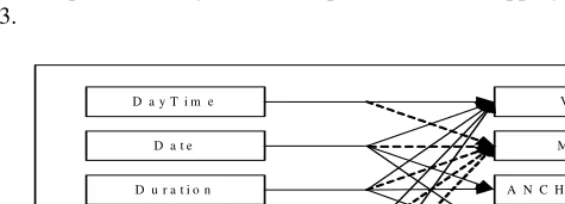
can be achieved by the explanation of these grammar rules. In this procedure, some basic objects, such as “number”, “unit”, “time” and “duration”, can be employed to store and convey temporal information. Applying grammar rules means creations or updates of basic temporal objects. Based on our temporal framework, we explain how to normalize the temporal expression extracted, i.e. mapping the expressions to the values of six attributes. The mapping procedure is different for different kinds of temporal expressions. A general description about the mapping procedure is shown in Fig. 3.
D a y T i m e
D a t e
D u r a t i o n
P o s D a t e
S e t
V A L
M O D
A N C H O R _ V A L
A N C H O R _ D I R
S E T
Fig. 3. Mapping temporal expressions to attributes
[image:8.512.44.387.402.505.2]According to the classification scheme in Section 3.3, all temporal expressions can be mapped to the six attributes. The mapping procedures are complicated and selected examples are shown in Table 4. It is difficult to tell whether a temporal expression is “specific” or not, and few expressions are set a value at this attribute, we do not map expression to the attribute “NON_SPECIFIC”.
Table 4. Examples of normalization
Expressions Attributes 目前/now val="PRESENT_REF"
anchor_val="2000-10-05" anchor_dir="AS_OF" 晚上8时20分/20: 20 p.m. val="1999-04-26 T20:20"
后两年/the next two years val="P2Y"
anchor_val="2000" anchor_dir="STARTING" 每两天/every two days val="P2D" set="YES"
明天下午/ next afternoon val="2000-10-07TAF"
adopt the publishing times of news articles as the default reference times. Event ex-pressions are relevant with a specific event and it is hard to represent the exact mean-ing of them. In our system event expressions are not normalized.
5.3 Time/Duration Disambiguation
Sometimes people omit a part of a full temporal expression for convenience in Chi-nese texts. For example, “4月/April” and “97年/ ’97” are used to instead “2000年4月 /April, 2000” and “1997年/the year 1997”. However, “4月/four months” and “97年 /97 years” are also legal temporal expressions. These temporal expressions are com-binations of numbers and common time units. The first kind of explanations means these expressions are times and the second kind of explanations means they are dura-tions. To get the correct values of temporal attributes for these temporal expressions, disambiguation is necessary. Heuristic rules are employed for disambiguation, which are shown in Table 5.
Table 5. Some heuristic rules for disambiguation
IF a 3-digit or four-digit number is combined with the unit “年/year”, THEN this expression is time;
IF a 2-digit number is combined with the unit “年/year” and the number is bigger that 70, THEN this expression is time.
IF a 1-digit number is combined with the unit “年/year”, THEN this expression is duration.
6 Evaluation and Analysis
[image:9.512.50.380.474.557.2]In this section we report the results about evaluating our temporal parser on a manu-ally annotated corpus, which consist of 457 Chinese news articles. The data collection contains 285,746 characters/142,872 words and 4,290 manually annotated temporal expressions. We will evaluate the boundaries of expressions and the values of the six temporal attributes.
Table 6. Experiment configuration
Experiment No. Conditions
1 No constraints, combination of nested expressions 2 No constraints, combination of nested, overlapped and
adjacent expressions
3 Constraints, combination of nested expressions
4 Constraints, combination of nested, overlapped and adja-cent expressions
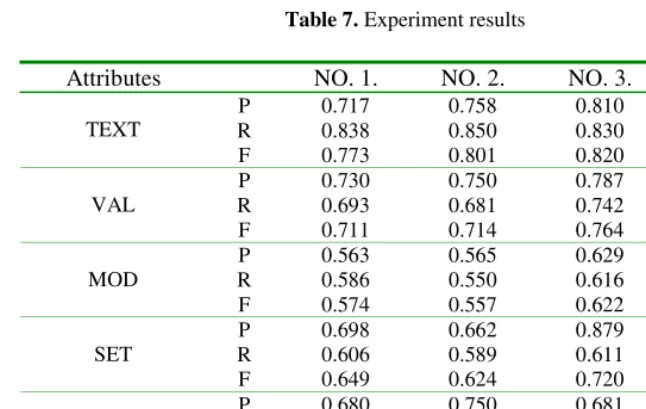
combine these nested components into the optimal answer, there will be so many mismatched expressions. So the combination of nested temporal expressions is neces-sary. In the experiments, we try to evaluate two factors: the constraint rules, and the combination of overlapped and adjacent temporal expressions. Four experiments are set up, which are described in Table 6. Given these conditions, the results of the ex-periments are shown in Table 7.
Table 7. Experiment results
Attributes NO. 1. NO. 2. NO. 3. NO. 4.
P 0.717 0.758 0.810 0.856 R 0.838 0.850 0.830 0.843 TEXT
F 0.773 0.801 0.820 0.849 P 0.730 0.750 0.787 0.807 R 0.693 0.681 0.742 0.732 VAL
F 0.711 0.714 0.764 0.768 P 0.563 0.565 0.629 0.626 R 0.586 0.550 0.616 0.574 MOD
F 0.574 0.557 0.622 0.599 P 0.698 0.662 0.879 0.867 R 0.606 0.589 0.611 0.598 SET
F 0.649 0.624 0.720 0.707 P 0.680 0.750 0.681 0.687 R 0.658 0.681 0.662 0.652 ANCHOR_VAL
F 0.669 0.714 0.672 0.669 P 0.724 0.727 0.733 0.737 R 0.682 0.669 0.694 0.682 ANCHOR_DIR
F 0.702 0.697 0.713 0.708
Several related works are designed to extract and normalize temporal expressions, however they are about English, Spanish, French, Korea and so on. We take part in TERN 2004 evaluation on Chinese temporal expression extraction and achieve the highest performance in this task. There is no public result on Chinese temporal ex-pression normalization, for reference we compare our normalization result of Experi-ment NO. 4 with the English normalization result in TERN 2004. Our performance is medium among their results.
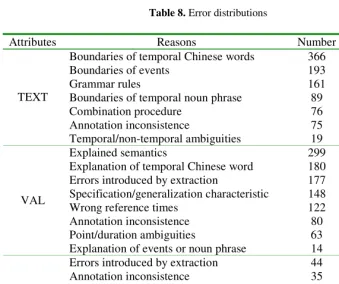
After the evaluation we collect the errors of Experiment NO. 4 and try to summary the reasons. Wrong attribute values include missed, incorrect and spurious cases. The reason for errors on the attributes “ANCHOR_VAL” and “ANCHOR_DIR” is that the system did not give correct reference times. Table 8 gives the error distributions according to different attributes. From this table, it can be seen that temporal Chinese words and events are difficult to extract and normalize.
Table 8. Error distributions
Attributes Reasons Number Percentage
Boundaries of temporal Chinese words 366 37.4%
Boundaries of events 193 19.7%
Grammar rules 161 16.4%
Boundaries of temporal noun phrase 89 9.1%
Combination procedure 76 7.8%
Annotation inconsistence 75 7.7%
TEXT
Temporal/non-temporal ambiguities 19 1.9%
Explained semantics 299 27.6%
Explanation of temporal Chinese word 180 16.6% Errors introduced by extraction 177 16.3% Specification/generalization characteristic 148 13.7%
Wrong reference times 122 11.3%
Annotation inconsistence 80 7.4%
Point/duration ambiguities 63 5.8%
VAL
Explanation of events or noun phrase 14 1.3% Errors introduced by extraction 44 33.3%
Annotation inconsistence 35 26.5%
Explanation of temporal Chinese word 27 20.5%
Explained semantics 23 17.4%
MOD
Ambiguities 3 2.1%
Explained semantics 35 81.4%
Errors introduced by extraction 3 7.0%
SET
Annotation inconsistence 5 11.6%
7 Conclusion
In our experiments the temporal parser is also evaluated with/without constraints, combination of nested and overlapped temporal expressions. We find that constraints are significant to the task extraction and normalization. At the same time, combina-tion has positive influence on the task extraccombina-tion. Error analysis shows that temporal Chinese words and events are more difficult to extract and normalize. To improve the performance of extraction, we plan to decide whether to keep any temporal Chinese words as a genuine temporal expression automatically according to the contribution of the word. We also plan to improve the performance of normalization by more precise semantic explanation.
Acknowledgement
The work presented in this paper is supported by Research Grants Council of Hong Kong (reference number: CERG PolyU 5085/02E and 5181/03E).
References
1. Ahn, D., Adafre, S. F., and Rijke, M. de.: Towards Task-Based Temporal Extraction and Recognition. Proceedings Dagstuhl Workshop on Annotating, Extracting, and Reasoning about Time and Events (2005)
2. Allen, J. F.: Towards a General Theory of Action and Time. Artificial Intelligence, Vol. 23, Issue 2, (1984) 123-154
3. Estela, S., Martinez-Barco, Patricio, and Munoz, R.: Recognizing and Tagging Temporal Expressions in Spanish. Workshop on Annotation Standards for Temporal Information in Natural Language, LREC 2002
4. Ferro, L., Gerber, L., Mani, I., Sundheim, B., And Wilson, G.: TIDES 2003 standard for the annotation of temporal expressions (2004). timex2.mitre.org
5. Filatove E. and Hovy E.: Assigning Time-Stamps to Event-Clauses. Proceedings of the ACL Workshop on Temporal and Spatial Information Processing, Toulouse (2001), 88-95 6. Gerber, L., Huang, S., and Wang, X.: TIDES 2003 standard for the annotation of temporal
expressions. Chinese supplement draft (2004). timex2.mitre.org
7. Hobbs, J. R. and Pan, F.: An Ontology of Time for the Semantic Web. ACM Transactions on Asian Language Information Processing (2004), Vol. 3, Issue 1, 66-85
8. Jang, S.B., Baldwin, J. and Mani, I.: Automatic TIMEX2 Tagging of Korean News. ACM Transactions on Asian Language Information processing (2004), Vol. 3, No. 1, 51-65 9. Li, W., Wong, K.-F., and Yuan, C.: A Model for Processing Temporal References in
Chi-nese. Proceedings of the ACL 2001 Workshop on Temporal and Spatial Information Proc-essing (2001)
10. Mani, I., Pustejovsky, J., and Sundheim, B.: Introduction to the special issue on temporal information processing. ACM Transactions on Asian Language Information Processing (2004), Vol. 3, Issue 1, 1-10
11. Mani, I. and Wilson G.: Robust Temporal Processing of News. Proceedings of the 38th Annual Meeting of the Association for Computational Linguistics. New Brunswick, New Jersey (2000)
13. Schilder, F. and Habel, C.: From temporal expressions to temporal information: semantic tagging of news messages. Proceedings of the ACL 2001 Workshop on Temporal and Spa-tial Information Processing. Toulouse (2001), 65-72
14. TERN-2004. http://timex2.mitre.org/tern.html 2005