Active Deep Networks for Semi-Supervised
Sentiment Classification
Shusen Zhou, Qingcai Chen and Xiaolong Wang
Shenzhen Graduate School, Harbin Institute of Technology
[email protected], [email protected],
[email protected]
Abstract
This paper presents a novel semi-supervised learning algorithm called Ac-tive Deep Networks (ADN), to address the semi-supervised sentiment classifica-tion problem with active learning. First, we propose the semi-supervised learning method of ADN. ADN is constructed by Restricted Boltzmann Machines (RBM) with unsupervised learning using labeled data and abundant of unlabeled data. Then the constructed structure is fine-tuned by gradient-descent based super-vised learning with an exponential loss function. Second, we apply active learn-ing in the semi-supervised learnlearn-ing framework to identify reviews that should be labeled as training data. Then ADN architecture is trained by the se-lected labeled data and all unlabeled data. Experiments on five sentiment classifica-tion datasets show that ADN outper-forms the semi-supervised learning algo-rithm and deep learning techniques ap-plied for sentiment classification.
1
Introduction
In recent years, sentiment analysis has received considerable attentions in Natural Language Processing (NLP) community (Blitzer et al., 2007; Dasgupta and Ng, 2009; Pang et al., 2002). Polarity classification, which determine whether the sentiment expressed in a document is posi-tive or negaposi-tive, is one of the most popular tasks of sentiment analysis (Dasgupta and Ng, 2009). Sentiment classification is a special type of text categorization, where the criterion of classifica-tion is the attitude expressed in the text, rather
than the subject or topic. Labeling the reviews with their sentiment would provide succinct summaries to readers, which makes it possible to focus the text mining on areas in need of im-provement or on areas of success (Gamon, 2004) and is helpful in business intelligence applica-tions, recommender systems, and message filter-ing (Pang, et al., 2002).
While topics are often identifiable by key-words alone, sentiment classification appears to be a more challenge task (Pang, et al., 2002). First, sentiment is often conveyed with subtle linguistic mechanisms such as the use of sar-casm and highly domain-specific contextual cues (Li et al., 2009). For example, although the sentence “The thief tries to protect his excellent reputation” contains the word “excellent”, it tells us nothing about the author’s opinion and in fact could be well embedded in a negative review. Second, sentiment classification systems are typ-ically domain-specific, which makes the expen-sive process of annotating a large amount of data for each domain and is a bottleneck in building high quality systems (Dasgupta and Ng, 2009). This motivates the task of learning robust senti-ment models from minimal supervision (Li, et al., 2009).
deep learning algorithm achieving notable suc-cess for semi-supervised learning (Hinton, et al., 2006). Ranzato and Szummer (2008) propose an algorithm to learn text document representations based on semi-supervised auto-encoders that are combined to form a deep network.
Active learning is another way that can mi-nimize the number of required labeled data while getting competitive result. Usually, the training set is chosen randomly. However, active learning choose the training data actively, which reduce the needs of labeled data (Tong and Koller, 2002). Recently, active learning had
been applied in sentiment classification
(Dasgupta and Ng, 2009).
Inspired by the study of semi-supervised learning, active learning and deep architecture, this paper proposes a novel semi-supervised po-larity classification algorithm called Active Deep Networks (ADN) that is based on a repre-sentative deep learning algorithm Deep Belief Networks (DBN) (Hinton, et al., 2006) and ac-tive learning (Tong and Koller, 2002). First, we propose the ADN architecture, which utilizes a new deep architecture for classification, and an exponential loss function aiming to maximize the separability of the classifier. Second, we propose the ADN algorithm. It firstly identifies a small number of manually labeled reviews by an active learner, and then trains the ADN classifier with the identified labeled data and all of the unlabeled data.
Our paper makes several important contribu-tions: First, this paper proposes a novel ADN architecture that integrates the abstraction ability of deep belief nets and the classification ability of backpropagation strategy. It improves the ge-neralization capability by using abundant unla-beled data, and directly optimizes the classifica-tion results in training dataset using back propa-gation strategy, which makes it possible to achieve attractive classification performance with few labeled data. Second, this paper pro-poses an effective active learning method that integrates the labeled data selection ability of active learning and classification ability of ADN architecture. Moreover, the active learning is also based on the ADN architecture, so the la-beled data selector and the classifier are based on the same architecture, which provides an uni-fied framework for semi-supervised
classifica-tion task. Third, this paper applies semi-supervised learning and active learning to senti-ment classification successfully and gets com-petitive performance. Our experimental results on five sentiment classification datasets show that ADN outperforms previous sentiment clas-sification methods and deep learning methods.
The rest of the paper is organized as follows. Section 2 gives an overview of sentiment classi-fication. The proposed semi-supervised learning method ADN is described in Section 3. Section 4 shows the empirical validation of ADN by comparing its classification performance with previous sentiment classifiers and deep learning methods on sentiment datasets. The paper is closed with conclusion.
2
Sentiment Classification
Sentiment classification can be performed on words, sentences or documents, and is generally categorized into lexicon-based and corpus-based classification method (Wan, 2009). The detailed survey about techniques and approaches of sentiment classification can be seen in the book (Pang and Lee, 2008). In this paper we focus on corpus-based classification method.
Corpus-based methods use a labeled corpus to train a sentiment classifier (Wan, 2009). Pang et al. (2002) apply machine learning approach to corpus-based sentiment classification firstly. They found that standard machine learning tech-niques outperform human-produced baselines. Pang and Lee (2004) apply text-categorization techniques to the subjective portions of the sen-timent document. These portions are extracted by efficient techniques for finding minimum cuts in graphs. Gamon (2004) demonstrate that using large feature vectors in combination with feature reduction, high accuracy can be achieved in the very noisy domain of customer feedback data. Xia et al. (2008) propose the sentiment vector space model to represent song lyric document, assign the sentiment labels such as light-hearted and heavy-hearted.
Supervised sentiment classification systems are domain-specific and annotating a large scale corpus for each domain is very expensive (Dasgupta and Ng, 2009). There are several so-lutions for this corpus annotation bottleneck.
clas-sification. Blitzer et al. (2007) investigate do-main adaptation for sentiment classifiers, which could be used to select a small set of domains to annotate and their trained classifiers would transfer well to many other domains. Li and Zong (2008) study multi-domain sentiment clas-sification, which aims to improve performance through fusing training data from multiple do-mains.
The second type of solution is semi-supervised sentiment classification. Sindhwani and Melville (2008) propose a semi-supervised sentiment classification algorithm that utilizes lexical prior knowledge in conjunction with un-labeled data. Dasgupta and Ng (2009) firstly mine the unambiguous reviews using spectral techniques, and then exploit them to classify the ambiguous reviews via a novel combination of active learning, transductive learning, and en-semble learning.
The third type of solution is unsupervised sen-timent classification. Zagibalov and Carroll (2008) describe an automatic seed word selec-tion for unsupervised sentiment classificaselec-tion of product reviews in Chinese.
However, unsupervised learning of sentiment is difficult, partially because of the prevalence of sentimentally ambiguous reviews (Dasgupta and Ng, 2009). Using multi-domain sentiment cor-pus to sentiment classification is also hard to apply, because each domain has a very limited amount of training data, due to annotating a large corpus is difficult and time-consuming (Li and Zong, 2008). So in this paper we focus on semi-supervised approach to sentiment classifi-cation.
3
Active Deep Networks
In this part, we propose a semi-supervised learning algorithm, Active Deep Networks (ADN), to address the sentiment classification problem with active learning. Section 3.1 formulates the ADN problem. Section 3.2 proposes the semi-supervised learning of ADN without active learning. Section 3.3 proposes the active learning method of ADN. Section 3.4 gives the ADN procedure.
3.1 Problem Formulation
There are many review documents in the dataset. We preprocess these reviews to be classified,
which is similar with Dasgupta and Ng (2009). Each review is represented as a vector of uni-grams, using binary weight equal to 1 for terms present in a vector. Moreover, the punctuations, numbers, and words of length one are removed from the vector. Finally, we sort the vocabulary by document frequency and remove the top 1.5%. It is because that many of these high doc-ument frequency words are stopwords or domain specific general-purpose words.
After preprocess, every review can be represented by a vector. Then the dataset can be represented as a matrix:
feature words in the dataset. Every column of X corresponds to a sample x, which is a representa-tion of a review. A sample that has all features is viewed as a vector in D, where the ith coordi-nate corresponds to the ith feature.The L labeled samples are chosen randomly
from R training samples, or chosen actively by active learning, which can be seen as:
, [ , ,...,1 2 ] 1
2where S is the index of selected training reviews to be labeled manually.
Let Y be a set of labels corresponds to L la-beled training samples and is denoted as:
where C is the number of classes. Every column
of Y is a vector in C, where the jth coordinate
For example, if a review x is positive, y=[1, -1]’; else, y = [-1, 1]’.
We intend to seek the mapping function
L L
X Y using the L labeled data and R+T-L
3.2 Semi-Supervised Learning
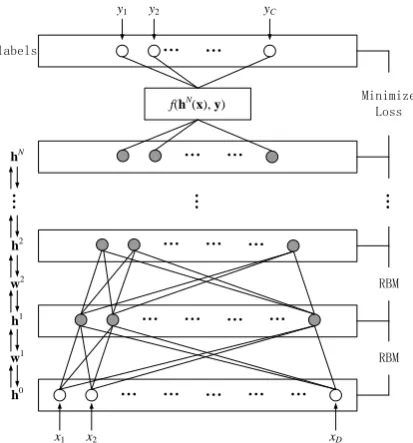
To address the problem formulated in section 3.1, we propose a novel deep architecture for ADN method, as show in Figure 1. The deep architec-ture is a fully interconnected directed belief nets with one input layer h0, N hidden layers h1, h2, …, hN, and one label layer at the top. The input layer h0 has D units, equal to the number of
features of sample data x. The label layer has C
units, equal to number of classes of label vector y. The numbers of units for hidden layers, cur-rently, are pre-defined according to the expe-rience or intuition. The seeking of the mapping functionXLYL, here, is transformed to the
problem of finding the parameter space W={w1,
w2,…,wN} for the deep architecture.
The semi-supervised learning method based on ADN architecture can be divided into two stages: First, AND architecture is constructed by greedy layer-wise unsupervised learning using RBMs as building blocks. All the unlabeled data together with L labeled data are utilized to find
the parameter space W with N layers. Second,
ADN architecture is trained according to the ex-ponential loss function using gradient descent
method. The parameter space W is retrained by
an exponential loss function using L labeled data.
x1 x2 xD
Figure 1. Architecture of Active Deep Networks
For unsupervised learning, we define the
The conditional distributions over hk and hk-1 are:
1
1
where the logistic function is:
sigm 1 1e 12
The derivative of the log-likelihood with
re-spect to the model parameter wk can be obtained
by the CD method (Hinton, 2002):
denotes an expectation with respect to
the data distribution and M P
denotes a
distribu-tion of samples from running the Gibbs sampler initialized at the data, for M full steps.
The above discussion is based on the training of the parameters between two hidden layers
with one sample data x. For unsupervised
learn-ing, we construct the deep architecture using all labeled data with unlabeled data by inputting
them one by one from layer h0, train the
can use it to construct the up one layer h2. The
The parameter space wN is initialized
random-ly, just as backpropagation algorithm. Then ADN architecture is constructed. The top hidden layer is formulated as:
For supervised learning, the ADN architecture is trained by L labeled data. The optimization problem is formulized as:
and the loss function is defined as
T( )r exp(r) 18
In the supervised learning stage, the stochastic activities are replaced by deterministic, real va-lued probabilities. We use gradient-descent through the whole deep architecture to retrain the weights for optimal classification.
3.3 Active Learning
Semi-supervised learning allows us to classify reviews with few labeled data. However, anno-tating the reviews manually is expensive, so we want to get higher performance with fewer la-beled data. Active learning can help to choose those reviews that should be labeled manually in order to achieving higher classification perfor-mance with the same number of labeled data. For such purpose, we incorporate pool-based active learning with the ADN method, which accesses to a pool of unlabeled instances and requests the labels for some number of them (Tong and Koller, 2002).
Given an unlabeled pool XR and a initial la-beled data set XL(one positive, one negative), the ADN architecture hN will decide which
in-stance in XR to query next. Then the parameters
of hN are adjusted after new reviews are labeled
and inserted into the labeled data set. The main issue for an active learner is the choosing of next unlabeled instance to query. In this paper, we choose the reviews whose labels are most uncer-tain for the classifier. Following previous work on active learning for SVMs (Dasgupta and Ng, 2009; Tong and Koller, 2002), we define the uncertainty of a review as its distance from the separating hyperplane. In other words, reviews that are near the separating hyperplane are cho-sen as the labeled training data.
After semi-supervised learning, the parame-ters of ADN are adjusted. Given an unlabeled
manuallyare given by:
: j min
20s j d d
We can select a group of most uncertainty re-views to label at each time.
The experimental setting is similar with Dasgupta & Ng (2009). We perform active learning for five iterations and select twenty of the most uncertainty reviews to be queried each time. Then the ADN is re-trained on all of la-beled and unlala-beled reviews so far with semi-supervised learning. At last, we can decide the
label of reviews x according to the output hN(x)
of the ADN architecture as below:
for each iteration, classify the unlabeled reviews in the pool and choose the appropriate number of positive and negative reviews to let them equally.
3.4 ADN Procedure
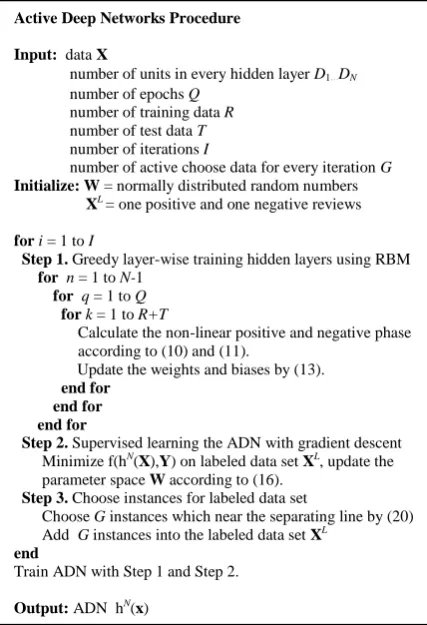
The procedure of ADN is shown in Figure 2. For the training of ADN architecture, the parameters are random initialized with normal distribution. All the training data and test data are used to train the ADN with unsupervised learning. The
training set XR can be seen as an unlabeled pool.
We randomly select one positive and one nega-tive review in the pool to input as the initial la-beled training set that are used for supervised learning. The number of units in hidden layer
D1﹍DN and the number of epochs Q are set
ma-nually based on the dimension of the input data and the size of training dataset. The iteration
times I and the number G of active choosing
da-ta for each iteration can be set manually based on the number of labeled data in the experiment.
For each iteration, the ADN architecture is trained by all the unlabeled data and labeled data in existence with unsupervised learning and su-pervised learning firstly. Then we choose G re-views from the unlabeled pool based on the dis-tance of these data from the separating line. At last, label these data manually and add them to the labeled data set. For the next iteration, the ADN architecture can be trained on the new la-beled data set. At last, ADN architecture is re-trained by all the unlabeled data and existing labeled data. After training, the ADN architec-ture is tested based on Equation (21).
The proposed ADN method can active choose the labeled data set and classify the data with the same architecture, which avoid the barrier be-tween choosing and training with different archi-tecture. More importantly, the parameters of ADN are trained iteratively on the label data se-lection process, which improve the performance of ADN. For the ADN training process: in unsu-pervised learning stage, the reviews can be ab-stracted; in supervised learning stage, ADN is trained to map the samples belong to different classes into different regions. We combine the unsupervised and supervised learning, and train parameter space of ADN iteratively. The proper data that should be labeled are chosen in each iteration, which improves the classification per-formance of ADN.
Figure 2. Active Deep Networks Procedure.
4
Experiments
4.1 Experimental Setup
We evaluate the performance of the proposed ADN method using five sentiment classification datasets. The first dataset is MOV (Pang, et al., 2002), which is a widely-used movie review da-taset. The other four dataset contain reviews of four different types of products, including books (BOO), DVDs (DVD), electronics (ELE), and kitchen appliances (KIT) (Blitzer, et al., 2007; Dasgupta and Ng, 2009). Each dataset includes 1,000 positive and 1,000 negative reviews.
Similar with Dasgupta and Ng (2009), we di-vide the 2,000 reviews into ten equal-sized folds randomly and test all the algorithms with cross-validation. In each folds, 100 reviews are ran-dom selected as training data and the remaining 100 data are used for test. Only the reviews in the training data set are used for the selection of labeled data by active learning.
The ADN architecture has different number of hidden units for each hidden layer. For greedy
Active Deep Networks Procedure
Input: data X
number of units in every hidden layer D1﹍DN
number of epochs Q
number of training data R
number of test data T
number of iterations I
number of active choose data for every iteration G
Initialize: W = normally distributed random numbers
XL = one positive and one negative reviews
fori = 1 to I
Step 1. Greedy layer-wise training hidden layers using RBM
for n = 1 to N-1
for q = 1 to Q
for k = 1 to R+T
Calculate the non-linear positive and negative phase according to (10) and (11).
Update the weights and biases by (13). end for
end for end for
Step 2. Supervised learning the ADN with gradient descent
Minimize f(hN(X),Y) on labeled data set XL, update the
parameter space W according to (16).
Step 3. Choose instances for labeled data set
Choose G instances which near the separating line by (20) Add G instances into the labeled data set XL
end
Train ADN with Step 1 and Step 2.
layer-wise unsupervised learning, we train the weights of each layer independently with the fixed number of epochs equal to 30 and the learning rate is set to 0.1. The initial momentum is 0.5 and after 5 epochs, the momentum is set to 0.9. For supervised learning, we run 10 epochs, three times of linear searches are performed in each epoch.
We compare the classification performance of ADN with five representative classifiers, i.e., Semi-supervised spectral learning (Spectral) (Kamvar et al., 2003), Transductive SVM (TSVM), Active learning (Active) (Tong and Koller, 2002), Mine the Easy Classify the Hard (MECH) (Dasgupta and Ng, 2009), and Deep Belief Networks (DBN) (Hinton, et al., 2006). Spectral learning, TSVM, and Active learning method are three baseline methods for sentiment classification. MECH is a new semi-supervised method for sentiment classification (Dasgupta and Ng, 2009). DBN (Hinton, et al., 2006) is the classical deep learning method proposed recent-ly.
4.2 ADN Performance
For MOV dataset, the ADN structure used in this experiment is 100-100-200-2, which represents the number of units in output layer is 2, in 3 hidden layers are 100, 100, and 200 re-spectively. For the other four data sets, the ADN structure is 50-50-200-2. The number of unit in input layer is the same as the dimensions of each datasets. All theses parameters are set based on the dimension of the input data and the scale of the dataset. Because that the number of vocabu-lary in MOV dataset is more than other four da-tasets, so the number of units in previous two hidden layers for MOV dataset are more than other four datasets. We perform active learning for 5 iterations. In each iteration, we select and label 20 of the most uncertain points, and then re-train the ADN on all of the unlabeled data and labeled data annotated so far. After 5 itera-tions, 100 labeled data are used for training.
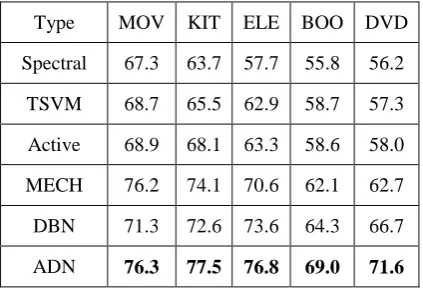
The classification accuracies on test data in cross validation for five datasets and six me-thods are shown in Table 1. The results of pre-vious four methods are reported by Dasgupta and Ng (2009). For ADN method, the initial two labeled data are selected randomly, so we repeat thirty times for each fold and the results are
av-eraged. For the randomness involved in the choice of labeled data, all the results of other five methods are achieved by repeating ten times for each fold and then taking average on results.
Through Table 1, we can see that the perfor-mance of DBN is competitive with MECH. Since MECH is the combination of spectral clus-tering, TSVM and Active learning, DBN is just a classification method based on deep neural net-work, this result proves the good learning ability of deep architecture. ADN is a combination of semi-supervised learning and active learning based on deep architecture, the performance of ADN is better than all other five methods on five datasets. This could be contributed by: First, ADN uses a new architecture to guide the output vector of samples belonged to different regions of new Euclidean space, which can abstract the useful information that are not accessible to oth-er learnoth-ers; Second, ADN use an exponential loss function to maximize the separability of labeled data in global refinement for better dis-criminability; Third, ADN fully exploits the em-bedding information from the large amount of unlabeled data to improve the robustness of the classifier; Fourth, ADN can choose the useful training data actively, which also improve the classification performance.
Type MOV KIT ELE BOO DVD
Spectral 67.3 63.7 57.7 55.8 56.2
TSVM 68.7 65.5 62.9 58.7 57.3
Active 68.9 68.1 63.3 58.6 58.0
MECH 76.2 74.1 70.6 62.1 62.7
DBN 71.3 72.6 73.6 64.3 66.7
ADN 76.3 77.5 76.8 69.0 71.6
Table 1. Test Accuracy with 100 Labeled Data for Five Datasets and Six Methods.
4.3 Effect of Active Learning
To test the performance of our proposed active learning method, we conduct following addi-tional experiments.
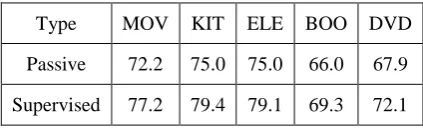
learning method of ADN is used to train and test the performance. Because of randomness, we repeat 30 times for each fold and take average on results. The test accuracies of passive learn-ing for five datasets are shown in Table 2. In comparison with ADN method in Table 1, we can see that the proposed active learning method yields significantly better results than randomly chosen points, which proves effectiveness of proposed active learning method.
Fully supervised learning: We train a fully supervised classifier using all 1,000 training re-views based on the ADN architecture, results are also shown in Table 2. Comparing with the ADN method in Table 1, we can see that em-ploying only 100 active learning points enables us to almost reach fully-supervised performance for three datasets.
Type MOV KIT ELE BOO DVD
Passive 72.2 75.0 75.0 66.0 67.9
Supervised 77.2 79.4 79.1 69.3 72.1
Table 2. Test Accuracy of ADN with different experiment setting for Five Datasets.
4.4 Semi-Supervised Learning with
Va-riance of Labeled Data
To verify the performance of semi-supervised learning with different number of labeled data, we conduct another series of experiments on five datasets and show the results on Figure 3. We run ten-fold cross validation for each dataset. Each fold is repeated ten times and the results are averaged.
We can see that ADN can also get a relative high accuracy even by using just 20 labeled re-views for training. For most of the sentiment datasets, the test accuracy is increasing slowly while the number of labeled review is growing. This proves that ADN reaches good performance even with few labeled reviews.
5
Conclusions
This paper proposes a novel semi-supervised learning algorithm ADN to address the senti-ment classification problem with a small number of labeled data. ADN can choose the proper
20 30 40 50 60 70 80 90 100
60 62 64 66 68 70 72 74 76 78 80
Number of labeled review
Te
s
t
a
c
c
u
ra
c
y
(
%
)
MOV KIT ELE BOO DVD
Figure 3. Test Accuracy of ADN with Different Number of Labeled Reviews for Five Datasets.
training data to be labeled manually, and fully exploits the embedding information from the large amount of unlabeled data to improve the robustness of the classifier. We propose a new architecture to guide the output vector of sam-ples belong to different regions of new Eucli-dean space, and use an exponential loss function to maximize the separability of labeled data in global refinement for better discriminability. Moreover, ADN can make the right decision about which training data should be labeled based on existing unlabeled and labeled data. By using unsupervised and supervised learning ite-ratively, ADN can choose the proper training data to be labeled and train the deep architecture at the same time. Finally, the deep architecture is re-trained using the chosen labeled data and all the unlabeled data. We also conduct experiments to verify the effectiveness of ADN method with different number of labeled data, and demon-strate that ADN can reach very competitive clas-sification performance just by using few labeled data. This results show that the proposed ADN method, which only need fewer manual labeled reviews to reach a relatively higher accuracy, can be used to train a high performance senti-ment classification system.
Acknowledgement
References
Bengio, Yoshua. 2007. Learning deep architectures for AI. Montreal: IRO, Universite de Montreal.
Blitzer, John, Mark Dredze, and Fernando Pereira. 2007. Biographies, Bollywood, Boom-boxes and Blenders: Domain Adaptation for Sentiment Classification. In 45th Annual Meeting of the Association of Computational Linguistics.
Dasgupta, Sajib, and Vincent Ng. 2009. Mine the Easy, Classify the Hard: A Semi-Supervised Approach to Automatic Sentiment Classification. In Joint Conference of the 47th Annual Meeting of the Association for Computational Linguistics and 4th International Joint Conference on Natural Language Processing of the Asian Federation of Natural Language Processing.
Gamon, Michael. 2004. Sentiment classification on customer feedback data: noisy data, large feature vectors, and the role of linguistic analysis. In International Conference on Computational Linguistics.
Hinton, Geoffrey E. . 2002. Training products of experts by minimizing contrastive divergence. Neural Computation, 14(8): 1771-1800.
Hinton, Geoffrey E. , Simon Osindero, and Yee-Whye Teh. 2006. A Fast Learning Algorithm for Deep Belief Nets. Neural Computation, 18: 1527-1554.
Kamvar, Sepandar, Dan Klein, and Christopher Manning. 2003. Spectral Learning. In International Joint Conferences on Artificial Intelligence.
Li, Shoushan, and Chengqing Zong. 2008. Multi-domain Sentiment Classification. In 46th Annual Meeting of the Association of Computational Linguistics.
Li, Tao, Yi Zhang, and Vikas Sindhwani. 2009. A Non-negative Matrix Tri-factorization Approach to Sentiment Classification with Lexical Prior Knowledge. In Joint Conference of the 47th Annual Meeting of the Association for Computational Linguistics and 4th International Joint Conference on Natural Language Processing of the Asian Federation of Natural Language Processing.
Pang, Bo, and Lillian Lee. 2004. A Sentimental Education: Sentiment Analysis Using Subjectivity Summarization Based on Minimum Cuts. In 42th Annual Meeting of the Association of Computational Linguistics.
Pang, Bo, and Lillian Lee. 2008. Opinion mining and sentiment analysis (Vol. 2).
Pang, Bo, Lillian Lee, and Shivakumar Vaithyanathan. 2002. Thumbs up? Sentiment Classification using Machine Learning Techniques. In Conference on Empirical Methods in Natural Language Processing.
Raina, Rajat, Alexis Battle, Honglak Lee, Benjamin Packer, and Andrew Y. Ng. 2007. Self-taught learning: transfer learning from unlabeled data. In International conference on Machine learning.
Ranzato, Marc'Aurelio, and Martin Szummer. 2008. Semi-supervised learning of compact document representations with deep networks. In International Conference on Machine learning.
Salakhutdinov, Ruslan, and Geoffrey E. Hinton. 2007. Learning a Nonlinear Embedding by Preserving Class Neighbourhood Structure. In Proceedings of Eleventh International Conference on Artificial Intelligence and Statistics.
Sindhwani, Vikas, and Prem Melville. 2008. Document-Word Co-regularization for Semi-supervised Sentiment Analysis. In International Conference on Data Mining.
Tong, Simon, and Daphne Koller. 2002. Support vector machine active learning with applications to text classification. Journal of Machine Learning Research, 2: 45-66.
Wan, Xiaojun. 2009. Co-Training for Cross-Lingual Sentiment Classification. In Joint Conference of the 47th Annual Meeting of the Association for Computational Linguistics and 4th International Joint Conference on Natural Language Processing of the Asian Federation of Natural Language Processing.
Xia, Yunqing, Linlin Wang, Kam-Fai Wong, and Mingxing Xu. 2008. Lyric-based Song Sentiment Classification with Sentiment Vector Space Model. In 46th Annual Meeting of the Association of Computational Linguistics.
Zagibalov, Taras, and John Carroll. 2008. Automatic Seed Word Selection for Unsupervised Sentiment Classification of Chinese Text. In International Conference on Computational Linguistics.